How Zigong Became the World’s Lantern Capital: 800 Years of Craft, Innovation & Global Reach
Every year, millions of visitors walk through illuminated wonderlands at zoos, museums, shopping malls, and theme parks across 40+ countries. What most don’t realize is that the majority of these spectacular lantern festivals trace their origins to a single city in southwestern China — Zigong (自贡).
Known globally as the “Lantern Capital of the World” and the “Hometown of Chinese Lantern Culture,” Zigong has been the beating heart of Chinese lantern-making for over 800 years. From the flickering oil lamps of the Tang Dynasty to today’s towering LED-powered dragon sculptures, the city’s artisans have transformed a regional folk tradition into a $3 billion global industry.
In this article, you’ll discover the complete story: how geography, salt wealth, imperial patronage, and modern engineering converged to make Zigong the undisputed center of the world’s lantern industry — and why the world’s most ambitious festivals still source their displays from this city of 2.5 million people.
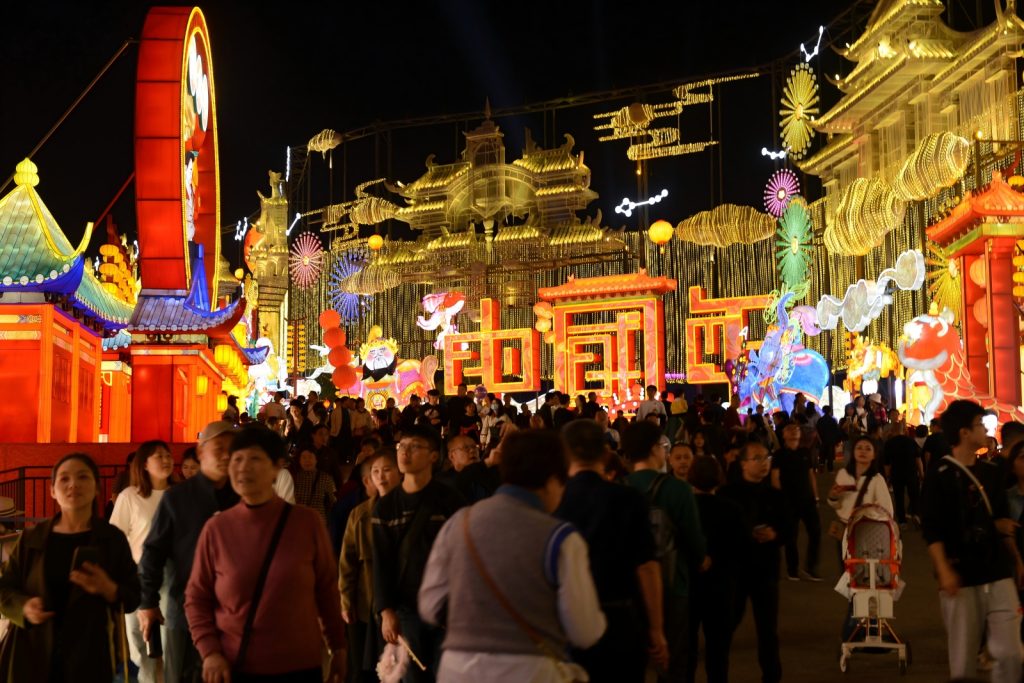
What Is Zigong? Geography, History & Identity
Zigong (自贡, pronounced “Tzu-gong”) is a prefecture-level city located in Sichuan Province, southwestern China, approximately 200 km south of the provincial capital, Chengdu. Nestled in the Sichuan Basin where the Fuxi River meets the Tuo River, Zigong sits at a strategic crossroads of natural resources that shaped its destiny.
Why Zigong’s Geography Mattered
| Geographic Factor | Historical Impact |
|---|---|
| Salt Deposits | Zigong possessed China’s richest underground brine wells. By the 19th century, it produced 80% of Sichuan’s salt, creating enormous wealth that funded lantern craftsmanship. |
| Bamboo Forests | Abundant bamboo supplied the raw material for lantern frames — lightweight, flexible, and locally available. |
| Silk Production | Sichuan’s silk industry provided the translucent, color-saturated fabric that became the signature medium of Zigong lanterns. |
| River Transport | The Tuo River connected Zigong to the Yangtze River system, enabling early trade and cultural exchange. |
| Moderate Climate | Warm, humid winters allowed outdoor lantern displays during the traditional festival season (15th day of the first lunar month). |
The city’s name itself — Zi (自, from) + Gong (贡, tribute) — reflects its imperial-era identity as a tribute-paying salt production center. This wealth didn’t just build mansions; it funded an extraordinary cultural renaissance that would eventually light up the world.
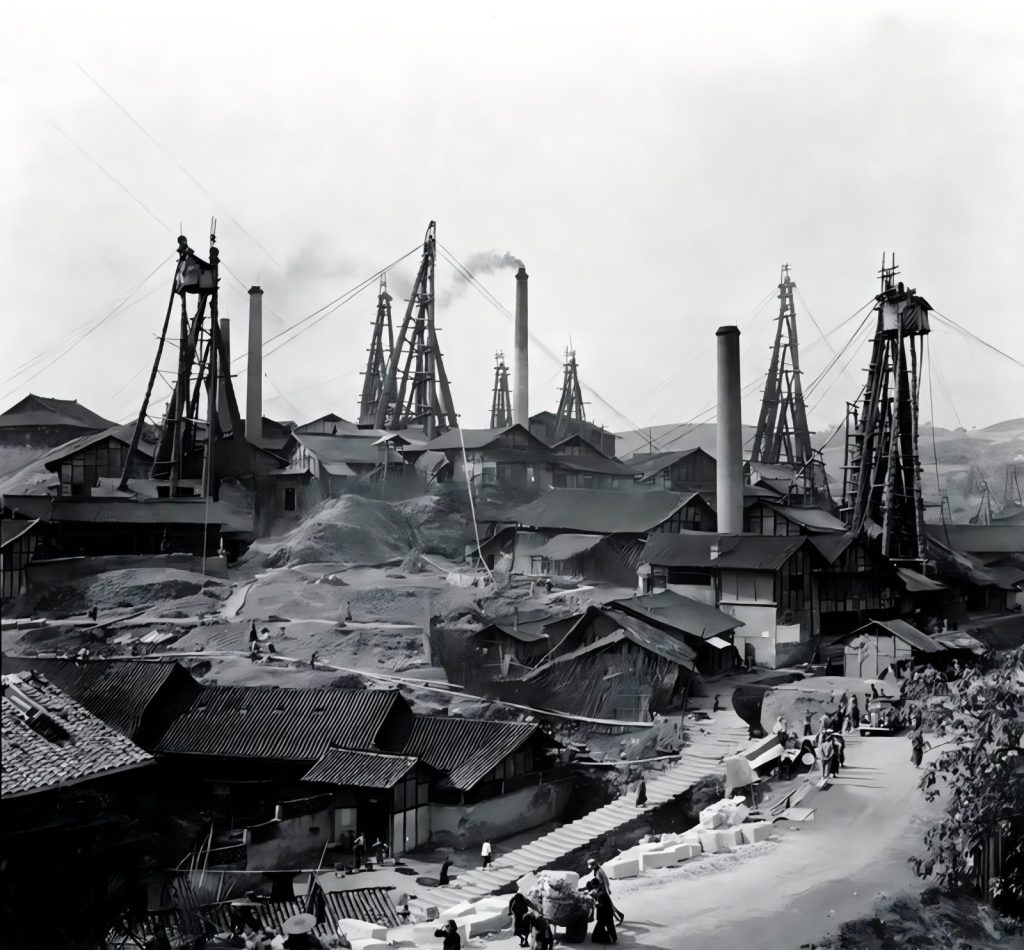
The Origins of Chinese Lantern Culture (Tang Dynasty, ~800 AD)
The story of Zigong lanterns begins not in Zigong itself, but in the Tang Dynasty (618–907 AD) — an era widely considered the golden age of Chinese civilization.
The First Lanterns: From Military Signal to Celebration
Lanterns were not invented in Zigong. The earliest Chinese lanterns date to the Eastern Han Dynasty (25–220 AD), when Emperor Mingdi (明帝) ordered Buddhist temples to light lamps on the 15th day of the first lunar month to honor Buddha. These were simple oil lamps placed inside paper-covered bamboo frames.
But it was during the Tang Dynasty that lantern culture truly flourished. Under Emperor Xuanzong (唐玄宗, r. 712–756), the Shangyuan Festival (上元节, Lantern Festival) was elevated from a religious observance to a three-day national celebration. The imperial capital, Chang’an (modern Xi’an), became a city of light:
- 30,000+ lanterns illuminated the streets in 713 AD
- Lantern towers reaching 150 feet (45 meters) were erected in palace courtyards
- Curfew was suspended for three nights, allowing citizens to roam freely among the displays
- Poets and painters documented the spectacle in works that survive to this day
The Zigong Connection: Salt Merchants Bring the Tradition Home
Here’s where geography and economics enter the story. As Tang Dynasty trade routes expanded, Zigong’s salt merchants traveled regularly to Chang’an and other cultural centers. They witnessed the imperial lantern festivals firsthand and brought the tradition back to Sichuan.
But Zigong’s artisans didn’t merely copy Chang’an’s lanterns. They improved them:
| Tang Dynasty Lantern (Chang’an) | Zigong Innovation |
|---|---|
| Paper covering (fragile, flammable) | Silk covering (durable, translucent, color-rich) |
| Bamboo frame (simple construction) | Steel-wire reinforced frame (larger scale, wind-resistant) |
| Oil lamp (dim, smoky) | Candle placement inside hollow frame (brighter, contained) |
| Static displays | Rotating mechanisms (wind-powered or hand-cranked) |
| Basic shapes (cylinders, cubes) | Figurative sculptures (animals, deities, legends) |
By the late Tang period, Zigong’s lantern craftsmen had developed a distinctive style that would define the art form for the next millennium.
The Song & Ming Dynasties: From Royal Court to Folk Art
Song Dynasty (960–1279): The Lantern Festival Democratizes
The Song Dynasty saw the lantern festival evolve from an aristocratic spectacle into a genuinely popular celebration. Emperor Taizong (宋太宗) extended the festival from three days to five days. By the Southern Song (1127–1279), it had grown to a week-long celebration in major cities.
In Zigong, this democratization had profound effects:
- Guilds and associations began organizing neighborhood lantern competitions
- Salt merchant families commissioned increasingly elaborate private displays
- Craft specialization emerged: frame-makers, silk-painters, mechanics, and lighting specialists
- Written manuals began circulating, documenting techniques for the first time
A Song Dynasty poem from a Sichuan traveler captures the atmosphere:
“The streets of Zigong are rivers of light — ten thousand lanterns reflecting in the Tuo River, as if the Milky Way had fallen to earth.”
Ming Dynasty (1368–1644): Lanterns as Political Symbolism
The Ming Dynasty brought a new dimension to lantern culture: political and philosophical symbolism. The Hongwu Emperor (朱元璋), founder of the Ming, came from a humble background and used the lantern festival as a tool of soft power — demonstrating imperial benevolence through public celebration.
In Zigong, three key developments occurred:
- The “Deng Hui” (灯会, Lantern Assembly): Formalized guild-based lantern exhibitions where different crafts competed for prestige
- Integration with opera and theater: Lantern displays began incorporating mechanical puppets that moved within the lanterns — a precursor to modern animatronics
- Color symbolism systematization: Specific colors became associated with meanings (red = prosperity, gold = imperial authority, blue = longevity, green = harmony)
The Qing Dynasty: Zigong’s Salt Wealth Fuels Lantern Innovation
If the Tang Dynasty planted the seed and the Song/Ming nurtured it, the Qing Dynasty (1644–1912) was when Zigong’s lantern culture exploded into its modern form. The reason was simple: money.
The Salt Economy: Zigong Becomes China’s Wealthiest County
During the Qing, Zigong’s salt industry reached its zenith. The city controlled what historians call the “Salt Monopoly of Sichuan” — a government-sanctioned cartel that supplied salt to half of China.
| Economic Indicator | Qing Dynasty Peak (c. 1850) |
|---|---|
| Annual salt production | 300,000+ tons |
| Salt tax revenue | 10% of Qing national tax income |
| Number of salt wells | 13,000+ |
| Salt merchant families | 200+ millionaire households |
| Zigong’s relative wealth | Richest county in Sichuan Province |
This extraordinary wealth had a direct cultural impact. Salt merchant families — the Wangs, Lis, Zhangs, and Huangs — competed to outdo each other in lantern extravagance.
The “Ten Thousand Lantern Mansions”
The most powerful salt merchant families built what locals called “Wan Deng Lou” (万灯楼, Ten Thousand Lantern Towers) — private estates where:
- Entire courtyards were filled with lantern installations year-round
- Artisan workshops employed 50–100 full-time lantern makers
- Competition displays featured mechanical lanterns with moving figures
- Innovation budgets funded experimental techniques (new materials, lighting methods, scale)
One surviving account from an 1843 travel diary describes a Zigong salt merchant’s Lantern Festival display:
“The courtyard contained a mountain of lanterns — literally a 30-foot artificial mountain, covered in 2,000 individual silk lanterns, with mechanical dragons that crawled through caves, phoenixes that fanned their wings, and a working waterfall illuminated from within. The merchant claimed it took 200 artisans six months to build.”
The Birth of Modern Lantern Techniques
The Qing period saw the emergence of techniques still used today:
| Technique | Qing Dynasty Origin | Modern Application |
|---|---|---|
| Steel-wire frame | Replaced bamboo for large-scale structures | Still primary frame material for structures >5m |
| Layered silk painting | Multiple translucent layers for depth | Standard technique for 3D visual effects |
| Internal candle channels | Hollow frames with ventilation for candles | Adapted for LED wiring pathways |
| Mechanical movement | Wind and hand-cranked automata | Evolved into modern animatronic systems |
| Waterproofing | Wax-coated silk for outdoor displays | Evolved into modern IP65-rated materials |
The 20th Century: Lanterns Go Modern
The 20th century brought both challenges and transformation to Zigong’s lantern tradition.
Republican Era (1912–1949): Tradition Under Pressure
The fall of the Qing Dynasty and subsequent civil wars disrupted the salt economy that had funded lantern craftsmanship. Many wealthy salt merchant families fled or lost their fortunes. However, the craft survived through three channels:
- Government preservation efforts: Local authorities recognized lanterns as a cultural asset worth protecting
- Guild reorganization: Artisan guilds restructured as cooperatives
- Folk persistence: Ordinary families continued making simpler lanterns for the annual festival
Mao Era (1949–1976): State-Sponsored Revival
Under the People’s Republic, Zigong’s lantern culture received state sponsorship — but with a twist. The government promoted lanterns as “folk art of the working people” while suppressing the “feudal” salt-merchant associations that had historically funded them.
Key developments:
- 1956: The Zigong Lantern Art Factory (自贡市彩灯艺术厂) was established as a state-owned enterprise
- 1960s: Lantern designs began incorporating socialist realism themes (workers, tractors, revolutionary heroes) alongside traditional motifs
- 1964: The first Zigong Lantern Festival was held as an official municipal event — a pivotal moment we’ll discuss next
Reform Era (1978–2000): The Export Revolution Begins
reforms launched by Deng Xiaoping in 1978 transformed Zigong’s lantern industry from a local tradition into a global export business.
- 1980s: Taiwan and Hong Kong businessmen began commissioning Zigong lanterns for Chinese New Year celebrations
- 1988: The first Zigong lanterns were exported to Singapore for the Spring Festival
- 1990: The Zigong Lantern Art Factory was restructured as a collective enterprise, allowing private investment
- 1992: Lanterns exported to Japan for the Osaka Lantern Festival
- 1994: First major export to Europe (Germany, for a Chinese cultural exhibition)
- 1997: First North American exhibition (San Francisco Chinese New Year Festival)
By 2000, Zigong had 12 registered lantern export companies and annual export revenue exceeding $10 million USD.
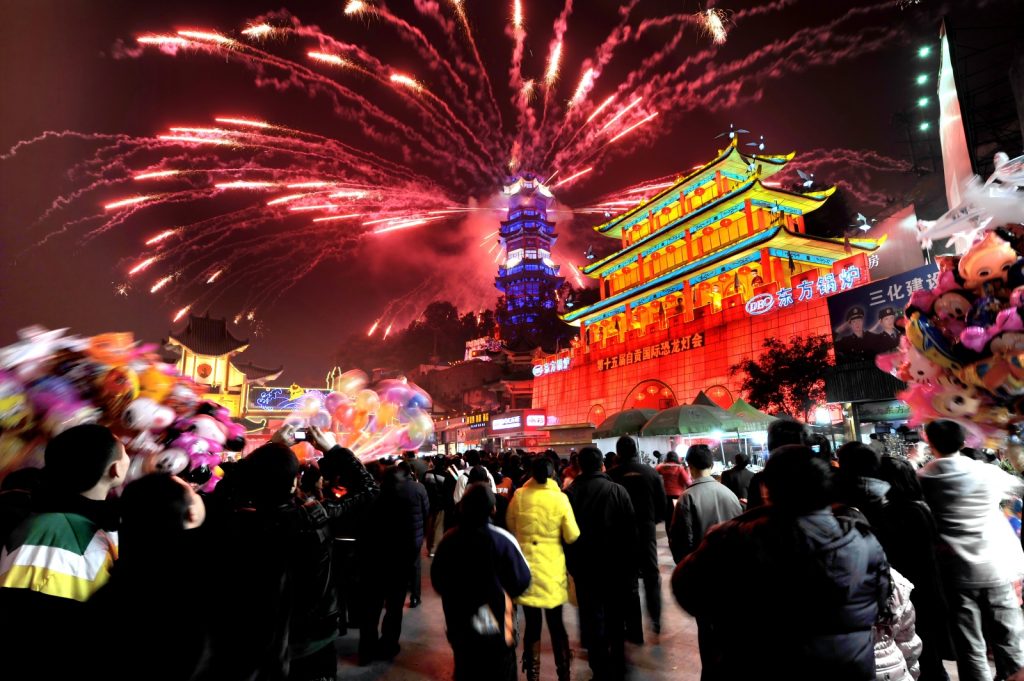
The Zigong International Dinosaur Lantern Festival (1964–Present)
No discussion of Zigong’s lantern legacy is complete without the Zigong International Dinosaur Lantern Festival — the event that transformed a local tradition into a global cultural brand.
1964: The First Official Festival
The inaugural festival in 1964 was modest by today’s standards:
- Duration: 15 days (Lantern Festival period only)
- Location: Zigong City Center Park
- Lanterns: ~1,000 pieces, mostly traditional designs
- Visitors: ~50,000 local residents
- Budget: Government-funded, ~200,000 RMB
But it established a crucial precedent: the lantern festival as a municipal institution.
The Dinosaur Connection: A Brilliant Marketing Pivot
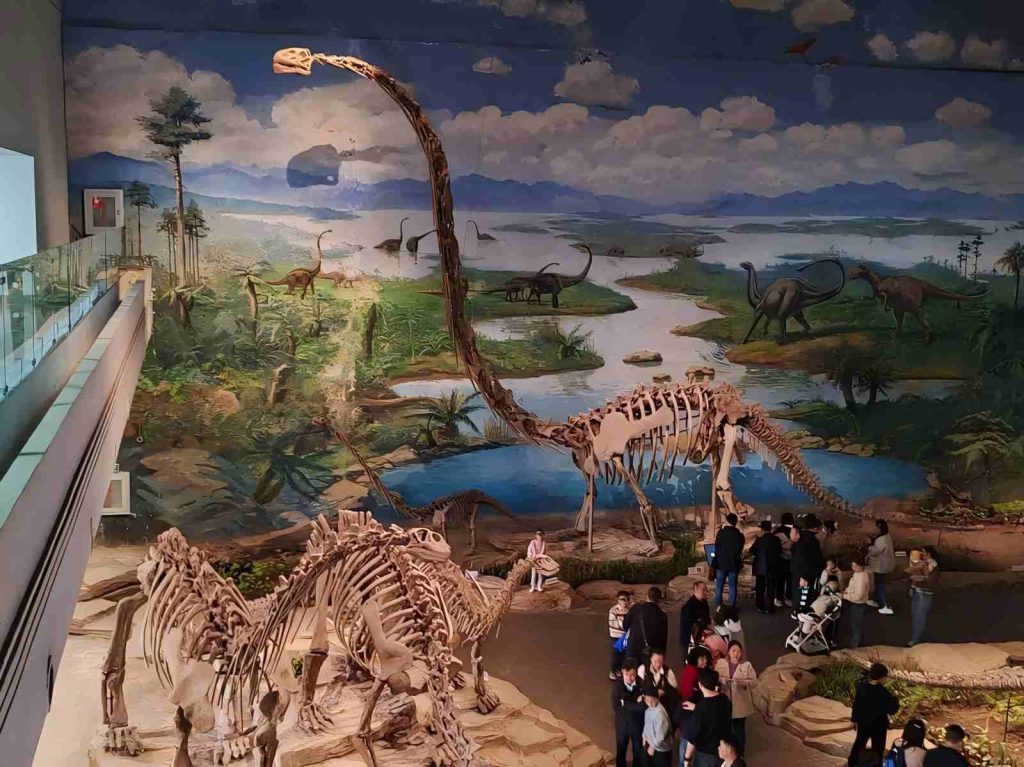
Here’s the genius move that changed everything. Zigong is not only the “Lantern Capital” — it’s also one of the world’s richest dinosaur fossil sites.
In 1915, American geologist R.C. Andrews discovered dinosaur fossils near Zigong. Subsequent excavations (1972–1980s) revealed:
| Discovery | Significance |
|---|---|
| Dashanpu Formation | One of the world’s most complete Middle Jurassic dinosaur fossil sites |
| 200+ individual dinosaurs | Including 18 complete skeletons |
| New species identified | Shunosaurus, Omeisaurus, Huayangosaurus — all named after the region |
| Zigong Dinosaur Museum | Opened 1987, Asia’s first dedicated dinosaur museum |
In 1987, festival organizers made a historic decision: combine lanterns with dinosaurs. The result was the world’s first dinosaur-themed lantern festival.
Evolution of the Festival (1964–2026)
| Year | Milestone | Scale |
|---|---|---|
| 1964 | First festival | 1,000 lanterns, 50,000 visitors |
| 1987 | Dinosaur theme introduced | 5,000 lanterns, 500,000 visitors |
| 1990 | First international visitors | 10,000 lanterns, 1M visitors |
| 1995 | First overseas satellite festival (Singapore) | Exported 50 lantern sets |
| 2000 | Online ticketing introduced | 2M visitors |
| 2005 | 3D design technology adopted | 30,000+ lanterns |
| 2010 | First “Lantern + Technology” interactive exhibits | 5M visitors |
| 2015 | 50th anniversary; first global livestream | 10M+ viewers |
| 2020 | Pandemic-era virtual festival | 50M+ online views |
| 2024 | 60th anniversary celebration | 8M in-person + 100M online |
| 2026 | Current edition (projected) | 100,000+ lanterns, 10M+ visitors |
Festival by the Numbers (2024)
| Metric | Figure |
|---|---|
| Total lanterns displayed | 120,000+ |
| Largest single lantern | 45-meter-tall Dragon Gate (龙宫) |
| LED lights used | 50 million+ |
| Festival area | 550,000 m (55 hectares) |
| Peak daily visitors | 350,000 |
| Total festival visitors | 8.2 million (in-person) |
| Countries represented (exhibitors) | 18 |
| Economic impact (direct + indirect) | $850 million USD |
| Media coverage | 3,000+ international news articles |
The Zigong Lantern Festival has become so iconic that “seeing the Zigong lanterns” is now on the bucket list of millions of international travelers.
UNESCO Recognition: Intangible Cultural Heritage of Humanity
On October 12, 2008, the United Nations Educational, Scientific and Cultural Organization (UNESCO) made a historic designation:
“The Lantern Festival of Zigong” was inscribed on the Representative List of the Intangible Cultural Heritage of Humanity.
What This Recognition Means
| Aspect | Significance |
|---|---|
| International legitimacy | Zigong lantern-making is officially recognized as a cultural practice of global importance |
| IP protection | The “Zigong Lantern” name gains legal protection against unauthorized use |
| Tourism boost | UNESCO designation increased international visitor numbers by 40% in the following decade |
| Funding access | Eligible for international cultural preservation grants |
| Brand value | “UNESCO-recognized” becomes a powerful marketing tool for manufacturers |
The Citation
UNESCO’s official citation highlights:
“The Lantern Festival of Zigong represents a unique synthesis of artistic craftsmanship, engineering innovation, and communal cultural practice. The tradition, maintained continuously for over eight centuries, demonstrates the extraordinary capacity of human creativity to transform simple materials — silk, bamboo, and light — into instruments of collective wonder.”
How Zigong Lanterns Are Made: The 8-Step Craft Process
Understanding Zigong’s lantern legacy requires understanding how the lanterns are actually made. The process has been refined over 800 years and remains remarkably consistent today.
Step 1: Concept & Design (1–3 weeks)
| Activity | Details |
|---|---|
| Client consultation | Theme, venue, budget, timeline |
| 3D modeling | Modern: Maya / 3ds Max / Blender; Traditional: hand-drawn sketches |
| Structural engineering | Load calculations, wind resistance, foundation requirements |
| Color palette selection | Based on theme, cultural symbolism, and LED compatibility |
| Scale confirmation | Full-size mockup for structures >10m |
Step 2: Frame Construction (2–6 weeks)
| Material | Application | Modern Equivalent |
|---|---|---|
| Bamboo | Small lanterns (<3m), detail elements | Still used for fine details |
| Steel wire | Medium structures (3–15m) | Galvanized steel wire, 1.5–6mm diameter |
| Steel tubing | Large structures (>15m) | Q235 galvanized steel, welded joints |
| Aluminum alloy | Moving parts, lightweight elements | 6061-T6 aluminum |
The frame is built using traditional binding techniques (wire wrapping + welding) combined with modern CAD-guided cutting for precision.
Step 3: Silk Application (1–4 weeks)
| Silk Type | Properties | Typical Use |
|---|---|---|
| Satin silk | High sheen, vibrant color | Main body surfaces |
| Organza | Translucent, ethereal | Wings, clouds, water effects |
| Brocade | Patterned, textured | Traditional motifs, royal themes |
| Stretch silk | Flexible, form-fitting | Complex curves, organic shapes |
Traditional method: Hand-stretch silk over frame, secure with rice-starch paste.
Modern method: Machine-cut silk panels with adhesive bonding + reinforced stitching.
Step 4: Hand-Painting (1–6 weeks)
This is where Zigong’s artistic tradition truly shines. Master painters use:
- Mineral-based pigments (traditional) or acrylic paints (modern)
- Fine-tipped brushes for details down to 0.5mm precision
- Layered techniques: Base color → shading → highlights → protective coating
- Gold leaf application for imperial/mythological themes
A single large lantern (e.g., a 10-meter dragon) can require 200+ hours of hand-painting.
Step 5: LED Integration (3–10 days)
| LED Type | Application | Color Range |
|---|---|---|
| SMD 5050 | General illumination | RGB + Warm White |
| SMD 2835 | Detail lighting, eyes | Single color |
| Pixel LEDs (WS2812B) | Programmable effects | 16.7 million colors |
| Flood LEDs | Large surface wash | RGBW |
| Laser modules | Special effects | Red/Green/Blue |
Wiring: All internal, hidden within frame channels. IP rating: IP65 minimum for outdoor installations.
Step 6: Mechanism Installation (3–14 days)
For animated/moving lanterns:
| Mechanism | Application | Power Source |
|---|---|---|
| Electric motors | Rotation, flapping, crawling | 12V/24V DC |
| Pneumatics | Rapid movement, jumping | Compressed air (6 bar) |
| Hydraulics | Heavy lifting, large structures | Oil hydraulic (150 bar) |
| Servo systems | Precise positioning | Programmable controllers |
| Sensor triggers | Interactive elements | IR/motion/pressure sensors |
Step 7: Quality Control & Testing (2–5 days)
| Test | Standard | Pass Criteria |
|---|---|---|
| Structural load test | 1.5x design wind load | No deformation |
| Waterproof test | IP65 spray test | No water ingress |
| Electrical safety | IEC 60598 | Insulation resistance >2MΩ |
| Color consistency | Pantone matching | ΔE <3 |
| Animation cycle | 72-hour continuous | Zero mechanical failures |
Step 8: Packing & Shipping (3–7 days)
| Packing Method | Application | Protection Level |
|---|---|---|
| Wooden crate | Large structures (>5m) | Shock-proof, moisture-resistant |
| Corrugated carton | Small-medium lanterns | Standard export packaging |
| Bubble wrap + foam | Delicate elements | Anti-vibration |
| Custom frame | Irregular shapes | Tailored protection |
Shipping: Ocean freight (standard, 20–40 days) or air freight (urgent, 3–7 days). Incoterms: Typically FOB Shanghai/Ningbo or CIF destination port.
From Local Craft to Global Industry: Zigong’s Export Revolution
The Numbers: Zigong’s Global Market Share
| Year | Export Value (USD) | Countries Served | Major Markets |
|---|---|---|---|
| 1995 | $15M | 8 | Asia-Pacific |
| 2000 | $45M | 18 | Asia + Europe |
| 2005 | $120M | 32 | Global |
| 2010 | $280M | 45 | Global |
| 2015 | $550M | 58 | Global |
| 2020 | $680M | 62 | Global (pandemic dip) |
| 2024 | $1.2B | 68 | Global |
| 2026 (est.) | $1.5B | 72 | Global |
Where Zigong Lanterns Go Today
| Region | Share | Typical Venues |
|---|---|---|
| North America | 28% | Zoos, botanical gardens, theme parks, shopping malls |
| Europe | 22% | City festivals, museums, cultural centers, Christmas markets |
| Middle East | 18% | Shopping festivals, national celebrations, luxury resorts |
| Asia-Pacific | 20% | Theme parks, cultural festivals, corporate events |
| Latin America | 7% | City festivals, cultural exchanges |
| Africa | 5% | Cultural festivals, Chinese embassy events |
Key Export Markets by Country (2024)
| Rank | Country | Annual Import Value | Notable Venues |
|---|---|---|---|
| 1 | USA | $180M | Bronx Zoo, LA Zoo, Missouri Botanical Garden |
| 2 | UK | $95M | London Zoo, Kew Gardens, Manchester Festival |
| 3 | Germany | $78M | Frankfurt Zoo, Munich Christmas Market |
| 4 | UAE | $72M | Dubai Festival City, Global Village |
| 5 | France | $65M | Paris Zoo, Lyon Festival of Lights |
| 6 | Japan | $58M | Tokyo Midtown, Osaka Festival |
| 7 | Canada | $52M | Toronto Zoo, Vancouver Botanical Garden |
| 8 | Australia | $48M | Sydney Zoo, Melbourne Festival |
| 9 | Singapore | $42M | Gardens by the Bay, Sentosa |
| 10 | Netherlands | $38M | Amsterdam Light Festival |
Why the World Chooses Zigong Lantern Manufacturers
The “Zigong Advantage”
| Factor | Zigong | Other Regions |
|---|---|---|
| Craft heritage | 800+ years continuous | <100 years or none |
| Artisan workforce | 15,000+ trained craftsmen | Limited |
| Supply chain | Complete (silk, steel, LED, paint) | Fragmented |
| Scale capability | 100,000+ lanterns/year | 5,000–20,000 |
| Price competitiveness | 30–50% below Western manufacturers | Higher |
| Customization | Full bespoke (any size, theme, shape) | Limited catalogs |
| Installation service | Global on-site teams | Rarely offered |
| IP protection | Patent portfolio (200+) | Limited |
| Cultural authenticity | UNESCO-recognized tradition | Replicas |
Quality vs. Price: The Zigong Sweet Spot
| Quality Tier | Price Range (FOB) | Typical Client |
|---|---|---|
| Standard | $80–150/m² | Small festivals, community events |
| Premium | $150–300/m² | Zoos, botanical gardens, city festivals |
| Luxury | $300–600/m² | Theme parks, luxury hotels, national celebrations |
| Bespoke Monumental | $600–1,500/m² | Iconic installations, record-breaking structures |
Note: Prices vary by complexity, animation features, and installation requirements. All FestiveLanterns products are custom-quoted based on project specifications.
Modern Innovations: LED, 3D Design & Silicone Skin Technology
Zigong’s lantern industry hasn’t remained frozen in tradition. Over the past two decades, three technological revolutions have transformed the craft:
Revolution 1: LED Technology (2005–2015)
| Before LED | After LED |
|---|---|
| Incandescent bulbs (hot, fragile, short lifespan) | SMD LEDs (cool, durable, 50,000+ hour lifespan) |
| Limited color palette (warm white, red, yellow) | Full RGB spectrum + programmable color changing |
| High energy consumption (500W per large lantern) | 80% energy reduction (100W equivalent brightness) |
| Fire risk (open flame/candles) | Zero fire risk, IP65 waterproof |
| Static brightness | Programmable dimming, pulsing, chasing effects |
| Manual color changes | DMX-controlled, synchronized to music |
Revolution 2: 3D Design & Digital Manufacturing (2010–2020)
| Traditional Process | Modern Process |
|---|---|
| Hand-drawn sketches | 3D modeling (Maya, 3ds Max, Blender) |
| Physical scale models | VR walkthrough previews |
| Manual frame bending | CNC wire bending machines |
| Hand-cut silk panels | Laser-cut precision panels |
| Painted by eye | Color-calibrated digital printing |
| Trial-and-error assembly | Pre-fabricated modular components |
Impact: Design-to-production time reduced from 6 months to 8 weeks for standard projects.
Revolution 3: Silicone Skin Technology (2018–Present)
The most significant recent innovation is silicone skin technology for animatronic lanterns and dinosaur exhibits.
| Traditional Material | Silicone Skin | Advantage |
|---|---|---|
| Fiberglass | Medical-grade silicone | 300% more realistic texture |
| Rigid surface | Soft, elastic, self-healing | Can be touched/pressed without damage |
| Painted finish | Pigment-integrated material | Color doesn’t chip, peel, or fade |
| 3–5 year lifespan | 10–15 year lifespan | 3x durability |
| Cold/artificial feel | Warm, skin-like touch | Enhanced visitor experience |
FestiveLanterns holds the exclusive patent for this technology (Chinese Patent ZL 2022 1 0224489.5), making us one of only three manufacturers worldwide capable of producing silicone-skinned animatronic exhibits at commercial scale.
Zigong Today: Numbers That Define the Industry
The Zigong Lantern Ecosystem (2024)
| Category | Figure |
|---|---|
| Total lantern enterprises | 1,200+ |
| Large manufacturers (>100 employees) | 85 |
| Medium manufacturers (20–100 employees) | 340 |
| Small workshops (<20 employees) | 800+ |
| Total industry employment | 85,000+ |
| Master craftsmen (高级工艺师) | 1,200 |
| Annual industry output value | $3.2 billion USD |
| Export revenue | $1.2 billion USD |
| Domestic revenue | $2.0 billion USD |
| Lanterns produced annually | 500,000+ pieces |
| Countries served | 68 |
| International festivals supplied | 320+ annually |
| Museum exhibits supplied | 150+ annually |
| Theme park installations | 200+ annually |
| Zoo light events | 80+ annually |
Zigong’s Supporting Industries
| Industry | Role in Lantern Production |
|---|---|
| Steel fabrication | Frame manufacturing, 200+ specialized suppliers |
| LED electronics | Lighting systems, 50+ LED assembly factories |
| Silk/textile | Covering materials, 30+ silk processors |
| Paint/pigments | Artistic materials, 15+ chemical suppliers |
| Packing/logistics | Export packaging, 80+ logistics providers |
| 3D printing | Rapid prototyping, 20+ service bureaus |
| Animation/AV | Interactive content, 10+ multimedia studios |
FestiveLanterns: Continuing the Zigong Legacy
At FestiveLanterns (Zigong Huilongtang Culture & Art Co., Ltd.), we are proud to be part of this 800-year tradition. Founded in 2012 by Yang Shiping, our company represents the next evolution of Zigong lantern craftsmanship.
Our Connection to Zigong’s Heritage
| Heritage Element | How We Preserve It |
|---|---|
| Master craftsmen | 35+ artisans with 20+ years experience, trained in traditional Zigong techniques |
| Hand-painting | Every lantern receives hand-painted details — no mass-printed shortcuts |
| Silk-on-frame tradition | Primary construction method for all display lanterns |
| Zigong design philosophy | “One lantern, one story” — each piece tells a cultural narrative |
| Guild-quality standards | Internal QC stricter than industry norms |
Our Modern Innovations
| Innovation | Application |
|---|---|
| Silicone skin technology | Patented animatronic dinosaur/animal exhibits |
| Interactive sensor systems | Visitor-triggered animations and sound |
| App-controlled LED programming | Remote color/brightness/effect management |
| Modular design system | Faster installation, easier maintenance |
| VR preview service | See your festival before production begins |
Why Clients Choose FestiveLanterns
“We’ve worked with lantern manufacturers from three countries. FestiveLanterns is the only one that truly understands both the artistic tradition and the technical requirements of modern zoos. Their silicone-skin dinosaurs are the most realistic we’ve ever installed.”
— Director of Exhibits, Major North American Zoo (2024)“The level of detail in their silk painting is extraordinary. Our visitors spend 20+ minutes at each lantern because there’s always something new to discover.”
— Festival Director, European City Light Festival (2023)
Our Services
- Custom Lantern Design & Manufacturing: Any theme, any scale, any venue
- Animatronic Dinosaurs & Animals: Life-size, interactive, silicone-skinned
- Turnkey Festival Solutions: Concept → Design → Production → Shipping → Installation → Support
- Zoo Lights Packages: Complete illuminated animal sculpture collections
- Museum Exhibit Design: Educational, interactive, culturally authentic
Explore Our Product Categories →
Frequently Asked Questions
What makes Zigong the “Lantern Capital of the World”?
Zigong’s claim rests on four pillars: (1) 800+ years of continuous lantern-making tradition, (2) UNESCO Intangible Cultural Heritage recognition, (3) 60%+ global market share in custom festival lanterns, and (4) the world’s largest and oldest annual lantern festival (the Zigong International Dinosaur Lantern Festival, since 1964).
How old is the Zigong lantern tradition?
The tradition dates to the Tang Dynasty (618–907 AD), approximately 1,400 years ago. Zigong artisans began developing distinctive techniques during this period, and the craft has continued uninterrupted to the present day.
Are all Chinese lanterns made in Zigong?
No — but the majority of high-quality, large-scale custom festival lanterns are. Zigong accounts for approximately 60% of global custom lantern production and 80% of export-quality festival lanterns. Mass-produced decorative lanterns (small, inexpensive items) are manufactured across China and Southeast Asia.
What’s the difference between a Zigong lantern and a regular Chinese lantern?
| Feature | Zigong Lantern | Regular Chinese Lantern |
|---|---|---|
| Construction | Steel-wire frame + hand-painted silk | Paper or thin fabric on bamboo |
| Scale | 1–45 meters | Typically <1 meter |
| Durability | 2–15 years (outdoor rated) | 1–2 seasons |
| Artistic detail | Museum-quality hand-painting | Printed or simple designs |
| Lighting | LED-integrated, programmable | Single bulb or candle |
| Customization | Fully bespoke | Catalog items only |
How long does it take to make a Zigong lantern?
- Small lanterns (1–3m): 2–4 weeks
- Medium lanterns (3–10m): 4–8 weeks
- Large lanterns (10–20m): 8–12 weeks
- Monumental structures (20m+): 12–20 weeks
- Full festival package (50+ pieces): 3–6 months
Can I visit Zigong to see the lanterns being made?
Yes! FestiveLanterns offers factory tours for qualified buyers and event planners. Contact us at [email protected] to arrange a visit to our 60,000m² production facility in Zigong.
When is the best time to visit the Zigong Lantern Festival?
The festival runs annually from late January through early March (covering the Chinese New Year period). The peak period is the first two weeks of February. We recommend booking accommodation 3+ months in advance.
Do Zigong lantern manufacturers provide installation services?
Yes — this is a standard service. Reputable manufacturers like FestiveLanterns provide full turnkey installation including:
- Shipping and customs clearance
- On-site assembly by experienced technicians
- Electrical connection and testing
- Staff training for operation and maintenance
- Post-event disassembly and storage (if needed)
Featured Image Recommendation
- Subject: Wide-angle night shot of the Zigong International Dinosaur Lantern Festival showing massive illuminated installations along a river with crowds
- Size: 1600 x 900 pixels
- Format: JPEG, 80% quality, <= 400KB
- Alt text:
Zigong International Dinosaur Lantern Festival at night with massive illuminated dragon and dinosaur sculptures along the river - File name suggestion:
zigong-international-lantern-festival-night-panorama.jpg
Inline Image Suggestions (6–8 images throughout article)
| Position | Image Subject | Alt Text | File Name Suggestion |
|---|---|---|---|
| After “What Is Zigong?” section | Aerial view of Zigong city with river and salt well museum | Aerial view of Zigong city showing Tuo River and historic salt well district | zigong-city-aerial-view.jpg |
| After “Tang Dynasty” section | Museum diorama of Tang Dynasty Chang’an lantern festival | Tang Dynasty Chang'an lantern festival historical diorama with palace and thousands of lanterns | tang-dynasty-lantern-festival-diorama.jpg |
| After “Qing Dynasty” section | Historical photo or painting of Qing-era salt merchant mansion with lanterns | Qing Dynasty salt merchant mansion courtyard in Zigong decorated with traditional silk lanterns | qing-dynasty-zigong-salt-merchant-mansion.jpg |
| After “UNESCO Recognition” section | Close-up of artisan hand-painting silk on a lantern frame | Zigong artisan hand-painting intricate details on silk-covered lantern frame in workshop | zigong-artisan-hand-painting-lantern.jpg |
| After “8-Step Process” section | Workshop interior showing multiple lanterns in various production stages | Zigong lantern factory workshop showing steel frames, silk application, and painting stations | zigong-lantern-factory-workshop-interior.jpg |
| After “Export Revolution” section | Map showing global distribution of Zigong lantern festivals | World map showing countries and cities where Zigong lanterns have been exported and installed | zigong-lanterns-global-export-map.jpg |
| Before FAQ section | Modern LED dragon lantern at a zoo lights event in North America | Massive LED-illuminated Chinese dragon lantern installation at North American zoo lights event | modern-led-dragon-lantern-zoo-lights.jpg |
If you are an event planner, theme park manager, shopping mall marketing director, or city tourism organizer looking to host a Chinese Lantern Festival — or any large-scale illuminated attraction — this guide is for you.
A Chinese Lantern Festival is not just a decoration project. It is a complete immersive experience that draws hundreds of thousands of visitors, generates media buzz, and creates the kind of Instagram-worthy moments that modern audiences expect. From the world-famous Zigong International Lantern Festival (which attracts 3+ million visitors annually) to traveling lantern exhibitions in zoos, botanical gardens, and shopping districts across North America, Europe, and the Middle East — lantern festivals have become one of the fastest-growing event categories globally.
At FestiveLanterns, we have designed, manufactured, and installed custom Chinese lantern festivals and illuminated attractions for clients in over 40 countries. This guide covers everything you need to know: from understanding what makes a lantern festival special, through planning your event, to working with the right manufacturing partner.
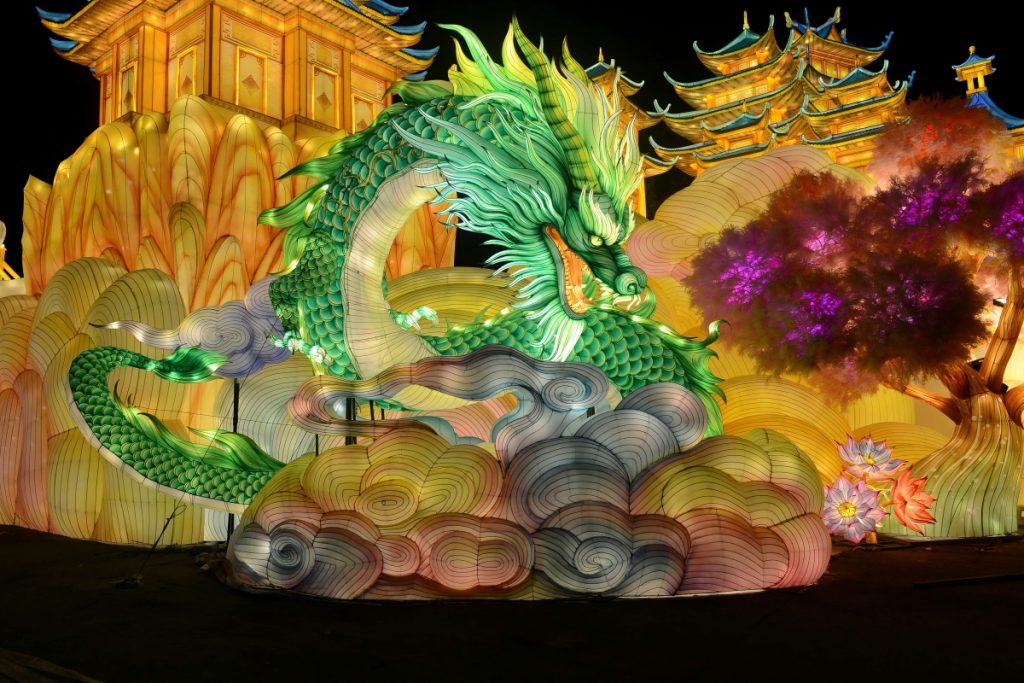
What Is a Chinese Lantern Festival?
Origins & Cultural Heritage
The Chinese Lantern Festival (元宵节 / Yuánxiāo Jié) dates back over 2,000 years to the Han Dynasty. Traditionally celebrated on the 15th day of the first lunar month, it marks the end of Chinese New Year celebrations with elaborate lantern displays, riddle-guessing games, lion dances, and family gatherings.
Today’s commercial lantern festivals have evolved far beyond their traditional roots:
| Era | Form | Scale | Audience |
|---|---|---|---|
| Traditional (Han–Qing Dynasties) | Handmade paper/silk lanterns | Household / Village | Local community |
| Modern Public (1980s–2000s) | Electric lights + steel frames | City parks | Regional tourists |
| Global Commercial (2010s–Present) | Giant animated lanterns + multimedia | International venues | Global audiences |
What Makes a Modern Lantern Festival Special?
Unlike Christmas light displays or standard illumination events, a genuine Chinese lantern festival features:
- Handcrafted Artistry — Each lantern is built by skilled artisans using traditional techniques: steel frame welding, silk or fabric covering, hand-painting, and LED internal lighting. No two are exactly alike.
- Giant-Scale Installations — Modern festival lanterns range from 3 meters to over 30 meters in height. A single dragon installation can stretch 50+ meters.
- Thematic Storytelling — The best lantern festivals tell a cohesive visual story: “Journey Through Ancient China,” “Mythical Creatures of the East,” “Zodiac Adventure,” or fully customized themes tied to your venue.
- Day-and-Night Appeal — High-quality lantern sculptures look impressive during the day as colorful art installations and become absolutely magical at night when internally lit.
- Interactive Elements — Modern lantern festivals incorporate motion sensors, projection mapping, soundscapes, and photo opportunities to engage younger audiences.
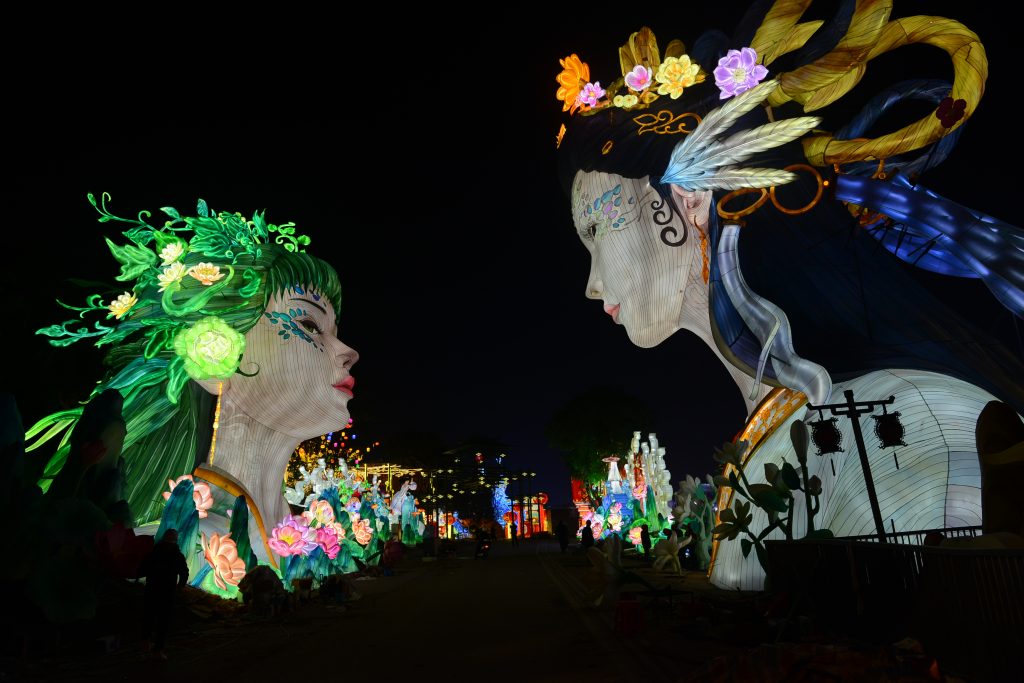
Types of Lantern Festivals & Illuminated Attractions
When planning a lantern-based event, it helps to understand the main categories:
1. Traditional Chinese Lantern Festival
The classic format: dozens to hundreds of handcrafted Chinese-style lantern installations arranged along a walking path. Themes typically draw from Chinese mythology, zodiac animals, historical scenes, and floral designs.
Best for: Botanical gardens, city parks, cultural centers, waterfront promenades
Typical scale: 30–150+ lantern installations
Duration: 4–8 weeks
2. Zoo Lights / Animal-Themed Lantern Festival
One of the most popular formats globally. Life-size and oversized animal lanterns (both real species and mythical creatures) displayed throughout a zoo or wildlife park. Visitors experience familiar animal exhibits reimagined as glowing artworks.
Best for: Zoos, wildlife parks, safari parks
Typical scale: 50–200+ animal lantern installations
Duration: 6–12 weeks (often spanning holiday seasons)
3. Holiday Lights & Seasonal Illumination
Broader than traditional Chinese lanterns, these events combine Chinese lantern craftsmanship with Western holiday themes: Christmas markets, winter wonderlands, Halloween trails, and summer night festivals.
Best for: Shopping malls, amusement parks, resorts, downtown districts
Typical scale: 20–100+ mixed installations
Duration: 4–12 weeks (season-dependent)
4. Indoor Lantern Exhibitions
Smaller-scale, climate-controlled lantern displays inside convention centers, museums, or shopping atriums. These use compact lantern designs with focused lighting and often include cultural workshops.
Best for: Museums, convention centers, luxury hotels, indoor entertainment complexes
Typical scale: 15–60 installations
Duration: 2–6 months (longer run due to indoor protection)
5. Floating & Water Lantern Festivals
Lanterns specifically engineered for water surfaces: floating lotus flowers, illuminated dragon boats, bridge-spanning arches, and fountain-integrated installations. These create some of the most photogenic scenes in the lantern festival world.
Best for: Lakeside venues, riverfront parks, resort pools, waterfront promenades
Typical scale: 20–80 installations
Duration: 4–8 weeks
How to Plan Your Lantern Festival: Step by Step
Phase 1: Concept & Feasibility (Weeks 1–2)
Define your objectives:
- What is the primary goal? (Ticket sales / Foot traffic / Brand awareness / Media coverage)
- Who is your target audience? (Families / Couples / Tourists / Local residents)
- What is your available space? (Open-air park / Indoor hall / Mixed)
- What is your budget range?
Site assessment checklist:
- [ ] Total available square meters / acres
- [ ] Walking route length and width
- [ ] Power supply capacity and access points
- [ ] Weather exposure (wind, rain, snow considerations)
- [ ] Visitor capacity per hour
- [ ] Accessibility requirements (ADA / wheelchair routes)
Phase 2: Design & Theme Selection (Weeks 3–5)
Work with your lantern manufacturer on a custom design package. Key decisions:
- Theme direction — Traditional Chinese, fantasy/mythology, animal kingdom, cultural fusion, or fully custom?
- Installation count and sizes — Mix of centerpiece giants (10m+), medium feature pieces (3–8m), and small decorative elements (1–3m)
- Lighting scheme — Static color, color-changing LEDs, synchronized lighting effects, or interactive/motion-triggered?
- Interactive features — Motion sensors, sound modules, projection elements, AR integration
Pro tip: The most successful lantern festivals have 3–5 “wow moment” centerpiece installations that serve as social media magnets, surrounded by 30–100+ supporting lanterns that create atmosphere and extend the visitor journey.
Phase 3: Manufacturing (Weeks 6–16)
This is where your manufacturer’s capability matters most.
Production timeline reference:
| Project Size | Manufacturing Period | Shipping | Installation |
|---|---|---|---|
| Small (20–30 lanterns) | 4–5 weeks | 2–3 weeks (sea) | 3–5 days |
| Medium (50–80 lanterns) | 6–8 weeks | 3–4 weeks | 5–10 days |
| Large (100+ lanterns) | 10–14 weeks | 4–5 weeks | 10–20 days |
| Mega (200+ / Giants) | 14–18 weeks | 5–6 weeks | 2–4 weeks |
During production, reputable manufacturers provide:
- Progress photos at key milestones (frame completion → skin application → painting → lighting test)
- Video previews of animated/interactive elements
- Quality inspection reports before shipping
Phase 4: Shipping & Logistics (Varies)
What you need to know about shipping giant lanterns:
- Lanterns ship disassembled in steel-reinforced wooden crates
- Typical crate size: 1–4 cubic meters each, depending on lantern size
- A medium festival (60 lanterns) fills roughly 1–3 × 40ft containers
- Shipping method: Sea freight (most common) or air freight for rush orders
- Import classification: Usually “festive decorations” or “art installations” — check your local HS codes
Your manufacturer should handle:
- Crating and export documentation
- Customs clearance coordination
- Door-to-door or port-to-door delivery options
Phase 5: On-Site Installation (3 Days – 4 Weeks)
Installation complexity varies enormously:
| Type | Duration | Team Size | Notes |
|---|---|---|---|
| Small indoor display | 3–7 days | 3–5 technicians | Simple assembly, minimal rigging |
| Medium outdoor park | 1–2 weeks | 5–10 technicians | Requires lifting equipment, power setup |
| Large festival with giants | 3–4 weeks | 10–20 technicians | Crane operation, structural engineering, weather contingency |
Critical success factors during installation:
- Site preparation completed before team arrival (ground leveling, power points ready, access routes clear)
- Daily coordination meetings between venue staff and installation lead
- Weather contingency plan (wind speed limits for tall structures)
- Safety protocols for public areas near active construction zones
Phase 6: Operation & Dismantling
During the event:
- Routine inspections (especially after severe weather)
- Spare parts and repair materials on-site
- Manufacturer remote support for technical issues
- Visitor feedback collection for future improvements
After the event:
- Professional dismantling (lanterns are reusable for 3–5+ years with proper storage)
- Crate repacking and storage guidance
- Off-season maintenance recommendations
- Planning for next year’s expansion or redesign
Budget Planning: What Does a Lantern Festival Cost?
Budgets vary widely based on scope. Below are realistic industry ranges for planning purposes:
| Festival Tier | # of Installations | Budget Range (USD) | Best For |
|---|---|---|---|
| Starter | 15–30 lanterns | $30,000 – $80,000 | Small malls, hotel lobbies, pop-up events |
| Standard | 40–80 lanterns | $80,000 – $250,000 | City parks, mid-sized zoos, regional festivals |
| Premium | 100–180 lanterns | $250,000 – $600,000 | Major zoos, botanical gardens, destination events |
| Landmark | 200+ with giants | $600,000 – $1.5M+ | World-class venues, multi-city tours, long-term installations |
What’s typically included in a turnkey package:
- Custom design and 3D renderings
- All lantern manufacturing (frames, skins, painting, lighting)
- Ocean shipping to your nearest port
- On-site installation by factory technicians
- Spare parts kit and basic maintenance training
Additional costs to budget separately:
- Inland freight from port to venue ($2,000–$10,000)
- Venue site preparation (power, ground work, fencing)
- Marketing and promotion
- Event insurance
- Staffing during the event run
Choosing the Right Lantern Festival Partner
This decision will make or break your project. Here is what to evaluate:
1. Manufacturing Capability
Ask potential suppliers:
- Do you have your own factory, or do you outsource? (Factory-direct = better quality control and pricing)
- Can you show photos/videos from your actual workshop?
- What is your maximum annual production capacity?
- Do you handle both lanterns AND animatronic exhibits? (Integrated suppliers save coordination headaches)
2. Portfolio & Track Record
Request:
- Case studies from similar-sized projects (not just photos — ask about challenges solved)
- Client references you can contact directly
- Examples of past projects in your region/country
3. Design Capability
- Do they offer custom 3D design, or only catalog products?
- Can they adapt to YOUR venue’s layout and requirements?
- Is there a dedicated designer assigned to your project?
4. Full-Service vs. Product-Only
This is critical:
| Service Level | What You Get | Risk |
|---|---|---|
| Product Only | Lanterns shipped to your door | You handle installation, wiring, repairs — high risk if inexperienced |
| Turnkey Package | Design → Manufacture → Ship → Install → Support | One point of accountability; recommended for first-time organizers |
Our strong recommendation: For your first lantern festival, choose a turnkey provider who handles everything from initial concept to final installation. The cost difference is usually justified by avoided problems and smoother execution.
5. After-Sales Support
- Warranty period and coverage terms
- Availability of replacement parts post-warranty
- Remote troubleshooting support
- Options for off-season refurbishment
Why Choose Zigong-Based Manufacturers?
Zigong (自贡), in Sichuan Province, China, is recognized worldwide as the capital of lantern making. Here is why:
- UNESCO recognition: Zigong Lantern Making is listed as an Intangible Cultural Heritage.
- 2,000+ years of tradition combined with modern animatronic technology.
- Concentrated ecosystem: Over 1,000 specialized companies, artisans, engineers, and designers all in one city.
- The Zigong International Lantern Festival serves as the world’s largest annual showcase — a living R&D lab where new techniques are pioneered every year.
- Cost efficiency: Factory-direct pricing without middlemen.
At FestiveLanterns, we are proud to be based in Zigong. Our team includes master artisans with 14+ years of lantern-making experience, many of whom have contributed to the official Zigong International Lantern Festival.
Common Mistakes to Avoid
❌ Starting Too Late
Lantern festivals require 3–5 months of lead time for design and manufacturing. If you want a festival for November–January (peak season), you should be engaging your manufacturer by July–August at the latest.
❌ Underestimating Power Requirements
Each lantern installation needs electrical supply. A medium festival (60 lanterns) may need 50–100 kW of stable power. Plan your power infrastructure early.
❌ Ignoring Wind and Weather
Outdoor lanterns must be engineered for local wind loads. A 12-meter lantern structure becomes a significant sail in high winds. Ensure your supplier provides wind-rated certifications.
❌ Skipping the Walking Path Design
The order and spacing of lantern installations dramatically affects visitor experience. Work with your supplier on a detailed pathway plan that creates rhythm: big reveal → intimate passage → group scene → grand finale.
❌ Choosing Price Over Value
The lowest bid often means inferior materials (cheap fabric instead of silk, basic paint instead of UV-resistant automotive-grade finish), no warranty, and zero after-sales support. A lantern festival is a visible, high-profile investment — quality shows.
Frequently Asked Questions
How long do festival lanterns last?
With proper care, high-quality steel-frame lanterns with silicone-treated skins last 5–8 years outdoors and can be reused across multiple festival seasons. Silk/fabric lanterns in protected environments can last even longer.
Can lanterns withstand rain and snow?
Yes — when properly engineered. Quality outdoor lanterns use galvanized steel frames, waterproof LED systems, and weather-resistant coverings. Snow load ratings should be specified for cold climates. Always discuss your local weather conditions with your manufacturer.
Do I need special permits for a lantern festival?
This depends on your location and scale. Common requirements include:
- Temporary structure permits (for large installations)
- Electrical safety certificates
- Fire safety approvals (even though modern LED lanterns run cool)
- Business/event operating licenses
Your turnkey supplier should provide technical documentation to support your permit applications.
Can I customize the lantern designs to match my brand?
Absolutely. Reputable manufacturers offer full customization including:
- Corporate colors and logo integration
- Mascot or IP character creation as lantern figures
- Thematic alignment with your existing branding
What is the minimum viable size for a lantern festival?
For a coherent visitor experience, we recommend at least 15–20 lantern installations covering a walking route of 300+ meters. Smaller setups work well as lobby displays or entrance features rather than standalone festivals.
Do you offer rental / lease options?
Many manufacturers (including FestiveLanterns) offer seasonal leasing, multi-year partnerships, and revenue-sharing models. This reduces upfront investment risk while still delivering a premium experience.
Ready to Start Your Lantern Festival Project?
Whether you have a clear vision or just a rough idea, the next step is a conversation.
At FestiveLanterns, we provide one-stop lantern festival solutions:
✅ Custom design tailored to your venue and audience
✅ In-house manufacturing in Zigong, China
✅ Global shipping and logistics coordination
✅ Professional on-site installation and testing
✅ After-sales support and maintenance guidance
Tell us about your venue, timeline, and vision — and we’ll send you a preliminary concept proposal within 48 hours.
Published: June 2025 | Last Updated: June 2025
FestiveLanterns — Chinese Lantern Festival Manufacturer & Animatronic Dinosaurs | Zigong, China
About FestiveLanterns
FestiveLanterns (自贡市汇龙堂文化艺术有限公司) is a one-stop festival solutions provider based in Zigong, Sichuan — the world-renowned capital of Chinese lantern making. We specialize in:
- Custom Chinese Lantern Festivals — From concept design to on-site installation
- Animatronic Dinosaurs & Animals — Including our patented silicone skin technology
- Illuminated Attraction Packages — Zoo lights, holiday displays, floating lanterns, and more
- Turnkey Event Solutions — Planning, manufacturing, shipping, installation, and support
With 14+ years of experience, 80+ team members, and projects delivered to 40+ countries, we bring the magic of Zigong’s lantern heritage to venues worldwide.
View Our Portfolio → | Contact Us →
SEO Metadata (Yoast)
| Field | Content |
|---|---|
| Focus Keyword | chinese lantern festival |
| SEO Title | Chinese Lantern Festival Complete Guide: Plan, Source & Succeed | FestiveLanterns |
| Meta Description | Complete guide to planning a Chinese lantern festival: types, budget ranges, step-by-step process, and how to choose the right manufacturer. Free consultation available. |
| Slug | chinese-lantern-festival-complete-guide |
Featured Image Recommendation
- Subject: Wide-angle shot of a colorful Chinese lantern festival at dusk, showing multiple illuminated lantern installations along a pathway with visitors
- Size: 1600 × 900 pixels
- Format: JPEG, 80% quality, ≤400KB
- Alt text:
Chinese lantern festival pathway with colorful illuminated installations at twilight - File name suggestion:
chinese-lantern-festival-guide-hero.jpg
Inline Image Suggestions (6–8 images throughout article)
| Position | Image Subject | Alt Text | File Name Suggestion |
|---|---|---|---|
| After “What Makes It Special?” section | Close-up of artisan hand-painting a lantern | Artisan hand-painting details on a traditional Chinese lantern | lantern-hand-painting-detail.jpg |
| After Types section | Giant dragon lantern installation at night | Massive illuminated dragon lantern stretching over 40 meters at night | dragon-lantern-installation-night.jpg |
| After Planning Phase 2 | 3D rendering/design mockup of a lantern festival layout | 3D design rendering showing lantern festival layout and walking path | lantern-festival-3d-design.jpg |
| After Manufacturing table | Workshop interior showing multiple lanterns in production | Lantern manufacturing workshop with multiple installations under production | lantern-workshop-production.jpg |
| After Installation section | Technician team installing a large lantern on-site | Installation team assembling a large lantern structure at venue | lantern-on-site-installation.jpg |
| Before FAQ section | Panoramic view of completed festival with crowd | Panoramic view of completed Chinese lantern festival with crowds enjoying the display | completed-lantern-festival-crowd.jpg |
Tags
chinese lantern festival, lantern festival planning, zigong lanterns, lantern festival manufacturer, custom lantern display, zoo lights, illuminated event, lantern exhibition, festival lighting, cultural event, turnkey lantern solution, lantern supplier china, outdoor light festival, holiday light show
If you are planning a museum exhibition, theme park attraction, or shopping mall event, you have probably asked this question: How much does a life size animatronic dinosaur actually cost?
The short answer is: anywhere from $5,000 to over $150,000, depending on size, features, and customization. But that range is too broad to be useful. In this guide, we break down exactly what drives the price of an animatronic dinosaur, what you get at each budget level, and how to make a smart investment for your venue.
At FestiveLanterns, we have manufactured and installed life size animatronic dinosaurs for clients in over 50 countries. This guide is based on real project data from our factory in Zigong, China.
What Affects the Cost of an Animatronic Dinosaur?
Before looking at price ranges, it is important to understand the five main factors that determine the final quote.
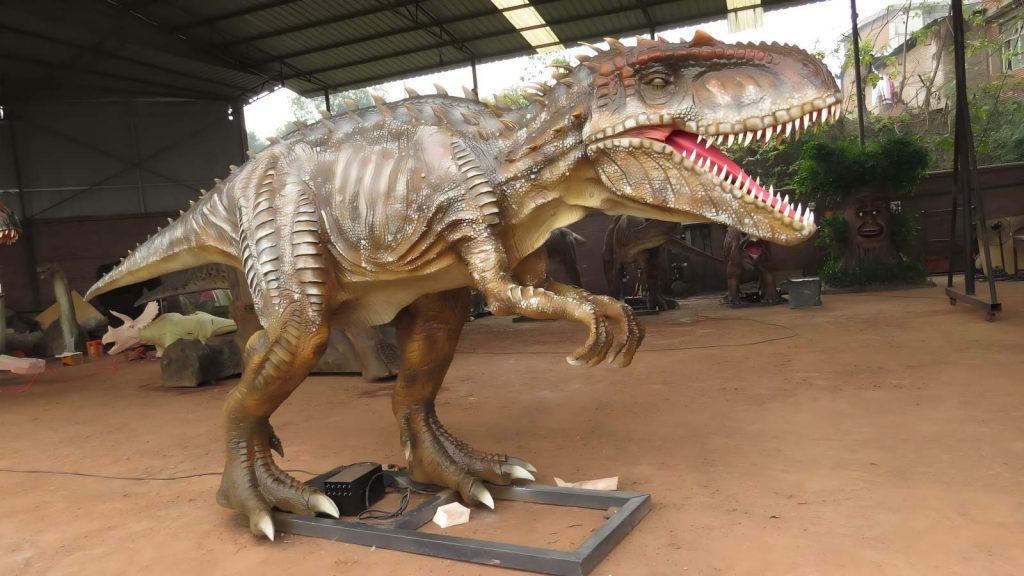
1. Size (Length & Height)
Size is the single biggest cost driver. A 3-meter baby dinosaur and a 25-meter Argentinosaurus require vastly different amounts of steel, silicone, and engineering.
| Size Category | Typical Dimensions | Complexity |
|---|---|---|
| Small | 3–5 meters | Basic frame + static pose |
| Medium | 8–12 meters | Full animatronic movement |
| Large | 15–20 meters | Advanced mechanics + sound |
| Giant | 25+ meters | Custom engineering required |
2. Movement & Animation Level
Not all animatronic dinosaurs move the same way. The more lifelike the animation, the higher the engineering cost.
- Static Model: No movement. Used for background scenery or photo opportunities.
- Basic Animation: Head turning, tail swaying, jaw opening. Ideal for mid-budget projects.
- Full Animatronic: Multiple synchronized movements (head, neck, tail, claws, eyes) + breathing motion. Best for flagship exhibits.
- Interactive: Motion-sensor triggered responses, touch-activated roars, or app-controlled actions.
3. Materials & Skin Quality
Premium animatronic dinosaurs use a steel skeleton with high-density foam and custom-molded silicone skin. The quality of the skin texture, color painting, and durability directly impacts cost.
At FestiveLanterns, we use patented silicone skin technology that resists UV damage and extreme temperatures, making it ideal for both indoor museums and outdoor theme parks.
4. Sound System
A basic roaring sound module costs less than a multi-channel system with:
- Species-specific vocalizations
- Environmental background audio
- Volume control based on visitor proximity
5. Customization & Scene Design
Off-the-shelf models cost less than fully custom designs. Customization includes:
- Unique color patterns or feather details
- Branding or signage integration
- Matching scenery (rocks, plants, fog effects)
- Educational display panels
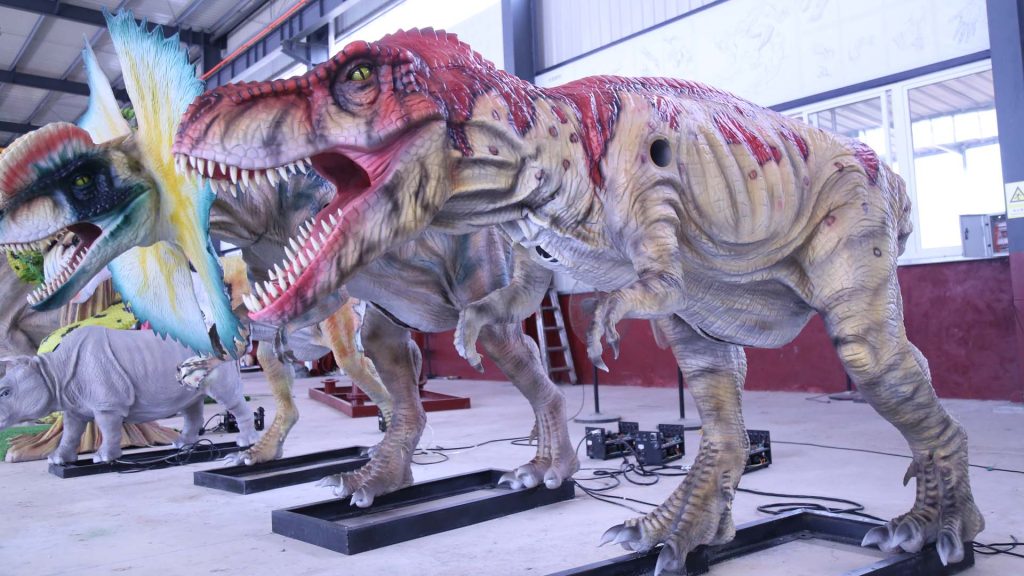
Price Ranges by Size & Feature Level
Note: All prices below are reference ranges for budgeting purposes. As a custom manufacturer, we provide final quotes based on your specific requirements.
Small Animatronic Dinosaurs (3–5 Meters)
Price Range: $5,000 – $15,000
What You Get:
- Steel frame with basic foam sculpting
- Static or limited movement (head turn, jaw open)
- Basic sound module
- Suitable for: retail stores, small museums, private collections
Popular Models: Velociraptor, baby T-Rex, small Triceratops
Medium Animatronic Dinosaurs (8–12 Meters)
Price Range: $20,000 – $50,000
What You Get:
- Full animatronic movement system (head, neck, tail, claws)
- High-quality silicone skin with detailed texture
- Multi-sound audio system
- Suitable for: theme parks, science centers, shopping malls
Popular Models: Adult Triceratops, Spinosaurus, Stegosaurus
Large Animatronic Dinosaurs (15–20 Meters)
Price Range: $60,000 – $120,000
What You Get:
- Advanced pneumatic or electric movement systems
- Realistic skin with hand-painted details
- Interactive sensors or remote control
- On-site installation support
- Suitable for: major museums, large theme parks, city exhibitions
Popular Models: Adult T-Rex, Brachiosaurus, Allosaurus
Giant Animatronic Dinosaurs (25+ Meters)
Price Range: $150,000+
What You Get:
- Custom-engineered structural design
- Full animation suite with programmable sequences
- Premium silicone skin with weatherproofing
- Dedicated project management and installation team
- Suitable for: landmark attractions, international expos, mega-resorts
Example: A life size Argentinosaurus at 30+ meters requires custom steel engineering and months of production.
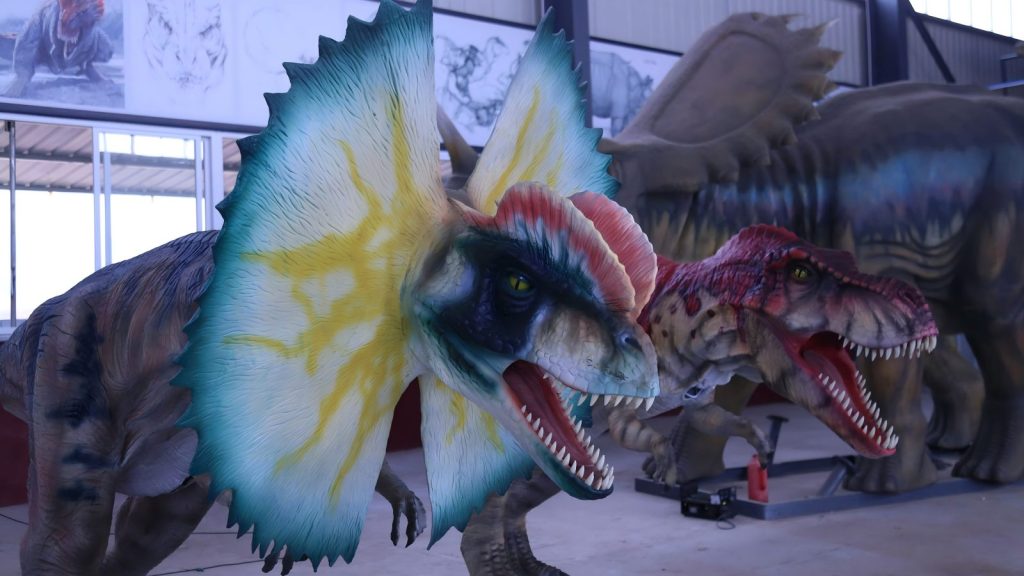
Real Case Study: Museum-Grade T-Rex Exhibit
One of our clients, a natural history museum in Europe, commissioned a 12-meter adult Tyrannosaurus Rex for their new Jurassic wing.
Specifications:
- Length: 12 meters
- Height: 4.5 meters
- Movement: Head, neck, tail, arms, jaw (6 independent motors)
- Skin: UV-resistant silicone with hand-scaled texture
- Sound: 8-channel audio with motion-triggered roar
- Installation: On-site assembly over 5 days
Timeline: 8 weeks production + 1 week shipping + 5 days installation
This project fell into our medium-to-large category, delivering a centerpiece attraction that draws over 200,000 additional visitors annually.
Hidden Costs to Consider
When budgeting for an animatronic dinosaur, remember these additional expenses:
| Cost Item | Typical Range | Notes |
|---|---|---|
| Shipping (sea freight) | $2,000 – $8,000 | Depends on size and destination |
| Import duties & taxes | 5% – 15% | Varies by country |
| On-site installation | $1,500 – $5,000 | Includes technician travel |
| Maintenance (annual) | $500 – $2,000 | Motor lubrication, skin inspection |
| Scene/scenery | $1,000 – $10,000 | Rocks, plants, lighting, signage |
Frequently Asked Questions
How long does it take to build a life size animatronic dinosaur?
Production typically takes 6 to 12 weeks, depending on size and complexity. Custom designs or giant models may require up to 16 weeks.
What is the lifespan of an animatronic dinosaur?
With proper maintenance, a quality animatronic dinosaur lasts 8 to 15 years. Our silicone skin technology includes a 2-year warranty.
Do you ship animatronic dinosaurs worldwide?
Yes. We have shipped life size animatronic dinosaurs to over 50 countries including the USA, UK, Germany, UAE, Australia, and Japan.
Can the dinosaur be used outdoors?
Absolutely. We offer weatherproofing options including rain covers, UV-resistant coatings, and temperature-resistant motors for outdoor installations.
Is the sound volume adjustable?
Yes. All our animatronic dinosaurs include volume control. For venues with noise restrictions, we also offer silent-mode operation with visual-only animation.
Get a Custom Quote for Your Project
Every project is different. The best way to get an accurate price for your life size animatronic dinosaur is to tell us:
- What species or design you need
- The target size (length / height)
- Indoor or outdoor installation
- Required movement features
- Your target delivery date
At FestiveLanterns, we manufacture every animatronic dinosaur in our Zigong, China facility using traditional craftsmanship combined with modern robotics. From a 3-meter Velociraptor to a 30-meter Argentinosaurus, we deliver museum-quality exhibits at factory-direct pricing.
Response within 24 hours. No obligation.
Related Articles
- Life Size T-Rex vs Real T-Rex: Size Comparison
- Top 10 Animatronic Dinosaurs for Theme Parks
- Animatronic Velociraptor: The Fastest Growing Trend in Dinosaur Exhibits
Published: June 2025 | Last Updated: June 2025
FestiveLanterns — Custom Festival Lanterns & Animatronic Dinosaurs | Zigong, China
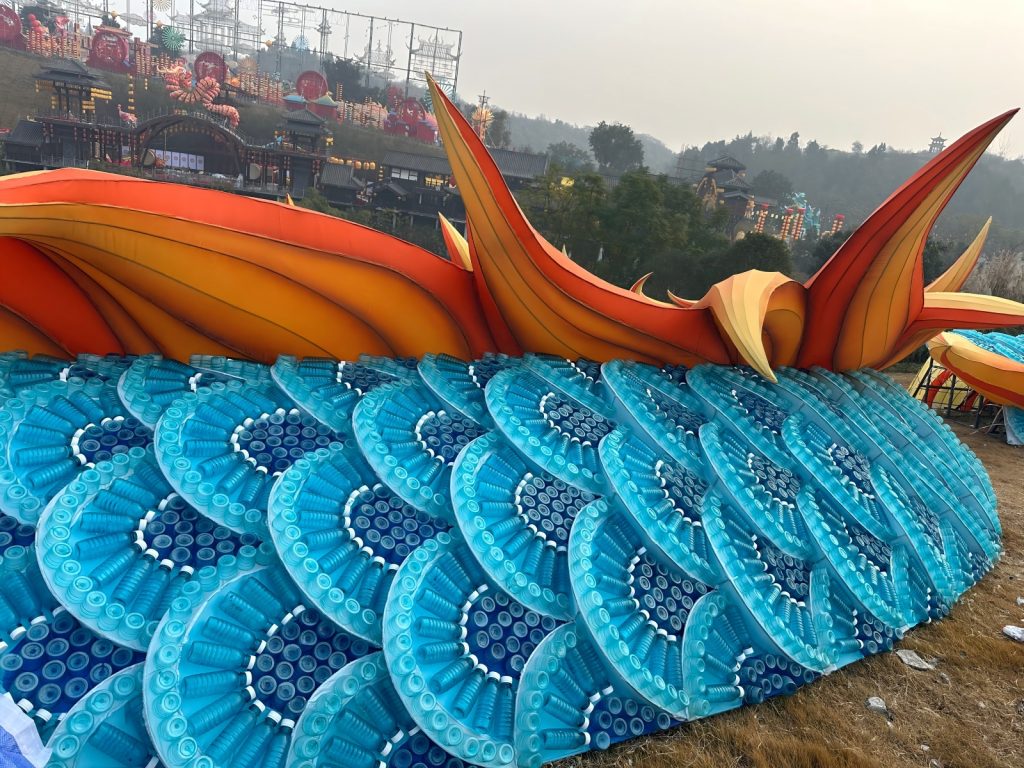
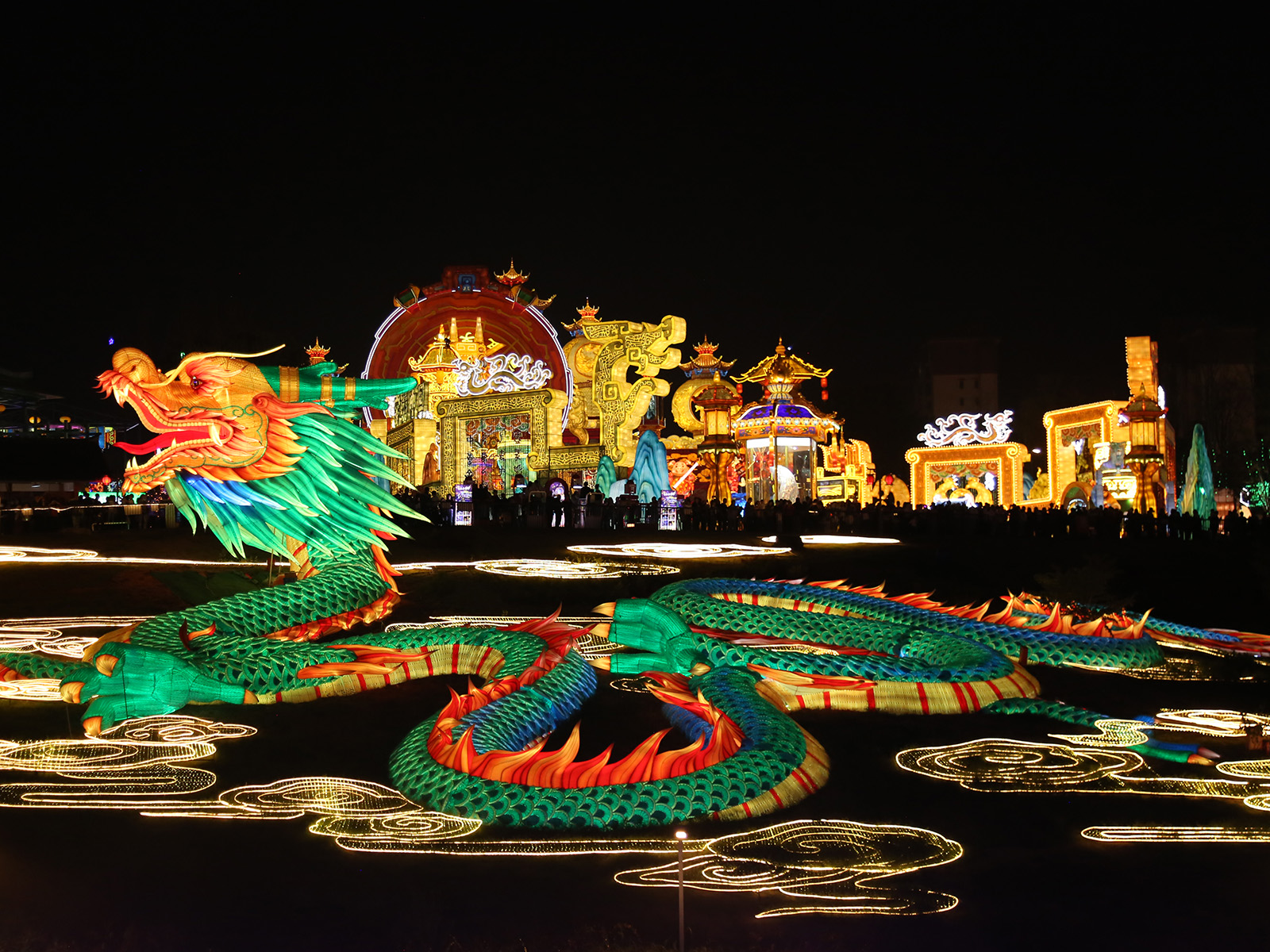
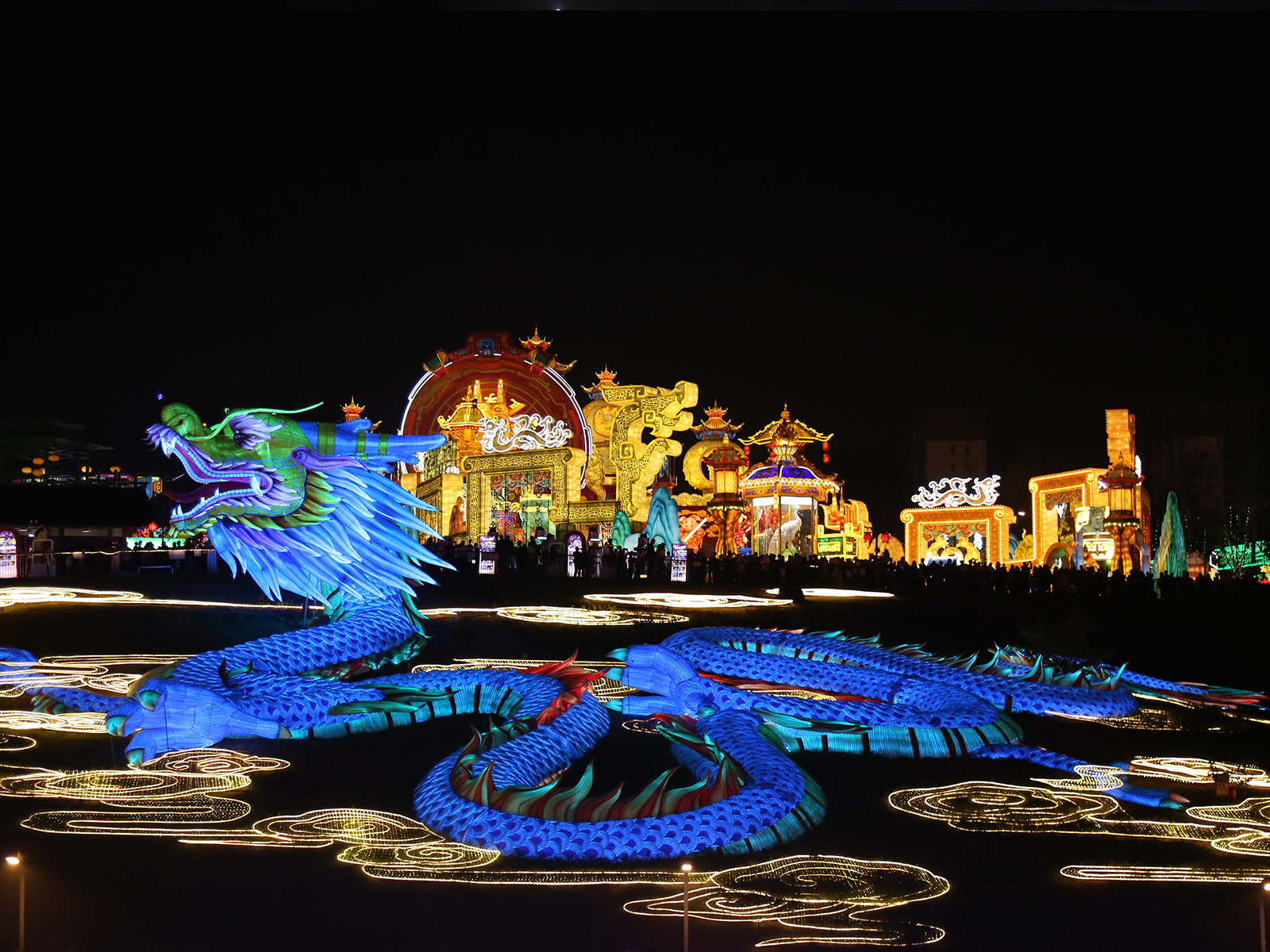
Zigong, China — February 2024 — At the 30th Zigong International Dinosaur Lantern Festival, a spectacular 202.4-meter dragon lantern group titled “Intangible Cultural Heritage Chinese Dragon” (非遗中国龙) captivated global audiences and set a new standard for eco-friendly large-scale lantern installations. Created by master artisans from Zigong — the world-renowned birthplace of Chinese lantern art — this monumental piece represents a groundbreaking fusion of traditional intangible cultural heritage techniques, innovative material science, and modern lighting technology.
A Dragon of Unprecedented Scale
The “Intangible Cultural Heritage Chinese Dragon” is not merely a lantern — it is an engineering marvel and a testament to sustainable artistic innovation:
| Specification | Detail |
|---|---|
| Total Length | 202.4 meters |
| Dragon Head Height | 9 meters |
| Dragon Head Diameter | 4 meters |
| Fire Orb Diameter | 4 meters |
| Flame Height | 8 meters |
| Total Weight | Nearly 10 tons |
| Segments | 17 sections (16 body segments + 1 head) |
| Primary Material | 200,000 recycled plastic bottles |
| Dragon Scales | 3,000+ individually crafted panels |
| Steel Components | 500+ pieces |
| LED Strip Length | 3,800 meters |
| Light Lifespan | 50,000 hours |
| Working Temperature Range | -40°C to 70°C |
Revolutionary Eco-Material Innovation
The most striking feature of this installation is its primary construction material: 200,000 recycled plastic bottles. This bold choice transforms waste into wonder, embodying the festival’s commitment to green, low-carbon, and environmentally conscious exhibition practices.
The Technical Breakthrough: No Water Required
Traditionally, plastic bottles used in lantern construction required filling with water to achieve proper light diffusion and structural stability. The “Intangible Cultural Heritage Chinese Dragon” breaks from this convention through a major technical innovation:
The bottles remain empty — no water is added inside.
Instead, the creative team developed a high-transparency, high-adhesion bottle coloring agent specifically formulated for lantern applications. After hundreds of experiments and optimizations, they perfected a rapid-dip dyeing process that achieves a stunning glass-like aesthetic while maintaining exceptional light transmission properties.
This breakthrough offers multiple advantages:
- Reduced weight — Empty bottles significantly decrease the overall structural load
- Enhanced durability — Eliminates water-related issues such as leakage, freezing, or algae growth
- Superior light effects — The specialized coloring agent creates brilliant, saturated colors with excellent light diffusion
- Streamlined production — Faster processing without the need for water filling and sealing
Material Processing at Scale
The production of the dragon’s “scales” required extraordinary effort:
- 15 skilled workers spent 20 consecutive days hand-dyeing all 200,000 bottles
- Each bottle was individually treated to ensure consistent color quality and light transmission
- The bottles were then hand-tied and bonded using traditional Zigong lantern-making techniques
Design Heritage: Inspired by Imperial Majesty
The dragon’s design draws inspiration from the Nine-Dragon Wall (九龙壁) at the Forbidden City in Beijing — one of China’s most iconic dragon representations. The design team, led by chief planner Zhong Yi (钟逸), conducted extensive research into traditional Chinese dragon culture before selecting the coiled dragon motif from this imperial masterpiece.
To faithfully represent the dragon’s majestic presence while accommodating the unique properties of plastic bottle materials, the artisans combined multiple traditional techniques:
- Special binding techniques — Traditional Zigong lantern knotting and lashing methods
- Inlay techniques — Precision placement of colored bottle segments
- Adhesion techniques — Specialized bonding for durable outdoor installation
- Silk-wrapping and dimensional pasting — Used specifically for the dragon head to achieve complex three-dimensional curves and rich layering
The Dragon Head Challenge
The dragon head posed a particular challenge due to its complex three-dimensional geometric surfaces and rich layering. The solution combined plastic bottle construction with silk-wrapping and dimensional pasting techniques, resulting in a more vivid and lifelike appearance.
Illumination Engineering: Day and Night Visual Impact
The lighting system represents another major technical achievement. The installation employs waterproof, full-color, multi-variable LED fantasy light strips with exceptional performance characteristics:
- High illumination intensity with excellent light penetration
- Rich, uniform, highly saturated colors
- Smooth color-changing effects across the entire dragon body
Synchronized Control Challenge
Achieving simultaneous color changes across 17 segments — including a 9-meter-high dragon head — presented a significant control engineering challenge. The solution:
- 15 independent control systems strategically positioned throughout the installation
- 5 days and nights of continuous testing by technical specialists to calibrate synchronization
- Result: A dragon that appears to breathe, flow, and pulse with life through perfectly coordinated chromatic transitions
Construction: 45 Days, 80+ Artisans
| Phase | Details |
|---|---|
| Total Construction Period | 45 days |
| Total Workforce | 80+ workers and technicians |
| Bottle Dyeing | 15 workers × 20 days |
| Structural Engineering | 500+ steel components |
| Light System Testing | 5 days continuous |
| On-site Assembly | 17 prefabricated sections |
The structural engineering team addressed the challenges of giant-scale pattern-making and safe load-bearing through overall structural optimization design. The dragon was fabricated in 17 separate segments off-site, then transported and assembled on location at the No. 2 Square lawn area.
A New Chapter in Sustainable Lantern Art
The “Intangible Cultural Heritage Chinese Dragon” exemplifies Zigong’s evolving approach to lantern festival production:
- Waste-to-Art Transformation — 200,000 discarded bottles given new life as cultural artwork
- Energy Efficiency — LED technology reduces power consumption by 38% compared to previous festivals
- Material Innovation — New coloring agents and processing techniques expand creative possibilities
- Heritage Preservation — Traditional intangible cultural heritage techniques applied to contemporary materials
Global Recognition
Since its debut, the “Intangible Cultural Heritage Chinese Dragon” has achieved remarkable media coverage:
- National Media: People’s Daily, CCTV News, China News Service, International Online
- Regional Media: Sichuan Daily, Sichuan Online, Cover News
- Social Platforms: Extensive sharing across WeChat, Douyin (TikTok), Kuaishou, Bilibili
The installation has become one of the most photographed and shared attractions in the history of the Zigong Lantern Festival.
About Zigong Lantern Festival
With a history spanning over 60 years, the Zigong International Dinosaur Lantern Festival stands as one of the world’s premier lantern art events. Each year, millions of visitors experience the magic of Zigong’s master artisans, who continue to push the boundaries of scale, technology, and artistic expression in illuminated installations.
For more information about custom lantern installations and international exhibition opportunities, contact Huilongtang Culture & Art Co., Ltd.
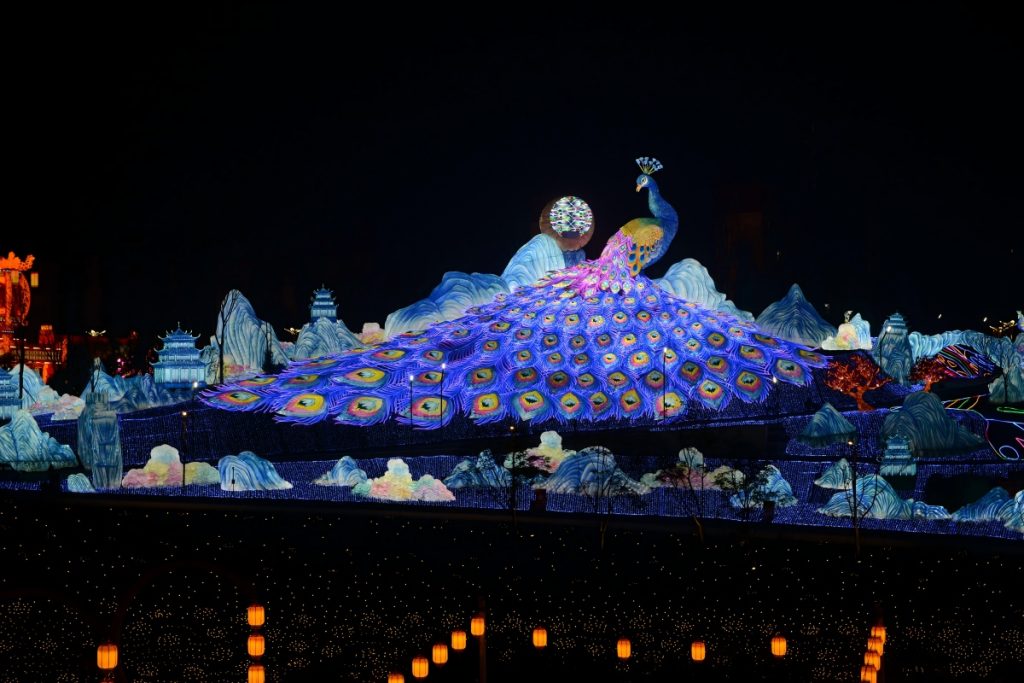
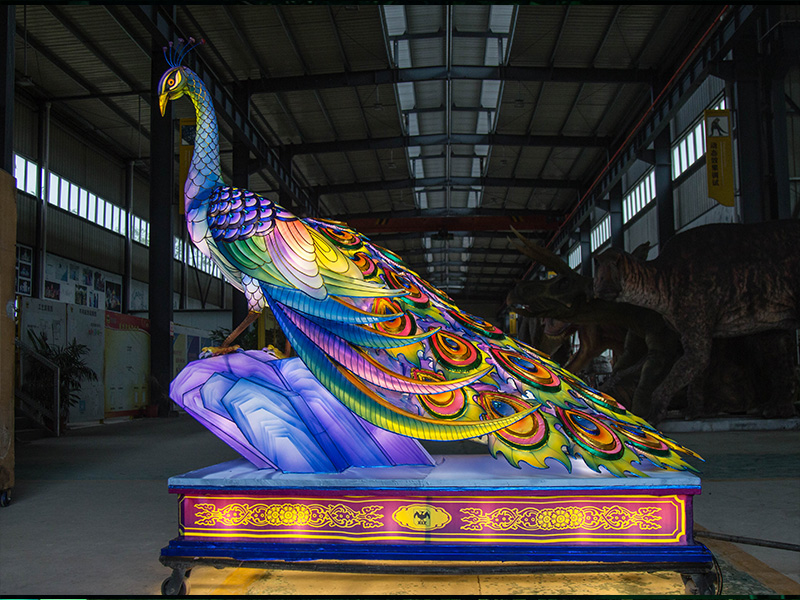
The peacock has long been a symbol of beauty, pride, and good fortune across cultures. When this majestic bird is transformed into a large-scale LED peacock lantern sculpture, it becomes an unforgettable centerpiece that captivates visitors at festivals, theme parks, shopping malls, and cultural celebrations around the world.
Why Choose a Peacock Lantern for Your Event?
The peacock lantern stands out among festival decorations for several compelling reasons:
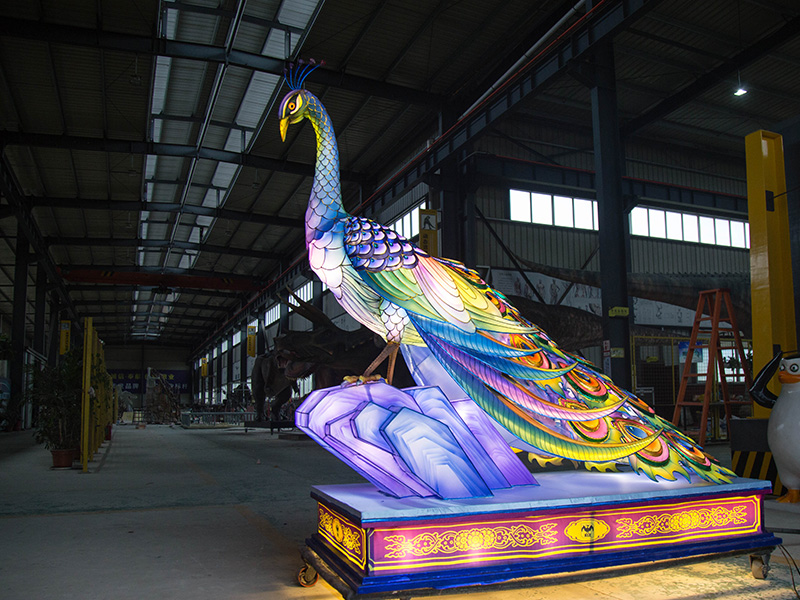
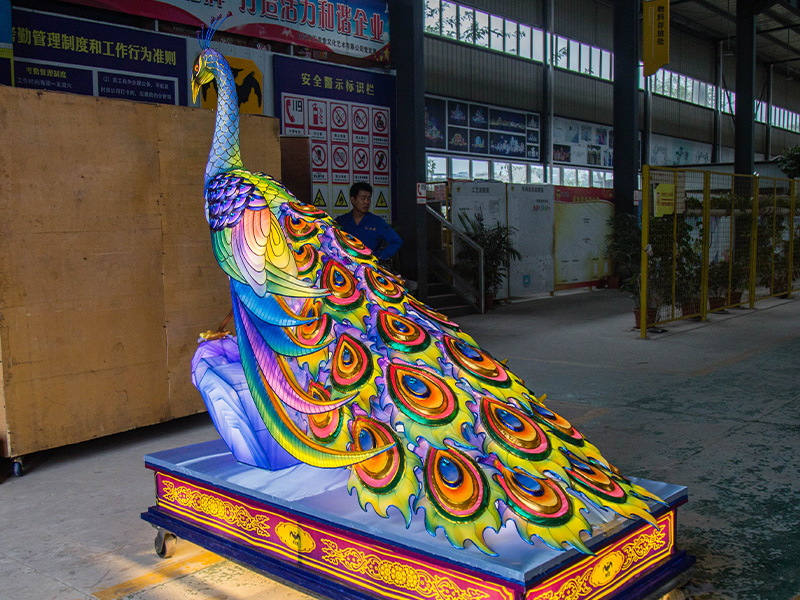
- Visual Impact: The extended tail feathers, adorned with hundreds of individually crafted “eyes,” create a stunning display that draws crowds from a distance.
- Cultural Significance: In many Asian traditions, the peacock represents dignity, beauty, and auspiciousness—making it a meaningful addition to cultural festivals and celebrations.
- Versatility: Whether placed in a lantern festival, a botanical garden night tour, a shopping center atrium, or a theme park entrance, the peacock lantern adapts beautifully to any setting.
- Photogenic Appeal: In the age of social media, a brilliantly lit peacock sculpture becomes an instant photo magnet, generating organic online exposure for your event.
Handcrafted Details That Set Our Peacock Lanterns Apart
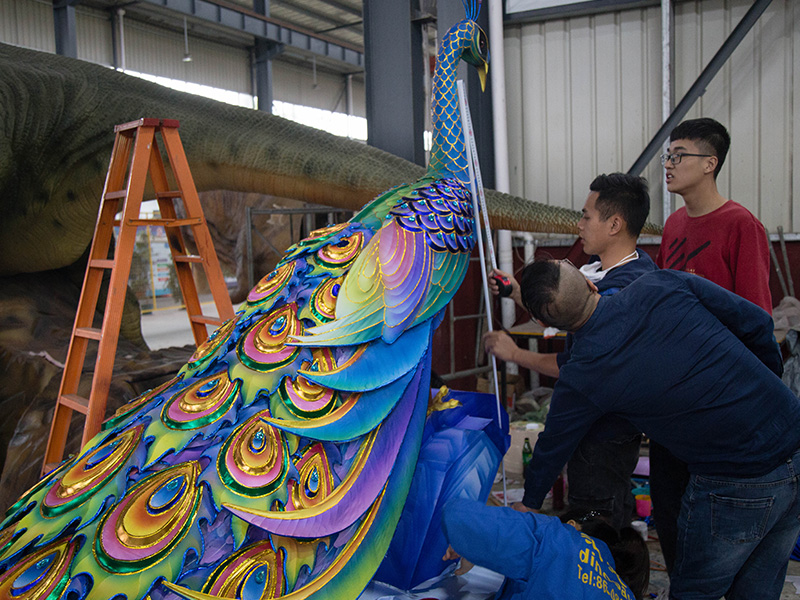
Every peacock lantern we produce is the result of meticulous craftsmanship rooted in the centuries-old Zigong lantern-making tradition. Our artisans pay extraordinary attention to the details that make each sculpture unique:
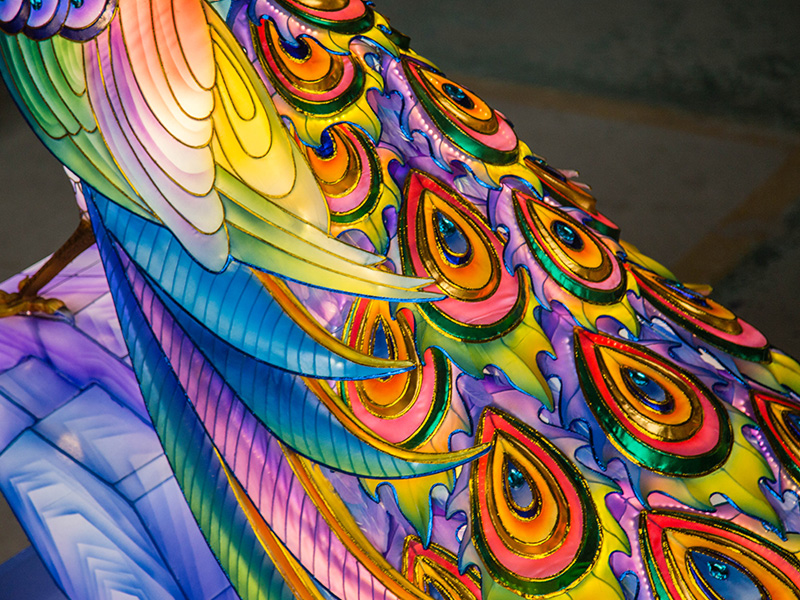
Vibrant Tail Feather Design
The tail is the crown jewel of any peacock lantern. Our artisans individually shape and paint each feather layer, creating a gradient of colors—from deep sapphire and emerald to brilliant gold and magenta. The iconic “eye” patterns on each feather are carefully outlined with metallic accents that shimmer under LED illumination.
Dynamic LED Lighting System
We integrate energy-efficient LED lighting throughout the sculpture, with programmable controllers that allow for multiple lighting effects:
- Steady warm glow for elegant evening ambiance
- Color-changing sequences for dynamic festivals
- Pulsing effects synchronized with music or event timelines
Durable Construction for Outdoor Display
Built on a reinforced steel frame and wrapped in weather-resistant fabric and silk, our peacock lanterns withstand outdoor conditions including light rain, wind, and temperature variations. The internal LED drivers are housed in sealed compartments, ensuring reliable operation throughout extended exhibition periods.
Customization Options
We understand that every event and venue has unique requirements. Our peacock lanterns can be customized in the following ways:
- Size scaling: From 2-meter tabletop displays to 6-meter monumental sculptures
- Color schemes: Traditional vibrant hues, elegant monochromes, or brand-specific color palettes
- Base and pose: Standing with feathers fanned, perched on a decorative rock, or in a walking pose
- Interactive elements: Motion sensors that trigger light changes when visitors approach
Ideal Venues and Applications
Our LED peacock lanterns have illuminated events across the globe, including:
- Lantern Festivals: As a signature piece in Chinese New Year and Mid-Autumn Festival celebrations
- Theme Parks: Enhancing nighttime atmospheres in animal-themed zones or cultural pavilions
- Botanical Gardens: Creating magical night garden experiences during summer exhibitions
- Shopping Centers: Driving foot traffic during holiday seasons with Instagram-worthy installations
- Cultural Exchanges: Representing Chinese intangible cultural heritage at international exhibitions
Bringing Your Vision to Life
From initial concept sketches to final installation, our team works closely with event organizers, park operators, and cultural institutions to deliver peacock lantern sculptures that exceed expectations. We provide:
- 3D design renderings for approval before production
- Detailed production timelines with milestone updates
- Installation guidance and on-site technical support
- Maintenance recommendations for long-term displays
If you are planning a festival, park renovation, or special event and want a show-stopping centerpiece that combines traditional artistry with modern LED technology, a custom peacock lantern sculpture is an investment that delivers lasting impressions.
Contact our team today to discuss your project requirements and receive a tailored proposal for your peacock lantern installation.
Introduction: Where Legend Meets Light
Chinese mythology is rich with deities, immortals, and legendary figures who have captured the imagination for millennia. At HuiLongTang Culture & Arts, we bring these divine beings to life through the ancient art of silk lantern craftsmanship — creating illuminated sculptures that honor tradition while captivating modern audiences.
Mythological figure lanterns represent some of our most technically challenging and culturally significant work. Each piece requires not only masterful craftsmanship but also deep understanding of Chinese iconography, symbolism, and storytelling traditions.
The Pantheon in Silk: Featured Deities
The Warrior Goddess: Strength in Silk
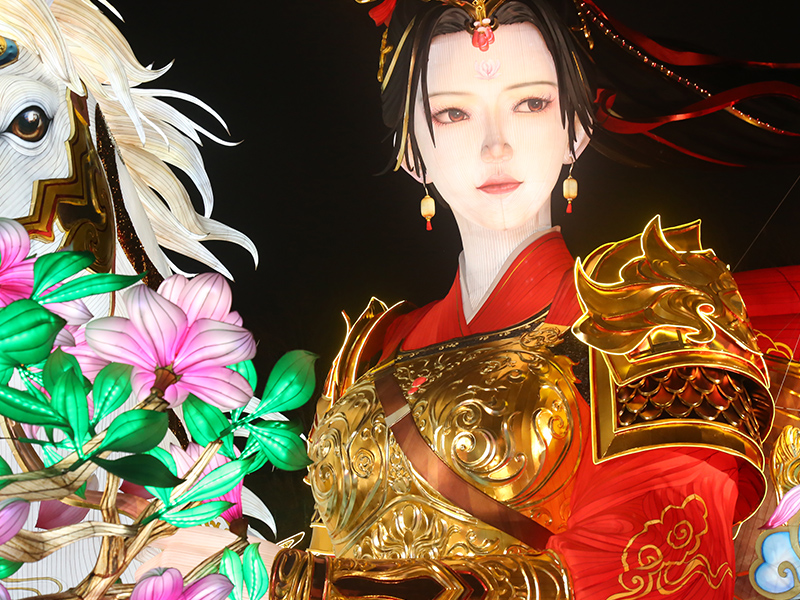
Our warrior goddess lanterns draw inspiration from legendary Chinese heroines like Mulan. Clad in ornate golden armor with crimson robes, these imposing figures embody courage and dignity. The intricate detailing of scale armor, flowing sashes, and ceremonial headdresses demonstrates the pinnacle of our artisans’ skill.
Strategic lighting from within creates a divine glow, emphasizing the figure’s noble bearing. When displayed at festivals, these warrior lanterns become powerful symbols of strength that resonate with visitors of all ages.
[Warrior goddess in golden armor with red robes and elaborate headdress]
The Calligraphy Immortal: Brushstrokes of Blessing
One of our most beloved designs depicts a scholarly immortal figure wielding an enormous brush, painting blessings across the night sky. The flowing scroll beside him overflows with illuminated “福” (fortune) characters — each one individually crafted to glow with warm light.
This figure connects deeply with Chinese cultural values of education, literary achievement, and the transmission of wisdom across generations. The contrast between the scholar’s flowing white robes and the golden scroll creates a visually stunning centerpiece for any exhibition.
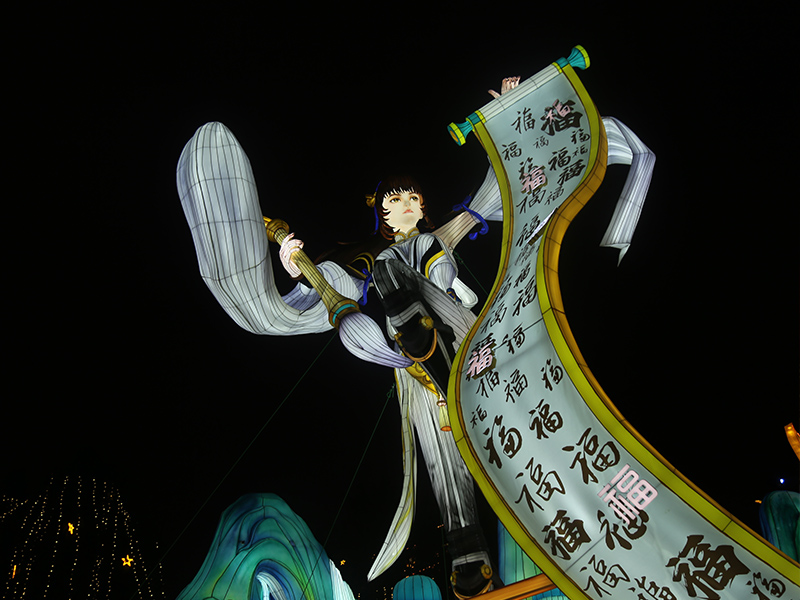
[Scholar immortal with giant brush and fortune scroll covered in glowing characters]
Celestial Musicians: Harmony in Light
Our immortal musician lanterns capture the ethereal beauty of celestial beings who have achieved transcendence through art. One particularly stunning piece depicts a white-haired immortal in flowing turquoise robes, playing a massive guqin (traditional Chinese zither).
The instrument itself becomes part of the lighting design — strings glow as if vibrating with celestial music, while the figure’s serene expression embodies the concept of “immortal transcendence through artistic mastery.” Mountains and lotus flowers in the background complete this meditation on the connection between nature, art, and enlightenment.
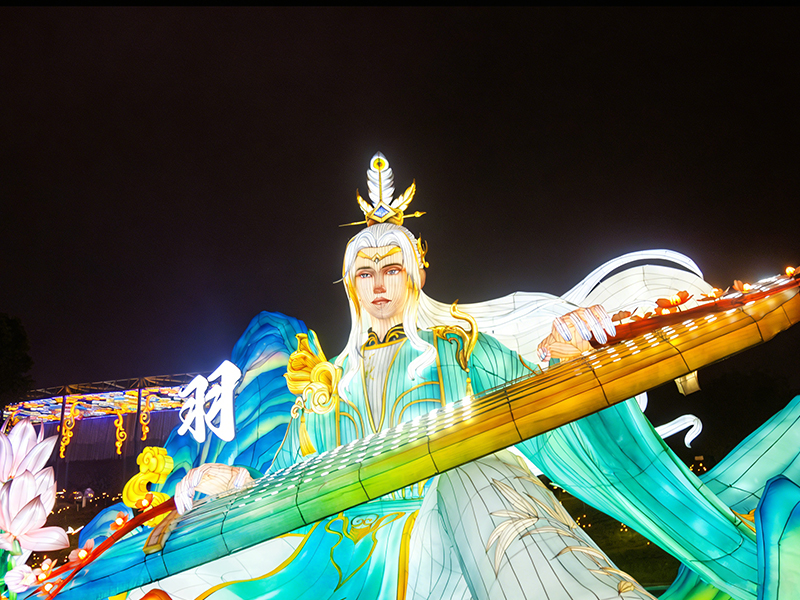
[Immortal musician with white hair playing glowing guqin among mountains and lotus flowers]
The Crane Rider: Modern Mythology
Contemporary Chinese mythology increasingly blends traditional elements with modern aesthetics. Our “Crane Boy” (仙鹤童子) figure exemplifies this fusion — a youthful immortal riding a golden-winged crane through clouds, dressed in clothing that combines classical flowing robes with modern tech-inspired details.
The figure’s blue hair and headphones represent how ancient mythological concepts adapt to contemporary imagination. This design particularly appeals to younger audiences while maintaining connections to the traditional “boy riding crane” motif that symbolizes longevity and transcendence.
[Modern-style crane rider with blue hair and headphones on golden-winged crane among clouds]
Mythological Processions: Epic Scenes
The most spectacular mythological displays feature multiple figures in dynamic compositions. One such scene depicts several immortals riding giant carp and mystical whales across waves, each figure distinct in personality and attire.
These procession installations tell stories through composition — the positioning of figures suggests movement, hierarchy, and relationships between mythological beings. Vibrant colors, from purple hair to golden fish scales, create a feast for the eyes that honors the visual richness of Chinese mythological art.
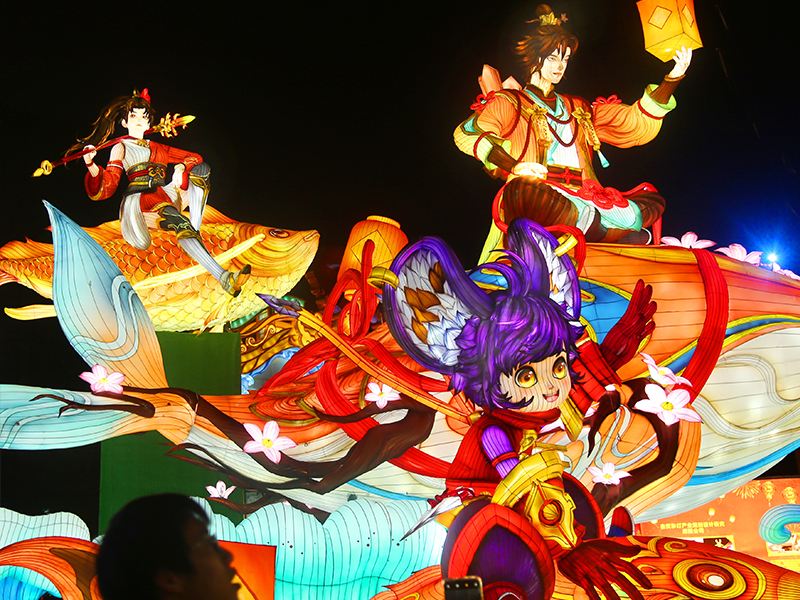
[Multiple mythological figures riding carp and whales in colorful procession scene]
Symbolism and Meaning in Mythological Lanterns
Chinese mythological figures carry deep symbolic weight that informs their design:
Color Symbolism
- Gold and yellow represent imperial authority and divine power
- Red signifies good fortune, courage, and celebration
- White and silver indicate purity and transcendence
- Blue and turquoise connect to the heavens and immortality
- Purple represents spiritual wisdom and cosmic energy
Iconographic Elements
- Weapons and armor denote protection and martial virtue
- Musical instruments indicate artistic achievement and harmony
- Scrolls and brushes represent wisdom and literary culture
- Mounts (cranes, dragons, fish) signify different spiritual realms
- Cloud motifs indicate celestial or transcendent status
Facial Expressions
Unlike Western traditions where deities often appear stern, Chinese mythological figures typically display serene, benevolent expressions. Our lanterns capture this through carefully crafted facial features that convey both dignity and approachability.
Technical Mastery: Crafting Divine Figures
Creating mythological figure lanterns presents unique challenges:
Complex Costumes
Immortal figures wear layered, flowing robes with intricate patterns. Each fold must be individually crafted from silk, with internal wire structures maintaining the illusion of fabric in motion. A single figure may require dozens of individual silk pieces.
Expressive Faces
The face is the soul of any figure lantern. Our artisans study classical Chinese painting techniques to create expressions that convey the proper balance of divine authority and compassionate wisdom. Eyes are particularly crucial — they must appear lifelike even from a distance.
Scale and Proportion
Mythological figures are often displayed at heroic scale (3-5 meters tall). This requires careful engineering to maintain proportions while ensuring structural stability. Internal steel frameworks must support significant weight while remaining invisible.
Dynamic Posing
Unlike static religious statues, festival lanterns capture movement and energy. A figure playing an instrument, riding a mount, or casting a spell creates visual drama that draws visitors into the mythological narrative.
Cultural Education Through Art
Mythological figure lanterns serve important educational functions:
Introducing Legends
Many younger visitors first encounter Chinese mythology through these illuminated figures. Interpretive signage explains each figure’s story, cultural significance, and associated festivals or traditions.
Artistic Heritage
The craftsmanship itself represents living heritage. Visitors learn about silk-on-frame techniques, traditional color palettes, and the evolution of Chinese lantern-making from the Song Dynasty to present day.
Cross-Cultural Bridge
For international audiences, mythological lanterns offer accessible entry points into Chinese culture. The visual spectacle transcends language barriers while accompanying materials provide cultural context.
Applications and Settings
Mythological figure lanterns enhance various venues:
Chinese New Year Festivals
Deity figures are essential elements of Spring Festival celebrations, representing hopes for blessings, prosperity, and protection in the coming year.
Cultural Center Exhibitions
Museums and cultural institutions use mythological lanterns to illustrate Chinese religious traditions, artistic heritage, and storytelling culture.
Theme Park Attractions
Amusement venues create immersive mythological realms where visitors walk among giant illuminated deities, creating unforgettable experiences.
Temple and Garden Illuminations
Traditional sites use subtle mythological lanterns to enhance evening ambiance while respecting spiritual atmosphere.
The Future of Mythological Lantern Art
As Chinese culture continues to influence global popular culture, mythological lanterns evolve:
Contemporary Interpretations
Younger artists are reimagining traditional figures with modern aesthetics — cyberpunk immortals, anime-inspired deities, and fusion designs that blend Eastern and Western mythological elements.
Interactive Elements
Motion sensors trigger responsive lighting, sound effects, or projection mapping that brings static figures to life through digital enhancement.
Narrative Installations
Instead of individual figures, contemporary exhibitions create mythological “worlds” where multiple figures interact within immersive environments, telling complete stories through spatial design.
Conclusion: Eternal Stories in Ephemeral Light
Chinese mythological figure lanterns represent the perfect fusion of storytelling, artistry, and spiritual tradition. From warrior goddesses to scholarly immortals, from celestial musicians to modern crane riders, these illuminated beings continue ancient narratives while inspiring new generations.
At HuiLongTang, we consider it both privilege and responsibility to carry forward this tradition — creating lanterns that honor the gods while bringing joy to all who encounter their light.
About the Author: HuiLongTang Culture & Arts Co., Ltd. specializes in traditional Chinese silk lanterns and animatronic exhibits, bringing 800 years of Zigong lantern heritage to global audiences. Contact us to bring mythological magic to your festival or exhibition.
Category: Lantern Guides | Tags: #MythologicalLanterns #ChineseDeities #ImmortalFigures #CulturalHeritage #SilkLanternArt
Introduction: Where Ancient Craft Meets Ancient Creatures
In the heart of Zigong, Sichuan — a city celebrated as both the “Lantern Capital of China” and the “Dinosaur Capital of the World” — something magical happens when two ancient traditions converge. At HuiLongTang Culture & Arts, we’ve perfected the art of bringing prehistoric giants to life through illuminated silk sculptures that captivate visitors of all ages.
Dinosaur lanterns represent one of our most popular exhibition categories, combining scientific accuracy with artistic imagination to create immersive prehistoric worlds that transport visitors back millions of years.
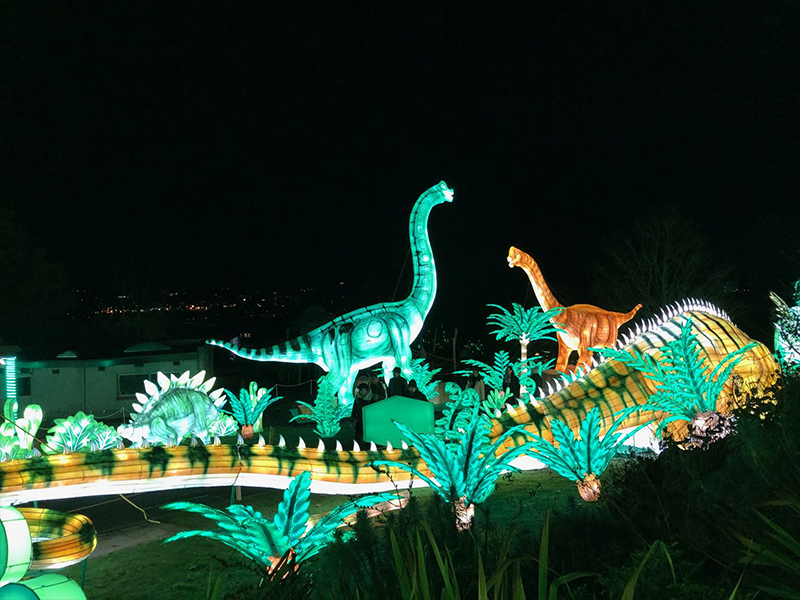
The Zigong Connection: A Perfect Match
Zigong’s unique dual heritage makes it the ideal birthplace for dinosaur lantern art. The region has yielded some of China’s most significant dinosaur fossil discoveries, including the famous Dashanpu Dinosaur Quarry. Simultaneously, Zigong’s 800-year lantern-making tradition represents the pinnacle of Chinese festival lighting craftsmanship.
This convergence means our artisans understand both the anatomical details that make dinosaurs scientifically compelling and the lighting techniques that make them visually spectacular.
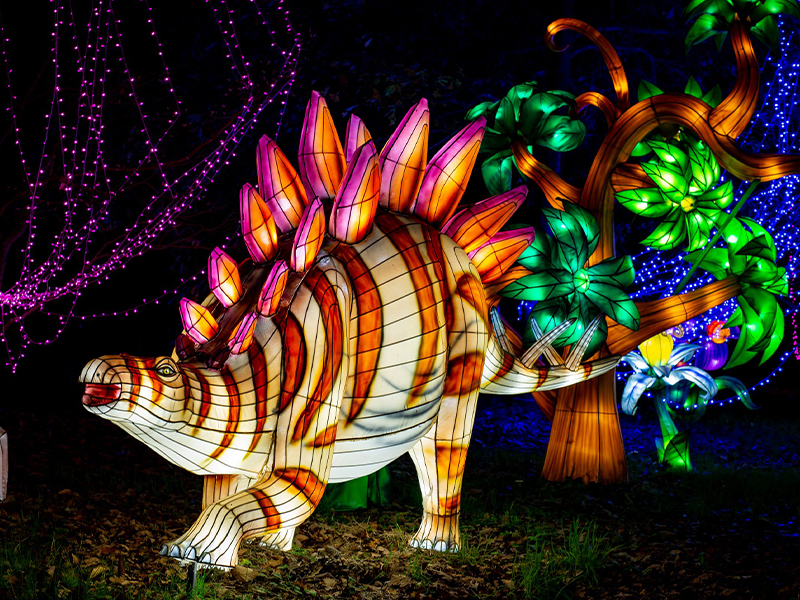
Featured Dinosaur Lantern Species
Stegosaurus: The Plated Wonder
Our Stegosaurus lanterns showcase the distinctive kite-shaped plates that make this Jurassic herbivore instantly recognizable. Using gradient coloring techniques, we illuminate each plate in warm oranges, pinks, and purples, creating a stunning silhouette against the night sky. The alternating pattern of the 17 plates demonstrates both scientific accuracy and artistic flair.
[Stegosaurus lantern with colorful illuminated plates in garden setting]
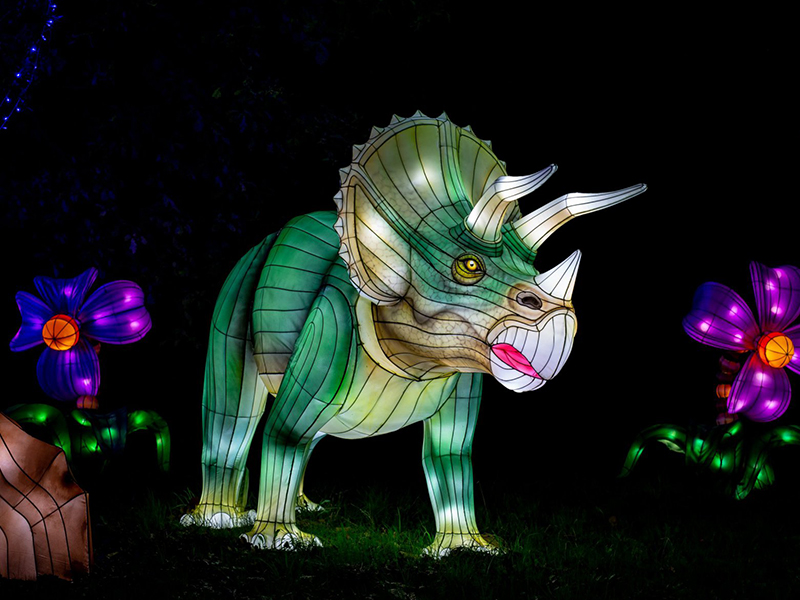
Triceratops: Family Groups in Light
Nothing captures visitors’ hearts quite like our Triceratops family installations. Featuring protective parents with their curious calves, these groupings demonstrate the social nature that paleontologists believe these horned dinosaurs exhibited. The detailed frill patterns and expressive eyes give each Triceratops personality, while strategic lighting emphasizes their impressive three-horned profiles.
[Triceratops family lantern group with parent and baby dinosaurs]
Brachiosaurus: Gentle Giants of the Canopy
Our towering Brachiosaurus lanterns reach heights of 8+ meters, their long necks craning upward as if browsing on prehistoric treetops. The countershading coloration — darker on top, lighter below — follows scientific theories about these massive sauropods. When illuminated in soft greens and warm ambers, they create an ethereal presence that dominates any exhibition space.
[Brachiosaurus long-neck dinosaur lanterns with palm trees]
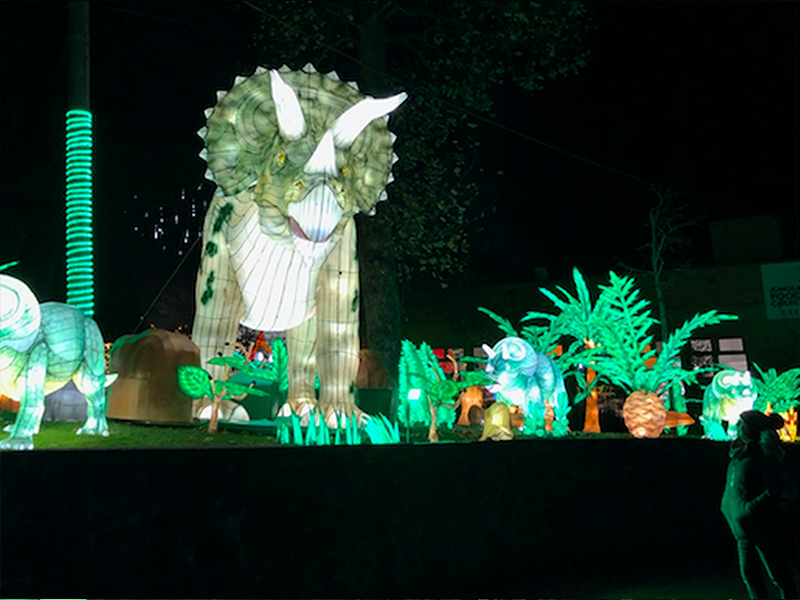
Tyrannosaurus Rex: King of the Lanterns
No prehistoric display is complete without the T-Rex. Our T-Rex lanterns capture the fearsome predator in dynamic poses — head lowered, powerful jaws agape, tiny arms poised for action. Strategic lighting from below creates dramatic shadows that emphasize the muscular structure and predatory nature of history’s most famous dinosaur.
![T-Rex and dinosaur group scene with multiple species]
The Technical Challenge: Engineering Prehistoric Accuracy
Creating scientifically accurate dinosaur lanterns requires extensive research and specialized techniques:
Anatomical Research
Our design team studies the latest paleontological findings to ensure proportions, posture, and features reflect current scientific understanding. We collaborate with paleontologists from the Chinese Academy of Sciences and local universities to verify accuracy.
Structural Engineering
Large dinosaurs like Brachiosaurus present unique engineering challenges. Our steel framework must support significant weight while maintaining the graceful curves that characterize these creatures. Internal LED placement ensures even illumination without visible wiring.
Color Theory
While we can’t know dinosaurs’ exact colors, we apply scientific principles — countershading for camouflage, display colors for species recognition, and environmental adaptation — to create plausible and visually striking color schemes.
Dynamic Posing
Unlike static museum displays, our lanterns capture movement and behavior: a Triceratops protective stance, a Velociraptor’s hunting posture, or a Stegosaurus turning to display its defensive plates.
Creating Immersive Prehistoric Environments
The most successful dinosaur lantern exhibitions don’t just display individual creatures — they recreate entire ecosystems:
Jurassic Forests
Towering tree ferns, cycads, and prehistoric conifers surround our dinosaur lanterns, creating the lush environment these creatures would have inhabited. Fiber-optic “fireflies” add magical atmosphere.
Cretaceous Plains
Open grassland scenes featuring herds of duck-billed dinosaurs grazing, with T-Rex figures positioned as distant threats on the horizon. The sense of scale and ecosystem interaction educates while entertaining.
Interactive Elements
Sound design brings the prehistoric world to life — rumbling sauropod calls, trumpeting hadrosaurs, and the terrifying roar of predators. Motion sensors trigger responsive lighting that makes the dinosaurs appear to notice visitors.
Global Success Stories
Our dinosaur lanterns have delighted audiences worldwide:
- Boston Franklin Park Zoo**: A summer exhibition featuring 60+ dinosaur and marine life installations, drawing 80,000+ visitors
- European Light Festivals**: Stegosaurus and Triceratops lanterns as centerpieces of winter light trails
- Asian Theme Parks**: Permanent dinosaur valley installations with 20+ species represented
Educational Impact
Beyond entertainment, dinosaur lanterns serve important educational functions:
Science Communication**
Each installation includes interpretive signage explaining the dinosaur’s era, diet, size, and unique characteristics. Visitors learn while experiencing the “wow factor” of giant illuminated creatures.
Paleontology Inspiration**
Young visitors, captivated by the spectacle, often develop lasting interest in paleontology and natural history. Many future scientists first fell in love with dinosaurs through experiences like these.
Cultural Exchange**
For international venues, dinosaur lanterns represent a unique cultural offering — Chinese artistic tradition applied to universally fascinating subject matter.
Planning Your Dinosaur Lantern Exhibition
Whether you’re a zoo, museum, theme park, or festival organizer considering a dinosaur lantern exhibition, we recommend:
Species Selection
Mix iconic favorites (T-Rex, Triceratops, Stegosaurus) with lesser-known species to provide educational variety. Consider your audience — younger children love gentle herbivores, while older visitors appreciate scientific accuracy.
Scale Variation
Include specimens of various sizes — towering sauropods create spectacle, while smaller raptors allow detailed observation. The contrast emphasizes the true diversity of prehistoric life.
Thematic Grouping
Organize by era (Triassic, Jurassic, Cretaceous) or ecosystem (forest, plains, coastal) to create educational coherence. This helps visitors understand that “the age of dinosaurs” spanned 160 million years of changing environments.
Interactive Components
Photo opportunities, fossil dig stations, and educational trails extend the experience beyond passive viewing. Consider augmented reality features that show dinosaurs “coming to life” through visitors’ phones.
The Future of Dinosaur Lantern Art
As LED technology advances and paleontological discoveries continue, dinosaur lantern art evolves. We’re currently developing:
- Animated Elements: Subtle movements — head turning, tail swaying, breathing effects — powered by quiet electric motors
- Responsive Lighting: Dinosaurs that react to visitor presence with sound and light changes
- AR Integration: Phone apps that overlay skin, feathers, and behaviors based on latest scientific theories
- Modular Systems: Reconfigurable installations that can represent different prehistoric eras or ecosystems
Conclusion: Timeless Appeal, Modern Magic
Dinosaur lanterns represent the perfect fusion of ancient Chinese artistry and timeless human fascination with prehistoric life. From Zigong’s workshops to exhibitions around the world, these illuminated giants continue to inspire wonder, educate visitors, and create unforgettable memories.
At HuiLongTang, we’re proud to carry forward both traditions — the 800-year lantern-making heritage and the scientific legacy of Zigong’s dinosaur discoveries — to create experiences that educate, entertain, and inspire audiences around the world.
About the Author: HuiLongTang Culture & Arts Co., Ltd. is a leading Chinese lantern and animatronic manufacturer based in Zigong, Sichuan. With 80+ professionals and a 60,000m² production base, we’ve delivered projects to 30+ countries. Contact us to discuss your dinosaur lantern exhibition needs.
Category: Lantern Guides | Tags: #DinosaurLanterns #PrehistoricArt #ZigongLanterns #DinosaurExhibition #ChineseLanternCraft
At Festive Lanterns, we don’t just build decorations — we create living, breathing works of art that transform any space into a world of wonder. Our **animal lanterns** are among the most requested designs by zoos, theme parks, museums, and festival organizers worldwide. From prehistoric giants to African savanna creatures and ocean dwellers, each piece is handcrafted with meticulous attention to detail.
In this article, we take you behind the scenes to show how our artisans in Zigong, China — the birthplace of Chinese lantern art — bring these magnificent creatures to life.
—
What Are Animal Lanterns?
Animal lanterns are large-scale illuminated sculptures shaped like animals, built using a combination of traditional wire-framing, silk/fabric covering, and modern LED lighting systems. Unlike static decorations, our animal lanterns feature dynamic lighting effects, animatronic movements (optional), and weather-resistant construction that allows them to shine in any environment — rain or shine.
Our portfolio spans three main categories:
–Prehistoric & Dinosaur Lanterns** — Stegosaurus, T-Rex, Triceratops, and more
– Land Animal Lanterns** — Rhinos, giraffes, zebras, elephants, big cats
– Marine Life Lanterns** — Sea turtles, sharks, dolphins, crocodiles
—
The Crafting Process: 5 Steps to a Perfect Animal Lantern
Step 1: Concept & Sketch Design
Every animal lantern begins with detailed concept art. Our design team studies reference photos, anatomy, and movement patterns to create sketches that capture both realism and artistic flair. For the **stegosaurus lantern** shown in our portfolio, the team referenced fossil records and modern paleoart to ensure the proportions — from the distinctive back plates to the spiked tail — were scientifically grounded yet visually stunning.
Step 2: Steel Frame Construction
Once the design is approved, our metalworkers bend and weld galvanized steel into the animal’s skeletal structure. This frame must be strong enough to withstand outdoor conditions (wind, rain, UV exposure) while remaining lightweight for transport and installation. A full-size adult rhino frame, for example, uses over 200 meters of steel tubing.
Step 3: Fabric Covering & Painting
The steel skeleton is wrapped in specially treated silk fabric or durable synthetic materials. Our painters then apply layers of hand-painted details — scales, skin textures, eye patterns, and color gradients. This is where artistry meets engineering: the covering must be translucent enough for LED light to glow through, yet opaque enough to show fine details in daylight.
Step 4: LED Lighting Integration
This is where the magic happens. We install energy-efficient LED strips throughout the frame, programmed to create different lighting effects:
– Static warm glow — for natural, lifelike appearance
– Color-changing sequences — for festival atmosphere
– Motion-sensor activation— for interactive exhibits
– Day/night auto-switching— for 24/7 installations
Our crocodile lantern features jaw lighting that creates an ominous glow from within, while the **sea turtle lantern** uses blue and purple LEDs to simulate an underwater bioluminescence effect.
Step 5: Quality Testing & Shipping
Every animal lantern undergoes rigorous testing before leaving our factory:
– 72-hour continuous lighting test
– Waterproof seal verification (IP65 rating)
– Structural load testing
– Final photographic documentation for client approval
—
Featured Creations
Stegosaurus Lantern: A Prehistoric Marvel
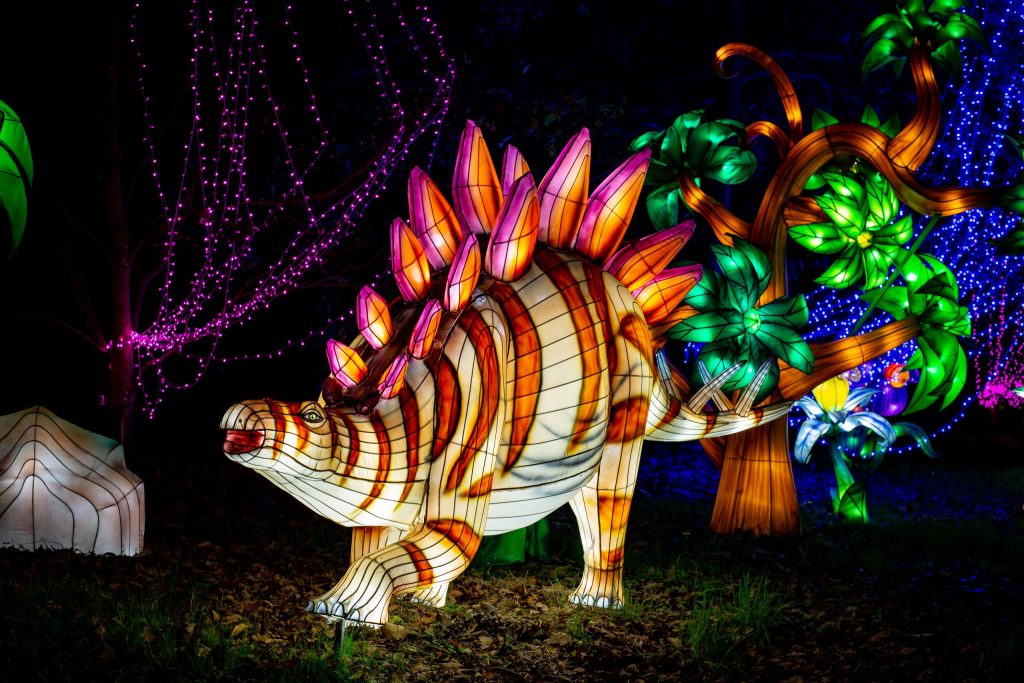
*Alt text: Life-size stegosaurus lantern with colorful back plates illuminated by LED lights at night*
Our stegosaurus lantern stands 4 meters long and 2.5 meters tall. The back plates feature a gradient of warm orange to cool purple, creating a striking silhouette against the night sky. This piece was originally created for a dinosaur-themed lantern festival in Europe and has become one of our most popular designs.
African Safari Collection: Rhino Family
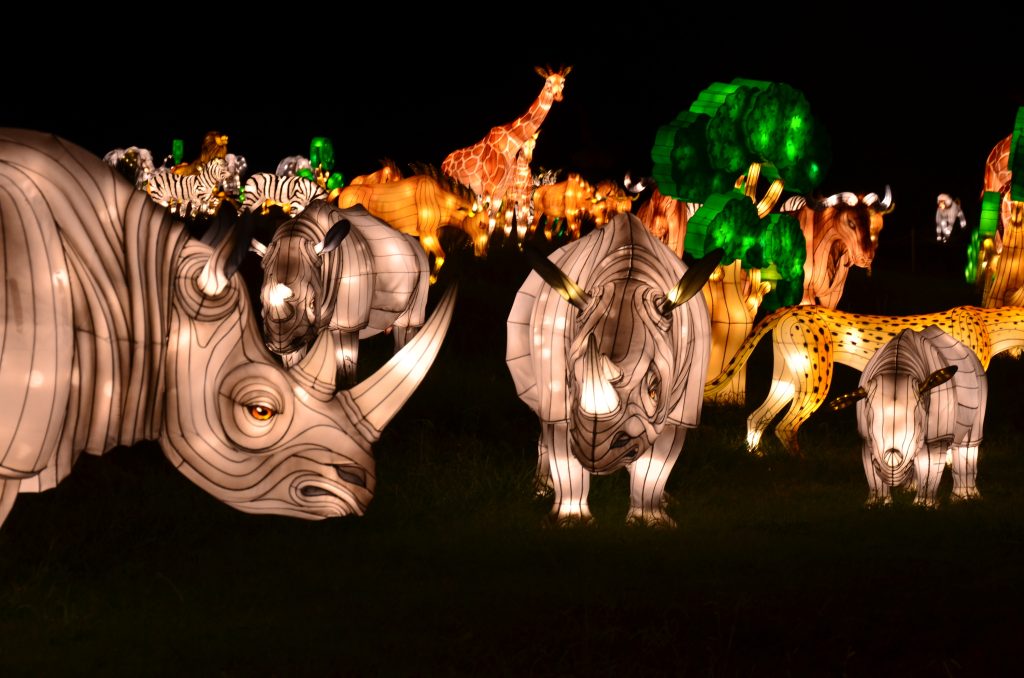
*Alt text: Family of illuminated rhino lanterns with zebras and giraffes in background at night festival*
The African safari collection showcases the diversity of our animal lantern catalog. The rhino family — featuring an adult and calf — demonstrates our ability to create both monumental and intimate-scale pieces. The subtle white-gray tones are achieved through layered fabric painting, while amber LED eyes add a lifelike warmth.
Crocodile Lantern: Predator of the Night
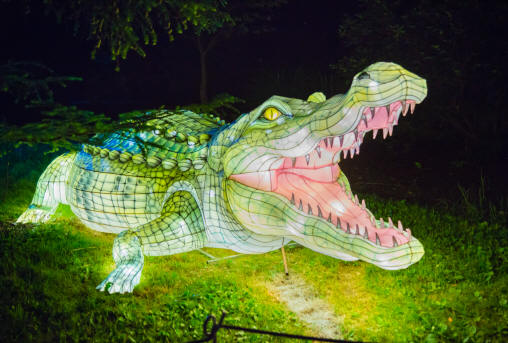
*Alt text: Giant crocodile lantern with open mouth showing detailed teeth and green LED lighting*
Nothing commands attention quite like a 5-meter crocodile with jaws aglow. This piece uses green LED strips to create an eerie swamp atmosphere. The interior of the mouth is painted in vivid pink and lined with individually crafted teeth, making it a favorite photo opportunity at any event.
Sea Turtle Lantern: Ocean Grace
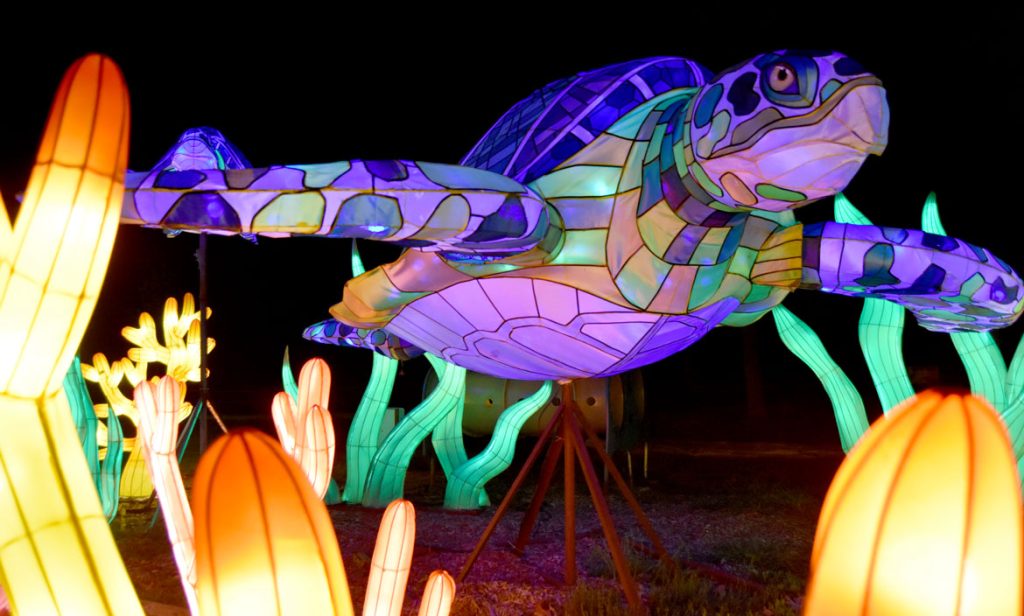
*Alt text: Illuminated sea turtle lantern with blue and purple shell patterns surrounded by coral reef decorations*
Our sea turtle lantern represents the pinnacle of aquatic-themed design. The shell features intricate geometric patterns inspired by real hawksbill turtles, rendered in iridescent blues, greens, and purples. Floating in a “coral reef” installation with companion pieces, it creates an immersive underwater world.
—
Why Choose Festive Lanterns for Animal Lanterns?
| Feature | Our Advantage |
|——–|—————|
| **Experience** | 12+ years exporting to 50+ countries |
| **Customization** | Any animal, any size, any color scheme |
| **Quality** | IP65 weatherproof, fire-retardant materials |
| **LED Technology** | Energy-efficient, 50,000+ hour lifespan |
| **Installation Support** | Technical guidance and on-site assistance available |
| **Shipping** | Full container (FCL) and less-than-container (LCL) options |
—
## Where Are Animal Lanterns Used?
Our animal lanterns have illuminated events and venues across six continents:
– **Zoos & Aquariums** — Night safaris, seasonal events, fundraising galas
– **Theme Parks** — Dinosaur zones, fantasy lands, seasonal overlays
– **Museums** — Natural history exhibits, special exhibitions
– **Shopping Malls** — Holiday displays, grand openings, promotional events
– **City Festivals** — Chinese New Year, Christmas, local cultural celebrations
– **Private Events** — Weddings, corporate parties, product launches
—
## Custom Animal Lanterns: Your Vision, Our Craft
Have a specific animal in mind? We specialize in **custom animal lantern designs** based on your requirements. Whether you need a single statement piece or a complete themed environment, our team handles everything from concept sketches to installation.
**Popular customization requests include:**
– Specific species (rare or regional animals)
– Branded colors and logos
– Interactive elements (sound, motion, touch sensors)
– Themed environments (jungle, ocean, desert, arctic)
– Educational signage and QR-code integration
[Contact our team](/contact/) for a free consultation and quote.
—
## Conclusion
Animal lanterns represent the perfect fusion of ancient Chinese craftsmanship and modern lighting technology. At Festive Lanterns, every creature that leaves our factory carries with it the heritage of Zigong’s 800-year lantern tradition, combined with the precision and durability required by today’s international events industry.
Whether you’re planning a dinosaur exhibition, a zoo night safari, or a city-wide festival, our animal lanterns promise to create unforgettable moments for your visitors.
**Ready to light up your next event?** [Browse our animal lantern collection](/products/lanterns/animal-lanterns/) or [request a custom design](/contact/).
—
## Internal Linking Strategy
| Anchor Text | Target URL | Purpose |
|————-|———–|———|
| Browse our animal lantern collection | /products/lanterns/animal-lanterns/ | Product page conversion |
| Contact our team | /contact/ | Lead generation |
| request a custom design | /contact/ | Lead generation |
| dinosaur exhibition | /products/dinosaurs/animatronic-dinosaurs/ | Cross-sell dinosaurs |
| festival organizers | /services/ | Service page traffic |
| LED lighting systems | /products/lanterns/led-light-shows/ | Category cross-link |
| zoo night safari | /projects/ | Portfolio showcase |
| Chinese New Year | /products/lanterns/festival-lanterns/ | Seasonal relevance |
| IP65 weatherproof | (future blog post) | Content cluster |
| 800-year lantern tradition | /about/ | Brand story |