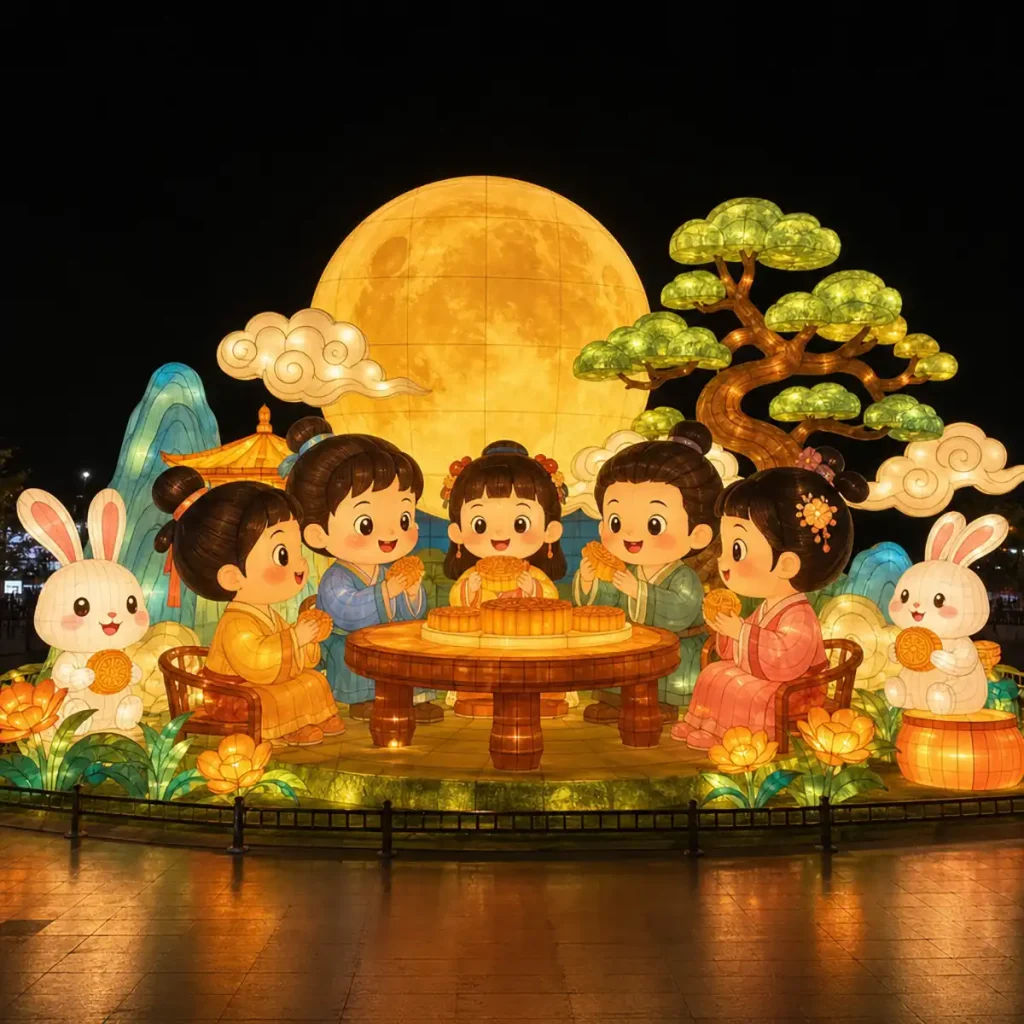
Mid-Autumn Jade Rabbit & Osmanthus Moon Lantern Design
About This Design
This is an AI-assisted concept visualization paired with human-written design intent and production-verified technical specifications. It is a design direction — not a manufactured product. When you order, our team creates custom 3D renderings and fabricates the actual lantern in our Zigong workshop.
A Mid-Autumn scene is not really a scene, it is a gathering. That distinction decides the whole layout: the festival is about a group of people around a table under a moon, not about a figure standing on a plinth. This design takes the gathering literally — a round table at the centre with children seated around it and a full moon behind — and the arrangement does more work for the reading than any single element in the build.
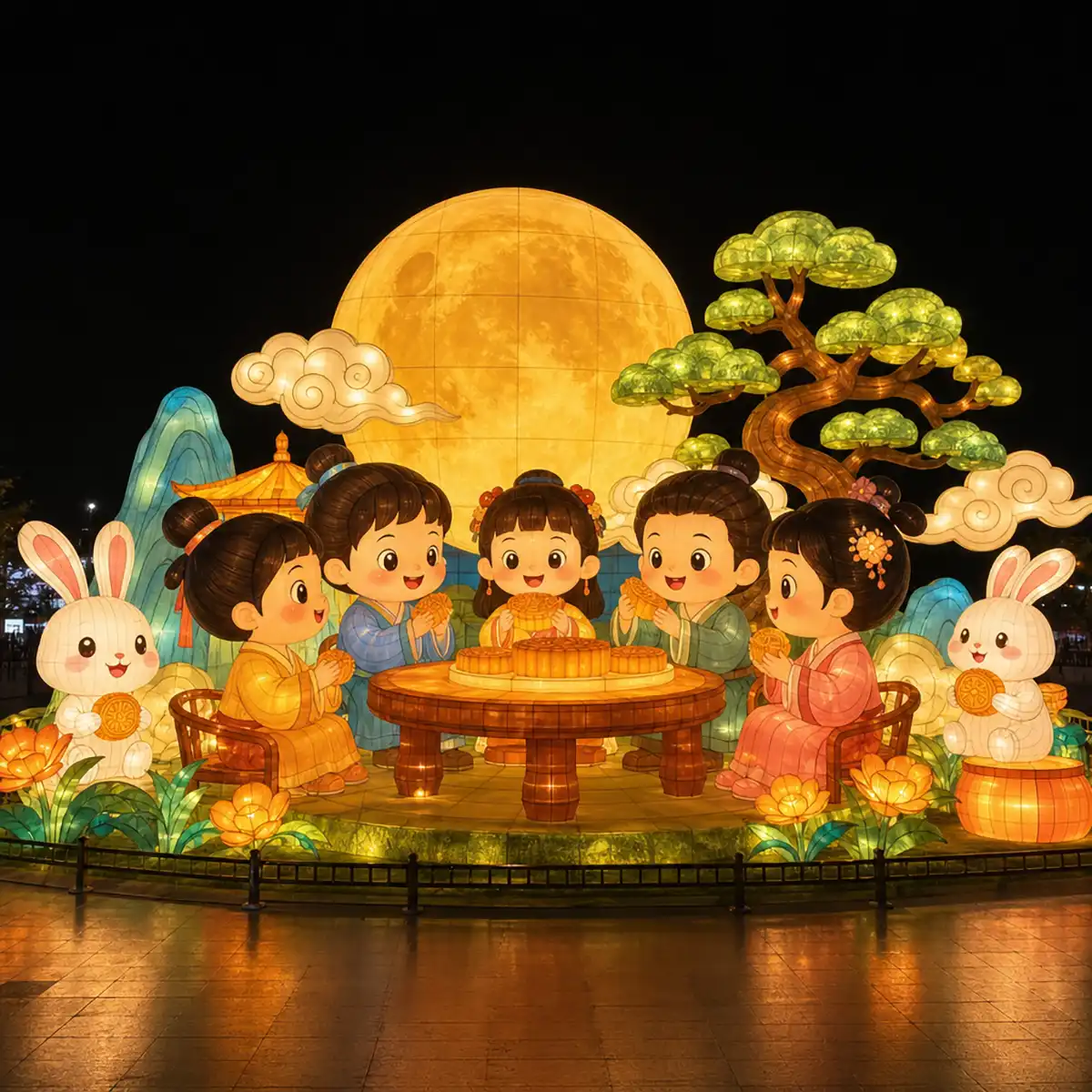
The reference build is a seated group of five children in traditional robes around a round table, each holding a mooncake, with a stacked platter of mooncakes at the centre. Two white jade rabbits hold mooncakes at the outer edges, a giant full moon fills the background, and an osmanthus tree with a golden trunk rises on the right. Cloud scrolls, blue-green mountain lanterns with a golden pavilion, and a band of glowing lotus flowers complete the composition.
This is an AI-assisted concept visualisation paired with human-written design intent and production specifications. It is a design direction rather than a photograph of a finished product — when a project goes ahead, the scene is re-drawn to your venue dimensions and fabricated in our Zigong workshop on a weatherproof internal frame, covered in hand-painted high-density fabric over a shaped understructure, and lit internally with low-voltage LED. The same build method scales from a table-and-rabbits group up to a full festival centrepiece.
Design Intent
The round table is the anchor of the whole composition. A round table forces a radial arrangement — everyone seated at it faces inward, and the group reads as one circle instead of a row. A rectangular table would have produced two facing rows and a corridor of empty space down the middle, and the scene would have split into two halves. That is the reason the table is round, and it is worth protecting in any re-drawing: change the table, and the reading changes with it.
The moon is a backdrop, not a crown. It sits behind and slightly above the group rather than above their heads, which means the scene has one clear viewing side and does not need to be walked around. It also means the moon can be a flat panelled disc rather than a sphere — at this scale the surface is assembled in square panels, and the seam grid is visible across the face. Overnight the grid reads as lunar detail rather than as a join, which is a fortunate reading worth designing around rather than fighting: the disc texture is laid in to work with the panel pattern instead of trying to hide it.
The mooncake is the prop that ties everything to the festival. Every child holds one, the rabbits hold one each, and the centre of the table carries a stacked platter of them. One repeated prop does more for recognition than a dozen different details, and it is the reason the scene reads as Mid-Autumn rather than as children at a table. Remove the mooncakes and the same figures could belong to any family-themed installation.
Each child wears a different robe colour — yellow, blue, green, pink, and one in teal. This is the same principle as separating characters anywhere else in the range: colour separation is what makes a group read as five people rather than as one repeated figure. Five robes in one colour would have produced a uniform, and a uniform in a seated group reads as a school photograph rather than a family.
The two jade rabbits bookend the group at child height. Placing them at the outer edges rather than in the centre gives the arrangement two soft, recognisable ends, and it puts the two most photographable figures exactly where a small child can stand next to them. The rabbits are also the only white in the composition, which is what makes them findable against a gold scene at a distance.
The palette is built on contrast rather than on gold alone. The scene is overwhelmingly gold — moon, table, tree trunk, mooncakes — and the blue-green mountain lanterns, the tree canopy and the lotus leaves exist to give the gold something to sit against. Gold only reads as gold when there is a cool colour next to it, which is the same reason the teal wave forms matter in our lotus water scene.
Specifications
| Theme | Mid-Autumn jade rabbit and osmanthus moon — seated gathering |
| Hero group | Five children in traditional robes seated around a round table, each holding a mooncake |
| Table centrepiece | Stacked platter of illuminated mooncakes |
| Companion figures | Two white jade rabbits holding mooncakes, positioned at the outer edges |
| Backdrop | Large full moon disc, assembled in square panels |
| Vertical element | Osmanthus tree with a golden trunk and green canopy clusters |
| Background elements | Blue-green mountain lanterns with a golden pavilion, cloud scrolls |
| Base band | Glowing lotus flowers with leaves, concealing the plinth line |
| Group scale | Seated figures 1.6 m – 2.4 m; moon disc 8 m – 14 m diameter |
| Group footprint | 14 m – 22 m frontage in a radial arrangement |
| Base | Ballasted plinth with a low fence line; no penetration of paving |
| Construction | Welded internal frame, hand-painted fabric panels over a shaped understructure |
| Lighting | Warm gold core, cool blue-green on the mountains and canopy, amber on the lotus band |
| Power | 110V or 220V, DMX-capable control, weatherproof connections |
| Weather | Outdoor-rated, specified to the wind exposure of the site |
Key Features
- Round table arrangement makes the group read as one gathering rather than two facing rows
- Full moon built as a panelled flat disc, with the seam grid worked into the painted lunar texture
- Mooncakes repeated across every figure, which is what ties the scene to the festival
- Each child in a different robe colour, so the group reads as five people and not a uniform
- Jade rabbits placed at the outer edges at child height, in the only white in the composition
- Cool blue-green mountains and canopy give the gold a contrast to read against
- Osmanthus tree provides a second vertical that balances the moon
- Lotus band along the base conceals the plinth and adds a low warm glow
- Seated group sits low enough for visitors to stand at the table edge for photographs
- Ballasted plinth and fence line developed for paved plazas and park lawns
Where It Works in a Mid-Autumn Programme
This design is built for the main gathering point of a Mid-Autumn programme — the piece a venue puts where visitors stop, sit, and photograph each other. Because the arrangement is a family at a table, it works best at the point where the audience is already settling rather than moving: a plaza centre, a park lawn, a lake promenade, or the entrance court of a cultural venue.
Its second home is overseas Chinese communities, where Mid-Autumn is a public event rather than a private one. Singapore, Malaysia, Vietnam and Hong Kong, China all run substantial public lantern programmes, and the gathering format travels well because the subject is recognisable without any explanation. Our Mid-Autumn lantern festival page covers how the season is built across those markets.
For venues building a wider programme, the scene pairs naturally with the cultural long-form guide to the festival — see food, customs and traditions of the Mid-Autumn Festival for the story a venue’s signage and marketing can draw on. On a mixed site, the same piece also works as the cultural anchor of a city lantern festival display programme, and it is a common element on routed seasonal experiences built with zoo lights.
Production Notes
Figures are shaped over welded internal frames with hand-painted fabric stretched in panels over the shaped understructure. On a seated group the table is the piece that carries the engineering: the children’s chairs, the table column and the platter all resolve into one structure, and the seating is built onto it rather than assembled beside it. That keeps the group rigid and, more usefully, keeps the figures at consistent height relative to the table — a seated group that is a few centimetres out of line looks wrong in a way that standing figures do not.
The moon disc is built as a flat framed panel in sections, joined on site. It is the piece most sensitive to wind, so it carries its own tie-backs, and its siting has to take the prevailing wind direction into account. The osmanthus tree is shaped metalwork — the trunk curvature is formed rather than bent on site — and the canopy clusters are separate covered pieces.
The mountain lanterns and the pavilion are flat-fronted pieces built to sit behind the group and add depth without weight. They are the simplest way to extend the composition backwards, and they are specified at low height deliberately, so they read as distance rather than as competition for the moon.
Electrically the scene runs on low-voltage LED in separate circuits: warm gold on the moon, the table and the mooncakes; cool blue-green on the mountains and canopy; amber on the lotus band. Splitting the moon onto its own circuit matters because the disc should be adjustable independently of the group in front of it. Control is DMX-capable with weatherproof connections throughout, and the installation is outdoor-rated and specified to the wind exposure of the actual site.
Everything travels as separate units and installs on a ballasted plinth behind a low fence line, without penetrating paving. Assembly sequence and site safety are documented in our on-site installation guide, and container planning for European and international delivery is set out in the shipping guide. Ports, CE documentation and install crews across Europe are covered in our European festival programme.
FAQ
Can the number of children be changed?
Yes. The seated group is built around the table, so the count can be reduced or increased and the arrangement is re-drawn around the new number. The table stays round either way — that is what keeps the group reading as one gathering.
Does the scene need a wall or a backdrop behind it?
No. The moon disc is the backdrop, which is exactly why the scene has a single viewing side and can be sited in the open. If a venue has a building or a tree line behind it, the disc simply reads against that instead of against the sky.
Can the scene be made without the moon?
It can, but the moon is doing two jobs — it sets the festival and it gives the group a background. Without it the seated group needs a different backdrop behind, and the composition loses most of its height. A smaller moon disc is usually the better adjustment.
Can the mooncakes carry a venue’s own branding?
The platter and the individual mooncakes are painted panels, so the surface pattern can be adapted to a venue’s own design. Sponsor branding is usually carried on the base band or the plinth panels, where a change does not touch the figures.
Can the figures be re-dressed for a later season?
The frames, the table structure, the disc and the lighting infrastructure are the durable part; the covering and painted panels carry the theme and the robes. A later season is a change of covering and artwork rather than a rebuild, which is normally planned at design stage for venues running an annual programme.
How is the disc specified for an exposed site?
The frame, the disc tie-backs and the ballast are specified to the wind exposure of the actual location rather than to a default. A sheltered plaza and a waterfront promenade are different briefs, and the disc is the piece that decides the anchoring.
The Mid-Autumn Lantern Collection
This gathering is the seated set piece of the Mid-Autumn range. Its counterpart is the Mid-Autumn lotus lantern water scene, which builds the same festival around a moonlit water reading with Chang’e and a lotus band rather than around a table. Venues running a full route usually deploy both, with the gathering at the point where the audience settles and the water scene at the point where they pause.
The season as a whole is set out on the Mid-Autumn lantern festival page. Ready-to-order pieces that ship alongside this group include the moon palace lantern and the Mid-Autumn festival theme lantern set, and the wider range by occasion is listed under festival lanterns. Custom lantern manufacturing covers a gathering worked up from a venue’s own figures and story.
Related Designs & Resources
- Mid-Autumn lantern festival — the full season range
- Mid-Autumn food, customs and traditions — the story behind the festival
- City lantern festival displays — site selection, power and approvals
- On-site installation guide — assembly sequence and site safety
- Shipping festival lanterns from China to Europe — ports, transit and customs
- Lantern displays for European festivals — documentation, ports and install crews
- Lantern products — the full range
- All creative designs — browse the full concept collection
Build This Look at Your Venue
From Concept to Your Venue
Select & Customise
Choose a design direction. We will adjust size, colours, lighting, and theme to match your venue.
3D Render
Our design team creates production-ready 3D renderings based on the concept and your requirements.
Fabricate
Master artisans handcraft your lantern in our Zigong workshop — internal frame, hand-painted covering, LED programming.
QC & outdoor-rated Test
72-hour burn-in test, full weatherproof verification, structural inspection. Built to last.
Ship & Install
Export docs handled. Container loading. On-site installation crew available for your event.