How We Work
Start With Your Brief, Not Our Catalogue
We are a Zigong workshop, not a catalogue reseller. Send us the four constraints your programme actually runs on — footprint, power, opening date, and the approval body you answer to — and we build the display list around them.
Drawings Go to the Workshop Floor
No trading company between you and the people cutting metal. The brief you send is the brief the workshop builds to, and the same team answers your questions at 3pm and at 3am.
14 Years of Festival Production
Two decades of continuous festival output means we have already solved the problems your site will throw at us — high wind corridors, salt air, freezing rain, tight delivery windows.
Documentation Built for Procurement
Structural calculations, electrical schedules, material statements and packing lists supplied in the format your procurement team asks for, not the format that suits us.
One Point of Contact End to End
From first sketch to container loading, you deal with one project lead who knows your file. No handing you between sales, design and shipping.
Install Supervision on Your Site
Our crew supervises installation alongside your contractors, or installs with our own team. Either way, someone who built the piece is on site when it goes up.
Compliance Paperwork Included
UL and CE component documentation, IP ratings for water-adjacent installs, and the electrical certification your inspection body will ask to see before you open.
City & Municipal Programmes · After Dark
A City Lantern Festival Trail Lit for Every Night of the Season
Dense, walkable, photographed from every angle — and planned so your operations team can run it from first switch-on to final pack-down.
Planning Method
Plan a City Lantern Festival Around Your Operating Brief
Four decisions, in this order. Every one of them is yours to make — we only tell you what each one commits you to.
1. Define What the Programme Has to Deliver
City lantern festivals get funded for a reason, and that reason drives every display decision that follows. Tell us which one is yours:
Winter footfall recovery — you need a reason for people to come into the city centre after dark between November and January. That argues for a dense, walkable trail close to existing retail, with high photo-stop density.
Cultural or twin-city programming — the content has to be accurate, not decorative. That argues for heritage-accurate pieces, bilingual interpretation, and a named cultural consultant on the file.
Tourism season extension — you are pulling visitors into a shoulder season. That argues for one or two monumental anchor pieces that photograph well and travel on social media, supported by a smaller number of satellite displays.
Community and civic pride — residents are the primary audience, not tourists. That argues for local symbolism, school and community group involvement in the design narrative, and pricing accessible to families.
2. Map the Site the Way Your Operations Team Will
Before any drawing, your operations team needs answers to five questions. We ask them on the first call because they change the design more than any aesthetic preference:
Where does the crowd enter and exit? If entry and exit are the same gate, you need a loop layout, not a line. Loops need wider paths and more pieces; lines need fewer, larger ones.
What power exists, and where? Available amperage at each zone determines whether a piece is mains-fed or needs a generator. This is the single most common cause of late-stage redesign.
Can emergency vehicles still get through? Any piece placed on an access route needs to be demountable or set back. We flag this in the layout, not after installation.
What is the ground? Grass, paving, gravel and historic surfaces each need a different anchoring method. Tell us and we specify the fixings.
What is the wind exposure? Open plazas and waterfronts carry a very different wind load to a sheltered park. Engineering follows the exposure rating you give us.
3. Fit the Build to Your Approval Timeline
Municipal programmes run on committee dates that do not move. We work backwards from yours rather than forwards from ours.
Tell us your committee or council approval date, and we deliver the drawing and documentation package in time for that meeting — not in time for our production slot.
Tell us your opening date, and we build the production and shipping schedule backwards from it, including the customs and inland transport leg, so the containers land with install time to spare.
Tell us your procurement format, and we supply the technical file in it — whether that is a formal tender response, a sole-source justification, or a framework call-off.
4. Fix Who Owns What After Handover
The handover is where most programmes quietly go wrong. Decide these four things on day one and put them in the contract:
Who operates the lighting programme nightly? Your team or a contracted operator. We hand over the control files either way.
Who handles daily visual checks? We supply a checklist of what to look at each morning and what to escalate.
Where does everything go at season close? Storage capacity on site decides whether pieces are designed as modular sections or as single units.
Who owns the rebuild next season? Your crew, our returning team, or a local contractor we supervise remotely.
Display Types
Six Display Types Municipal Teams Specify
Almost every city programme we build is some combination of these six. Pick the ones that serve your brief — you do not need all of them.
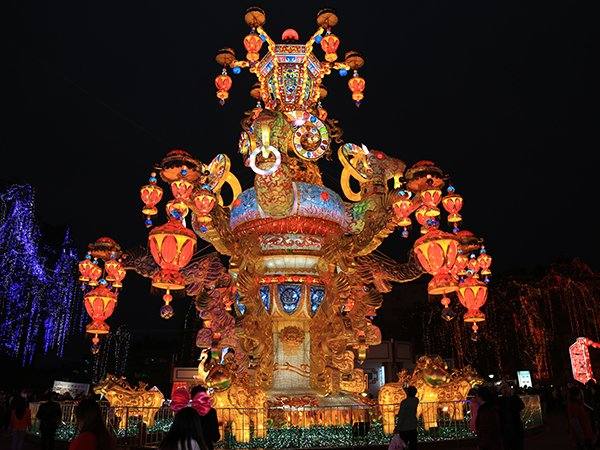
Monumental Lantern Sculptures
8m to 30m+ centrepiece pieces that read from across a plaza and anchor a zone. These are the pieces that end up on the front page and on every visitor's camera roll — most programmes need one, rarely more than three.
Explore →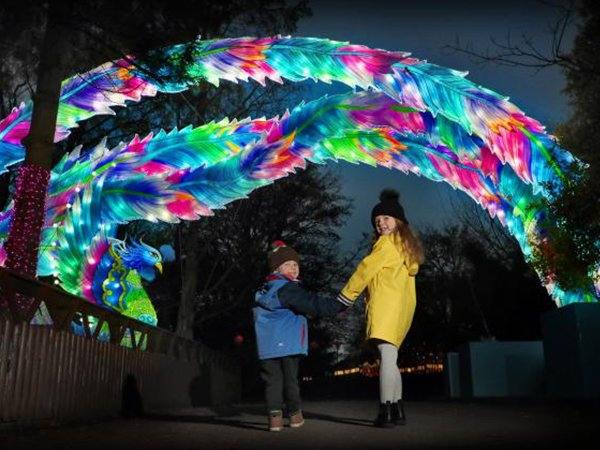
Arrival Arches and Gateways
The piece that tells people they have arrived. Sized to your entrance width and engineered for the wind exposure of an open threshold, which is usually higher than the rest of the site.
Explore →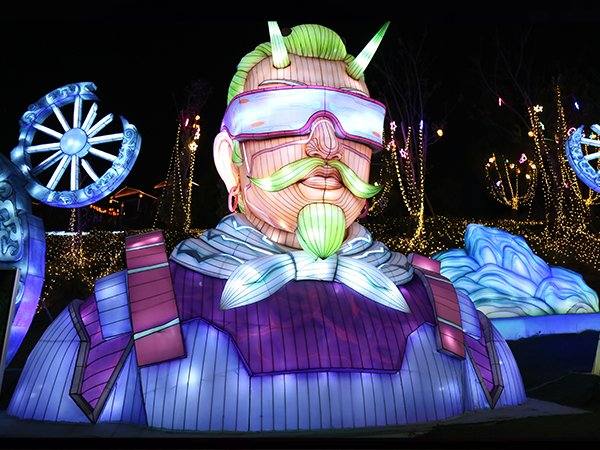
Themed Trail and Pathway Sets
The working backbone of a walking festival. Repetition at intervals keeps people moving, which is what protects your crowd density. Planned against your path width and sightlines.
Explore →
Cultural Storytelling Sets
Pagodas, dragon pillars, zodiac sequences and heritage scenes built to a culturally accurate standard. Used where the programme has an educational or twin-city purpose and accuracy actually matters.
Explore →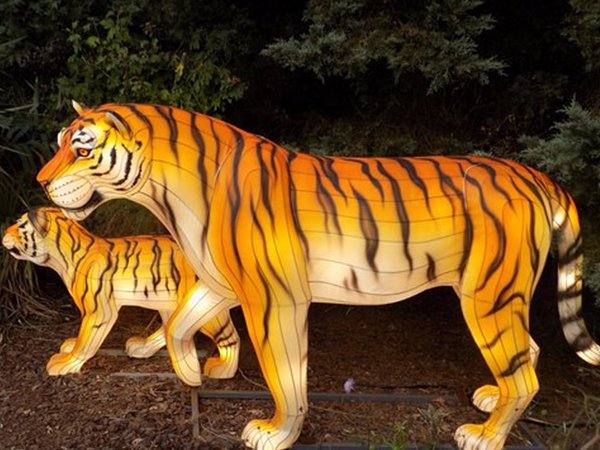
Illuminated Wildlife and Zodiac
The pieces children point at and families photograph. Placed at natural stopping points to spread crowd density rather than concentrate it at the anchor piece.
Explore →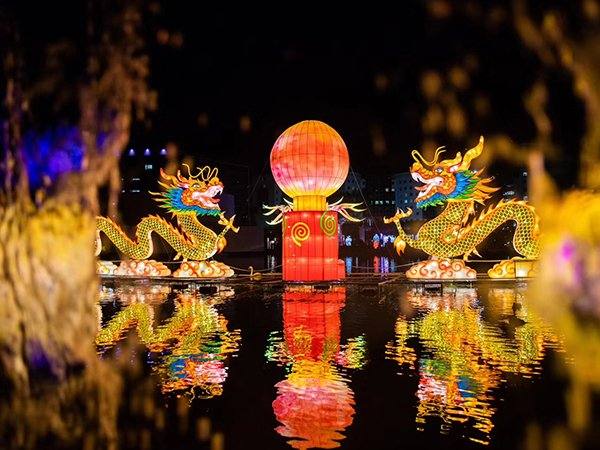
Water and Bridge Installations
Floating pieces, bridge dressing and reflection compositions for waterfronts and river corridors. IP-rated for water-adjacent installation and engineered for the mooring or fixings your site allows.
Explore →Site Matching
Where Each Display Type Works in a City
Venue type determines display type far more than taste does. This is how we match them.
| Site Type | Displays That Work | What Constrains the Design |
|---|---|---|
| Civic square or plaza | Monumental anchor, heritage set, photo-stops | Wind exposure, emergency vehicle access, existing surface fixings |
| Public park or botanical garden | Trail sets, wildlife, themed zones | Path width, tree protection zones, available power along the route |
| Waterfront or river corridor | Water installations, bridge dressing, reflections | Mooring permissions, IP rating, water-level variation |
| High street or retail district | Gateway arches, overhead dressing, shopfront-scale pieces | Loading hours, overhead fixing points, pedestrian flow during trading |
| Museum or cultural quarter | Heritage sets, narrative sequences, interpretation pieces | Curatorial accuracy, bilingual signage, indoor/outdoor transition |
| Transport hub or station forecourt | Gateway pieces, compact high-impact displays | Security screening, overnight install windows, anti-climb considerations |
Working Sequence
From Approved Drawings to Opening Night
Six stages. You get a visible output at each one, so you are never waiting on us without knowing where the file stands.
1. Site Brief & Constraints
You send footprint, power, ground type, wind exposure and opening date. We confirm feasibility and flag anything that will cause problems later.
2. Concept & Layout
Concept sketches and a site layout showing where each piece sits, with crowd flow, power runs and emergency access marked.
3. Engineering & Documentation
Structural calculations, electrical schedules and component certification prepared in the format your approval body requires.
4. Production at the Workshop
Fabrication in our Zigong workshop, with production photographs sent at agreed milestones so you can see progress without travelling.
5. Testing, Packing & Shipping
Full assembly and lighting test before packing, sectional packing for container efficiency, and shipping scheduled to your install window.
6. Installation & Handover
Our crew on site with your contractors, full commissioning, then a documented handover of controls, spares and operating procedures.
What You Receive
What We Hand Over to Your Operations Team
The programme is yours to run after we leave. These are the documents and files that make that possible.
Technical File
Structural calculations, electrical drawings, load data and anchoring specification for each piece — the file your inspection body will ask for.
Lighting Control Files
Programmed sequences handed over in editable form, so your operator can change colours, timing and chase patterns for a different theme.
Assembly & Storage Manual
Section-by-section assembly drawings, storage requirements and handling notes, written for whoever rebuilds the display at your site.
Daily Operations Checklist
What to check each morning, what to escalate, and which spare parts to hold on site — written for a duty manager, not an engineer.
Spare Parts List
Consumables and replaceable components identified with part numbers, so your team can hold stock rather than wait for a shipment.
Crew Training Session
A hands-on session with your operations and maintenance crew at handover, covering assembly, lighting control and daily checks.
FAQ
Questions Procurement Teams Ask First
Send Us Your Site Brief
Footprint, power, opening date and the approval body you answer to. We will come back with a layout, an indicative specification, and the things we think will cause you trouble.
Request Your Site Review →