Every October, zoos, theme parks, shopping malls, and municipalities transform into haunted wonderlands of glowing pumpkins, eerie illuminated creatures, and spectacular light installations. But behind the most unforgettable Halloween events lies a supply chain challenge that most venues never talk about: where do you actually source professional-grade Halloween lights and illuminated displays that can withstand outdoor conditions, handle thousands of visitors, and create genuinely Instagram-worthy moments?
If you’ve ever tried to outfit a large-scale Halloween event with retail string lights and plastic decorations, you already know the answer: you can’t. Professional Halloween light displays require custom design, industrial-grade materials, and manufacturing expertise that your local party supply store simply cannot provide.
This guide covers everything event organizers need to know about sourcing professional Halloween lights and custom illuminated displays, from lantern sculptures to animatronic creatures, and why the world’s leading venues are turning to custom manufacturing for their seasonal transformations.
Beyond String Lights: What Professional Halloween Lights Actually Look Like
When most people hear “Halloween lights,” they picture orange and purple string lights draped across a front porch. For professional venues, the category is far broader and more spectacular.
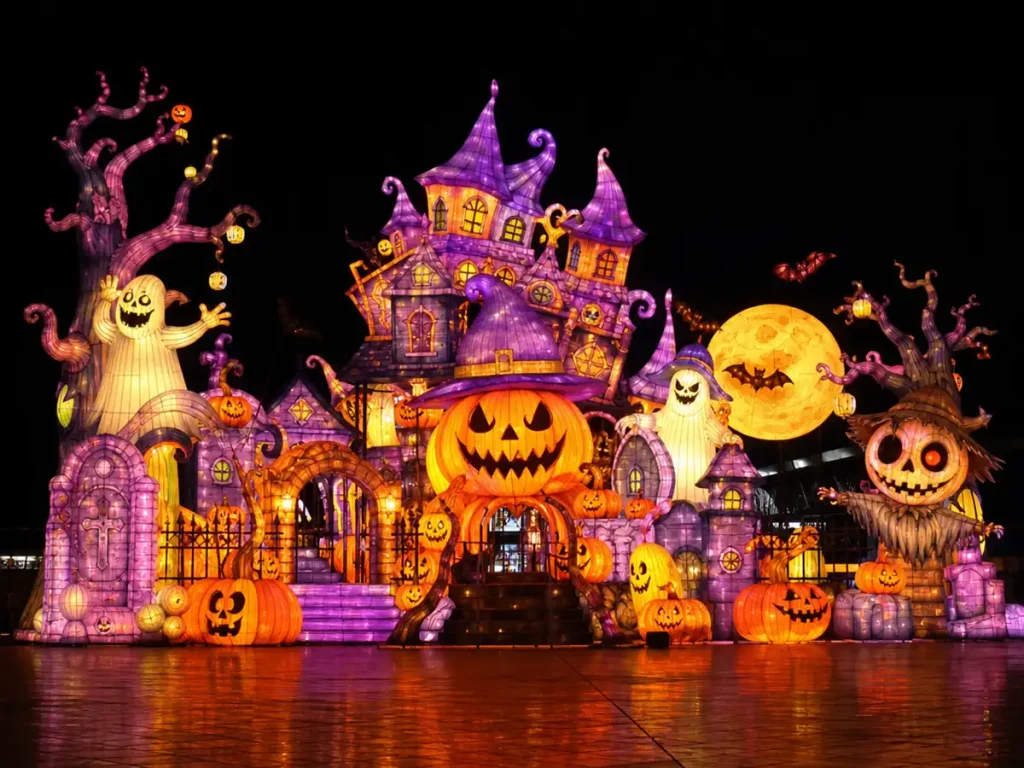
Illuminated Halloween Lantern Sculptures
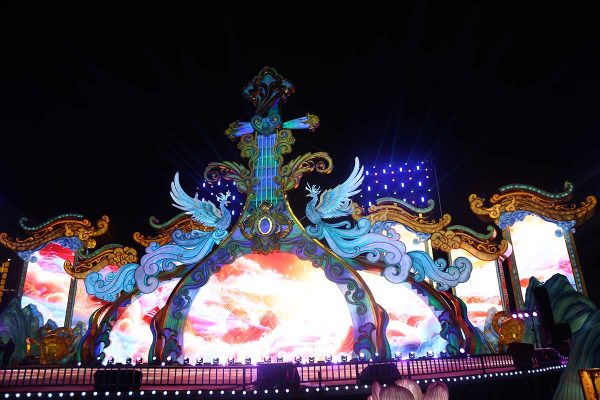
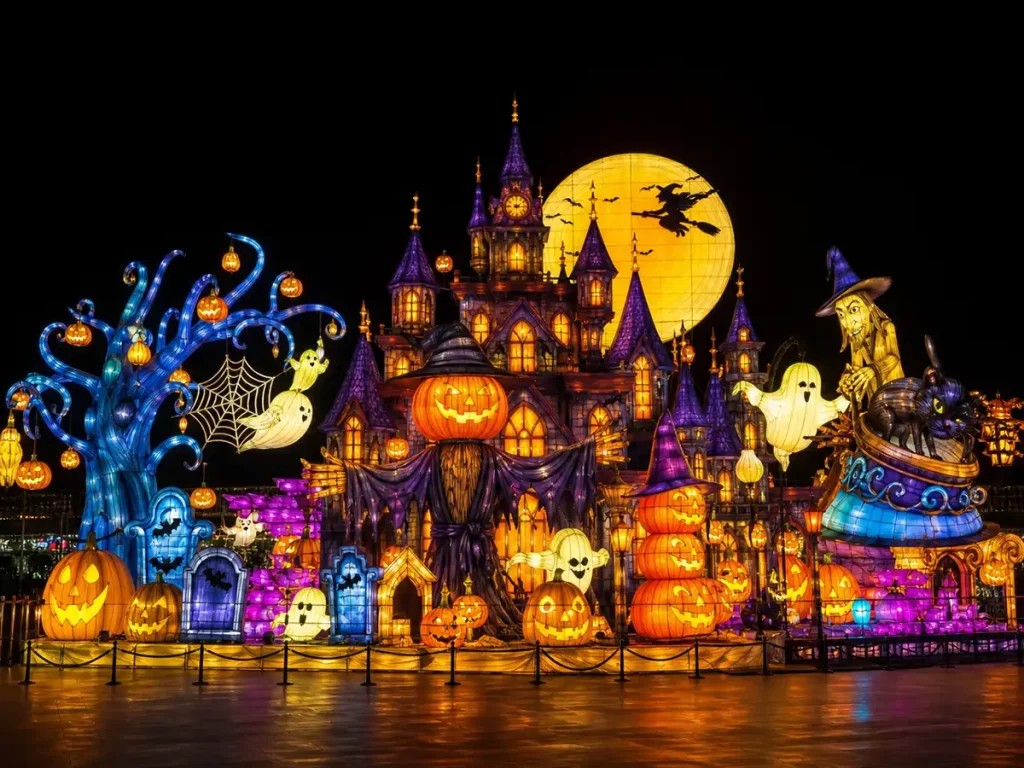
Custom-designed light sculptures depicting Halloween-themed characters and creatures: giant illuminated pumpkins, glowing ghost figures, skeletal dragons, witch-themed displays, and haunted house facades. These are not inflatable lawn decorations. They are metal-framed, silk-wrapped, LED-illuminated structures built to withstand wind, rain, and crowds of visitors. A single piece can stand 3 to 8 meters tall and become the centerpiece of an entire event.
These installations transform ordinary park paths into immersive narrative journeys — making them the most popular format for custom halloween lantern display packages worldwide.
Animatronic Halloween Creatures with Integrated Lighting
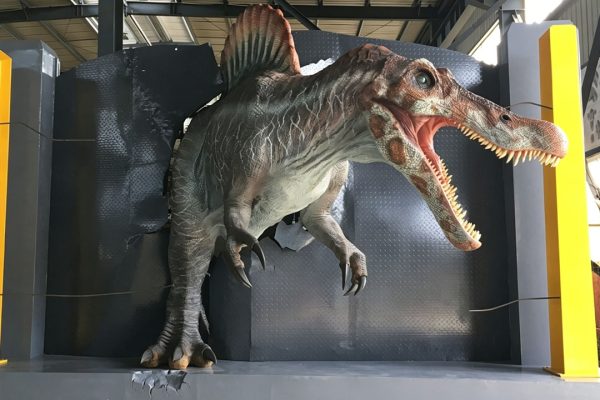
The next evolution of Halloween attractions combines movement with illumination. Imagine a 5-meter animatronic werewolf whose eyes glow red and whose body is outlined in eerie LED light, triggered by motion sensors as visitors approach. Or a life-size animatronic zombie emerging from a crypt with synchronized sound and lighting effects. These hybrid animatronic-lantern combinations are becoming the gold standard for premium Halloween events worldwide.
Themed Light Trails and Pathways
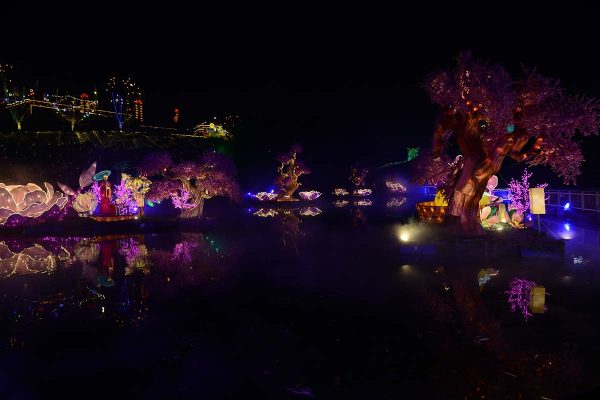
Full-scale illuminated pathways that guide visitors through a curated Halloween experience: glowing jack-o’-lantern arches, LED-lit spider webs spanning 10 meters, illuminated gravestone pathways, and forest trails lined with glowing eyes peering from the darkness. These installations transform ordinary park paths into immersive narrative journeys.
Interactive Halloween Light Installations
Touch-responsive lighting, motion-activated scares, and photo-opportunity installations designed for social media. A color-changing witch’s cauldron that responds to visitor proximity, a tunnel of light synchronized to Halloween soundtracks, or a massive illuminated pumpkin that visitors can walk inside for photos.
If you’re planning a halloween lantern display for a zoo, theme park, or festival, custom illuminated sculptures offer a level of visual impact that retail decorations simply cannot match.
Why Retail Halloween Lights Don’t Work for Professional Venues
The temptation to source Halloween decorations from big-box retailers is understandable. It seems cheaper upfront. But the math falls apart quickly for professional operations.
Retail Halloween lights are designed for single-season use. Their wiring is not weatherproof. Their frames cannot support their own weight beyond a few feet. Their LEDs burn out after 200-300 hours of continuous operation, which is less than two weeks of a typical evening event schedule.
Professional custom Halloween light displays are fundamentally different products. They use commercial-grade LED systems rated for 50,000+ hours. Their internal frames are weatherproof against rust. Their silk surfaces are treated with UV-resistant and fire-retardant coatings. They are designed for assembly, disassembly, storage, and reuse across multiple seasons.
A well-maintained custom illuminated display typically lasts 5 to 8 seasons, making the per-event cost significantly lower than replacing retail decorations every year. More importantly, custom displays create visual experiences that no retail product can match — and in the competitive event industry, visual differentiation is everything.
Halloween Lights by Venue Type: What Different Venues Need
Different venues have fundamentally different requirements for Halloween light displays. Understanding your venue type is the first step in planning an effective installation.
Zoos and Wildlife Parks
Zoos face unique challenges for Halloween events. The lighting must not disturb the real animals. Pathways must accommodate families with strollers. And the theme should be spooky enough to entertain but not so frightening that it alienates younger visitors.
Successful zoo Halloween light installations typically feature animal-themed illuminated sculptures with a spooky twist: glowing-eyed tigers, illuminated bat colonies hanging from trees, skeleton-themed dinosaur lanterns, and spider-infested light tunnels. The emphasis is on wonder and discovery rather than horror.
The zoo market is particularly attractive for Halloween events because zoos already have the infrastructure — pathways, ticketing systems, food vendors, and parking — for large-scale evening events. Many zoos report that Halloween light events generate 25-40% of their annual October revenue.
Theme Parks and Amusement Parks
Theme parks compete on spectacle, and their Halloween light installations reflect that ambition. Haunted house exteriors with synchronized lighting shows, massive illuminated skull entrances, parade floats with integrated LED displays, and coaster tracks outlined in programmable color-changing lights.
Parks typically plan Halloween installations 6 to 8 months in advance, with the production timeline driving their ordering schedule. Custom manufacturing from overseas suppliers requires a lead time that parks must factor into their event planning calendar.
Shopping Malls and Retail Centers
Malls use Halloween lights to drive foot traffic during the competitive holiday season ramp-up. Their installations tend to be more family-friendly and photo-oriented. Central atrium displays featuring illuminated pumpkin villages, trick-or-treat trail markers, and Instagram-ready photo backdrops are common.
Mall installations also face unique spatial constraints: ceiling heights, fire codes, and the need to maintain clear evacuation routes while still creating immersive environments.
Municipal and City Events
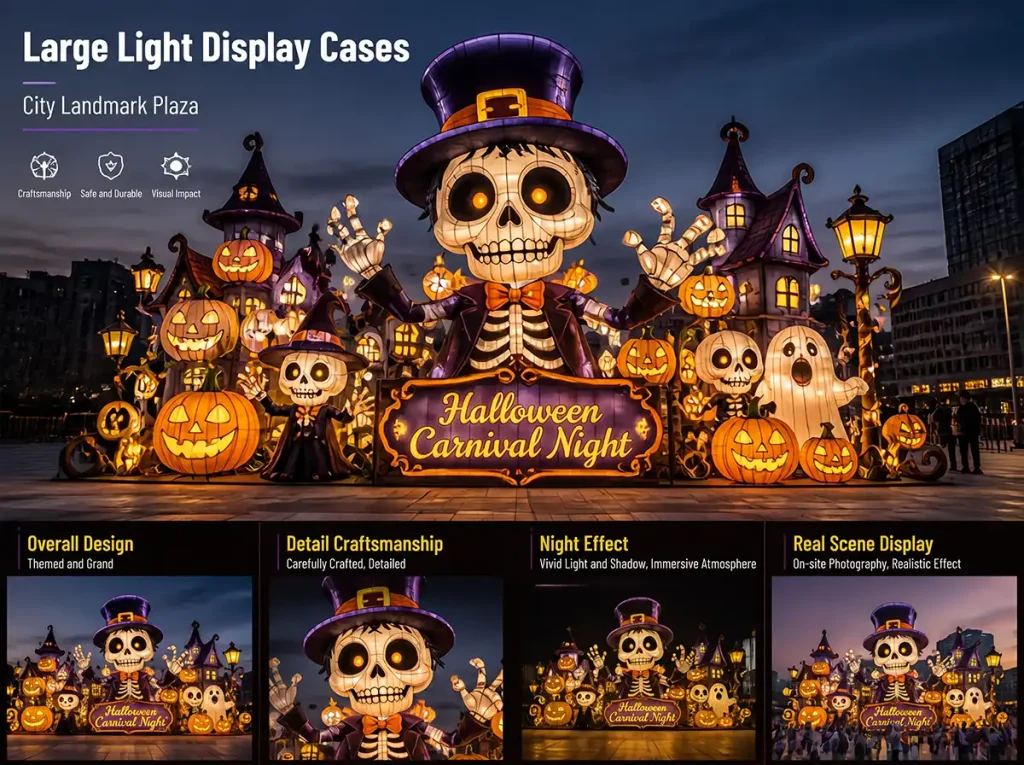
City-organized Halloween festivals require the broadest range of installations. They need entrance gateways that make a statement from 100 meters away, pathway lighting that guides visitors through park circuits, performance stage backdrops, and crowd-management infrastructure that doubles as decorative elements.
Municipal buyers also face procurement regulations that favor turnkey solutions — single contracts covering design, manufacturing, shipping, and installation — rather than piecemeal sourcing.
The Manufacturing Process: How Custom Halloween Light Displays Are Made
Understanding the manufacturing process helps buyers evaluate suppliers and set realistic expectations for timelines and costs.
Design Phase (2-4 weeks)
The process begins with concept sketches based on the client’s theme, venue requirements, and budget. These evolve into detailed 3D renderings showing each installation in context — how it will look at night, how visitors will interact with it, and how it relates to adjacent installations.
Engineering Phase (1-2 weeks)
The 3D designs are converted into structural specifications: internal frame dimensions, LED circuit layouts, power consumption calculations, and assembly sequence documentation. For animatronic elements, the movement mechanisms and control systems are designed in parallel.
Fabrication Phase (4-8 weeks)
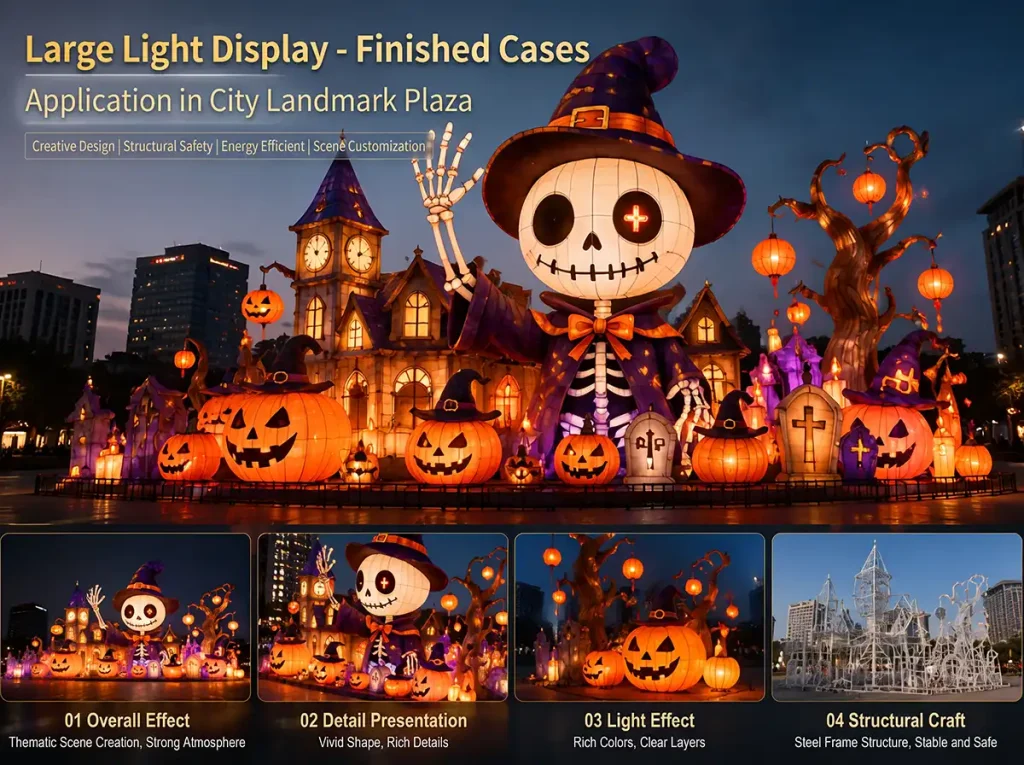
Skilled artisans bend and weld metal rod into the skeletal structure of each piece. Silk fabric — treated for UV resistance, fire retardancy, and weather endurance — is cut, shaped, and bonded to the frame. LED strips are installed and tested. For complex pieces, the fabrication involves dozens of individual artisans working on different sections simultaneously.
Quality Control (1 week)
Every piece undergoes a full illumination test, a structural stability check, and a weather-simulation test. Electrical systems are checked for load balance and fault tolerance. For interactive elements, the sensor and control systems are calibrated and stress-tested.
Shipping and Installation
Custom displays are modular by design — large pieces break down into manageable sections that fit standard shipping containers. On-site installation by the manufacturer’s technicians typically takes 1 to 2 weeks, including electrical hookup, positioning, and final calibration.
Cost Factors for Halloween Light Displays
Every custom Halloween light project is priced individually based on several variables:
Scale and quantity: A small installation of 15-25 pieces for a zoo pathway costs significantly less than a 100-piece park-wide transformation. Entry-level custom Halloween projects typically start around $30,000 USD for small-scale installations. Mid-range projects covering a full zoo or medium theme park area range from $80,000 to $250,000. Large-scale city or park-wide installations with animatronic elements can exceed $500,000.
Size of individual pieces: Larger pieces require more materials, more complex engineering, and more expensive shipping. A 2-meter illuminated pumpkin might cost $800-1,200, while an 8-meter haunted castle facade could be $15,000-25,000.
Animatronic integration: Adding movement and interactivity typically increases the cost of a piece by 40-80%, but the visitor engagement return is disproportionately higher. Animatronic pieces consistently generate the longest visitor dwell times and the most social media shares.
Shipping distance and method: Sea freight is the most cost-effective for large orders but requires 15-30 days of transit time. Air freight is faster but significantly more expensive per cubic meter.
Common Pitfalls to Avoid When Sourcing Halloween Light Displays
Underestimating Lead Time
The number one mistake event organizers make is underestimating how long custom manufacturing takes. From concept approval to delivery, a typical Halloween light project requires 10 to 14 weeks. For events planned for October, the ordering deadline falls in June or July — not September.
Ignoring Weather Specifications
Halloween events happen in October and November, when weather can be unpredictable. Displays must be rated for the specific climate conditions of the venue. Rain, wind, and temperature fluctuations all affect performance. Insist on outdoor-rated weatherproofing at minimum, with outdoor-rated for any ground-contact components.
Forgetting Storage and Maintenance
The display life depends heavily on proper off-season storage. Displays need climate-controlled storage away from direct sunlight and moisture. Manufacturers should provide disassembly guides, storage recommendations, and spare parts kits. The long-term cost of custom displays is far lower than retail replacements, but only if they are properly maintained.
Questions to Ask Any Halloween Light Display Manufacturer
Before signing a contract, ask every potential supplier these questions:
- Do you provide 3D renderings of the proposed installations before production begins?
- What is your support period and what does it cover?
- Do you offer on-site installation support and operator training?
- Can you provide references for similar-scale projects in my region?
- What is your spare parts policy for ongoing maintenance?
- How do you handle customs clearance and import documentation?
A manufacturer that cannot answer all six questions clearly is not ready for professional event production.
Conclusion: Halloween Lights as a Revenue Strategy
For zoos, parks, and event venues, professional Halloween light displays are not just decorations. They are revenue engines. They extend the operating season into traditionally slow months. They create ticket-upgrade opportunities. They generate press coverage and social media exposure that would cost far more to buy through advertising.
The difference between a forgettable Halloween event and one that sells out every night comes down to one factor: the quality and originality of the visual experience. Custom-manufactured Halloween light displays deliver that experience at a per-season cost that, over a 5-year service characteristics, typically undercuts the annual retail replacement cycle.
Ready to explore custom Halloween light displays for your venue? Contact our design team for a free concept proposal with 3D visualization. No obligation, no cost — just a conversation about what’s possible.
Related Products & Resources
- Festival Lanterns Collection — Browse our full range of festival lantern displays including Halloween, Christmas, and seasonal designs
- Zoo Lights Festival Provider — Complete zoo Halloween light displays including pumpkin and spider light installations
- Animal Lanterns — Illuminated animal sculptures perfect for Halloween-themed zoo and theme park events
- Lantern Festival Planning Guide — Complete guide to planning and sourcing a lantern festival event
Explore more: Venues planning a Halloween lantern display may also want these scene concepts: cute witch ghost village Halloween lantern set · giant pumpkin witch festival Halloween lantern · giant pumpkin witch Halloween lantern centerpiece · haunted castle skulls path Halloween lights · witch pumpkin ghost Halloween display scene · purple castle scarecrow Halloween lantern display · large Halloween lantern display detail case · giant skull walkthrough Halloween light show