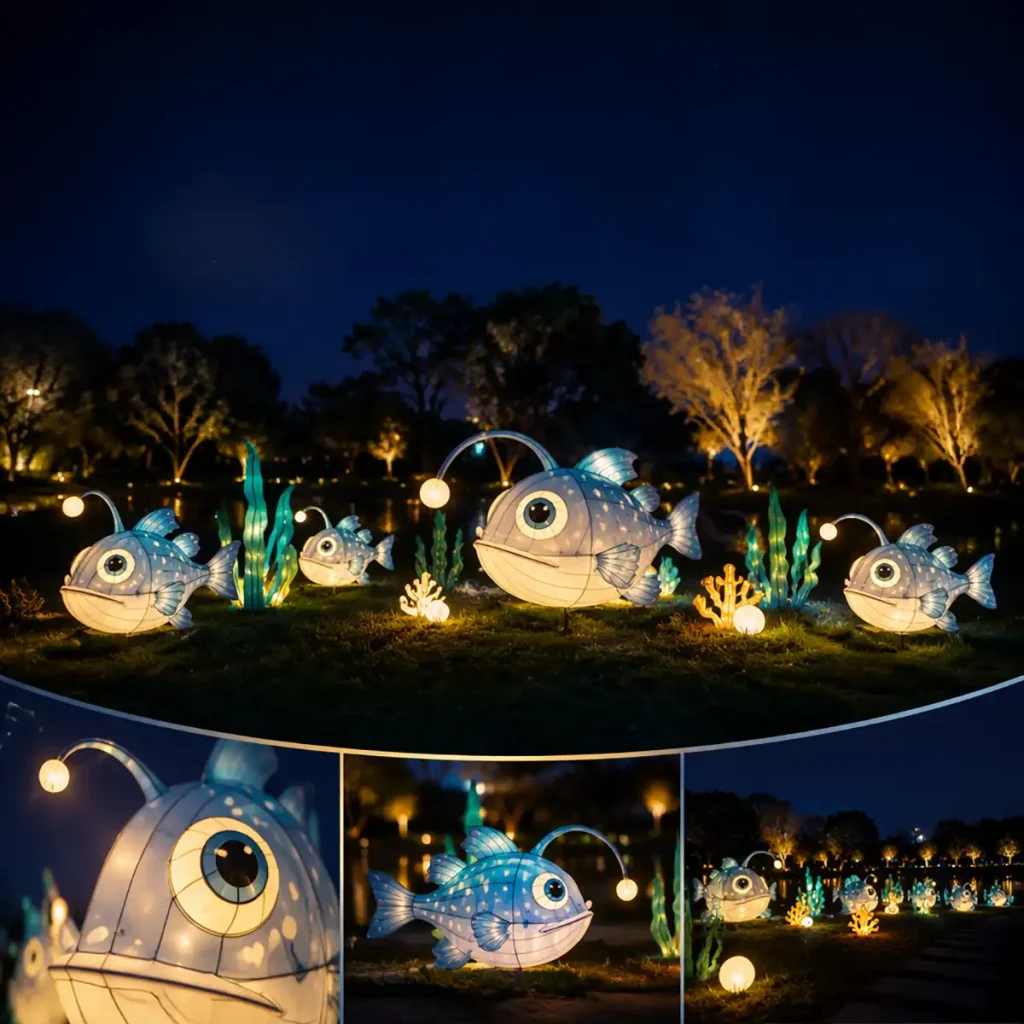
Glowing Fish Lantern — Deep-Sea Fish School
About This Design
This is an AI-assisted concept visualization paired with human-written design intent and production-verified technical specifications. It is a design direction — not a manufactured product. When you order, our team creates custom 3D renderings and fabricates the actual lantern in our Zigong workshop.
A glowing fish school is sold as a quantity, not as an animal, and that changes the design brief completely. There is no hero figure to get right, no face to read and no single viewpoint that has to work. What makes or breaks the piece is whether the group reads as a school, whether the light reads as something alive in deep water, and — the part most installations get wrong — whether the scene is lit the way a deep-sea subject has to be lit, which is the opposite of how every other festive piece in this range is lit.
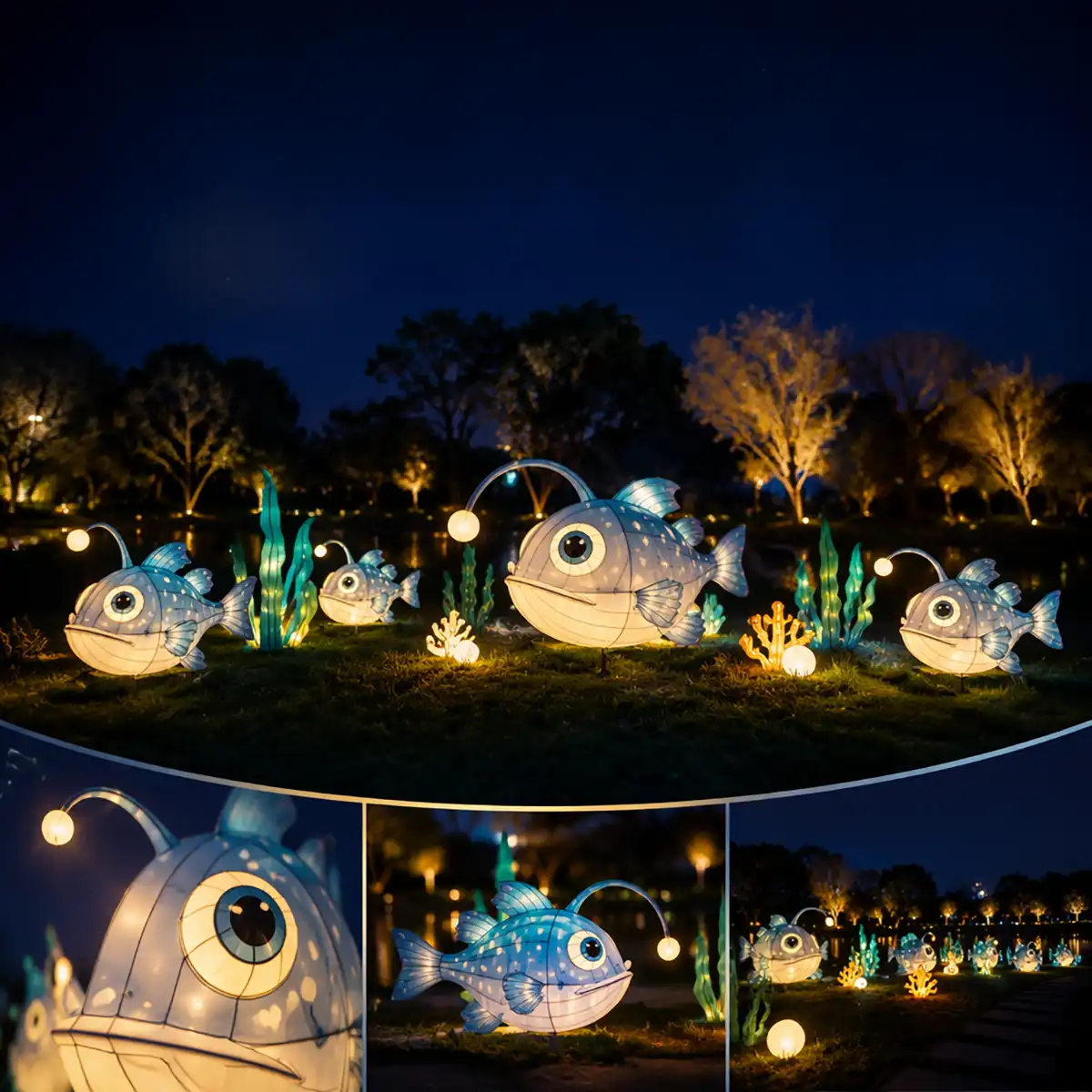
The installation is built as a set of identical fish units, each roughly 1.5 m long and 0.8 m tall, on slim supports or suspended from a frame, arranged in three dimensions across the site. Each fish carries an internally lit body on a low-voltage outdoor-rated circuit and a single bright antenna point at the end of its lure. Units share a supply bus so that a group of fifty can be commissioned and serviced as a manageable number of runs rather than fifty individual connections.
A school is made of quantity, not of one good fish
The first instinct on this subject is to make a very good fish and then multiply it. That produces a row of good fish, which is not a school. A school is a pattern created by number, by a shared direction of travel, and by figures overlapping in depth — and the third of those is the one usually missing.
| Arrangement | What it reads as |
|---|---|
| Eight fish in a line, evenly spaced, all at one height | A row of fish. The eye counts them and moves on. |
| Eight fish at varied heights but all on a single plane | A decorative screen. Better, but still flat — visitors see the arrangement from the side and it resolves into a pattern. |
| Twenty fish at varied heights and depths, aligned in direction | A school. The overlapping creates depth and the direction of travel creates movement. |
| Fifty fish with five per cent off-axis | A living school. The small number of fish turned off the main direction is what stops the group reading as a printed pattern. |
Three practical rules follow. The first is that the shared direction has to be visible from the main approach — a school travelling at right angles to the route reads as scattered fish. The second is that the deviation from that direction should be small and rare: five to ten per cent of the units, each turned a little, is enough. The third is spacing: perfectly even spacing is what makes a school look manufactured, and the variation in gaps matters more than the variation in heights.
The light of a deep-sea fish is a point, not a panel
This is the single decision that determines whether the piece reads as deep sea or as a festive display. Bioluminescence in the deep ocean is a small, intense point of light in an otherwise dark animal. It is not a glowing body with a bright detail on the front.
- Keep the body dim and the antenna bright. The fish bodies should be lit just enough to read as forms against the dark — a low interior glow on a dark ground, not a bright lantern. The antenna point carries all the intensity.
- One point per fish, not several. Multiple glowing spots per figure read as a string of bulbs. A single bright point at the end of the lure is what reads as an organism.
- Shield the antenna from below. Bright points at head height or above are looked at from underneath as visitors walk through, and an unshielded point is a source of glare rather than an effect. A small shade above and beside the module keeps the light in the viewing direction.
- Let the point be the brightest thing in the frame. In this composition the antenna points are the only elements that should be at full intensity. If the reef or the ground is lit to a comparable level, the points stop reading as light sources and the scene turns into a normal illuminated installation.
Layout in three dimensions, not on a lawn
A fish school is one of the few subjects in this range that is genuinely spatial. Laid out flat it works as a wall; laid out in three dimensions, with the fish at different heights and depths across a walking route, it becomes an environment. Visitors walk through it rather than past it, which is the reason to specify this piece at all.
- Vary the mounting height across the group. A band of roughly 2 to 5 m above ground gives the school a vertical extent and lets visitors pass underneath. Fish all at the same height, whether high or low, read as a flat plane.
- Vary the depth as well as the height. Depth is what creates overlap, and overlap is what makes the number of units read as more than it is. A group of twenty with real depth reads denser than forty on a single plane.
- Keep the supports thin and consistent. Slim supports entering the body from the belly or behind the tail, hidden by the fish from the approach direction. Consistency matters as much as slimness — a group where some supports show and others do not looks unfinished.
- Keep the walking line clear. The school should be arranged around the route rather than across it, so the path stays a path. Where the route passes under the group, the clearance is set at the drawing stage.
Why this piece is lit the opposite way to a festive display
Almost every piece in this range is lit on the principle that everything should be visible. A deep-sea subject fails if it is lit that way, because the effect being reproduced only exists in darkness. The lighting philosophy here is the reverse: the background goes dark, and a small number of points carry the entire image.
- Keep the ground illumination very low or off. Ground wash is the single fastest way to destroy this piece. With the ground lit, the fish stop being objects in dark water and become objects on a lit lawn.
- Keep the surrounding pieces out of the frame. A fish school placed next to a brightly lit festive display loses its effect entirely, not because of anything wrong with the school but because the ambient light in the visitor’s field of view is too high. Give the piece its own dark stretch of route.
- Use the dark as the subject. The gaps between the fish are as much a part of the installation as the fish are. The tendency to add more light to make it more impressive is what turns a deep-sea scene into a decorative one.
- Keep the light points warm against the cool body and the dark. A warm point in a cool, dark field is the strongest visual signal available, and it is also what the subject actually looks like.
Colour that reads as deep sea
Deep-sea colour is a narrow band: dark upper surfaces, pale undersides, and one warm accent. It is also easy to over-decorate, because a subject this simple invites adding colour to make it interesting.
- Keep the body desaturated and dark. A low-saturation blue-grey upper surface and a pale underside is the whole palette. Saturated blues go bright under internal light and turn the fish into toys.
- Reserve warmth exclusively for the antenna points. If warm light appears on the bodies, on the ground or on the supports, the points stop being the accent and stop reading as light sources.
- Keep the pale undersides below the brightness of the points. A whale or fish underside has almost no headroom before it blows out, and once it goes white the form of the animal is lost.
- Do not introduce reef colour into this piece. This is an open-field subject. Bright coral or plant elements underneath it move the piece into a different category and undo the effect the layout is built for.
Walking under a school
Where the layout allows visitors to pass beneath the group, the experience of the piece changes substantially — and so do the practical requirements.
- Gather the fish around the route, not spread evenly over it. A visitor walking under an even distribution sees two or three fish. Walking through a denser band with gaps at either end sees the school as a school.
- Keep the density highest at the point where visitors first pass under. The first impression should be the densest, because that is the moment that establishes what the piece is.
- Check every point for glare from below. The walking line is the one place where every antenna in the group is seen from underneath. Shielding is settled against that view rather than against the view from the path.
- Keep the group’s direction of travel consistent with the walking direction, or clearly across it. A school that swims with the visitor reads differently from one that swims against them, and either is fine as long as it is deliberate rather than mixed.
Specifications
| Attribute | Details |
|---|---|
| Fish units | Standard 1.5 m long × 0.8 m tall; 8 units minimum, scalable to 50+ |
| Layout | Three-dimensional, 2 m – 5 m above ground, varied in height and depth; aligned in a shared direction with five to ten per cent turned off-axis |
| Lighting | Dim low-voltage body lighting with a single shielded bright point at the end of each lure; points as the brightest elements in the composition |
| Glare control | Shaded antenna modules so points do not glare when seen from below on the walking line |
| Supports | Slim supports entering the body from the belly or behind the tail, concealed by the fish from the approach direction; frame suspension where available |
| Wiring | Shared supply bus with grouped circuits rather than individual connections for each fish |
| Colour | Desaturated blue-grey upper surface, pale underside kept below the brightness of the points, warm light reserved for the antenna points |
| Ground | Ground illumination minimal or off; no bright reef or plant elements in this piece |
| Structure | Weatherproof metal armatures; high-density fabric over frame |
| Materials finish | UV-resistant painted silk; CE / UL electrical components |
| Weather rating | Outdoor-rated, with grouped service access |
| Applications | Outdoor lantern festivals, lakeside parks, beachfront promenades, aquarium exteriors, dark-route feature sections |
Frequently Asked Questions
How many fish are needed before it reads as a school?
Around eight is where a group starts reading as a group rather than as a few fish, but the number matters less than the layout. Twenty units with real variation in height and depth read denser than forty laid out on a single plane, and the spacing variation is what the eye picks up.
Why is the body lighting so dim?
Because bioluminescence is a point of light on a dark animal, not a bright animal. If the bodies are lit like lanterns the piece reads as a festive display with bright details rather than as a deep-sea subject, and the antenna points stop functioning as light sources. The dimness of the bodies is what makes the points work.
Will people be able to walk underneath?
Usually yes, and it is the arrangement that makes this piece worth specifying. The group is arranged around the route with clearance set at the drawing stage, and the antenna shielding is checked from the walking line, which is the one view where every point in the group is seen from below.
Can it be installed next to other lit pieces?
It can, but the effect depends on the surrounding light level. A deep-sea group placed against a brightly lit display loses most of its impact, not because of anything in the piece itself. The usual approach is to give it its own darker stretch of route, which is a programming decision as much as a design one. See the underwater and marine designs for related pieces.
Can the school be extended in a later season?
Yes. Units are produced to the same reference and the layout drawing records the positions, so additional fish can be added into the existing arrangement. Because the units share a supply bus, extension usually means adding to an existing circuit rather than running a new one.
Does it work indoors?
Yes, and a dark interior suits the lighting philosophy better than most outdoor sites. Aquarium halls and exhibition spaces are common specifications. For a larger single-figure marine piece, see the whale lantern sculpture.
Related Products and Designs
Other marine designs: the whale lantern sculpture and the ocean world archway, with the wider group on the underwater and marine designs page.
Smaller fish pieces: the fish lantern, and the animal lanterns range for other species.
Send the route plan, the available height and the number of units through the contact form, and we will return a three-dimensional layout with positions and circuit grouping marked.
From Concept to Your Venue
Select & Customise
Choose a design direction. We will adjust size, colours, lighting, and theme to match your venue.
3D Render
Our design team creates production-ready 3D renderings based on the concept and your requirements.
Fabricate
Master artisans handcraft your lantern in our Zigong workshop — internal frame, hand-painted covering, LED programming.
QC & outdoor-rated Test
72-hour burn-in test, full weatherproof verification, structural inspection. Built to last.
Ship & Install
Export docs handled. Container loading. On-site installation crew available for your event.