A whale lantern is almost always specified in a suspended pose — breaching, arcing, turning — and that single choice decides the engineering before any of the visual decisions get made. A ground-standing animal carries its own weight down through its feet. A whale held in mid-air carries its weight through a concealed support, and the entire mass of a large figure then acts as a lever on that support. This page covers that, together with the two colour problems specific to this subject, the fact that blue is the fastest colour in the range to start looking like plastic, and the fact that at double life size the surface detail that works at human scale stops being visible at all.
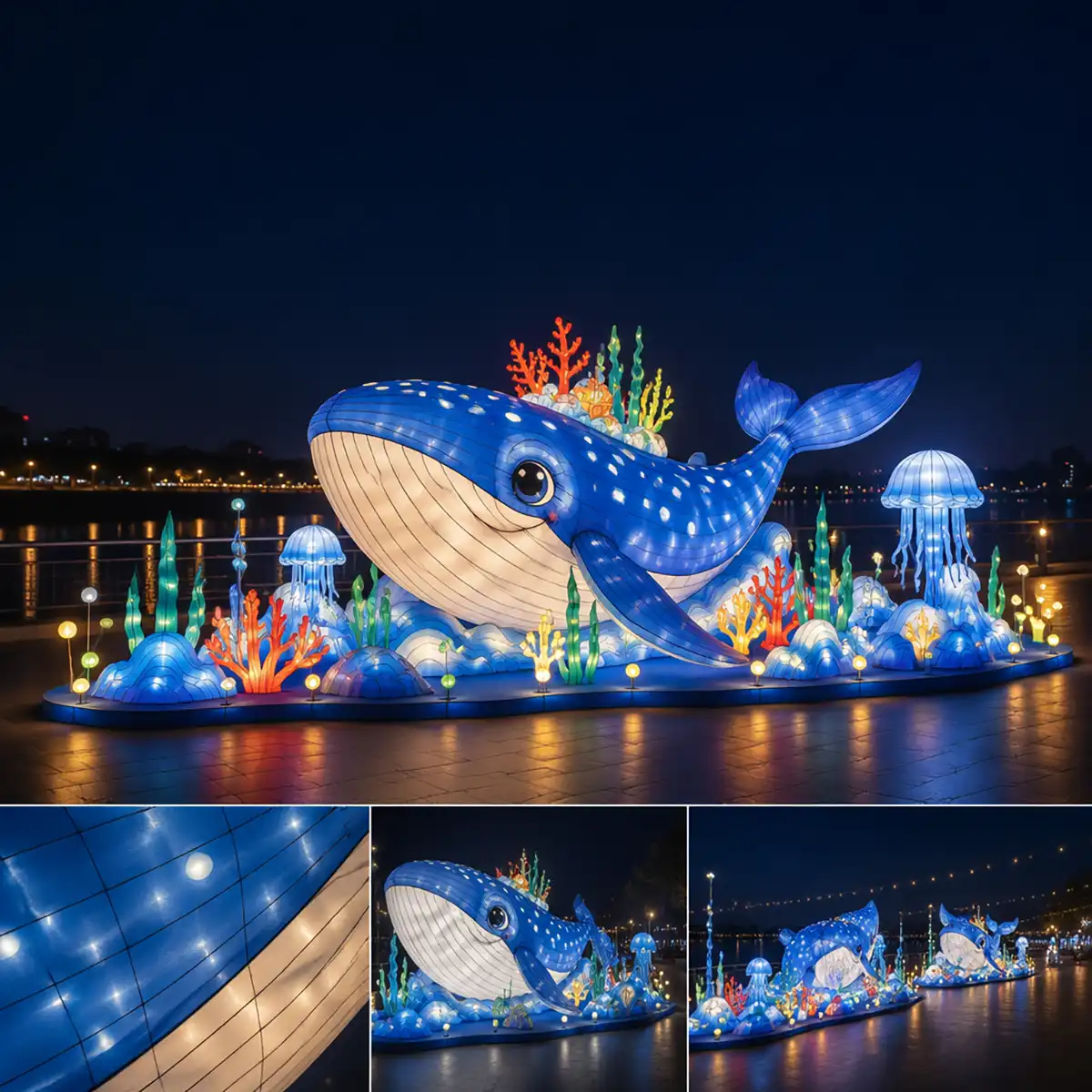
The piece is built as a framed body on a concealed support, mounted over a coral reef base that carries its own lit elements — jellyfish figures, sea grass and reef structure. The body is framed in weatherproof metal with high-density fabric over the form, internally lit on low-voltage outdoor-rated circuits, with the base elements on separate supplies so the balance between the whale and the reef can be set on site. Body sections are built to split for transport.
A suspended animal is a structural problem before it is a design
The visual appeal of a breaching whale is that it appears to be doing something impossible for its size. Making that read requires the support to be effectively invisible from the main viewing direction, and hiding a support for a figure of this mass is not a small detail.
- Bring the support in from below, at the underside of the body or the base of the tail. These are the two places where a tube can meet the body and be covered by the body itself from the approach angle. A support attached at the flank or the head is visible from every direction except one.
- Size the base against overturning, not against weight. The load on the base is not the mass of the whale, it is the moment created by that mass at the end of a long arm — plus wind on a large surface high above the ground. Bases that are sized by weight and look adequate are frequently inadequate, and the failure mode is the whole piece tipping rather than the support bending.
- Conceal the support in the composition, not with scenery. Hiding a support behind a rock or a stand of sea grass works until the visitor moves. The reliable solution is to have the body overhang its own support from the direction people arrive from.
- Give the support its own service access. A failed module in a suspended figure means working at height, and being able to reach the runs through the support is what turns a crane job into a ladder job.
Where a site allows it, an overhead suspension from a frame or a structure is the cleaner arrangement and removes the ground support entirely. It also changes the installation requirements substantially, so it is a decision for the drawing stage rather than the installation week.
Blue is the colour that goes plastic fastest
Blue is the most common request for a marine subject and the colour most likely to look wrong once lit. Under internal illumination a saturated blue surface loses its mid-tones, and the result is a flat, bright, obviously synthetic panel rather than the deep slightly grey blue of water.
| Approach | What happens |
|---|---|
| Body painted in saturated blue with a lit surface | Flat and bright. Reads as painted plastic, and the animal loses its form because there is no tonal range left to model with. |
| Body in grey-blue with blue carried by the environment | Holds its mid-tones, and the blue reads as light rather than as pigment. This is the workable approach. |
| Body in blue with a strong white underlight | Washes the underside and destroys the dark markings that identify the species. |
What makes this work is separating the colour of the surface from the colour of the light. The whale’s own finish should be a desaturated blue-grey, which is close to what a whale actually looks like in water; the blue that the visitor perceives comes from the reef base lighting, from the surroundings and from a cool rim light along the top of the body. That combination produces a blue animal without painting one.
The pale underside follows the same logic in reverse. The white belly and throat are the brightest parts of a whale and they also have almost no headroom before they blow out. Keeping the underside a step below the brightest element in the scene — which in this composition should be the lit reef below it — preserves the tonal separation that the rest of the figure depends on.
Spotted markings: the dark areas carry the species
Markings are what tell a visitor which whale they are looking at, and on lantern animals the markings only work if the dark regions are left dark. This is the same principle as the mask on a raccoon or the eye patches on a panda, and it fails the same way: the instinct to light the whole figure evenly removes exactly the contrast that makes the animal identifiable.
- Do not light the dark markings. Adding light to a dark region turns it into a grey patch and the animal becomes generic. The markings are a silhouette device, not a surface.
- Keep the boundary between markings and skin crisp. On silk, dark paint over a lit surface bleeds at the edge. An opaque backing behind the dark areas rather than relying on paint thickness is what keeps the edge readable at distance.
- Distribute markings unevenly, as the species does. Real markings are asymmetric and cluster in some areas and not others. Evenly scattered spots read as a pattern rather than an animal, and the eye recognises it immediately as manufactured.
- Scale the markings against the viewing distance. At double life size, markings that read correctly from ten metres will be almost invisible from thirty. If the piece is meant to be seen from across a plaza, the marking sizes are set against that distance rather than against a close-up view.
The reef base must not outshine the whale
Coral is the most colour-dense element in any marine composition, and it competes with the animal for attention by default. A reef base lit at the same level as the whale turns the piece into a bright base with an animal above it, which is the opposite of the intended reading.
- Keep coral saturation below the whale’s. Coral can be warm and varied, but at a lower intensity than the animal. The reef is context, and context that is louder than the subject stops being context.
- Light the reef at a lower level than the whale. This is not only a hierarchy decision, it is a directional one: a lit reef below a suspended animal throws light up onto the underside and removes the belly shading that gives the body its shape.
- Build the reef as structure, not as a flowerbed. Coral is a skeleton form with flat faces and open gaps, not a dense cluster of soft shapes. Getting that wrong is the main reason reef bases read as decorative bushes.
- Keep the reef footprint readable. The base is what the piece stands on, and it should read as a piece of ground with coral growing on it rather than as a plinth with decoration attached.
What changes above life size
Scaling a whale to double life size changes the viewing experience before it changes anything else. At twelve metres plus, nobody sees the whole animal at once if they are standing near it, and the details that carry a smaller piece drop out.
- Detail has to be simplified into blocks of light and shade. Finer surface modelling that works on a 5 m figure is invisible on a 15 m one. The form has to read as large shapes: the mass of the head, the line of the back, the sweep of the tail.
- The silhouette does all the work. At this scale the recognisability of the piece comes from outline rather than surface, which is why the fluke shape and the head profile matter more than any painted detail.
- Marking sizes have to increase with the figure. Everything scales, including the markings, but the viewing distance increases faster than the figure does on a large site, so markings often need to be proportionally larger than life.
- The approach matters more than the object. On a large piece the visitor’s experience is the sequence — seeing the tail from the path, the body from the plaza, the head from underneath. Designing the piece as a set of views rather than a single object is what makes the scale work.
Building something that has to travel in sections
Any whale lantern above roughly 6 m is built in sections and assembled on site, and where the joints fall is a design decision rather than a packing one.
- Put joints where the body has a natural change of direction or a colour boundary. A joint on a straight run of a smooth surface is visible from any angle. A joint at the shoulder line or at a marking boundary can be made to disappear.
- Design the joints to be aligned, not just closed. A visible step between two sections of a large smooth body is the most obvious tell on an assembled figure. Register pins or a shaped mating face keep the sections true.
- Keep the lighting runs connected across joints. Plugs that are reached through an access hatch at the joint mean the body does not have to be opened to commission the piece.
- Plan for the sections to be re-assembled without the original crew. Large pieces are frequently re-installed on a second site, and numbered sections with a marked layout drawing make that practical.
Specifications
| Attribute | Details |
|---|---|
| Body length | Typically 12 m – 25 m for a double-life-size hero figure; smaller versions from 6 m |
| Pose | Breaching, arcing or turning, with the support concealed below at the underside or tail base from the main viewing direction |
| Base | Coral reef unit sized against overturning moment and wind load, not dead weight; lit at a lower level than the body |
| Companion elements | Jellyfish figures, sea grass, starfish and reef structure as independent lit units |
| Colour | Desaturated blue-grey body with the blue carried by reef and rim lighting; pale underside kept below the brightest element |
| Markings | Dark regions unlit with an opaque backing for crisp edges; uneven distribution; sized against the intended viewing distance |
| Structure | Weatherproof metal armature; high-density fabric over frame; built in sections with joints at natural breaks and aligned mating faces |
| Lighting | Low-voltage outdoor-rated LED; separate circuits for body and reef; service access through the support and at joints |
| Materials finish | UV-resistant painted silk; CE / UL electrical components |
| Weather rating | Outdoor-rated; designed against wind load on a large elevated surface |
| Applications | Coastal plazas, aquarium entrances, beachfront festivals, lakeside parks, city landmark installations |
Frequently Asked Questions
How is the whale held up?
On a concealed support entering the body from below at the underside or the tail base, positioned so the body overhangs it from the direction visitors arrive. Where a site has an overhead structure, suspension from above is a cleaner arrangement and removes the ground support. Both are settled at the drawing stage because they change the base design.
Why not paint it blue?
Because a saturated blue surface under internal light loses its mid-tones and reads as plastic, and the animal then has no tonal range left to model its form with. The body is finished in a desaturated blue-grey and the blue the visitor sees comes from the reef lighting, the surroundings and a cool rim light along the back.
Can the pose be changed?
Yes. Breaching, arcing and turning are all built, and the pose is set from a reference at the drawing stage. The pose determines where the support can be concealed, so it is the first decision rather than a refinement.
How large can it be built?
Body lengths up to around 25 m are built for landmark installations, in sections. Above that the practical constraints are transport and site access rather than fabrication, and the section plan becomes the limiting design document.
Can the reef be reduced for a smaller site?
Yes. The base elements are independent units, so the piece can be delivered as the body, the support and a minimal reef, with the jellyfish, sea grass and additional reef structure added later. See the fish lantern for a smaller marine piece often specified in the same setting.
Does it work indoors?
Yes, and indoors the suspension arrangement becomes straightforward — an overhead structure is usually already present. Interior versions are common for aquarium entrances and exhibition halls. See the underwater and marine designs for related pieces.
Related Products and Designs
Other marine designs: the glowing fish school and the ocean world archway, with the wider group on the underwater and marine designs page.
Large suspended figures: the fish lantern, or browse the animal lanterns range for other oversized animals.
Send the site plan, the intended viewing distance and whether an overhead structure is available through the contact form, and we will return a support arrangement and section plan.
This is an AI-assisted concept visualization paired with human-written design intent and production-verified technical specifications. It is a design direction — not a manufactured product. When you order, our team creates custom 3D renderings and fabricates the actual lantern in our Zigong workshop.
This design is built specifically for Underwater & Marine / Seahorse Encounter. Every element is handcrafted by Zigong lantern artisans on a weatherproof internal frame and wrapped in high-density fabric with energy-efficient LED lighting. The set scales from compact (3 m wide) to monumental (8 m+ wide) depending on your venue footprint and budget.
Design Specifications
| Theme | Underwater & Marine / Seahorse Encounter |
| Main Figures | Hero seahorse (1.5x life-size, upright spiral posture), 3-5 smaller seahorse companions |
| Companion Elements | Coral reef base, shell lanterns, illuminated pearls, sea grass |
| Frame Material | Internal frame |
| Skin Material | High-density fabric |
| Lighting | Energy-efficient LED fixtures (custom color palette per scene) |
| Color Palette | Sky blue, deep blue, gold ridges, coral pink, cream accents |
| Recommended Setting | City plaza roundabout, marine aquarium entrance, hotel lobby wall, children ocean park, beachside promenade |
| Customization | Size scaling, color adjustments, figure modifications, school count (for fish school) |
| Installation | On-site assembly by our crew or supervised local install |
Design Features
- Hand-Painted Silk Construction — Every surface is hand-painted in our Zigong workshop by experienced artisans. No two scenes are identical.
- Festival-Grade Durability — Built to outdoor permanence with outdoor-rated lighting and anti-corrosion frame, suitable for multi-month coastal installations.
- Modular Architecture — Each design element (hero figure, companions, scenery) is a separate module for transportation, storage, and re-use.
- Scaled to Your Space — Standard configurations range from 3 m to 8 m in key dimensions. We scale to match your exact site footprint.
- Energy-Efficient LED Lighting — Bright, vivid colors without heat or excessive power draw — ideal for nightly runs through the summer festival season.
- Bioluminescent Detail — Antenna modules and jellyfish components use RGB accent lighting for animated night-time display.
FAQ
Is this design a real product or a concept?
This is an AI-assisted concept visualisation, not a manufactured product. When you order, our team creates custom 3D renderings based on your requirements and fabricates the actual lantern in our Zigong workshop.
Can the size be adjusted?
Yes. Standard configurations range from 3 m to 8 m in key dimensions. We scale up or down to match your exact site footprint and ceiling height constraints.
Can the colours and themes be customised?
Yes. Colours, figure details, and scene elements can all be adjusted. We produce custom 3D renderings for approval before fabrication begins.
Is this suitable for outdoor display?
Yes. All designs use weatherproof internal frames and treated fabric rated for outdoor conditions. Festival-grade weatherproofing handles multi-month outdoor exposure.
How long does production take?
Standard production is 6–10 weeks depending on size and order queue. Add 1-2 days for on-site installation.
Related Designs & Resources
- All Creative Designs — Browse our full collection of AI-concept lantern designs
- Underwater & Marine Designs — sibling ocean scenes
- Ocean World Lantern Archway — companion entrance piece
- Spinosaurus Aquatic Predator — companion aquatic dinosaur
- Animal Lanterns collection — marine + animal designs
- Request a Custom Design — Get pricing for your ocean-themed event
Explore our Animatronic Argentinosaurus — Lifesize Sauropod Dinosaur Exhibit for your next custom festival or themed event.
Explore our Life-Size Animatronic Woolly Mammoth — Ice Age Megafauna for Museum & Theme Park Exhibits for your next custom festival or themed event.
Build This Look at Your Venue
A glowing fish school is sold as a quantity, not as an animal, and that changes the design brief completely. There is no hero figure to get right, no face to read and no single viewpoint that has to work. What makes or breaks the piece is whether the group reads as a school, whether the light reads as something alive in deep water, and — the part most installations get wrong — whether the scene is lit the way a deep-sea subject has to be lit, which is the opposite of how every other festive piece in this range is lit.
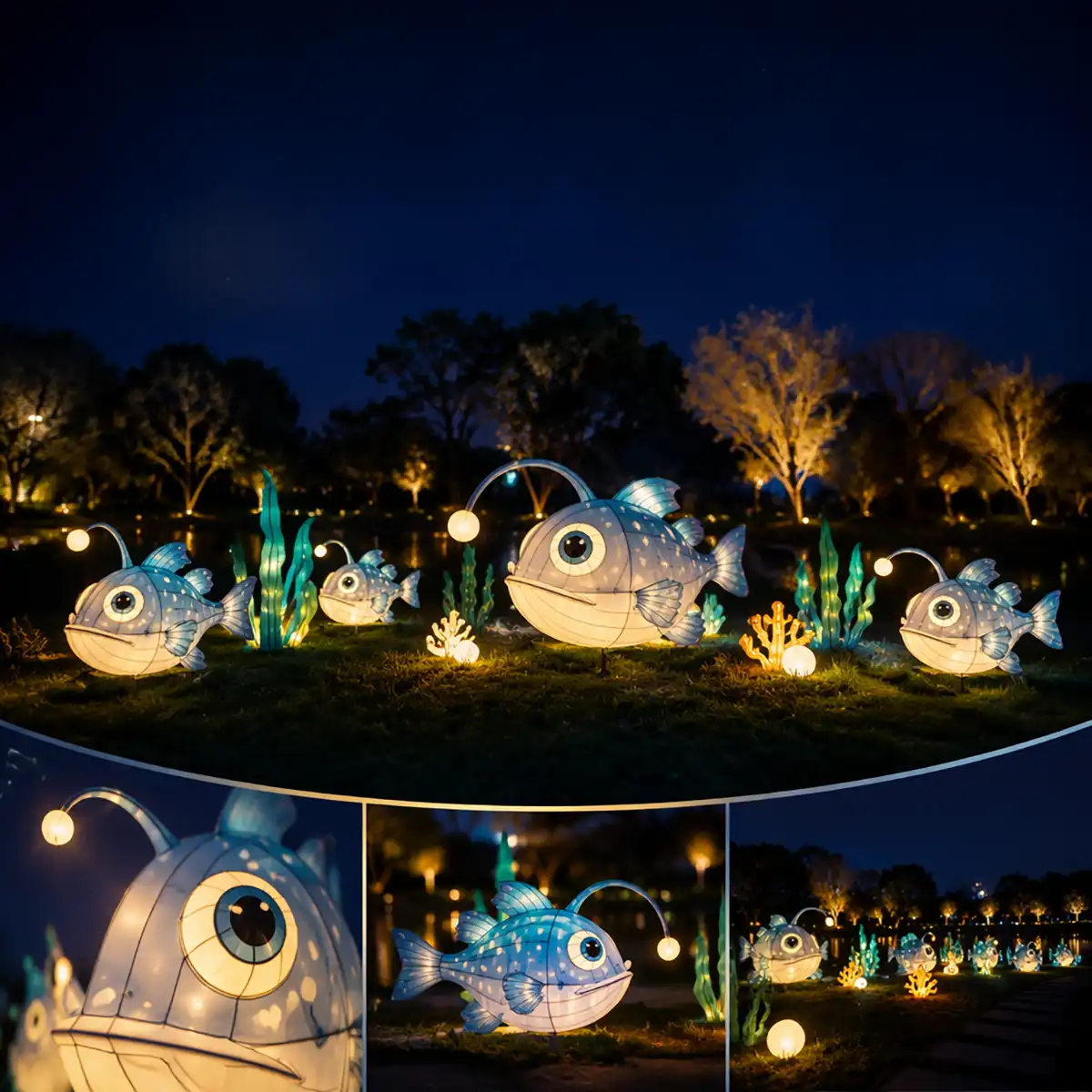
The installation is built as a set of identical fish units, each roughly 1.5 m long and 0.8 m tall, on slim supports or suspended from a frame, arranged in three dimensions across the site. Each fish carries an internally lit body on a low-voltage outdoor-rated circuit and a single bright antenna point at the end of its lure. Units share a supply bus so that a group of fifty can be commissioned and serviced as a manageable number of runs rather than fifty individual connections.
A school is made of quantity, not of one good fish
The first instinct on this subject is to make a very good fish and then multiply it. That produces a row of good fish, which is not a school. A school is a pattern created by number, by a shared direction of travel, and by figures overlapping in depth — and the third of those is the one usually missing.
| Arrangement | What it reads as |
|---|---|
| Eight fish in a line, evenly spaced, all at one height | A row of fish. The eye counts them and moves on. |
| Eight fish at varied heights but all on a single plane | A decorative screen. Better, but still flat — visitors see the arrangement from the side and it resolves into a pattern. |
| Twenty fish at varied heights and depths, aligned in direction | A school. The overlapping creates depth and the direction of travel creates movement. |
| Fifty fish with five per cent off-axis | A living school. The small number of fish turned off the main direction is what stops the group reading as a printed pattern. |
Three practical rules follow. The first is that the shared direction has to be visible from the main approach — a school travelling at right angles to the route reads as scattered fish. The second is that the deviation from that direction should be small and rare: five to ten per cent of the units, each turned a little, is enough. The third is spacing: perfectly even spacing is what makes a school look manufactured, and the variation in gaps matters more than the variation in heights.
The light of a deep-sea fish is a point, not a panel
This is the single decision that determines whether the piece reads as deep sea or as a festive display. Bioluminescence in the deep ocean is a small, intense point of light in an otherwise dark animal. It is not a glowing body with a bright detail on the front.
- Keep the body dim and the antenna bright. The fish bodies should be lit just enough to read as forms against the dark — a low interior glow on a dark ground, not a bright lantern. The antenna point carries all the intensity.
- One point per fish, not several. Multiple glowing spots per figure read as a string of bulbs. A single bright point at the end of the lure is what reads as an organism.
- Shield the antenna from below. Bright points at head height or above are looked at from underneath as visitors walk through, and an unshielded point is a source of glare rather than an effect. A small shade above and beside the module keeps the light in the viewing direction.
- Let the point be the brightest thing in the frame. In this composition the antenna points are the only elements that should be at full intensity. If the reef or the ground is lit to a comparable level, the points stop reading as light sources and the scene turns into a normal illuminated installation.
Layout in three dimensions, not on a lawn
A fish school is one of the few subjects in this range that is genuinely spatial. Laid out flat it works as a wall; laid out in three dimensions, with the fish at different heights and depths across a walking route, it becomes an environment. Visitors walk through it rather than past it, which is the reason to specify this piece at all.
- Vary the mounting height across the group. A band of roughly 2 to 5 m above ground gives the school a vertical extent and lets visitors pass underneath. Fish all at the same height, whether high or low, read as a flat plane.
- Vary the depth as well as the height. Depth is what creates overlap, and overlap is what makes the number of units read as more than it is. A group of twenty with real depth reads denser than forty on a single plane.
- Keep the supports thin and consistent. Slim supports entering the body from the belly or behind the tail, hidden by the fish from the approach direction. Consistency matters as much as slimness — a group where some supports show and others do not looks unfinished.
- Keep the walking line clear. The school should be arranged around the route rather than across it, so the path stays a path. Where the route passes under the group, the clearance is set at the drawing stage.
Why this piece is lit the opposite way to a festive display
Almost every piece in this range is lit on the principle that everything should be visible. A deep-sea subject fails if it is lit that way, because the effect being reproduced only exists in darkness. The lighting philosophy here is the reverse: the background goes dark, and a small number of points carry the entire image.
- Keep the ground illumination very low or off. Ground wash is the single fastest way to destroy this piece. With the ground lit, the fish stop being objects in dark water and become objects on a lit lawn.
- Keep the surrounding pieces out of the frame. A fish school placed next to a brightly lit festive display loses its effect entirely, not because of anything wrong with the school but because the ambient light in the visitor’s field of view is too high. Give the piece its own dark stretch of route.
- Use the dark as the subject. The gaps between the fish are as much a part of the installation as the fish are. The tendency to add more light to make it more impressive is what turns a deep-sea scene into a decorative one.
- Keep the light points warm against the cool body and the dark. A warm point in a cool, dark field is the strongest visual signal available, and it is also what the subject actually looks like.
Colour that reads as deep sea
Deep-sea colour is a narrow band: dark upper surfaces, pale undersides, and one warm accent. It is also easy to over-decorate, because a subject this simple invites adding colour to make it interesting.
- Keep the body desaturated and dark. A low-saturation blue-grey upper surface and a pale underside is the whole palette. Saturated blues go bright under internal light and turn the fish into toys.
- Reserve warmth exclusively for the antenna points. If warm light appears on the bodies, on the ground or on the supports, the points stop being the accent and stop reading as light sources.
- Keep the pale undersides below the brightness of the points. A whale or fish underside has almost no headroom before it blows out, and once it goes white the form of the animal is lost.
- Do not introduce reef colour into this piece. This is an open-field subject. Bright coral or plant elements underneath it move the piece into a different category and undo the effect the layout is built for.
Walking under a school
Where the layout allows visitors to pass beneath the group, the experience of the piece changes substantially — and so do the practical requirements.
- Gather the fish around the route, not spread evenly over it. A visitor walking under an even distribution sees two or three fish. Walking through a denser band with gaps at either end sees the school as a school.
- Keep the density highest at the point where visitors first pass under. The first impression should be the densest, because that is the moment that establishes what the piece is.
- Check every point for glare from below. The walking line is the one place where every antenna in the group is seen from underneath. Shielding is settled against that view rather than against the view from the path.
- Keep the group’s direction of travel consistent with the walking direction, or clearly across it. A school that swims with the visitor reads differently from one that swims against them, and either is fine as long as it is deliberate rather than mixed.
Specifications
| Attribute | Details |
|---|---|
| Fish units | Standard 1.5 m long × 0.8 m tall; 8 units minimum, scalable to 50+ |
| Layout | Three-dimensional, 2 m – 5 m above ground, varied in height and depth; aligned in a shared direction with five to ten per cent turned off-axis |
| Lighting | Dim low-voltage body lighting with a single shielded bright point at the end of each lure; points as the brightest elements in the composition |
| Glare control | Shaded antenna modules so points do not glare when seen from below on the walking line |
| Supports | Slim supports entering the body from the belly or behind the tail, concealed by the fish from the approach direction; frame suspension where available |
| Wiring | Shared supply bus with grouped circuits rather than individual connections for each fish |
| Colour | Desaturated blue-grey upper surface, pale underside kept below the brightness of the points, warm light reserved for the antenna points |
| Ground | Ground illumination minimal or off; no bright reef or plant elements in this piece |
| Structure | Weatherproof metal armatures; high-density fabric over frame |
| Materials finish | UV-resistant painted silk; CE / UL electrical components |
| Weather rating | Outdoor-rated, with grouped service access |
| Applications | Outdoor lantern festivals, lakeside parks, beachfront promenades, aquarium exteriors, dark-route feature sections |
Frequently Asked Questions
How many fish are needed before it reads as a school?
Around eight is where a group starts reading as a group rather than as a few fish, but the number matters less than the layout. Twenty units with real variation in height and depth read denser than forty laid out on a single plane, and the spacing variation is what the eye picks up.
Why is the body lighting so dim?
Because bioluminescence is a point of light on a dark animal, not a bright animal. If the bodies are lit like lanterns the piece reads as a festive display with bright details rather than as a deep-sea subject, and the antenna points stop functioning as light sources. The dimness of the bodies is what makes the points work.
Will people be able to walk underneath?
Usually yes, and it is the arrangement that makes this piece worth specifying. The group is arranged around the route with clearance set at the drawing stage, and the antenna shielding is checked from the walking line, which is the one view where every point in the group is seen from below.
Can it be installed next to other lit pieces?
It can, but the effect depends on the surrounding light level. A deep-sea group placed against a brightly lit display loses most of its impact, not because of anything in the piece itself. The usual approach is to give it its own darker stretch of route, which is a programming decision as much as a design one. See the underwater and marine designs for related pieces.
Can the school be extended in a later season?
Yes. Units are produced to the same reference and the layout drawing records the positions, so additional fish can be added into the existing arrangement. Because the units share a supply bus, extension usually means adding to an existing circuit rather than running a new one.
Does it work indoors?
Yes, and a dark interior suits the lighting philosophy better than most outdoor sites. Aquarium halls and exhibition spaces are common specifications. For a larger single-figure marine piece, see the whale lantern sculpture.
Related Products and Designs
Other marine designs: the whale lantern sculpture and the ocean world archway, with the wider group on the underwater and marine designs page.
Smaller fish pieces: the fish lantern, and the animal lanterns range for other species.
Send the route plan, the available height and the number of units through the contact form, and we will return a three-dimensional layout with positions and circuit grouping marked.
This is an AI-assisted concept visualization paired with human-written design intent and production-verified technical specifications. It is a design direction — not a manufactured product. When you order, our team creates custom 3D renderings and fabricates the actual lantern in our Zigong workshop.
This design is built specifically for Underwater & Marine / Dolphin Encounter. Every element is handcrafted by Zigong lantern artisans on a weatherproof internal frame and wrapped in high-density fabric with energy-efficient LED lighting. The set scales from compact (3 m wide) to monumental (8 m+ wide) depending on your venue footprint and budget.
Design Specifications
| Theme | Underwater & Marine / Dolphin Encounter |
| Main Figures | Hero dolphin (2.5x life-size, mid-leap arc) |
| Companion Elements | Coral reef (orange/pink/cream), illuminated water spheres, orange starfish, sea grass |
| Frame Material | Internal frame |
| Skin Material | High-density fabric |
| Lighting | Energy-efficient LED fixtures (custom color palette per scene) |
| Color Palette | Sky blue, deep blue, coral pink, cream, orange accents |
| Recommended Setting | City street corner plaza, shopping mall entrance, marine aquarium walkway, resort lobby, theme park |
| Customization | Size scaling, color adjustments, figure modifications, school count (for fish school) |
| Installation | On-site assembly by our crew or supervised local install |
Design Features
- Hand-Painted Silk Construction — Every surface is hand-painted in our Zigong workshop by experienced artisans. No two scenes are identical.
- Festival-Grade Durability — Built to outdoor permanence with outdoor-rated lighting and anti-corrosion frame, suitable for multi-month coastal installations.
- Modular Architecture — Each design element (hero figure, companions, scenery) is a separate module for transportation, storage, and re-use.
- Scaled to Your Space — Standard configurations range from 3 m to 8 m in key dimensions. We scale to match your exact site footprint.
- Energy-Efficient LED Lighting — Bright, vivid colors without heat or excessive power draw — ideal for nightly runs through the summer festival season.
- Bioluminescent Detail — Antenna modules and jellyfish components use RGB accent lighting for animated night-time display.
FAQ
Is this design a real product or a concept?
This is an AI-assisted concept visualisation, not a manufactured product. When you order, our team creates custom 3D renderings based on your requirements and fabricates the actual lantern in our Zigong workshop.
Can the size be adjusted?
Yes. Standard configurations range from 3 m to 8 m in key dimensions. We scale up or down to match your exact site footprint and ceiling height constraints.
Can the colours and themes be customised?
Yes. Colours, figure details, and scene elements can all be adjusted. We produce custom 3D renderings for approval before fabrication begins.
Is this suitable for outdoor display?
Yes. All designs use weatherproof internal frames and treated fabric rated for outdoor conditions. Festival-grade weatherproofing handles multi-month outdoor exposure.
How long does production take?
Standard production is 6–10 weeks depending on size and order queue. Add 1-2 days for on-site installation.
Related Designs & Resources
- All Creative Designs — Browse our full collection of AI-concept lantern designs
- Underwater & Marine Designs — sibling ocean scenes
- Ocean World Lantern Archway — companion entrance piece
- Spinosaurus Aquatic Predator — companion aquatic dinosaur
- Animal Lanterns collection — marine + animal designs
- Request a Custom Design — Get pricing for your ocean-themed event
Explore our Animatronic Argentinosaurus — Lifesize Sauropod Dinosaur Exhibit for your next custom festival or themed event.
Explore our Life-Size Animatronic Woolly Mammoth — Ice Age Megafauna for Museum & Theme Park Exhibits for your next custom festival or themed event.
Build This Look at Your Venue
The first thing visitors reach for their camera for. A single phoenix lantern stands three metres tall, plumage fanning from gold at the chest to electric blue at the tail tip — every feather shaped, painted and backlit by hand in our Zigong workshop. Place it at the entry curve of a lantern festival and visitors stop walking. Put it beside a water feature and the reflection doubles the spectacle. Mount it as the hero piece on a resort atrium and guests take a thousand photos before the weekend is over.
What separates this piece from the long phoenix body lanterns our industry produces is the bird’s own presence. Most phoenix lanterns are designed to live inside a longer scene — perched at the front of a glowing procession, riding on the back of a dragon. This piece stands alone. The posture is proud, the gaze level, the tail feathers engineered to catch wind without losing shape. It reads as a sculpture the moment the lighting goes down and a lantern the moment it lights up.
The build is the same hand-crafted standard we apply to every piece from this workshop — welded internal skeleton, sculpted foam sub-form, hand-laid fabric, layered hand-painting in iridescent pigments, internal LED warm-white lighting tuned to bring out the gold and blue without washing the orange. Available as a single hero sculpture, a matched pair for symmetrical entrances, or scaled up to five metres for outdoor plazas. Based in Zigong, shipped and installed worldwide.
Design Specifications (Production Reference)
| Design Name | Ocean World Lantern Archway |
| Type | Walk-through festival archway (single or multi-arch procession) |
| Standard Size | 5 m wide × 4 m tall × 2 m deep (single arch) / custom 4–12 m configurations |
| Frame | Welded internal skeleton, anti-corrosion treated for outdoor use |
| Skin | Hand-sculpted foam sub-forms + layered fabric, hand-painted |
| Character Modules | Manta rays (2), schooling whales (3-5), coral reef pillars (2-4), kelp fronds (8-12), globe lanterns (12-20) |
| Finish | Polka-dot pattern on manta rays + whales, multi-tone coral palette, ocean-blue underlighting |
| Lighting | Internal warm-white LED + RGB accent lighting on character modules, outdoor-rated outdoor rated |
| Control | Standard on/off, DMX512 programmable for sequencing, app-controlled available |
| Power | 110/220 V AC, single phase, ~1.5 kW peak for standard 5 m archway |
| Weatherproofing | outdoor-rated — continuous outdoor display ready, -25°C to 50°C |
| Installation | Crane-lift, ground-anchored base plates; 4-6 person crew, 1-2 days |
| Customisation | Silhouette scale, character modules, colour palette, lighting sequence |
Design Intent
Why an ocean theme works for an entrance archway
Most festival archways are either vegetative (floral, tree, leaf) or architectural (pagoda, palace gate, modern). Underwater themes are rarer because of the engineering challenge — marine life is sculptural rather than symmetrical, and the elements need to feel weightless. Get it right and the visitor feels they have stepped into another world before they have walked five metres. This is the upside of the concept and the reason we have it on the design board.
The manta ray at the apex reads as a gateway
The two manta rays at the apex are not decorative — they are the structural load-bearing element of the arch. Their outstretched fins form the arch curve itself, with the polka-dot belly pattern providing the backlit illumination through the central walking lane. The cultural reference is subtle and global — manta rays do not need to be explained, they are immediately recognised as the signature of a marine environment.
The coral pillars function as both decoration and structural support
The bottom-third of the arch is a coral reef — branching pink and orange coral fans, swaying kelp fronds, and round globe lanterns that read as floating bubbles. This is not just decoration. The coral pillars are the structural supports that anchor the archway to the ground plane, hiding the metal uprights inside the sculpted reef forms.
The walking lane is the actual functional asset
A festival archway only earns its place if visitors walk through it. The single-arch layout gives a 1.8 m walking lane; the multi-arch procession layout extends this to 3-4 m. The colour gradients from cool blue at the entrance to warmer rainbow inside the festival transition visitors out of the outside world and into the event.
The colour palette is customisable
The default palette is deep ocean blue + coral pink + pastel rainbow. Venues that want a different mood can shift to (a) night-sky black with bioluminescent green accents, (b) sunset coral with deep red gradients, or (c) full pastel rainbow for a children’s land entry. Palette changes are pre-agreed before fabrication and included in standard production.
Applications
- Marine Aquarium Walkway Entrance — The primary application. Place the archway at the entry from the visitor centre to the outdoor aquarium walkway. Visitors photograph it before they read a single sign.
- Water Park Entry — Water parks use this as the entry archway to the evening festival section. The ocean theme bridges the actual waterpark and the festival narrative.
- Beach Resort Evening Display — Place at the entrance to a beachside evening market or restaurant row. The arcs of the manta rays frame the sunset direction.
- Summer Festival Opening — Festival organisers use this as the seasonal entrance for July–August summer festival openings. The cool blue palette provides relief from summer heat visually.
- Pier-End Lantern Night — Coastal cities hosting lantern festivals at piers or waterfronts use this as the entry from the pier head to the festival grounds.
- Children’s Ocean Park — Aquatic-themed children’s parks install this as the entry archway to the “underwater kingdom” section. The globe lanterns at children’s eye height are the photo moment.
FAQ
- Is this design suitable for a venue that does not have an ocean theme? Yes. The design is colour-customisable. We can shift the palette to bioluminescent green (forest theme), sunset coral (desert theme), or a neutral warm white for venues that want the silhouette without the ocean colour narrative.
- Can the archway be scaled up to a multi-arch procession? Yes. The standard version is a 5 m single arch. We can extend to a 3-arch procession layout (15 m wide) or a 5-arch layout (25 m wide) for larger festival entrances. The silhouette is engineered to scale without losing the manta ray at the apex effect.
- How long does production take? From approved 3D rendering to on-site delivery is 30–45 days. Add 1-2 days for site installation on top.
- Can the colour of the manta rays be changed (not just the body)? Yes. Default is polka-dot blue/white. We can shift to bioluminescent green, sunset coral, or any custom palette. Polka-dot pattern can be replaced with custom design.
- What footprint does the archway need? Standard 5 m × 4 m archway needs approximately 6 m × 6 m of clear floor space plus 1 m working clearance around. Multi-arch processions scale linearly.
- Is the piece suitable for permanent outdoor display? Yes. Anti-corrosion treated internal frame, outdoor-rated LED modules, weather-sealed hand-finished surface, operating range -25°C to 50°C. We have similar archways in continuous outdoor service in coastal China, Singapore and the Mediterranean.
- Can this design integrate with our existing venue architecture? Yes. We build to your entrance dimensions. The archway can attach to existing architecture (arches, columns, building portals) or stand as a freestanding structure with its own base plates.
Internal Linking
- All Creative Designs — full AI concept gallery
- Spinosaurus Aquatic Predator — companion aquatic dinosaur piece
- Penguin Colony Igloo Lantern — companion marine animal lantern
- Animal Lanterns collection — full marine + animal designs
- Chinese Lantern Ceremony — event installation service
- Request a free 3D design and quote