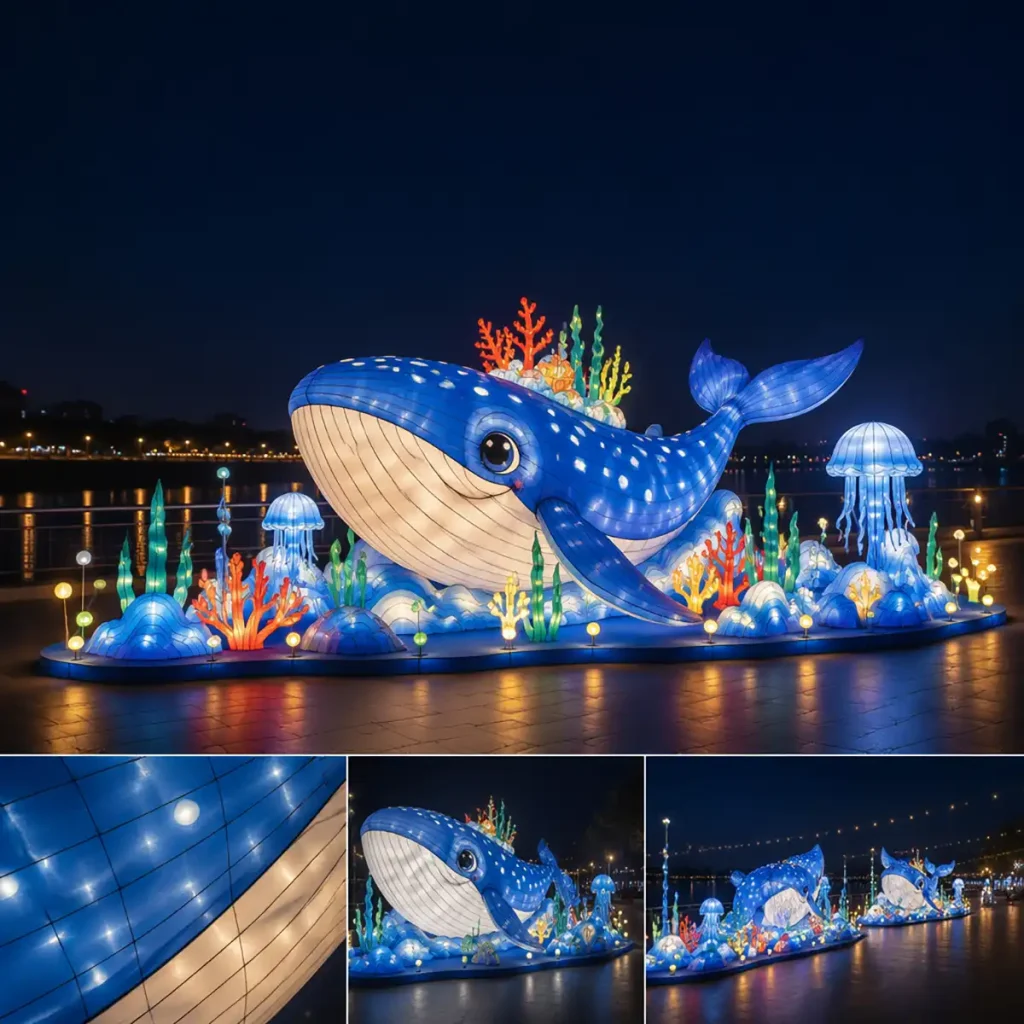
Whale Lantern — Ocean Encounter Sculpture
About This Design
This is an AI-assisted concept visualization paired with human-written design intent and production-verified technical specifications. It is a design direction — not a manufactured product. When you order, our team creates custom 3D renderings and fabricates the actual lantern in our Zigong workshop.
A whale lantern is almost always specified in a suspended pose — breaching, arcing, turning — and that single choice decides the engineering before any of the visual decisions get made. A ground-standing animal carries its own weight down through its feet. A whale held in mid-air carries its weight through a concealed support, and the entire mass of a large figure then acts as a lever on that support. This page covers that, together with the two colour problems specific to this subject, the fact that blue is the fastest colour in the range to start looking like plastic, and the fact that at double life size the surface detail that works at human scale stops being visible at all.
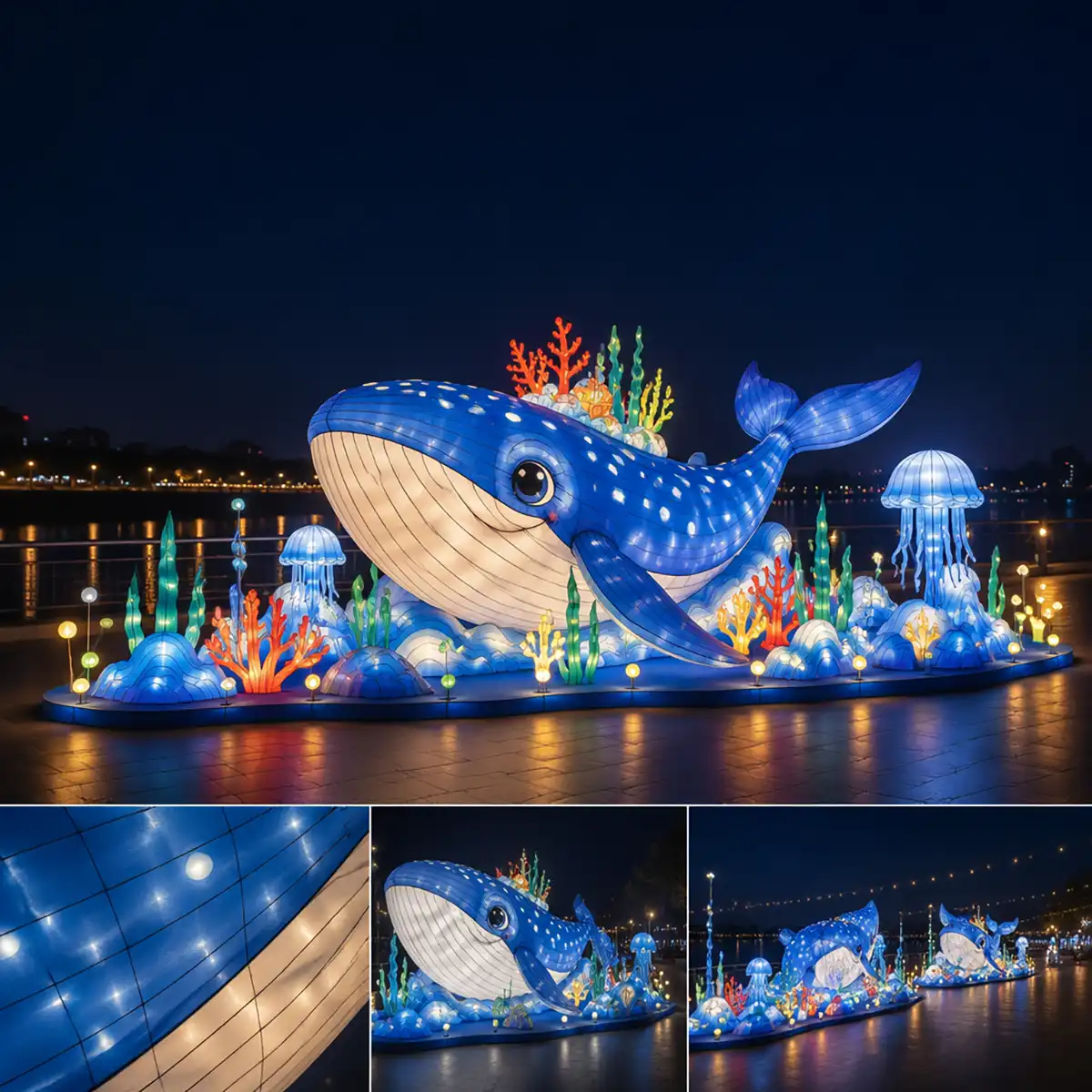
The piece is built as a framed body on a concealed support, mounted over a coral reef base that carries its own lit elements — jellyfish figures, sea grass and reef structure. The body is framed in weatherproof metal with high-density fabric over the form, internally lit on low-voltage outdoor-rated circuits, with the base elements on separate supplies so the balance between the whale and the reef can be set on site. Body sections are built to split for transport.
A suspended animal is a structural problem before it is a design
The visual appeal of a breaching whale is that it appears to be doing something impossible for its size. Making that read requires the support to be effectively invisible from the main viewing direction, and hiding a support for a figure of this mass is not a small detail.
- Bring the support in from below, at the underside of the body or the base of the tail. These are the two places where a tube can meet the body and be covered by the body itself from the approach angle. A support attached at the flank or the head is visible from every direction except one.
- Size the base against overturning, not against weight. The load on the base is not the mass of the whale, it is the moment created by that mass at the end of a long arm — plus wind on a large surface high above the ground. Bases that are sized by weight and look adequate are frequently inadequate, and the failure mode is the whole piece tipping rather than the support bending.
- Conceal the support in the composition, not with scenery. Hiding a support behind a rock or a stand of sea grass works until the visitor moves. The reliable solution is to have the body overhang its own support from the direction people arrive from.
- Give the support its own service access. A failed module in a suspended figure means working at height, and being able to reach the runs through the support is what turns a crane job into a ladder job.
Where a site allows it, an overhead suspension from a frame or a structure is the cleaner arrangement and removes the ground support entirely. It also changes the installation requirements substantially, so it is a decision for the drawing stage rather than the installation week.
Blue is the colour that goes plastic fastest
Blue is the most common request for a marine subject and the colour most likely to look wrong once lit. Under internal illumination a saturated blue surface loses its mid-tones, and the result is a flat, bright, obviously synthetic panel rather than the deep slightly grey blue of water.
| Approach | What happens |
|---|---|
| Body painted in saturated blue with a lit surface | Flat and bright. Reads as painted plastic, and the animal loses its form because there is no tonal range left to model with. |
| Body in grey-blue with blue carried by the environment | Holds its mid-tones, and the blue reads as light rather than as pigment. This is the workable approach. |
| Body in blue with a strong white underlight | Washes the underside and destroys the dark markings that identify the species. |
What makes this work is separating the colour of the surface from the colour of the light. The whale’s own finish should be a desaturated blue-grey, which is close to what a whale actually looks like in water; the blue that the visitor perceives comes from the reef base lighting, from the surroundings and from a cool rim light along the top of the body. That combination produces a blue animal without painting one.
The pale underside follows the same logic in reverse. The white belly and throat are the brightest parts of a whale and they also have almost no headroom before they blow out. Keeping the underside a step below the brightest element in the scene — which in this composition should be the lit reef below it — preserves the tonal separation that the rest of the figure depends on.
Spotted markings: the dark areas carry the species
Markings are what tell a visitor which whale they are looking at, and on lantern animals the markings only work if the dark regions are left dark. This is the same principle as the mask on a raccoon or the eye patches on a panda, and it fails the same way: the instinct to light the whole figure evenly removes exactly the contrast that makes the animal identifiable.
- Do not light the dark markings. Adding light to a dark region turns it into a grey patch and the animal becomes generic. The markings are a silhouette device, not a surface.
- Keep the boundary between markings and skin crisp. On silk, dark paint over a lit surface bleeds at the edge. An opaque backing behind the dark areas rather than relying on paint thickness is what keeps the edge readable at distance.
- Distribute markings unevenly, as the species does. Real markings are asymmetric and cluster in some areas and not others. Evenly scattered spots read as a pattern rather than an animal, and the eye recognises it immediately as manufactured.
- Scale the markings against the viewing distance. At double life size, markings that read correctly from ten metres will be almost invisible from thirty. If the piece is meant to be seen from across a plaza, the marking sizes are set against that distance rather than against a close-up view.
The reef base must not outshine the whale
Coral is the most colour-dense element in any marine composition, and it competes with the animal for attention by default. A reef base lit at the same level as the whale turns the piece into a bright base with an animal above it, which is the opposite of the intended reading.
- Keep coral saturation below the whale’s. Coral can be warm and varied, but at a lower intensity than the animal. The reef is context, and context that is louder than the subject stops being context.
- Light the reef at a lower level than the whale. This is not only a hierarchy decision, it is a directional one: a lit reef below a suspended animal throws light up onto the underside and removes the belly shading that gives the body its shape.
- Build the reef as structure, not as a flowerbed. Coral is a skeleton form with flat faces and open gaps, not a dense cluster of soft shapes. Getting that wrong is the main reason reef bases read as decorative bushes.
- Keep the reef footprint readable. The base is what the piece stands on, and it should read as a piece of ground with coral growing on it rather than as a plinth with decoration attached.
What changes above life size
Scaling a whale to double life size changes the viewing experience before it changes anything else. At twelve metres plus, nobody sees the whole animal at once if they are standing near it, and the details that carry a smaller piece drop out.
- Detail has to be simplified into blocks of light and shade. Finer surface modelling that works on a 5 m figure is invisible on a 15 m one. The form has to read as large shapes: the mass of the head, the line of the back, the sweep of the tail.
- The silhouette does all the work. At this scale the recognisability of the piece comes from outline rather than surface, which is why the fluke shape and the head profile matter more than any painted detail.
- Marking sizes have to increase with the figure. Everything scales, including the markings, but the viewing distance increases faster than the figure does on a large site, so markings often need to be proportionally larger than life.
- The approach matters more than the object. On a large piece the visitor’s experience is the sequence — seeing the tail from the path, the body from the plaza, the head from underneath. Designing the piece as a set of views rather than a single object is what makes the scale work.
Building something that has to travel in sections
Any whale lantern above roughly 6 m is built in sections and assembled on site, and where the joints fall is a design decision rather than a packing one.
- Put joints where the body has a natural change of direction or a colour boundary. A joint on a straight run of a smooth surface is visible from any angle. A joint at the shoulder line or at a marking boundary can be made to disappear.
- Design the joints to be aligned, not just closed. A visible step between two sections of a large smooth body is the most obvious tell on an assembled figure. Register pins or a shaped mating face keep the sections true.
- Keep the lighting runs connected across joints. Plugs that are reached through an access hatch at the joint mean the body does not have to be opened to commission the piece.
- Plan for the sections to be re-assembled without the original crew. Large pieces are frequently re-installed on a second site, and numbered sections with a marked layout drawing make that practical.
Specifications
| Attribute | Details |
|---|---|
| Body length | Typically 12 m – 25 m for a double-life-size hero figure; smaller versions from 6 m |
| Pose | Breaching, arcing or turning, with the support concealed below at the underside or tail base from the main viewing direction |
| Base | Coral reef unit sized against overturning moment and wind load, not dead weight; lit at a lower level than the body |
| Companion elements | Jellyfish figures, sea grass, starfish and reef structure as independent lit units |
| Colour | Desaturated blue-grey body with the blue carried by reef and rim lighting; pale underside kept below the brightest element |
| Markings | Dark regions unlit with an opaque backing for crisp edges; uneven distribution; sized against the intended viewing distance |
| Structure | Weatherproof metal armature; high-density fabric over frame; built in sections with joints at natural breaks and aligned mating faces |
| Lighting | Low-voltage outdoor-rated LED; separate circuits for body and reef; service access through the support and at joints |
| Materials finish | UV-resistant painted silk; CE / UL electrical components |
| Weather rating | Outdoor-rated; designed against wind load on a large elevated surface |
| Applications | Coastal plazas, aquarium entrances, beachfront festivals, lakeside parks, city landmark installations |
Frequently Asked Questions
How is the whale held up?
On a concealed support entering the body from below at the underside or the tail base, positioned so the body overhangs it from the direction visitors arrive. Where a site has an overhead structure, suspension from above is a cleaner arrangement and removes the ground support. Both are settled at the drawing stage because they change the base design.
Why not paint it blue?
Because a saturated blue surface under internal light loses its mid-tones and reads as plastic, and the animal then has no tonal range left to model its form with. The body is finished in a desaturated blue-grey and the blue the visitor sees comes from the reef lighting, the surroundings and a cool rim light along the back.
Can the pose be changed?
Yes. Breaching, arcing and turning are all built, and the pose is set from a reference at the drawing stage. The pose determines where the support can be concealed, so it is the first decision rather than a refinement.
How large can it be built?
Body lengths up to around 25 m are built for landmark installations, in sections. Above that the practical constraints are transport and site access rather than fabrication, and the section plan becomes the limiting design document.
Can the reef be reduced for a smaller site?
Yes. The base elements are independent units, so the piece can be delivered as the body, the support and a minimal reef, with the jellyfish, sea grass and additional reef structure added later. See the fish lantern for a smaller marine piece often specified in the same setting.
Does it work indoors?
Yes, and indoors the suspension arrangement becomes straightforward — an overhead structure is usually already present. Interior versions are common for aquarium entrances and exhibition halls. See the underwater and marine designs for related pieces.
Related Products and Designs
Other marine designs: the glowing fish school and the ocean world archway, with the wider group on the underwater and marine designs page.
Large suspended figures: the fish lantern, or browse the animal lanterns range for other oversized animals.
Send the site plan, the intended viewing distance and whether an overhead structure is available through the contact form, and we will return a support arrangement and section plan.
From Concept to Your Venue
Select & Customise
Choose a design direction. We will adjust size, colours, lighting, and theme to match your venue.
3D Render
Our design team creates production-ready 3D renderings based on the concept and your requirements.
Fabricate
Master artisans handcraft your lantern in our Zigong workshop — internal frame, hand-painted covering, LED programming.
QC & outdoor-rated Test
72-hour burn-in test, full weatherproof verification, structural inspection. Built to last.
Ship & Install
Export docs handled. Container loading. On-site installation crew available for your event.