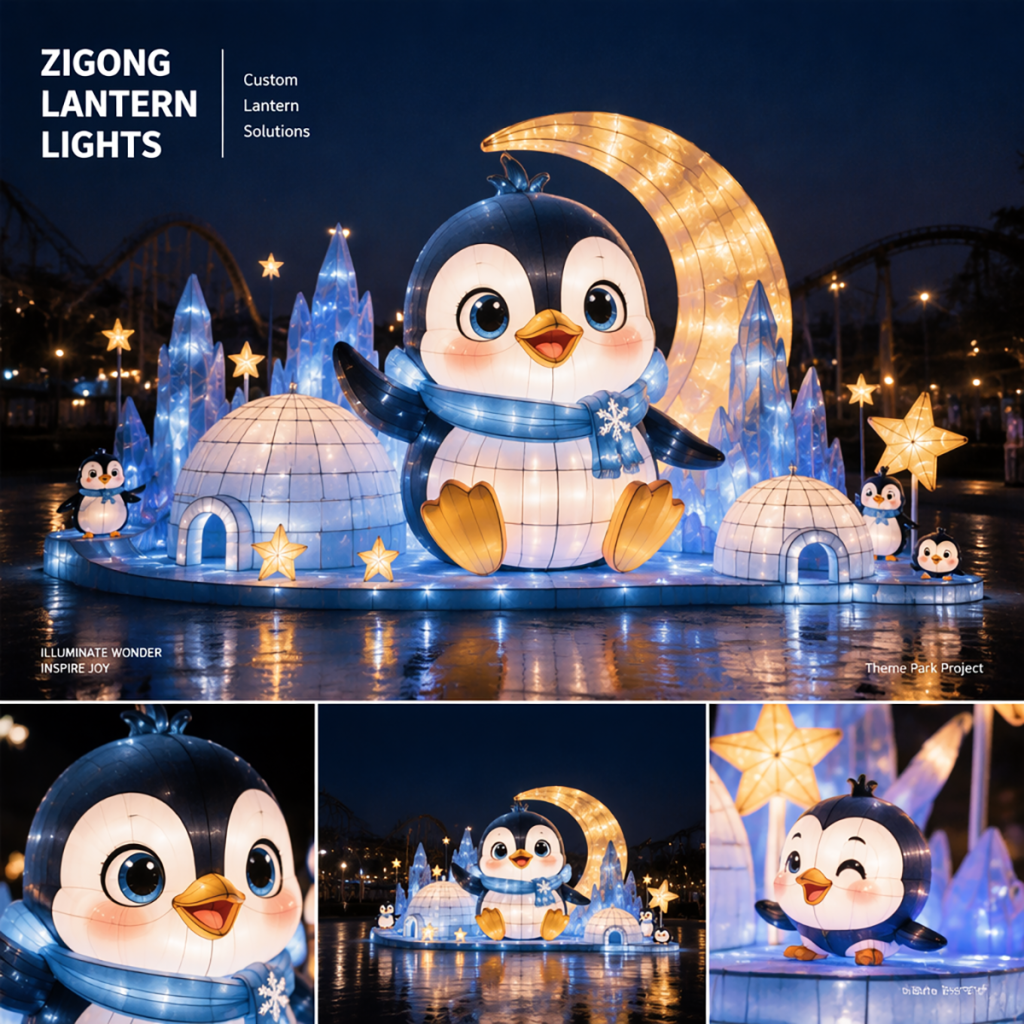
Penguin Winter Lantern — Crescent Moon Scene
About This Design
This is an AI-assisted concept visualization paired with human-written design intent and production-verified technical specifications. It is a design direction — not a manufactured product. When you order, our team creates custom 3D renderings and fabricates the actual lantern in our Zigong workshop.
A penguin lantern scene built around a crescent moon is doing something different from most animal pieces: the moon is not decoration, it is a frame. The inner curve of the crescent becomes the opening visitors stand inside to be photographed, which makes the shape and position of that curve a functional decision rather than an artistic one. This page covers that, plus the proportion rules that make a hero-and-companions composition read as a family group, and the lighting arrangement that most photo pieces get wrong — which is that the side facing the camera is usually the side nobody lit.
The scene is built on a shared base in independent units: a central figure of roughly 5 to 7 m, two smaller companion figures at about 2 to 2.5 m, twin lit igloos and ice formations, and a freestanding crescent backdrop with star and snowflake elements. Everything is framed in weatherproof metal and wrapped in high-density fabric, lit internally on low-voltage outdoor-rated circuits, with the backdrop on its own supply so the moon can be balanced against the figures.
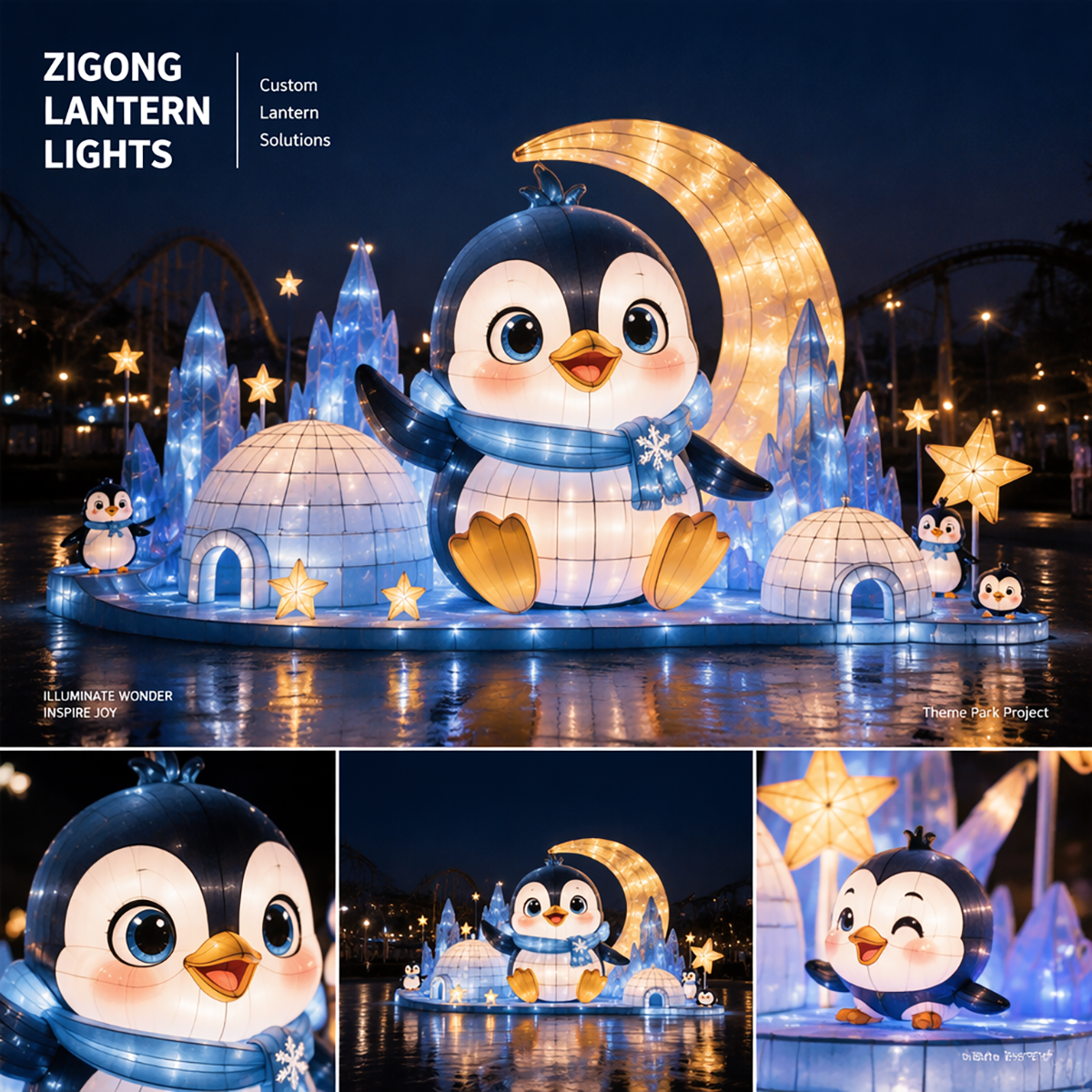
The moon is a frame, so its size is set by people
Where a moon backdrop is treated as scenery it is sized against the figures. Where it is treated as a frame it is sized against the visitors, because the people standing in it are the subject of every photograph taken of the piece.
- The clear opening should take two adults side by side plus a child. Below that, the frame crops people out at the edges; well above it, the framing effect disappears and the moon becomes a flat panel again.
- The opening should sit at standing height. If the inner curve is at 3 m, nobody can use it. The bottom of the crescent’s inner arc is the part that has to be set against people, not against the penguins.
- The moon should be behind the visitors, not behind the penguins. This is the arrangement that actually produces a frame: visitors stand inside the crescent, the animal group sits in front of them and off to one side, and the shot includes both. Placing the moon behind the figures instead gives a silhouette backdrop with no photographic function.
- Leave a hard edge on the moon. A softly glowing disc with indistinct edges reads as a screen. A crescent with a solid, defined outline reads as a moon, and it also gives the photograph an edge to compose against.
Proportion: how a hero and companions read as a family
The relationship between the central figure and the two smaller ones is what determines whether the piece reads as a group. It is not the absolute size that matters, it is the ratio, and there is a fairly narrow band that works.
| Ratio of hero to companions | What it reads as |
|---|---|
| Under 2:1 | Three similar animals. The central figure has no authority and the group reads as a set. |
| Around 2.5:1 to 3:1 | A family group. The central figure leads and the companions read as young, which is the intent. |
| Over 4:1 | Two scales, not a group. The companions read as props belonging to the large figure. |
Two further points follow. First, the companions should not be positioned symmetrically at equal distance from the hero — that arrangement reads as a diagram, and one placed closer and one further back gives the group depth. Second, the companions should be turned slightly inward rather than facing directly forward; it is the turning that makes the group a unit rather than three separate figures on one base.
Dressing an animal: what the knit hat and scarf actually do
Small human accessories on an animal figure change what the visitor is looking at. Without them the piece is a penguin; with a hat and scarf it is a character, and visitors respond to characters differently from animals — they photograph them, name them, and come back. That shift is the whole reason the accessories are there, and it comes with constraints.
- Keep the accessories to one or two items. A hat and a scarf work. A hat, scarf, mittens and boots turns the animal into merchandise and loses the animal entirely.
- Keep the colours in the scene’s palette. Blue on a winter piece sits with the cool palette and lets the moon and snow stay white. Warm accessories pull attention off the face and fight the cool backdrop.
- Do not light the accessories more brightly than the face. The hat is above the face, so it catches more light naturally. If it is also the brightest surface on the figure, the eye goes to the hat and the expression — which is the reason the piece is friendly — is never read.
- Build the accessories as removable units. They are the part most likely to be re-specified for a different event or a different season, and they are also the part most exposed to damage. Making them detachable keeps both problems manageable.
Getting the camera side lit
The most common failure on a photo-oriented scene is that the piece is designed from the front and lit from behind. Because the moon is a large bright surface, the figures standing in front of it are backlit by default, and a backlit figure photographs as a dark shape.
- Put dedicated frontal light on the faces. The hero’s face and the two companions’ faces each need light from the visitor side, on their own circuit, so the exposure can be raised independently of the moon.
- Keep the moon below the faces in luminance. A backdrop that is brighter than the subject produces silhouettes every time. This is counter-intuitive, because the moon is supposed to look bright — but brightness in a photograph is relative, and the figures have to sit above the backdrop to read.
- Make sure the snowflake and star projections do not land on the faces. Patterned light across a face reads as noise in a photograph and is one of the things people notice only after the event.
- Keep the shot position clear of the composition. Leave an unobstructed standing area in front of the frame and make sure no base, cable or ground element sits inside it.
What goes inside the igloos
The twin igloos are containers, and what they hold is what makes them worth looking into rather than two more white shapes on the base.
- Put a small scene inside each, lit slightly brighter than the shell. If the interior is darker than the outside of the igloo, the opening reads as a black hole. The interior has to be the brighter of the two.
- Give the two igloos different contents. Two identical interiors read as one unit repeated. A different small character or a different arrangement in each gives the base two things to look at.
- Size the openings against the viewing distance. Openings sized so the interior detail is visible from a metre away will be invisible from five. Set them against where visitors will actually stand.
- Finish the interior from every visible angle. With an opening in a dome, the inside of the shell is visible from several directions, and cable, drivers and armature all have to be concealed from each of them.
Cool palette, warm accents: the balance that holds
Winter scenes work when the cool palette carries the environment and a small number of warm elements carry the interest. The reverse — warm ambient with cool highlights — reads as a summer piece with blue details.
- Let the snow and ice surfaces be near-white, not blue. Blue light on snow reads as blue plastic within seconds. The cold cast in a good winter scene comes from the surroundings and from the sky-coloured elements, not from tinting the snow.
- Keep the warm accents small and few. A warm scarf edge, warm-lit eyes or a warm glow inside an igloo is enough. Warm elements used widely flatten the palette and the piece loses its winter identity.
- Keep the moon’s colour within the cool range. A cool white or a very slightly blue-white moon reads correctly against the figures. A gold moon turns the piece into a warm scene, which is a different design.
- Keep ground illumination low. Strong ground wash under a white animal reflects upward and removes the shadow that gives the figure its shape.
Specifications
| Attribute | Details |
|---|---|
| Hero figure | 5 m – 7 m, upright pose, with removable knit hat and scarf in the scene palette |
| Companion figures | Two at 2 m – 2.5 m, offset asymmetrically and turned slightly inward |
| Crescent backdrop | Freestanding lit unit with a hard-edged crescent; clear opening sized for two adults and a child at standing height |
| Igloos | Twin lit domes at roughly 2.5 m with different interior scenes, interiors lit above shell luminance |
| Additional elements | Ice formations, star and snowflake projection elements kept clear of the faces |
| Structure | Weatherproof metal armature; high-density fabric over frame; shared base with independent units |
| Lighting | Low-voltage outdoor-rated LED; dedicated frontal lighting for each face on its own circuit; backdrop on a separate supply |
| Palette | Near-white snow and ice, cool moon, small warm accents; accessories in the cool palette |
| Materials finish | UV-resistant painted silk; CE / UL electrical components |
| Weather rating | Outdoor-rated, with service access to each unit |
| Applications | Theme park winter anchors, zoo light trails, city plaza Christmas displays, photo-op destinations |
Frequently Asked Questions
Can the moon be a different colour or shape?
Yes — cool white, warm white, gold and colour-changing versions are all built, and a full moon, a crescent or a ring can be specified. Note that a warm or gold moon changes the piece into a warm-palette scene, so the decision affects the whole composition rather than just the backdrop.
How does this differ from the other penguin designs?
This one is built around a single hero figure and a photographic frame; the penguin parade is a parent-and-young group, and the polar adventure series is a multi-species arctic scene. The penguin colony is a group arranged around a single igloo for walk-around viewing.
Can the igloos be removed for a smaller site?
Yes. The igloos and the ice formations are independent units, so the scene can be delivered as the hero, the companions and the moon only, with the base detail added later. This is also the usual way the piece is extended in a second season.
How much space does the photo position need?
Enough for two adults and a child to stand inside the crescent plus a metre of clear ground in front of the frame for the photographer. The opening is sized at the drawing stage, so it is worth telling us the intended group size at the start.
Is the scene suitable for indoor use?
Yes, and the frame aspect works particularly well in a mall or atrium, where the standing area in front of the crescent is naturally available. For interior versions the exposed frame is finished to a presentable standard. See the polar adventure series for a similar piece often specified in the same setting.
How is it installed on a light trail?
The scene is positioned so the moon faces the route and the standing area falls between the frame and the path, which keeps the photo point out of the walking line. For route programming, see the zoo lights page and the winter lantern festival programme.
Related Products and Designs
Other winter and arctic pieces: the ice and snow penguin display, the penguin parade and the polar bear and iceberg lantern.
Animal lanterns for winter routes: browse the winter lantern festival designs and the animal concept designs, or see the full range on the animal lanterns pages.
Send the site layout, the intended photo group size and the viewing direction through the contact form, and we will return a layout with the crescent opening and the standing area resolved.
From Concept to Your Venue
Select & Customise
Choose a design direction. We will adjust size, colours, lighting, and theme to match your venue.
3D Render
Our design team creates production-ready 3D renderings based on the concept and your requirements.
Fabricate
Master artisans handcraft your lantern in our Zigong workshop — internal frame, hand-painted covering, LED programming.
QC & outdoor-rated Test
72-hour burn-in test, full weatherproof verification, structural inspection. Built to last.
Ship & Install
Export docs handled. Container loading. On-site installation crew available for your event.