Holiday & Seasonal Decorations Collections
Holiday & Seasonal Decorations
Holiday and seasonal lanterns are the part of a programme that changes with the calendar. This collection covers what we build for Christmas and winter trails, Halloween routes, summer night events and covered atriums — 17 designs at the time of writing, all made to order in the Zigong workshop. Sizes run from a 1.5 m table-height figure to a 12 m entrance gateway, and the brief decides which.
Related guides: Themed Lantern Displays for Events and Venues · Chinese Lantern Manufacturer · Chinese Lantern Festival Displays · Lantern Festival Supplier · Zoo Light Trails
Deep reads: Christmas Market Lighting in Germany · Nordic Winter Light Markets: A Sourcing Guide for Denmark, Sweden, Norway and Finland · Chinese Lantern Festival Sourcing & Budget Guide 2026
All Holiday & Seasonal Decorations
Holiday & Seasonal Decorations
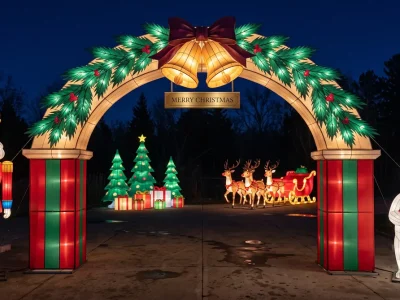
Nutcracker Christmas Arch Gateway
An arch is a frame, and a frame is only worth building…
Holiday & Seasonal Decorations
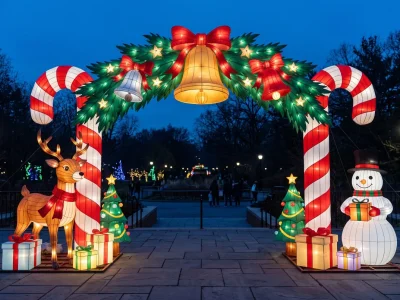
Candy Cane Christmas Arch Gateway
The candy cane arch is the cheapest way to give a site…
Holiday & Seasonal Decorations
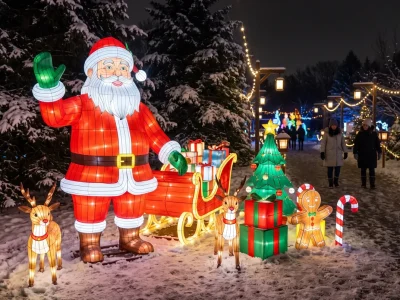
Santa Claus and Gift Sleigh Lantern Scene
Santa beside a loaded sleigh is the most photographed composition on any…

Holiday & Seasonal Decorations
Santa Claus Lantern Figure with Gift
Santa is the one figure every visitor already knows, which means the…
Holiday & Seasonal Decorations
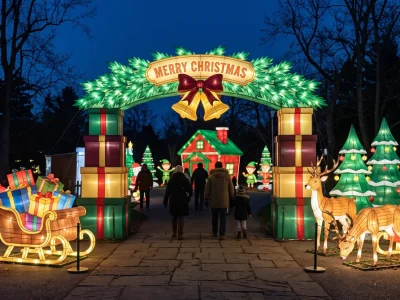
Gift Box Column Christmas Arch Gateway
Gift-box columns solve a problem that plain posts cannot: they make the…
Holiday & Seasonal Decorations
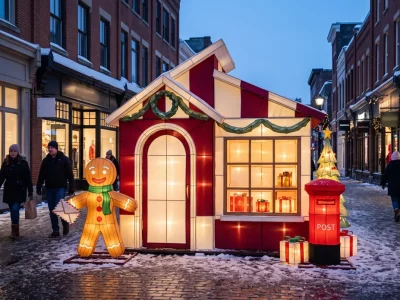
Candy Stripe Christmas Chalet Lantern
A candy-stripe chalet reads as a market stall from 40 m and…
Holiday & Seasonal Decorations
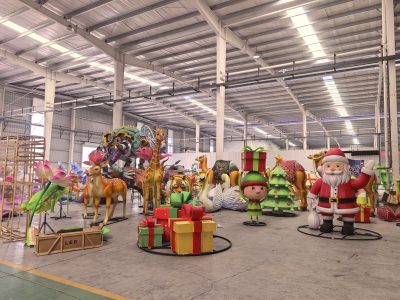
Santa Claus Lantern Figure
Holiday & Seasonal Santa claus lantern figure — a standing Santa with…

Holiday & Seasonal Decorations
Christmas Elephant with Gifts
Holiday & Seasonal Christmas elephant with gifts — an elephant wearing a…
Holiday & Seasonal Decorations
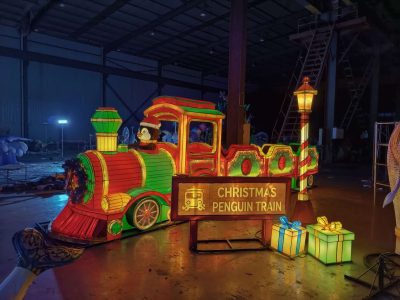
Christmas Train & Garden Arch
Holiday & Seasonal Christmas train & garden arch — a lit train…

Holiday & Seasonal Decorations
Christmas Ball Tree Lantern
Holiday & Seasonal Christmas ball tree lantern — a cone of coloured…
Holiday & Seasonal Decorations
Christmas Reindeer Light Sculpture, Warm Gold
Light sculpture · Holiday collection The same wire frame reindeer, built in…
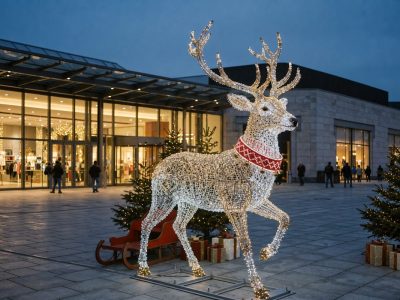
Holiday & Seasonal Decorations
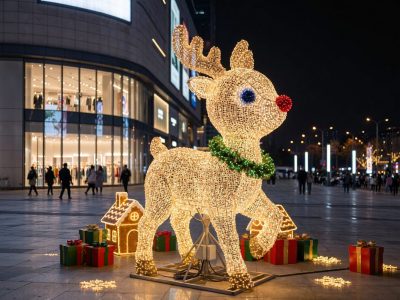
Christmas Reindeer Light Sculpture, Silver Wire Frame
Light sculpture · Holiday collection A full-standing reindeer built on a silver…
Three ways venues buy this collection
A shopping centre or hotel usually orders one hero piece and two or three supporting elements. The hero goes where the footfall already is — under the atrium, at the entrance doors, beside the escalator bank — and the supporting pieces fill the dead corners that otherwise read as unfinished. For that kind of order the constraint is ceiling height and floor loading, not wind.
A zoo, garden or park buys a trail. That means 8 to 20 pieces set at 15 to 25 m intervals along a route the visitors already walk, so the walk from one landmark to the next stays alive. One or two pieces do the landmark work at 6 to 9 m tall; the rest are 1.2 to 3 m and carry the rhythm. A trail built only from hero pieces feels empty between them.
Cities and theme parks buy the overlay: a gateway, a route, photo points, and something that reads from outside the fence. These programmes are scoped around the entrance sequence rather than around individual pieces, because the first 30 seconds decide what visitors expect to pay. The programme-level version of that work sits in christmas light festival planning, and the atrium and mall case is covered under shopping mall christmas decorations.
Christmas and winter: what the weather decides
Winter work is engineered for the site rather than for the theme. An exposed position — a coastal promenade, a hilltop park, a car park with nothing upwind — is designed for 0.5 to 0.7 kN/m² on the projected face, with every base anchored. A sheltered town-centre square carries about half that. We ask for the exposure before the frame is drawn, because the same reindeer needs a different base in Blackpool and in Munich.
Snow sets the roof profile. A flat-topped piece collects it and has to carry the weight; anything with an 8 to 10 degree crown sheds most of it. Where a venue runs through a hard winter, the crown is the cheaper answer.
Cold changes the materials. Silk and stretch fabric stay workable below freezing; rigid PVC panels go brittle and crack at the fixing points after a few seasons outdoors. That is why our winter pieces outdoors are covered in fabric and the clear panels are reserved for indoor or sheltered use.
Freeze-thaw is the quiet killer. Water collects at the base, freezes overnight, and pushes the frame feet out of line. Base frames sit on 100 mm risers, and every ground fix is specified by surface: chemical anchors in asphalt, screw anchors plus ballast in grass, a buried beam or pad in gravel, through-bolts in timber decking. Near the coast the fixings go stainless, because weatherproof metal at a salt-air site shows rust at the welds within one season. The winter builds themselves are set out under winter lantern festival manufacturer, and the ice and snow pieces have their own collection at ice and snow lanterns.
Atriums, ceilings and indoor builds
Indoor work swaps wind load for ceiling load. Every suspension point is rated before the piece is designed, and the load is spread across a four-point bridle so a single anchor never carries the whole weight. We issue a suspension plan with the rated load at each point, which is what the venue's structural engineer signs off on.
Indoor versions run low-heat LED modules, a lighter frame, and a service hatch that can be reached from a step ladder rather than a scaffold. Cabling stays above public reach, and the drivers go in a location the venue's own electrician can reach without dismantling the display.
Storage, rotation and the second season
Seasonal pieces are bought once and used for years, so the dismantling sequence matters as much as the build. Each order ships with a numbered sequence and a crate plan, and the crates are sized so the largest single element fits through a standard 1.2 m door.
Storage decides whether year two is a one-day job or a one-week repair. Fabric goes into the crate clean and dry, frames are touched up at the joints before packing, and a pallet under the crate keeps damp out of the bottom layer. A set that comes out of a wet container in November costs workshop time to bring back; the same set stored dry goes up in a day.
Where a venue wants to re-theme rather than store, the frame is the reusable part. A Christmas set can come back as a spring set with the surface re-covered, which is cheaper than a new build and keeps the same footprint and fixing points.
Beyond Christmas: the shoulder seasons
A venue that only lights up in December leaves eleven months empty. The same fixing points, cable routes and crate plan can carry a second and third season if the first one is planned for it — standardise the base plates and the power drops in year one, and changing the display between seasons becomes a two-day job rather than a re-engineering project.
What changes is the palette and the subject. Halloween runs dark: pumpkins, witches, skeletons and haunted house fronts, in a palette that has to work with almost no ambient light — that side of the range is set out in halloween lantern displays. Spring and summer move to flowers, ocean forms and lantern fields, which read better in twilight than in full dark. The frames and the electrical architecture stay the same, which is where the saving is.
What to send before a design starts
Five answers settle most of the design: the dates the display has to be open, a site plan with the walking route marked, the location of power and the available supply, the ground or ceiling the pieces will fix to, and who the audience is. Height and access follow from those — a 12 m gateway needs a truck that can reach the site and a crane window, and neither is usually available during trading hours.
Send those five and the concept comes back with the pieces placed in your actual layout at the sizes they will be built, which is the point where a programme becomes a budget conversation. The brief form is at request a quote.
How a seasonal order is scheduled
A small set for an atrium runs 4 to 6 weeks from approved concept to crating. A full trail of 8 to 20 pieces runs 10 to 14 weeks. A custom themed programme with new sculpting and a gateway runs 16 to 20 weeks. Shipping sits on top: 15 to 30 days by sea to the US West Coast, 30 to 45 days to Europe, and 3 to 5 days by air when a date has already slipped.
The two things that move a delivery date are late sign-off on the concept and site access restrictions that appear after production has started. Both are avoidable with an early conversation. The documentation to expect at each stage is set out in our procurement guide.
Holiday and seasonal lantern FAQs
Can the same pieces come back next season?
Yes, for seasonal use. Every order ships with a dismantling sequence and a storage checklist, and the crates are built to be reopened rather than cut open.
Can a Christmas set be re-themed for another holiday?
The frame and the fixing points are reusable; the surface is re-covered. That is normally cheaper than a new build for the same footprint.
Do you supply the lighting control as well as the lights?
Yes. Drivers are outdoor-rated and sit in an accessible enclosure, and where scenes change through the evening the controllers run on DMX512 so the display can be timed with the rest of the site.
How is an indoor piece suspended?
On a four-point bridle with a rated load at each anchor, issued as a suspension plan your structural engineer can sign off before anything is lifted.