Penguin Colony Lantern — Igloo Scene
Penguin Colony Lantern — Igloo Scene
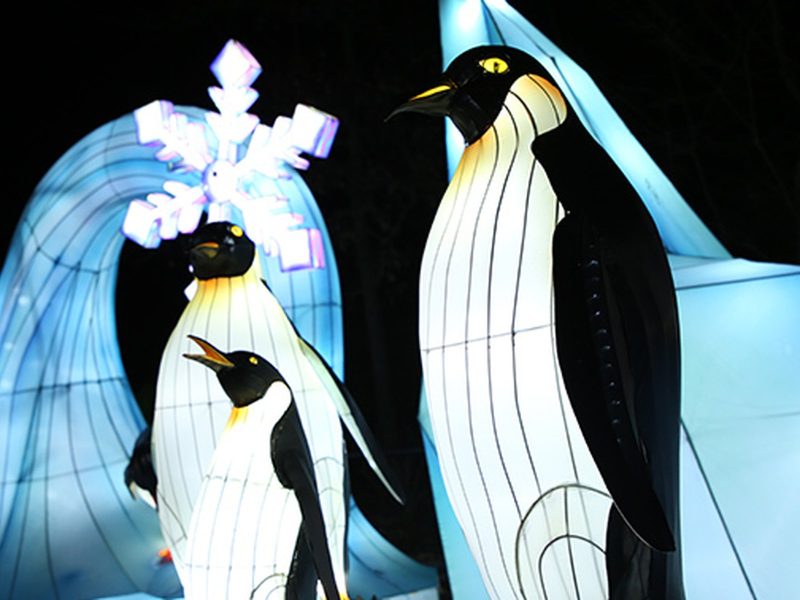
A penguin colony lantern is a different brief from a penguin family. A family is a portrait — two or three figures the visitor reads in one glance and photographs once. A colony is an environment: a number of birds…
A penguin colony lantern is a different brief from a penguin family. A family is a portrait — two or three figures the visitor reads in one glance and photographs once. A colony is an environment: a number of birds arranged on a snow shelf around an illuminated igloo, where the interest is in the group and in the structure they are gathered around, not in any single bird. That difference drives almost every decision below — how the birds are spaced, how the igloo is lit from inside, how tall the whole thing stands, and what the visitor is invited to do when they reach it.
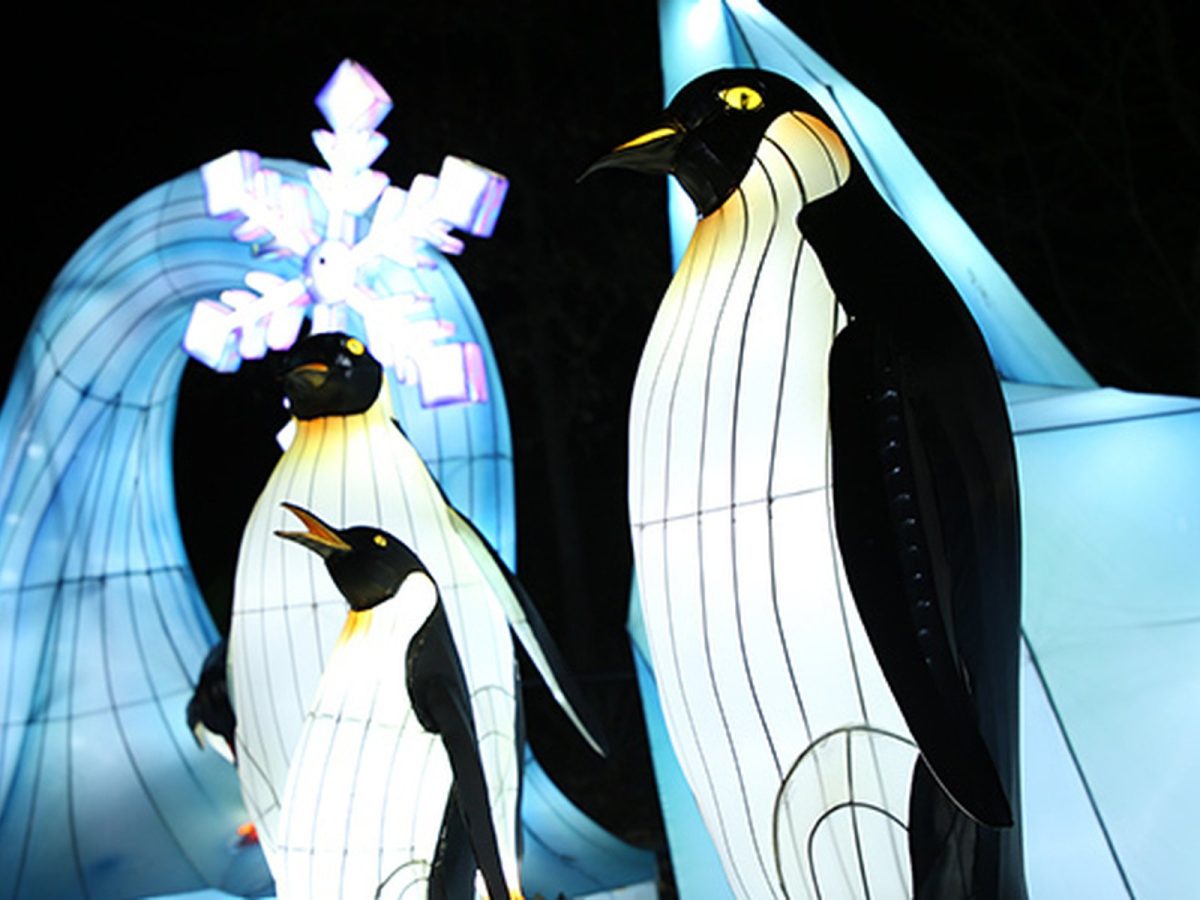
The scene is built as a set of independent lit units: an igloo dome on its own shaped base, and a group of penguin figures from roughly 1 m to 1.5 m, each on a weatherproof metal armature with high-density fabric over the form, lit internally by outdoor-rated LED modules on low-voltage runs. The crystalline ice effects are translucent fabric stretched in layers rather than solid mouldings, which is what lets light pass through unevenly and read as frozen rather than cast. Everything is finished for outdoor winter use, and the whole scene is dimensioned to be assembled on site by a small crew.
Why a colony reads differently from a family group
Visitors move past a family group. They stop at a colony. The reason is not scale, it is that a group creates an implied social space — a place where something is happening — and the eye keeps looking for the edges of that space. A family of three has no edges to find; it is closed after one look.
This has two practical consequences for design:
- The group needs a centre, and the centre is the igloo. Without a focal structure, a scattered set of penguins reads as stock arranged on a lawn. The igloo gives the group a reason to be where it is, and gives the visitor a single point to walk towards.
- The group needs an edge that is not a line. If the birds are set in a row, the implied space becomes a corridor and the visitor reads it as a queue barrier. If they are set in a loose arc with two or three birds turned outward at the ends, the space stays open and people naturally walk around it.
Colonies also survive distance better. At thirty metres, a family group is three small shapes; a colony with a lit dome behind it is still legible as a scene, which matters on a long winter walking route where the display has to hold attention between features.
The igloo is a lighting fixture, not a building
The most common mistake in igloo pieces is treating the dome as a prop that happens to be white. It is not — it is the light source for the entire scene, and the whole composition depends on how it behaves.
- The light comes from inside, so the skin has to be diffusing but not transparent. A translucent silk stretched over a ribbed armature gives an even interior glow with the structural ribs faintly visible as shading — which is exactly what makes it read as built ice rather than an inflated form. A fully opaque dome kills the effect; a fully transparent one shows the lamps and the wiring.
- The dome should be slightly brighter than the penguins. If the birds are the brightest thing in the frame, eye contact goes to the nearest bird and the group never assembles. Keep the dome as the brightest surface and let the birds sit a step below it in luminance.
- The entry opening changes the whole read. A dome with a visible dark opening reads as a place something lives in. A sealed dome reads as an object. If the piece is meant to feel inhabited, the opening has to be there — even when nobody is allowed to walk in.
- A ribbed armature gives you the ice-block texture for free. The rib lines cast soft shadow patterns onto the inner skin, and the more irregular their spacing, the more the surface reads as frozen blocks rather than a geometric lattice.
Arranging the group so it reads as a colony
Real colonies do not distribute evenly — they cluster by age and by position, with the youngest birds typically toward the outside of the huddle and the sheltered positions in the middle. Using that logic visibly in a lantern piece is what separates a designed colony from a set of figures placed at equal intervals.
| Arrangement | What it produces |
|---|---|
| Equal spacing, all facing the path | A row. Reads as stock, photographs badly, creates an unintended corridor. |
| Loose arc around the dome, alternating heights | A group. Reads as gathered, invites walking around the outside. |
| Two or three birds turned away or outward at the ends | An open edge. Extends the scene visually beyond the physical set and stops the row reading. |
| One adult pair at the dome opening, smaller birds further out | A story. Gives the composition a hierarchy and a reason for the igloo. |
Three further points that come up on almost every build of this type. First, the birds should not all face the same way — real penguins orient to wind, to the water and to each other, and a set of identical orientations is the single fastest way to make a scene look manufactured. Second, heights should vary by roughly 20 to 30 per cent across the group; a colony all at one height loses its middle ground and reads flat from the far end of a route. Third, put at least one bird in front of the dome opening rather than beside it — the overlap is what ties the figures to the structure instead of leaving them as two separate elements on the same base.
Colour: why cold palettes fail more often than warm ones
Arctic scenes attract cold palettes — ice blue, cyan, cool white — and this is where most of them go wrong. Cool light on a cool palette removes tonal separation, and the whole scene collapses into one pale mass with no readable shapes.
The fix is not to abandon the cold palette, it is to layer it:
- Use near-white for the snow and the dome, not blue. Snow lit by a blue source looks like blue plastic almost immediately. Near-white or very slightly warm white keeps the surface reading as snow, and the surrounding blue comes from the environment instead.
- Keep the penguins’ black areas unlit. The dark plumage is a silhouette device, not a surface to be filled. Adding light to the black region removes the contrast that makes the birds legible at distance, and the result looks like grey fabric.
- Give each bird a narrow warm rim rather than broad cool wash. A thin warm edge on the head and chest separates the figure from the cold background and does more for definition than raising overall brightness.
- Reserve cyan strictly for the ice effects. If cyan appears on snow, on the dome and on the birds, nothing reads as ice any more. One accent, one job.
This is why the palette on a successful piece usually looks warmer in photographs than the brief suggested. The cold is carried by the surroundings and by a small number of deliberately icy surfaces; the light doing the actual work is in the neutral to warm-neutral range.
Making ice effects read as ice, not as plastic
Crystalline effects are easy to specify and hard to get right, because the material that looks frosted under a workshop light often looks like clear film at night.
- Layer translucent fabric rather than using one sheet. Two or three layers of stretched silk with slightly different opacity give depth to the glow. A single sheet is flat, and flat frosted material reads as packaging.
- Vary the interior lighting, not the exterior. Ice reads as ice because light behaves differently at different depths inside it. Placing the light source off-centre inside the form, or using two modules at different brightness, produces that variation. Painting the surface to look icy does not.
- Leave the structure visible at the edges. Where a crystalline form meets the frame, letting the armature show through the fabric slightly reads as an edge of ice. Hiding everything inside a uniform glow reads as a moulded acrylic sheet.
- Keep snow surfaces matte. A slightly textured matte finish scatters light in all directions, which is what snow does. A glossy white surface under the same light produces a highlight that no snow surface ever has.
Walk-in or look-in: the decision to make early
Once an igloo has a visible opening, visitors will try to enter it. Whether they can is a design decision, and it needs to be made before the structure is dimensioned, not after.
- Walk-in pieces need a clear internal width for a wheelchair or a pushchair, a floor that is level and non-slip when wet, and interior lighting that is dimmer than the dome exterior so the transition does not blind people on the way in. They also need the opening aligned with the site’s walking route, otherwise the entry becomes a dead end and people turn around inside.
- Look-in pieces need the opening blocked at low level. A physical low barrier — a solid sill or a low rock set — is the only reliable way to stop entry; a sign or a rope is not, especially in the dark.
- Either way, the interior has to be finished. Visitors will look in. An unfinished interior with visible cable, ballast and armature is the most common disappointment on this type of scene, and it costs very little to close the ceiling of the shell properly.
- If photography is the goal, the view from outside should be the designed view. Set the interior detail and the entrance frame so that the group of penguins outside is visible within the opening when shot from the path — that composition is what gets shared.
Cold weather and what it does to the scene
Winter pieces are installed in the conditions that are hardest on them, and a few material behaviours are worth planning around rather than discovering on site.
- Silk stiffens and can crease when it is cold and becomes flexible again indoors. Fabric that was tensioned in a warm workshop can slacken slightly after a cold installation cycle. Turning every panel into a serviceable unit that can be re-tensioned on site removes the problem entirely.
- Snow load is a structural item, not an aesthetic one. It gathers on horizontal surfaces, which on this scene means the snow shelf and any flat rim on the dome. Sloping the shelf and keeping upper surfaces small is cheaper than reinforcing them.
- Frozen ground changes your anchoring. Ground stakes that work in a lawn in summer will not drive into frozen ground in January. Bases need to be ballasted or plate-mounted, with the choice made against the actual ground condition on site.
- Keep every circuit accessible. A failed module in a sealed dome in February means a return visit; making the light runs and drivers reachable from a service hatch is worth more than any marginal improvement in the finish.
Specifications
| Attribute | Details |
|---|---|
| Penguin height | 1 m – 1.5 m per figure; scene typically 4 – 8 figures |
| Igloo height | 2 m – 3 m, with optional entry opening |
| Structure | Weatherproof metal armature, ribbed dome frame, translucent high-density fabric |
| Lighting | Low-voltage outdoor-rated LED modules; near-white for snow, warm rim lighting on figures, cyan reserved for ice effects |
| Materials finish | Silk with UV-resistant treatment; matte snow surfaces; CE / UL electrical components |
| Weather rating | Outdoor-rated with cold-weather finish; snow-resistant sloping surfaces |
| Installation | Pre-assembled units, on-site assembly by a small crew; ballasted or plate-mounted base for frozen ground |
| Applications | Winter lantern festival routes, zoo arctic zones, Christmas markets, garden light trails |
Frequently Asked Questions
Related Products and Designs
Other winter and arctic scenes: the penguin parade, the ice and snow penguin display, the smiling penguin scene and the polar adventure series.
Animal lanterns for venue routes: see the animal lantern range and the animal lantern programme, or browse the animal concept designs and the winter lantern festival designs.
Send the footprint, the walking route and the figure count through the contact form, and we will return a layout with positions and heights resolved. For winter programmes specifically, the winter lantern festival programme page sets out how multi-piece scenes are staged across a season.

You May Also Like
Related Products
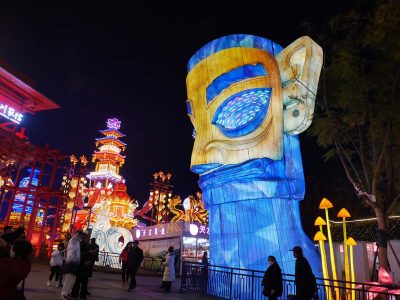
Silk & Traditional Lanterns
Sanxingdui Bronze Mask Lantern Display – Ancient Sichuan Culture Light Installation
View Details →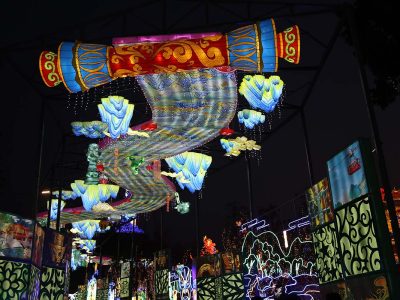
Lantern Festival Packages
Giant Chinese Scroll Lantern Display – Illuminated Painted Scroll Installation
View Details →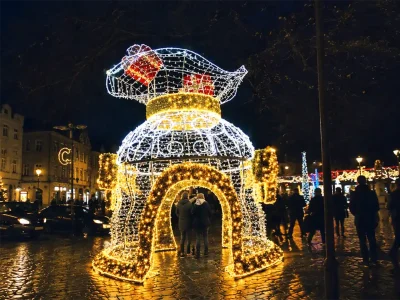
Light Sculptures
Giant Christmas Bell Walk-Through Light Archway — Illuminated Holiday Tunnel
View Details →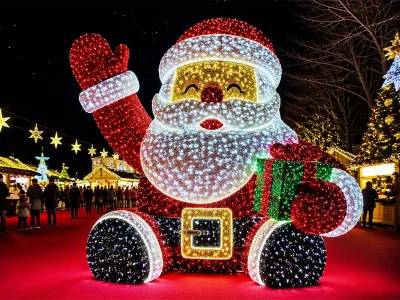
Light Sculptures
Sitting Santa Claus Gift Box Light Sculpture — Holiday Toy Car Figure
View Details →Questions
Frequently Asked Questions
Interested in This Product?
Get a custom quote within 24 hours. Our team is ready to help.