Project Case Study
Lightopia at Manchester — a city park lantern festival where the route, not the individual pieces, was the design problem.
The brief
Lightopia commissioned a lantern festival for a Manchester park: a ticketed evening route through an open landscape, a family audience, and a site that had to return to normal public use once the season ended. That last requirement shaped everything — nothing could be permanent, and everything had to come out in the same access window it went in through.
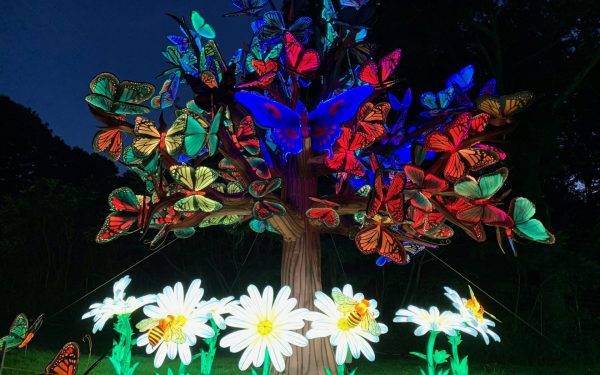
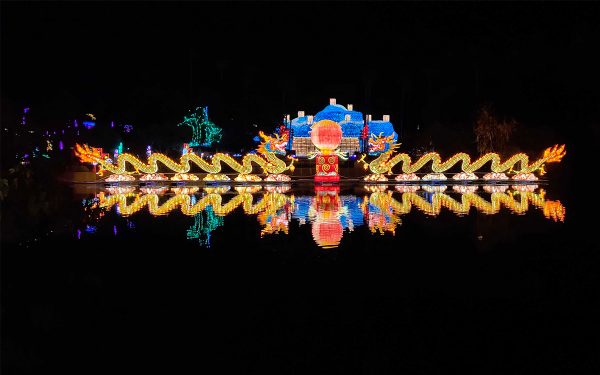
The route was planned as a sequence of zones rather than a collection of pieces, so that visitors move through changing light and scale rather than walking past a line of similar objects.
What an open park site changes
A park is the opposite of a paved plaza: the ground is soft, the trees are fixed obstacles, and the route has to follow terrain rather than a straight line. Soft ground means ballast is not always possible, so pieces are anchored by ground spikes or weighted bases depending on the surface each position sits on.
Existing trees also become part of the design. Where a route passes between mature trees, the lighting and the piece heights are set to use them rather than compete with them.
Route length and dwell time
A ticketed route lives or dies on how long visitors stay. Too short and it feels poor value; too long and the crowd bunches. The usual approach is to set the route length from a target dwell time, then place the feature pieces at the points where the crowd naturally slows.
Zones alternate deliberately: a bright, dense section followed by a quieter one. That rhythm is what stops a long route feeling monotonous, and it is the same logic we apply to zoo and city trails.
Delivery and removal
The installation was built in Zigong, shipped as sections, assembled on site, and then removed at the end of the season. Removal is planned at the design stage rather than after: sections are numbered, joints are designed for repeated assembly, and the crate sequence is recorded so the same crates come back.
That planning is what makes a seasonal installation economic for a venue that runs it year after year.
Specification
| Item | Detail |
|---|---|
| Project type | Ticketed lantern festival route, city park |
| Location | Manchester, United Kingdom |
| Site | Open parkland, soft ground, mature trees |
| Route | Zoned sequence with alternating light and scale |
| Fixing | Ground spikes or weighted bases per surface |
| Scope | Design, manufacture, shipping, installation, removal |
| Season | Temporary installation, removed after the run |
| Planning | Section numbering and crate sequence planned for repeat use |
Related
All project case studies
Delivered installations across Europe and North America.
Lantern festival packages
Route-scale programmes rather than single pieces.
Request a quote
Send the site plan and the target route length.
Planning a ticketed route through a park?
Send the site plan, the ground conditions and the target dwell time. We will reply with the route structure.