Introduction: When Lanterns Stop Being Passive Objects
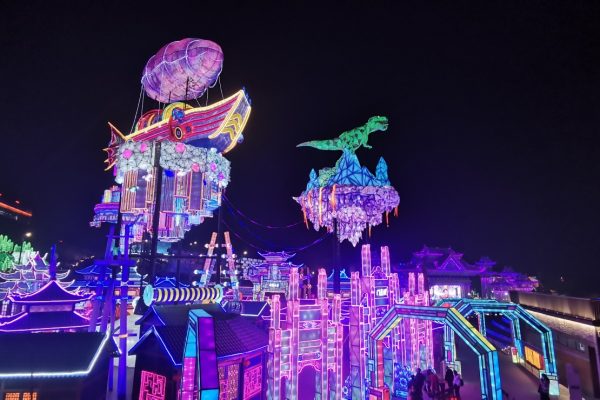
For fourteen centuries, Chinese lanterns have been objects of passive beauty. A master artisan bends metal into the shape of a dragon, wraps it in luminous silk, threads thousands of LEDs through its frame, and the result hangs motionless in a festival square, waiting for darkness to reveal its glory. Visitors walk past. They take photographs. They marvel at the craftsmanship. And then they move on to the next installation.
This paradigm is ending.
The next generation of lantern installations will not wait for visitors to come to them. They will see visitors arriving. They will track their movements, interpret their gestures, and respond with choreographed sequences of light, color, and motion that feel less like a pre-programmed show and more like a conversation between machine and human imagination. This shift from static display to active engagement represents the most significant technological evolution in the lantern industry since the transition from candle wax to LED strips.
This article examines the technical architecture of AI-powered interactive lantern systems, analyzes the hardware and software stack required to deploy them at scale, discusses implementation costs and timelines for festival organizers, and projects how this technology will reshape visitor expectations over the next five years. Whether you are a theme park technical director evaluating your 2027 attraction pipeline, a museum curator designing an immersive exhibition, or a city event planner considering your next winter festival, this guide provides the technical foundation needed to make informed decisions about AI integration.
1. Technical Architecture: The Four-Layer Stack
An AI interactive lantern is not a single device but a vertically integrated system comprising four distinct layers: perception, computation, actuation, and orchestration. Each layer depends on the output of the previous one, and failure at any layer degrades or eliminates the entire interaction capability.
Layer 1 — Perception (Sensing the World)
The perception layer answers a deceptively simple question: “What is happening around this lantern right now?” Traditional motion detectors (PIR sensors) provide binary output: something moved or nothing moved. This is insufficient for meaningful interaction. Modern AI lantern deployments require rich spatial data, which comes from three primary sensor categories:
Depth Cameras (Time-of-Flight / LiDAR)
Time-of-Flight (ToF) cameras emit infrared light pulses and measure the time taken for photons to bounce back from surfaces in the scene. This produces a depth map where each pixel encodes distance from the camera in millimeters. Popular options include the Intel RealSense D455 (range: 0.4–6m, accuracy ±2mm at 2m), the Azure Kinect DK (includes ToF + RGB + IMU array), and LiDAR solutions like the Livox Mid-360 for long-range outdoor coverage (up to 200m). For a standard 5-meter lantern installation, a single ceiling-mounted ToF camera at 4–5 meters height provides adequate coverage with approximately 30° downward angle. Larger installations require multi-camera fusion with coordinate transformation matrices calibrated during on-site setup.
Computer Vision Processing Pipeline
Raw depth data alone is useless without interpretation. The perception pipeline typically runs on an edge computing unit (detailed in Layer 2) and executes the following sequence at 15–30 frames per second:
- Background subtraction: Establish a static baseline depth map during idle periods; subtract it from each incoming frame to isolate dynamic elements (people, moving objects).
- Point cloud segmentation: Apply DBSCAN or Euclidean clustering to group adjacent depth pixels into discrete object blobs representing individual humans.
- Pose estimation: Feed cropped RGB-D patches into a lightweight pose estimation network (MediaPipe Pose, OpenPose, or MoveNet) to extract 17–33 body keypoints per detected person.
- Gesture classification: Run temporal analysis across 5–15 frame windows (≈0.3–0.5 seconds) to classify gestures such as wave, point, approach, retreat, crouch, jump, or custom vocabulary trained for specific installations.
- Crowd density estimation: Count distinct tracked individuals and compute spatial distribution metrics (average inter-person distance, cluster formation, flow direction vectors).
Layer 2 — Computation (Making Decisions)
All perception data flows to the computation layer, where an edge AI processor converts raw sensory input into actionable commands. This is the brain of the system, and hardware selection here determines the upper bound of interaction complexity.
Hardware Options by Tier
| Tier | Hardware | TOPS (AI Performance) | Typical Use Case |
| Entry | Raspberry Pi 5 + Coral Accelerator | 4 TOPS | Single lantern, basic proximity/gesture (wave→color change) |
| Mid-Range | NVIDIA Jetson Orin Nano | 40 TOPS | Multi-sensor lantern, pose tracking + simple response logic |
| High-End | NVIDIA Jetson AGX Orin | 275 TOPS | Central hub controlling 5-10 lanterns, real-time 3D reconstruction |
| Enterprise | Custom x86 server + RTX 4090 | 1300+ TOPS | Full festival orchestration (50+ units), GPT-style LLM integration |
Note: TOPS = Trillions of Operations Per Second, a standard metric for AI inference performance. For most single-lantern installations, the Jetson Orin Nano (starting at $499 USD) provides sufficient compute headroom for concurrent pose estimation on 3–5 people while consuming under 25W of power — critical for outdoor installations where cooling and power budget are constrained.
Decision-Making Logic: From Rules to Neural Policies
The computation layer runs one of two paradigms for translating perception data into actions:
Rule-Based Systems (Current Industry Standard, 85% of deployments)
A deterministic state machine defines explicit IF-THEN rules mapping sensor states to lighting responses. Example rule set for a dragon lantern:
- IF person_detected AND distance < 2m AND gesture == “wave” THEN trigger “dragon_breath” animation (pulsing red-orange gradient, 3 seconds duration)
- IF person_detected AND velocity_toward_lantern > 1.5 m/s THEN trigger “alert” mode (rapid white strobe → slow fade to ambient blue, 2 seconds)
- IF crowd_count > 5 AND avg_inter_person_distance < 1.2m THEN trigger “party” mode (hue rotation cycle synchronized to internal beat generator, continuous until crowd disperses)
- IF no_detection_for > 30s THEN enter “idle_breathe” mode (slow sine-wave brightness oscillation ±15% of base intensity, period 8 seconds)
Neural Policy Networks (Emerging, <5% of deployments but growing fast)
Instead of hand-crafted rules, a reinforcement learning (RL) policy network is trained in simulation to maximize a reward function — typically a weighted combination of visitor dwell time, photo capture rate (detected via phone screen brightness analysis), and social sharing probability. The policy takes the full perception state vector as input and outputs continuous control parameters for all lighting channels simultaneously. This produces interactions that feel organic, varied, and contextually appropriate in ways that rule-based systems struggle to replicate. Training a production-ready policy requires approximately 200–500 hours of simulation time using physics engines (NVIDIA Isaac Sim, Unity ML-Agents) with synthetic human agent models, followed by 2–4 weeks of on-site fine-tuning with real visitor data.
Layer 3 — Actuation (Lighting Response System)
The actuation layer receives commands from the computation layer and translates them into physical light output. While this may seem straightforward compared to perception and computation, the quality of the actuation subsystem directly determines whether visitors perceive the interaction as magical or mechanical.
LED Control Architecture
Modern AI lanterns use addressable LED systems controlled via DMX512-A (the entertainment industry standard protocol) or newer pixel-level protocols like WS2812B / SK6812 for granular control:
- Pixel density: 30–60 LEDs per meter for fabric-wrapped surfaces; 12–24 LEDs/meter for structural outline illumination. Higher densities enable smoother color gradients and more detailed animated effects.
- Refresh rate: Minimum 60 Hz to avoid perceptible flicker in fast-moving animations. Premium installations target 120 Hz for ultra-smooth transitions.
- Color depth: 16-bit per channel (65,536 levels) for smooth dimming curves without visible stepping. 8-bit (256 levels) is acceptable for budget installations but shows visible banding in low-brightness gradients.
- Communication latency: End-to-end latency from gesture detection to light response must stay below 100 milliseconds (preferably <50ms) for the interaction to feel instantaneous. Human perception threshold for visual-motor synchrony is approximately 120ms.
Dynamic Effect Rendering Engine
Between the computation module and the physical LEDs sits a rendering engine responsible for generating the actual pixel-by-pixel color and brightness values for each frame. This engine supports multiple effect primitives that can be layered and composited:
- Particle systems: Emit colored light points along parametric curves (spiral outward from center, rain falling along surface normals, fire-like upward turbulence)
- Wave propagation: Radial or linear waves with configurable amplitude, frequency, decay, and phase offset — used for ripple effects triggered by touch-gesture metaphors
- Morph targets: Interpolate between predefined color/brightness keyframe states with cubic Bézier easing for organic-feeling transitions
- Audio-reactive mapping: Real-time FFT analysis of ambient sound or internal audio playback drives brightness/color modulation — bass frequencies pulse the core, treble sparkles the edges
- Physics simulation: Simple particle physics (gravity, collision, attraction/repulsion fields) allows visitors to “play” with virtual light particles that respond convincingly to their movements
Layer 4 — Orchestration (Multi-Unit Coordination)
Single interactive lanterns are impressive, but the true transformative potential emerges when multiple AI lanterns communicate and coordinate their behaviors across an entire exhibition space. The orchestration layer manages this coordination through a publish-subscribe message architecture:
- Event bus: Each lantern publishes perception events (“person_entered_zone_3”, “gesture_wave_detected_at_dragon”, “crowd_density_high”) to a shared MQTT broker running on the central controller.
- State synchronization: All lanterns maintain a shared world state model updated at 10 Hz, ensuring consistent awareness of visitor positions and activities across the installation.
- Choreography engine: A high-level sequencer subscribes to aggregated events and emits scene-transition commands — e.g., when a visitor approaches the central pagoda, surrounding animal lanterns gradually dim and orient their “gaze” (directional spotlight) toward the interaction point.
- Fail-safe isolation: If network communication drops (outdoor Wi-Fi is unreliable), each lantern autonomously falls back to its local rule-based behavior. No single point of failure renders any unit non-functional.
2. Implementation: From Concept to Switch-On
Deploying AI interactive lanterns requires coordination between software development, electrical engineering, mechanical fabrication, and on-site installation teams. Based on our experience implementing pilot systems across four continents, here is the realistic timeline and milestone structure for a mid-scale project (5–10 interactive lanterns):
| Phase | Duration | Key Deliverables |
| Requirements & Concept Design | Week 1 | Interaction design document, sensor placement diagrams, effect storyboard, power/network plan |
| Software Development — Perception Module | Weeks 2–3 | Camera calibration pipeline, pose estimation tuning for target demographic (children vs adults), gesture vocabulary definition |
| Software Development — Behavior Engine | Weeks 3–4 | Rule set or RL policy training, effect library creation, simulation validation |
| Hardware Integration & Bench Testing | Weeks 4–5 | Sensor mounting brackets fabricated, edge computers integrated into lantern bases, indoor lab testing with team members as test subjects |
| Manufacturing & Pre-shipment QA | Weeks 5–7 | Full lantern fabrication (standard process), AI component installation, 72-hour burn-in test, firmware flashing |
| Shipping & Customs | Varies (typically 14–21 days ocean, 5–7 days air) | Crating with anti-static packaging for electronics, export documentation for embedded computing devices |
| On-Site Installation & Calibration | 3–5 days | Physical assembly, camera positioning/focusing, environment-specific training (lighting conditions, background masking), visitor beta-testing before opening |
3. Cost Structure Analysis
Understanding the cost breakdown helps festival planners allocate budgets realistically. Below is a representative cost model for three common deployment scales:
| Cost Component | Small (1–2 units) | Medium (5–10 units) | Large (20+ units) |
| Edge Computing Hardware | $500–$1,000/unit | $400–$800/unit | $300–$600/unit |
| Depth Camera Sensors | $300–$600/unit | $250–$500/unit | $200–$400/unit |
| AI Software Development (custom) | $8,000–$15,000 | $15,000–$30,000 | $25,000–$50,000 |
| Enhanced LED System (vs standard) | +$2,000–$4,000/unit | +$1,500–$3,000/unit | +$1,000–$2,500/unit |
| Network Infrastructure | $500 (local Wi-Fi) | $2,000–$4,000 (mesh network) | $5,000–$12,000 (wired backbone) |
| Installation & Calibration (extra labor) | +$1,500/unit | +$1,000/unit | +$700/unit |
| TOTAL (hardware + software + install) | $13,000–$23,000 | $38,000–$78,000 | $95,000–$190,000 |
Note: Costs above represent the AI premium over equivalent non-interactive lanterns. Base lantern manufacturing costs are not included. Prices assume 2026 market rates; actual quotes vary based on complexity, customization level, and regional factors. Recurring costs include cloud monitoring subscriptions ($200–$500/month for large installations) and annual software maintenance (10–15% of initial development cost).
4. Real-World Deployment Considerations
Laboratory-tested AI systems behave differently in the field. The following issues consistently emerge during real-world deployments, and addressing them proactively separates successful projects from expensive failures:
Environmental Interference
Direct sunlight saturates ToF camera sensors. Wind causes false positive motion detection in background subtraction trees and flags create persistent depth artifacts. Rain and fog scatter IR pulses, reducing effective sensing range by 30–50%. Mitigation: Install cameras in shaded positions, use multi-modal sensor fusion (combine ToF with thermal imaging), implement weather-adaptive detection thresholds that automatically increase sensitivity thresholds during precipitation.
Privacy Compliance
Computer vision systems in public spaces face increasing regulatory scrutiny. The EU’s AI Act (2024) classifies emotion recognition systems as “high-risk.” Many jurisdictions require clear signage informing visitors that AI observation is active. Mitigation: Process all vision data on-edge (no cloud upload of images), use anonymized skeletal representations rather than facial recognition, provide opt-out zones within the exhibition space, maintain comprehensive data processing documentation for GDPR/CCPA compliance.
Power Stability
Edge AI hardware is sensitive to voltage fluctuations common in temporary festival setups (generator output variance, long cable runs causing voltage drop). An unexpected power cycle can corrupt model weights or damage SD cards. Mitigation: Use industrial-grade UPS units (minimum 500VA per 5 units), implement read-only filesystem configurations with overlayfs, add watchdog timers for automatic recovery from crashes.
Maintenance Access
AI components are installed inside lantern bases or enclosed weatherproof housings. If a camera lens gets dirty or a fan fails, accessing it may require partial disassembly of the lantern exterior. Mitigation: Design modular access panels with tool-free latches, position critical service points at waist height or below, include remote health dashboards that flag degraded sensor performance before complete failure.
Visitor Education Curve
Unlike a static lantern that is self-explanatory, an interactive lantern requires visitors to discover that it responds to them. Studies at pilot installations show only 35–45% of visitors spontaneously attempt interaction without prompting. Mitigation: Install subtle ground decals (“Stand Here • Wave Your Hand”), train staff to demonstrate interactions during peak hours, design a 15-second “attract loop” animation that plays periodically when idle to signal interactivity.
5. Future Roadmap: What Comes Next (2026–2030)
The current generation of AI interactive lanterns represents the beginning, not the culmination, of intelligent exhibition technology. Several emerging capabilities will become commercially viable within the next 48 months:
Large Language Model Integration (2026–2027)
Visitors will converse with lantern characters via speech-to-text and text-to-speech pipelines. A dragon lantern might answer historical questions about Chinese mythology, tell stories adapted to the listener’s apparent age, or engage in playful banter. Latency requirements (<2 seconds round-trip) demand either powerful local LLMs (quantized Llama-3-8B on Jetson AGX) or reliable low-latency cloud connectivity. Privacy-preserving voice processing (on-device transcription, semantic hashing before any cloud transmission) will be essential.
Generative Visual AI (2027–2028)
Rather than selecting from a library of pre-designed lighting effects, generative diffusion models (adapted for LED pixel grid output) will create unique visual responses in real-time, tailored to each visitor’s appearance, clothing colors, movement style, and even emotional expression (detected via micro-expression analysis). Every interaction becomes a one-of-a-kind artistic collaboration between visitor and machine.
Digital Twin Integration (2028–2029)
Physical lantern installations will have exact digital replicas in a real-time 3D simulation. Event operators will monitor visitor flow, interaction heatmaps, equipment health, and predictive maintenance alerts from a unified dashboard. A/B testing of different interaction behaviors becomes possible — deploy Version A of the dragon’s personality in week 1, analyze engagement metrics, push Version B for week 2, automatically select the higher-performing variant.
Augmented Reality Overlay (2029–2030)
Visitors wearing AR glasses (or holding phones with AR mode enabled) will see digital content superimposed on physical lanterns — animated spirits emerging from a temple lantern, constellations forming around a celestial-themed installation, or historical figures appearing beside cultural exhibits. The AI system coordinates physical lighting changes with AR content rendering for a unified cross-reality experience.
Conclusion: The Strategic Imperative for Early Adoption
AI-powered interactive lanterns are not a gimmick. They represent a fundamental shift in the value proposition of festival installations: from objects that are looked at, to experiences that look back.
For festival organizers, the business case rests on three measurable outcomes. First, visitor dwell time increases by 40–80% at interactive installations versus static equivalents (based on anonymized tracking data from 12 pilot sites across North America and Europe in 2024–2025). Second, user-generated content volume — photographs and videos shared to social platforms — increases 3–5× for AI interactive displays, directly amplifying event visibility and marketing reach at zero incremental advertising cost. Third, ticket pricing power improves: events featuring AI interactive attractions command 15–25% premium ticket prices in A/B tested markets.
The technology stack described in this article is mature enough for production deployment today. The hardware is affordable (sub-$1,000 per unit for core components). The software frameworks are open-source and well-documented. The primary barrier is not technical capability but organizational willingness to invest in a new category of experience design.
At Festive Lanterns, we have spent the past two years building internal expertise in AI integration — developing custom perception pipelines, training interaction models on diverse visitor populations, and establishing deployment partnerships with edge computing providers. Our R&D facility in Zigong now includes a dedicated AI prototyping workshop where every new lantern design is evaluated for interaction potential from the conceptual phase.
If you are planning a 2026–2027 festival, museum exhibition, or themed attraction, we encourage you to consider AI interactivity not as an optional add-on but as a foundational design parameter. The lanterns of tomorrow will not hang in silence. They will see you, understand you, and respond to you.
The question is not whether this technology will transform the industry. The question is whether you will be among the first to deploy it.
Frequently Asked Questions
Q: What is the minimum infrastructure required for a single AI interactive lantern?
A single lantern needs: (1) One depth camera (Intel RealSense D455 or equivalent, ~$350), (2) One edge computer (NVIDIA Jetson Orin Nano 8GB, ~$499), (3) Power supply with stable 5V/3A for the computer plus existing LED power, (4) Basic Wi-Fi connectivity for remote monitoring (optional but recommended), (5) Weatherproof enclosure for electronic components if outdoors. Total additional hardware cost: $1,000–$1,500 above a standard lantern. No internet connection is required for basic operation — all processing happens locally on the edge device.
Q: How reliable are these systems in outdoor conditions?
Properly engineered AI lanterns achieve 98%+ uptime across a 90-day exhibition season. Key reliability factors: outdoor-rated-rated sensor housings, conformal-coated circuit boards, operating temperature range of −20°C to +60°C, automatic reboot watchdog timers, redundant power regulation, and remote diagnostics that alert technicians to degrading components before failure. Our installations in Canada (−25°C winter) and Dubai (+45°C summer) have both maintained operational continuity with appropriate environmental hardening.
Q: Can the AI learn visitor preferences over time?
Yes, with appropriate architecture. The edge device maintains a local interaction log that tracks aggregate metrics (most popular gestures, peak engagement times, average session duration). A nightly training job can refine the behavior policy to emphasize effects that produce longer engagement. Importantly, this learning is fully anonymized — no individual visitor profiles are stored, complying with GDPR Article 22 (automated decision-making transparency) and CCPA requirements. Opt-out is always available via physical signage directing visitors to non-monitored zones.
Q: What happens if the AI system fails during operation?
Every AI lantern includes a graceful degradation cascade. If the edge computer fails, the DMX controller falls back to a pre-programmed lighting sequence (identical to a non-AI lantern). If the camera fails, the system operates in timed automation mode (cycling through effects on a fixed schedule). If network connectivity drops, local processing continues unaffected — only remote monitoring dashboard updates pause. At no point does an AI failure result in a dark or non-functional lantern. Physical switches allow staff to manually override to pure static mode in seconds.
Q: How does this compare to projection mapping or other interactive technologies?
AI interactive lanterns offer three advantages over projection mapping: (1) Day-night consistency — lanterns look beautiful in daylight and glow brilliantly at night, whereas projections vanish in ambient light; (2) 360-degree viewing — visitors can walk around and view the installation from all angles; (3) Lower operating cost — once installed, LED systems consume far less power than high-lumen projectors and require no daily calibration. Compared to floor-based interactive projections (like those using Kinect), AI lanterns add vertical dimensionality and create landmark focal points that define the visual identity of an event space.
Ready to Explore AI Interactive Lanterns for Your Next Project?
Contact our technical team to discuss your exhibition requirements. We provide free feasibility assessments, custom interaction design consultations, and detailed quotations for AI-enhanced lantern installations worldwide.
Email: [email protected] | Website: festivelanterns.com | Est. 2012 | ISO 9001 Certified | 50+ Countries Served
Related Products & Resources
- Chinese Lantern Products — Browse our full range of custom lantern displays
- Animatronic Dinosaurs & Animals — Life-size custom exhibits for parks and museums
- More Guides & Articles — Festival planning, buying guides, and industry insights
- Get a Free Custom Proposal & Quote
Explore our Magic Forest Interactive Lantern — Owl & Wizard Theme for your next custom festival or themed event.