Zoo Lantern Festivals: Panda and Animal Lantern Displays for Modern ZoosA zoo lantern festival turns a daytime animal collection into a nighttime attraction — and the single most requested piece in almost every one we build is a panda lantern. Zoos book lantern festivals because the format reuses what they already own: real animals become the reference for illuminated sculptures, walking routes become light trails, and a season that would otherwise close at dusk starts earning after dark. We have built these programmes for zoos and wildlife parks in Ireland, the UK, France, China and the United States, including Dublin Zoo’s Wild Lights and Franklin Park Zoo in Boston.
Why Zoos Book Lantern Festivals in the First Place
The commercial logic is straightforward. A zoo has fixed infrastructure — car parks, ticketing, catering, animal areas, staff — and those assets sit idle after closing time. A lantern festival adds an evening session to the same footprint, roughly doubling the hours in which the venue can sell tickets without building anything permanent.
The second reason is thematic rather than financial. A zoo’s animals are its brand, so a lantern festival that sculpts those same species reads as an extension of the collection rather than a travelling fair dropped onto the lawn. At Dublin Zoo’s Wild Lights, the illuminated route was built from African safari, Arctic wildlife, tropical rainforest and fantasy scenes — the animals the zoo already keeps, reimagined in light.
- Evening sessions on existing infrastructure — the venue opens a second, after-dark window with no permanent construction
- The animal collection becomes the design brief — sculptures echo species visitors already come to see
- Winter fills a seasonal gap — in Europe the format runs through the quiet November to January period
- A photography attraction — lit sculptures generate visitor images and word of mouth through the season
Dublin Zoo’s seasonal route covered more than 100 lantern installations and drew over 60,000 visitors across the winter season. Lightopia in Manchester, built on 80-plus installations, drew over 100,000 across its run. Those are client outcomes, not sales figures — they are the reason zoos rebook the format in subsequent years.
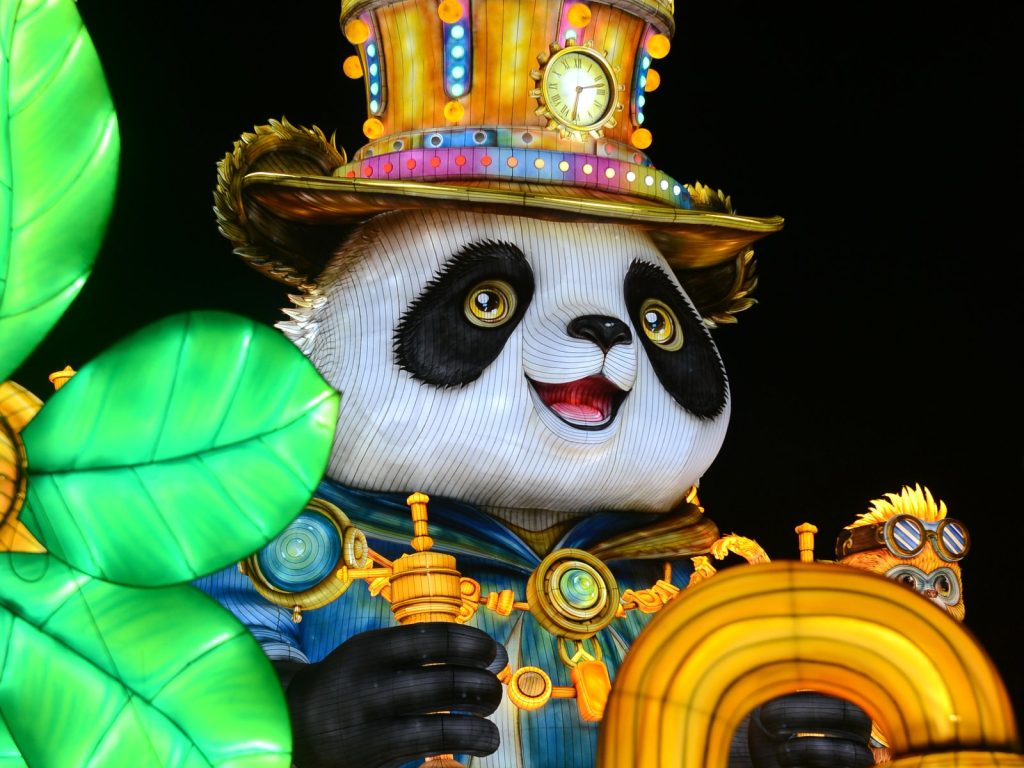
Panda Lanterns: The Most Requested Zoo Lantern
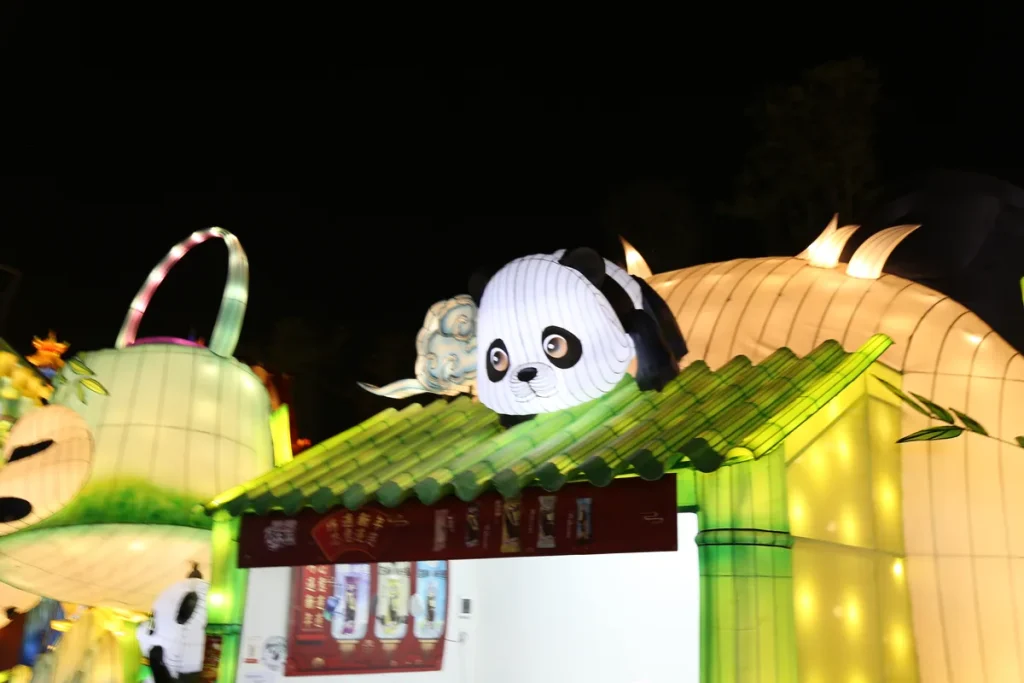
If you are building a lantern festival for a zoo or wildlife park, the panda is the piece your marketing team will ask for first. It is instantly recognisable at a distance, it photographs well in low light, and it carries none of the cultural distance that a purely Chinese mythological figure might — a panda reads as a wildlife icon in every market we have worked in.
We build panda lanterns as a family rather than a single design, so a zoo can place different versions in different zones of the same route:
- Cartoon panda pair — rounded, playful forms that work at a walkway entrance where children pass close by
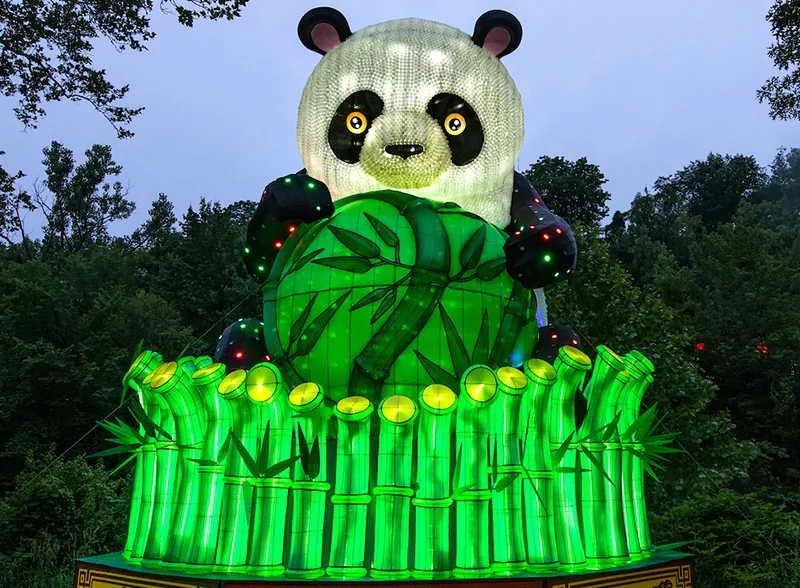
- Panda hugging bamboo — the classic silhouette, strongest on a lawn or at the mouth of a bamboo planting
- Opera-mask panda — a panda painted with Beijing opera facial patterns, for cultural zones and intangible-heritage displays
- Steampunk panda — gears, gauges and brass tones, aimed at science-fiction or interactive game areas
- Panda pavilion scene — a multi-piece build with a bamboo-house setting, for a plaza-sized centrepiece
- Workshop panda — a behind-the-scenes figure that pairs well with a craft demonstration for school groups
Two practical notes on panda lanterns for zoos. First, scale drives visibility: the same design at two metres reads as a photo prop, while at four to five metres it becomes a landmark that pulls visitors along a route. Second, colour temperature matters more than colour itself — a panda is a black-and-white subject, so the warmth of the surrounding light decides whether it looks crisp or muddy after dark.

When a Giant Panda Arrives: Turning Panda Fever into a Season
A new giant panda arrival is unlike any other animal transfer a zoo will handle. Pandas move between countries under long-standing conservation loan agreements, and each arrival lands as a city-level news event: local media follow the transfer, sponsors ask how to attach their name to it, and gate numbers move within weeks. The awkward part comes afterwards. The news cycle ends long before the panda’s stay does, and all that attention is left with nothing to land on.
That gap is what a panda display is built for. The families who came for a first look at the panda discover the rest of the park; the sponsors who backed the arrival want a reason to stay involved past the opening ceremony. A programme built around the panda turns a single news spike into a season you can repeat every year — and it can be timed to open while the arrival is still being talked about.
Three Ways Zoos Put a Panda to Work
Most zoos in this position use the panda in one of three formats. They are less alternatives than a sequence, and the same animal can carry all three across a single year.
- A panda lantern festival — a full seasonal trail built around pandas, sited along the walkway the zoo already owns and supported by habitat-zone animal lanterns elsewhere on the route. This is the format that carries ticket revenue, and the panda is what goes on the poster.
- Panda lanterns for specific dates — not every zoo wants a full festival. An arrival anniversary, a first public cub viewing, a birthday, a sponsor family weekend: a smaller set of pieces can be produced for the date that matters, then either stored or folded into the wider trail the following season.
- A permanent panda sculpture — lanterns come down at the end of winter; a sculpture stays. Zoos that want the panda visible all year round — at the entrance, in the plaza, or at the approach to the enclosure — commission a built sculpture that photographs by day and lights by night.
What the Panda Actually Does on Site
Strip away the theming and a large panda performs three practical jobs on a zoo site:
- Photo opportunities. A panda is one of the few subjects visitors instinctively photograph, and every shot posted from inside the park carries the location with it. That is why the panda is usually placed where the queue forms rather than at the quiet end of the trail.
- Wayfinding. A four-to-five-metre panda is visible across an open lawn, a lake or a car park. Zoos use it as the landmark that answers “which way now?” — placed at a junction, it pulls visitors deeper into the site instead of letting them loop back toward the exit.
- Landscape and centrepiece. A panda pavilion scene gives a plaza or a lake edge a reason to be used after dark. This matters most in parks where the daytime landscaping is strong but the site goes flat and empty once the light drops.
One note on timing, because both calendars involved are stubborn. A lantern season has to be designed, built, shipped and tested before the winter opening, and a panda arrival date is set by factors well outside the zoo’s control. The practical move is to plan the display in parallel with the arrival announcement rather than after it: the design can be locked, the route surveyed and the groundwork prepared while the transfer is still being arranged, so the trail opens in the first season the panda is on site rather than a year later.
If a panda is arriving at your site — or arrived recently and the attention has already started to fade — the useful conversation is about which of the three formats fits your calendar. Send us the arrival date, the walkway you would use and the sponsor you have in mind, and we will tell you what can realistically be built, shipped and installed for that season.
Animal Lanterns Grouped by Habitat
The most reliable way to plan a zoo lantern route is to group animals by the habitat zones the zoo already uses. Visitors walk a route that mirrors their daytime experience, and the zoo gets to reinforce its own signage and interpretation along the way.
- African savanna — giraffe, zebra, cheetah, elephant and lion families, usually placed along the widest sightlines
- Arctic and polar — polar bear, penguin, seal and reindeer, which suit the colder end of the season and read strongly against dark backgrounds
- Tropical rainforest — butterflies, tree frogs, owls and insect clusters, best used for walk-through tunnels and enclosed corridors
- Marine and aquatic — sea turtle, jellyfish, octopus and crab, often paired with water features and reflections
- Fantasy and storybook — creatures that do not exist in the collection but extend the route between two real habitat zones
Grouping by habitat also solves a design problem that catches zoos out: a route made of unrelated standalone figures feels like a collection of objects, while a route built in habitat clusters feels like a walk through the collection. Our guide to animal lantern displays covers how species are selected and scaled, and the process from sketch to finished installation shows what each stage looks like before you commit to it.
What European Zoos Need to Plan For
Europe is the market where we see the strongest response to this format, because the seasonal pattern suits it. Winter is long, daylight is short, and the November-to-January window that would otherwise be the quietest part of the year becomes the evening season. Zoos, wildlife parks, botanical gardens and country estates across the UK, Ireland, France, the Netherlands, Germany and Spain all book illuminated routes of this kind.
Four things decide whether a European zoo lantern festival runs smoothly, and all four are settled long before anything is built:
- A fixed opening date with weather risk — a winter opening date does not move, so the build has to be planned backwards from it and protected against a wet autumn
- Rain, wind and soft ground — European winters put sustained moisture and wind load on outdoor pieces, and a zoo lawn is not a hardstanding, so ballast and access routes matter as much as the sculptures
- Walking routes and visitor flow — most European zoos are walk-through sites with existing one-way paths, so the lantern route usually follows the daytime path rather than cutting a new one
- Character of the site — a heritage estate, a botanical collection and a modern wildlife park each want a different visual language, and repeating the same build in all three reads as generic
That last point is where a lot of imported festivals fail. A route designed for a commercial site in Asia can look borrowed when it is dropped into a listed park in the Netherlands or a Victorian botanical garden in the UK. For European projects we plan the piece list against the venue’s own planting, architecture and sightlines, and for the UK and Ireland specifically we cover route planning, ground protection and winter scheduling in our guide to light trail installation in the UK and Ireland.

Three European Projects
The clearest way to show what a zoo lantern festival looks like in practice is to walk three European projects we delivered.
Dublin Zoo — Wild Lights
At Phoenix Park in Dublin, Wild Lights ran through the winter season with more than 100 lantern installations and drew over 60,000 visitors per season. The route was built around the zoo’s own collection: African safari, Arctic wildlife, tropical rainforest and fantasy creatures, connected by illuminated archways and interactive pieces that visitors could walk through. For an Irish winter, the practical work sat in ground protection and wind loading — the illuminated figures had to stand safely on parkland through months of wet weather.
Lightopia, Manchester
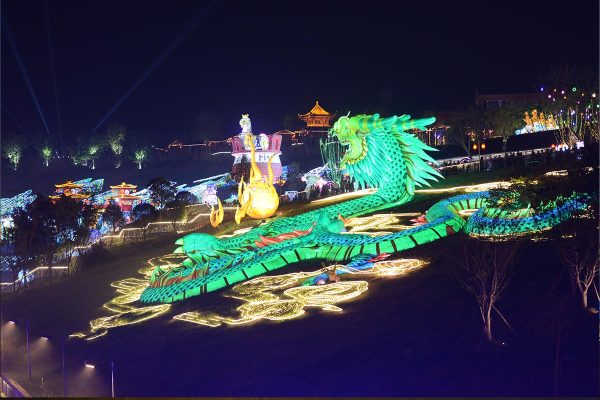
Lightopia ran across Manchester venues including Heaton Park, built on more than 80 installations and drawing over 100,000 visitors per season. This programme leaned into fantasy rather than straight wildlife: a Chinese dragon with crystal detailing, crystal caves, mystical creatures and illuminated archways, with immersive light trails connecting each zone. It is a useful example for zoos that want one fantasy corridor inside an otherwise animal-led route.
Festival de Lanternes, Nice
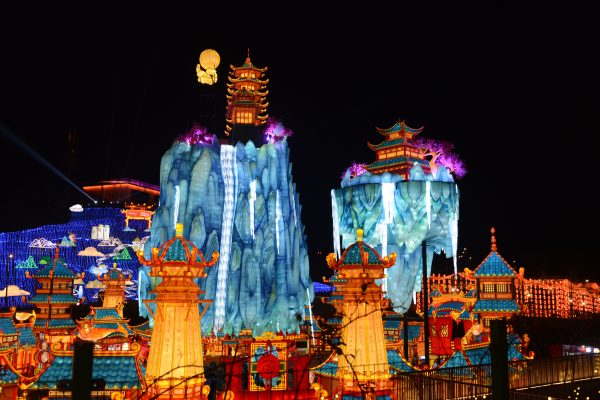
At Parc Phoenix in Nice, the festival ran for 87 days from late November into February, with more than 50 installations including dragons, Chinese architecture, pandas, peacocks and interactive light tunnels. The Nice programme is the closest reference for a Mediterranean winter: milder temperatures, a botanical setting, and a route that had to work around a living plant collection rather than replace it.
Further afield, Franklin Park Zoo in Boston ran a summer programme with over 60 installations across a butterfly garden, marine life and a fantasy forest, drawing over 80,000 visitors, and the annual programme at the Montréal Botanical Garden has run for multiple seasons with 150-plus installations. Between them these projects cover winter, spring and summer openings — the season, not the format, is what changes.
How a Zoo Lantern Festival Is Scoped
A zoo lantern festival is scoped from the venue rather than from a catalogue, and the sequence is consistent across every project we run.
- Site survey and route plan — walking the site, recording sightlines, ground conditions, power points, vehicle access and the width of every gate the pieces must pass through
- Zone and piece list — agreeing which habitat zones the route covers and which species appear in each, before any drawing is made
- Scale and clearance — setting the height of every piece against its viewing distance, and checking overhead clearance along the full route
- Winter-specific engineering — ballast or ground anchors, wind load, drainage on soft ground, and the electrical layout for a season of outdoor running
- Production and pre-assembly — every piece is built and test-lit in the workshop, then packed as numbered sections
- Installation and commissioning — on-site assembly, electrical commissioning after dark, and a crew walkthrough before opening night
Zoos that are planning a first season usually want the piece list settled early, because the marketing calendar for a winter opening starts months ahead of the build. If the venue is still deciding, a lantern festival supplier should be able to produce a zone plan and a sectioned build drawing before a contract is signed. We work this way for zoos, wildlife parks and zoo lights programmes in more than 50 countries.
Frequently Asked Questions
How much space does a zoo lantern festival need?
It scales to the site. A compact programme of 20 to 30 pieces can run along an existing one-way path, while a full seasonal route of 60 to 100-plus pieces needs several connected zones and a return leg. The route plan is drawn from the zoo’s own path network, so the venue does not need spare land.
Can panda lanterns be made at different sizes?
Yes. Panda lanterns are built as a family of designs, and each design can be scaled for its placement — a two to three metre figure for a walkway, or a larger version for a lawn or plaza centrepiece. Size is set against viewing distance and the clearance along the route.
Can the lanterns match our existing habitat zones?
That is the usual starting point. We plan the piece list against the zoo’s own zones — African savanna, Arctic, rainforest, marine — so the illuminated route mirrors the daytime experience and reinforces the venue’s signage and interpretation.
Can a lantern festival run outdoors through a European winter?
Yes. Winter programmes are built with outdoor-rated materials, weather-resistant electrical systems and wind load engineered for the site, and are ballasted or anchored to suit soft ground. Dublin Zoo’s Wild Lights and the Nice festival both ran through the winter months.
How early should a zoo start planning?
Earlier than most venues expect. Because a winter opening date is fixed, the route plan, piece list and access requirements should be settled months ahead so that production and shipping are not compressed into the final weeks.
Do you provide installation on site?
Yes. Our technicians travel for turnkey projects, covering pre-assembly in the workshop, on-site rigging, electrical commissioning after dark and a crew walkthrough before opening. Documentation and section numbering are handed over with the display.

Planning a Lantern Festival for Your Zoo
A zoo lantern festival works when the programme is built around the collection the zoo already has, scaled to the routes visitors already walk, and engineered for the season it will actually run in. Panda lanterns are usually the first pieces on the list and the ones visitors photograph most — but they only carry a route if the animal zones around them are planned with the same care.
Tell us which habitat zones you want the route to cover, roughly how many pieces you are considering, and the opening date you are working towards. We will come back with a zone plan, a sectioned build drawing and a piece list for your site.
Request a free zoo lantern festival proposal →
Built in our own Zigong workshop and installed on site — for zoos, wildlife parks and botanical gardens across Europe, North America and beyond.