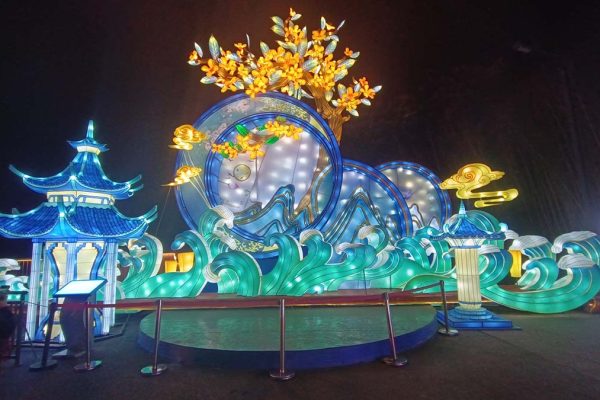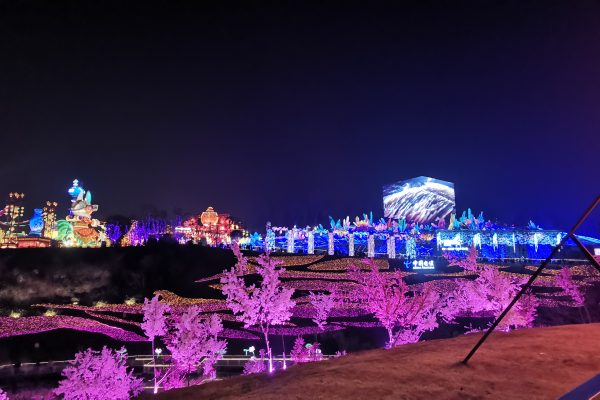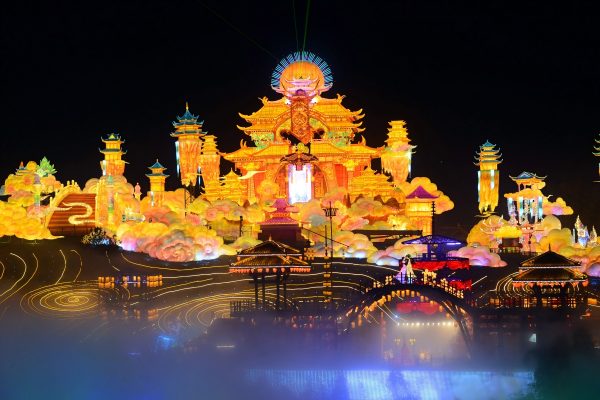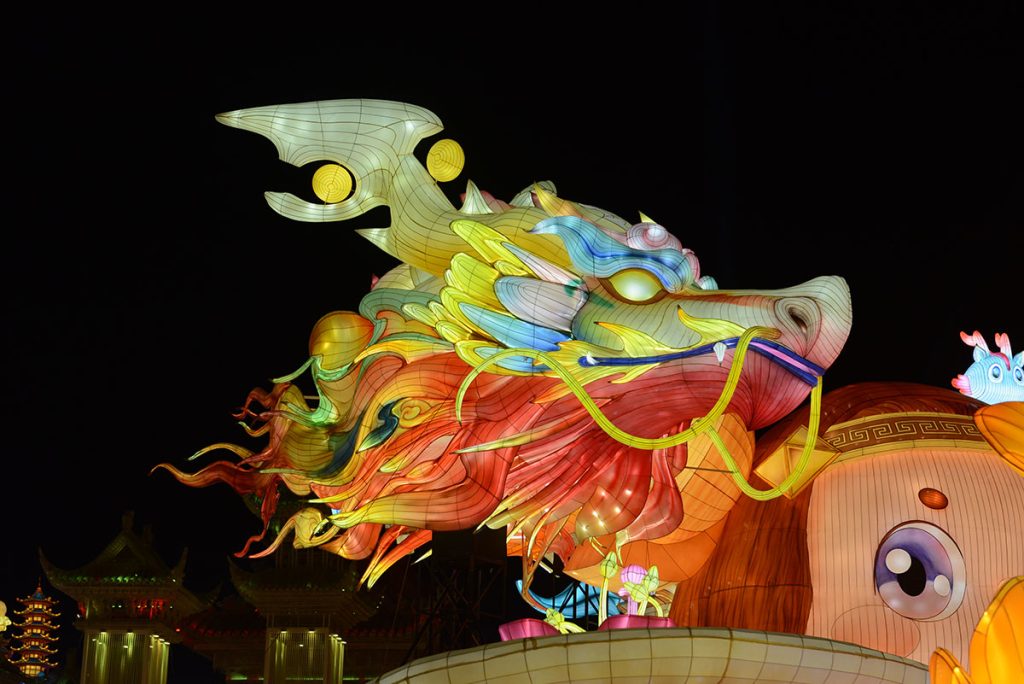
Every visitor to a Chinese festival lantern display has the same reaction: how does the light glow so evenly through the surface? The answer is not in the LED — it is in the fabric. The material that wraps a lantern determines how much light passes through, how evenly it diffuses, how long it lasts outdoors, and ultimately whether the finished display feels premium or cheap.
For Chinese lantern festival manufacturers in Zigong, the material of choice is **densified polyester satin ** — a high-density woven synthetic fabric that has become the industry standard after generations of trial and error with paper, silk, and transitional fabrics. This article explains why this material is used, how it compares to alternatives, and the evolution of lantern covering materials that led to its adoption.
What Is Densified Polyester Satin?
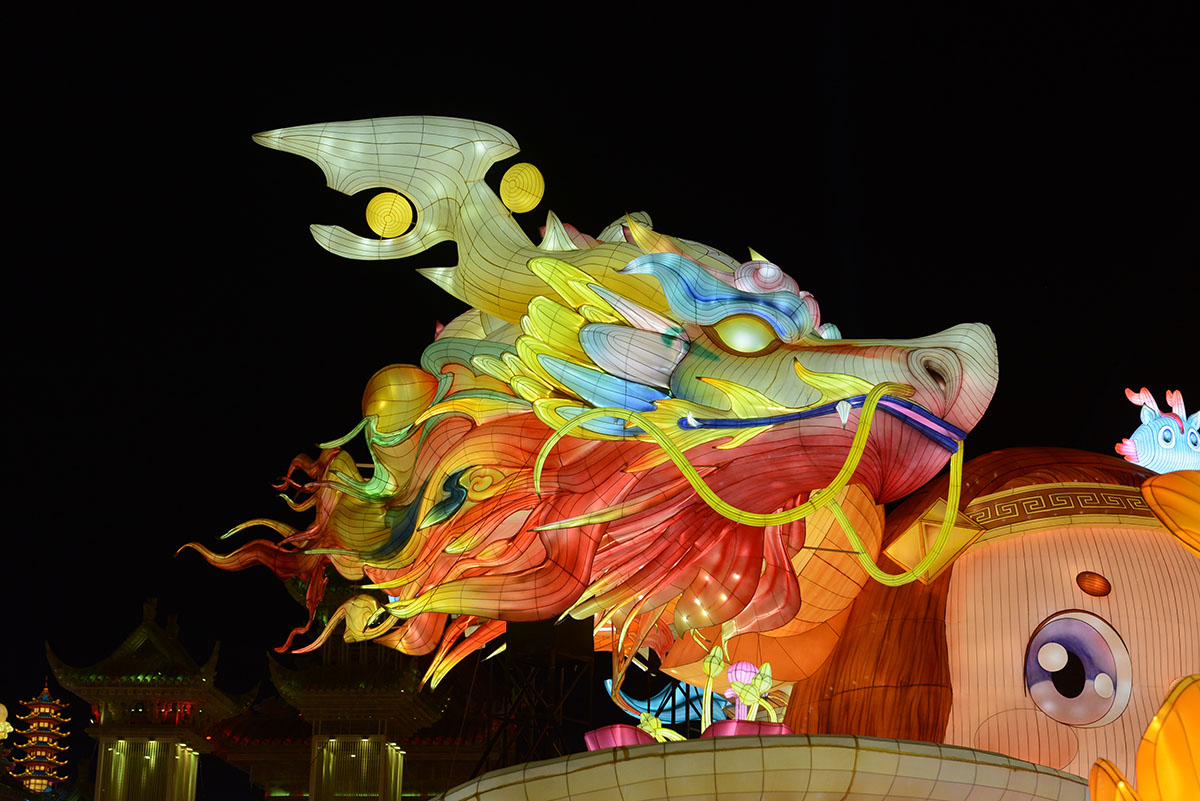
Densified polyester satin — also sold under the trade name **”Bamei satin” ** — is a synthetic fiber fabric with a woven satin weave structure. Its technical material name is polyester fiber satin weave fabric.
Key properties:
- Base fiber: Polyester (PET), continuous filament
- Weave: Satin weave — warp threads float over multiple weft threads, creating a smooth, lustrous surface
- Density: Higher thread count than standard polyester fabric, hence “densified” — fewer gaps between threads for more uniform light diffusion
- Weight: Typically 80–120 g/m² for standard lantern use
- Finish: Treated for UV resistance, water repellency, and optional fire retardancy
The satin weave gives the fabric a soft, silk-like luster that reflects some light while transmitting the rest — this reflective-transmissive balance is what gives lanterns their characteristic warm, non-glaring glow.
The Evolution of Lantern Covering Materials
Zigong’s 800-year lantern-making tradition has seen a clear progression of fabric materials, each driven by the conflict between light transmission and outdoor durability.
Phase 1: Paper (800+ years — pre-industrial era)
The earliest lanterns were covered with paper — specifically, hand-made rice paper or bark paper.
| Property | Paper |
|---|---|
| Light transmission | Excellent — warm, soft glow |
| Durability | Very poor — tears easily, disintegrates when wet |
| UV resistance | None — fades and embrittles in sunlight |
| Outdoor suitability | Not suitable — indoor/covered use only |
| Cost | Low |
Paper transmitted light beautifully, but it was useless outdoors. A single rain shower could destroy weeks of work. This limited lantern festivals to indoor halls and covered courtyards.
Phase 2: Silk (Ming-Qing dynasties, ~1400–1900)
As Zigong’s salt industry boomed, wealthy merchants funded higher-quality lanterns using real silk.
| Property | Silk |
|---|---|
| Light transmission | Very good — natural luster |
| Durability | Moderate — stronger than paper, but fragile under tension |
| UV resistance | Poor — fades and weakens under sunlight |
| Outdoor suitability | Limited — covered outdoor use only |
| Cost | High |
Silk produced a gorgeous, luminous glow that paper could not match. But silk was expensive (10–20× the cost of synthetic alternatives), and its UV sensitivity made it unsuitable for outdoor displays lasting more than a few weeks. Silk lanterns had to be re-skinned every season, which was labor-intensive and costly for large installations.
Phase 3: Weatherproof Silk (mid-20th century)
An early attempt to solve the outdoor problem was coating silk or similar fabrics with weather sealing treatments.
| Property | Weatherproof Silk |
|---|---|
| Light transmission | Inconsistent — coating created uneven diffusion |
| Durability | Moderate — better than untreated silk |
| UV resistance | Still poor — coating did little to protect fiber |
| Outdoor suitability | Limited — intermediate solution |
| Cost | Moderate |
The weatherproof coating solved one problem but created another: the coating blocked light unevenly, creating visible hot spots and dark patches on the lit surface. The visual compromise was unacceptable for premium displays.
Phase 4: Bamei Satin (early polyester satin, 1970s–1990s)
The first generation of polyester satin — “Bamei satin” — was a significant step forward. It offered better light transmission consistency than treated silk and much better durability than paper.
| Property | Early Bamei Satin |
|---|---|
| Light transmission | Good — more even than weatherproof silk |
| Durability | Good — tear-resistant, water-resistant |
| UV resistance | Moderate — some fading over extended exposure |
| Outdoor suitability | Decent — usable for seasonal outdoor displays |
| Cost | Low-moderate |
This material allowed Zigong lanterns to move definitively outdoors. However, after 2–3 months of continuous outdoor exposure, colors would begin to fade, and the fabric’s light transmission would degrade as the surface wore.
Phase 5: Densified Polyester Satin (current industry standard)
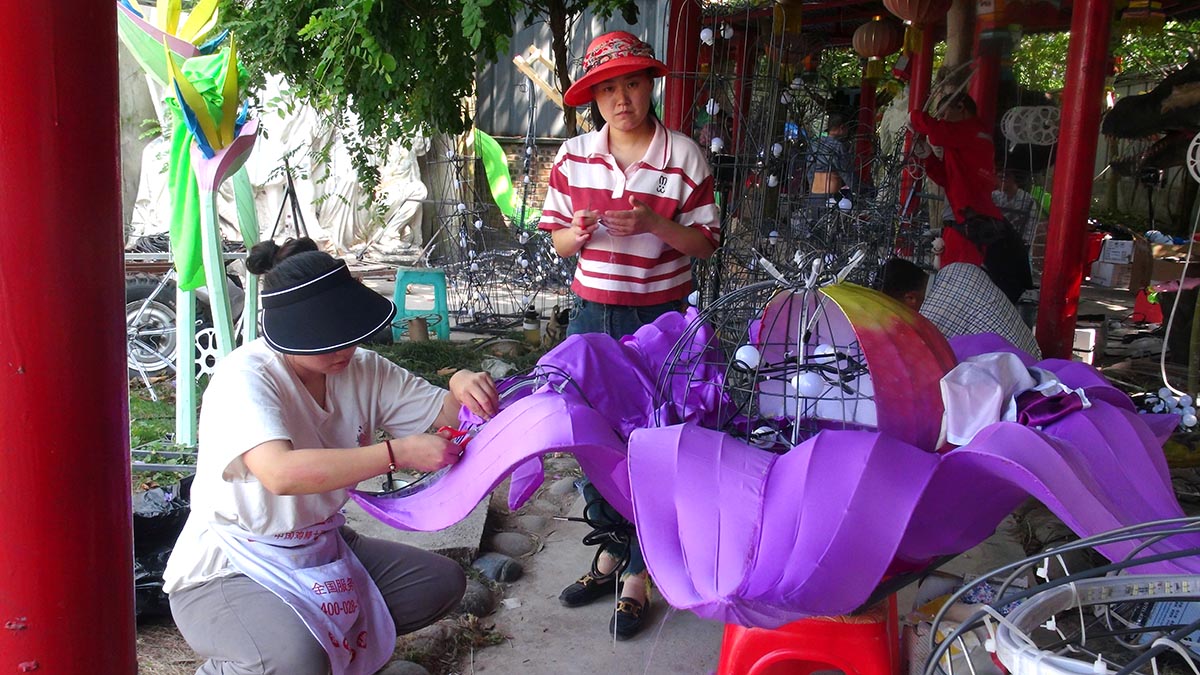
The breakthrough came with densified polyester satin — a higher thread count, better UV stabilization, and optional flame-retardant treatment. This is the standard material used by professional Zigong manufacturers today.
| Property | Densified Polyester Satin |
|---|---|
| Light transmission | Excellent — uniform diffusion across entire surface |
| Durability | Very good — high tear strength, water-repellent |
| UV resistance | Good — ISO color fastness 4–5 (5 = highest) |
| Fire retardancy | Optional — NF P 92-507 compliant |
| Outdoor suitability | Yes — full outdoor, multi-season use |
| Color range | 200+ colors |
| Cost | Low — Working directly with the workshop |
Why Densified Polyester Satin Solves Both Problems
The fundamental challenge of lantern fabric is that light transmission and outdoor durability are natural enemies. A material that lets light through easily (thin, porous) is usually fragile. A material that is tough and weather-resistant (thick, dense) usually blocks too much light.
Densified polyester satin solves this through its woven structure:
- High thread count in a satin weave: The satin weave minimizes thread crossings, creating long “floats” on the surface. These floats reflect and refract light across the fabric surface rather than letting light pass straight through in narrow beams. This is what produces the even, non-glowing glow.
- Polyester fiber: PET polyester is inherently UV-resistant — far more stable than natural fibers like silk or paper. It does not absorb water, so rain and humidity do not degrade it.
- Surface treatment: A thin, optically clear finish seals the fabric surface, adding water repellency without blocking or distorting light transmission.
A comparison of the five phases shows why densified polyester satin won:
| Era | Material | Light Transmission | Durability | Outdoor Use |
|---|---|---|---|---|
| Pre-1900 | Paper | ⭐⭐⭐⭐ | ⭐ | ❌ |
| 1400–1900 | Silk | ⭐⭐⭐⭐ | ⭐⭐ | ⚠️ Limited |
| Mid-1900s | Weatherproof Silk | ⭐⭐⭐ | ⭐⭐⭐ | ⚠️ |
| 1970–2000 | Early Bamei Satin | ⭐⭐⭐⭐ | ⭐⭐⭐ | ✅ Seasonal |
| Current | Densified Polyester Satin | ⭐⭐⭐⭐⭐ | ⭐⭐⭐⭐ | ✅ Multi-season |
Fire Retardancy and Safety Certification
Modern densified polyester satin can be treated with flame-retardant additives during the weaving or finishing process. This is not optional for international events:
- EU compliance: NF P 92-507 (French standard, widely accepted across Europe)
- Test standards: ISO 6941 / EN 1103 for fabric flammability
- Typical rating: M1 (non-flammable) or M2 (difficult to ignite) depending on treatment
For event organizers and venue operators, certified fire-retardant fabric is a legal requirement in most jurisdictions for public outdoor displays. Always confirm with your supplier that the satin fabric used in your lanterns carries the relevant certification.
What This Means for Buyers
When you source a custom lantern display, the fabric quality is one of the three most important specifications (alongside frame engineering and electrical compliance). Ask your supplier:
- What is the fabric’s thread count and weight?
- Does it have UV stabilization for outdoor use?
- Is fire-retardant treatment available and certified?
- What is the available color range?
- How does the fabric hold up after 2–3 months of continuous outdoor exposure?
A manufacturer that can answer these specifics confidently is using genuine densified polyester satin — not a lower-grade substitute.
Why Advertising Materials (Vinyl, PVC, Acrylic) Cannot Replace Satin Fabric
A common question from buyers new to lantern procurement is: why not just use vinyl banner material, PVC sheet, or acrylic panel? Those are cheaper and already weatherproof.
The answer comes down to three requirements that rigid or heavy advertising materials cannot meet:
1. Complex 3D Shapes
A lantern is not a flat sign. A dragon’s coiled body, a panda’s rounded ears, a phoenix’s layered tail feathers — these shapes require a fabric that can stretch, curve, and conform to a metal wire frame in three dimensions. Vinyl banner material is stiff and resists tight curves. PVC sheet and acrylic cannot bend to complex contours at all without heat-forming, which is impractical and expensive for multi-figure displays. Satin fabric, by contrast, drapes naturally and can be tensioned across compound curves without creasing.
2. Hand-Painted Gradient and Blending Effects (晕染)
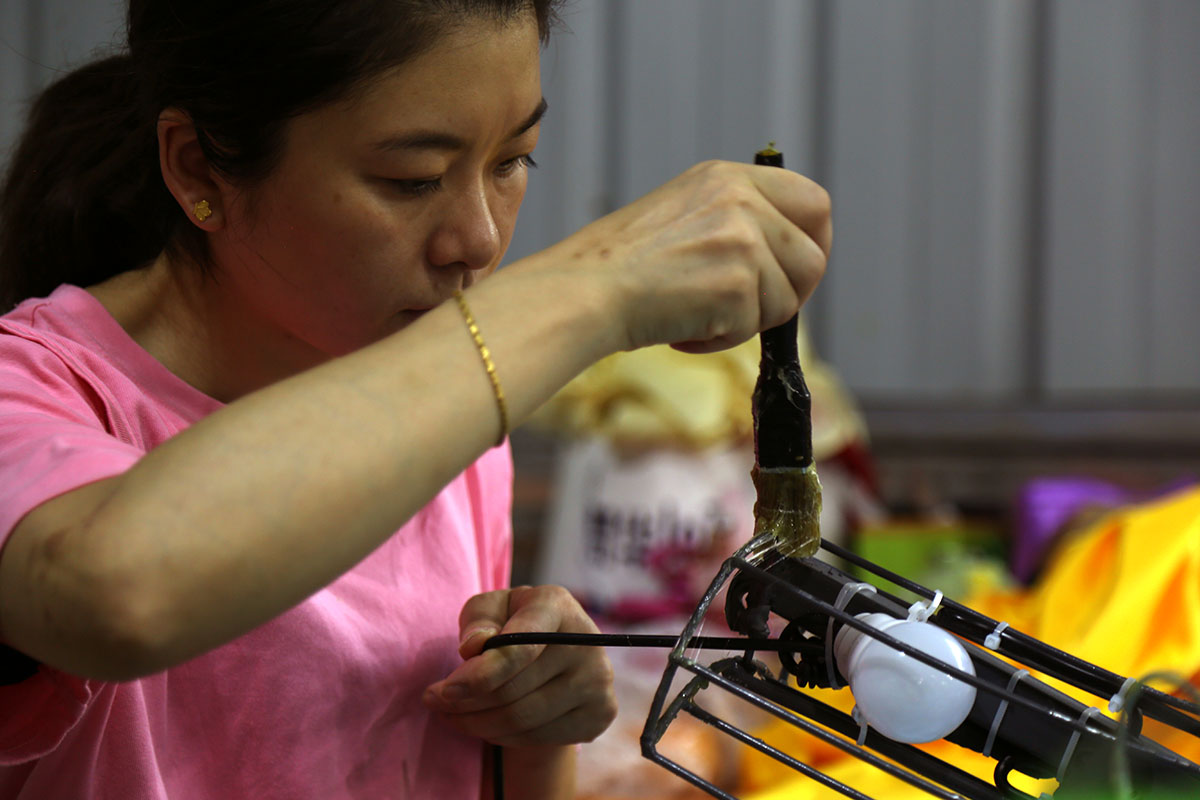
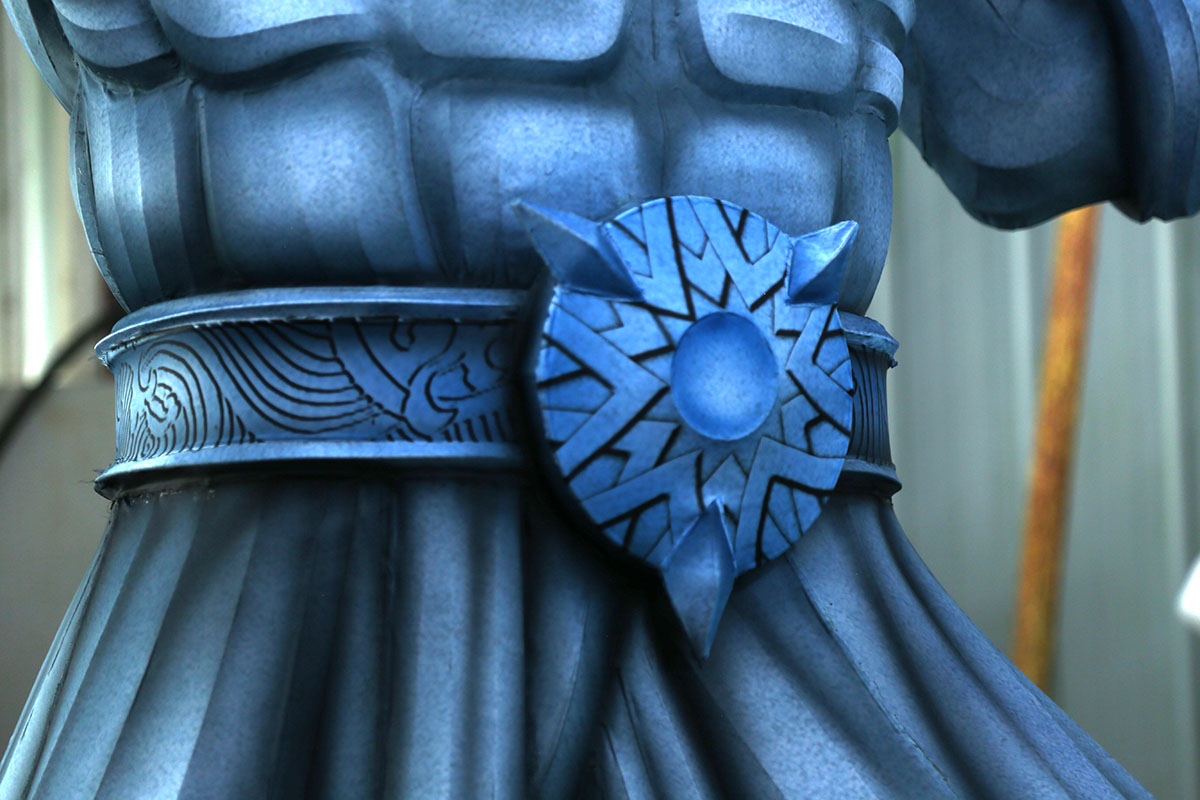
One of the defining visual features of Zigong lanterns is the hand-painted surface — colors are not printed or screened onto the fabric, they are brush-painted by artisans who create smooth gradients, soft blushes, and multi-tone blending directly on the stretched fabric. This 晕染 (yun rǎn / wash-and-blend) technique produces the soft transitions between colors that give each figure depth, warmth, and an organic, handcrafted feel.
Satin fabric absorbs and holds paint evenly, allowing the artisan to work wet-on-wet for seamless transitions. Vinyl and PVC are non-porous — paint beads on the surface and cannot be blended. Acrylic panels require screen printing or vinyl wrap, which produces flat, hard-edged colors that lack the luminous depth of hand-painted satin.
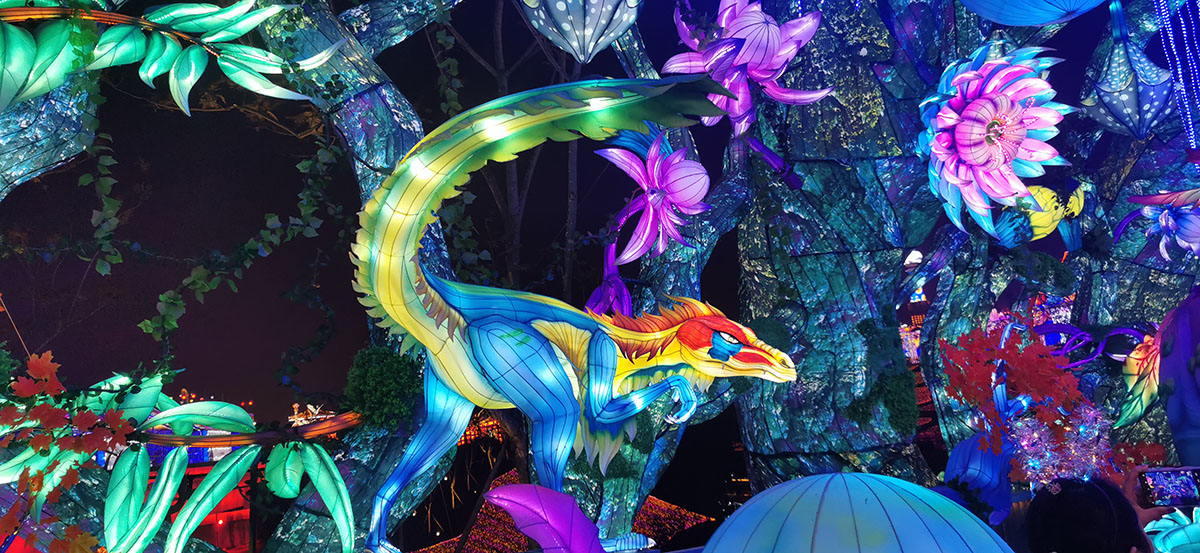
3. Even Light Diffusion Through a Painted Surface
The satin fabric does two jobs simultaneously: it transmits light from the LEDs inside, and it shows the painted artwork on its surface. The fabric’s satin weave diffuses light evenly across the painted area, so the gradient appears to glow from within rather than being lit from behind like a sign.
With vinyl or PVC, the painted layer sits on top of an impermeable surface — light passes through the gaps but cannot produce the soft, internal-glow effect. With acrylic, the material is rigid and must be lit from behind at a specific distance, creating hot spots and wasting the volumetric illusion that makes lantern figures feel alive.
| Requirement | Densified Polyester Satin | Vinyl Banner | PVC Sheet | Acrylic Panel |
|---|---|---|---|---|
| Conforms to complex 3D shapes | ✅ Excellent | ❌ Stiff | ❌ Rigid | ❌ Rigid, needs heat-forming |
| Hand-painted gradient effects | ✅ Absorbs, blends | ❌ Paint beads on surface | ❌ Non-porous, no blend | ❌ Needs wrap/print |
| Even light diffusion | ✅ Satin weave | ⚠️ Uneven | ❌ Blocks light | ⚠️ Hot spots |
| Weight for suspended installation | Light | Heavy | Heavy | Heavy |
| Repairability on site | ✅ Patch/replace sections | ⚠️ Replace whole panel | ⚠️ Replace whole panel | ⚠️ Replace whole panel |
Satin fabric is not the cheapest material per square meter. It is the only material that simultaneously delivers the formability, paintability, and light transmission that a three-dimensional painted lantern requires. For a flat billboard or a backlit sign, vinyl and acrylic are fine. For a handcrafted, glowing, three-dimensional lantern figure, satin is irreplaceable.
Conclusion
The fabric covering a Chinese lantern is not just a decorative skin. It is the material through which the entire display communicates with its audience. Densified polyester satin represents the culmination of 800 years of trial and error — a material that finally balances the fundamental conflict between light transmission and outdoor durability.
Today, it is the industry standard for professional Zigong lantern manufacturers, and the reason your festival’s displays can glow beautifully, night after night, from opening to closing.
As a Zigong-based manufacturer, FestiveLanterns uses densified polyester satin (Bamei satin) with UV stabilization and fire-retardant treatment on every outdoor display — because the glow is the product, and the fabric makes the glow.
Internal Links:
- Custom Chinese Lanterns — Complete Product Collection — Browse festival lantern displays made with premium densified polyester satin
- How Zigong Became the World’s Lantern Capital — The craft heritage behind modern lantern manufacturing
- City Lantern Festival Displays — Outdoor installations built with industry-standard materials
- Chinese Lantern Ceremony — From material to installation — the complete offering
Related Products & Resources
- Chinese Lantern Products — Browse our full range of custom lantern displays
- Animatronic Dinosaurs & Animals — Life-size custom exhibits for parks and museums
- More Guides & Articles — Festival planning, buying guides, and industry insights
- Get a Free Custom Proposal & Quote