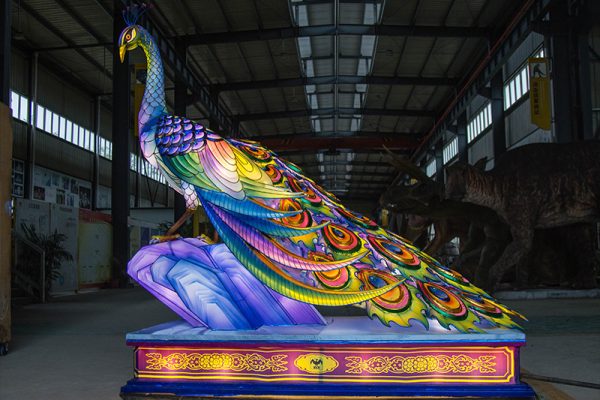
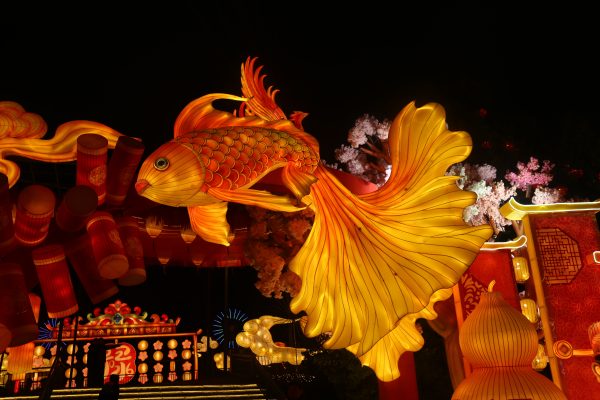
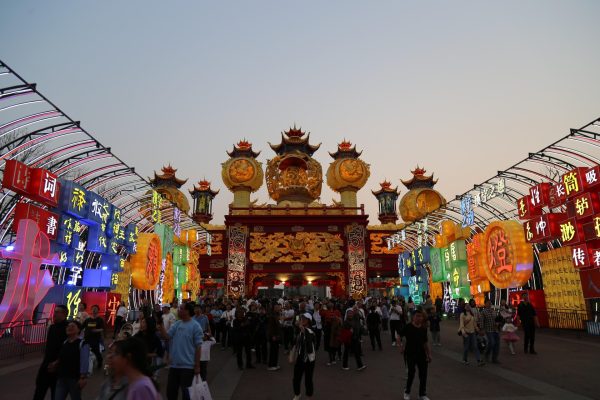
Every year, shopping malls, botanical gardens, cultural centers, and community parks across North America, Europe, and the Middle East host Mid-Autumn Festival events — and the numbers are growing. According to industry reports, attendance at cultural festival events in North American malls increased by over 30% between 2022 and 2025, with Mid-Autumn ranking as the fastest-growing non-winter holiday activation.
But planning a successful Mid-Autumn event requires more than booking a few food stalls and hanging paper lanterns. Venue operators need a structured plan covering everything from timeline and budget to the all-important visual centerpiece — the lantern display that makes visitors stop, photograph, and share.
This checklist walks through every stage of Mid-Autumn event planning, based on our experience supplying lantern displays to venues in 15+ countries.
Phase 1: Pre-Planning (6-8 Months Before Event Date)
The most common mistake venue operators make is starting too late. Professional-grade custom lantern installations take 6-11 weeks to manufacture and 3-5 weeks to ship internationally. Add 2-3 weeks for on-site installation and you need to begin planning at least 5-6 months in advance.
Pre-planning checklist:
- [ ] Confirm the event date. Mid-Autumn 2026 falls on October 4 (Sunday) . Plan your event for October 2-5 (Friday through Monday) to capture the full weekend.
- [ ] Define your event goals: Foot traffic? Revenue from ticket sales? Brand awareness? Community engagement? Each goal shapes your budget allocation differently.
- [ ] Establish a preliminary budget range. For a mid-size mall or park event with a professional lantern display, plan for $15,000-$80,000 depending on scale.
- [ ] Assess your venue’s footprint. Where will the main display be placed? Is there adequate power access? Will foot traffic flow naturally past the key attractions?
- [ ] Check local permit requirements. Outdoor events typically need fire safety approval, electrical inspection, and crowd management permits.
Phase 2: Sourcing Your Visual Centerpiece (5-6 Months Before)
The single most important decision in Mid-Autumn event planning is the visual centerpiece — the element that appears in every visitor photo, every social media post, and every press article about your event. For 80%+ of venues we work with, that centerpiece is a large-scale Mid-Autumn lantern installation.
What to look for in a lantern display manufacturer:
| Criterion | Why It Matters |
|---|---|
| Mid-Autumn experience | Manufacturers who understand the festival’s cultural symbols (moon rabbit, Chang’e, lotus, full moon) deliver authentic, meaningful designs |
| Weatherproof construction | Displays must operate for 4-6+ weeks outdoors — IP65-rated LEDs, galvanized steel frames, UV-resistant silk |
| Custom design capability | Off-the-shelf decorations look generic. A venue-specific design (e.g., “Gateway Mall presents: The Moon Palace of Chang’e”) builds brand identity |
| Past venue projects | Ask for photos of past installations at venues similar to yours |
| Shipping & installation support | Factory-direct shipping via sea freight (3-5 weeks) + remote or on-site installation guidance |
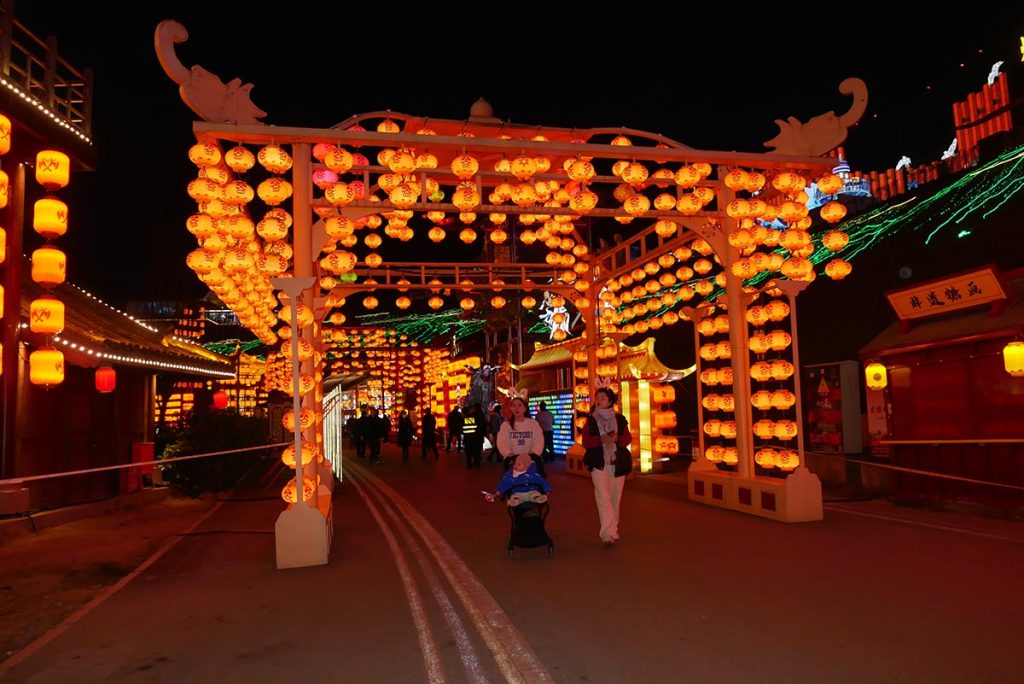
A grand lantern tunnel entrance at a Mid-Autumn Festival venue — rows of red and amber lanterns hang in a layered wooden archway, with mountainside lantern displays glowing in the background. This is the kind of immersive entrance installation that turns a venue perimeter into a destination in itself: visitors photograph the archway on approach, walk through the warm-lit corridor, and emerge directly into the main lantern grounds. The same archway design is used at commercial venue entrances (malls, parks, cultural centers) to channel foot traffic and set the festival tone from the very first moment.
Supplemental decorations to consider:
- Hanging lantern strings along corridors and walkways (standard silk lanterns, 30-60cm diameter)
- Tabletop rabbit and lotus lanterns for restaurant areas and VIP zones
- Moon-shaped photo frame installations (2-3m diameter) for selfie stations
- LED-lit Mid-Autumn greeting banners with your venue’s branding
Phase 3: Designing the Visitor Experience (4-5 Months Before)
A great visual display draws visitors in. A great experience keeps them there — and keeps them spending.
Activity planning checklist:
- [ ] Interactive zones. Consider a mooncake-making station, a calligraphy corner where visitors write wishes on decorative cards, and a traditional tea ceremony demonstration.
- [ ] Performance schedule. Book lion dance troupes, Chinese instrumental musicians (guzheng, erhu), and martial arts demonstrations for weekend time slots.
- [ ] Children’s activities. Mid-Autumn is family-oriented. Plan a paper lantern-making workshop, a “find the Jade Rabbit” scavenger hunt, and face painting with moon-themed designs.
- [ ] Food & beverage plan. Partner with local Chinese restaurants or bakeries for mooncake and tea tasting stations. Include non-Chinese food options to appeal to all visitors.
- [ ] Photo opportunities. Beyond the main lantern display, add 3-5 smaller photo spots throughout your venue — each with event hashtags displayed.
- [ ] Evening programming. Mid-Autumn is fundamentally a nighttime festival. Plan your peak programming for 6:00-9:00 PM when lanterns look most dramatic.
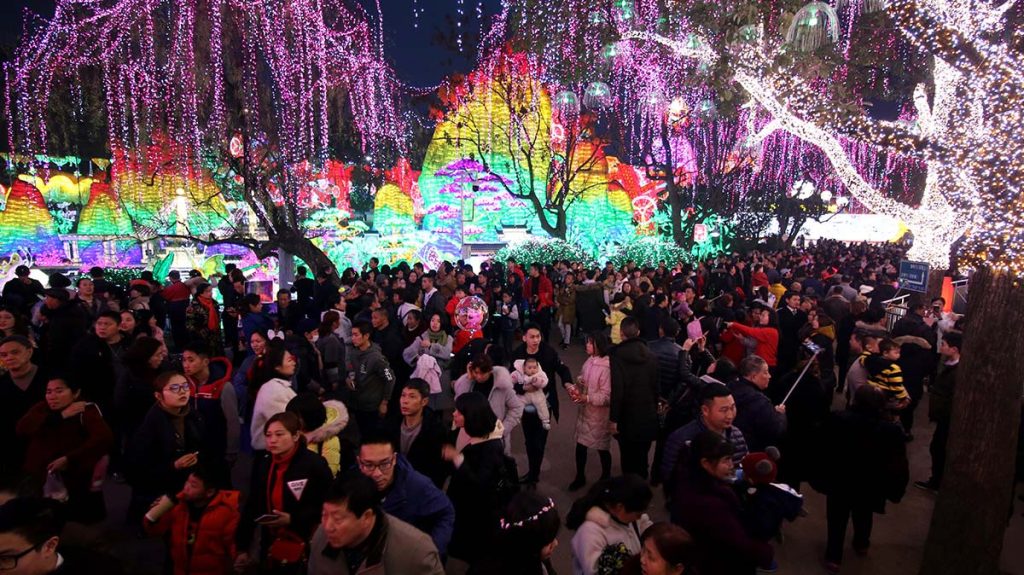
Tens of thousands of visitors packed shoulder-to-shoulder at a Chinese lantern festival — pink and white LED-lit weeping willows overhead, a multi-coloured mountain-themed lantern display in the background. This is what a successful Mid-Autumn event actually looks like on peak night. A well-designed lantern installation is a gravitational force: visitors come because they have seen other people’s photos, and they stay because the venue is so visually overwhelming that leaving early feels like a wasted trip. The density in this image is also the most persuasive marketing asset for next year’s edition.
Phase 4: Marketing and Promotion (2-3 Months Before)
Your marketing should build anticipation in waves, not blast everything at once:
8 weeks before — “Save the Date” phase:
- Send press releases to local media, cultural publications, and tourism boards
- Post a “Save the Date” teaser on social media with a silhouette image of your lantern design
- Add the event to community calendars and event listing platforms (Eventbrite, Facebook Events)
4-6 weeks before — “Build Anticipation” phase:
- Begin posting behind-the-scenes content: lantern design sketches, photos from the manufacturing process, installation preparation
- Launch an early-bird ticket sale (if ticketed) or VIP preview registration
- Partner with local influencers — invite them to an exclusive pre-opening tour in exchange for social media coverage
2 weeks before — “Drive Action” phase:
- Release the full event schedule and map
- Run geo-targeted social media ads within 25km of your venue
- Distribute printed flyers to nearby businesses, community centers, and schools
- Send an email blast to your venue’s subscriber list with a countdown
During the event — “Amplify Reach” phase:
- Set up a live photo wall displaying Instagram posts with your event hashtag in real time
- Station photographers at key photo spots and offer free digital downloads (with event watermark)
- Run a “Best Photo” contest with a small prize — this doubles your user-generated content
Key marketing metric: For a well-executed Mid-Autumn event at a mid-size mall, expect 500-2,000 social media posts with your event hashtag, reaching 50,000-200,000 local users organically — all driven by the visual appeal of your custom lantern display.
Phase 5: Logistics and Operations (4-8 Weeks Before)
Installation timeline:
| Task | Timing | Notes |
|---|---|---|
| Site preparation | 2-3 weeks before | Electrical hookups, ground anchoring, safety barriers |
| Lantern delivery | 10-14 days before | Sea freight + customs clearance + last-mile trucking |
| Main display assembly | 5-7 days before | Modular lantern sections assembled on-site |
| Electrical testing | 3-4 days before | Full power-on test, color programming, DMX sync |
| Soft opening | 1-2 days before | Staff walkthrough, influencer preview |
| De-installation | 1-3 days after event ends | Modular disassembly, crating, storage or return |
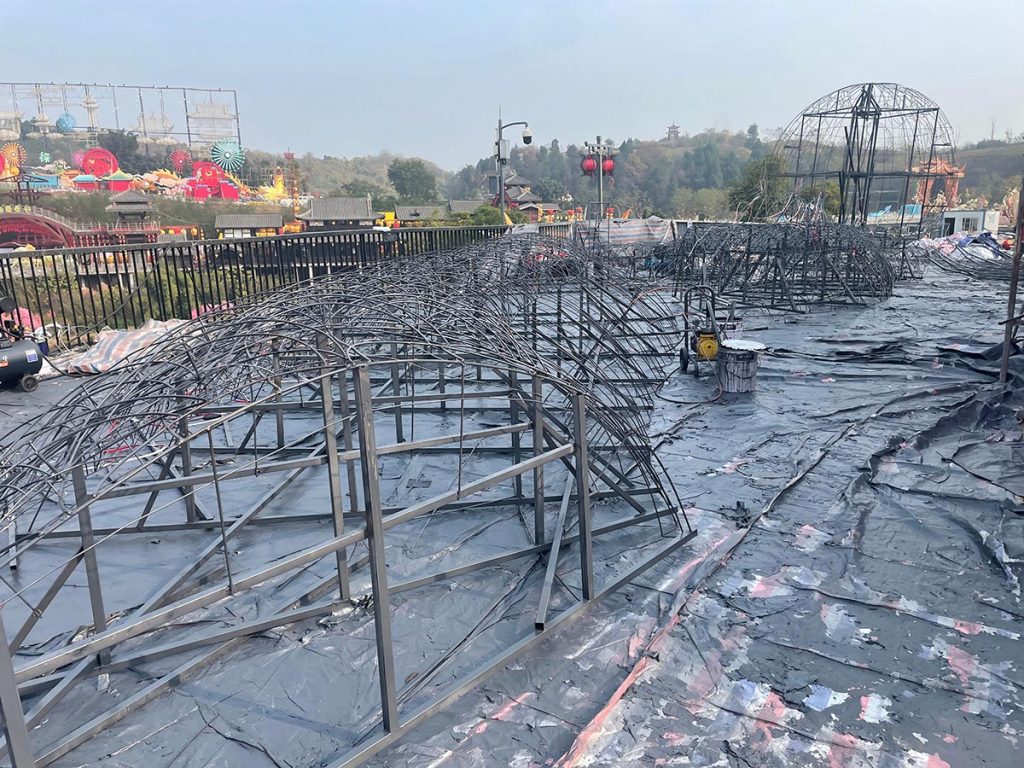
The on-site production yard for a large-scale Mid-Autumn lantern festival — multiple arched steel skeleton frames laid out on protective ground sheeting, with completed lantern installations glowing in the background. This is what the week before opening night actually looks like: modular steel sections, freshly welded and ready for silk application, electrical fit-out, and final assembly. Venue operators who tour the production site during this phase gain a realistic understanding of the scale, the modularity, and the time required to bring a multi-hectare lantern festival from shipping container to opening night.
Operational checklist:
- [ ] Confirm power supply locations and capacity (110V/220V matched to your country’s standard)
- [ ] Arrange security for overnight periods when the display is unstaffed
- [ ] Prepare a weather contingency plan (high wind? heavy rain? Know your display’s wind rating — ours are tested to 60-90 km/h)
- [ ] Brief staff on the lantern display’s operation (on/off schedule, safety protocols, troubleshooting contacts)
- [ ] Print signage: event map, attraction descriptions, safety notices — bilingual if your audience includes Chinese-speaking visitors
Budget Breakdown: Where the Money Goes
For a representative mid-size Mid-Autumn event at a shopping mall or community park with a 5-8 meter centerpiece lantern display:
| Budget Category | % of Total | Typical Range |
|---|---|---|
| Lantern display + shipping | 35-45% | $15,000-$80,000 |
| On-site installation labor | 8-12% | $3,000-$8,000 |
| Performance & entertainment | 10-15% | $2,000-$10,000 |
| Marketing & promotion | 10-15% | $2,000-$10,000 |
| Food & beverage setup | 5-8% | $1,000-$5,000 |
| Permits, insurance, security | 5-8% | $1,000-$5,000 |
| Decorations & signage | 5-8% | $1,000-$5,000 |
| Contingency reserve | 5-10% | $1,000-$8,000 |
Cost-saving tip: The lantern display is the largest single cost — but it is also the one item you can reuse across multiple years if you invest in professional-grade materials. Our silk-and-steel lanterns last 3-5 seasons with proper storage, spreading the cost across multiple events. A $30,000 display used across 3 Mid-Autumn events effectively costs $10,000 per year.
Measuring Success: Post-Event Analysis
After the event, measure what mattered:
- Foot traffic: Compare daily visitor counts to the same dates the previous year (without an event)
- Revenue: Track tenant sales reports (for malls), ticket revenue (for ticketed venues), F&B sales
- Social media: Count posts with your event hashtag, total impressions, and engagement rate
- Press coverage: Number of media articles, total reach
- Survey feedback: Exit surveys asking visitors what they enjoyed most and what they’d improve
Return on Investment (ROI) framework:
A mall investing $50,000 in a Mid-Autumn event with a professional lantern display might see:
- 15-25% increase in weekend foot traffic
- 8-15% increase in tenant sales during the event period
- 500-2,000 organic social media posts (estimated media value: $10,000-$40,000)
- New customer acquisition through community press coverage
For many venues, the return comes not just in immediate sales but in brand positioning — being known as the venue that “does Mid-Autumn right” in your city.
Common Planning Mistakes to Avoid
1. Starting too late.
Professional lantern manufacturing needs 6-11 weeks + 3-5 weeks shipping. If you contact a manufacturer in August for an October event, you are likely too late for a custom design.
2. Under-budgeting the visual centerpiece.
The lantern display is what visitors photograph, share, and remember. Cheap decorations that look flimsy in person will not generate the social media exposure that drives attendance.
3. Ignoring weather requirements.
Mid-Autumn falls in late September or early October — outdoor events in northern climates need a weather plan. Confirm your lantern display’s wind rating, waterproof rating, and operating temperature range before ordering.
4. Forgetting the “evening magic.”
Mid-Autumn is a moon-viewing festival. If you schedule all your programming for daytime hours, you miss the entire atmospheric point. Plan peak activities for 6:00-9:00 PM when lanterns glow and the moon rises.
5. Neglecting staff cultural training.
Your front-line staff should understand the basic story of Chang’e and the Jade Rabbit, the significance of mooncakes, and why lanterns matter. This transforms their interactions from “pointing at decorations” to “sharing cultural stories.”
Conclusion
A well-planned Mid-Autumn event does three things simultaneously: it attracts visitors, generates social media exposure, and positions your venue as a culturally engaged destination in your community. The anchor of any successful Mid-Autumn event is the visual centerpiece — a display that makes people stop, take photos, and share their experience with friends and family.
If you are planning a Mid-Autumn event for 2026, start the conversation with a manufacturer now. Custom designs take time — and the venues that plan earliest get the best results.
Related Products & Resources
- Mid-Autumn Festival Lantern Display Manufacturer — Custom moon festival lanterns from Zigong. Design, manufacturing, shipping, and installation support worldwide.
- Zoo Lantern Festival Provider — Large-scale illuminated animal displays and light tunnels for zoos, gardens, and cultural venues.
- Custom Chinese Lanterns — Full Product Catalog — Browse all lantern types: animal lanterns, festival centerpieces, floating lanterns, and themed installations.
- Request a Free Event Design Proposal — Tell us your venue, event date, and vision. Concept rendering and quotation within 3-5 business days.