Every year on the 15th day of the 8th lunar month, millions of families across China and East Asia gather under the full moon to celebrate the Mid-Autumn Festival. It is the second most important traditional festival in Chinese culture — but beyond the mooncakes and lanterns, there is a rich world of customs, stories, and regional traditions that make this celebration unique.
Whether you are a cultural venue planning an event, a family looking to celebrate authentically, or simply curious about one of Asia’s most visually stunning festivals, this guide covers everything from food symbolism to modern celebration trends.
The Story Behind the Moon: Chang’e and Hou Yi
At the heart of the Mid-Autumn Festival is the legend of Chang’e , the moon goddess, and her husband Hou Yi , the legendary archer who shot down nine suns.
According to the most widely told version, Hou Yi was rewarded with an elixir of immortality after saving the earth from scorching heat. Rather than share it, a greedy apprentice tried to steal it. To prevent this, Chang’e drank the elixir herself — and began floating upward toward the moon, where she has lived ever since with only a Jade Rabbit for company.
Hou Yi, heartbroken, would lay out Chang’e’s favorite foods under the full moon each year. This tradition evolved into the Mid-Autumn Festival we know today — a celebration of reunion, gratitude, and the beauty of the full moon.
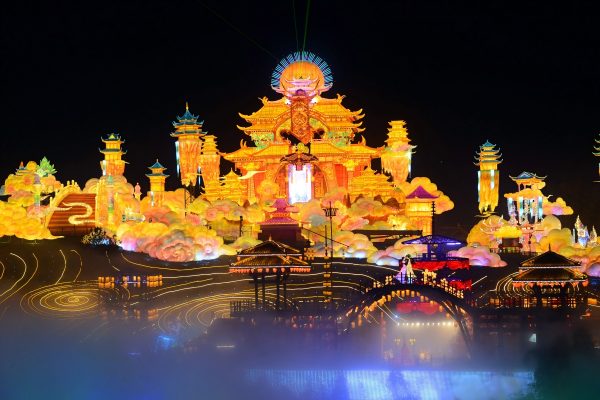
The lunar legend also explains why the moon rabbit and moon palace are recurring motifs in festival decorations — including the large-scale Mid-Autumn lantern displays we manufacture for venues worldwide.
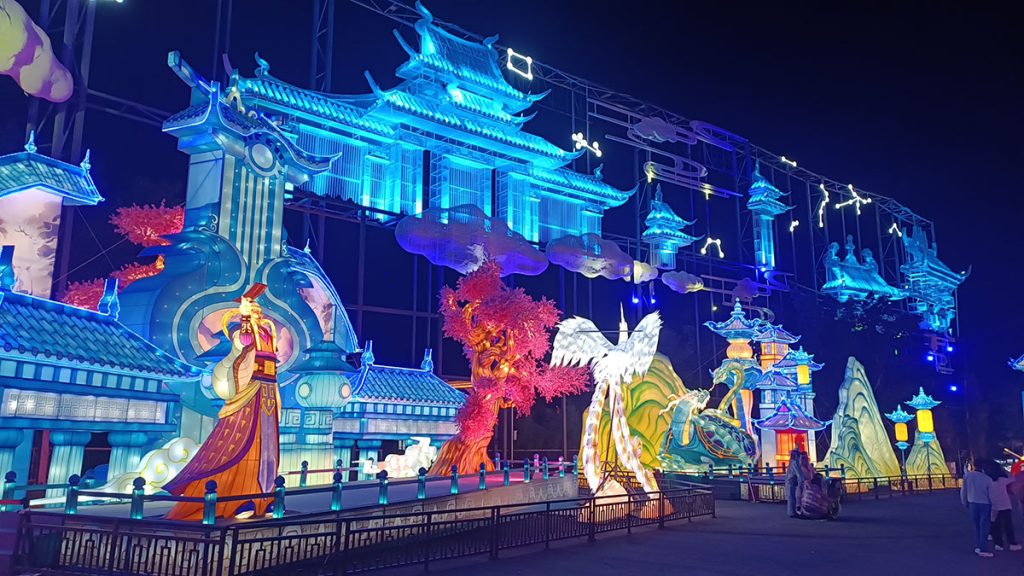
A monumental illuminated moon palace lantern installation — bathed in cool blue light, the scene features the moon goddess Chang’e in flowing robes, a soaring phoenix with outstretched wings, multi-tiered traditional Chinese pavilions, and glowing peach trees. This is the signature showpiece for our largest Mid-Autumn Festival commissions: architectural-scale, full-pavilion palace scenes that anchor public lantern festivals and become the “must-photograph” centerpiece of any event.
Mooncakes: The Iconic Mid-Autumn Food
No Mid-Autumn celebration is complete without mooncakes . These dense, round pastries — symbolizing completeness and reunion — are exchanged among family members, business partners, and friends during the festival season.
Traditional mooncake varieties by region:
| Region | Style | Key Characteristics |
|---|---|---|
| Cantonese (Guangdong) | Sweet, smooth lotus seed paste | Thin golden crust, salted egg yolk center, most widely exported |
| Suzhou-style (Jiangsu) | Savory, flaky pastry | Pork-filled, layered crust, eaten hot, regional favorite in eastern China |
| Beijing-style (Northern) | Sweet, dense filling | Red bean or jujube paste, thicker crust, often decorated with red stamps |
| Snow Skin (Hong Kong) | Chilled, mochi-like shell | Fruit or custard fillings, served cold, popular summer variant |
| Yunnan-style | Ham and flower paste | Salty-sweet combination with rose petal filling |
Mooncake etiquette tips for business gift-giving:
- Gift in pairs (even numbers symbolize harmony)
- Include high-quality tea (mooncakes are dense and pair well with pu’er or jasmine)
- Avoid gifting “four” as the number sounds like “death” in Chinese
- Modern gift boxes often include culturally themed packaging — an opportunity for venue branding
Beyond Mooncakes: The Mid-Autumn Feast
While mooncakes dominate media coverage, the Mid-Autumn dinner table tells a richer story:
Seasonal foods and their meanings:
- Taro : Harvested in early autumn, taro symbolizes prosperity and abundance. In Chaoshan and Hakka communities, taro cakes are as important as mooncakes.
- River Snails : A Guangdong and Fujian tradition — eating snails during Mid-Autumn is believed to improve eyesight, as the cooked snail meat resembles a bright, shining eye.
- Pomelo : The Chinese word for pomelo sounds like “blessing” and “protection.” Families display pomelos on the dinner table and children wear pomelo-peel hats for good luck.
- Osmanthus Wine & Jelly : The osmanthus flower blooms during Mid-Autumn, and its fragrance is woven into festival foods. Osmanthus jelly is a light, floral dessert popular in southern China and Taiwan.
- Duck : Roasted or braised duck is a festival staple across multiple Chinese regions, symbolizing fidelity and completeness.
For commercial venues hosting a Mid-Autumn event, incorporating these foods into a “taste of the festival” menu or food stall lineup creates a more immersive visitor experience — especially when paired with a custom lantern festival display as the visual centerpiece.
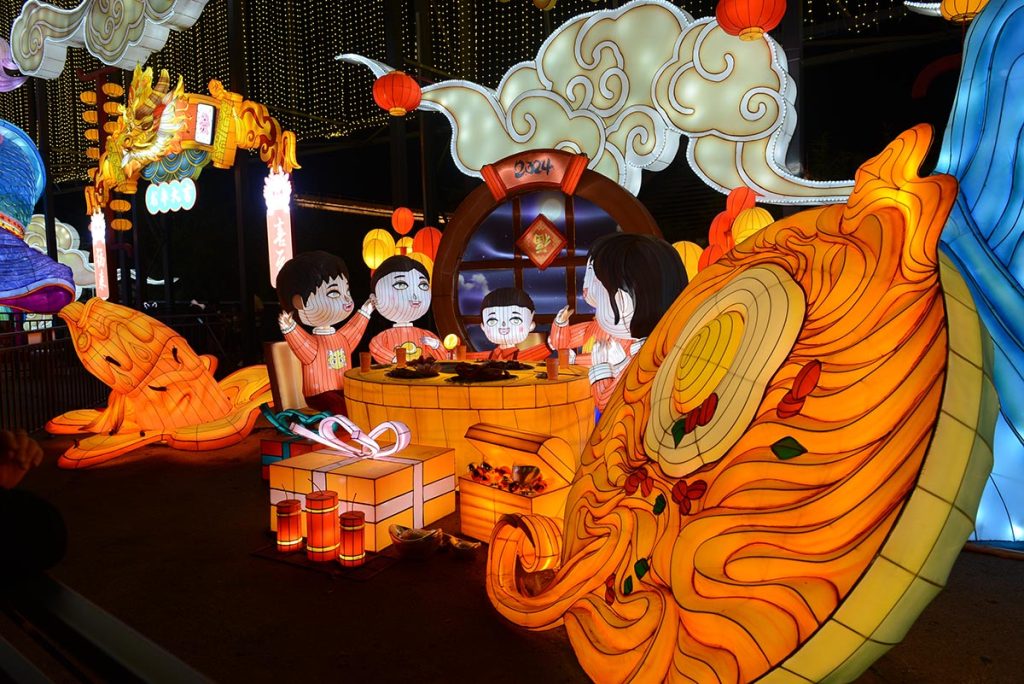
An illuminated Chinese lantern sculpture depicting a Mid-Autumn family reunion dinner — a father, mother and child figurine gathered around a round mooncake table, framed by auspicious clouds, red lanterns, and a glowing “2024” moon-arch gateway. This themed sculptural scene is one of our most-licensed Mid-Autumn centerpieces: it captures the cultural heart of the holiday — 团圆 (tuányuán, family reunion) — in a single tableau that photographs beautifully after dark and is instantly readable as Mid-Autumn to viewers of any background.
Lantern Traditions During Mid-Autumn Festival
While lantern displays are more famously associated with Chinese New Year and the Lantern Festival (元宵节, Yuánxiāo Jié), they play an equally important — if distinct — role during the Mid-Autumn Festival.
Three distinct Mid-Autumn lantern traditions:
1. Handheld Paper Lanterns for Children
In southern China, Hong Kong, and Southeast Asian Chinese communities, children carry small, candle-lit paper lanterns on the evening of Mid-Autumn. These are often shaped like rabbits, fish, or stars — lightweight and inexpensive. The tradition is especially strong in Hong Kong, where families gather in parks and along the harbor to display thousands of lanterns simultaneously.
2. Floating Water Lanterns
In riverside and coastal communities, lotus-shaped lanterns are set afloat on rivers, lakes, and ponds. Each lantern carries a written wish — for love, health, academic success, or family harmony. This practice is shared with Vietnam’s Tết Trung Thu and Korea’s Chuseok celebrations, highlighting the festival’s pan-East Asian roots.
3. Large-Scale Public Displays
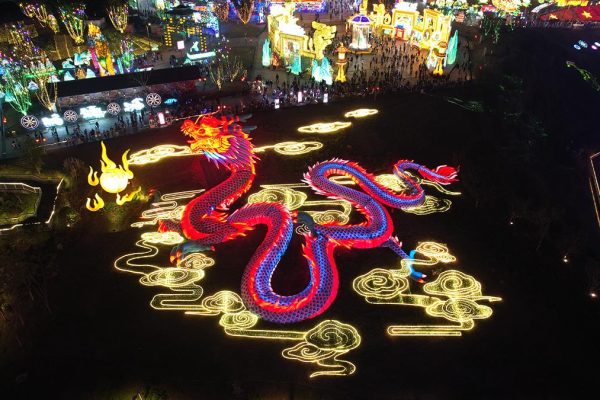
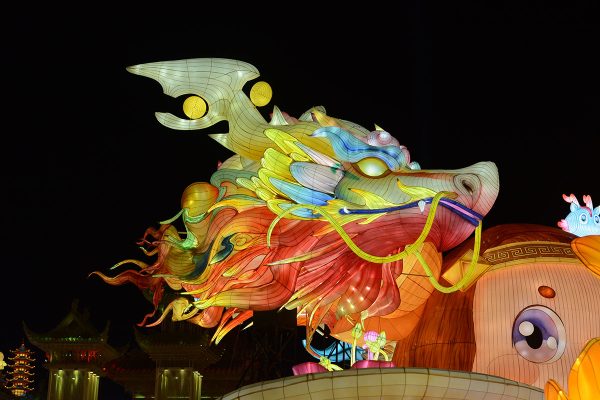
Modern cities and commercial venues commission large Mid-Autumn lantern installations — illuminated moon rabbit sculptures 5-10 meters tall, moon palace scene dioramas, and lantern tunnels stretching 50+ meters. These professional-grade displays use internal frames, LED lighting, and UV-resistant covering to operate outdoors for 4-6 weeks, drawing tens of thousands of visitors.
The evolution from handmade paper lanterns to engineered light installations reflects how the festival itself has grown — from a family ritual into a major cultural tourism attraction.
Regional Differences: How Mid-Autumn Is Celebrated Across Asia
The Mid-Autumn Festival is not limited to China. Multiple East and Southeast Asian cultures observe variations of the full moon celebration:
| Country/Region | Name | Unique Traditions |
|---|---|---|
| China | 中秋节 (Zhōngqiū Jié) | Mooncakes, family dinner, moon worship, handheld lanterns for children |
| Vietnam | Tết Trung Thu | “Children’s Festival” — lion dances, star-shaped lanterns (đèn ông sao), toy markets |
| South Korea | Chuseok (추석) | Ancestor worship (charye), songpyeon rice cakes, traditional wrestling (ssireum), visit to family graves |
| Japan | Tsukimi (月見) | Pampas grass (susuki) decoration, tsukimi dango rice dumplings, seasonal foods like taro and chestnuts |
| Singapore & Malaysia | Mid-Autumn Festival | Lantern processions in Chinatown, large-scale light-up displays, mooncake gifting culture |
| Taiwan | 中秋節 | Barbecuing outdoors with family and friends — a uniquely Taiwanese modern tradition |
| Chinese diaspora worldwide | Moon Festival | Community lantern parades, cultural performances in Chinatowns, mooncake sharing among neighbors |
This regional diversity creates opportunities for cultural venues — a well-planned Mid-Autumn event can draw visitors from multiple communities by incorporating elements from different traditions alongside a professionally manufactured lantern display.
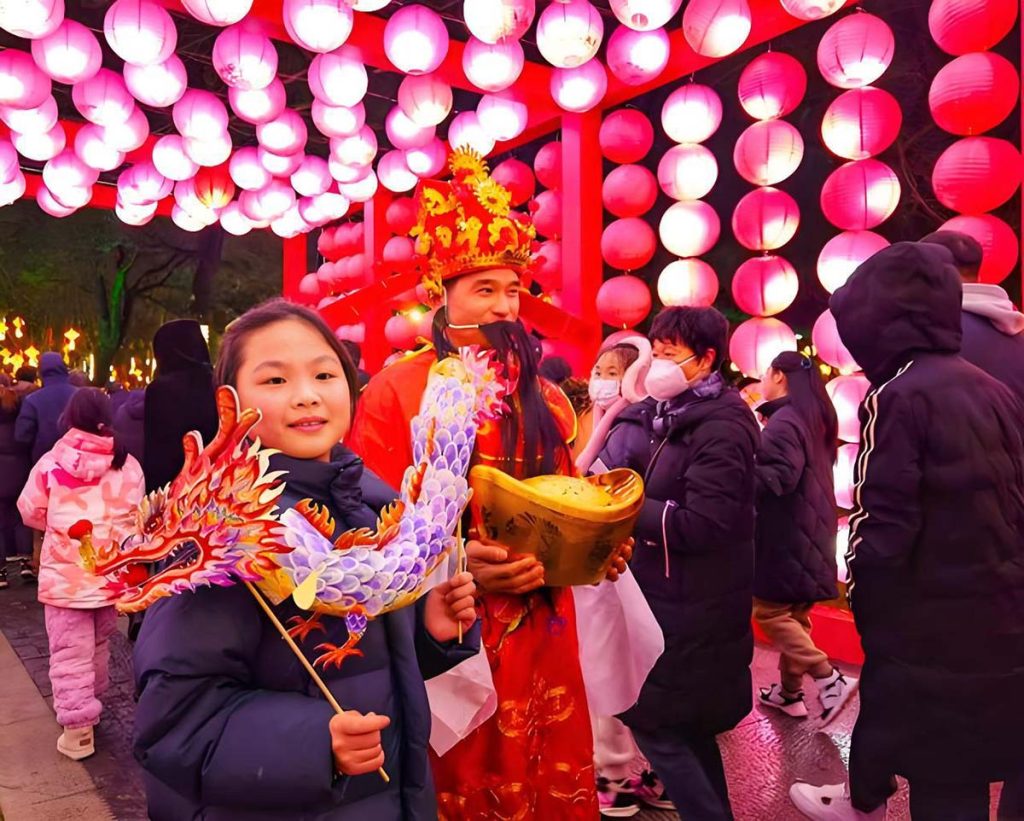
A child posing with a hand-held dragon lantern at a Chinese lantern viewing event — alongside a costumed Caishen performer carrying a golden ingot, all under a tunnel of pink and red lanterns. Across China, Vietnam (Tết Trung Thu), Hong Kong, and Southeast Asian Chinese communities, children carrying themed handheld lanterns on festival evenings is one of the most visually distinctive and cross-cultural elements of the lunar celebrations — and adding costumed character performers like Caishen is a popular way for public festivals to deepen visitor engagement and photo opportunities.
Modern Mid-Autumn Celebration Ideas for 2026
As the festival evolves, new celebration formats are emerging — especially in cities with significant Chinese diaspora communities:
For Families:
- Host a mooncake-making workshop at home (pre-made lotus paste and mold kits available online)
- Create a “full moon picnic” — head to a park or rooftop with seasonal foods, tea, and portable lanterns
- Video-call distant family members during dinner — the tradition of reunion adapts to modern life
For Communities:
- Organize a neighborhood lantern walk (check local fire safety regulations for open-flame candles)
- Host a floating lantern ceremony at a local pond or pool (use LED tea lights for fire safety)
- Screen a classic moon-themed film outdoors (e.g., “Over the Moon,” a 2020 animated feature)
For Commercial Venues:
Malls, cultural centers, and theme parks are increasingly treating Mid-Autumn as a major consumer event. Effective approaches include:
- Lantern photo zones: A custom-designed lantern installation as a selfie backdrop generates organic social media exposure — the single most effective marketing tool for modern festivals
- Mooncake tasting stations: Partner with local bakeries for sampling events
- Calligraphy workshops: Visitors write Mid-Autumn wishes on decorative cards or paper lanterns
- Storytelling performances: Live readings of the Chang’e legend with shadow puppetry or lantern-lit stages
- Multi-cultural nights: In diverse cities, feature Vietnamese lantern dances, Korean songpyeon making, and Japanese tsukimi displays alongside Chinese traditions
Mid-Autumn Festival vs. Lantern Festival: What’s the Difference?
Because both festivals prominently feature lanterns, newcomers often confuse them:
| Aspect | Mid-Autumn Festival | Lantern Festival (元宵节) |
|---|---|---|
| Date | 15th day of 8th lunar month (Sep-Oct) | 15th day of 1st lunar month (Feb-Mar) |
| Theme | Harvest, family reunion, moon worship | Marks end of Chinese New Year celebrations |
| Lantern role | Smaller-scale, children’s activities, wish lanterns | Massive public displays, lantern riddles, the festival centerpiece |
| Signature food | Mooncakes, taro, pomelo | Tangyuan (sweet glutinous rice balls) |
| Commercial opportunity | Growing but less saturated | Highly competitive display market |
For venue operators, this distinction matters: Mid-Autumn events face less competition for visitor attention (compared to CNY and Lantern Festival), offering a better return on investment per marketing dollar spent on a custom Mid-Autumn lantern display.
Frequently Asked Questions
Q: When is Mid-Autumn Festival 2026?
A: Mid-Autumn Festival 2026 falls on October 4, 2026 (Sunday). The 15th day of the 8th lunar month corresponds to this Gregorian date. The public holiday in China typically spans 3 days, while Chinese communities worldwide celebrate on and around this date.
Q: What is the difference between mooncakes from different regions?
A: Cantonese mooncakes are the most common export variety — thin crust with lotus seed paste and salted egg yolk. Suzhou-style are savory with flaky pastry and pork filling. Snow skin mooncakes are a modern chilled variety. Yunnan-style incorporates local ham and rose petal flavors.
Q: Are lanterns only used during Chinese New Year?
A: No. Lanterns are used during the Mid-Autumn Festival, the Lantern Festival (15th day of Chinese New Year), and other celebrations. Mid-Autumn lanterns are typically smaller and more personal — handheld paper lanterns for children and floating lotus lanterns for wish-making — though large public displays are increasingly common.
Q: What should I wear to a Mid-Autumn Festival event?
A: There is no strict dress code, but many families and event attendees wear traditional Chinese clothing like qipao (cheongsam) or tangzhuang jackets for photos. For outdoor evening events, bring a light jacket — Mid-Autumn evenings can be cool.
Q: How do other Asian countries celebrate the full moon festival?
A: Vietnam celebrates Tết Trung Thu as a children’s festival with lion dances and star-shaped lanterns. Korea observes Chuseok with ancestor worship and songpyeon rice cakes. Japan’s Tsukimi features pampas grass decorations and white rice dumplings. Each culture has unique foods and rituals but shares the central theme of harvest gratitude.
Q: Can I organize a Mid-Autumn event at my venue even if we’re not in China?
A: Absolutely. Many of our clients — including shopping malls in Dubai, cultural centers in London, and botanical gardens in Toronto — host successful Mid-Autumn events. The key is an authentic Chinese lantern display as the visual anchor, complemented by local food vendors, craft activities, and cultural performances.
Related Products & Resources
- Mid-Autumn Festival Lantern Display Manufacturer — Custom moon festival lanterns for events, malls, and cultural venues. Factory direct from Zigong.
- Custom Chinese Lantern Collection — Browse our full range of festival lantern displays, from small accent pieces to 30m+ centerpieces.
- Chinese Lantern Festival — Complete Event Displays — Turnkey festival packages for zoos, theme parks, and cultural venues worldwide.
- Get a Free Custom Lantern Design Proposal — Tell us your event date, venue, and theme. Design rendering and quote within 3-5 business days.
Before you budget the event, read our mid-autumn festival cost guide to plan realistic spend across venues, food and lantern displays.
Looking for mid-autumn lantern festival display ideas, themes and venue planning tips? Explore our complete mid-autumn lantern festival guide — custom moon palace displays, rabbit and lotus scenes for zoos, parks and cultural venues.