The Netherlands runs one of Europe’s densest winter light festival circuits — the Dutch call them lichtfestivals, and the route that links them is a lichtroute. Alkmaar opens at the end of October. GLOW Eindhoven follows in the first half of November. Amsterdam Light Festival runs from late November into mid-January. Between them, five or six cities turn their canals, parks and city centres into a walking route for a season that lasts nearly four months.
Almost all of them share two features that shape the installation work: the route is pedestrian, and the route follows water. That is what makes a Dutch commission different from a Christmas market or a ticketed drive-through. This guide covers what a Dutch light festival actually requires from a lighting manufacturer — water and quayside installation, route planning through a city centre, the documentation organisers ask for, and the timeline that has to be worked back from an opening week in November. For the wider programme, see our lantern festival manufacturer for Europe overview.
Light Festival Installation in the Netherlands: What Makes the Dutch Model Different
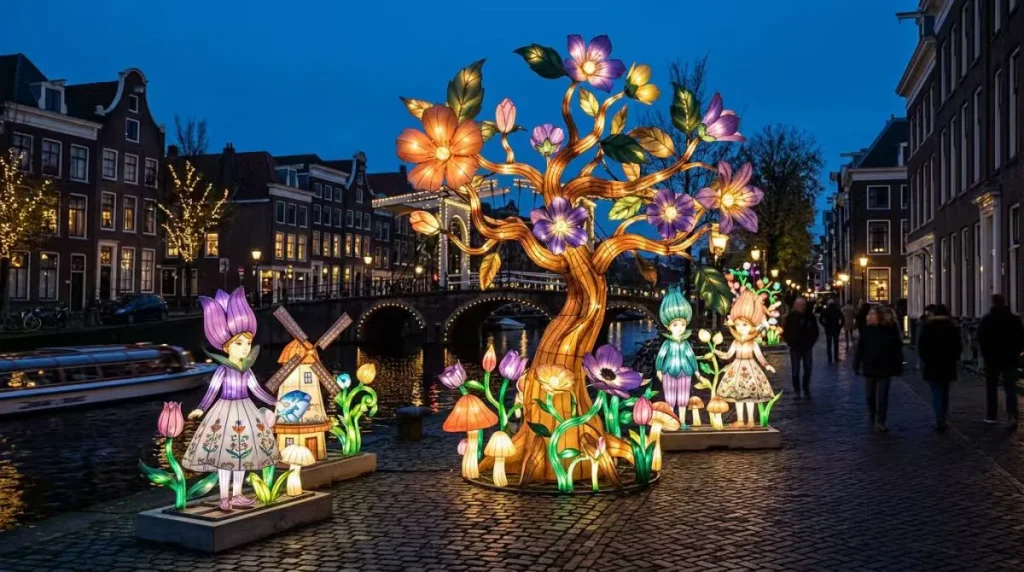
A Dutch light festival is usually a free or low-cost walking route through public space, rather than a fenced attraction with a ticket gate. Amsterdam Light Festival has run as a free walking route for years, with works placed along and on the canals. GLOW Eindhoven works the same way, with the city itself acting as the venue.
Three consequences follow for anyone supplying the lighting:
- The route is public infrastructure. Pieces sit on quaysides, bridges, streets and squares that still have to function. Installation windows are night shifts, and anything left on the ground has to withstand city traffic, bicycles and weather for months.
- There is no gate to control flow. Visitor movement is managed by spacing and lighting cues along the route rather than by barriers — which puts the planning weight on where pieces sit and how the route reads after dark.
- The season is long. A festival that opens in early November and closes in mid-January has to be built for four months of Dutch winter, not for a two-week holiday window.
The buyers are the gemeente (municipality), tourism boards, festival foundations, and the event contractors who tender the installation work, and the programme sits inside an evenementenvergunning — the event permit — with conditions attached rather than in a purely commercial contract. Whichever group you sit in, the questions are the same: can it be built to the concept, can it be installed inside the window, and will it pass the documentation and public-space requirements.
The 2026/27 Dutch Light Festival Season
Dutch light festivals do not open together. They stagger from late October to early January, and several of them run for weeks rather than days. That matters commercially: a supplier working across more than one festival is delivering to several installation windows in the same autumn, not to one.
| Festival | 2026/27 dates | Format |
|---|---|---|
| Alkmaar | 29–31 October 2026 | City centre, short run |
| GLOW Eindhoven | 7–14 November 2026 (21st edition, theme CONNECT) | Walking route through the city |
| Amsterdam Light Festival | 26 November 2026 – 17 January 2027 (15th edition) | Around 20 works on a 5 km free walking route |
| Enschede Lights Up | 10–13 December 2026 | City centre installations |
| Gouda bij Kaarslicht | 11 December 2026 | Candlelight and light installations, city centre |
| I Light U Utrecht | 8 January – 7 February 2027 | Walking route, winter run |
Two scheduling points matter more than the rest. First, the earliest opening week is the one the delivery plan has to be built around — a piece that arrives on site in time for Amsterdam may already be late for GLOW. Second, the long Amsterdam and Utrecht runs mean pieces stay exposed through the worst of the Dutch winter, including the January storms, which raises the bar on structural design and on how easily a piece can be serviced mid-season without closing the route.
The dates above are the ones to plan against. The pattern repeats each season with small shifts, so confirm the current year’s dates with the festival organisation before a design is frozen. The Dutch names are worth keeping for correspondence and for the permit file: GLOW Eindhoven, het Amsterdam Light Festival, Enschede Lights Up, Gouda bij Kaarslicht and I Light U Utrecht.
Installing On and Along Water
Water is the part of a Dutch commission with no easy equivalent elsewhere. A piece placed on a canal is a different engineering problem from the same piece placed on a square, and the difference has to be designed in rather than solved on site.
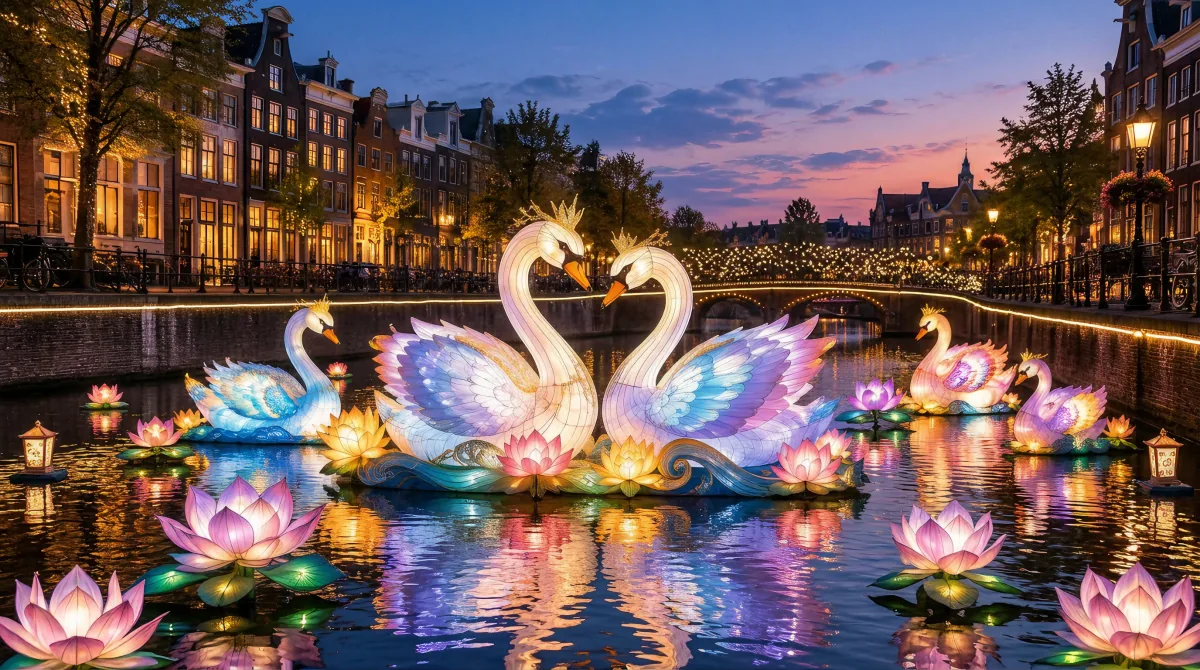
What a floating or semi-floating installation has to answer for:
- Platform stability. A floating base has to stay upright under wind loading, visitor movement on adjacent quays, and the wake of passing boats. The structure above the waterline and the platform below it are designed as one system.
- Viewing angle. On a canal, the audience looks down and across, never up. Sightlines are set by the quay wall height, which is fixed — so the composition is usually designed to read from a 15–30 metre viewing distance rather than from directly underneath.
- Access for servicing. A piece in the middle of a canal cannot be reached by ladder. Either it is built for the full season without intervention, or the design includes a way to bring it alongside.
- Level and draught. Water level changes with rainfall and with lock movements. Anchoring and cable routing have to allow for that movement without stressing either.
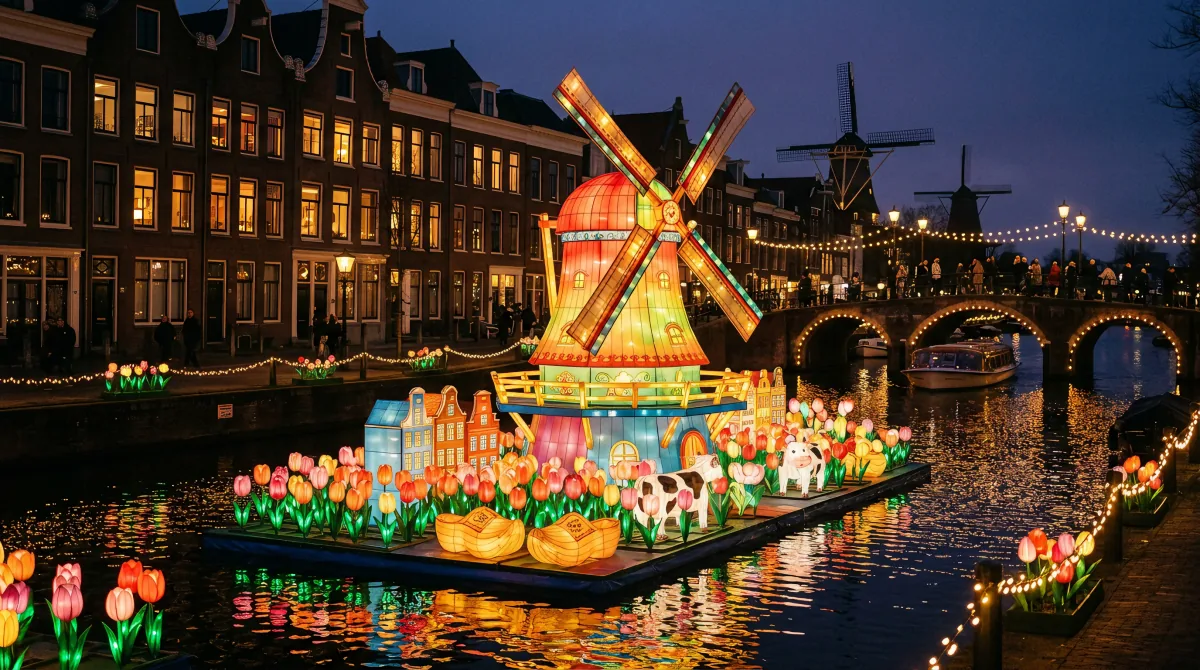
Quayside and semi-submerged work raises a second set of questions: how close the piece may sit to a working mooring, whether the quay edge can take the load, and how power reaches the water without a cable across a public walkway. These are answered with whoever owns the water and the bank: the gemeente for municipal canals and quays, Rijkswaterstaat where a route touches a national waterway, bridge or lock, and the waterschap — the regional water board — for the water itself and its levels. Each of those has its own process and its own lead time, and the bridge or lock paperwork is usually the longest of the three. Our floating and water lantern Our floating and water lantern range covers the forms most often specified for canal work.
Two documents decide whether a water-borne piece clears the Dutch process. The first is the constructieberekening — the structural calculation covering the platform, the mooring loads and wind acting on a piece that sits above an open water surface, with the platform and the structure above it designed as one system rather than two. The second is the electrical installation, which the local electrician will assess against NEN 1010, the Dutch standard for low-voltage installations. Water, temporary supply and public access together make the earthing and residual-current protection part of the design, not part of the site works.
Route Planning for Canals and City Centres
On a walking route, the lighting is the wayfinding. There is no gate, no queue rail, and often no sign large enough to read from across a canal. Visitors follow the light, which means the sequence of pieces does the work a map would otherwise do.
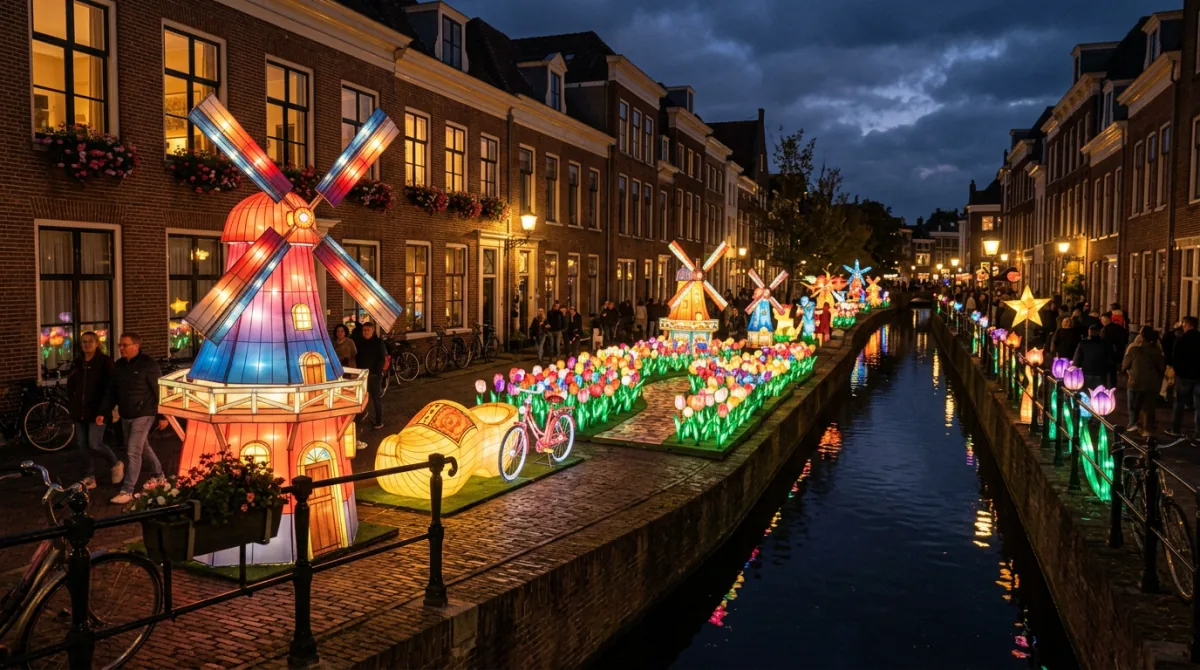
Four things a route planner has to decide early:
- Dwell points versus through-points. Some pieces are meant to stop a visitor, others only to keep them moving. Placing two dwell points next to each other creates a bottleneck on a narrow quay; placing none creates a route that visitors walk in ten minutes and do not return to.
- Reading distance. A piece on the far bank is seen at 30 metres and cannot carry fine detail. Detail belongs on pieces the visitor passes within a few metres of, which usually means a mix of scales along the route rather than one size throughout.
- Light spill. Dutch city-centre routes run through residential streets. Light that throws into first-floor windows becomes a complaint, and complaints become conditions on the permit.
- Power and cable routing. A 5 km route cannot be powered from one point. The distribution plan decides where the large pieces can go, so it is usually drawn before the artwork list is final.
The practical brief is a route map with each stop marked by scale, viewing distance and power requirement. Given that, a manufacturer can tell you quickly which pieces are buildable as designed and which ones need to move.
Two municipal instruments shape that route. Light that spills into homes is handled under the local APV (the municipal ordinance), where lichtoverlast — light nuisance — becomes a condition on the permit rather than a complaint to be managed later; a piece that reads well on paper can be ruled out by a first-floor window. And any street that has to close or lose parking needs a verkeersbesluit, the formal traffic decision, which is published and can be objected to, so it sits earlier in the calendar than most suppliers expect.
Garden and Countryside Venues
Not every Dutch commission is urban. Botanical gardens, estate parks and rural visitor attractions run winter light routes of their own, and they have a different constraint: the venue is often a working landscape that cannot be dug up.
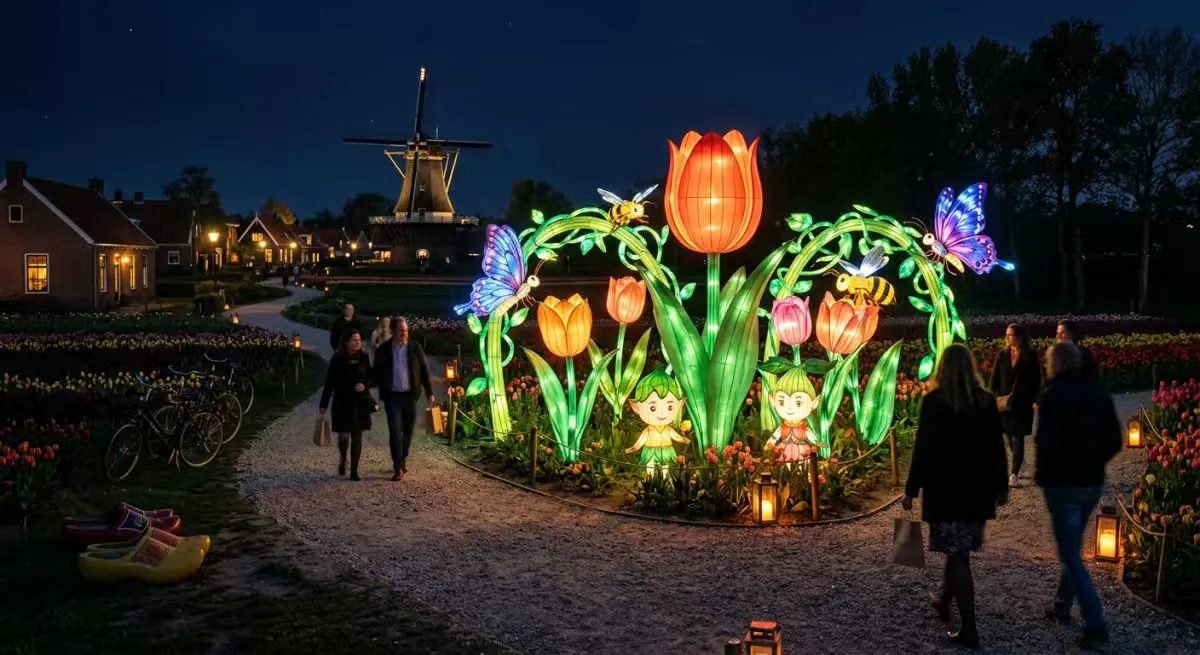
- No excavation. Routes through gardens and estates usually cannot trench for power. Ballasted bases and surface cable routes that stay invisible after dark are the normal answer.
- Existing planting is part of the design. A garden route reads as seasonal because the light works with what is already there, not because it replaces it.
- Ground conditions. Grass, gravel and bark behave differently under load and after rain. A piece that stands correctly on a paved square may sink or lean on soft ground.
- Wildlife and closing hours. Many venues close at dusk or restrict lighting near water and nesting areas, which limits both placement and running hours.
Garden routes are usually shorter than city routes and run for longer, so durability across the full winter matters more than the number of pieces.
Commercial Streets, Squares and Shopping Districts
The third Dutch format is the commercial one: city shopping streets, squares and retail districts that use winter lighting to hold footfall through November and December. The lighting here competes for attention with lit shopfronts, which changes what works.
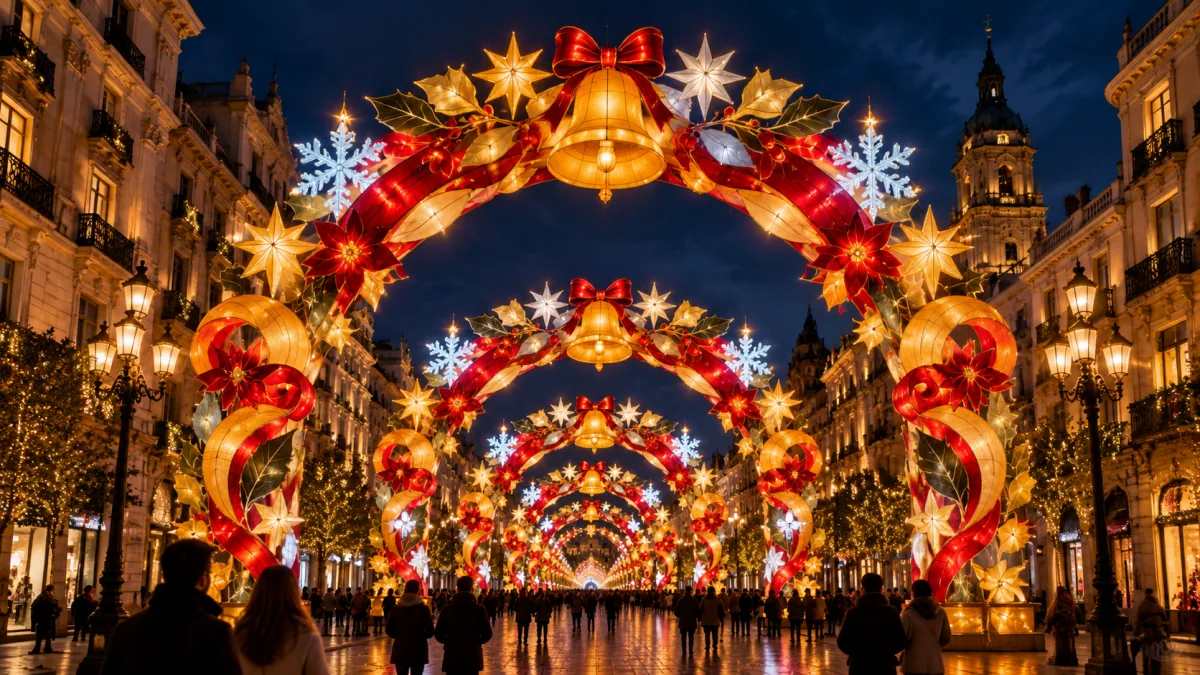
- Repetition beats individual pieces. A repeated overhead element along a street reads as one installation. Individual pieces spread along the same street read as clutter.
- Photographability from street level. Visitors photograph what they walk under, at phone height and against a dark sky. Pieces designed to be photographed from a distance rarely work here.
- Daytime appearance. Shopping streets are busy in daylight too. The structure has to look deliberate when it is switched off.
- Overhead clearances and fixing points. Spanning a shopping street means working with existing facades, tram infrastructure or designated fixing points, which is agreed with the municipality rather than chosen by the designer.
Shopping-district commissions are often split across streets and delivered in phases. That makes a common visual language across phases more valuable than any single piece.
What to Brief a Lighting Manufacturer With
The briefs that move fastest share the same five items. Without them, every supplier quotes a different product and the comparison is meaningless.
- Route or site plan, with each stop marked by scale, viewing distance and power availability.
- Opening and closing dates, plus the on-site installation window and any night-work restrictions.
- Water or ground conditions — canal, quay, soft ground, cobbles, or paved square — and any anchoring restrictions.
- The documentation the organiser requires — CE marking for the electrical elements, structural assumptions, and the local standards the installation will be assessed against. In the Netherlands that normally means NEN 1010 for the electrical installation, the EN 1991 wind load cases for anything standing in the open, and EN 13501-1 for the fire class of any covering material.
- Whether pieces must survive the full season unattended, or whether the route can be closed briefly for servicing.
Send those five and the answer you get back is a buildable scope rather than a catalogue page. Send none of them and the reply will be a range.
Installation Windows for a November Opening
An opening in the first half of November means installation happens in late October, when nights are already long and the weather is already unstable. On Dutch routes this is tight for a specific reason: much of the work happens on public quays and streets that are busy during the day and can only be worked at night.
Two things follow. Everything that can be prepared off site should be, because site hours are the least flexible part of the programme. And the delivery date that matters is not the opening date — it is the date the installation crew needs the pieces alongside the quay, which is typically two to three weeks earlier.
For a water-borne piece there is a third constraint: a crane or barge slot on a working canal has to be booked, and it moves if the weather closes in. Building in slack around the water installation is the difference between an opening week that holds and one that slips.
Frequently Asked Questions
Do you install light festival pieces in the Netherlands?
Yes. We supply and support installation for Dutch light festivals, garden and estate routes, and city-centre winter lighting, both on land and on water. Our European lantern installation work covers the Netherlands alongside Belgium, Germany and the wider EU.
Can installations be designed for canal and quayside locations?
Yes. Water-borne and quayside pieces are engineered with their platform as one system, sized for the viewing angle from the quay and built to an outdoor-rated standard, supplied with UL or CE marking for the destination market.
How early should a Dutch light festival brief a manufacturer?
For a November opening, six to nine months ahead is normal. The concept, the route and the water logistics all need to be settled before fabrication starts, and installation windows on public quays and canals are booked well in advance.
Do the pieces have to come down at the end of the season?
That depends on the festival. Some routes are removed each year and stored; others keep permanent structures and re-theme them. If a route runs into January, we design for mid-season service access rather than assuming the piece can be reached once installed.
Do you work with the festival’s own installation contractor?
Yes. We can deliver with installation support, or supply to the contractor who holds the site works. On water installations the split is normally agreed early, because the barge and crane logistics sit with whoever is on the canal.
Which permits does a Dutch light festival installation need?
The evenementenvergunning from the gemeente is the base permit, with conditions on capacity, night-time working and temporary structures. A larger or longer build may also need an omgevingsvergunning. Anything on or over water adds a permit from Rijkswaterstaat (national waterways) or the waterschap, and a street closure adds a verkeersbesluit. These run on separate clocks, and the water and traffic processes are usually the long ones.
Which standards will the gemeente’s engineer check?
In practice: NEN 1010 for the low-voltage installation, the EN 1991 load cases for wind on anything standing or floating in the open, and EN 13501-1 for the fire class of covering materials. For water-borne pieces the constructieberekening covers the platform and mooring rather than the display alone. We supply the drawings, load assumptions and component documentation that sit underneath those checks.
Plan Your Dutch Light Festival Installation
Tell us the city or venue, the route or site plan, the opening week and whether any piece goes on water. We will come back with a buildable scope, the structural and electrical documentation your organiser will ask for, and a delivery date worked back from the installation window.
See the wider range in our lantern collections, or the seasonal programmes in Christmas light festivals. For Belgian and German routes, our European overview covers the full market. Request a design proposal with your route plan and dates.
More on European Delivery
Low-country city routes lean on overhead structures more than on figures — the light arch promenade and the walk-through archway are the two we build most for shopping streets and squares.
- Christmas market lighting in Germany — the November–December window
- Shipping festival lanterns from China to Europe — ports, customs & timelines
Tags: light-festival netherlands