Denmark’s winter sits around freezing. Finnish Lapland spends December between −20°C and −40°C, and for weeks the sun does not clear the horizon at all. Both are called Nordic winter markets. They are not the same job, and a lighting programme specified for one will fail in the other.
This guide is written for the people who actually sign off on a Nordic winter lighting programme — municipal events officers, julemarked organisers, procurement staff, and the contractors who install for them. It covers what each country calls its market, the light tradition that anchors December, the engineering that changes in real cold, the standards each country applies, and the procurement route you will be asked to follow.
Why the Nordic Market Is Not One Market
The four countries share a language family, a Lutheran calendar and a fondness for candles. On every technical point that matters to a lighting supplier, they diverge.
- Climate — Copenhagen in January averages around 0°C. Rovaniemi in the same week can sit at −25°C. Tromsø runs a polar night from late November to mid-January.
- Standards — each country adopts the same European norms under its own national prefix: DS/EN in Denmark, SS-EN in Sweden, NS-EN in Norway, SFS-EN in Finland. Same technical content, four different document numbers on the drawing set.
- Electrical practice — Denmark works to DS/HD 60364, Sweden to SS 436 40 00, Norway to NEK 400, Finland to SFS 6000.
- Procurement law — Udbudsloven in Denmark, LOU (Lag om offentlig upphandling) in Sweden, LOA with its forskrift in Norway, Hankintalaki in Finland.
- The word for the event — julemarked in Denmark and Norway, julmarknad in Sweden, joulumarkkinat in Finland.
If a proposal arrives written for a generic Scandinavian winter, the organiser notices immediately. A Stockholm events office reads julmarknad, not “Christmas market”. A Finnish municipality reads joulumarkkinat. Getting the name right in the first email costs nothing and does more for credibility than any amount of render polish.
The same country-by-country logic is why our European work is specified per market rather than per continent. The German Christmas market lighting and Netherlands light festival installation programmes share a season and almost nothing else — the documentation, the fixing method and the weather case are all different, and so are these four.
What Each Country Calls Its Christmas Market
These are the established markets most often referenced when a Nordic brief is written. Knowing which one your client runs tells you the scale, the audience and usually the review process.
Denmark — julemarked. Tivoli Gardens in Copenhagen runs the country’s best-known Christmas season, and the distinction matters commercially: Tivoli is a gated, ticketed attraction with its own design language, not a street market. Nyhavn’s quayside market and the Kronborg market at Helsingborg-facing Elsinore, and Den Gamle By in Aarhus, are the other names that come up.
Sweden — julmarknad. Stortorget in Stockholm’s Gamla Stan is the reference point, a small square with low capacity and high footfall. Liseberg in Gothenburg and Skansen in Stockholm are the attraction-scale programmes. Note that Sweden’s municipal structure means a large share of these are run by the kommun or by a municipal company, which pulls the procurement into LOU territory.
Norway — julemarked. Oslo’s Spikersuppa market, the Bryggen frontage in Bergen, and the Tromsø market inside the polar night are three completely different technical briefs. The Tromsø one is the outlier: it operates with effectively no daylight.
Finland — joulumarkkinat. Helsinki’s market on Senaatintori, in front of the cathedral, is the main one. Turku opens the season with the Declaration of Christmas Peace on 24 December, a tradition dating to the 1300s, and Rovaniemi runs the Santa Claus Village inside the Arctic Circle.
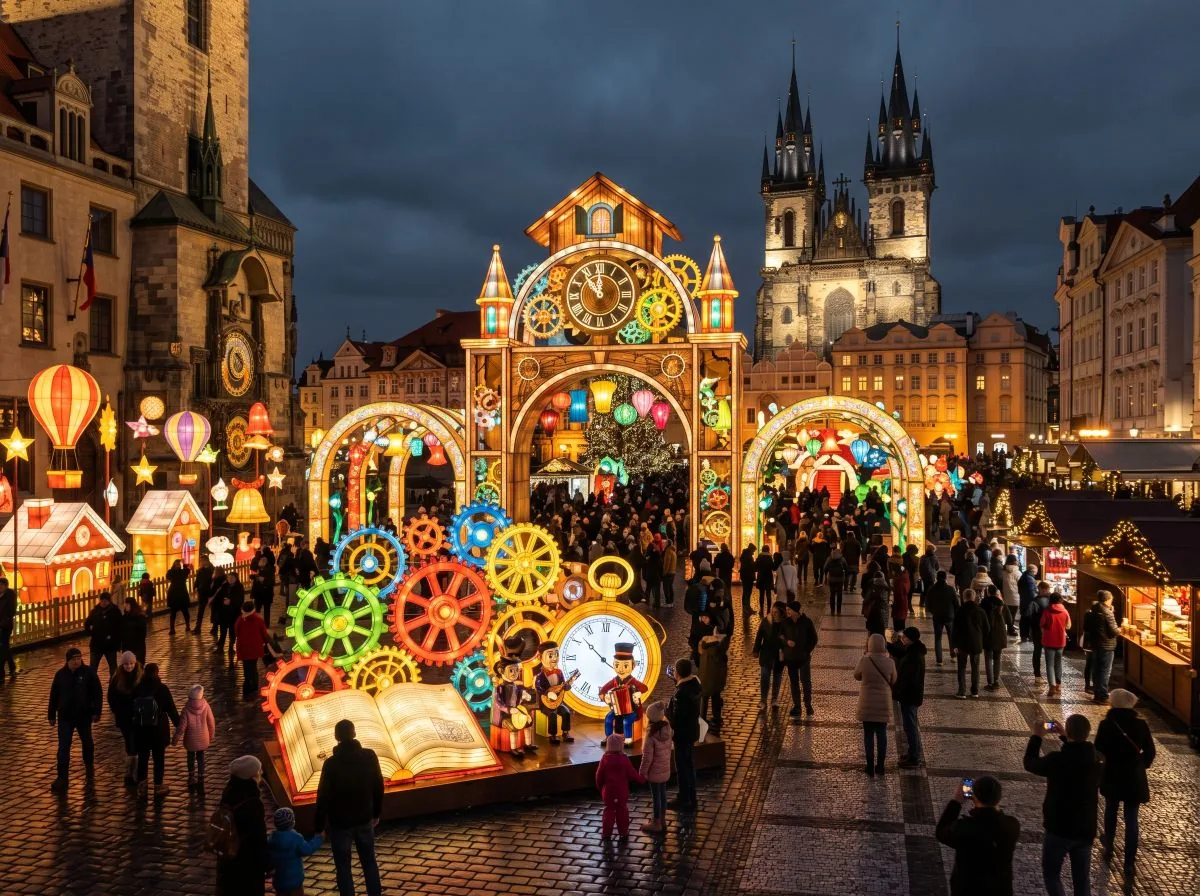
Saint Lucia: The Light Procession That Anchors December
On 13 December, all four countries mark Saint Lucia’s Day. A procession of children in white, led by one wearing a crown of candles, moves through schools, churches and town centres. In Sweden it is close to a national event; in Denmark, Norway and Finland it is observed with varying formality.
For a lighting supplier, this is not cultural background, it is a specification cue. Lucia processions are often held outdoors and in the dark, in the same squares and walkways that carry the winter lighting programme. Municipal organisers frequently want the existing installation to be usable as the procession route — safe walking surfaces, adequate light at child height, no glare into the eyes of someone carrying live candles.
Practical consequence: ask early whether the Lucia route is part of the brief. Designing a walkway lighting scheme that ignores it means the organiser will ask for changes in November, when production is already booked. In Sweden, the season formally ends on Tjugondag Knut, 13 January, when the tree comes down — which is the real operating window your installation has to survive.
Designing for Polar Night
North of the Arctic Circle, December lighting is not decorative. For several weeks there is no meaningful daylight, and the winter lighting programme becomes the primary illumination of a town centre. That changes the brief in three ways.
Contrast works differently. In central Europe, an installation competes with dusk, street lighting and shopfronts. In Tromsø or Rovaniemi, it is the only bright object in the frame. Colour temperature that reads as warm and inviting against a lit building can read as harsh when it is the sole source — a point worth raising with organisers before the design is frozen.
Night vision matters. Residents move through these spaces for weeks with very little natural light. A route that alternates bright feature pieces with genuinely dark stretches forces the eye to re-adapt repeatedly. Spacing the lighting so the path stays legible between features is usually more valuable to the organiser than one more large sculpture.
Snow reflects. Fresh snow bounces a large share of the light back up. Under a clear sky, an installation that is correctly lit for a wet cobbled square can blow out on a snow-covered one. If the venue keeps snow, dimming and beam control become operational requirements, not niceties.
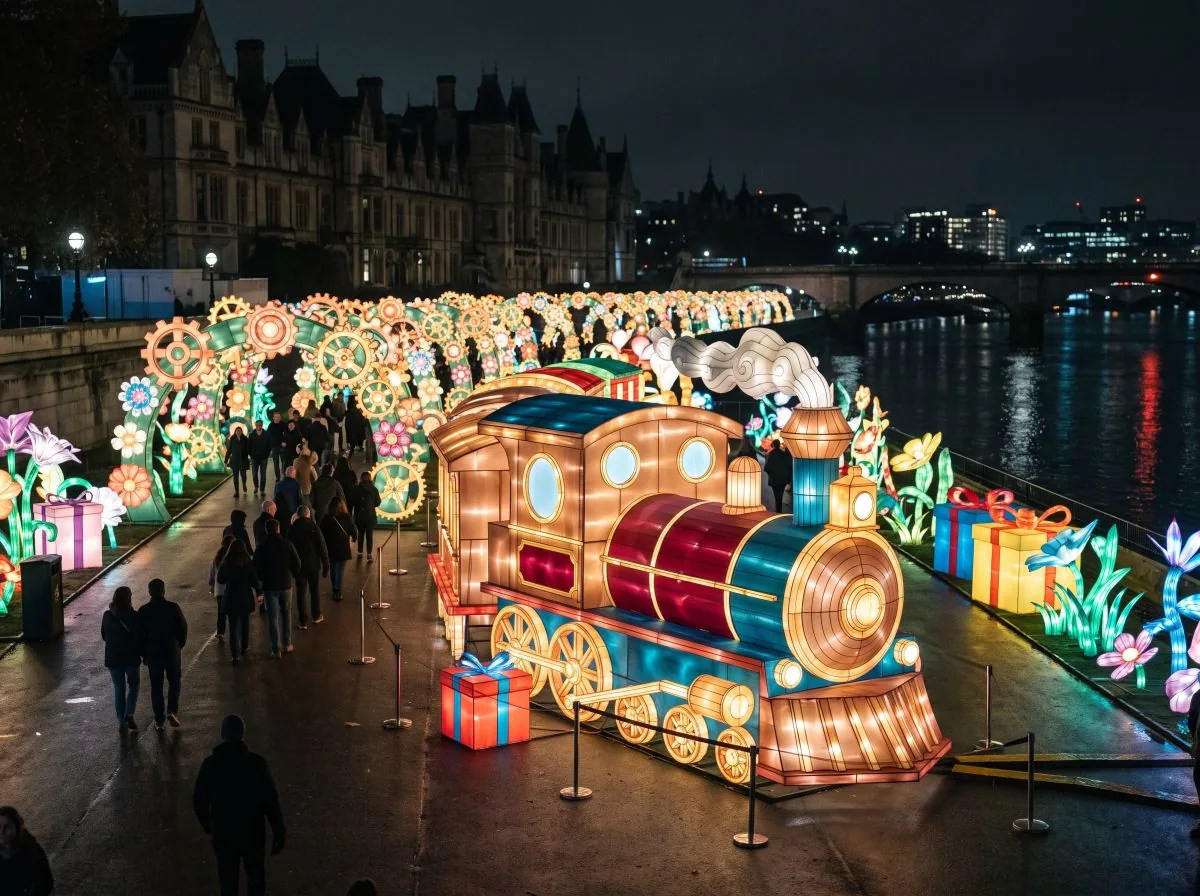
Engineering for Cold: What Changes Below −20°C
This is where a programme specified for a German Christmas market starts to come apart in Finnish Lapland. The failures are predictable and they are all in the same handful of components.
- Cable insulation — standard PVC-sheathed flex is typically rated to roughly −15°C to −20°C. Below that it stiffens, and stiff cable cracks when it is handled or flexed during installation. Cold-rated cable with rubber or PUR insulation is specified for outdoor Nordic work, and it is not interchangeable.
- LED drivers — electrolytic capacitors lose capacity as temperature falls, and the driver needs a higher voltage to start. The classic Nordic failure mode is an installation that works perfectly in the workshop and fails to strike on a −28°C morning. Drivers rated for the operating temperature, or mounted in an insulated enclosure, avoid it.
- Motion systems — grease thickens with cold. Starting torque rises well above the running figure, which is exactly when an under-specified gearbox fails. Low-temperature lubricant and a motor sized on cold-start torque, not running torque, are the fix.
- Skin and fabric — surface finish holds flexibility far below the temperatures in play. Standard PVC fabrics do not; they stiffen and crease. For outdoor Nordic installations the covering material is a design decision with a temperature consequence.
- Structural metal — carbon metal loses toughness at low temperature. For a static display this rarely governs, but it matters for tall or slender structures under wind and snow load, and it is a question a Nordic structural reviewer may ask.
- Snow and ice accumulation — snow settles on horizontal surfaces: arch tops, roofs, ledges, and the upper face of any lettering. The structure has to carry it, and the design should not create pockets that fill and then freeze solid.
The commercial point is simple. A single cold-rated specification costs more per piece than a standard one. It costs far less than a failed installation in a market where the opening night is fixed by tradition and cannot move.
Snow, Ice and Wind: Loads You Must Design For
Nordic venues are assessed against the same European load basis as the rest of the continent — EN 1991-1-3 for snow and EN 1991-1-4 for wind — but the values those norms produce in northern Finland or inland Norway are not the values they produce in the Netherlands. Snow load rises steeply with latitude and altitude.
Two practical consequences for a lighting programme:
Ballast is usually the wrong answer in deep snow. Water-filled or block-ballasted bases are common in central Europe because they avoid fixing into historic paving. In a venue that keeps snow, a ballasted base can be buried or floated by freeze-thaw movement. Discuss fixing strategy against the actual venue, not against a summer photograph of it.
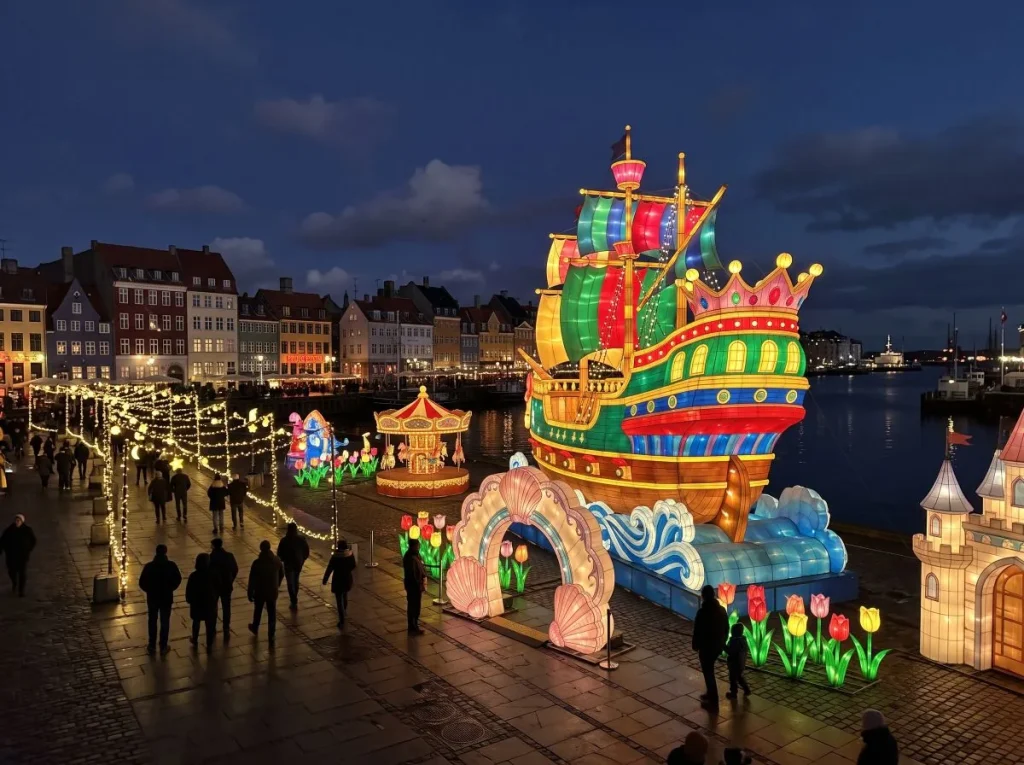
Wind matters more when the structure is lighter. A large lantern sculpture is a sail. In an exposed harbour frontage such as Nyhavn, or on an open square, gust loading on a walk-through arch is the design case, and the anchor detail is what the reviewer will look at.
Fire performance of covering materials is assessed to EN 13501-1, the same classification used across the EU, with national fire authorities reviewing the installation: Räddningstjänsten in Sweden, Brannvesenet in Norway, Brandvæsenet in Denmark, Pelastuslaitos in Finland.
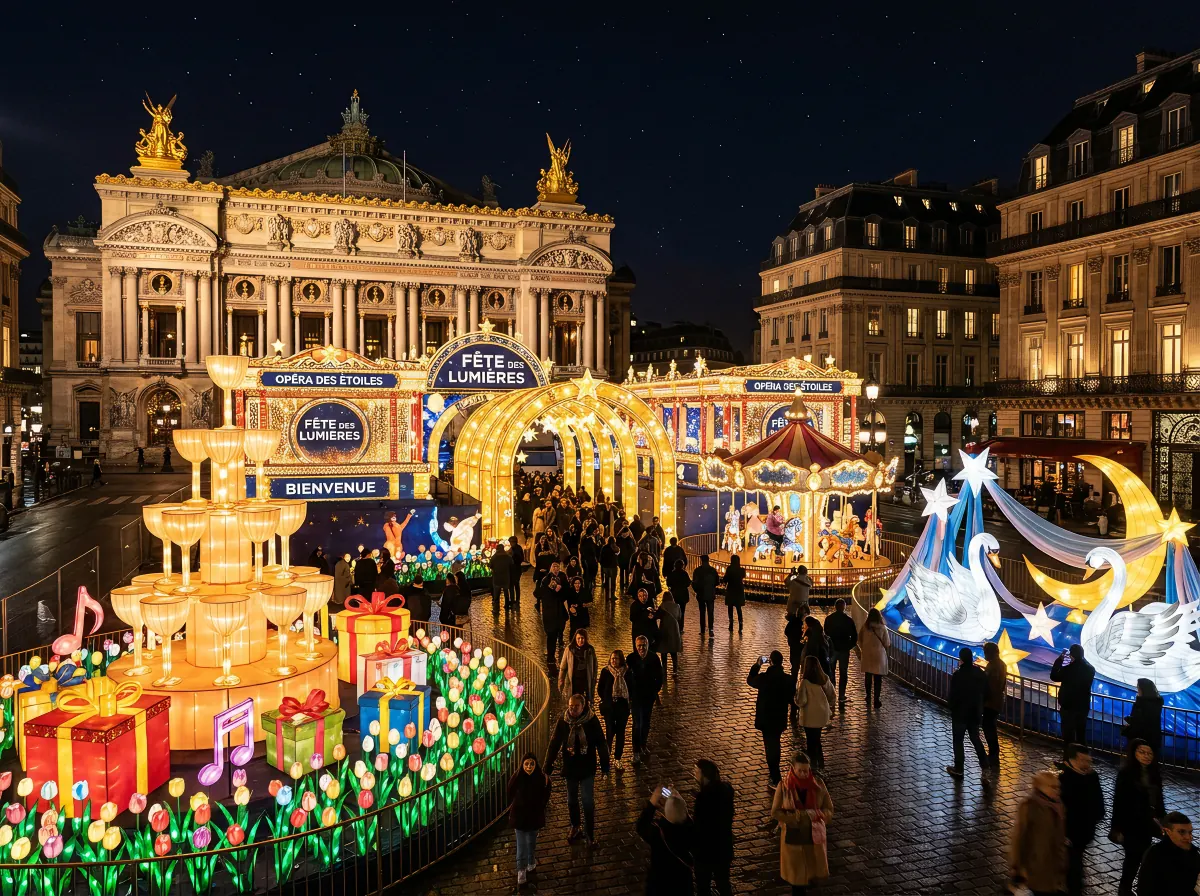
Electrical Rules and the Standards Each Country Applies
The luminaires themselves are covered by EN 60598 in all four countries. What differs is the installation standard the local electrician works to, and that determines how your cabinets, earthing and protection devices have to be presented:
| Country | Installation standard | Standards body | National EN prefix |
|---|---|---|---|
| Denmark | DS/HD 60364 | DS | DS/EN |
| Sweden | SS 436 40 00 | SIS | SS-EN |
| Norway | NEK 400 | Standard Norge | NS-EN |
| Finland | SFS 6000 | SFS | SFS-EN |
What a Nordic organiser will normally ask for is a documentation pack, not a certificate: CE marking and a declaration of conformity for the electrical elements, the manufacturer’s data for the components inside, a method statement for the temporary installation, and structural assumptions for snow and wind. Where the organiser’s framework names a national standard, you cite the national number — the EN prefix table above is the whole point.
Permits sit alongside this. Depending on the venue and country these may include a building-type consent (bygglov in Sweden, byggetillatelse in Norway, rakennuslupa in Finland, tilladelse in Denmark), a consent for occupying public ground, and in Sweden sometimes a police permit for a public event. These are the organiser’s to obtain, but they are usually the reason a design revision lands on your desk, so it helps to know they exist.
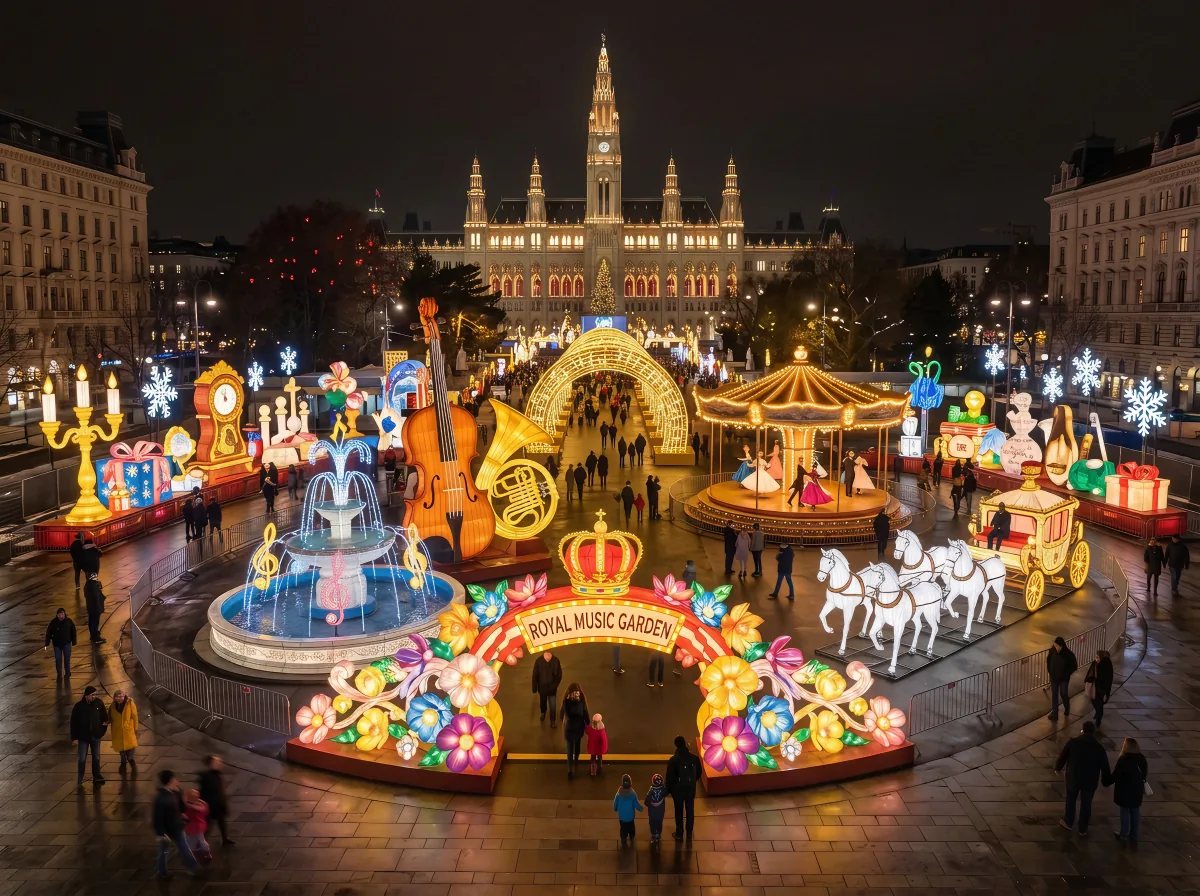
Public Procurement: Tenders, Terminology and Timelines
A large share of Nordic winter lighting is bought with public money, which means a formal tender rather than a negotiation. Each country’s framework has its own vocabulary and its own clock:
- Denmark — udbud. Notice and material are published on the national tender portal; tilbudsfrist is the submission deadline.
- Sweden — upphandling under LOU. Documents are the förfrågningsunderlag, and the response is the anbud. Municipal companies are often in scope, not just the kommun itself.
- Norway — anskaffelse. Tilbud is the bid; rules follow the anskaffelsesforskriften and the threshold regime.
- Finland — hankinta under Hankintalaki. Tarjous is the offer, tarjouspyyntö the request for it.
Three practical notes. First, a tender document will almost always ask for a reference list with contactable references — so keep project references and permissions in a form you can hand over quickly. Second, an anbud is assessed against stated criteria, which means an answer that ignores the evaluation criteria and talks about manufacturing capability instead scores poorly even when the product is right. Third, the submission window is short relative to production. A tender published in spring for a November opening is normal, and by then your freight and installation slots for the season are being booked by everyone else.
Our own procurement guide covers the document set we normally issue with a tender response.
Shipping Into the Nordic Winter
Sea freight from China to a Nordic port runs on its own schedule, and two details are specific to this region.
Ice and winter port operations. Northern Baltic and Norwegian ports handle ice, and berth availability and port operations can slow in an exceptional winter. Booking the shipping slot when production is confirmed, rather than when the pieces are finished, is the difference between a scheduled delivery and a scramble. Denmark and southern Sweden are substantially less exposed; northern Finland and Norway much more so.
Customs and VAT. All four countries are in the EU, so an intra-EU delivery has no import clearance at the border and VAT is handled through the organiser’s own national regime. Your EORI, the Incoterm you quote on, and who is the importer of record should all be settled in writing before the freight booking — see our guide to shipping festival lanterns from China to Europe for the detail on DDP versus DAP and how the VAT recovery works on the buyer’s side.
Then there is the installation window itself. It arrives before opening and it is not flexible. A Nordic installation team working outdoors in January is doing so in the dark, often at temperatures that stop work by regulation or by common sense. The on-site installation and handover guide covers how we sequence a winter build-up and what has to be confirmed before a crew is booked.
Storage, Reuse and the Second Season
The economics of a Nordic winter lighting programme are decided over five seasons, not one. Most organisers intend to reuse what they buy, and the specification has to support that.
Three things make the difference:
Access for mid-season service. A Norwegian market may run from late November into January, with snow clearance and crowd movement passing the installation every day. If a single failed driver requires a crane to reach, the repair stops being routine.
Storage conditions. Cold-rated cable and cold-rated LED drivers survive the season; what shortens their life is being coiled, crushed and stored in an unheated, damp container between seasons. A short storage specification at handover is worth more than a longer support argument later.
Re-theming, not rebuilding. The markets that keep installations across seasons generally re-theme paths and entrance pieces rather than replacing structures. That is a design decision made in year one — modular route pieces cost more initially and far less over five years.
Cost structure across a five-season programme, and what drives the year-one figure, is set out in what a Christmas light festival costs.
The operating model matters here too. A ticketed attraction such as Tivoli or Liseberg is specified differently from a street market that must stay open through daily snow clearance — see how a Christmas light festival is put together. Zoo and garden routes, which run as separate winter programmes in Denmark and Sweden, are covered in our zoo lights guide.
Planning Timeline for a November Opening
Working backwards from the first market weekend, a Nordic programme normally looks like this:
- 12–10 months out — concept and route agreed; site conditions, snow load basis and fixing strategy confirmed against the actual venue; tender or negotiation route settled.
- 9–8 months — design frozen. This is the last point at which changing the fabric specification or the number of animated pieces is cheap.
- 8–6 months — fabrication, with progress photographs through the build so the organiser can sign off without flying to the factory.
- 5–3 months — sea freight booked and shipped; documentation pack issued for the organiser’s reviewers.
- 6–3 weeks before opening — arrival, customs handling if applicable, installation sequence agreed with the venue.
- 2–1 weeks — installation, electrical connection by the local contractor, testing, commissioning and handover.
The sequence changes if the brief touches the Saint Lucia route, or if the venue carries snow into the operating period. Both push the design freeze earlier, because they add a design iteration and a structural review.
Frequently Asked Questions
Do you supply winter lighting to all four Nordic countries?
We supply and support installation across Europe, including Denmark, Sweden, Norway and Finland, working with market organisers, municipal events teams and lighting contractors. European projects are handled with the destination country’s documentation requirements in mind from the start of the design.
What temperature should a Nordic outdoor installation be specified for?
It depends entirely on the country and often on latitude within it. A Copenhagen programme and a Rovaniemi programme are different specifications. We ask for the venue, the month of operation and the expected minimum temperature, and specify cable, drivers and lubrication to that figure rather than to a generic European assumption.
Can you work to our national standard, such as SS-EN or NS-EN?
Yes. The European norms are identical in technical content across the four countries; only the national prefix and the national electrical installation standard differ. Tell us which country and which standards body applies, and the documentation pack is issued against that framework.
How does the Saint Lucia procession affect the lighting design?
It usually means the winter route also has to function as a procession route in low light, with safe walking surfaces and lighting at child height that does not glare. It is worth confirming at briefing stage, because it can change the layout rather than just the fittings.
Can an installation be reused for a second season?
Most programmes we build for Nordic organisers are designed for repeat use from the outset — serviceable access, cold-rated components, and route pieces that can be re-themed rather than replaced. What still needs the full lead time in a second season is any new piece, and the shipping slot.
How early should a Nordic market brief a manufacturer?
Ten months before opening is comfortable, eight is workable, and anything under six months starts trading scope for schedule. The constraint is not fabrication speed — it is the freight booking, the documentation review and the installation window, in that order.
Planning a Nordic Winter Programme
Send us the venue, the country, the operating weeks and the expected minimum temperature, and we will come back with a design direction and the documentation the destination country expects. If the brief includes a Lucia route, snow clearance or a fixed municipal review date, tell us now — those are the three things that change the schedule.
Start with our European festival lighting overview for how the Nordic programme sits alongside our work in Germany, the Netherlands and southern Europe. For a street-level view of what a winter route involves end to end, see winter lantern festival production. The forms most often specified for Nordic routes are in the ice and snow lantern range and the animal lantern collection.
The figures Nordic programmes specify most often are reindeer for the route itself, arctic wildlife family scenes for the quieter sections, and a penguin winter display where there is a children’s zone.