Germany runs more than 2,500 Christmas markets — Weihnachtsmärkte — every winter, and every one of them is a fixed-date event. Cologne opens around 16 November. Nuremberg, the last of the major markets to open, starts on 27 November. There is no slipping those dates and no second opening night.
That single constraint shapes how market organisers, city authorities and event contractors buy lighting. This guide covers what a German Christmas market actually needs from a lighting supplier — entrance arches, walkway lighting, illuminated signage and landmarks, the documentation organisers ask for, and the timeline that has to be worked backwards from opening night. For the wider programme, see our Chinese lantern festival manufacturer for Europe overview.
Christmas Market Lighting in Germany: A Buyer’s Overview
Lighting at a German Christmas market is rarely a single product. It splits into four functional groups, and buyers normally specify all four in the same brief:
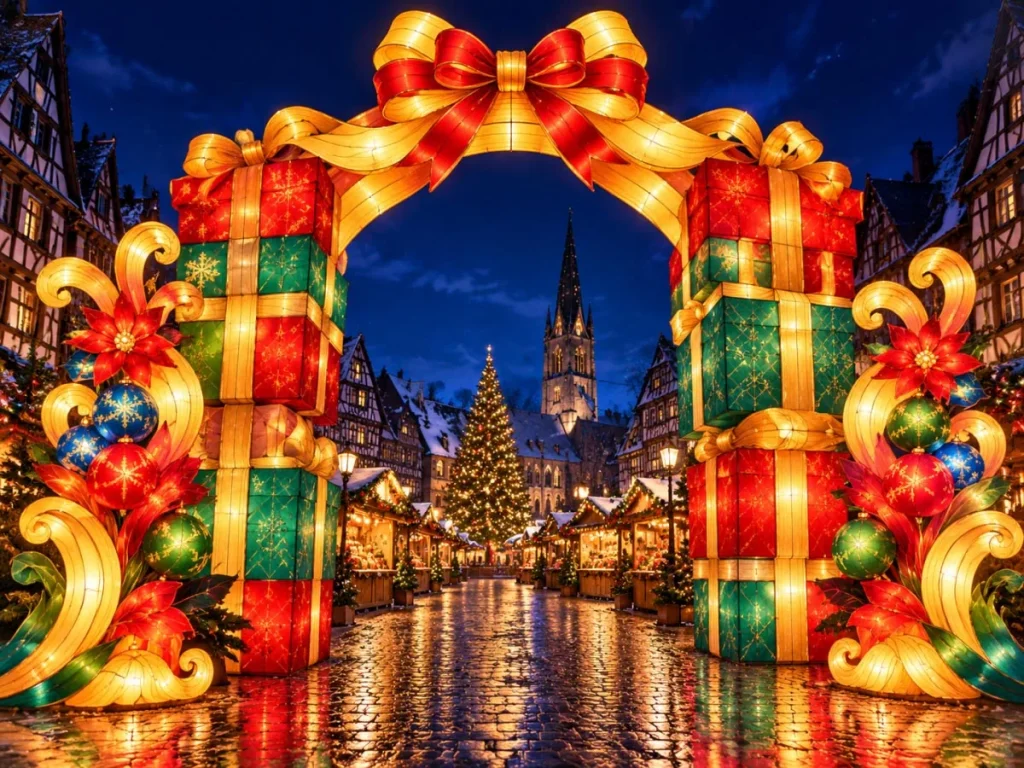
- Entrance and gateway lighting — the arch or gate that marks the market boundary and becomes the photograph everyone posts.
- Route lighting — the light along stall aisles and walkways that keeps visitors moving and makes the market safe to walk after dark.
- Signage and wayfinding — illuminated lettering, directional pieces and stage or sponsor markers where the market carries them.
- Landmarks and focal pieces — the large illuminated centrepiece that gives a market its identity: a themed figure, a nativity scene, a large-scale sculpture.
The buyers are equally varied. City councils and tourism authorities commission the largest installations. Market associations buy on behalf of their members. Event and lighting contractors tender for the work and look for a supplier who can hit a fixed installation window. Whichever group you sit in, the questions are the same: can it be built to the design, can it be delivered before the build-up starts, and will it pass the paperwork.
German organisers brief, tender and assess in German, even when the correspondence with a supplier runs in English. The words that come up in almost every meeting are worth knowing before the first one: the market is a Weihnachtsmarkt or, in Nuremberg, a Christkindlesmarkt; the lighting programme as a whole is Weihnachtsbeleuchtung. Permission comes as a Genehmigung, usually from the Ordnungsamt or the city itself, and the person who runs the market day to day is the Marktmeister. The stalls are Buden or Stände. None of this is decoration — a proposal that answers the organiser in their own terms moves through committee faster than one that has to be translated first.
Entrance Arches and Gateways for German Christmas Markets
The entrance is the piece that defines a market, and it is also the piece with the most engineering behind it. A gateway has to span a public right of way — often a cobbled street or square — on ground that is rarely level, and then stand for four to six weeks of winter weather.
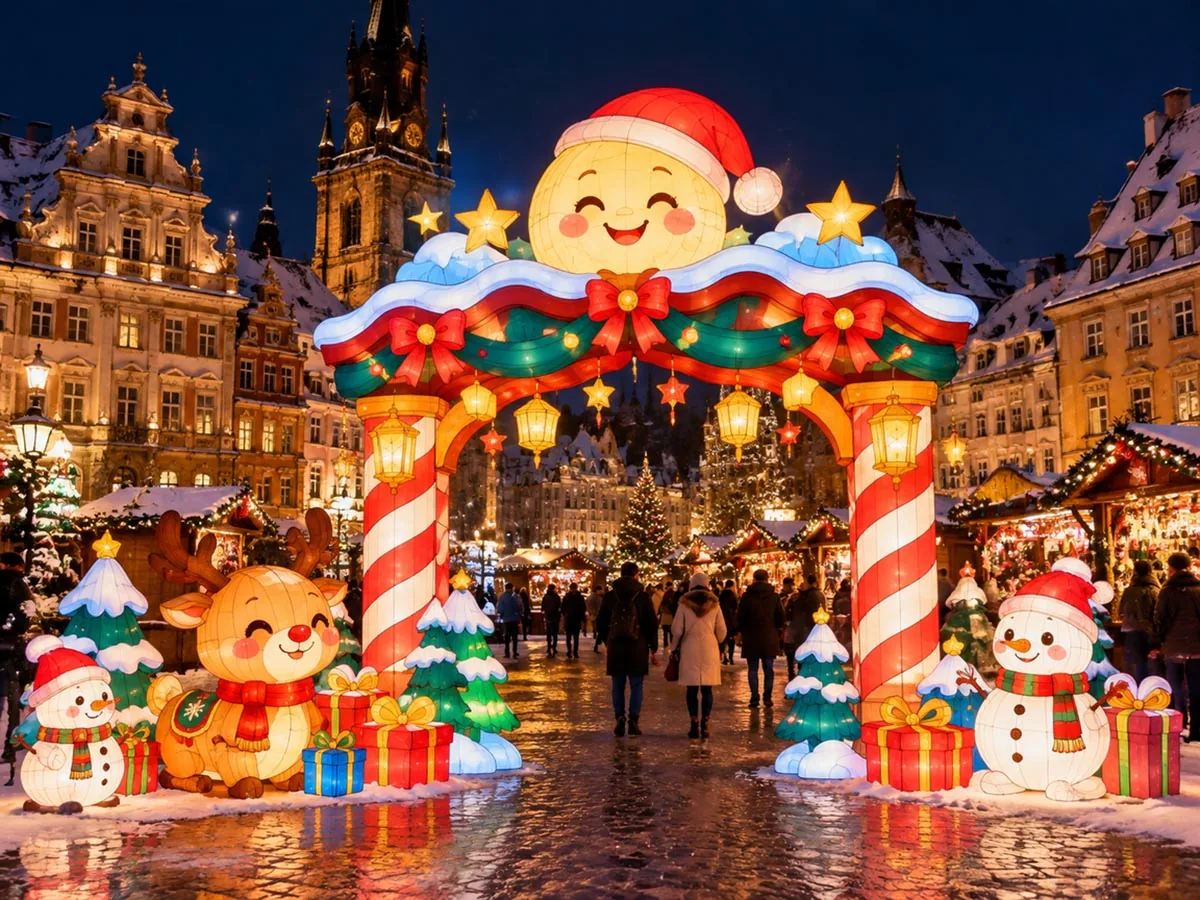
Four practical points come up on almost every German gateway:
- Clearance. The span has to clear more than pedestrians. German organisers typically want a defined minimum headroom and a width that still lets a fire appliance through.
- Anchoring. A market square rarely offers a clean fixing point. Bases are usually ballasted or water-filled, because drilling into cobbles or paving is seldom permitted.
- Wind. An arch is a sail. The larger the span, the more the structural design has to account for gust loading rather than static weight alone.
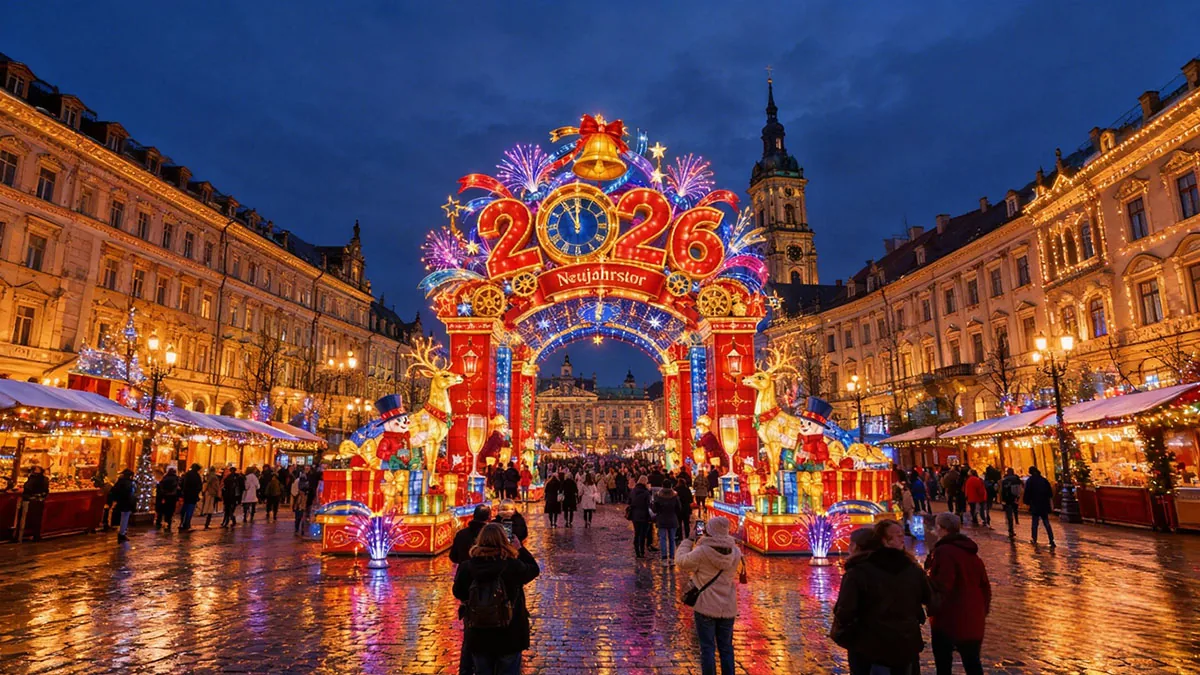
- Integration. Gateways normally carry the market name, a sponsor panel or the year, so structure and illuminated lettering are designed together rather than fitted afterwards.
An arch designed to stand outdoors through a German December is a different engineered product from one built for indoor use. Ask what the structure is rated for, and ask for the wind and snow assumptions in writing — it is a question organising committees will put to you anyway.
Both of those German questions have names. The structural case is the Standsicherheitsnachweis — verification of structural stability — and on a public square it is normally reviewed by a Prüfstatiker appointed by the organiser rather than by the supplier. What you supply into it is the load case, the section drawings and the material data; what the venue needs is the signed verification. Clearance comes from the other direction: the Feuerwehr (fire brigade) and the Brandschutz requirements set the width the gateway must keep open as a Rettungsweg, and that dimension usually settles the span before any design question does.
Stall Aisle and Walkway Lighting for Winter Conditions
Walkway lighting is the least glamorous part of a Christmas market and the part visitors notice most when it is wrong. German markets are walked in the dark, in rain, and across wet cobbles, so the brief is usually about control rather than brightness.
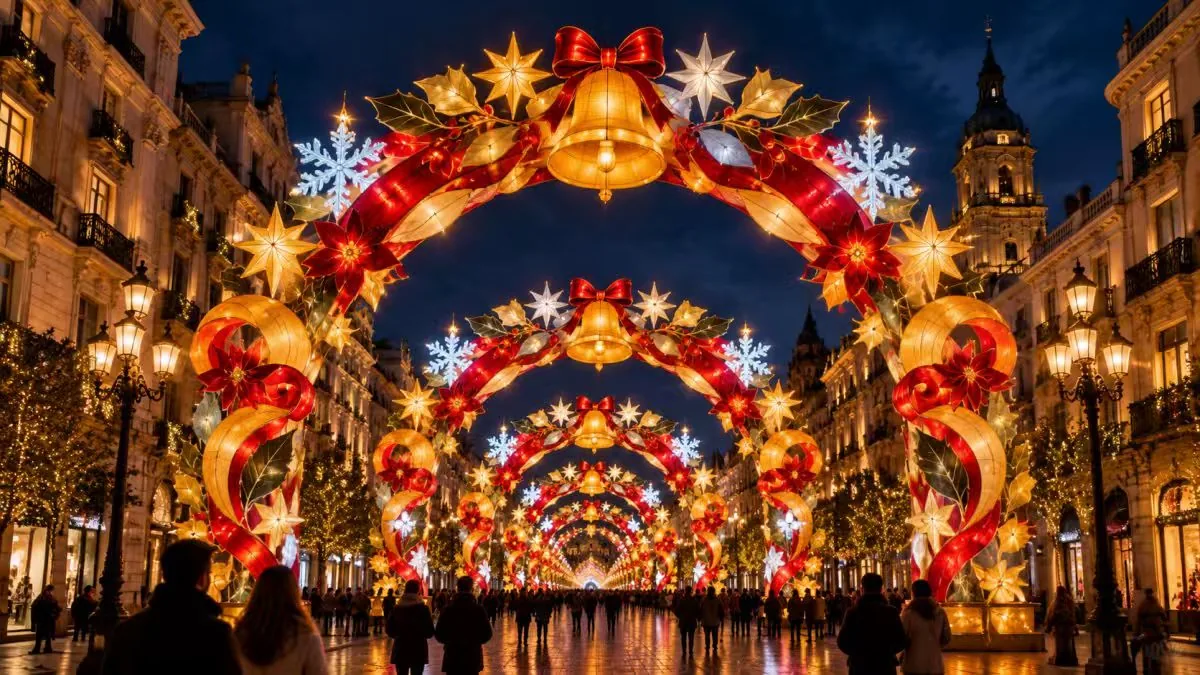
- Continuous, low-glare light. Warm, even light along the aisle rather than bright pools under individual stalls.
- Directional separation. The stall light shows the wares; the walkway light lights the floor. When the two compete, both look worse.
- Spacing that reads as rhythm. Repeated elements — catenary spans, hanging pendants, illuminated garlands — give the aisle a sense of direction.
- Ground conditions. Wet, polished cobbles reflect light back up, so fixtures that look correct on a dry test day can glare after rain. Frost and snow change it again.
- Safe cable management. Public walkways need routes that cannot be tripped over and that do not depend on visitors not touching anything.
Because the walkway carries the visitor flow, it is also where accessibility usually fails first: uneven ground, a cable across a threshold, or a lighting level that drops away at the far end of the aisle.
On a German market the walkway is also part of the safety concept. Fire officers look for continuous escape routes, clear widths and a covering material whose fire behaviour is classified rather than assumed — the class itself is the subject of the documentation section below.
Illuminated Signage and Market Landmarks
Beyond the entrance and the aisle, most German markets commission one or two statement pieces. These do work that marketing photographs cannot do alone: they give a market a visual identity that is recognisable in a single frame.
Illuminated light sculptures are the usual form — a large-scale figure or scene built as a lit sculpture rather than a flat sign. Common subjects in a German winter setting are seasonal animals, storybook characters, and large gift or star forms that anchor a square. The practical brief is the same as for any landmark: visible from the approach, photographable from the ground, and stable in a crowd.
Illuminated lettering sits in the same category. Market names, sponsor boards and directional signage are usually specified as lit pieces, because unlit signage disappears the moment the light drops.
Documentation German Organisers Ask For (CE / TÜV / DIN)
This is the part of a German tender that suppliers from outside the EU most often underestimate. Organising committees and municipal procurement teams are answerable for public safety, so documentation is requested as a matter of course rather than as a special condition — it is treated as a condition of the event, not as a commercial extra.
What is normally asked for:
- CE marking and a declaration of conformity for the electrical elements, as required for products placed on the EU market.
- Electrical test documentation for the components used, plus confirmation that the installation is designed to be connected and inspected by a local electrician.
- Structural documentation — the design assumptions for wind and snow loading on anything that spans a walkway or stands in an open square.
- DIN and VDE references, where an organiser’s framework requires the structure or the electrical work to be assessed against German standards.
- Insurance and liability paperwork, which sits with the organiser but usually has to name the installation and the installation contractor.
The practical advice is to ask for the documentation list before the design is frozen. A design that is otherwise perfect can fail a German organiser’s process on paperwork alone, and retrofitting a document pack to a finished design costs weeks.
The numbers behind those requests are worth having to hand, because a Prüfstatiker or a Sachverständiger will ask in exactly these terms:
- EN 60598 — the luminaire standard behind the CE marking of the light fittings and chain sets used inside a lit structure.
- EN 13501-1, with DIN 4102 where an older framework still refers to it — fire classification of the covering material. This is the first question a fire officer asks about a fabric-covered structure in a public space.
- EN 1991-1-3 (snow) and EN 1991-1-4 (wind) — the Eurocode load cases that a Standsicherheitsnachweis resolves to. Gust loading matters more than static weight on anything spanning a walkway.
- EN 1090 — execution of metal structures, referenced when the frame itself has to be assessed to a formal standard.
- VDE 0100 — the German electrical installation rules your local electrician will work to when the temporary supply is connected and inspected.
- TÜV or an independent Sachverständiger — where the organiser’s framework requires third-party review rather than supplier documentation alone.
Where a display sits inside or next to a covered venue, the state Versammlungsstättenverordnung can apply as well, with its own rules on escape routes and materials. It is worth asking which set of rules the venue is being assessed under before the design is fixed, because the two can point in different directions.
Installation Windows and Market Build-Up Schedules
German market squares are usually public space with other claims on them. That makes the installation window short, fixed, and negotiable only within narrow limits.
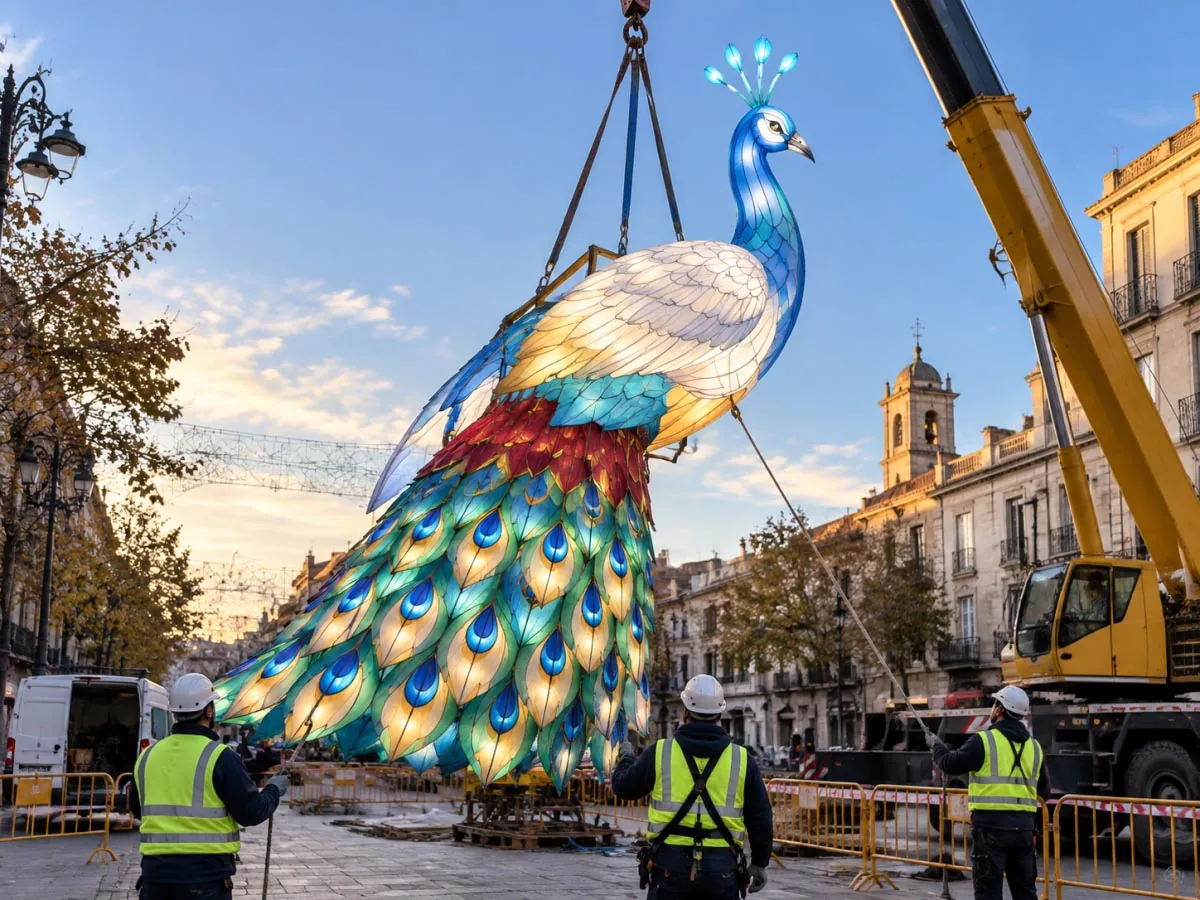
In practice, build-up for a large market starts two to three weeks before opening. Across that window a contractor is running several parallel jobs: laying power to each zone, setting bases or ballast, erecting structures, hanging lighting, and then programming and testing it — testing that can only be done after dark, which caps how many useful hours each day gives you.
Two things follow from that. First, everything that can be prepared off site should be, because site hours are the most expensive and least flexible part of the programme. Second, the delivery date that matters is not the opening date — it is the date the installation crew needs the pieces on the ground, which is typically two to three weeks earlier.
Opening Dates Across Germany’s Major Markets, 2026–2027
Germany’s largest markets do not open on the same day. They stagger across roughly ten days in November, which is why the delivery and installation schedule has to be planned per market rather than per country.
| Market | Opening date (2026 season) |
|---|---|
| Cologne | around 16 November |
| Munich | 20 November |
| Frankfurt | 23 November |
| Leipzig | 24 November |
| Dresden (Striezelmarkt) | 25 November |
| Stuttgart | 25 November |
| Nuremberg (Christkindlesmarkt) | 27 November |
| Berlin (Gendarmenmarkt) | 27 November |
The dates above are the ones to plan against, and the pattern repeats each season with only small shifts. Two of them matter more than the rest for scheduling:
- Cologne opens first, around 16 November, which makes it the earliest hard deadline of the season.
- Nuremberg opens last, on 27 November. Its Christkindlesmarkt is also the market that German organisers use as the reference point for “the season has started”.
Frankfurt closes earliest, on 22 December. That produces the single most useful planning number in this article: all eight of these markets are open at the same time only between 27 November and 22 December — a full-open window of about three and a half weeks. If an installation has to be seen and signed off across the whole country at once, that is the window.
For correspondence and place names, the German forms are the ones that appear on permits and invoices: Kölner Weihnachtsmarkt, Münchner Christkindlmarkt am Marienplatz, Frankfurter Weihnachtsmarkt am Römerberg, Leipziger Weihnachtsmarkt, Dresdner Striezelmarkt, Stuttgarter Weihnachtsmarkt, Nürnberger Christkindlesmarkt and the market on the Gendarmenmarkt in Berlin.
Working Backwards from Opening Night: Production and Shipping Timeline
Working back from a mid-November opening, a realistic schedule for a market installed with product shipped from China looks like this:
- Mid-November — market opens.
- Late October — installation complete, lighting tested after dark.
- Early October — build-up begins on site; containers cleared and delivered.
- Late August to mid-September — shipment departs origin.
- May to July — production slot.
- March to April — design frozen and documentation pack issued.
- January to February — theme, layout and internal sign-off.
Sea freight from China to a German port normally runs four to six weeks on the water, plus customs clearance and inland delivery. That is the stage most often underestimated, and it is the stage least able to absorb a delay: a container that misses its booking does not arrive a day late, it arrives on the next sailing. Our guide to shipping lanterns from China to Europe covers the freight and customs side in detail.
The uncomfortable implication is this: for the season that opens in November, the procurement decision was made in the first half of the same year. By the time markets open, the buying window for that season has already closed — which is why serious organisers start the conversation in spring, and why the calendars above are worth keeping in front of you all year rather than in the autumn.
Frequently Asked Questions
When should we start planning lighting for a German Christmas market?
Work backwards from opening night. Production, sea freight, customs and on-site installation together need roughly seven to nine months, so a November opening means starting the process in the first quarter of the same year. Starting in early spring gives you room to consult properly on the design rather than choosing between a compressed schedule and a reduced scope.
Do you supply Christmas market lighting to Germany and the rest of Europe?
Yes. Germany is one of our main European markets and we supply market organisers, city authorities and lighting contractors across Europe. European projects are handled with EU documentation requirements in mind from the start of the design.
What documentation do German organisers normally request?
Typically CE marking and a declaration of conformity for the electrical elements, electrical test documentation for the components, structural assumptions for wind and snow loading, and references to DIN or VDE where the organiser’s framework requires them. Ask for the organiser’s documentation list before the design is frozen.
Can an installation be reused for a second season?
Yes, and most markets designed for repeat use are planned that way from the outset. Between seasons the pieces are inspected, cleaned, repaired where needed and stored ready for the next build-up. What still needs the full lead time in a second season is any new piece and the shipping slot.
How long does shipping from China to Germany take?
Sea freight to a German port normally takes four to six weeks on the water, after which customs clearance and inland delivery to the venue follow. It is worth booking the shipping slot when production is confirmed rather than when the pieces are finished, because autumn capacity on Asia–Europe routes tightens quickly.
What weather conditions do outdoor installations have to handle?
German markets run through rain, frost, snow and wind, on cobbles and open squares. Installations are specified as outdoor-rated, with ballasted or water-filled bases where ground fixing is not permitted, and with structural design that accounts for gust loading on anything spanning a walkway.
What is a Standsicherheitsnachweis, and who signs it?
It is the verification of structural stability that a German organiser needs for anything spanning a walkway or standing in a public square. It is normally reviewed and signed by a Prüfstatiker appointed by the organiser, not by the supplier. What we provide is the input: the load case with wind and snow assumptions stated, section drawings, anchoring layout and material data. Ask for the list of documents the Prüfstatiker wants before the design is frozen, because retrofitting that pack afterwards costs weeks.
Which standards will our engineer be checking against?
The ones that come up most often on a German market are EN 13501-1 (with DIN 4102 on older frameworks) for the fire class of the covering material, EN 1991-1-3 and EN 1991-1-4 for snow and wind, EN 60598 for the luminaires, EN 1090 where the metalwork is assessed formally, and VDE 0100 for the temporary electrical installation. We state which numbers apply to the build and supply the component and material documentation we hold, so your engineer is verifying rather than investigating.
Planning Your Market Lighting
If you are an organiser, a city authority or a contractor planning a German Christmas market, the useful starting point is the dates above and the installation window they imply. From there the design can be shaped around the site rather than around the calendar.
We work with European organisers on complete market lighting programmes — gateways, walkway lighting, illuminated signage and landmark pieces — with CE conformity documentation and a free design proposal in 24 hours. Start with the European lantern festival programme, browse illuminated light sculptures, or send us your market dates and site plan.
More on European Delivery
The market pieces themselves are usually bought as one matched set from a single workshop: an illuminated entrance archway, a sleigh and gift-box scene placed where visitors stop walking, and reindeer figures closing the ends of the stall rows.
- Light festival installation in the Netherlands — canal & water routes
- Shipping festival lanterns from China to Europe — ports, customs & timelines