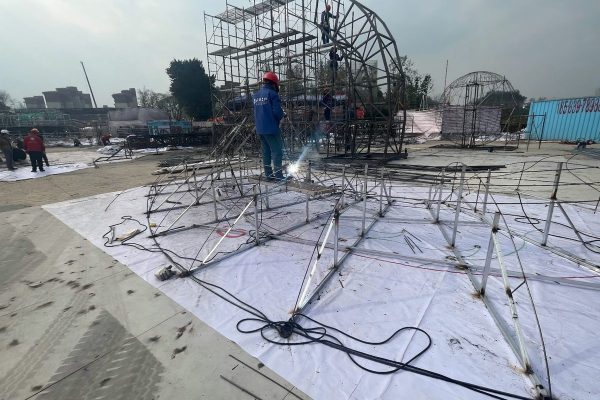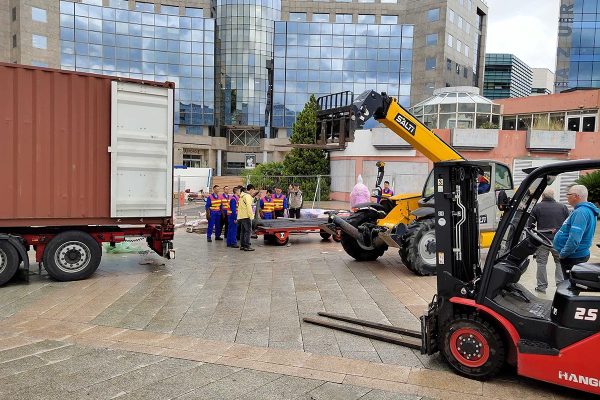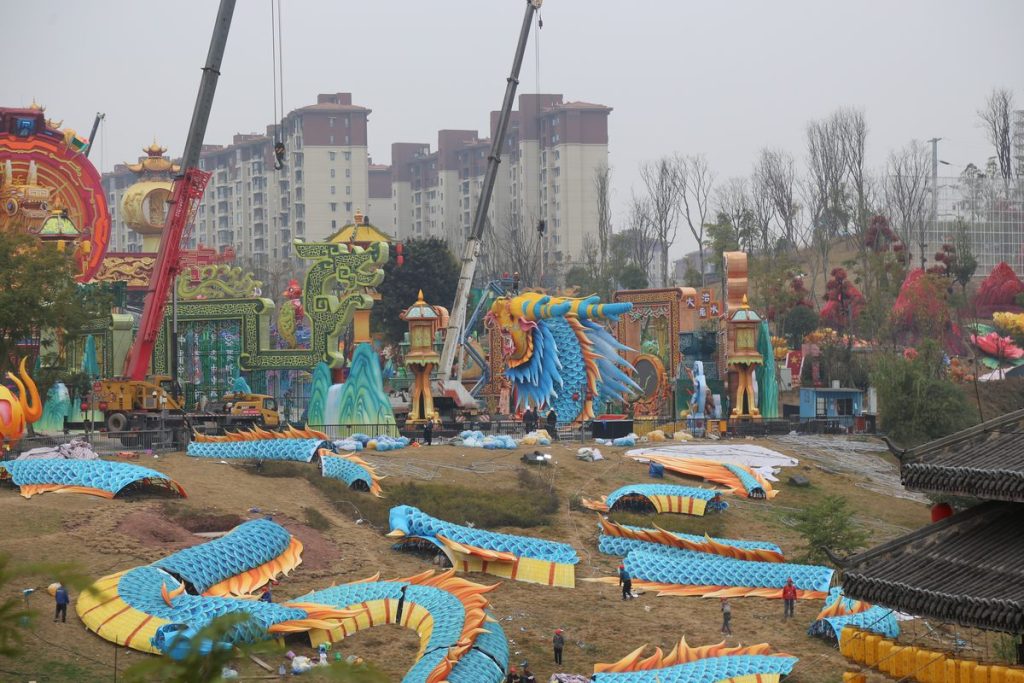
Professional Christmas light installation is not the same product as buying the lights and hanging them yourself. The difference sits in three places: someone signs the structural calculation, someone signs the electrical design, and someone carries the risk if the opening date slips. A venue that has decided to run a light programme is really choosing who holds those three liabilities.
This guide is written for the operator side of that decision — what to ask, what the quote should itemise, how the schedule actually runs, and the three failures that show up on site regardless of how good the design looked on paper.
Eight Questions to Ask Before You Sign
Most installation contracts go wrong at the briefing stage, not on site. These eight questions separate a contractor who has done this before from one who is learning on your event.
1. Who signs the structural calculation?
A lit structure of any real height is a temporary structure, and temporary structures have their own load case. The question is not whether a calculation exists — it is whose name is on it and whether that person carries professional indemnity. If the answer is “the workshop does the structure”, ask for the calculation and the name behind it.
2. Who signs the electrical design?
The same logic applies to power. Distribution, protective devices, earthing and the certification at handover should all trace to a named competent person. On a public site this is usually a legal requirement, not a preference, and it is the first thing an inspector will ask for.
3. What happens on a named storm night?
Every winter programme will meet at least one gust above 25 m/s — the ceiling most temporary-structure guidance works to. The contractor should be able to describe the shutdown trigger, who makes the call, what gets de-rigged, and how long that takes. A contractor who has not thought about this will improvise during the storm.
4. Is strike included, or is it a separate quote?
Installation quotes frequently cover installation only. Removal, crating and storage are then quoted separately at the end of the season, when the venue has no leverage. Ask for both numbers at the start, and ask where the pieces live between seasons.
5. Who holds the spares, and how fast can a piece be swapped?
A light trail runs 10 to 13 weeks on site including build and strike. Something will fail in that window. The question is whether the fix is a same-week swap from a spares kit held locally, or a six-week shipment from the factory. The answer decides how many dark pieces a visitor sees in January.
6. What is the handover inspection, and who attends?
A handover that consists of a walk-through and a handshake is not an inspection. Ask for the checklist in advance: what is tested, what is photographed, what is signed, and who from the venue attends. This document is also the baseline for any dispute later.
7. Has the crew built on this kind of ground before?
Ground decides more than structure does. A crew that has only built on hard standing will underestimate turf, gravel and slopes, and the fix usually appears as extra ballast ordered mid-installation. Ask for a site with similar ground, not just a similar-sized project.
8. What is the consequence if the opening date slips?
Opening dates are fixed by marketing, ticketing and press. A contract without a completion date and a defined consequence is a schedule risk transferred to the venue. The clause does not need to be punitive; it needs to exist.
What the Quote Should Itemise
A single lump sum is the most common shape of a light installation quote, and it is the hardest to manage. When scope changes — and it will — there is no rate to apply, so every change becomes a negotiation.
A quote that can be managed separates at least these lines:
- Design and structural calculation — including the review cycle and who approves drawings
- Fabrication — per piece, with the quantity basis stated
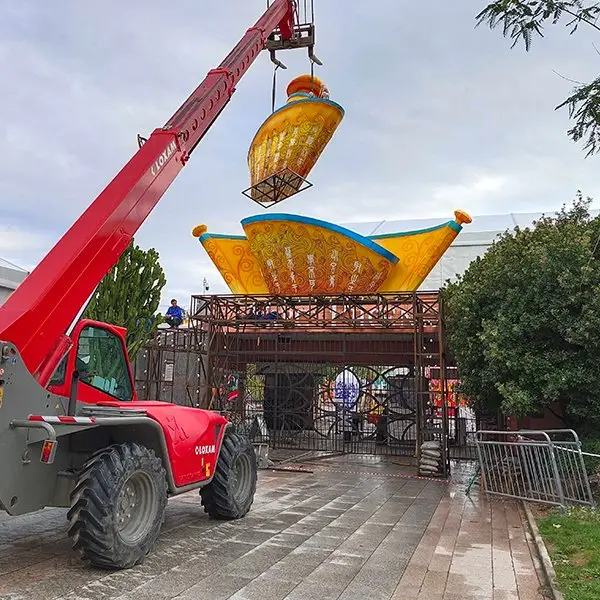
- Transport and cranage — port to site, plus any lifting equipment on the day
- Installation labour and supervision — crew size, days, and whether a supervisor travels
- Electrical connection and testing — distribution, protective devices, certification
- Strike, crating and storage — quoted at the same time as installation, not later
- Spares package — what is included and where it is held
Two lines are commonly missing and always cost more later: the ground protection (matting, plates, temporary track) and the make-good after strike. If turf is part of the site, both belong in the original quote.
Working Back from Opening Night
The schedule is arithmetic, and it is the part most often compressed by wishful thinking. For an imported programme the sequence runs roughly like this:
- Design and approval — 2 to 3 weeks, longer if the venue’s own approvals are slow
- Fabrication — 6 to 10 weeks depending on piece count
- Sea freight — 3 to 6 weeks, or 3 to 5 days by air for urgent items
- On-site installation — 2 to 3 weeks for a mid-size trail
That totals five to six months from order to opening. A late-November opening therefore needs the order placed in May or early June. The failure mode is familiar: a decision made in August, a compressed factory schedule, air freight on part of the order, and an installation crew working nights in the last week before opening.
On site, the programme should plan for a 10 to 13 week window that includes build and strike, not just the public run. That window carries 60 to 70 power cycles, 20 to 28 freeze-thaw cycles, and ten to fifteen wet days a month in a northern European winter. Equipment specified for a six-week summer event will not enjoy it.
What a Crew Actually Does on Site
An installation quote usually says “2 to 3 weeks”. What that time is spent on decides whether the programme runs smoothly or ends in a night shift before opening.
Days 1 to 2 — setting out. The route is marked on the ground against the approved drawing, levels are taken, and the power access points are confirmed. This is where a discrepancy between drawing and site is found cheaply. Crews that skip setting out find the same discrepancy on day ten, with pieces already built.
Days 3 to 7 — the large pieces. Anything needing lifting goes in first, because cranage and access are easier before the small pieces fill the route. Base plates, ballast and anchoring are finished and checked before the piece is dressed.
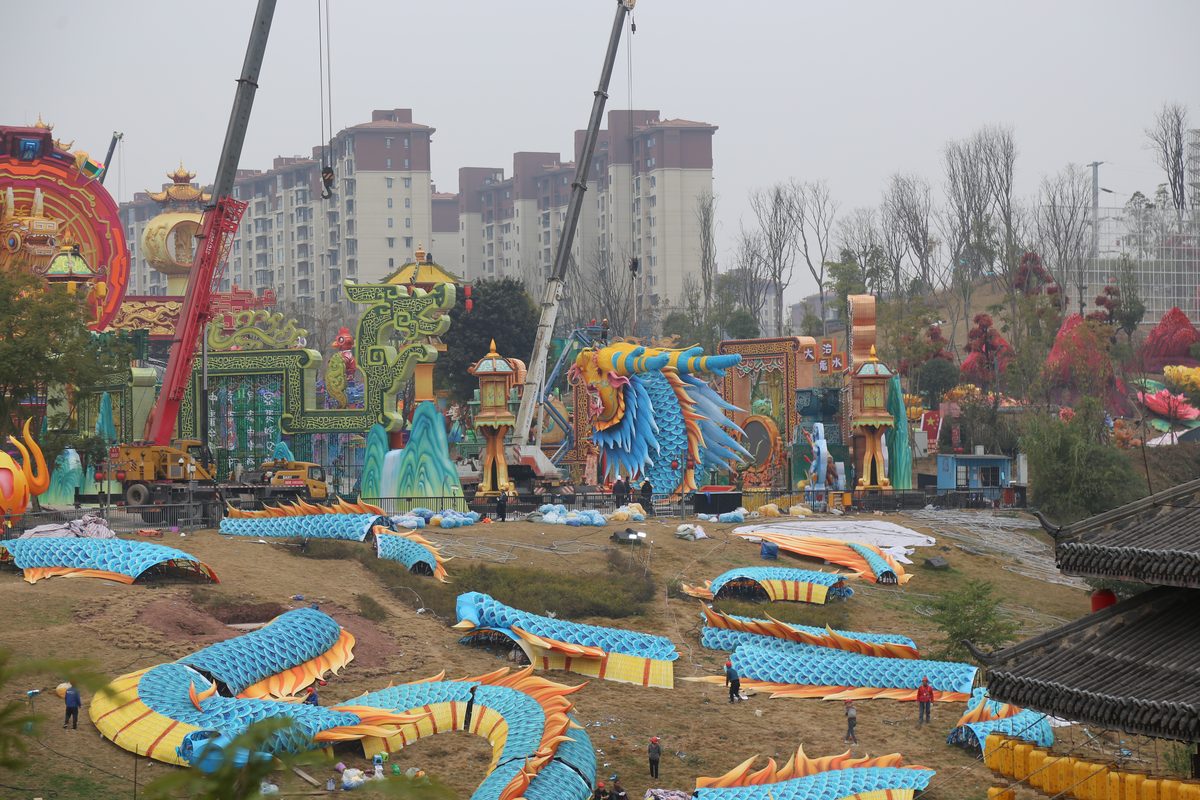
Days 8 to 12 — small pieces, cable and dressing. The bulk of the labour sits here: cable routing along path edges, connectors raised above the low line, and the surface work that makes a frame look finished.
Days 13 to 16 — electrical testing. Circuit by circuit: continuity, protective device operation, earthing resistance, and a full load test. This is the stage that produces the certificate at handover, and it should not be compressed.
Days 17 to 19 — night runs. The trail is energised after dark, walked, and adjusted. Colour balance, glare at eye level, dark spots on the route, and any piece that reads badly from the actual viewing distance all get fixed here.
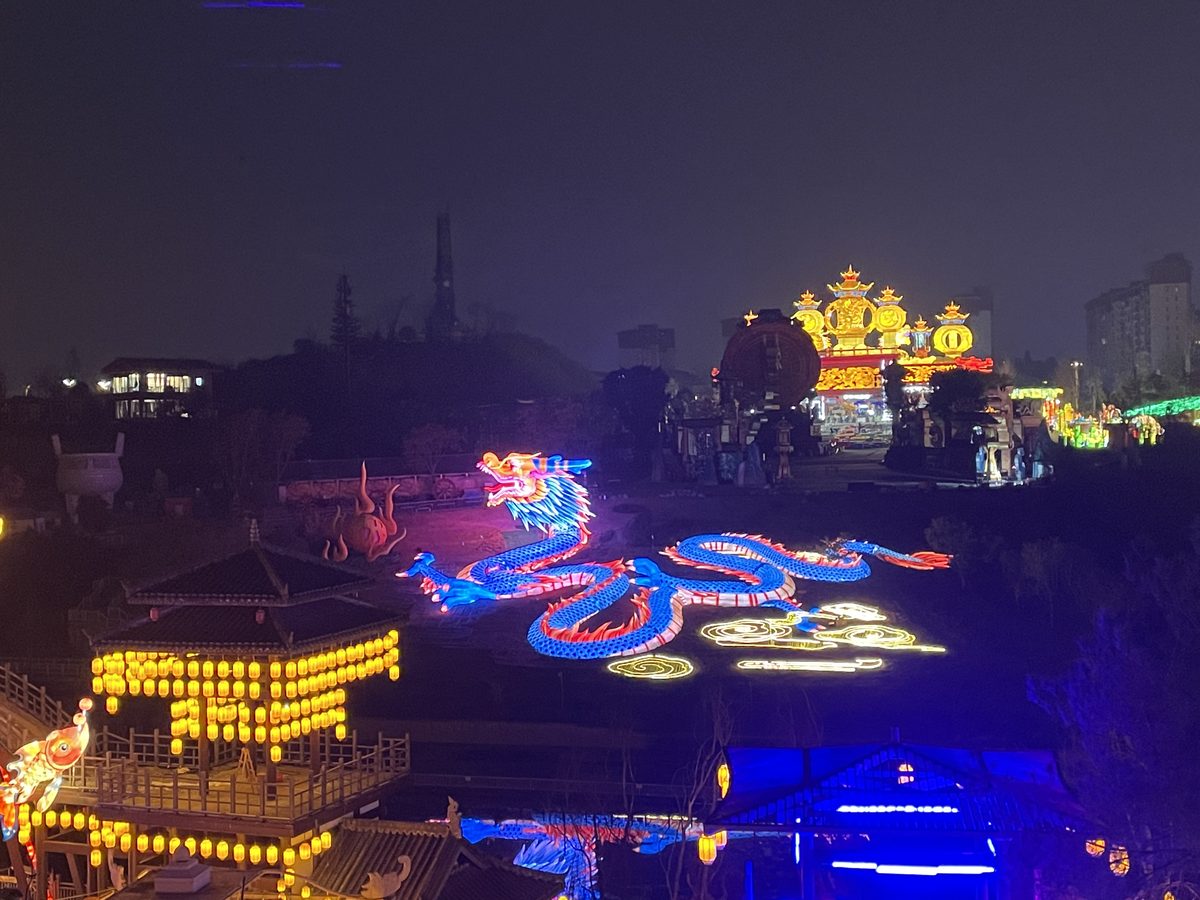
Days 20 to 21 — handover. Documentation, spares handover, and a walk-through with the venue’s operations team. The inspection checklist from the contract is completed and signed at this point, not later.
Compressing this sequence is the most common cause of a bad opening night. The two stages that get cut first are setting out and night runs, and they are the two that catch the errors a visitor would notice.
Three Failures We See on Site
Wind, and the temporary-structure ceiling
In November 2024, a UK winter light trail was walked the morning after a storm and found silk torn from frames and several figures on their sides. The structures had been designed and built; what they had not been designed for was the load case that actually arrived.
Temporary structures carry a lower wind ceiling than permanent buildings, and a winter trail in northern Europe will meet it. The practical answers are shorter cantilevers, lower height, more anchoring points, and a defined shutdown trigger — not a heavier base. A heavier base resists sliding; it does nothing for a frame that is being bent.
Ground, where uplift resistance quietly disappears
Ballast calculations are usually done for dry ground and then applied to whatever the site turns out to be. Wet turf, gravel over membrane, and frozen ground all behave differently from the assumption, and the difference shows up as a piece leaning after the first thaw.
The two numbers that matter are sliding resistance and uplift, and they are not the same calculation. On soft ground the governing case is usually uplift at a corner during a gust, not the total mass of the base. This is why a site visit before the quote is worth more than a specification sheet.
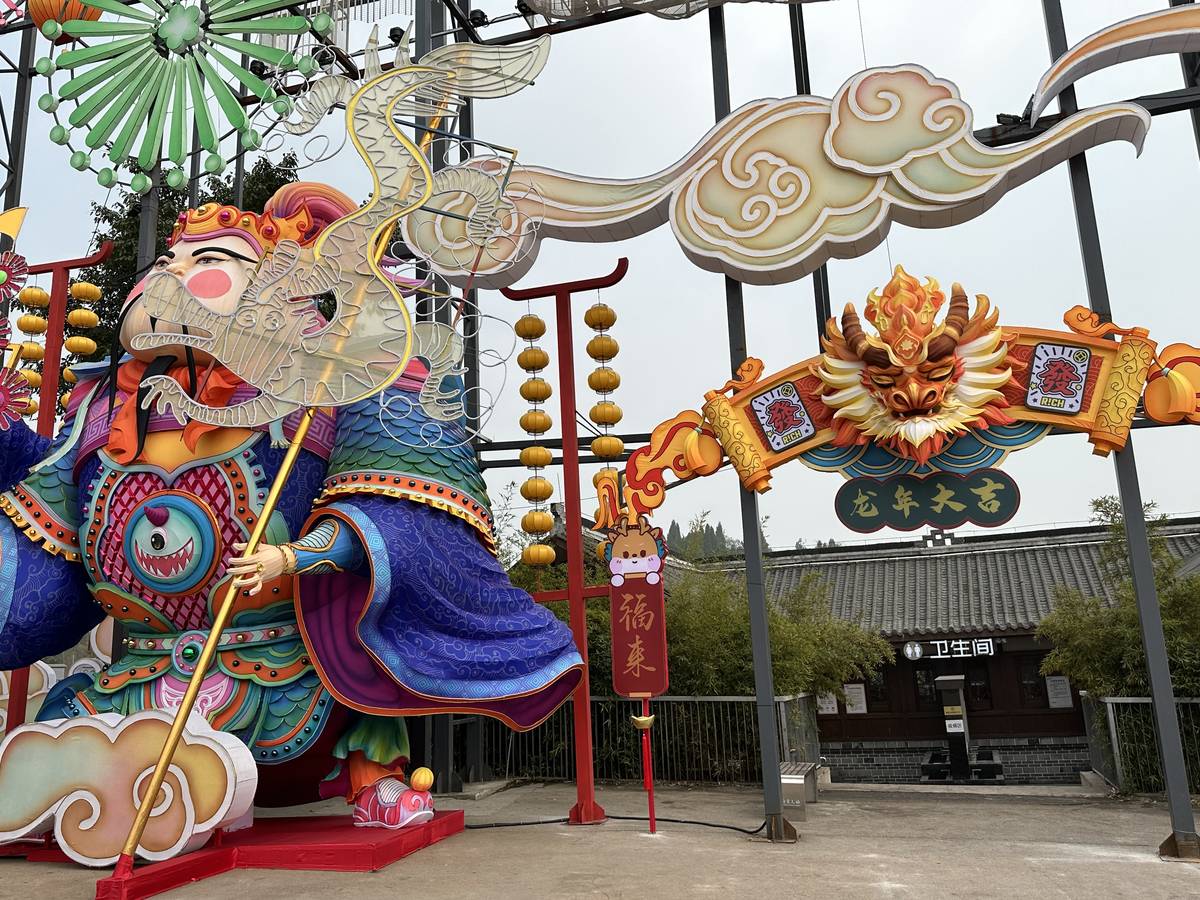
Electrical protection, and what an IP rating actually certifies
An outdoor-rated rating is a short laboratory test — minutes, not months. It certifies that water did not enter during the test; it does not certify that a connector will still be watertight after sixty power cycles and a season of freeze-thaw.
The failures cluster at the same points: the stitch line where cable enters a silk panel, the tie point where a connector hangs under load, and any joint that sits in a low spot where water collects. Good installation practice addresses all three — strain relief at entry points, connectors raised above the low line, and a service loop that lets water run off rather than in.
What to Hand the Installer
The quality of the installation is set partly by what the venue provides before the crew arrives. Five documents make the difference:
- Site plan with buried services — irrigation, drainage, power, and anything that cannot be drilled
- Load capacity — what the ground, structures and attachment points can actually take
- Power availability — capacity, location, and whether it is three-phase
- Permits and consents — fire, structure, electrical, and any heritage or tree protection conditions
- Operating constraints — opening date, daily build hours, noise limits, and site access times
Where those are missing, the crew improvises, and improvisation on a heritage or garden site is how damage happens.
Red Flags in the Site Visit
Most of the problems that surface during installation were visible at the first site visit. Five signals are worth treating as stop signs.
No buried services plan. If nobody can say where the irrigation, drainage and power run, every stake becomes a gamble. On a garden or heritage site this is not a minor gap — it is the difference between an installation and an insurance claim.
Load capacity described as “it’s solid”. Ground and structures have numbers. A contractor who cannot state them is planning to find out by testing, and the test is your event.
Power capacity left to “we’ll sort it”. Distribution, protective devices and earthing all follow from the available capacity. A site that has not confirmed its supply is a site where the electrical design cannot be finished.
Opening date fixed, site layout not. If marketing has announced a date and the layout is still being discussed, the schedule has already lost its float. Either the layout freezes or the date moves.
Structural detail deferred until after the renders. Beautiful renders are cheap; structural drawings are not. A supplier who produces the visuals first and the calculations later is likely to discover the piece cannot be built as drawn.
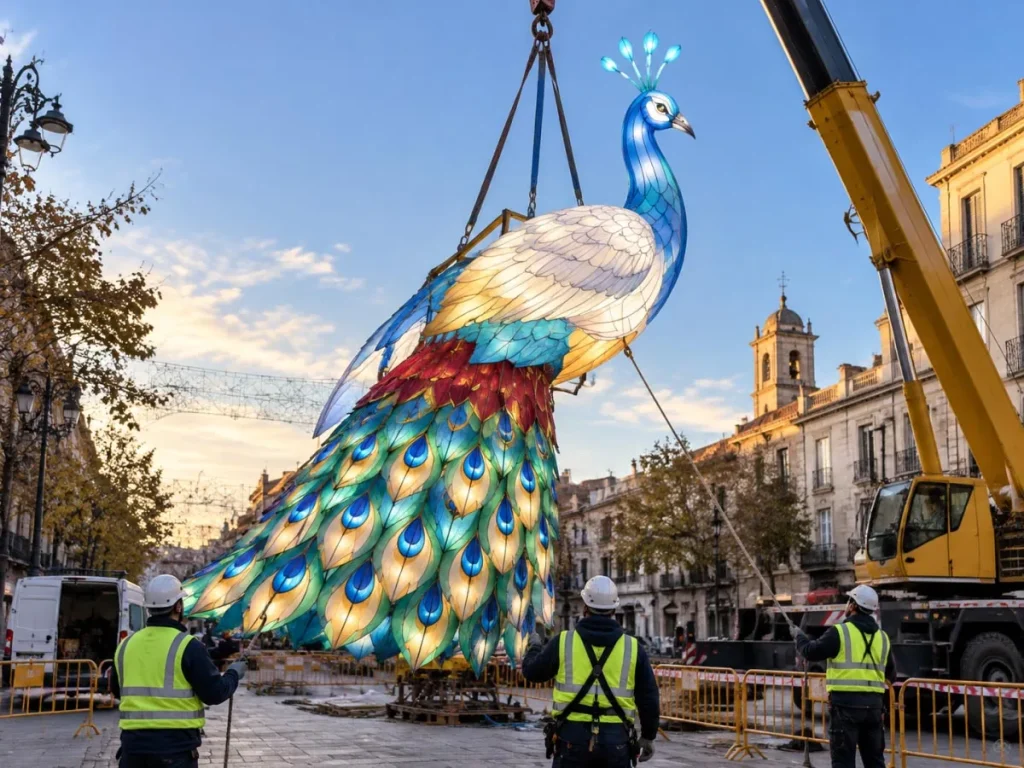
When a Local Crew Beats a Travelling Team
Not every project needs a supervisor flown in. The decision turns on complexity and repetition rather than size.
A travelling team earns its cost on a first installation, a complex structure, a site with tight tolerances, or a programme where several trades have to be coordinated on the same day. A local crew is usually the better answer for a repeat installation, a simple layout, or a venue that already has trained staff from a previous season.
The middle path is common and usually the most efficient: the supplier sends one supervisor, the venue supplies labour, and the supervisor owns the sequence, the structural checks and the electrical sign-off. That keeps the accountability where the liability sits without paying for a full crew to travel.
Frequently Asked Questions
How long does professional installation take?
A mid-size trail of 20 to 35 pieces takes 2 to 3 weeks on site with an eight-person crew, including testing and a full night run before opening. Larger programmes scale with crew size rather than calendar time, up to the point where site access becomes the constraint.
Can our own electricians do the connection?
Often yes, provided the design is issued by the supplier’s engineer and your electrician works to it, and provided the certification at handover names a competent person. Split responsibility is where sign-off gets messy, so agree in writing who certifies what.
Is removal included?
It should be quoted at the same time as installation. Strike, crating and storage are frequently left out of the original number and then negotiated at the end of the season when the venue has no alternative.
What happens if a piece fails mid-season?
The answer depends on the spares package and where it is held. A locally held kit with a documented swap procedure turns a failure into a same-week fix; a factory shipment turns it into a dark piece for a month.
When should we book for a November opening?
Five to six months ahead, which means May or early June. Later than that and part of the order travels by air, the factory schedule compresses, and the installation crew works nights in the final week.
What This Means for the Contract
The lighting is the visible part and the easiest part. What decides whether a winter programme opens on time and survives to January is who holds the structural calculation, who holds the electrical design, whether the quote itemises the lines that change, and whether the schedule was built backwards from a fixed date rather than forwards from a purchase order.
Ask those four questions before signing, and most of the failures described above never reach the site.
For the wider programme — route design, piece mix and how a trail is sequenced — see our Christmas light festival planning guide. For zoo and garden venues, the zoo lights programme covers the route logic that a Christmas trail inherits. UK and Irish sites have their own consent and grounding constraints, covered in the light trail installation guide for the UK and Ireland, and the supplier selection process is set out in our lantern festival supplier guide.
If you already have a site plan and an opening date, send them through our project enquiry form and we will come back with the structural and electrical questions that need answering before a quote means anything.