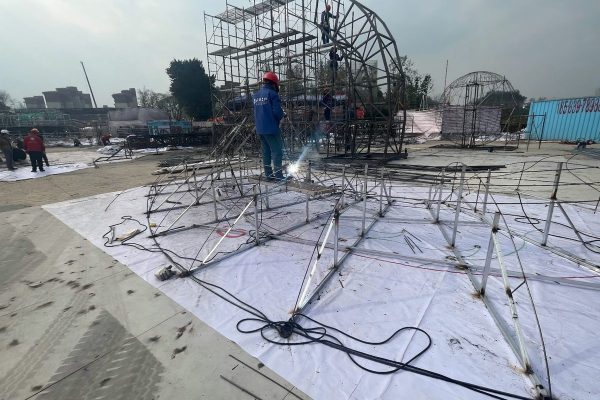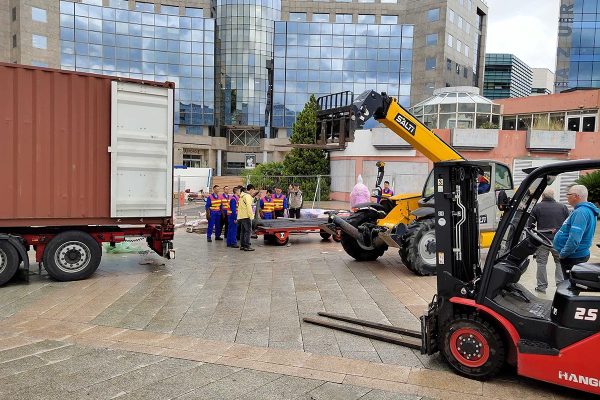
On the morning of 23 November 2024, the team at Longleat walked the Festival of Light route and found silk torn from frames and several illuminated figures on their sides. The event closed that day and the next. Every ticket was refunded or transferred, and it reopened on the Monday.
Nothing about that was a design failure in the ordinary sense. The figures had been built, wired and installed, and on the Friday night they worked. What failed was an assumption: that a structure of fabric, thread, cable ties and sealant holds together through a British winter without being engineered for one.
The question is not whether the figures look right on opening night. It is what this construction does across the ten weeks it has to survive.
The short version
- UK trails run from mid-November to early January. With build and strike, equipment stands on British ground for 10–13 weeks, in the worst weather of the year.
- That window brings 20–28 freeze-thaw cycles, 60–70 power cycles, 10–15 wet days a month and at least one gust above 25 m/s, which is also the IStructE ceiling for temporary structures.
- Failures start at seams, tie points, glands and cut cable ends far more often than in the lamp. outdoor-rated is a three-minute test.
- Surface Finish sealant cannot be applied outdoors in a British January, and pins in saturated December grass have no dependable uplift resistance.
The ten weeks
British light trails are six-to-nine-week attractions that happen to fall inside winter.
| Venue | Public run (2025/26) | Length |
|---|---|---|
| Christmas at Kew | 14 Nov – 4 Jan | ~7.5 weeks |
| Longleat Festival of Light | 8 Nov – 11 Jan | ~9.5 weeks |
| Christmas at Blenheim Palace | 14 Nov – 3 Jan | ~7.5 weeks |
| Christmas at the Botanics, Edinburgh | 20 Nov – 30 Dec | ~6 weeks |
Allow two to four weeks to build and a week to strike, and the same structures stand on British soil for 10 to 13 weeks. None of those weeks is in a mild month.
Nor does the equipment ever dry out. On 21 December London gets 7 hours 49 minutes of daylight and the sun sets at 15:53, and Heathrow averages under two hours of sunshine a day across the month. Trails energise at 15:50 and run to 22:00, so the daily pattern is: on at dusk, six hours running, cool overnight to 0–3 °C, off at close. Sixty to seventy times a season.
Add 20 to 28 freeze-thaw cycles, 10 to 15 wet days a month, and in most winters at least one gust above 25 m/s. Heathrow averages about 20 frost days from December to February; Edinburgh, about 28. Ten weeks is what to size everything against.

Driving rain: the load this construction was never designed to shed
Wind-driven rain is what this construction is least equipped for, and the UK already publishes a number for it. Approved Document C carries a map of exposure zones derived from BS 8104, in litres of rain driven into each square metre of wall during a single spell.
| Zone | Description | Wind-driven rain per spell (L/m²) |
|---|---|---|
| 1 | Sheltered | under 33 |
| 2 | Moderate | 33 to under 56.5 |
| 3 | Severe | 56.5 to under 100 |
| 4 | Very severe | 100 and above |
Most of England, Wales and lowland Scotland sits in zone 3 or 4, and the rule of thumb in the brick and cladding industries is blunter: anywhere within 30 miles of a west-facing coast counts as severe exposure. A cavity wall answers that with five mechanisms: drained cavity, capillary break, weep holes, drip, pressure equalisation. Those exist because 56.5 to 100 litres per square metre per spell is a great deal of water arriving sideways.
An illuminated figure has none of them. Fabric, a stitched seam, a tie through a punched hole, a bead of sealant. No cavity to drain into, no pressure equalisation, no drip edge, no weep hole. Water behind the skin has one route out: back through fabric now wet on both faces.
The entry points are consistent:
– The stitch line. A row of needle holes through the fabric at the point of highest stress, then loaded in tension by wind. – The tie point. Every cable tie passes through a punched hole, and that hole edge is where load concentrates. Wet fabric stretches; the tie does not. – Anything facing upward. Top seams, ear interiors, open mouths, cable entries, enclosure lids.
None of it is visible from the visitor path. Wet fabric also gains weight, sags, and moves against the frame, abrading the coating where load is highest. And the fabric rarely fails first: PVC-coated polyester cold-cracks around −30 °C under DIN EN 1876-1, below anything a British winter produces. The weak points are seam, hem and tie, and no standard test covers a stitched seam on a loaded fabric in wind-driven rain.
Wind: an ordinary named storm already exceeds the temporary-structure ceiling
IStructE’s guidance on temporary demountable structures sets the operational limit at 25 m/s at 10 m height, about 56 mph. Two action levels sit below it: 19.4 m/s (60% of operating load) puts personnel on alert; 22.3 m/s (80%) closes the site to the public.
For Storm Boelo in October 2026 the Met Office wording was: “Gusts of 55-65 mph are likely widely with some coastal and exposed areas potentially seeing gusts of 70-80 mph or more.” That is 25–29 m/s widely, 31–36 m/s on exposed coasts. A routine storm, forecast a day ahead, already sits at or above the design ceiling. Pressure rises with the square of velocity: q ≈ 0.613 v² Pa.
The same expression gives the pressure at each operating threshold, and at the top of the storm bands:
| Gust | km/h | mph | Dynamic pressure |
|---|---|---|---|
| 12 m/s | 43 | 27 | 88 Pa |
| 19.4 m/s | 70 | 43 | 231 Pa |
| 22.3 m/s | 80 | 50 | 305 Pa |
| 25 m/s | 90 | 56 | 383 Pa |
| 29 m/s | 104 | 65 | 516 Pa |
| 36 m/s | 130 | 80 | 794 Pa |
A figure 10 m high with 20 m² of frontal area takes 383 × 20 ≈ 7.7 kN at 25 m/s — about 780 kg of sideways push. At 36 m/s it takes roughly 1.6 tonnes.
A wind speed on its own is not an instruction. Figures for the same site can differ by a factor of three because they answer different questions. The operating envelope of a temporary structure is a working limit, a warning, a closure decision and a ceiling, and those are four separate things. Mixing them up is how a site ends up with a written threshold nobody can execute.
| Action | Trigger | Basis |
|---|---|---|
| Stop work at height | 12 m/s (43 km/h) | Industry limit for work at height |
| Alert — re-check structure and forecast | 19.4 m/s (70 km/h) | IStructE Level 1, 60% of operating load |
| Close the site to the public | 22.3 m/s (80 km/h) | IStructE Level 2, 80% of operating load |
| Operational ceiling | 25 m/s (90 km/h) | IStructE operational limit for temporary structures, measured at 10 m height |
An operator may set a closure trigger stricter than these thresholds. That is a policy choice, not a structural one, and it only helps if the site runs to it and the record says so. The 19.4, 22.3 and 25 m/s levels are not optional in the same way.
Two things matter more than the arithmetic. The first is the sail effect: IStructE states that “many structures have a much lower tolerance when fully sheeted”. A bare frame and a clad figure have different load paths, and stripping fabric changes which members carry what.
The second is location. Basic wind velocities at 10 m over open country run from 24–26 m/s at Edinburgh and Glasgow to 27–29 in the Western Highlands. At several popular trail sites, the site’s own basic wind speed sits in the same band as the temporary-structure ceiling. There is no headroom.
Wind stops work as well as closing trails. Working at height stops above 12 m/s of sustained gust, and figures much over 6 m need plant: in February 2016 a large illuminated festival at a Manchester retail site pushed its opening back a week for that reason.
Cold: the wrong model, and the details it produces
The instinct is that low temperature breaks things by freezing them. For most of this construction that is the wrong model, and designing to the wrong model produces the wrong details.
Acrylic is where the light comes out. PLEXIGLAS GS data gives tensile strength of 80 MPa at 23 °C, and 110 MPa at −40 °C. Cold makes it stronger. But the same sheet has an elongation at break of 5.5% and a notched impact strength of 1.6 kJ/m² against 15 kJ/m² unnotched. It also has a minimum cold-bend radius of 330 times its thickness: a 3 mm panel needs a one-metre radius. Read those together and the behaviour is clear: acrylic does not sag in the cold. It snaps, with no warning phase where it visibly deforms first.
So any panel forced into a bend during fabrication, clamped flat under a screw without a slip washer, or drilled close to an edge is a pre-loaded crack by the time it reaches zero degrees. Thermal movement finishes the job: a one-metre panel at 7 × 10⁻⁵ per kelvin wants to move about 1.75 mm through a 25 K swing, and if both ends are restrained that becomes stress at the fixing holes.
Cable is the second place the intuitive model misleads. Ordinary PVC-insulated flexible cable is type-tested for cold bend at −15 °C ± 2 °C: four hours at temperature, then wrapped 180° around a mandrel without visible cracks. British winter ground temperatures of −2 to −5 °C are comfortably inside that. The cable is compliant — and stiff, which is the risk. Uncoiling a cold drum at four in the morning, standing on it, or pulling it round a tight radius behind a frame leg is the cold bend test run as a destructive test. The failure surfaces weeks later as a section that goes dim. Rubber-sheathed cable (H05RR-F or H07RN-F) for work in the cold window, or a coil radius of six to eight times the cable diameter, avoids it.
Sealant is the third, and it quietly invalidates most winter maintenance plans. Neutral-cure surface finish is fine once cured, with a service range around −50 °C to +150 °C. The application window is the problem: manufacturers specify a minimum substrate temperature of +5 °C, +6 °C or +10 °C, and state it must not be applied to frosty or damp surfaces.
British daytime temperatures from December to February run 3–8 °C, and a surface exposed overnight is often below 5 °C when the working day starts. Field sealing in a British January is not a low-quality repair. It is outside the product’s application window. Any strategy built on “if it tears, seal it” needs rewriting before the season: hold spare panels, and define which failures are a swap and which wait for temperature.
Electrical protection: what an IP rating actually certifies
outdoor-rated is treated in most specifications as a synonym for “outdoor”. It is a specific, short, laboratory test.
| Rating | Water test | Conditions |
|---|---|---|
| outdoor-rated | IPX5 — jet | 6.3 mm nozzle, 12.5 L/min, from 2.5–3 m, at least 1 min per m², minimum 3 minutes |
| IP66 | IPX6 — powerful jet | 12.5 mm nozzle, 100 L/min, same distances and durations |
| outdoor-rated | IPX7 — immersion | 1 m depth, 30 minutes, still water |
Jet and immersion are different tests, not rungs on a ladder. An outdoor-rated product has demonstrated immersion resistance, not jet resistance.
The rating is also a type test on a sample, under controlled conditions, and it says nothing about duration in service. IEC 60529 does not test for condensation, corrosion, UV, thermal cycling or impact; impact is a separate code, IEC 62262. And it applies to the tested configuration only: field-made joints, glands, breathers and drilled holes fall outside it entirely.
A British winter front can deliver rain for six hours with 25 m/s of crosswind pressing it into any upward-facing gap. outdoor-rated proves three minutes, not a season.
Water gets in by two routes, and neither is the lamp body. The first is breathing: a sealed enclosure is still a volume of air that expands and contracts. A 0.5 m³ box cycling between 40 °C by day and 15 °C at night changes volume by about 8% and draws outside air in each night. At 25 °C and 80% relative humidity that is around 0.7 g of water, condensed on cold internal surfaces with no drain — a couple of hundred grams over a season. Terminals sit in water, insulation tracks, and the RCD trips.
The second is capillary wicking along the cable. A lamp warms, air inside is pushed out; it cools, and the slight negative pressure draws water along the gap between insulation and copper. The ingress point is almost never the lamp. It is the cut end or the soldered joint. What follows is electrolytic corrosion, showing as a section that goes dim rather than as a clean failure.
Then the regulatory layer. BS 7671:2018+A2:2022, Regulation 714.411.3.4 requires that “lighting that is accessible to the public shall have additional protection by an RCD” meeting Regulation 415.1.1: a residual operating current not exceeding 30 mA. “Gardens, spaces open to the public” are named among the examples. BS 7909 adds the temporary-system regime: a named Senior Person Responsible, a signed design, and retained records. A 30 mA device fitted at the factory is necessary but not sufficient; the site needs a signed commissioning record and RCD trip-time results, because those are what an inspector, an insurer or a coroner will ask for. Product standards for the specification: BS EN IEC 60598-1, BS EN 62031, BS EN 61347-2-13, BS EN 62471.
Ground: handing your uplift resistance to mud
Everything above assumes the structure is held down. In a British park in December, that is the weakest assumption in the chain.
Temporary works rely on presumptive bearing capacities: dense gravel around 392 kPa, firm dry clay around 196 kPa, wet clay below 98 kPa, and silt, organic soils, peat and made ground not to be assumed at all. UK park grassland from November to February is a saturated surface layer: the design value falls from roughly 196 to under 98, and in places to a number that cannot be assumed.
Then frost gets to work. Over 20 to 28 freeze-thaw cycles the soil around a pin heaves, thaws and heaves again; uplift resistance decays with each cycle and nothing visible changes at the surface. The pin tested in November is not the pin holding in January.
IStructE’s position is unambiguous: ground conditions vary within a single site, and pull tests or properly calculated ballast are required, because estimates are not sufficient. A calculation reading “ground pins, assumed firm clay” is a calculation for a different site, in a different month. The two legitimate options are anchors sized against saturated-soil values with a documented margin, or ballast designed against both overturning and sliding.
What to inspect at handover
None of this needs a specialist: a competent client representative can look, ask and record.
| # | Inspect | The question to ask | Risk if it is absent |
|---|---|---|---|
| 1 | Cable entry | Does the cable come in from below, with a drip loop? | Water tracks down the cable past a good gland. The IP rating is then irrelevant. |
| 2 | Unused entries | Is every knockout plugged? | An open hole is a direct path in, and sets the breathing rate. |
| 3 | Gland sizing | Does it seal on the sheath, not the cores? | An oversized gland leaves an open annulus around the cable. |
| 4 | Cut ends and joints | Double-sealed — heat-shrink plus gel? | This is where water enters the assembly, not the lamp body. |
| 5 | Enclosure drainage | If water condenses, where does it go? | It sits on the terminals. No IP rating covers condensation. |
| 6 | Acrylic fixing | Is the panel free to move, or clamped? Was it bent to fit? | A pre-loaded crack, with no warning before failure. |
| 7 | Anchor design basis | What soil were pins or ballast designed for? Is there a pull test? | December uplift resistance is not the November value. |
| 8 | Wind calculation | What design gust, at what frontal area, fully sheeted? | With no number written down there is no defensible closure trigger. |
| 9 | Monitoring and closure | Who measures wind, at what height, and who can close? | IStructE thresholds only help if someone is watching and can act. |
| 10 | Insurer documentation | Can wind and anchor calculations plus the closure procedure be produced? | Cover can be declined or conditioned on risk the insurer cannot quantify. |
| 11 | Cold-weather repair policy | Which failures are a swap, which wait for weather, what spares are held? | Sealant needs +5 to +10 °C. In January the only repair is replacement. |
Each line asks for evidence rather than quality. A trail that can answer eleven is in a different position from one that can answer six. The operator knows what the structure is rated for, and what to do when the forecast turns.
Why these close
The UK record over the last two winters barely mentions equipment failure. It is a list of gates that did not open.
Bute Park, Cardiff, 24 November 2024. Closed the day after opening for flood risk on the River Taff.
Dunham Massey, 14 November 2025. Opening night cancelled for Storm Claudia.
Scarborough and Whitby Abbey, October 2026. Storm Boelo, forecast gusts of 70–80 mph. Both cancelled, the council citing gusts expected to reach unsafe levels. No alternative dates, automatic full refunds.
River of Light, Liverpool, October 2026. Three consecutive nights cancelled, “in the interests of safety”.
Five closures in two winters, Longleat included, and none of them a broken light.
You cannot open, and you cannot move the date. A trail is a fixed-window product. A cancelled night is not deferred; it is refunded, and the build cost, staffing and marketing were already spent.
You may not be able to buy insurance. Starry Nights at Beecraigs Country Park lost a full season, and not because a structure failed. Storm damage to trees made the site unusable, and the operator, GC Live, could not obtain insurance because of rising storm risk; it offered West Lothian Council £30,000 to end a five-year contract early. Surviving 25 m/s is necessary but not sufficient. The file that proves it — wind load and anchor calculations, monitoring thresholds, a closure procedure — is what an underwriter can actually assess.
The site comes back damaged. Saturated ground under visitor load, plus a reinstatement obligation that usually sits with the site.
The judgement
A good photograph of a lit figure proves nothing about a British winter. What decides survival is whether ten weeks, twenty to twenty-eight freeze-thaw cycles and one 25 m/s gust were treated as known design conditions rather than bad luck — and whether the documents proving that exist at handover, in a form an insurer will accept. A factory that builds for these conditions will show you the calculations before it shows you the samples. Ask in June, not in November.