A UK light trail is sold before it is built. The opening night goes on sale in August, the local paper runs the dates in September, and by the time the first coach party arrives the route has been fixed for six months. Everything in a trail programme works backwards from that one date, and the paperwork has to be signed off long before anything is switched on.
This guide is written for the people who actually commission one: council events and parks teams, estate and garden trusts, zoo and wildlife park operators, and the contractors who install for them. It covers how the route is designed, how structures are held down without damaging the ground, what UK electrical and materials standards apply, the document pack a client will ask for, and how the season and the procurement calendar line up.
What a UK Light Trail Actually Is
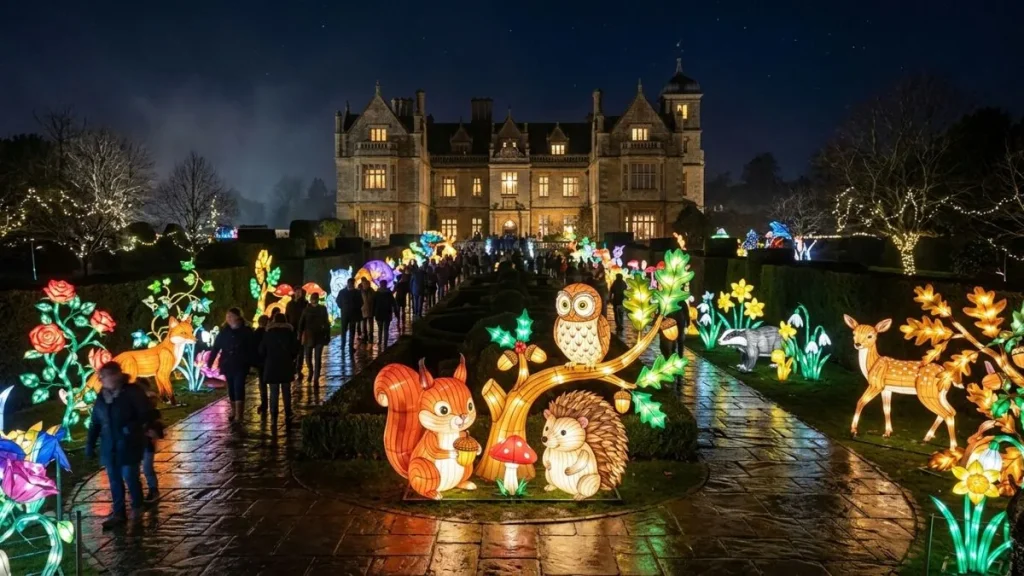
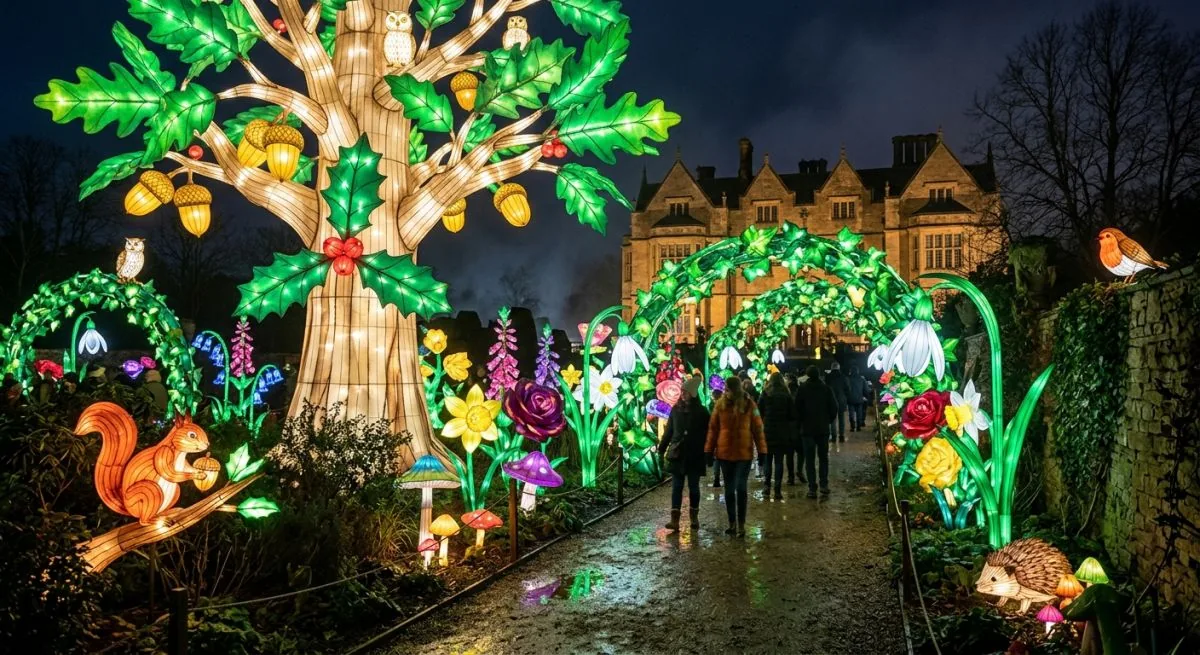
The term matters, because the three big winter lighting markets mean three different products. In North America the default is a drive-through: a field, a road, cars queuing with the radio tuned to a matching frequency. In Germany, Austria and much of central Europe the default is a market: wooden huts, stalls, mulled wine, with lighting as the setting rather than the attraction. In the UK and Ireland the default is a light trail — a walking route through mature woodland, a walled garden or a park, populated with illuminated figures, tunnels and arches, sold on timed entry with a last-entry time.
That difference changes everything downstream. A walking trail has a throughput limit, a surface to protect, an accessibility obligation and a set of sightline problems that a drive-through simply does not have. It also means the illuminated figures are the attraction, not the decoration, which is why trail budgets sit far closer to an event budget than to a Christmas decorations budget.
Three dates shape the UK season. The late-October half-term week is when most English trails open, and for many venues it is the first paying week. Bonfire Night on 5 November is a peak family night. The festive block from late November to Christmas Eve is the busiest stretch, and timed slots for the last week often sell out before December. Scottish, Welsh and Irish calendars differ slightly — the half-term week moves, and St Patrick’s Day gives Irish venues a second, entirely separate window in March.
Who Commissions a Trail, and What Each Buyer Cares About
Four buyer types dominate the UK market, and they are not buying the same thing.
- Councils and local authority parks teams. They bring a formal procurement process, a budget that has to be agreed in a committee cycle, a Safety Advisory Group that will comment on the route, and a public duty on accessibility. Depending on the contract value the work goes out to tender, which means the specification is written before the supplier is known — so the document pack has to stand on its own. They usually care most about the paperwork being complete and the site being returned to normal afterwards.
- Estates, gardens and heritage trusts. The landscape is the asset. Their constraints are about what you may not touch: tree root protection areas, listed structures, lawns that must recover by spring, and in some cases protected species. A supplier who turns up with ground anchors is out before the site walk.
- Zoos and wildlife parks. Evening opening is a revenue line, but animal welfare windows are fixed. Lighting and noise have to fit around them, some areas may be off limits entirely, and construction cannot disrupt the daytime operation. Most UK zoos and wildlife parks belong to BIAZA, and the wider visitor attraction sector to ALVA or BALPPA; those memberships shape the assurance framework an operator works inside, which is worth knowing before you propose a build window. Zoos also tend to want species that read to a British family — and increasingly want native wildlife rather than only exotic animals.
- Business improvement districts, high streets and retail parks. The purpose is footfall and dwell time, and the trail is usually a route between businesses rather than a single destination. Night-time economy considerations, loading access and trader objections all come into play.
The Site Sets the Brief: Six UK Venue Types
Before anything is designed, the venue type has already decided the route, the ground method and half the document pack. The table below is the shorthand we use at the briefing stage.
| Venue type | Typical route | Ground condition | Can you excavate? | Main constraint |
|---|---|---|---|---|
| Botanical garden | 1.0–1.8 km loop on existing paths | Bound gravel, tarmac, grass verges | No | Tree root protection and planting beds |
| Historic estate or walled garden | 0.8–1.5 km, often out-and-back | Gravel, stone paving, lawns | No | Listed structures, lawn recovery, sightlines from the house |
| Zoo or wildlife park | 1.0–2.0 km past enclosures | Tarmac and resin-bound paths | No | Animal welfare windows, nocturnal species, service access |
| Country park or woodland | 1.5–3.0 km | Unbound paths, mud, tree litter | Rarely | Waterlogging, tree safety, emergency vehicle access |
| Town centre and high street | 0.5–1.5 km linear | Paving, kerbs, street furniture | No | Traffic management, trader access, night-time economy |
| Retail park or mall grounds | 0.4–1.0 km | Tarmac and block paving | Sometimes | Loading bays, car park revenue, lighting spill |
Route Design: Lighting a Walk, Not a Field
A trail is a queue that has been designed to feel like a walk. Three numbers control it.
Throughput. How many people per hour the route can absorb at the pinch points, not on average. Every trail has two or three places where visitors stop — a big set piece, a photo moment, a tunnel entrance — and the whole timed-entry schedule has to be built around the narrowest one. If a set piece holds a group for ninety seconds longer than planned, the schedule fails within the first hour.
Dwell time. The target time from entry to exit, which sets the slot length and the number of slots per evening. Under-specify it and the route becomes a shuffle; over-specify it and you are selling fewer tickets than the site can carry.
Flow direction. One-way loops are easier to marshal and easier to light, because the visitor never meets an oncoming group at a pinch point. Out-and-back routes are cheaper to build but need wider sections or a passing place, and they look thinner under load.
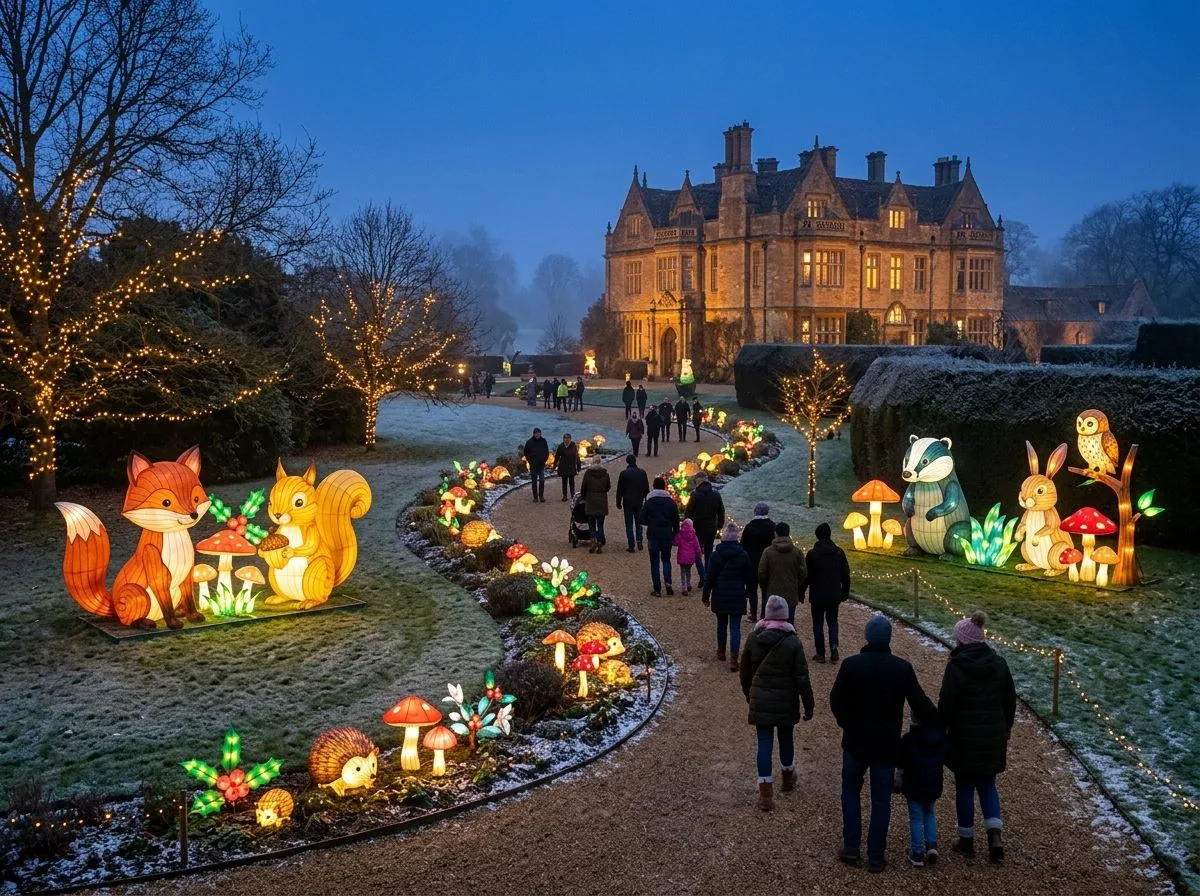
Two practical details that get missed. First, lit figures should be spaced so that at no point is a visitor walking between two unlit stretches — the feeling of a continuous trail is what people describe afterwards. Second, the exit must be lit and marshalled as carefully as the entrance; most complaints about trails are about the last two hundred metres, not the first two kilometres.
Ground Protection, Ballast and Tree Roots
Almost no UK trail site allows excavation, and the good ones will not allow it even where it is technically possible. That rules out ground anchors, concrete or otherwise, and it changes how every structure is held down.
The standard approach is ballasted bases: metal or water-filled counterweights, sized to the wind load for the specific position, sitting on a protective layer that spreads the load and stops abrasion on grass. Figures that would be anchored in a field are instead weighted, and the calculation behind that weighting is part of what your client’s engineer will want to see.
Cables are the second issue. On a public route they need to be either buried, or routed along a kerb or verge under a rated cover, with crossings in ramped cable protectors that a wheelchair or a pushchair can cross without a jolt. Temporary protection matting on grass keeps a route usable after rain and gives the surface a chance to recover — a trail that leaves a brown stripe through a lawn has damaged next year’s booking as well as this year’s.
Where there are mature trees, the root protection area is treated as off limits for weight and for compaction, which usually pushes the route onto the path and the figures onto the verge. Some sites also carry protected species considerations: lighting near watercourses and mature tree lines is often conditioned to avoid disturbing bats, which in practice means directionally shielded fittings, warmer colour temperatures and no upward floodlighting of canopies.
Power on Site: Temporary Electrical Systems
UK temporary installations sit under BS 7909, the code of practice for temporary electrical systems for entertainment and related purposes. In practice that means the distribution is designed as a system rather than assembled on the day: rated supplies, correct protective devices, recorded test results, and a distribution plan that shows what is fed from where and what happens if a circuit drops.
The other acronym every client will ask about is PAT testing — portable appliance testing, applied to every 230 V item that goes on site, with a label and a log. On a trail that means not just the obvious equipment but the small things that get overlooked: extension leads, hand tools used during the build, and anything a technician plugs in. The documentation is checked at the gate, not afterwards.
How the site is powered changes the design too. Mains supply through an existing distribution board is cheapest where it exists, but heritage sites often will not allow a new connection point. Generators solve that, at the cost of fuel logistics, noise near animal enclosures, and a cable route from the generator to the first distribution point. In every case the figure given to the client should be the connected load, not the estimate of what the lighting draws.
Wind Load: The Number Your Engineer Will Ask For
Structures on a public route are designed against BS EN 1991-1-4, the Eurocode on wind actions. Two things follow from that, and both catch suppliers out.
Wind speed is site specific. A figure at a coastal estate, a hilltop country park and a sheltered walled garden are three different numbers, and the calculation has to use the exposure of the actual position — a figure at the top of an open slope takes a very different load from the same figure under a tree line. Whether the site sits in a built-up area, and the terrain category around it, both go into the figure.
Second, ballast is calculated, not guessed. For a free-standing figure, the counterweight needed is a function of the sail area of the piece, the wind pressure and the geometry of the base — which is why a tall thin piece and a squat heavy one of the same height do not take the same base. Getting this wrong does not show up in a mild December. It shows up in the one night in January that closes the trail early.
UK winter weather is wet and cold rather than reliably snowy, so the working assumption is rain, mud, wind and repeated freeze-thaw on the ground, with snow treated as an occasional load the site may choose to design for. Our own outdoor pieces ship to an outdoor-rated standard with sealed LED modules and weatherproof frames, and the same specification is used whether the destination is a wet Welsh valley or a frosty courtyard.
Fire Performance of Covering Materials
Where illuminated figures sit in a public area, the covering material is a fire performance question, and the reference is EN 13501-1, the European classification of reaction to fire for construction products. Client teams increasingly ask for the classification of the covering rather than a generic statement that materials are treated, and a supplier who cannot produce the document will be asked for it at the worst possible moment — during the site inspection.
The practical points are straightforward. Coverings used on public routes should carry a documented reaction-to-fire classification. Where the piece sits close to a building, an enclosure or an escape route, the client’s fire officer may apply stricter expectations. And the material specification should be confirmed at design stage, not chosen at packing time, because changing a covering after the structure is signed off invalidates part of the documentation pack.
The Document Pack a UK Client Will Ask For
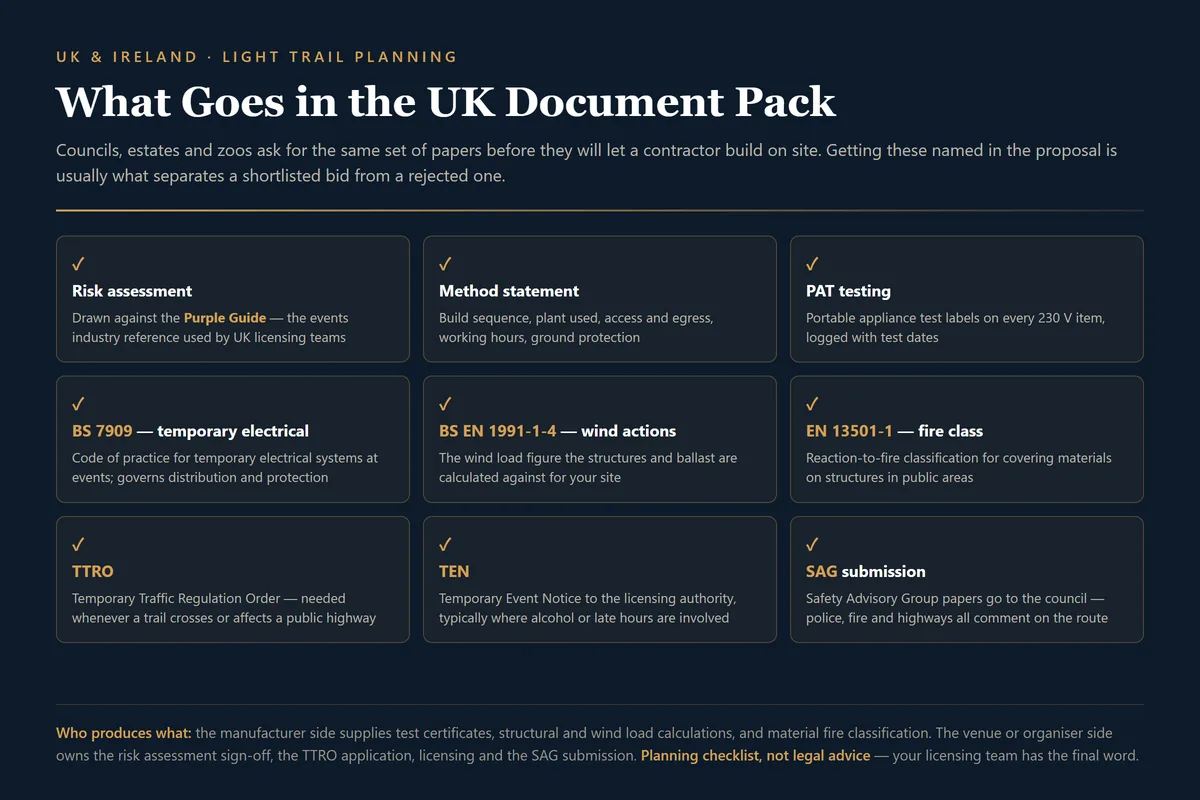
This is where mainland European and UK procurement genuinely diverge. A UK client is buying evidence as much as they are buying figures, and the pack is assembled before mobilisation. The two columns that matter are who produces each document and who signs it off.
| Document | Produced by | What it demonstrates |
|---|---|---|
| Risk assessment, aligned to the Purple Guide | Organiser, informed by supplier site data | Hazards identified, controls specified, responsibilities named |
| Method statement and RAMS | Supplier, signed by organiser | Build sequence, plant, access, working hours, ground protection |
| PAT test records and labels | Supplier | Every portable appliance on site tested and logged |
| BS 7909 distribution design and test results | Supplier’s electrical contractor | Temporary system designed, protected and recorded as a system |
| Wind load calculations to BS EN 1991-1-4 | Supplier’s engineer | Structure and ballast sized to the wind pressure for that position |
| EN 13501-1 classification for coverings | Materials supplier | Documented reaction-to-fire performance |
| TTRO application | Organiser, with highways authority | Legal order where the route affects the public highway |
| TEN or premises licence | Organiser, with licensing authority | Regulated activities covered for the trading period |
| Insurance certificates | Both parties | Public liability and, where relevant, works insurance in place |
The Purple Guide is the events industry reference that UK licensing teams work from, and it is the document that makes a risk assessment legible to a council. The Safety Advisory Group — the standing meeting of council, police, fire and highways — is where many trails are effectively approved, and it generally meets on a cycle that is months ahead of the opening night. A supplier who is not used to working with a SAG will lose weeks without realising it. Our own procurement guide for public-sector buyers sets out what we can supply on our side of that pack.
Accessibility and Timed Entry
Accessibility is not a nice-to-have in the UK; under the Equality Act it is an obligation, and it is one of the first things a council client will test. In practice it constrains the route before the lighting does.
- Surface and gradient. A step-free route with a firm surface, and gradients that a wheelchair can be pushed up by one person. Where the existing path fails, an alternative route or a diverted section is designed in.
- Width and turning. Enough width for a wheelchair and a pushchair to pass, plus turning space at set pieces so that anyone can stop without blocking the route.
- Rest points. Seating at intervals, and at least one sheltered point on a route over about a kilometre.
- Sensory load. Many venues now run a quieter session or a relaxed session, with reduced sound and static lighting in selected areas. It is inexpensive to design in and it fills otherwise unsellable slots.
- Timed entry. Makes the route survivable under load, but the slot length must allow for slower visitors, not just the average pace. A last-entry time should always be published.
Footfall data is the other reason timed entry exists. Knowing how many visitors per hour the site can hold — legally, physically and by parking capacity — turns ticketing from guesswork into revenue forecasting, and it is the number that justifies the trail at the next committee meeting.
Licensing, Road Closures and Insurance
The regulated items sit with the organiser, but they shape what a supplier can promise. A TTRO — a Temporary Traffic Regulation Order — is needed where a route crosses or affects a public highway, and it takes weeks to obtain with the highways authority, so it has to be identified at the route-design stage rather than discovered in October. A TEN, the Temporary Event Notice, covers licensable activities over a short period where a full premises licence is not appropriate.
On insurance, UK clients will typically ask for public liability cover at a level set by their own policy, plus evidence of employer’s liability where a build crew works on site. Both are certificates rather than conversations, and both take longer to arrange than anyone plans for.
Counting Back From Opening Night
The single most useful planning tool for a UK trail is a reverse schedule. Because the opening date is fixed and the ticket sales have already started, the build has to fit a window that closes rather than one that can be extended.
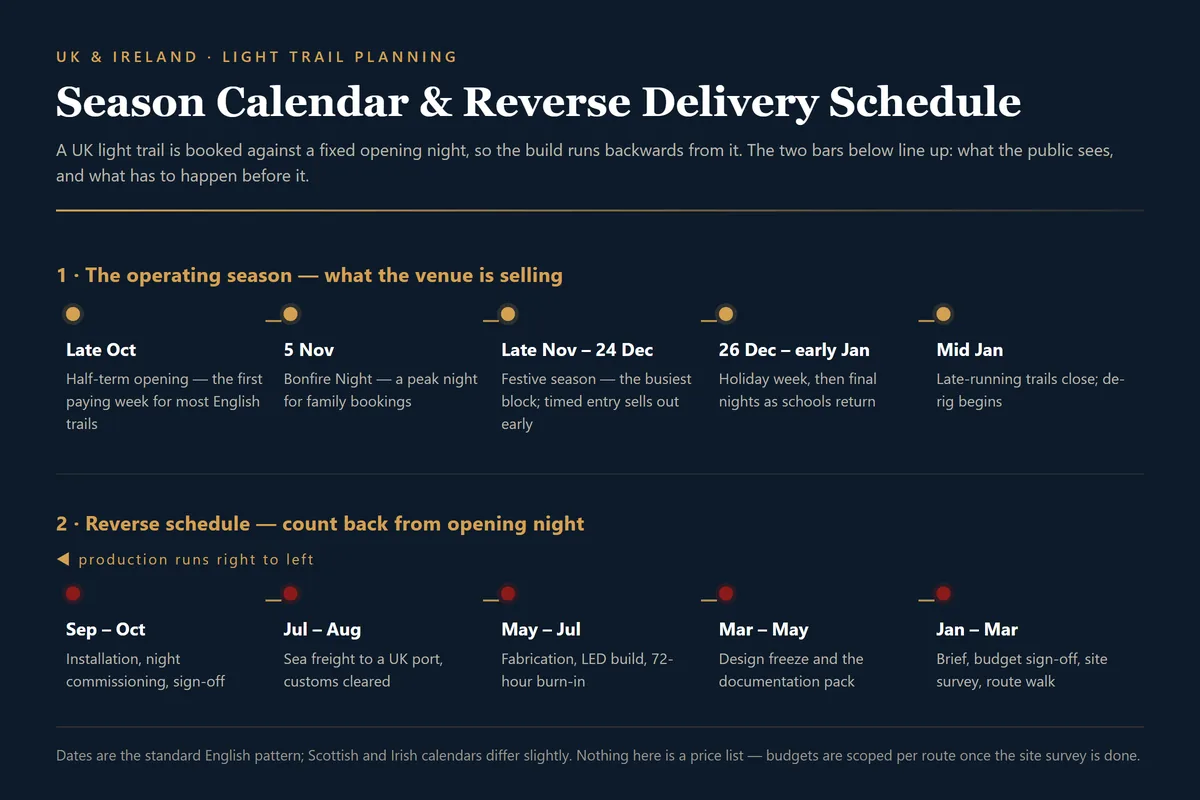
Working back from a late-October opening, the brief and budget sign-off need to happen in the first quarter, the design freeze and the documentation pack through the spring, fabrication over the summer, and sea freight from China in the July–August window to reach a UK port with time to spare. Installation and night-time commissioning then run through September and early October, leaving room to correct anything the first full week of operation exposes. Freight into the UK adds customs handling to the usual sea transit time, and the guide to shipping festival lanterns from China to Europe covers the EORI and customs side in detail.
Two things consistently compress this schedule: a late budget decision, which pushes the design freeze into the production window, and a late change to the route, which invalidates both the wind calculations and the electrical distribution design. Both are avoidable at the briefing stage and expensive afterwards.
Hire, Purchase or Revenue Share
UK buyers use three commercial models, and the right one depends on whether the trail is a one-off or a fixture on the events calendar.
- Purchase. The organiser owns the assets and the residual value. It makes sense for a venue that has committed to a multi-year trail, because the second and third years reuse the core set and only the new set piece is bought in.
- Hire. Lower capital outlay, and someone else stores the stock. The trade-off is that the same pieces tour other venues, so the exclusivity of the line-up is limited and the availability window is fixed by the fleet, not by the site.
- Revenue share. An operator funds and runs the trail in return for a share of ticket income. Attractive where the venue has no capital budget and no appetite for running ticketing, but it means the venue does not control the pricing, the creative or the marketing.
For a venue going into its second or third season, the sensible middle path is usually to buy the structural assets — tunnels, arches, large figures — and hire or theme-swap the smaller elements. That keeps the unit cost of the repeat season low while avoiding a site that looks identical to last year. Our winter lantern production page covers what changes when a set is specified for reuse.
Frequently Asked Questions
How far in advance should a UK light trail be planned?
For a late-October opening, start in the first quarter of the same year. That gives time for the budget cycle, the site survey, a design freeze in the spring and sea freight in the July–August window. Anything under five months before opening starts trading scope for schedule, and the first thing to go is usually the documentation review — which is the part a council will not waive.
What documents will a council ask for before we can install?
A risk assessment aligned to the Purple Guide, a method statement, PAT test records, a BS 7909 distribution design with test results, wind load calculations to BS EN 1991-1-4, EN 13501-1 classification for covering materials, insurance certificates, and either a TTRO or a TEN depending on the site and the activities. The Safety Advisory Group is where most of it gets reviewed.
Can a trail be installed without digging or anchoring into the ground?
On almost every UK site, yes. The standard method is ballasted bases sized to the wind load for each position, with cable routes either along the verge under rated covers or across paths in ramped protectors. Some sites, particularly historic estates, will not permit excavation at all, and the design has to be built around that from the first sketch.
Do you supply figures that suit a British audience?
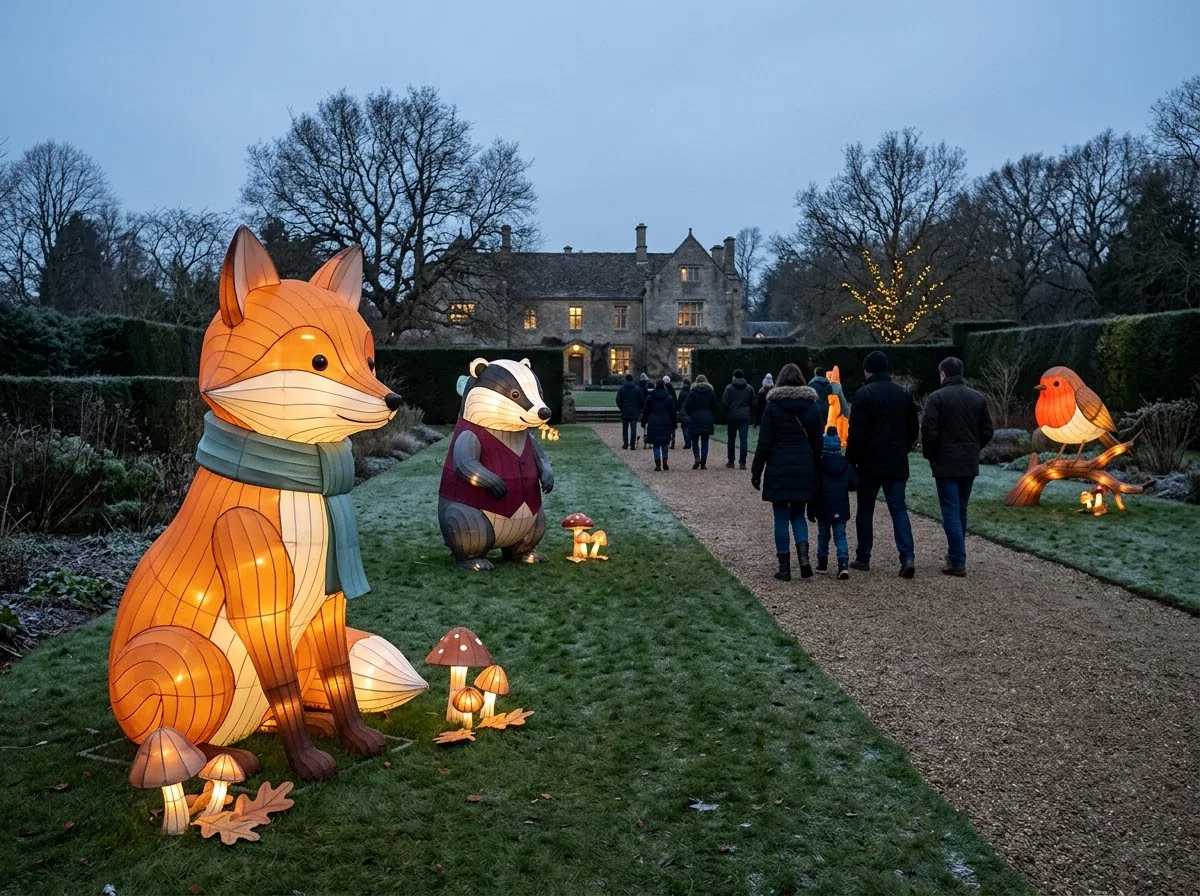
Native wildlife reads faster here than exotic species. Fox, badger, hedgehog, owl, robin, deer and woodland flora all work in garden and estate settings without a theming clash, and they are popular with zoo and wildlife park audiences as well. We also build to a brief: if the venue has a species, a story or a local landmark to work with, the figures are designed around it. Our animal lantern range covers the standard forms, and custom work starts from reference images or sketches.
What is the weather risk over a UK winter season?
The main risks are wind, waterlogging and repeated freeze-thaw rather than deep snow. Structures are designed to the wind load for their position under BS EN 1991-1-4, paths are protected with matting so the surface survives the season, and electrical equipment is specified for wet operation. Snow is treated as an occasional load a site may choose to design for, not as the default assumption.
How does a UK trail differ from a Christmas market installation?
A market is a collection of stalls with lighting as the setting; a trail is a designed route where the lighting is the attraction. That changes the throughput model, the ground protection, the accessibility requirements and the documentation. If you are comparing the two, our Christmas light festival page covers the market-and-festival format alongside the neighbouring European programmes in Germany, the Netherlands and the Nordic countries.
Planning a UK Light Trail
We manufacture the illuminated figures, structures and light tunnels that go onto a UK trail, and we work with the people who design and install them. That means we are used to supplying the manufacturer-side documents in the pack above — test certificates, wind load calculations and material fire classification — alongside the pieces themselves, rather than handing over a container and disappearing.
If you are at briefing stage, the most useful thing you can send us is the venue type, an idea of route length, the opening date and anything the site will not allow. We will come back with a route concept, a piece list and a written schedule that fits the reverse calendar above. For the wider picture across the continent, start with our European festival lighting overview, or see what a Christmas light festival costs for the budget structure. Installation sequencing is covered in the on-site installation and handover guide, and zoo-specific programmes in our zoo lights guide.
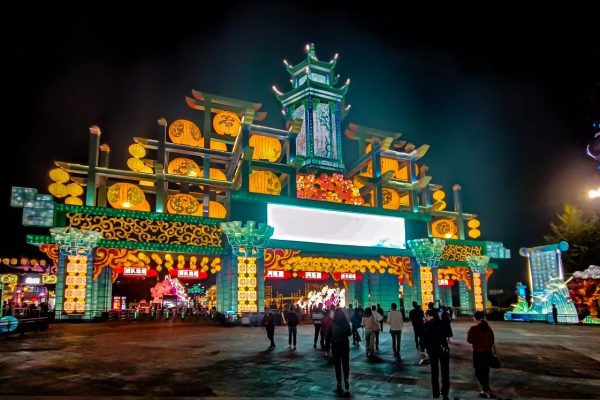
Trails that finish on a lit landmark usually close with a walk-through archway; and where the theme is native wildlife, a woodland character scene reads faster to a British audience than an exotic species does.