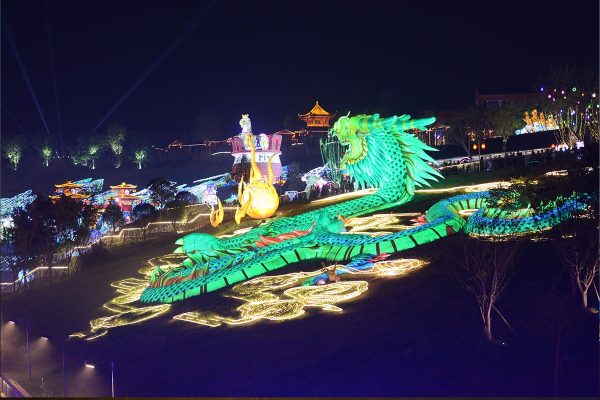
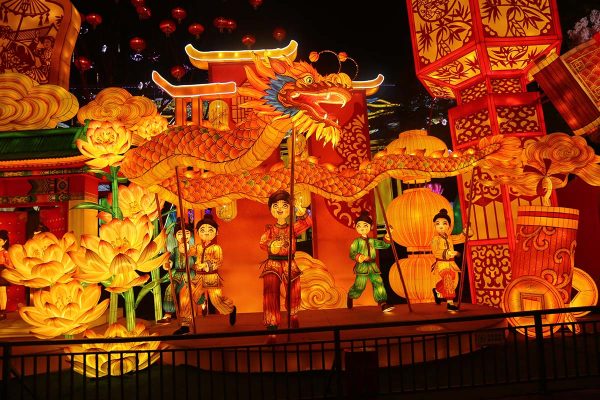
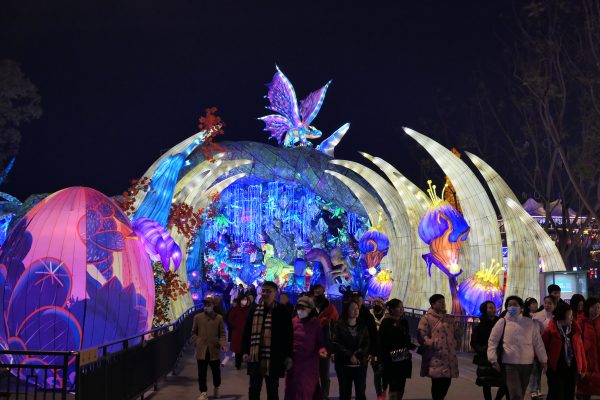
Walk into any major lantern festival — whether in Zigong, Lyon, or a U.S. zoo — and one reaction repeats itself: visitors stop, look up, and go silent.
It is not the individual LEDs or the fabric that causes this. It is scale. A 25-meter dragon archway spanning an entire plaza. An 18-meter phoenix rising above a lake, its reflection doubling its presence. A lantern tunnel stretching 80 meters, swallowing visitors inside a cathedral of light.
As a manufacturer that has produced over 2,000 large-scale lantern installations for clients in 40+ countries, we are often asked: What makes these displays so powerful? Is it just size?
The answer is no. It is a deliberate combination of engineering, psychology, and craftsmanship. This article unpacks the science behind the awe — and what event planners should know when commissioning a monumental lantern display.
1. The Psychology of Scale: Why “Big” Works
Human perception is wired to respond to scale. Psychologists call this the “awe response” — a mix of wonder, reverence, and a slight sense of being dwarfed that triggers emotional engagement.
Three psychological triggers at work:
| Trigger | How Large Lanterns Activate It |
|---|---|
| Vastness | A structure 10x human height forces the viewer to physically step back and tilt their head — a posture change that the brain interprets as “something important is happening.” |
| Accommodation | The brain cannot process a 20-meter illuminated structure in a single glance. It must scan — eyes move from the glowing dragon head to its coiled body to the pagoda it wraps around. This forced visual journey creates narrative and immersion. |
| Need for cognition | When a lantern is so large it cannot be fully seen from one angle, viewers instinctively walk around it — engaging multiple senses and forming a memory anchored in movement and exploration. |
Research published in the Journal of Environmental Psychology (2023) found that visitors to large-scale public art installations reported 47% higher emotional engagement scores compared to smaller, similarly themed displays.
The “Stendhal effect” of lanterns
Large lantern installations can trigger what art historians call the Stendhal syndrome — a powerful physiological reaction to overwhelming beauty. At major lantern festivals, it is common to see viewers: stop walking mid-step, forget to take photos, or stand silently with mouth slightly open. This is not dramatization — it is a predictable neurological response to unexpected scale combined with illumination in darkness.
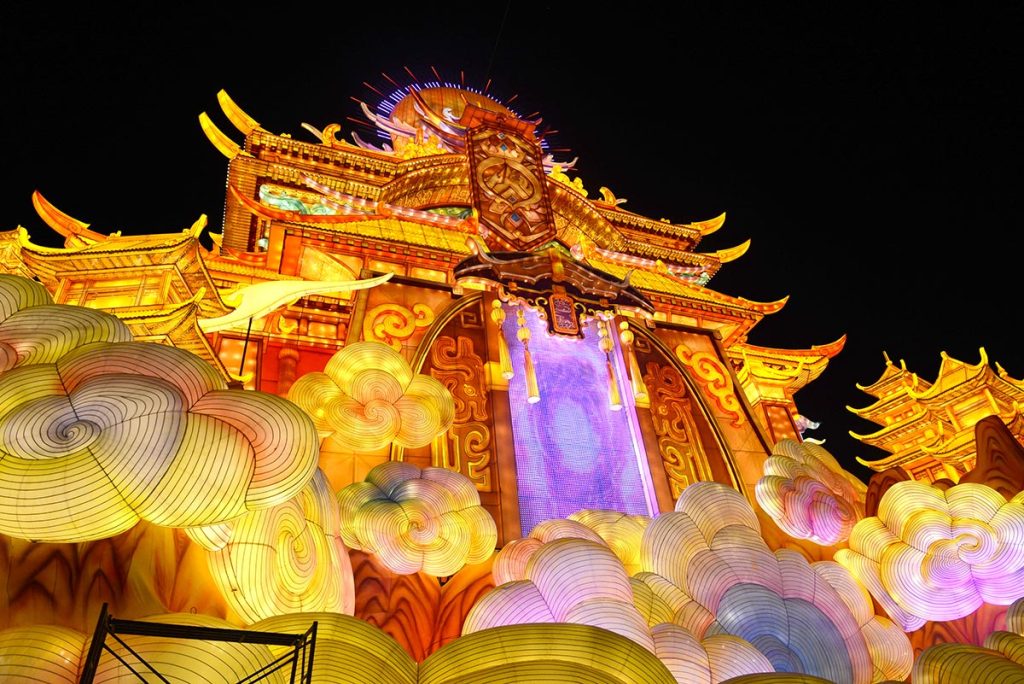
2. Engineering Scale: What Makes a 25-Meter Lantern Stand
A lantern is not a building. It cannot rely on concrete foundations or permanent anchoring. It must be lightweight, transportable, weather-resistant, and capable of standing outdoors for months.
Here is what our engineering team addresses for every monumental lantern:
2.1 The Metal Frame — Skeleton of the Giant
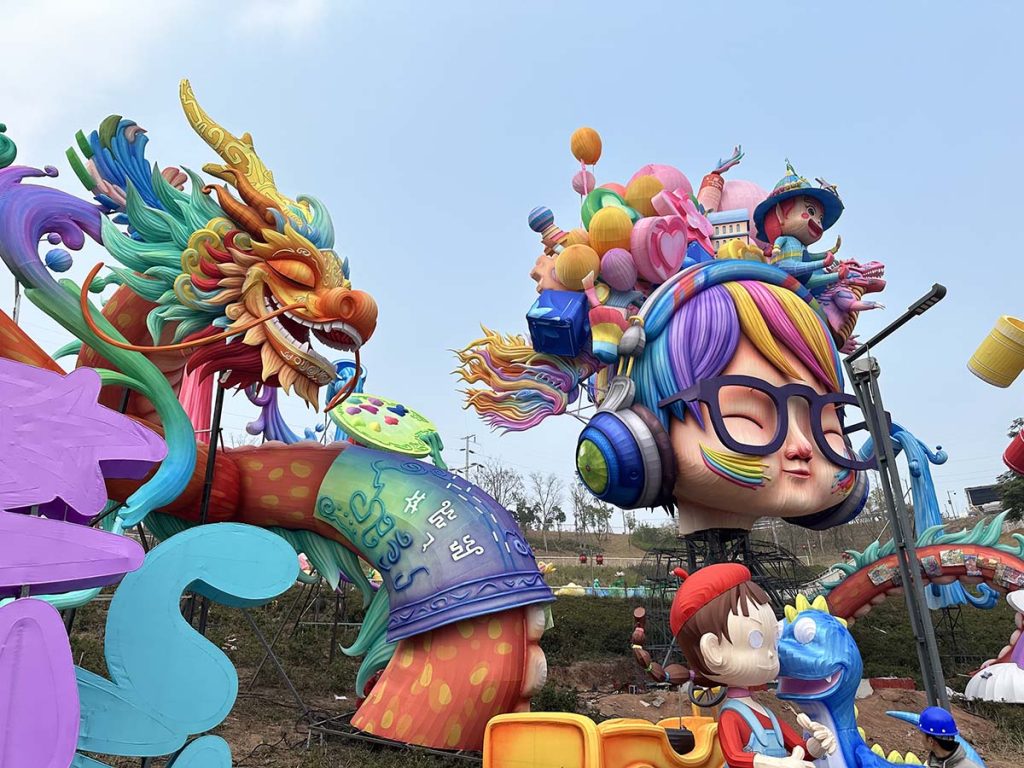
A 20-meter phoenix lantern contains approximately 2.5–4 tons of internal framework. The internal structure is a lattice of:
- Main load-bearing beams (thick-gauge square metal, 40×40mm or larger)
- Secondary contour ribs (thinner rods, 6–8mm diameter, bent to shape)
- Cross-bracing struts for wind resistance
The frame is designed with modularity: a 25-meter dragon breaks down into 5–7 transportable sections, each independently stable. During on-site assembly, sections are bolted together with alignment pins, and the entire structure is guy-wired to ground anchors rated for 80+ km/h winds.
2.2 Wind Load Calculation
A 15-meter-tall, 10-meter-wide lantern wall presents a wind-facing surface area of roughly 150 m². At 60 km/h winds, the lateral force can exceed 4,000 kg.
Our frames are engineered with:
- Wind tunnel simulation (CFD analysis for signature projects)
- Distributed anchor points (minimum 8 points for structures over 12m)
- Articulated joints that allow 2–3° of flex without stress concentration
- Emergency breakaway panels on flat surfaces to release pressure in extreme conditions
2.3 Lighting at Scale — Why Bigger Needs Smarter
A small lantern might use 50 LEDs. A monumental centerpiece uses 5,000–15,000 individually wired LED points, organized into 30–60 separate circuits managed by programmable controllers.
The challenge is twofold:
- Even illumination: A 20-meter surface requires careful LED spacing (typically 15–25cm between points) so the fabric skin glows uniformly without “hot spots.”
- Heat management: 15,000 LEDs in an enclosed fabric structure generate measurable heat. Ventilation channels and thermal-dissipation zones are built into the frame design.
3. The “Golden Ratio” of Lantern Scale
Through 20+ years of production data across thousands of installations, our design team has identified proportional relationships that consistently produce the strongest visual impact:
| Structure Type | Ideal Height-to-Width Ratio | Viewing Sweet Spot |
|---|---|---|
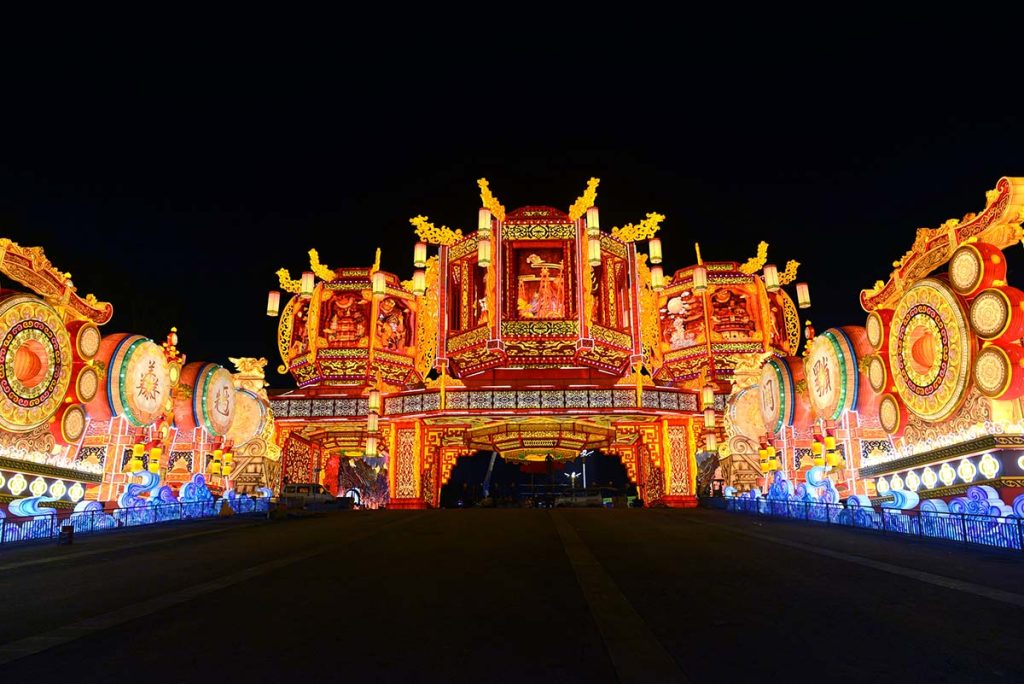
| Archway / Gate | 1:2.5 to 1:3.5 | 1.5–2× the arch height away |
| Single figure (dragon, phoenix) | 1:1.2 to 1:1.8 | 2–3× the figure height away |
| Landscape / panorama | 1:4 to 1:6 | 3–5× the center height away |
| Tunnel / corridor | Height : Length = 1:8 to 1:15 | Inside the tunnel |
Practical takeaway for event planners: If your venue has a 30-meter plaza, a centerpiece taller than 15 meters will feel cramped — visitors cannot step back far enough to take it in. Conversely, placing a 6-meter lantern in a 200-meter open field makes it look undersized. Scale must always be calibrated to the viewing distance available at the venue.
4. The Role of Lighting in Amplifying Scale
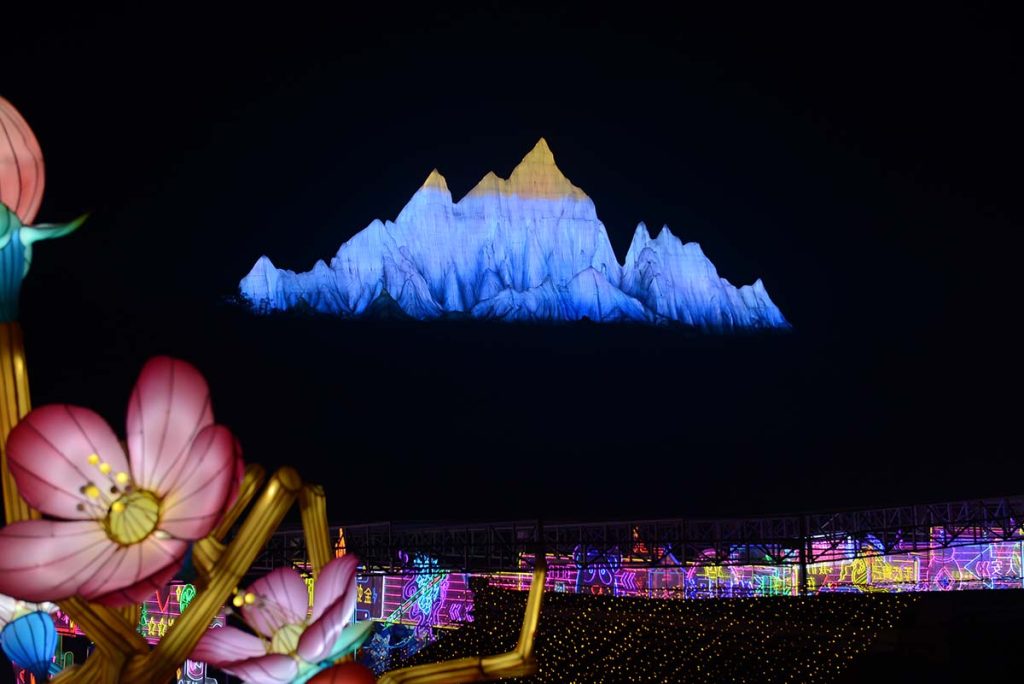
Darkness is the lantern’s best ally. A 20-meter structure illuminated at night appears larger and more imposing than the same structure viewed in daylight — because the edges bleed into the darkness, and the brain fills in the gaps with imagination.
Practical lighting techniques we use:
Edge glow vs. silhouette: Some monumental lanterns are designed to be seen entirely from within their light envelope; others are backlit to create a dramatic silhouette against the night sky. The choice depends on the venue sight lines.
Dynamic color shift: A single-color lantern, even at 25 meters, can visually “flatten.” Programming a slow, imperceptible color gradient movement (e.g., cool blue at the base warming to gold at the crown) makes the structure feel taller and more dimensional.
Reflection doubling: Placing a large lantern at the edge of a lake or reflective surface effectively doubles the visual impact — the reflection creates a second, inverted version that tricks the brain into perceiving even greater scale.
5. Case Example: The Anatomy of a 20-Meter Archway
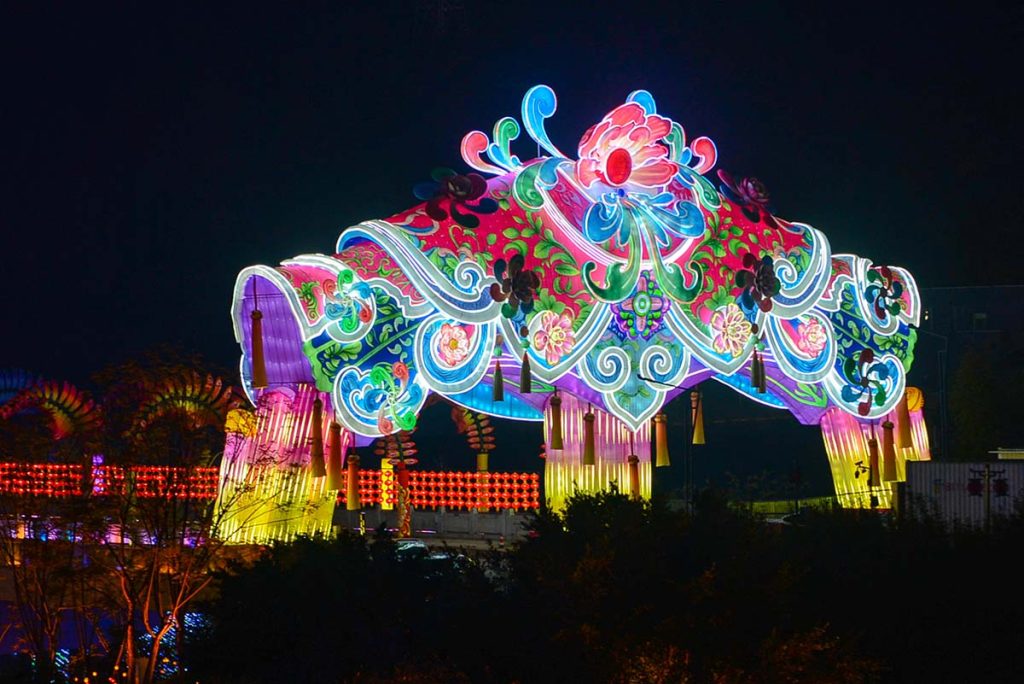
To make this concrete, here is the specification breakdown of a typical 20m × 25m festival entrance archway we produced for a European client:
| Specification | Detail |
|---|---|
| Height | 20 meters (top of center crown) |
| Width | 25 meters (pillar outer edges) |
| Internal frame weight | 3,200 kg |
| Silk fabric coverage | 380 m² |
| LED points | 8,400 individual LEDs |
| Total power draw | 28 kW (LED only) |
| Assembly crew | 12 workers × 5 days |
| Wind rating | 80 km/h (anchored) |
| Transport | 2 × 40ft shipping containers |
The archway served as the festival’s main entrance. Visitors walked under it — a deliberate design choice: passing through physical gates triggers the psychological transition from “outside world” to “festival inside.” The twin pillars were 3 meters wide at the base, and the crossbeam was a double-dragon design with interlocking bodies.
Visitor data: The venue reported that 78% of guests took photos at the archway (measured by geotagged social media posts), and the average dwell time near the archway was 4.2 minutes — significantly higher than any other single lantern in the festival.
6. Key Considerations for Commissioners
If you are planning a large-scale lantern display, here are the questions to ask your manufacturer:
- What is the structural engineering methodology? Ask for wind-load calculations, anchor specifications, and material certifications (ISO 9001, CE).
- How modular is the design? Monumental lanterns must ship internationally. Confirm the breakdown into container-sized modules and the on-site assembly plan.
- What is the power plan? A 20-meter lantern can draw 15–40 kW. Your venue must have sufficient electrical infrastructure or the manufacturer must include generator specifications.
- What is the maintenance protocol? Outdoor installations accumulate dust, rain, and bird droppings. Ask about access hatches for internal LED maintenance and fabric cleaning schedules.
- Is the design venue-calibrated? A good manufacturer will ask for your venue dimensions, sight lines, and expected visitor flow before proposing a scale.
Before you choose scale and colors, it pays to understand what your display will say. Our guide to Chinese lantern festival symbolism explains how every motif and hue carries meaning your audience will instinctively read.
FAQ
Q: What is the largest lantern you have ever built?
A: We have produced centerpiece lanterns exceeding 30 meters in height. The practical limit is typically determined by venue space, crane access, and transportation logistics — not manufacturing capability.
Q: How long does a monumental lantern last outdoors?
A: With proper maintenance, the internal frame lasts 5–10 years of seasonal use. The fabric skin typically lasts 2–4 years before replacement is recommended, depending on UV exposure and weather.
Q: Can large lanterns withstand snow?
A: Yes — our frames are engineered for snow loads up to 30 kg/m². Flat horizontal surfaces are intentionally minimized in the design. For heavy-snow regions, we integrate heated drainage channels and smart monitoring sensors.
Q: How are these giant structures shipped internationally?
A: A 20-meter lantern disassembles into modules sized to fit standard 40ft shipping containers. Each module is foam-padded, moisture-sealed, and labeled with assembly sequence numbers. On-site assembly takes 3–10 days depending on complexity.
Q: What if my venue has uneven ground?
A: We perform a pre-installation site survey (or review your venue’s topographic data) and design adjustable-height base plates that accommodate slopes up to 5°. For steeper terrain, custom foundation pads are fabricated.
Q: Do you provide on-site supervision for large installations?
A: Yes. For any lantern over 12 meters in height, we dispatch an installation supervisor to oversee the assembly, anchoring, electrical commissioning, and final safety inspection. Larger teams are available for multiple-installation festivals.
Related Products & Resources
- Giant Lanterns — Monumental Festival Centerpieces — Browse our portfolio of 15m+ lantern installations worldwide.
- Festival Lanterns Collection — Custom-designed lanterns for all scales, from 3m to 30m.
- Chinese Lantern Festival — Complete Guide — History, production process, and planning insights.
- Lantern Festival Planning & Logistics Checklist 2026 — Step-by-step guide for festival organizers.