What an Animatronic Animal Actually Is
An animatronic animal is a life-size mechanical recreation of a real species — not a prehistoric one — that moves, breathes and responds. A panda that shifts its weight and chews. A tiger that tracks a visitor walking past. A polar bear that lifts its head and exhales.
The distinction from the dinosaur side of our range matters, because the movement language is different. Reptiles move in sharp, angular gestures — a jaw snaps, a head jerks. Mammals move continuously: a chest rises and falls, an ear flicks, a tail shifts weight. Visitors read that difference instantly, even without knowing why. A wolf that moves like a lizard looks wrong, and the usual cause is that the build was adapted from a dinosaur rather than designed for a mammal.
That is why animatronic animals are a separate line in our workshop with their own sculpting team, rather than a re-skin of an existing dinosaur frame. The mechanics that make a mammal convincing — slow continuous breathing, subtle weight transfer, fine facial movement — are not the mechanics that make a predator convincing.
Species We Build
Orders cluster around a predictable set of species, and each one earns its place differently.
| Species | Where it works | What makes it sell |
|---|---|---|
| Giant panda | Cultural centres, Asia-themed zones, malls | Universal recognition; the fur requirement forces a high-end finish |
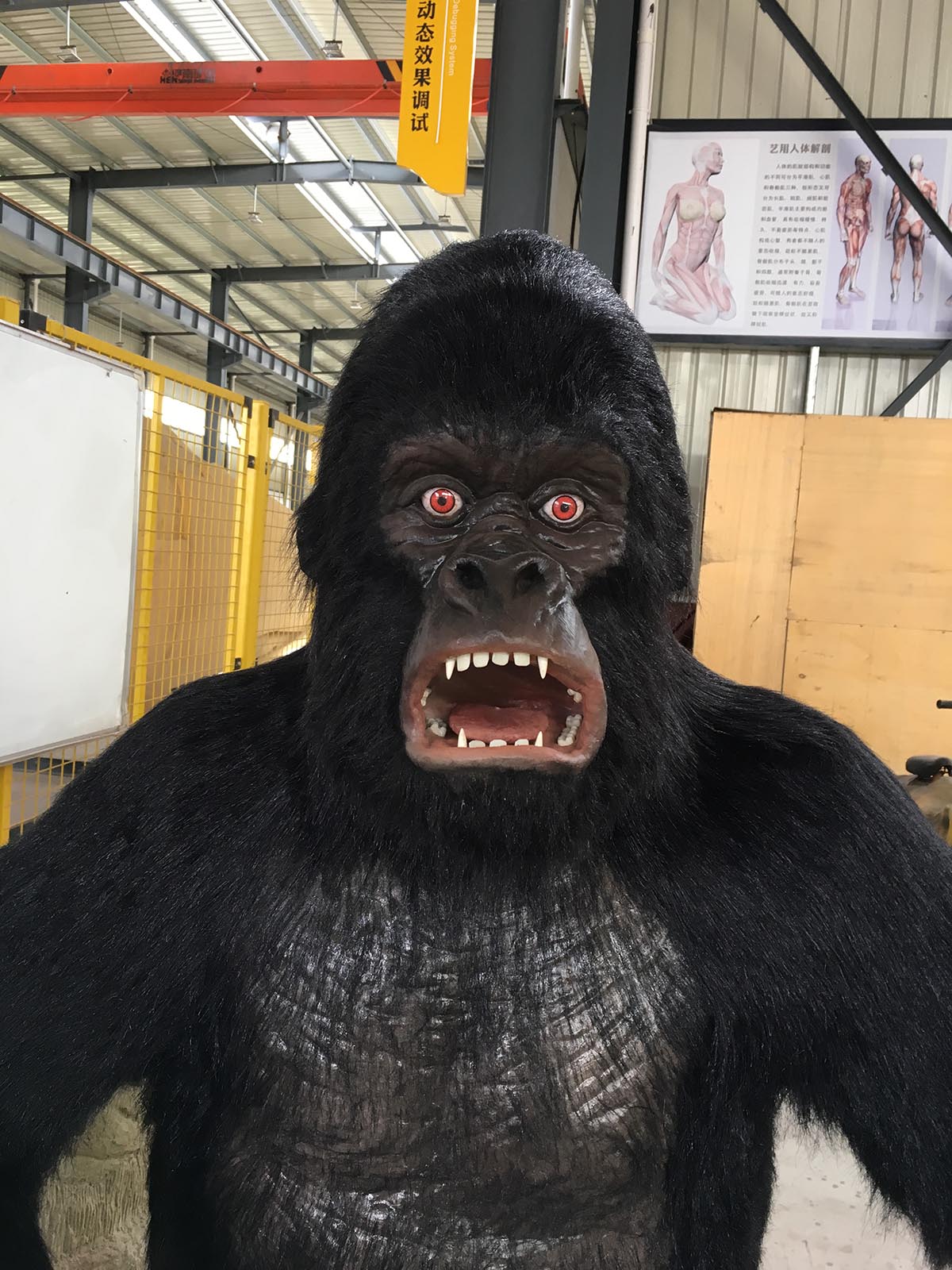
| Gorilla | Zoo primate houses, immersive dark zones | Bulk and stillness — a gorilla that barely moves is more convincing than one that gestures constantly |
| African elephant | Zoo entrances, safari zones | Scale statement; the trunk gives more articulation options than any other species |
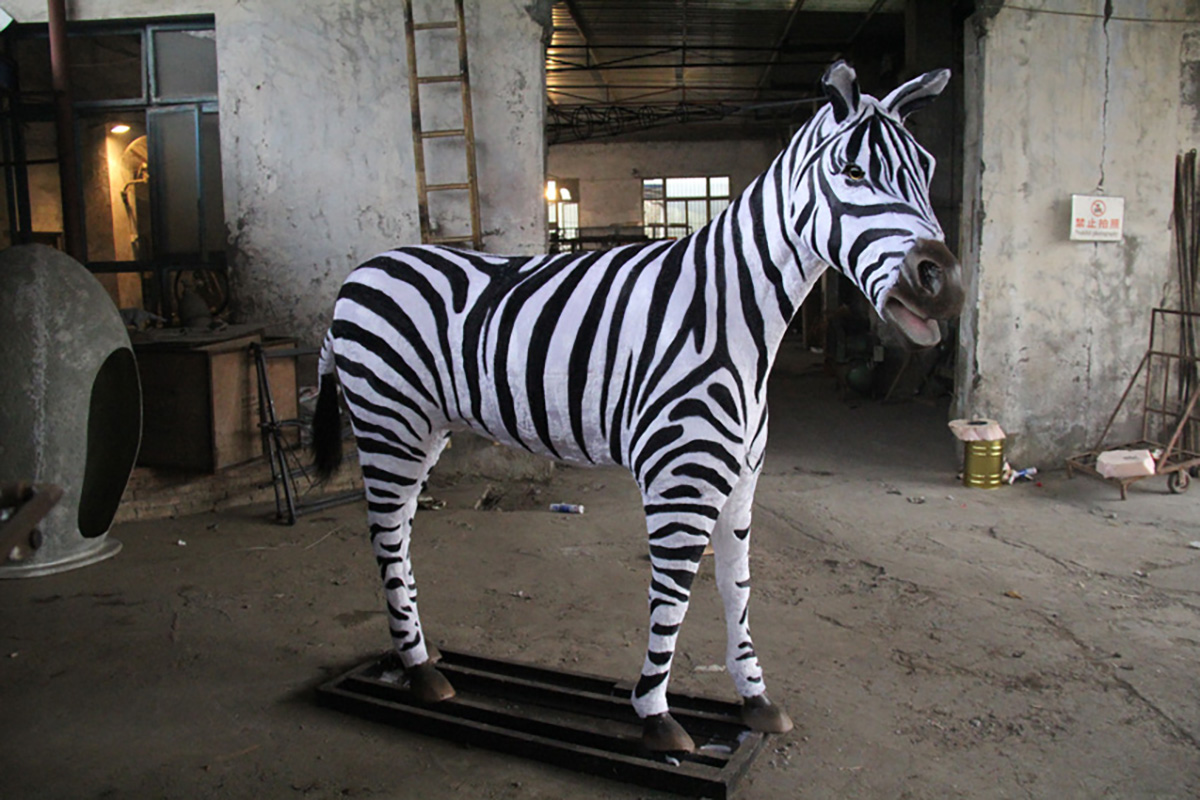
| Zebra (with foal) | Family trails, safari exhibits | Pair formatting — a mother-and-foal group holds attention far longer than a single animal |
| Tiger | Asia zones, predator displays | Interaction: a tiger that watches visitors cross a detection line is the most filmed model we make |
| White rhino | Safari exhibits, education programmes | Conservation messaging comes free with the species |
| Koala | Australian wildlife zones | Climbing pose capability; occupies vertical space other species cannot |
| Penguin | Aquarium and polar zones | Small footprint, group display, works at child height |
| Polar bear | Arctic exhibits, winter trails | Pairs with seasonal lighting programmes |
| Moose and elk | North American and European wildlife zones | Antler structure is the visual hook; surprisingly strong with domestic audiences |
Species outside this list are built to order — the constraint is reference material, not capability. A species with good photographic and anatomical references is straightforward. A species nobody can supply references for will need that research done first.
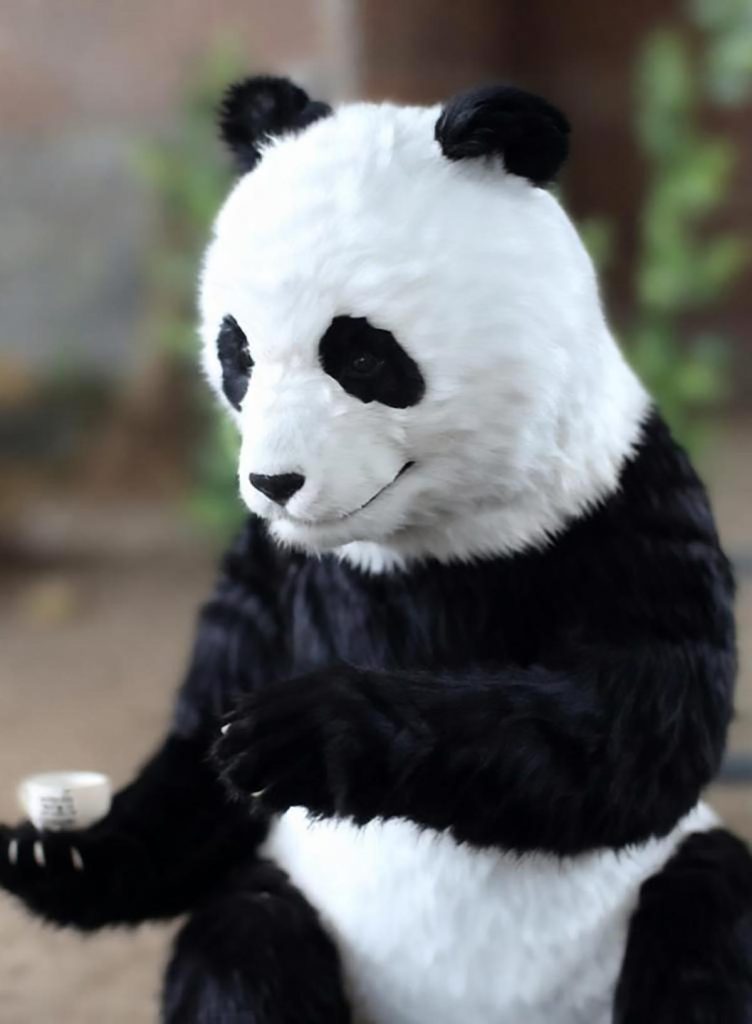
Some of the most-ordered models: the lifelike giant panda in a tea-ceremony pose, the animatronic zebra with foal, the life-size animatronic tiger, and the African elephant display. The full line sits in the animatronic animals collection.
Why Zoos and Wildlife Parks Buy Them
A zoo buys an animatronic animal for one of three reasons, and the reason changes the specification.
To fill a gap in the collection. A zoo without elephants can still tell an elephant story. This is the most common motivation, and it applies to species a zoo will never be able to keep — polar bears in warm climates, pandas outside China, extinct species like the cave bear.
To extend the trading day. An animatronic animal runs after dark, when living animals are inactive. A lit predator display in an evening trail is one of the few ways a zoo can sell a second visit on the same day.
To carry conservation messaging. A model can be placed where a live animal cannot go — beside a visitor path, at child height, in a walk-through encounter — which makes it an effective platform for interpretation. Zoos often pair a moving model with static interpretation panels about the real species’ status.
One practical note from the installations we have done: models placed along the visitor route rather than behind a barrier get photographed far more, but they also take far more physical contact. If contact is expected, say so at brief stage — the finish and the frame protection are specified differently.
Museums and Science Centres
Museums buy on accuracy. Science centres buy on comprehension. Both change the build.
For museums, the model has to sit credibly beside real specimens and curated text. That usually means a defined species, a defensible pose and a known reference source — the same rigor that applies to our dinosaur builds applies here.
For science centres, the model is teaching equipment. A moving animal that demonstrates biomechanics — how a trunk works, why an elephant’s weight sits where it does, how a cheetah’s spine stores energy — does work that a diagram cannot. These builds often need an operator mode, so a presenter can drive the animal during a scheduled talk rather than leaving it on a sensor loop.
Theme Parks and Family Attractions
Family attractions buy behaviour, not accuracy, and the brief looks different.
The models that work here are the ones with a clear, readable personality: a panda that plays with a bamboo stalk, a penguin group that reacts as visitors pass, a tiger that watches people cross a line. Interaction matters more than anatomical precision, and scale is tuned to the audience — models sized for children read as enormous, and a full-size elephant can feel intimidating rather than delightful in a family zone.
Attractions also tend to buy more units than zoos do. A single animal in a family zone is a landmark; five animals across a route is an experience. If the budget allows only one purchase, a group composition — parent and juvenile, or a small herd — gives the impression of more than it costs.
How One Is Made
- Reference and design. Species, pose, scale and movement set are agreed against references you supply or we source. This is where the silhouette is fixed; changing it later means rebuilding the frame.
- Frame and mechanism. A internal frame is built to carry the animal’s own mass and the loads of the moving parts. Actuator positions are decided now, because they determine how the body has to be sculpted around them.
- Sculpting. The body is shaped by hand over the frame — muscle groups, joints, the specific asymmetry that makes an animal look alive rather than symmetrical and therefore fake.
- Surface and finish. Skin, fur, feathers or scale are applied and finished by hand. Our surface formulation is patented (Patent ZL 2022 1 0224489.5), developed because surface failure — cracking, fading, fur shedding — was the most common long-term complaint on outdoor models.
- Programming. Movement sequences, breathing cycle, sound and any sensor logic are set and tested on the bench.
- Testing and crating. The finished animal runs through a full cycle before packing, and the crate is designed around the joint lines so that reassembly seams land where they are least visible.
Fur, Feathers and Finishes
The finish is where buyers most often try to save money and most often regret it.
Three approaches exist. Painted sculpted surface is the cheapest and the right answer for smooth-skinned species — elephants, rhinos, hippos, dolphins. Implanted synthetic fur is hand-applied strand by strand over a sculpted base and is what makes a panda, a tiger or a moose look alive at close range; it takes the longest to produce and is the single largest cost difference between a mid-range and a high-end build. Feather and scale work sits between the two, applied as a layer over a shaped body.
The practical question is viewing distance. A model seen from three metres needs fur. A model seen from thirty metres does not — and buying fur work for a distant silhouette is money that would be better spent on a second animal. Tell us the viewing distance and the finish specification follows.
Fur also dictates the maintenance routine and the environment. Indoors, fur lasts a long time with light cleaning. Outdoors, it collects moisture, dust and pollen, and needs a defined cleaning schedule. Exposed coastal sites are the hardest on fur work, and we will say so rather than sell a specification that will disappoint.
Movement and Interaction Options
Movement is specified as a list, and the list determines the cost as much as the size does.
- Breathing and weight shift — the baseline that separates a model from a statue. Chest and flank movement, subtle body sway. Cheap to add and disproportionate in effect.
- Head and neck — turn, tilt, track. On a predator this is the primary interaction channel; on a grazing species it is secondary.
- Jaw and vocalisation — jaw open and close with matched sound. Almost always worth including, because sound doubles the perceived realism at no structural cost.
- Eyes — blink and pupil movement. Small detail, large effect at close range, irrelevant at distance.
- Species-specific articulation — trunk, tail, ear, antler, wing. Where the money goes on a high-end build.
- Sensor response — proximity, motion or gesture triggering. This is the option that turns a display into an attraction, and it is usually the smallest line in the quotation.
Some venues can only afford a static animal. The honest answer is that a well-sculpted static model with good surface work outperforms a moving model with poor finish — but if there is budget for only one moving function, put it in the head and the sound.
Indoor and Outdoor Specifications
Moving an animal from indoors to outdoors is a different build, not a different finish.
Indoor models face stable temperature and humidity and no UV. The build is simpler, the surface ages slowly, and delicate fur or feather work is viable. This is where a museum-grade finish is most justified.
Covered outdoor — canopies, atria with open sides, covered walkways — introduces moisture movement without direct rain. Frames are sealed, and surface systems are chosen for humidity rather than sunlight.
Fully exposed outdoor is where specification discipline pays. UV degradation, driving rain, freeze-thaw movement at fixings, and wind loading on tall or upright poses all apply. Exposed builds use UV-stable surface systems, drainage in the base and sealed enclosures, and the anchor design is worked out from the actual ground conditions.
For coastal sites — salt air, high humidity, strong wind — the surface system and the fixings are specified separately again. We would rather decline a specification that will fail than supply one that looks right on the quotation and wrong after a season.
What to Specify Before You Order
- Species, size and pose, with references where you have a particular population or subspecies in mind.
- Indoor, covered or fully exposed — the single most useful line in the brief.
- Viewing distance — this decides the finish specification more than any other factor.
- Movement and interaction list, including whether visitors trigger anything.
- Public contact — will visitors be able to touch the animal, and are children likely to climb it?
- Ground, fixing and power — surface type, anchor method and where supply can be taken from.
- Maintenance responsibility — who cleans it, how often, and whether spare surface material should ship with the order.
There is no fixed price list, for the same reason as across our range: the same species at two sizes, with two movement sets and two fur specifications, is two entirely different builds. Once those points are settled, the quotation is precise.
Frequently Asked Questions
How long does an animatronic animal take to build?
Schedule follows from species, size, movement complexity and finish specification rather than from a standard lead time. Fur work is the longest stage and the one that cannot be compressed without the result showing. A fixed delivery date is agreed once the design is confirmed.
Can the animal be re-skinned for a different theme later?
Sometimes. If the frame and mechanism are built for it and the new species is anatomically close, a re-skin is possible and cheaper than a new build. Changing species across body types — a bear to a giraffe — is not a re-skin, it is a new animal.
Do animatronic animals need mains power?
Fixed installations are normally mains-fed with the control enclosure concealed at the base. Touring and temporary units can run on battery where no supply is available, at the cost of a charging routine in the daily schedule.
How much maintenance do they need?
Less than a ride, more than a statue. The routine is visual inspection of the surface, checking fixings after high winds, listening for changes in the drive, and cleaning the fur or surface on a schedule rather than when someone notices. Wear components are available as spares with the order.
What is the support?
Our standard position for animatronic products is a 12-month support, with spare parts and wear components available as part of the order, and remote support for adjustment after commissioning.
Next Steps
If you tell us the species, where it will stand and how close visitors will get, we can come back with a specification rather than a range — including what the site needs to have ready, what the schedule looks like, and which parts of the brief change the build if you decide differently.
Worth reading first: the animatronic animals collection for available species, the animatronic koala, penguin, white rhino, moose and python models for finished examples, and the animal lantern range if you are planning a lit route alongside the daytime exhibits.
Send us your brief to start.