Christmas Lantern Set — Sleigh, Tree & Gift Boxes

Christmas Lantern Set — Sleigh, Tree & Gift Boxes
A Christmas scene set is bought for a different reason than a single figure. You are not choosing one object — you are choosing a finished composition that arrives coordinated, packs into numbered crates and goes up in one session.…
A Christmas scene set is bought for a different reason than a single figure. You are not choosing one object — you are choosing a finished composition that arrives coordinated, packs into numbered crates and goes up in one session. The value of a set is in the relationships between its parts: a red sleigh, a decorated tree and a group of gift boxes in sizes that were decided together, in a palette that was chosen once. This page covers how those relationships are set, and how to lay the same three elements out on sites of very different shapes.
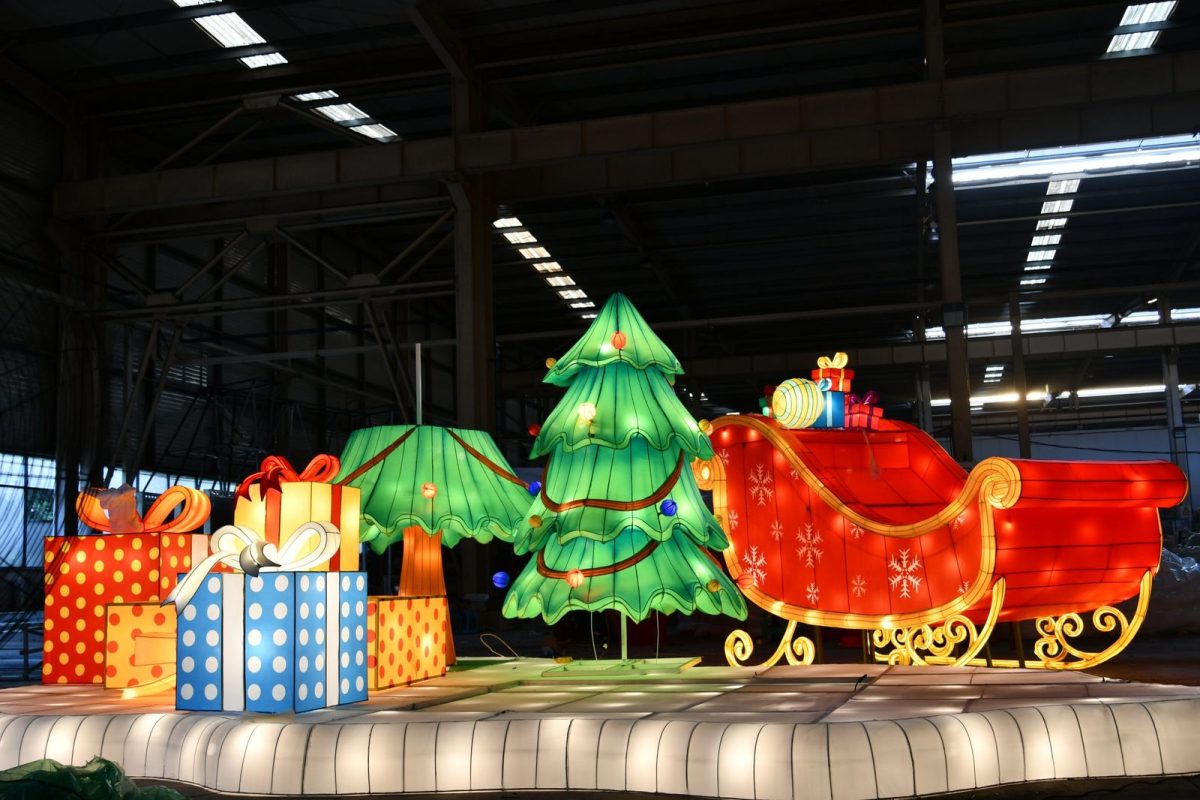
Every element is built on a weatherproof internal frame with hand-painted high-density fabric over a shaped understructure, lit internally with low-voltage LED and finished to an outdoor-rated standard. The set is designed as one piece of work from the outset — the sleigh, tree and boxes share a frame language, a paint palette and a lighting temperature, which is the part that is difficult to reproduce when pieces are ordered separately over several years.
What Makes a Set Different From Three Separate Pieces
Buyers sometimes compare a set against buying three items individually and come away thinking the difference is only convenience. In practice, four things change.
- Scale is resolved once. Bought separately, a tree ends up too tall for the sleigh or the boxes end up too small to register. In a set, the height relationships are decided at design stage and stay correct.
- One palette, one lighting temperature. Mismatched reds and mismatched warm whites are the most visible sign of an assembled display. A set is painted and lit from a single reference.
- One delivery, one build. The set packs into crates numbered by position, so site assembly follows a layout drawing instead of an improvised arrangement.
- Rework is designed in. Elements can be repositioned, split across two sites or expanded later without the composition falling apart.
The practical test is a photograph: a coordinated set reads as a designed scene from any angle, while an assembled group reads as separate objects that happen to share a lawn.
The Three Elements and Why They Are Sized That Way
The composition works because the three parts occupy different heights and different visual weights. Changing one without adjusting the others is what flattens a scene.
| Element | Role in the composition | Relationship to keep |
|---|---|---|
| Red sleigh with snowflake detailing | The narrative centre — the object that tells the story | Should sit at the height where visitors read detail, and no lower than about 0.8 m so it is not lost behind a crowd |
| Decorated Christmas tree | The vertical anchor and the top of the silhouette | The tallest element; roughly 1.5–2× the height of the sleigh so it frames rather than dominates |
| Gift boxes, assorted sizes | Ground-level mass and colour punctuation | Two or three distinct sizes, the largest no more than about half the sleigh height |
The tree also solves a practical problem that a flat arrangement cannot: verticality. Three objects at similar heights spread out on the ground read as a low band of light, which is the failure mode most commercial Christmas displays fall into. The tree is what gives the group a top edge and lets it be recognised from across a car park.
One Palette Across a Whole Scene
Colour discipline is easier in a set than in an assembled one, and it is also easier to get wrong at scale — the bigger the elements, the more a stray colour shows.
- Red, green and gold, no fourth colour. Three values is the practical ceiling across a composition this size. Adding a fourth — silver, blue or white — pulls attention away from the sleigh.
- Gold as the connector. Gold appears on the tree ornaments and the gift-box ribbons, which ties the three elements together visually without adding a shape.
- Keep the brightest element in one place. The tree topper or the star is the single brightest point. Two bright points on a low composition split the viewer’s attention and make the scene read as busy.
- Watch tint drift between elements. Painted surfaces drifting between an orange-red and a blue-red are the most common inconsistency in assembled displays, and the reason all elements in a set are painted from the same reference batch.
All elements run on internal low-voltage LED with local drivers, so a venue can also change the scene’s mood for a specific event — a warmer overall balance for a reception, a slightly cooler one for a photo booth — without repainting anything.
Three Layouts From the Same Set
The three elements can be arranged in several ways, and the right choice depends on how visitors approach the site rather than on preference.
| Layout | Shape | Best position |
|---|---|---|
| Linear | Sleigh, tree and boxes along one line | Straight approaches, building frontages, photo backdrops |
| Triangular | Tree set back, sleigh and boxes forward | Plazas and corners seen from a single main direction |
| Wraparound | Boxes forward, sleigh at one side, tree at the other | Open positions viewed from multiple angles, road ends, island sites |
Two placement notes matter more than the choice itself. First, keep a clear standing area in front of the sleigh — that is where photographs are taken, and if it is not left deliberately, visitors will create it by standing on the planting. Second, keep everything at least a metre back from a wall or hedge: a composition pushed against a boundary loses its silhouette and picks up shadow from the structure behind it.
Packing, Delivery and Site Assembly
Where a set earns its keep is on the day of the build, and that comes down to how it was packed.
- Numbered crates by position. Each element’s frame sections, skin panels and lighting looms are labelled to match the layout drawing, so the crew is not identifying parts on site.
- Pre-terminated lighting. Connections are made at the workshop and labelled, which removes the usual hour of fault-finding in the dark.
- Protected panels. Skin panels travel separately from frame sections and stack in order for reuse between seasons.
- One commission session. Full lighting test and a walk-through before the display opens, ideally with the venue’s facilities contact present.
Most sets of this scale are assembled in a single day with a small crew. Where the venue has a narrow service entrance, the frame sections are sized around that constraint at design stage — worth confirming early, as it is the most common reason a large scene has to be re-split.
Sizes and Custom Options
- Whole-set scaling. The composition scales as a unit so the relationships between sleigh, tree and boxes stay intact.
- Element substitution. The sleigh can be replaced or supplemented with a Santa figure or a reindeer pair; the tree can become a stylised form rather than a literal cone.
- Box count and sizes. Extra boxes are the cheapest way to fill a wider footprint without adding a new element.
- Brand integration. Ribbons and box panels are flat, well-lit faces and take a name or mark cleanly.
- Indoor and outdoor use. The same set suits covered atriums with a ballasted base, or an exposed plaza with a fixed base.
Related pieces that extend the same scene: the Santa sleigh light sculpture, the walk-through light archway and the illuminated bell arch. For a wider programme, see Christmas light festival and Christmas lighting show layouts.
Frequently Asked Questions
Related Products and Designs
Complementary products: the holiday ornament archway and the seated Santa with gift box.
Larger Christmas compositions in the same palette: the giant gift box tower, the storybook character collection and the full Christmas design set. See also the festival lantern range.
Send the available footprint, ceiling or height limit and the number of locations the scene needs to cover through the contact form, and we will return a layout with the elements already positioned.

You May Also Like
Related Products
Festival Lanterns
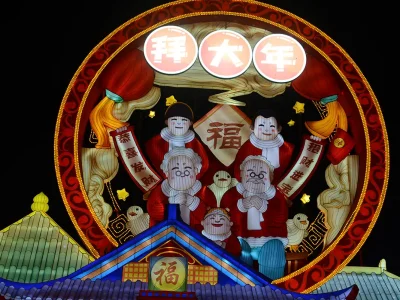
Chinese New Year Greeting Lantern Scene — Prosperity Blessing Festival Display
View Details →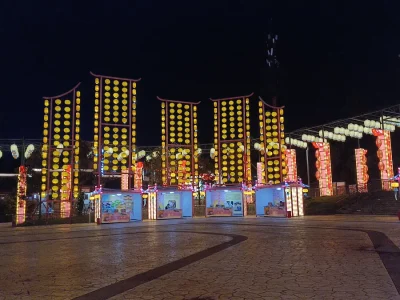
Festival Lanterns
Chinese Lantern Frame Display — Festival Lantern Pillar for City Plazas & Cultural Events
View Details →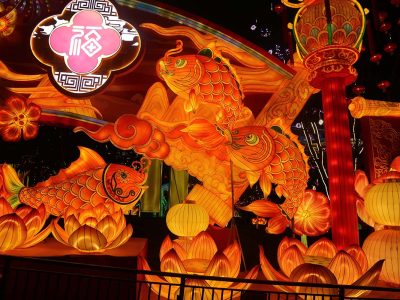
Questions
Frequently Asked Questions
Interested in This Product?
Get a custom quote within 24 hours. Our team is ready to help.