Engineering & Installation
A city lantern festival display is decided on site long before it is decided on paper — by wind, ground, power and the hours the street is closed.
Engineering & Installation·Built to order·Zigong workshop

This page is about the physical side of city lantern festival displays: what holds them up, what they stand on, what feeds them, how they arrive and how they come down. The commercial side — briefs, procurement, handover — sits on our main city page and is not repeated here.
The assumption behind everything below is that the site already exists. A street, a square, a waterfront promenade. The job is to put light into it without damaging it, without closing it for longer than agreed, and without creating a structure that fails its first windy night.
Scale is decided by reading distance, not by ambition
The first engineering number on any city piece is the longest unobstructed sightline to its position. That number sets the height, and the height sets the frame section, the base footprint and the wind area. Working from a desired height instead of a sightline is how pieces end up oversized and over-engineered at the same time.
On a pavement position in a city lantern festival display, the longest view is often under twenty metres. That means a piece built for forty-metre viewing is structurally excessive for where it stands, and it will look oversized to people passing at three metres. The same drawing set, re-sized to the actual sightline, usually requires less material and reads better.
Where a city lantern festival display has both a long approach and a close pass — a gateway seen down a boulevard and walked under at the entrance — the piece is sized for the long view and detailed for the close one. Those are two separate decisions and both have to be made.
Frame and wind load on an open urban site
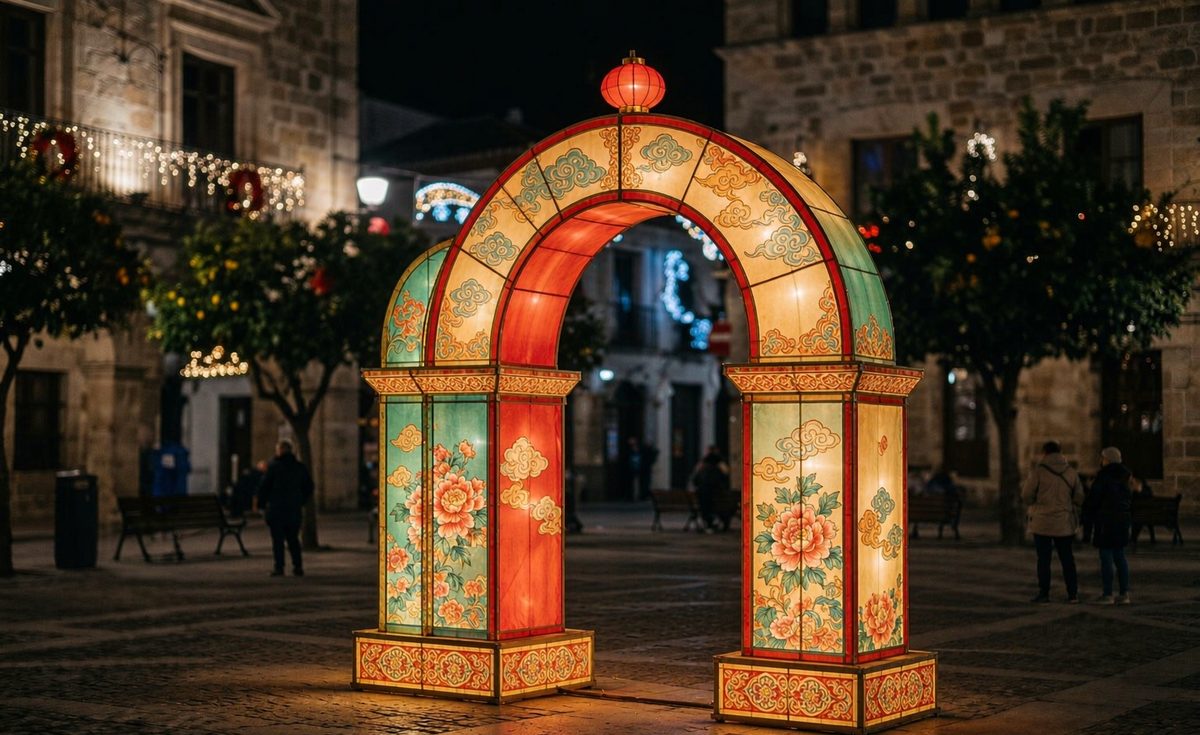
For city lantern festival displays, the street itself is a wind tunnel. Buildings on both sides accelerate the flow, and a piece that would be stable in a park can be exposed on a corner where two streets meet. Wind load, not weight, is what usually determines the frame section on an urban site.
Three frame types cover most positions. A welded metal arch on a fixed span suits semi-permanent placements where the geometry will not change. A modular bolt-together frame suits touring pieces and restricted-access sites, because it sections into loads a small crew can move by hand. A ballasted self-supporting frame suits paved ground where nothing may be fixed down.
The choice changes the base. A welded frame transfers load to defined anchor points; a ballasted frame spreads it across a footprint. On a city lantern festival display the footprint is often the real constraint, because the base occupies public space that the piece itself does not.
Where a city lantern festival display sits on an exposed site, the honest options are fewer pieces, shorter cantilevers, or a reduced height — not a heavier base hung on the same silhouette. Weight at the bottom does not help a structure whose problem is the area at the top.
Ground conditions and the fixing problem
Most city ground cannot be penetrated. Paved squares, heritage stone, weather sealing membranes over car parks, and planted surfaces all rule out drilling, and each has a different answer.
Paved squares. Ballast, weighted feet, or frames stable by geometry. Ballast is not a small detail — a tonne of water or concrete per position changes what a small crew can handle and how the site is staged.
Heritage and protected surfaces. No penetration and no abrasive contact. Frames are free-standing and loaded from above, with protective matting under contact points. Any load spreader has to be soft enough not to mark stone that has been there for a century.
Soft or planted ground. The reverse problem: the surface gives way. Ground spikes or buried plates, with reinstatement afterwards. On parkland the reinstatement is usually the item the client inspects last and remembers longest.
Power, cable runs and the site window
Power is the constraint that most often forces a redesign after the drawings are approved. Existing outlets are rarely where the pieces want to be, shared supplies cannot always be claimed for a temporary installation, and the supply may not be live during the hours the crew is allowed on site.
Three numbers settle the electrical layout: the available supply at each position, the maximum cable run before voltage drop becomes a problem, and the number of separate circuits the site can support. Those three decide how the elements are grouped, and the grouping is what the design has to work with.
On plaza christmas lighting installations cable routes matter as much as capacity. On a paved site, cable is surface-run inside matting or trunking, and every crossing of a pedestrian route needs a ramp that a wheelchair can pass. That constraint alone can move a piece two metres.
The site window shapes the build as well. Overnight access on a city street means shorter shifts, which means more sections and simpler joints. A city lantern festival display that needs four nights is built differently from one that needs two — and the section count is set by the calendar, not by the design.
Surface, material and the finish at scale
At city scale the surface is doing structural work as well as visual work. A fabric-covered surface built over a frame has to stay taut through temperature swings and repeated wetting, and the fixings have to be serviceable from a ladder rather than from scaffolding.
Surface panels on large pieces are built in sections with defined seams, so a damaged panel can be replaced without dismantling the piece. On high-traffic sites that is the difference between a two-hour repair and a two-night rebuild.
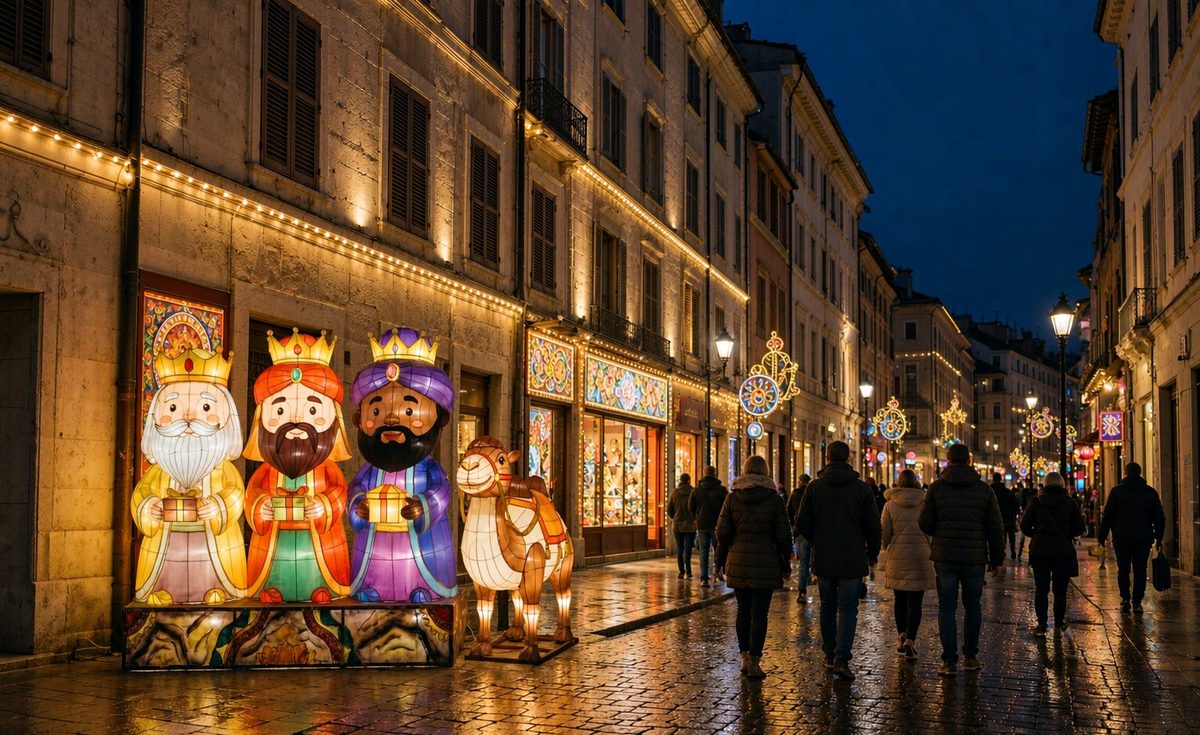
Where a piece is read against lit buildings, the finish matters more than the light output. A matte surface holds colour under street lighting; a gloss surface reflects it and turns the piece into a mirror of whatever is opposite. On a city lantern festival display facing shopfronts, that decision is made from the surroundings, not from a colour chart.
Lighting the surface is a separate problem from lighting the street. Where the piece has to be read against competing light, the outline carries the silhouette and the interior is lit lower — the reverse of the park formula, where the interior glow does the work.
Sectioning, transport and the arrival sequence
Large city lantern festival displays are always built in sections, and the section count is decided by three things: what fits through the access route, what a crew can lift without a crane, and how many sections the install window can close per night.
For a capital city festival of lights programme the arrival sequence matters more than it sounds. Sections are numbered, crated in assembly order, and recorded against a plan so the same crates go back in the same order at removal. A site that receives sections out of order loses a night of the install window to sorting.
Restricted access changes the crate design, not just the truck. Service corridors, lifts and doorways set the maximum crate dimensions, and a piece that cannot reach its position in one crate size has to be re-sectioned at the workshop rather than on the street.
Crowd flow and the clear-width problem
A city lantern festival display is installed into a pavement that already has a width, and the design has to work with what remains after the piece takes its share. The relevant number is the clear width left for two-way pedestrian flow, not the total width of the space.
Where the clear width is tight, pieces go against the wall rather than into the middle. Where a photo stop is expected, a pocket of space is left deliberately, because a crowd will stop there whether or not the layout allows for it — and a crowd stopped in a traffic lane is a problem the next morning.
Crossings are the other pinch point. Anything placed near a crossing stalls pedestrians where traffic needs them to keep moving, and it is usually the first element a city asks to be relocated after opening night.
Photographing a city at night
On a city site the photograph is often the reason the piece was commissioned, and it is an engineering constraint rather than a marketing afterthought. The piece has to work in a wide frame with buildings in shot, and at an exposure that also records the street.
That sets the brightness relative to ambient street lighting rather than in absolute terms. A piece that looks correct in isolation often blows out the buildings behind it, and the resulting image shows a bright object in a black void — which is not the city the client wanted photographed.
At least one position has to allow a person in frame without blocking the view. That decides where the photo pocket goes, and it usually decides which side of the piece the detail is built on.
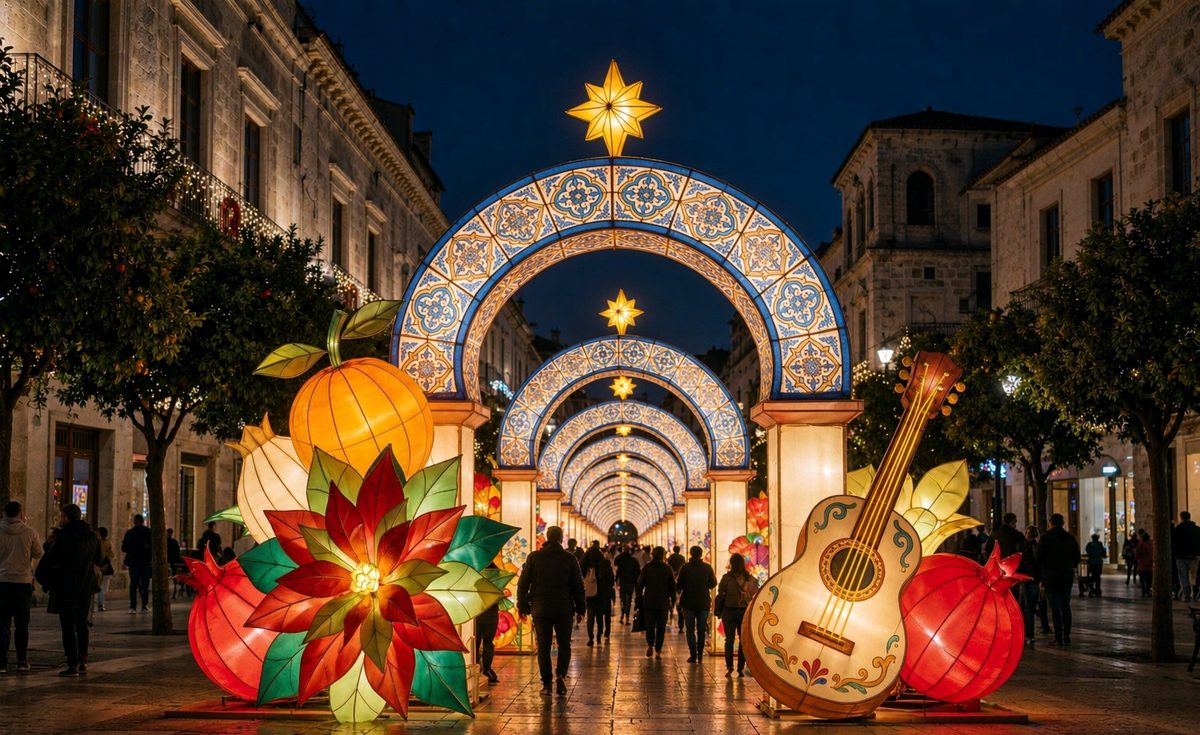
Removal, storage and reuse across seasons
Removal is designed at the same time as installation, not after. Sections come down in the reverse of the assembly order, into the same crates, within the same access window. A piece that takes six nights to install has to come out in the same six, at a time of year when the site may have other work scheduled.
On a city light festival installation, storage conditions determine how much survives to the next season. Fabric-covered surfaces stored folded hold creases that never fully come out; frames stored on damp ground corrode from the base up. The practical answer is a crate plan that keeps surfaces flat and frames off the floor, which takes storage space and saves replacements.
Where a city lantern festival display runs for several seasons, the frame and power distribution are the parts worth building for reuse and the surface is the part worth replacing. Re-dressing a rigged frame is a fraction of the work of installing from scratch, and it removes the annual risk of discovering that last season’s fixing points are no longer available.
Specification
| Item | Detail |
|---|---|
| Scope | Physical engineering of a city lantern festival display |
| Frame | Welded metal arch, modular bolt-together, or ballasted self-supporting |
| Wind | Frame section set by site exposure, not by weight at the base |
| Ground fixing | Ballast, protective load spreaders, or ground spikes per surface |
| Power | Layout set by available supply, cable run length and circuit count |
| Cable routing | Surface-run in matting or trunking; every crossing ramped for access |
| Surface | Sectioned panels with defined seams, replaceable individually |
| Sectioning | Count set by access route, crew lifting limit and install window |
| Removal | Reverse assembly order into numbered crates within the same window |
| Reuse | Frame and power distribution built for reuse; surface replaced per season |
Related
Giant lanterns
Large-scale structures and how wind load is engineered for open positions.
Walk-through corridor displays
Sectioning, clear width and assembly sequence for passage structures.
Project case studies
Delivered city installations with site conditions described.
Frequently Asked Questions
Can a city lantern festival display be installed without drilling the pavement?
Yes, and on most city sites it has to be. Ballasted frames and structures that are stable by geometry avoid penetration entirely, at the expense of a larger footprint. The base is designed from the surface survey before the artwork.
How is wind load handled on a street position?
The frame section is set from the site’s exposure, and where exposure is high the practical answers are shorter cantilevers, reduced height or fewer pieces — a heavier base does not solve a problem that sits at the top of the structure.
How many nights does installation take?
The section count is set by the access window rather than by the size of the display. A route built around overnight shifts is sectioned so that each night closes a defined portion of the work.
What survives to the next season?
The frame, rigging and power distribution are built for reuse; the surface is the part replaced. Storage conditions decide how much of the surface survives — flat surfaces and frames off damp ground make the difference.
Can the pieces be moved if the city changes the layout?
Modular frames can be re-positioned and re-spanned within limits. Ballasted pieces are easier to relocate than anchored ones, which is one reason ballast is often specified even where drilling would be permitted.
Engineering a city installation?
Send the site plan, the surface types, the available power and the install window. We will reply with the frame approach and the section plan for each position.