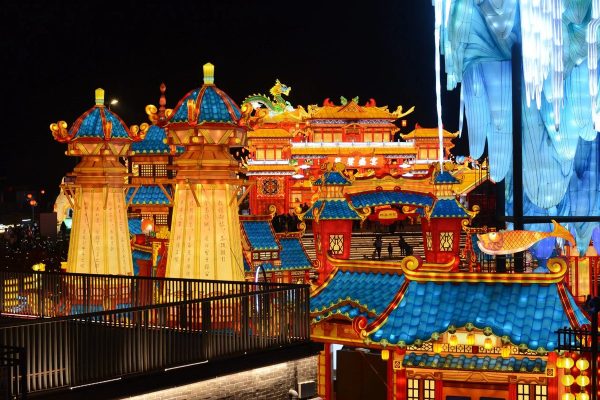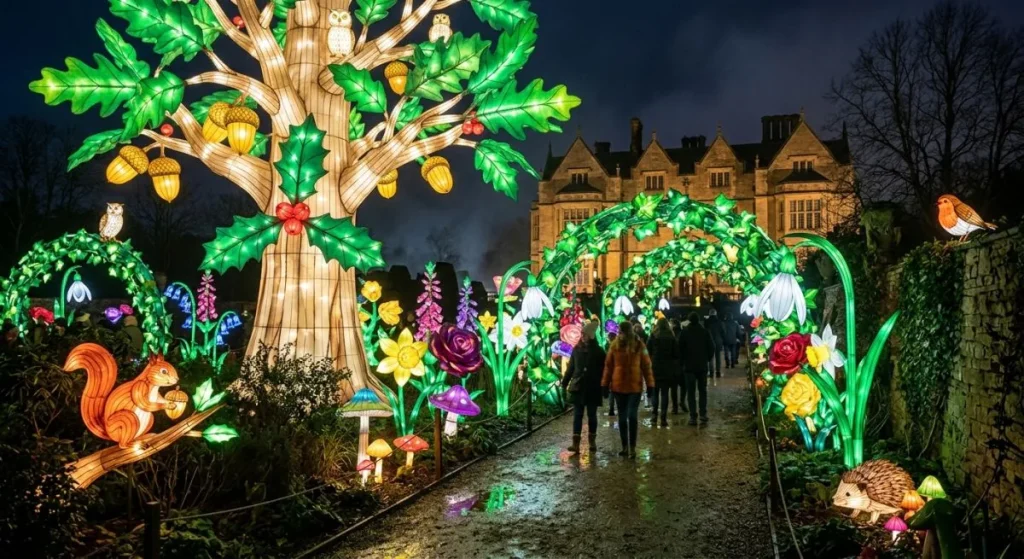
A botanical garden lantern festival works when the route is planned around the zones the garden already has, not around a list of displays. The single most important piece is not the largest lantern on site — it is the wayfinding lantern at each decision point, because after dark your visitors lose the landmarks they used on the way in. Everything else follows the ground: corridor lanterns where paths run without cover, scattered smaller pieces on open lawns and in front of buildings, large set pieces where there is room to stand back, and water installations where there is water.
This guide sets out how we plan a lantern festival on a living garden site: how to read the area and surfaces, how to match each lantern type to each zone, what the plants themselves require, and how the opening window is chosen. The constraints are different from a park or a plaza, and the route has to be designed around them from the first survey.
Why a Botanical Garden Works for a Lantern Festival
A garden already has everything a lantern festival needs: a defined boundary, a path network, mature planting that creates natural rooms, water features, visitor facilities and a reason for people to arrive. What it does not have is an evening. Botanical gardens are typically busiest in daylight and close before the light goes. A lantern festival fills that window with the asset the garden already owns, without building a new venue.
Filling the evening-hours gap
Most gardens operate a daytime model: ticketed entry during daylight, glasshouses and collections open, café trading through the afternoon. The evening is largely unused. A lit trail converts those same hours into a second trading period on the same footprint — same car park, same toilets, same staff structure, same entrance. Nothing has to be built to make the site work at night; it has to be lit.
What a lit trail adds to repeat visits
A garden’s returning visitors come for the season, not for a single visit. A lantern festival gives members a reason to come back in a different month and see familiar ground in an unfamiliar light. In practice this matters more than raw attendance: the trail is a second product on the same membership, and the garden’s own members are the most reliable early audience for a first season.
Start with the Site: Area, Surface and Circulation
Before any design work, four things need to be established about the site. Each of them changes what can be built and where. If you are comparing venues or planning a first season, these are also the four questions that separate a workable plan from a drawing that cannot be installed. The same sequence applies to any lit route, which is why it also sits at the front of our light trail planning approach.
Total area and usable area
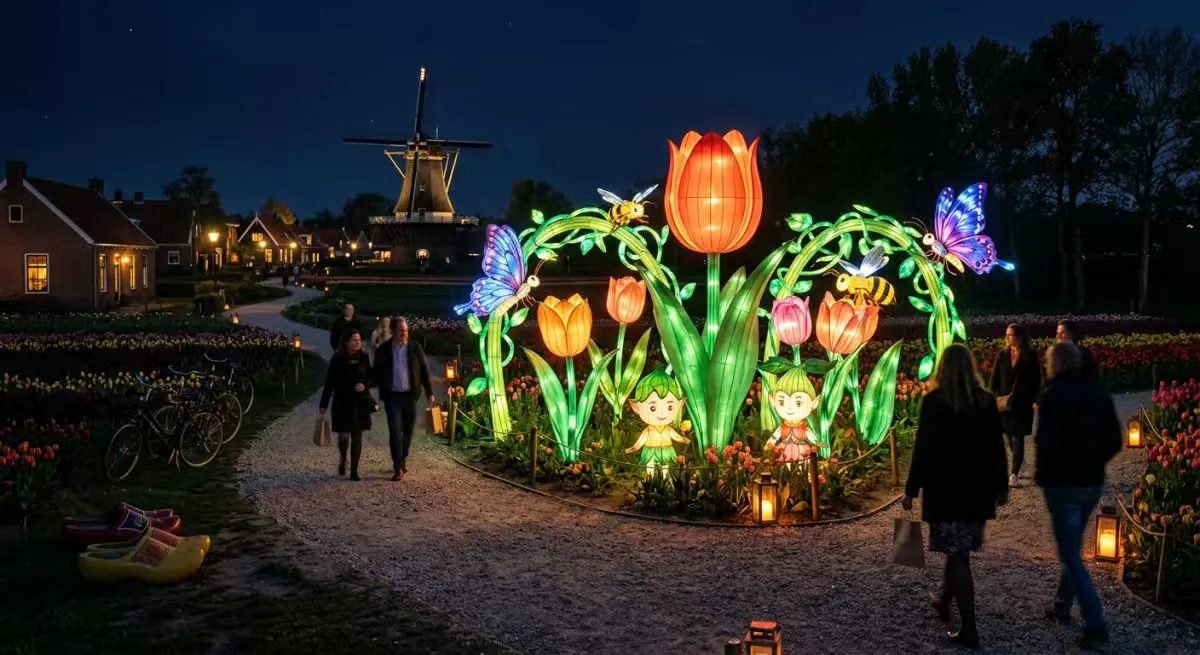
The figure that matters is usable area, not total area. A forty-hectare garden with twelve hectares of accessible path, lawn and plaza is a twelve-hectare event. Take the boundary, subtract everything that cannot be entered, walked on or stood on, and what is left is the canvas. Almost every first-season plan that runs into trouble has budgeted against total area.
Green space versus paved space
Map the site by surface before mapping it by theme. Paved plaza, hard path, gravel, lawn, border and water each take a different kind of display, a different base and a different amount of protection. Working out which is which — and how much of each you have — is what tells you how many large pieces the site can actually carry.
Vehicular and pedestrian circulation
A garden has two circulation systems: the one visitors use and the one the site runs on. Delivery routes, maintenance access, emergency vehicle paths and staff movements all have to remain clear, and they often cut straight across where a trail would naturally run. Establish both networks first, then route the trail through the gaps rather than over the top of them.
Commercial zones and visitor facilities
Locate the café, shop, toilets and any event space. These are not just amenities — they are the points where a trail either works commercially or does not. A route that ends near the shop and the café keeps visitors on site after the last lantern; one that dumps them at the car park does not. Plan the zone sequence with those facilities as anchors.
Mapping Lantern Types to Site Zones
This is the part that decides whether a trail feels designed or merely decorated. Each zone on the site takes a different kind of lantern, and the sequence — node, corridor, open ground, water — is what turns a collection of pieces into a route. Our own builds use the same set of forms, from animal and figure lanterns for feature positions to festival lantern groups for set pieces.
Nodes: wayfinding lanterns
This is the most important category on the site, and the one most often treated as an afterthought. After dark, visitors lose almost every reference point they used in daylight — the tree, the glasshouse, the slope, the way the path curved. A tall, bright, unmistakable lantern at each decision point replaces those references. It answers the only question a visitor has at a junction: which way now.
Place them at the main entrance, at every branch in the route, in front of major landmarks, and at the exit. Build them high enough and bright enough to be read across a lawn or a stretch of water, so a visitor looking over an open area can see where the route goes next. A node lantern that can be seen from forty metres does more for the visitor experience than three decorative pieces that can only be read from five.
The commercial effect is worth stating plainly: a route that reads clearly keeps people moving forward through the site. A route that does not sends them back the way they came, past everything they have already seen.
Paths without cover: corridor lanterns
Where a path runs without trees closing over it, the walk between one feature and the next can feel exposed and empty. Corridor lanterns — archways, tunnels, covered walkways and lit gateways — fill those stretches. They give the route a rhythm, mark progress, and make a simple path into a sequence rather than a transit.
Use them on straight runs, on the approaches to major pieces, and on any path where the planting does not already create an enclosure. Because they are built to be walked through rather than looked at, they carry themselves without needing viewing distance.
Open lawns, plazas and building frontages: scattered small lanterns
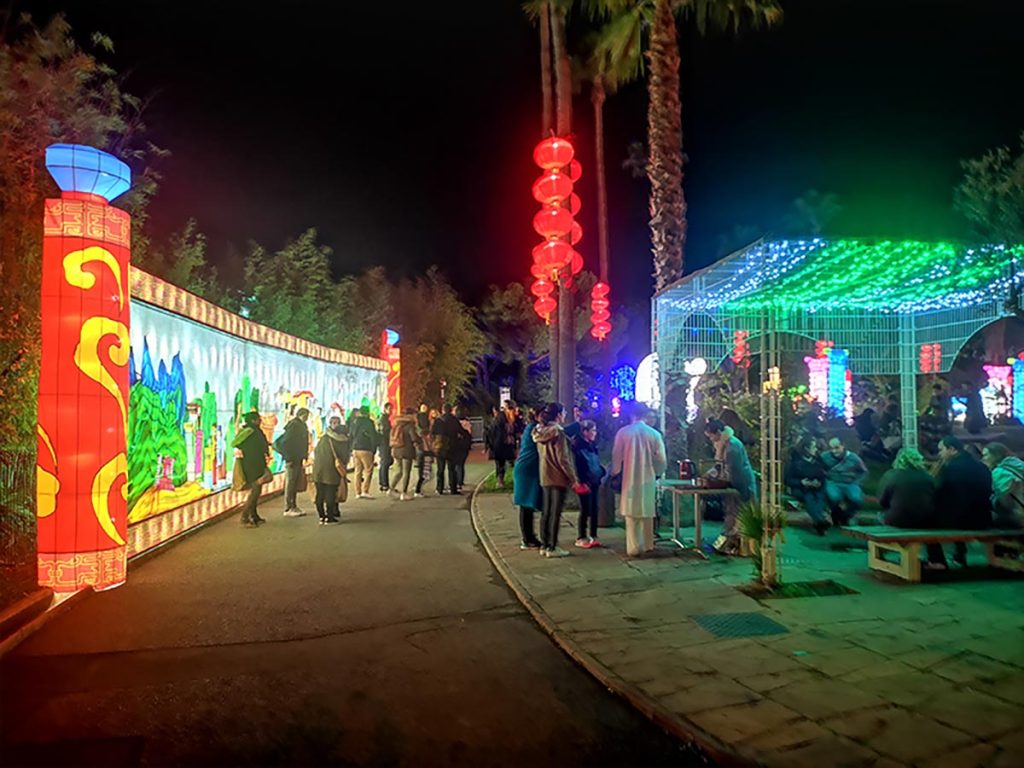
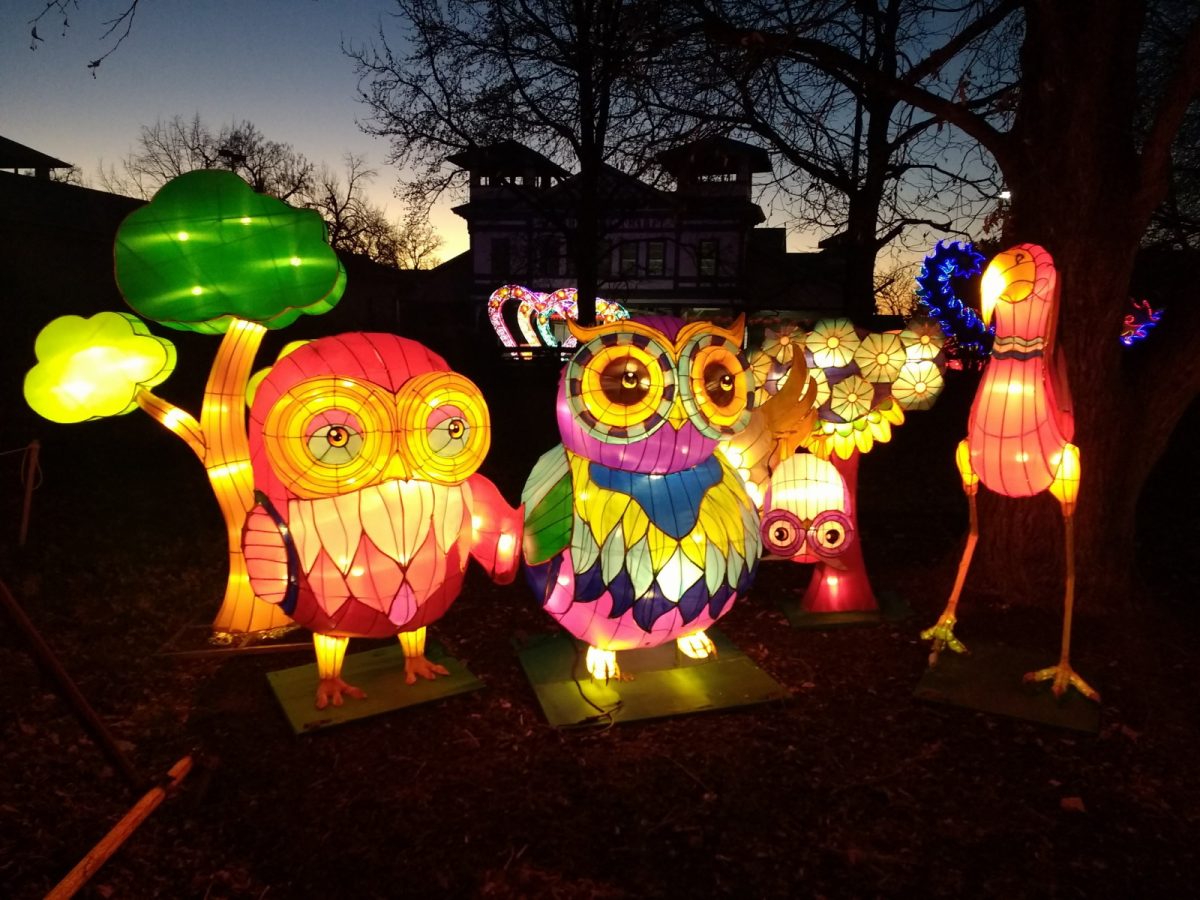
Where the ground opens up — a lawn left empty behind the glasshouse, a forecourt in front of a building, a wide paved area between two beds — the answer is usually a scatter of smaller pieces rather than one big installation. Scattered pieces fill a space without dominating it, need no viewing distance and no protective barrier, and let visitors move among them instead of standing in a queue to look at them.
This is also the most forgiving way to use ground you are not certain about. A single small lantern is easy to move if a piece of planting turns out to need more protection than expected. A five-metre set piece is not.
Large lawns and plazas: large-scale set pieces
Large pieces need room — not just room to stand on, but room to stand back. A tall installation viewed from three metres is a wall. The same piece viewed from twenty metres, with the lawn in front of it left open, is a scene. Reserve the large work for the biggest open ground on the site and protect its viewing distance in the plan; if the route runs too close, the piece loses most of its effect.
Where a plaza or a broad lawn can carry two or three large pieces, group them so they read as one scene from a distance and as separate pieces as visitors approach. That is what turns an open space into a destination rather than a place the route passes through.
Water surfaces: water installations
Water gives you a second ground plane. A lantern set on a lake, a canal or a large pond is seen twice — once in itself and once in its reflection — and it can be viewed from a distance without any of the standing space the same piece would need on land. On a garden site with existing water, this is usually the highest-value position on the whole route.
Water also solves a circulation problem. A floating or waterside installation draws visitors along a bank, which lets you route a trail onto an edge of the site that would otherwise be too narrow for a crowd.

Site Constraints Specific to a Botanical Garden
A garden is a living collection, and the route has to be designed around what is growing there. These four constraints are what make a botanical garden different from a plaza or a theme park, and they are why the survey matters more here than almost anywhere else.
Mature trees and root protection
Old trees have roots close to the surface and well beyond the canopy line. Digging anchors near them is not an option. The workable approach is above-ground ballast — weighted bases, counterweighted frames, ballasted platforms — with the route set back from the root zone and the canopy drip line kept clear. On a heritage site, the tree survey should be done before the design is fixed, not after.
Lawns, borders and load-bearing
A lawn will take a lantern festival, but it will not take it in the same condition it was left. Ask what the ground is rated for, keep heavy pieces off saturated turf, plan for ground protection matting on the access route, and give the turf a recovery period after dismantling. Beds and borders are simpler: keep the pieces and the access route out of them entirely.
Irrigation, ponds and water features
Irrigation lines, drainage runs and water features are the hidden network under a garden. Mark them on the survey and design around them. Above-ground cable routing along existing path edges avoids cutting anything, and where a display sits on water, the power and anchoring approach has to be agreed with the site team before anything is built.
Night-time circulation and accessibility
Confirm that the accessible route through the trail is the same width and gradient as the garden’s own accessible route, keep the emergency path genuinely clear, and run the trail one way at peak entry if the paths are narrow. A lit trail after dark is busier than the same path in daylight, because everyone arrives at once and stops to look.
Season, Weather and Opening Window
Dates are not purely a marketing decision on a garden site. The garden has its own calendar and the trail has to fit inside it.
Choosing dates around the garden’s own calendar
Work around the garden’s own programme: peak flowering, pruning and replanting, collection work, and any event the site already runs. The opening window also has to allow installation and dismantling around living material, which usually means a longer build period than on a hard-surfaced site. A short, well-chosen window beats a long one that collides with the garden’s own season.
Wind, frost and rain
Exposed gardens see more wind than enclosed sites, and a tall piece on open ground takes it. Ask for the wind load the structure is designed for and match it to the position — an installation protected by mature planting is not the same brief as one standing alone on a lawn. Frost affects the ground more than the displays: frozen turf changes what can be driven across for dismantling. Rain is mostly a route question, since a trail that crosses grass in a wet month ends up crossing mud.
Case: Festival de Lanternes at Parc Phoenix, Nice
Parc Phoenix in Nice is a botanical garden on the French Riviera, and in late 2019 it became the site of an eighty-seven-day lantern festival that ran from 29 November 2019 to 23 February 2020. The brief was to transform the botanical gardens into an illuminated route for the winter season — a period when the garden’s own planting is quiet and the evenings are long.
How the site was zoned
The exhibition carried more than fifty installations laid out across the garden’s different ground conditions, from the central lake to the formal walks. The pattern followed the zones: large feature pieces on the open ground where there was room to stand back, walk-through elements on the connecting paths, and the water used as its own stage — including the double-dragon installation on the lake, which was viewed from the bank as much as from the path.
What eighty-seven days showed
The festival drew an estimated 100,000-plus visitors over the season. Two operational lessons stood out. First, trail width at the entry nodes mattered more than at any other point on the route; when visitors stop to photograph the first installation, they stop on the path, and everything behind them backs up. Second, the pieces placed on the water and along the banks held visitors longest, because they could be seen from several points on the route rather than only from directly in front. Both of those findings are now built into how we plan node positions and viewing distances on garden sites.
Case: Gardens of Light at Montreal Botanical Garden
Montreal Botanical Garden’s Gardens of Light runs through a site with the same fundamentals as Nice: a large collection garden, established paths, water, and a winter window outside its own growing season. The installation applies the same zoning logic at a different scale — lit routes through the grounds with feature pieces positioned at the points where visitors change direction, and the garden’s own planting left undisturbed around them. You can see the full layout in our Montreal Botanical Garden project.
Working with a Lantern Manufacturer on a Garden Site
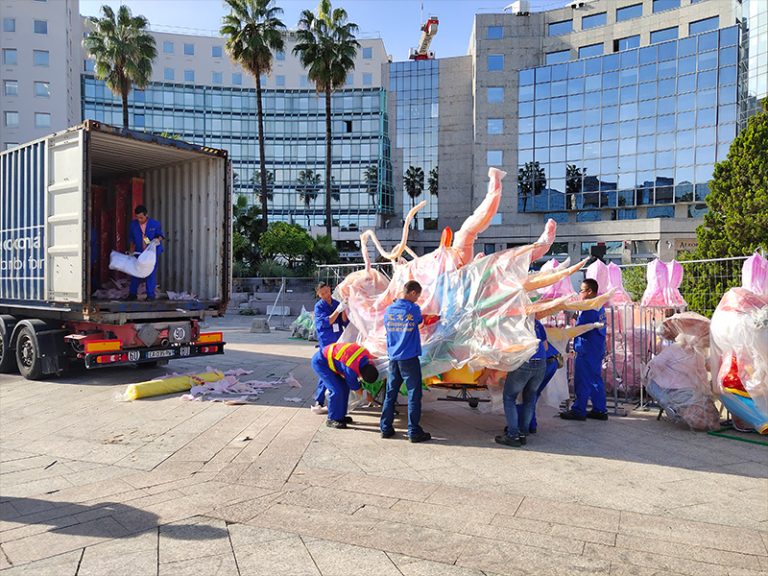
A garden site asks more of a manufacturer than a plaza does. The build has to fit an existing path network, sit on bases that do not disturb planting, and be installed on a schedule set by living material. That means the process starts with a survey rather than a catalogue: site plan, photographs of each zone, the tree survey, the path widths, the power points that already exist.
From there the sequence is the same as any turnkey build — design developed against the site, production, freight, installation, testing, handover — but with two garden-specific questions asked early: which base type goes on which surface, and how the route is protected while it is being installed. We set the wider version of this process out in our lantern festival supplier guide, and the same zoning logic applies to other venue types, from zoo lantern festivals to city parks.
Frequently Asked Questions
Can a lantern festival be installed in a botanical garden without damaging the planting?
Yes, provided the bases and the access route are designed around the planting from the start. Above-ground ballast and weighted bases avoid digging near root zones, ground protection matting carries the installation traffic, and pieces and cables are kept out of beds and borders entirely. The tree survey should be done before the design is fixed.
How long does installation take on a garden site?
Longer than on a hard-surfaced site, because of ground protection, routing around planting and the need to work around the garden’s own schedule. Plan a build period with contingency rather than a tight one, and agree the access windows with the garden team before production is scheduled.
What is the minimum trail length worth building?
There is no fixed figure — it depends on what the route passes. A short route with clear node lanterns and a strong water position can work better than a long one that fills distance with repeated pieces. Plan the zones first, then decide the length they need.
Can the displays use the garden’s existing paths and power supply?
In most cases yes. Routing along existing paths avoids new hard standing and new cabling runs, and where the garden already has power points, the trail can be planned to reach them. Where it does not, above-ground cable routing along path edges keeps the installation reversible.
Planning the Route Before Choosing the Displays
The order matters more than anything else in this guide. Read the site first — area, surfaces, circulation, facilities. Then place the node lanterns that make the route legible. Then fill the corridors, the open ground and the water with the pieces those zones can carry. A garden lantern festival planned in that order feels like a route from the first step. Planned the other way round, it becomes a collection of displays standing in a garden after dark.
If you are working on a garden site and have the plan, the photographs and the tree survey, send them over with the opening window you are aiming for. We review the site first and come back with the zoning, the positions and the base approach that fit the ground you actually have.