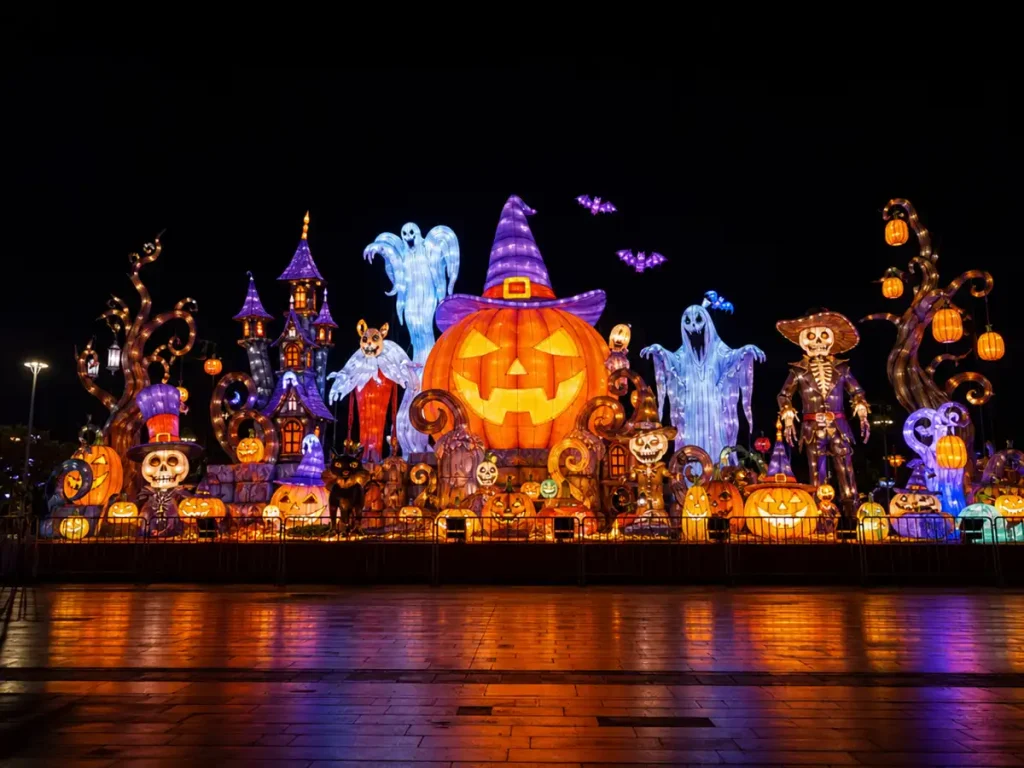
Giant Pumpkin Witch Festival Halloween Lantern
About This Design
This is an AI-assisted concept visualization paired with human-written design intent and production-verified technical specifications. It is a design direction — not a manufactured product. When you order, our team creates custom 3D renderings and fabricates the actual lantern in our Zigong workshop.
A frontage has a different job from a centrepiece. A centrepiece has to be found from across a square; a frontage has to hold a boundary. This design runs along a line — a fence, a park edge, a mall frontage, the long side of a plaza — and its whole logic is that a visitor walks past it rather than towards it. That changes what has to be solved: not depth, but variety along the length.
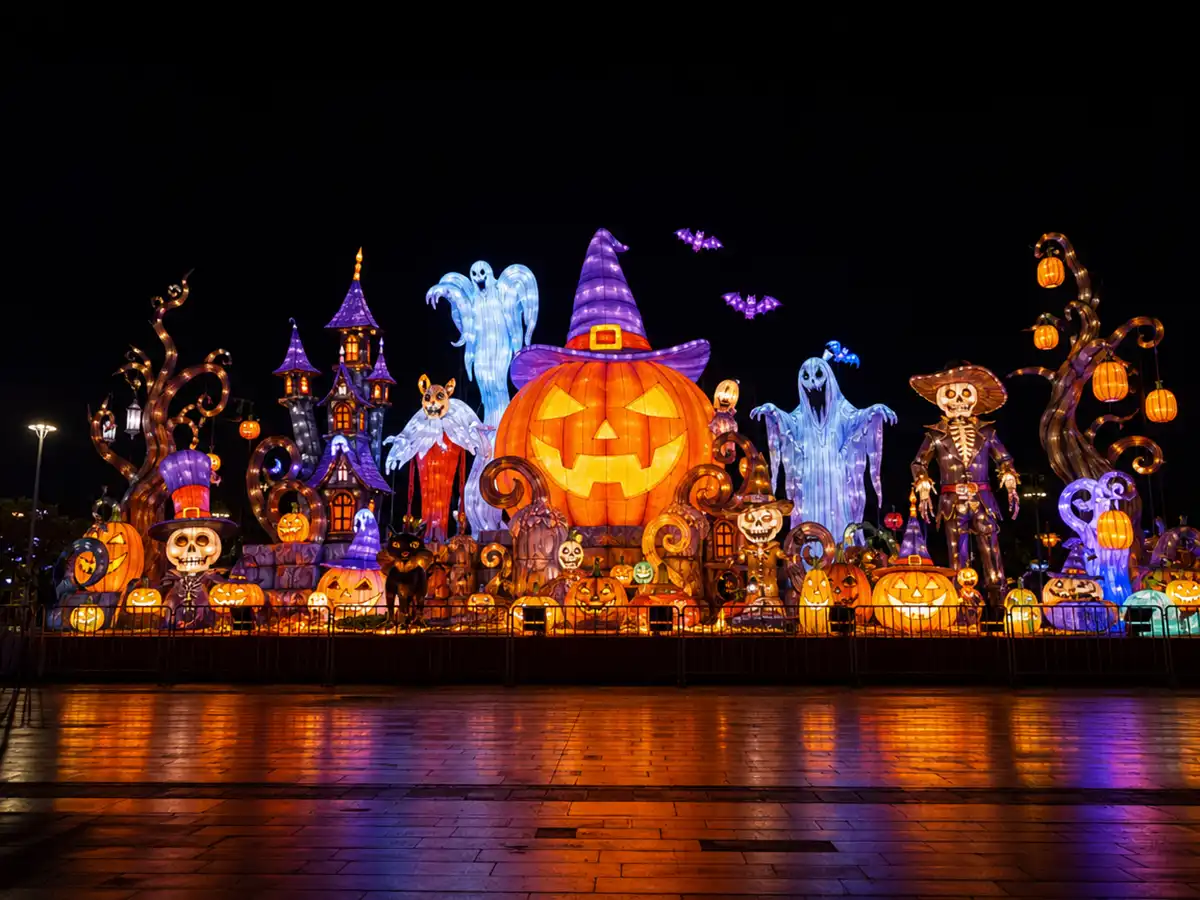
The reference build is a long row of characters behind a low fence: a purple witch-hat pumpkin at the centre, a set of tall flowing ghosts in white and blue, a gentleman skeleton in a top hat, a second skeleton in a wide-brim hat and jacket, a small purple castle with pointed turrets, and twisted trees hung with small pumpkin lanterns at both ends. At the base, a continuous band of pumpkins and lanterns; a black cat and an owl sit in among them as small discoveries.
This is an AI-assisted concept visualisation paired with human-written design intent and production specifications. It is a design direction rather than a photograph of a finished product — when a project goes ahead, the scene is re-drawn to your venue dimensions and fabricated in our Zigong workshop on a weatherproof internal frame, covered in hand-painted high-density fabric over a shaped understructure, and lit internally with low-voltage LED. The same build method scales from a short run of figures up to a full boundary frontage.
Design Intent
The whole design is built on silhouette variety along the line. Walking past a frontage, a visitor only ever sees a slice of it at a time, and progress depends on there being a new profile every few metres. In the reference build the run alternates heights and shapes deliberately: a soft irregular ghost mass, then a hard vertical castle tower group, then a pumpkin with a wide brim, then a wide-brim hat on a human frame, then a twisted tree. No two adjacent pieces share a silhouette.
The two skeletons are separated by hats, not by faces. A top hat and a wide-brim hat give two completely different head profiles, and profile is what carries at distance — the ribcage, the bow tie and the jacket detail only matter in the last few metres. If both skeletons wore the same hat the frontage would have a repeat in it, and a repeat in a linear run reads as a mistake rather than a pattern.
Ghosts are the cheapest height in the scene. A ghost is one soft silhouette with a wavy hem — no limbs, no joints, no pose, no structural articulation. That is why they are used here to fill the tall background slots, where a sculpted figure of the same height would be many times the work. Because they carry almost no detail, they also need contrast to read: they are lit cool white and blue against the violet structures, which is what stops them disappearing into the background.
The hanging pumpkin lanterns in the trees are doing a specific job. Between the tall figures and the ground band there would otherwise be a dark gap, and a frontage with a dark gap reads as a row of separate objects. The small lanterns at mid-height create a middle layer of glowing points that ties the tall pieces to the base and makes the whole run look dense. They are on short tethers so they swing, and the swing is worth having — it is the only thing on a static frontage that moves.
The fence is both a design device and a working element. Visually it draws a clean baseline under an irregular row of shapes, which is what stops the run looking untidy. Practically it hides the back-of-house line, and on a linear run cabling is the hardest thing to hide, because there is no depth to bury it in. Everything that feeds the frontage comes up behind that fence line.
Same palette rule as the rest of the range: violet for structure, amber for light. Pumpkins, lanterns and windows are amber; hats, trees, castle, ghosts and fence are violet and cool white. It is a two-colour system, and a busy row of characters needs it more than a single centrepiece does.
Specifications
| Theme | Giant pumpkin witch — Halloween lantern frontage |
| Hero piece | Jack-o’-lantern with a wide-brim witch hat, centred in the run |
| Character set | Two human-frame skeletons with different hats, multiple flowing ghosts, small purple castle |
| Companion elements | Twisted trees with hanging pumpkin lanterns, black cat and owl, pumpkin and lantern band |
| Figure scale | Ghosts and tall figures 4 m – 6 m; pumpkin hero 4 m – 6 m; base band 0.4 m – 1.2 m |
| Run length | 25 m – 45 m, extendable in modules by repeating the base band and adding figures |
| Depth required | Shallow — the run is built to be read from the front |
| Base | Ballasted ground plates behind a low fence line; no penetration of paving |
| Construction | Welded internal frame, hand-painted fabric panels over a shaped understructure |
| Lighting | Amber on the pumpkins and lanterns, violet on structures, cool white and blue on the ghosts |
| Power | 110V or 220V, DMX-capable control, weatherproof connections |
| Weather | Outdoor-rated, specified to the wind exposure of the site |
| Transport | Modular — figures, trees, castle and base band pack as separate units and the run length is set on site |
Key Features
- Built as a linear run, so it holds a boundary edge instead of occupying a square
- Every adjacent piece has a different silhouette, so the run stays interesting to walk past
- Two skeletons differentiated by hat profile — a top hat and a wide brim — rather than by detail
- Ghost figures used to fill tall slots cheaply, with cool white and blue light for contrast
- Hanging pumpkin lanterns at mid-height tie the tall figures to the ground band
- Low fence gives the run a clean baseline and conceals the back-of-house cable line
- Black cat and owl placed at child height as small discoveries along the route
- Extendable in modules — the base band repeats and figures can be added without redesign
- Two-colour system keeps a busy row of characters reading as one installation
- Ballasted bases developed for paved frontages and park edges that cannot be drilled
Where It Works in a Halloween Programme
This is the piece for a boundary. It runs along whatever edge already exists — a park perimeter, a fence line, a shopping centre frontage, the long side of a plaza, a riverside walk. Because it is shallow and front-facing, it needs very little floor area, which makes it the right choice where a centrepiece would eat the space a venue needs for circulation.
Its natural home is a walked route: the frontage does the work of a corridor, keeping visitors moving and giving them something to read at walking pace. That makes it a good fit for ticketed trails and for seasonal programming inside existing attractions. See zoo lights for how we structure routed programmes and where a frontage sits inside one.
On a city or town programme it is often the answer for the second and third locations, where the main square already has a hero piece and the surrounding streets need something of their own. Because the run extends in modules, a venue can start with a short frontage in year one and grow it. Site selection, power and the municipal approval sequence are covered on our city lantern festival displays page.
For European sites the shallow footprint is the practical advantage: the run can be installed along a frontage that has to stay in public use, with the fence and the base band doing the crowd control. Ports, documentation and install crews across those markets are covered in our European festival programme.
Production Notes
Figures are shaped over welded internal frames with hand-painted fabric stretched in panels over the shaped understructure. The ghosts are the simplest build in the set — a soft form with a hem and no articulation — while the skeletons are the most detailed, because the frame has to follow a skeletal profile rather than a solid body.
Hats are separate pieces and go on after the head is covered. That is deliberate: it means a venue can change the character of a figure at a later date by swapping one hat, which is a far smaller job than re-working a head. The castle is built in tower sections, and the trees are shaped metalwork with the curvature built into the branch, not bent on site.
The pumpkin lanterns in the trees are individual small lanterns on short tethers. They are the pieces most likely to need attention during a season, because they are the only moving parts, and they are specified so a single lantern can be replaced without dismantling the tree.
Electrically the run is split into circuits by colour family — amber for pumpkins and lanterns, violet for structures, cool white and blue for the ghosts — so one group can be adjusted without touching the others. Every circuit runs up behind the fence line, and the base band is set so that it closes over the cable entries. Control is DMX-capable with weatherproof connections, and the installation is outdoor-rated and specified to the wind exposure of the actual frontage — a linear run catches wind differently from a compact scene, and the anchoring is set accordingly.
Everything is modular and installs on ballasted ground plates without penetrating paving. Assembly sequence and site safety are documented in our on-site installation guide, and container planning for European delivery is set out in the shipping guide.
FAQ
Can the run be made longer or shorter?
Yes. The frontage is modular: the base band repeats and figures can be added or removed, so the run length is set to the site. The one piece that is not simply repeatable is the pumpkin hero, which is the visual centre of the composition and stays single.
How much depth does it need?
Very little. It is designed to be read from the front, so the run occupies a shallow strip along an existing edge. That is the main reason to choose a frontage over a centrepiece — it holds a boundary without taking space out of the middle of a site.
Can the two skeletons be made distinct?
They already are, and the difference is in the hats — a top hat and a wide brim. That is deliberate, because head profile is what carries at distance. If a venue wants two clearly different characters for a programme, the hats can be changed independently of the figures.
Can pieces be removed for a smaller site?
Yes. Every figure and every tree stands on its own base, so a venue can run a subset of the frontage. Removing pieces does affect the silhouette rhythm, so the shortened run is re-laid out rather than simply cut off at one end.
Can the figures be re-themed for a later season?
The frames, the base band, the fence and the lighting infrastructure are the reusable part; the covering and painted panels carry the theme. A later season is therefore a change of covering and artwork rather than a rebuild, which is usually planned at design stage for venues running an annual programme.
How is a linear run anchored in wind?
A long run presents a different wind profile from a compact scene, so it is specified to the exposure of the actual frontage rather than to a default. Ballast, tie-backs and the spacing of the ground plates are all set from the site, and nothing is drilled into the paving.
The Halloween Lantern Collection
This frontage is the boundary piece in a Halloween range that also includes a plaza-scale centrepiece, a full haunted castle with a walk-through arch, a walk-in pumpkin tunnel, a build-case study and a non-scary family village. The plaza-scale counterpart, the giant pumpkin witch centrepiece, is built around a moon disc and needs open space in front of it, which is the opposite requirement to this run.
Sibling designs: haunted castle and skulls path · giant skull walkthrough light show · cute witch and ghost village set
The season as a whole is set out on the Halloween lantern display page, the festival lantern range lists what ships alongside this run, and custom lantern manufacturing covers working up a frontage from a venue’s own theme.
Related Designs & Resources
- Halloween lantern displays — the full season range
- Zoo lights — routed seasonal programmes
- City lantern festival displays — site selection, power and approvals
- On-site installation guide — assembly sequence and site safety
- Shipping festival lanterns from China to Europe — ports, transit and customs
- Lantern displays for European festivals — documentation, ports and install crews
- Lantern products — the full range
- All creative designs — browse the full concept collection
From Concept to Your Venue
Select & Customise
Choose a design direction. We will adjust size, colours, lighting, and theme to match your venue.
3D Render
Our design team creates production-ready 3D renderings based on the concept and your requirements.
Fabricate
Master artisans handcraft your lantern in our Zigong workshop — internal frame, hand-painted covering, LED programming.
QC & outdoor-rated Test
72-hour burn-in test, full weatherproof verification, structural inspection. Built to last.
Ship & Install
Export docs handled. Container loading. On-site installation crew available for your event.