The Witch Pumpkin Ghost Halloween Display Scene is an AI-assisted concept visualization paired with human-written design intent and production-verified technical specifications. It is a design direction — not a manufactured product. When you order, our team creates custom 3D renderings and fabricates the actual lantern in our Zigong workshop.
This design is built specifically as a halloween lantern display. Every element is handcrafted by Zigong lantern artisans on a weatherproof internal frame and wrapped in high-density fabric with energy-efficient LED lighting. The set scales from compact (3 m wide) to monumental (15m+ wide) depending on your venue footprint and budget.
Specifications
| Theme | Halloween / Classic Witch-Pumpkin-Ghost Trio |
| Main Figures | Witch figure + giant pumpkin + floating ghost |
| Companion Elements | Cauldron with bubbling green light, spell book prop, black cat silhouette, broomstick |
| Frame Material | Internal frame |
| Skin Material | High-density fabric |
| Lighting | Energy-efficient LED fixtures (custom color palette per scene) |
| Color Palette | Witch green, pumpkin orange, ghost translucent white, cauldron bubbling green-yellow |
| Recommended Setting | General Halloween venues, party backdrops, bar/restaurant decor, community center displays |
| Customization | Size scaling, color adjustments, logo integration, element add/remove |
| Installation | On-site assembly by our crew or supervised local install |
Key Features
- Cute-Style (治愈系) Hero Design — Gentle expression, soft proportions, and an approachable visual tone that resonates with children, families, and social media audiences.
- Built for halloween lantern display — Purpose-designed scale and visibility make this a popular choice for Halloween seasonal events.
- Handcrafted in Zigong — Every figure is shaped and painted by experienced lantern artisans from the birthplace of Chinese lantern festivals.
- All-Weather Construction — Internal frame and high-density fabric stand up to autumn weather conditions.
- Energy-Efficient LED Lighting — Bright, vivid colors without heat or excessive power draw — ideal for nightly runs throughout October.
- Modular & Scalable — Deploy as a standalone hero piece or combine with other Halloween designs for a multi-scene festival route.
- Turnkey Design Support — Concept art, layout planning, production, shipping guidance, and on-site or remote installation supervision.
FAQ
Is this design suitable for halloween lantern display?
Yes. This concept is purpose-built for halloween lantern display scenarios including zoos, theme parks, town centers, and festival venues.
What sizes are available?
Standard configurations range from 3m to 8m in key dimensions. We can scale up or down to match your exact site footprint and ceiling height constraints.
Can the design be customized?
Yes. Colors, proportions, companion elements, and branding/logo placements can all be adjusted. We produce custom 3D renderings for approval before fabrication begins.
Is this suitable for outdoor use?
Yes. All designs use weatherproof internal frames and treated fabric rated for outdoor autumn weather conditions.
How long does production take?
Standard production is 6–10 weeks depending on size and order queue. For peak October deployment, we recommend placing orders by July.
Related Designs & Resources
- All Creative Designs — Browse our full collection of AI-concept lantern designs
- Lantern Products — Manufactured lantern exhibits ready for deployment
- Zoo Lights Solutions — Complete Halloween and holiday lighting packages for zoos
- Request a Custom Design — Get pricing for your Halloween event
Related Products & Resources
- Chinese Lantern Products — Manufactured lanterns ready for deployment
- Festival Lanterns — Custom holiday and event displays
- Zoo Lights Solutions — Complete packages for zoo events
- Turn This Concept Into a Custom Order
Bring This Design to Life
This witch pumpkin ghost halloween display scene concept can be built as a custom display for your venue. Pair it with related products from our factory in Zigong:
- Harvest Vegetable Lantern Display — Custom Farm-to-Table Festival Lanterns
- Walk-Through Lantern Tunnel — Immersive Corridor Lantern Display for Festivals, Theme Parks & Zoo Lights
The Purple Castle Scarecrow Halloween Lantern Display is an AI-assisted concept visualization paired with human-written design intent and production-verified technical specifications. It is a design direction — not a manufactured product. When you order, our team creates custom 3D renderings and fabricates the actual lantern in our Zigong workshop.
This design is built specifically as a halloween lights at the zoo. Every element is handcrafted by Zigong lantern artisans on a weatherproof internal frame and wrapped in high-density fabric with energy-efficient LED lighting. The set scales from compact (3 m wide) to monumental (15m+ wide) depending on your venue footprint and budget.
Specifications
| Theme | Halloween / Purple Gothic Castle & Scarecrow |
| Main Figures | Purple-gothic castle tower + animated scarecrow figure |
| Companion Elements | Purple uplighting, dead corn stalks, raven silhouettes, wrought iron fence elements |
| Frame Material | Internal frame |
| Skin Material | High-density fabric |
| Lighting | Energy-efficient LED fixtures (custom color palette per scene) |
| Color Palette | Deep purple, scarecrow straw tan, castle stone gray, accent eerie green |
| Recommended Setting | Upscale Halloween galas, garden party events, winery Halloween nights, boutique festival areas |
| Customization | Size scaling, color adjustments, logo integration, element add/remove |
| Installation | On-site assembly by our crew or supervised local install |
Key Features
- Cute-Style (治愈系) Hero Design — Gentle expression, soft proportions, and an approachable visual tone that resonates with children, families, and social media audiences.
- Built for halloween lights at the zoo — Purpose-designed scale and visibility make this a popular choice for Halloween seasonal events.
- Handcrafted in Zigong — Every figure is shaped and painted by experienced lantern artisans from the birthplace of Chinese lantern festivals.
- All-Weather Construction — Internal frame and high-density fabric stand up to autumn weather conditions.
- Energy-Efficient LED Lighting — Bright, vivid colors without heat or excessive power draw — ideal for nightly runs throughout October.
- Modular & Scalable — Deploy as a standalone hero piece or combine with other Halloween designs for a multi-scene festival route.
- Turnkey Design Support — Concept art, layout planning, production, shipping guidance, and on-site or remote installation supervision.
FAQ
Is this design suitable for halloween lights at the zoo?
Yes. This concept is purpose-built for halloween lights at the zoo scenarios including zoos, theme parks, town centers, and festival venues.
What sizes are available?
Standard configurations range from 3m to 8m in key dimensions. We can scale up or down to match your exact site footprint and ceiling height constraints.
Can the design be customized?
Yes. Colors, proportions, companion elements, and branding/logo placements can all be adjusted. We produce custom 3D renderings for approval before fabrication begins.
Is this suitable for outdoor use?
Yes. All designs use weatherproof internal frames and treated fabric rated for outdoor autumn weather conditions.
How long does production take?
Standard production is 6–10 weeks depending on size and order queue. For peak October deployment, we recommend placing orders by July.
Related Designs & Resources
- All Creative Designs — Browse our full collection of AI-concept lantern designs
- Lantern Products — Manufactured lantern exhibits ready for deployment
- Zoo Lights Solutions — Complete Halloween and holiday lighting packages for zoos
- Request a Custom Design — Get pricing for your Halloween event
Related Products & Resources
- Chinese Lantern Products — Manufactured lanterns ready for deployment
- Festival Lanterns — Custom holiday and event displays
- Zoo Lights Solutions — Complete packages for zoo events
- Turn This Concept Into a Custom Order
Bring This Design to Life
This purple castle scarecrow halloween lantern display concept can be built as a custom display for your venue. Pair it with related products from our factory in Zigong:
The Halloween Pumpkin Skeleton Witch Night Scene is an AI-assisted concept visualization paired with human-written design intent and production-verified technical specifications. It is a design direction — not a manufactured product. When you order, our team creates custom 3D renderings and fabricates the actual lantern in our Zigong workshop.
This design is built specifically as a halloween zoo lights. Every element is handcrafted by Zigong lantern artisans on a weatherproof internal frame and wrapped in high-density fabric with energy-efficient LED lighting. The set scales from compact (3 m wide) to monumental (15m+ wide) depending on your venue footprint and budget.
Specifications
| Theme | Halloween / Skeleton & Pumpkin Night Scene |
| Main Figures | Tall skeleton with witch hat + clusters of glowing pumpkins |
| Companion Elements | Vintage lantern props, ground fog effect area, small jack-o-lantern clusters |
| Frame Material | Internal frame |
| Skin Material | High-density fabric |
| Lighting | Energy-efficient LED fixtures (custom color palette per scene) |
| Color Palette | Bone white, pumpkin orange, witch purple, warm amber glow |
| Recommended Setting | Halloween zoo lights trails, theme park walk-through routes, festival pathways |
| Customization | Size scaling, color adjustments, logo integration, element add/remove |
| Installation | On-site assembly by our crew or supervised local install |
Key Features
- Cute-Style (治愈系) Hero Design — Gentle expression, soft proportions, and an approachable visual tone that resonates with children, families, and social media audiences.
- Built for halloween zoo lights — Purpose-designed scale and visibility make this a popular choice for Halloween seasonal events.
- Handcrafted in Zigong — Every figure is shaped and painted by experienced lantern artisans from the birthplace of Chinese lantern festivals.
- All-Weather Construction — Internal frame and high-density fabric stand up to autumn weather conditions.
- Energy-Efficient LED Lighting — Bright, vivid colors without heat or excessive power draw — ideal for nightly runs throughout October.
- Modular & Scalable — Deploy as a standalone hero piece or combine with other Halloween designs for a multi-scene festival route.
- Turnkey Design Support — Concept art, layout planning, production, shipping guidance, and on-site or remote installation supervision.
FAQ
Is this design suitable for halloween zoo lights?
Yes. This concept is purpose-built for halloween zoo lights scenarios including zoos, theme parks, town centers, and festival venues.
What sizes are available?
Standard configurations range from 3m to 8m in key dimensions. We can scale up or down to match your exact site footprint and ceiling height constraints.
Can the design be customized?
Yes. Colors, proportions, companion elements, and branding/logo placements can all be adjusted. We produce custom 3D renderings for approval before fabrication begins.
Is this suitable for outdoor use?
Yes. All designs use weatherproof internal frames and treated fabric rated for outdoor autumn weather conditions.
How long does production take?
Standard production is 6–10 weeks depending on size and order queue. For peak October deployment, we recommend placing orders by July.
Related Designs & Resources
- All Creative Designs — Browse our full collection of AI-concept lantern designs
- Lantern Products — Manufactured lantern exhibits ready for deployment
- Zoo Lights Solutions — Complete Halloween and holiday lighting packages for zoos
- Request a Custom Design — Get pricing for your Halloween event
Related Products & Resources
- Chinese Lantern Products — Manufactured lanterns ready for deployment
- Festival Lanterns — Custom holiday and event displays
- Zoo Lights Solutions — Complete packages for zoo events
- Turn This Concept Into a Custom Order
Most Halloween briefs arrive as a picture of a finished scene. The useful questions start after that: what holds it up, what it looks like before the covering goes on, and how it reads against whatever is already standing behind it. This page is the worked example — a large Halloween display on a city landmark plaza, shown as a finished piece, in detail, in light, and in frame.
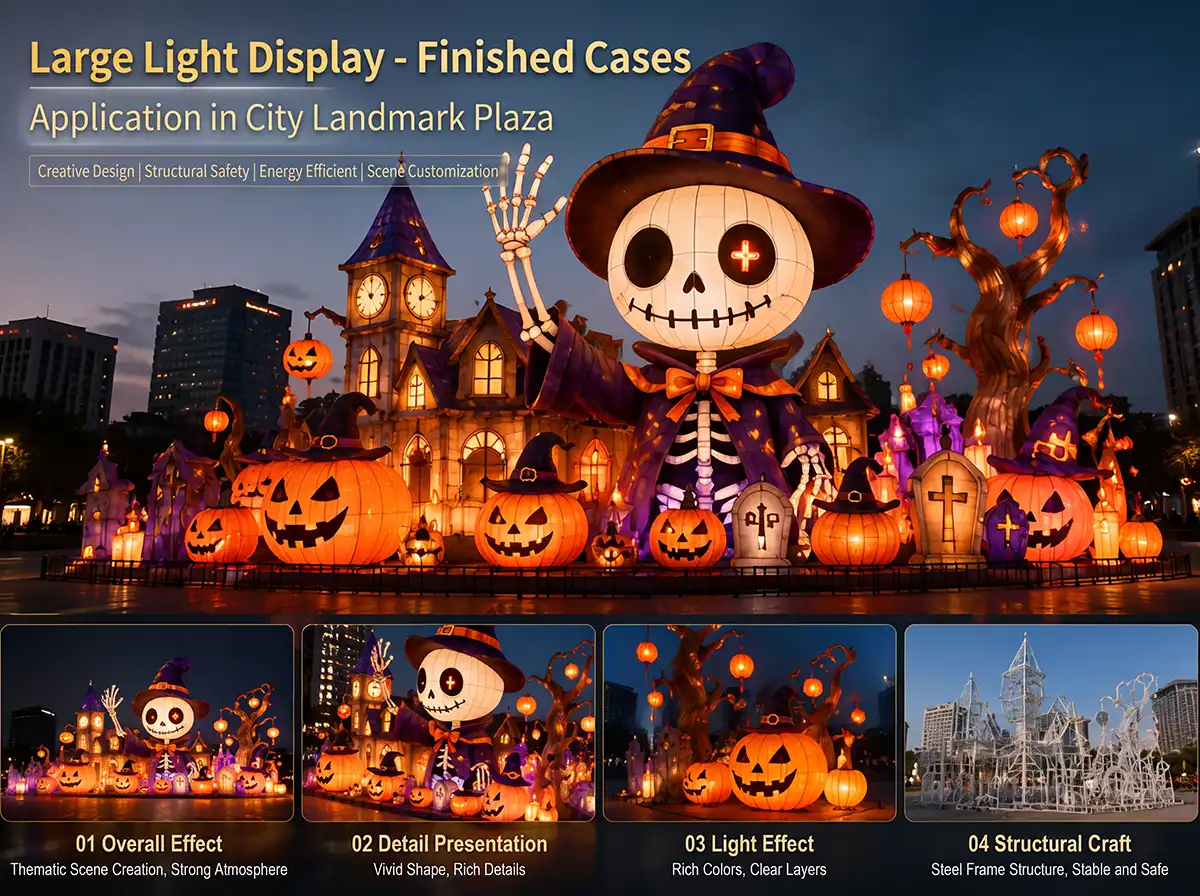
The reference installation is a large plaza scene built in front of an existing city landmark: a cartoon skeleton in a violet robe, witch hat and bow tie at the centre, holding one arm up; a court of pumpkins wearing small witch hats; gravestone markers with crosses; twisted trees hung with orange lanterns. The landmark building behind it is warm-lit and partly occluded by the scene, which is the arrangement the whole brief was designed around.
This is an AI-assisted concept visualisation paired with human-written design intent and production specifications. It is a design direction rather than a photograph of a finished product — when a project goes ahead, the scene is re-drawn to your venue dimensions and fabricated in our Zigong workshop on a weatherproof internal frame, covered in hand-painted high-density fabric over a shaped understructure, and lit internally with low-voltage LED. The same build method scales from a compact mall atrium set up to a full city plaza installation.
Design Intent
When an installation shares a site with a landmark building, the scene has to be designed against that building rather than in isolation. Here the landmark is a clock tower with warm-lit windows, and the scene answers it in three ways: the figure heights are set so the towers still read above the sculpture, the silhouette is kept clean enough that both shapes stay legible against each other, and the palette stays in the warm family so the new lighting does not compete with the building’s own.
The figure is a good illustration of how a family-facing Halloween character is assembled. The hat does the character work — a wide violet witch hat with a buckle gives instant recognition at distance, and it takes a cone, a brim and one painted panel. The bow tie does the same job at the other end of the scale: it takes a skull from menacing to comic in one small prop. Neither of those two elements is structural; between them they carry the whole tone of the piece.
The gravestone markers along the base are doing more than theme. A plaza scene sits on a plinth or a ground plate, and a plain base reads as a lump of engineering. The markers break that line up along its whole length and turn the base into part of the composition instead of a thing the composition stands on. They are simple flat pieces, and they are the highest-value detail in the whole scene for the work involved.
The twisted trees with hanging lanterns give the scene its second layer. A figure at ground level plus a building in the background leaves a gap in the middle of the frame; hanging lights at intermediate height fill it and make the installation look tall rather than wide. Everything in that middle layer is small, replaceable and on its own tether, which matters over a full season on a public site.
Specifications
| Theme | Large Halloween lantern display — city landmark plaza installation |
| Hero figure | Cartoon skeleton in a violet robe, wide-brim witch hat and bow tie, one arm raised |
| Base elements | Gravestone markers with crosses, pumpkin court in small witch hats, lantern-hung twisted trees |
| Hero figure scale | 6 m – 9 m, set so existing landmark towers still read above the sculpture |
| Companion pumpkins | 0.6 m – 2.5 m, arranged as a court around the hero figure |
| Group footprint | 15 m – 25 m frontage on a plaza or atrium floor |
| Base | Ballasted ground plates or plinth; no penetration of paving |
| Construction | Welded internal frame, hand-painted fabric panels over a shaped understructure |
| Lighting | Warm amber core, violet on figures and structures, low-level uplighting on trees |
| Power | 110V or 220V, DMX-capable control, weatherproof connections |
| Weather | Outdoor-rated, specified to the wind exposure of the site |
| Transport | Modular — figure, pumpkin court, trees, markers and base pack as separate units |
Key Features
- Figure heights set so an existing landmark building still reads above the installation
- Warm palette chosen to sit against a lit landmark rather than compete with it
- Wide-brim witch hat and bow tie carry the character in two low-cost props
- Gravestone markers turn the base line into part of the composition
- Lantern-hung trees create a mid-height layer that makes the scene read tall
- Pumpkin court gives the hero figure a crowd of small warm masses to sit against
- Every companion piece stands on its own base, so the scene can be re-laid out per site
- Small lanterns on individual tethers can be replaced singly during a season
- Ballasted bases and plinths developed for landmark plazas that cannot be drilled
- Modular units sized for a phased load-in on a public site that keeps trading
Where It Works in a Halloween Programme
This is a civic-scale piece for a site that already has architecture worth answering. A landmark plaza, a heritage square, a civic forecourt or a mall atrium with a strong existing frontage — anywhere the seasonal installation has to earn its place beside something permanent rather than stand in an empty field.
It suits venues whose Halloween is a season alongside an existing offer, rather than a standalone ticketed attraction. The scene reads from outside, works in daylight, and does not need a queue or a route built around it. Our city lantern festival displays page covers the siting, power and municipal approval sequence that a landmark location brings with it.
The same build also works indoors where the atrium is tall enough — the height cascade from the hero figure down to the pumpkin court is what makes it legible in a multi-level space, and the lamp output is adjustable for an interior setting. See zoo lights for how we structure seasonal programmes inside existing attractions.
For European sites the constraint is usually the load-in window, because a landmark plaza keeps trading through the season. The split between the hero figure, the pumpkin court and the trees is what allows a phased install. Ports, CE documentation and install crews across those markets are covered in our European festival programme.
How a Large Halloween Display Is Built
The order is always the same, and it is worth setting out because it explains where the weight of the work actually sits. First the frame: a welded metal armature shaped to the figure, with the load path decided before anything is covered. This is the stage that decides whether a figure holds its shape over a season — everything visible afterwards is stretched over this structure, so the shape of the build is the frame, not the covering.
Then the covering: high-density fabric stretched in panels over the shaped understructure and hand-painted. Colour and detail live in this painted layer rather than in the lamps, which is why a finished lantern keeps its colours when a lamp is replaced — on a public installation, that is the difference between a repaint and a small maintenance job.
Then lighting: low-voltage LED inside the frame, split into circuits by colour family, with the control on a DMX-capable system and weatherproof connections throughout. Circuits are grouped so the amber, the violet and the interiors can be adjusted independently — a scene lit as one circuit can only be all-on or all-off.
Then install: modular units on ballasted bases, assembled in a sequence that means nothing has to be dismantled to reach a connection. On a working plaza the load-in is phased, and the base units, the pumpkin court and the trees go in before the hero figure. The full sequence and site safety are documented in our on-site installation guide.
FAQ
Can the scene be scaled to an existing building?
Yes, and on a landmark site it has to be. Figure heights, frontage and palette are all set from the building behind — the aim is for both shapes to stay legible rather than for the installation to win the frame.
Can it be installed indoors?
Yes, where the atrium is tall enough. The height cascade from the hero figure down to the pumpkin court is what makes the scene legible across multiple levels, and the lamp output is adjusted for an interior setting. Ceiling clearances and fire requirements are set from the venue.
How long does the build take?
Fabrication and shipping take a set lead time from order confirmation, and the load-in on site runs over a few days depending on access. For a public plaza with a fixed opening date, we schedule backwards from the opening rather than forwards from the order.
Does the site have to be closed during installation?
Not necessarily. The build is modular, so on a working plaza it goes in in phases with the piece-by-piece layout set out in advance. Ground plates are ballasted, so nothing is drilled and the paving is left as found.
Can the pieces be re-used in a later season?
The frames, bases and lighting infrastructure are the durable part; the covering and painted panels carry the theme. A later season is a change of covering and artwork rather than a rebuild, which is normally planned at design stage for venues running an annual programme.
Is this scene available as a company-wide programme?
Yes. The reference case is a single site, but the same pieces can be rolled out across a group of locations with a shared look and a per-site layout. That is usually planned as one programme rather than as repeat single orders.
The Halloween Lantern Collection
This case study sits alongside the design pieces in the Halloween range: a plaza centrepiece, a linear character frontage, a full haunted castle with a walk-through arch, a walk-in pumpkin tunnel and a deliberately non-scary family village. For venues comparing the large builds, the closest piece to this one in structure is the giant skull walkthrough light show, which is designed around a walked route rather than a standing plaza.
Sibling designs: giant pumpkin witch centrepiece · haunted castle and skulls path · cute witch and ghost village set
The season as a whole is set out on the Halloween lantern display page, the festival lantern range lists what ships alongside this build, and custom lantern manufacturing covers a build worked up from a venue’s own landmark and theme.
Related Designs & Resources
- Halloween lantern displays — the full season range
- City lantern festival displays — site selection, power and approvals
- Zoo lights — routed seasonal programmes
- On-site installation guide — assembly sequence and site safety
- Shipping festival lanterns from China to Europe — ports, transit and customs
- Lantern displays for European festivals — documentation, ports and install crews
- Lantern products — the full range
- All creative designs — browse the full concept collection
Build This Look at Your Venue
A castle is the one Halloween prop that a venue cannot fake at scale. A pumpkin can be oversized and still read as a pumpkin; a castle that is not actually built out of towers reads as a picture of a castle. This design takes the expensive route deliberately — the castle is a real multi-tower structure with an arched gateway through its base, and the crowd walks under it.
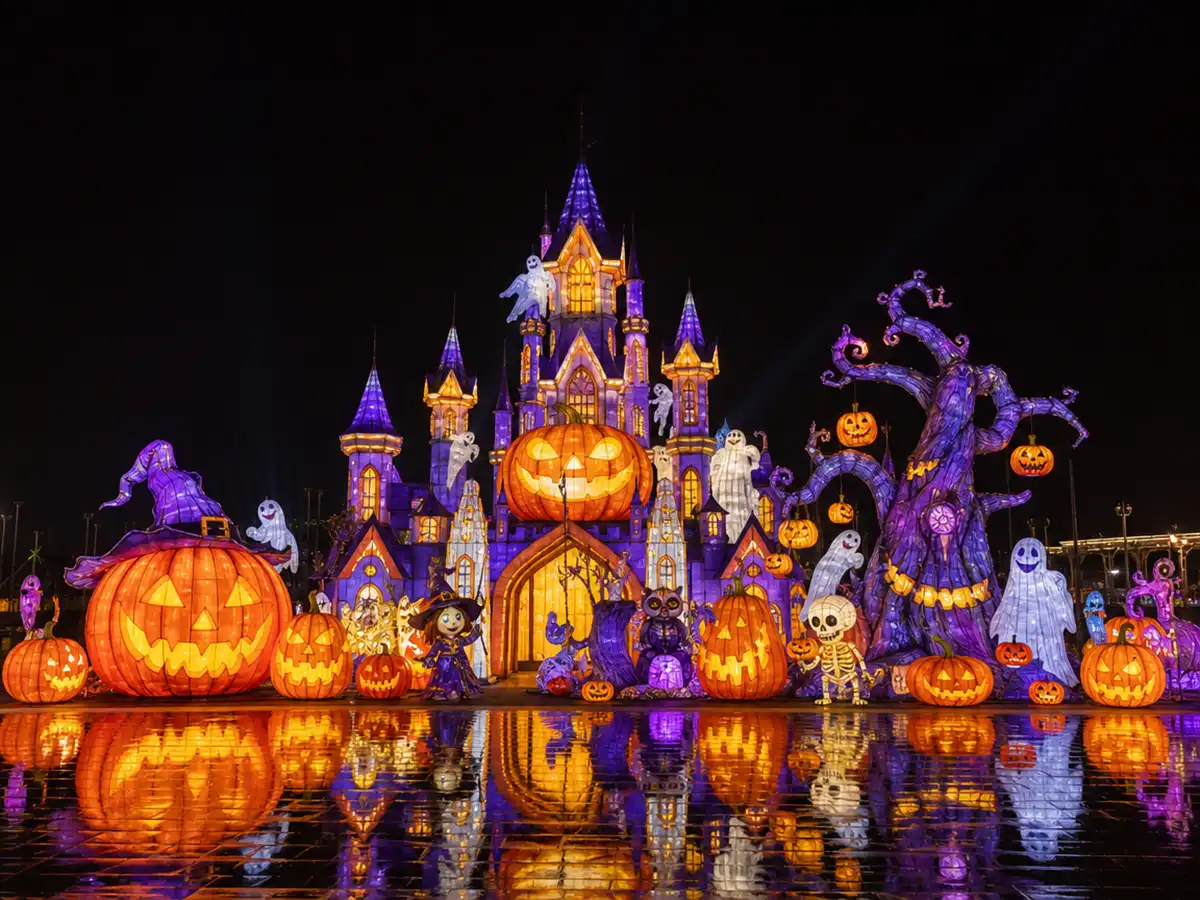
The reference build is a tall gothic castle with lit windows and a spire, sitting over an arched opening at ground level, with a large jack-o’-lantern set into its facade. A purple witch stands on top of a giant pumpkin at the left edge. A large twisted tree hung with pumpkin lanterns fills the right. Ghosts are distributed across the whole frontage at several heights, and a continuous band of pumpkins runs along the ground. The installation stands on polished paving, and the reflection below it effectively doubles the height of the whole composition.
This is an AI-assisted concept visualisation paired with human-written design intent and production specifications. It is a design direction rather than a photograph of a finished product — when a project goes ahead, the scene is re-drawn to your venue dimensions and fabricated in our Zigong workshop on a weatherproof internal frame, covered in hand-painted high-density fabric over a shaped understructure, and lit internally with low-voltage LED. The same build method scales from a compact haunted house up to a full walk-through castle.
Design Intent
The central decision is that the castle is built, not suggested. Because it is three-dimensional, it has real towers at real offsets, and the silhouette changes as a visitor moves across the frontage — a tower that overlaps another from one position separates from it three metres later. That parallax is available only to a built structure, and it is the reason a venue pays for one. If the brief is a castle that only needs to exist as a backdrop, the flat silhouette version in our plaza centrepiece scene does the same job for a fraction of the build.
The arched gateway is what turns the castle from scenery into a route. An opening at the base means the crowd passes through the piece rather than stopping in front of it, which makes this the anchor for a walked trail instead of a viewing stop. It also makes the castle a structural problem rather than a decorative one: an arch carries load around an opening, and that only works if the frame follows the arch curve. Cutting the covering is straightforward; the frame is where the engineering sits.
The witch is mounted on a pumpkin rather than on a plinth. Raising a character into the sightline normally means building a riser, and a riser is dead weight with nothing to look at. Standing the figure on a giant pumpkin solves the height in a single move and adds a second large warm mass to the left of the castle, which the composition needs for balance.
The tall castle is answered on the other side by a tall organic form. A large architectural silhouette on one side and nothing on the other would leave the composition lopsided; the twisted tree gives the right edge a vertical mass of a completely different character — curved where the castle is angular, organic where the castle is built. Opposite shapes at similar heights read as intentional; two similar shapes read as repetition.
The pumpkin band sits deliberately low and continuous. On a reflective surface, the ground row is doing two jobs: it hides the bases, and its mirrored image extends the scene downward, which is what gives the composition its depth on a wet plaza. That is a siting decision as much as a design one — it only pays off where the paving is polished or the ground is wet, and it needs light aimed to graze the surface rather than flood it.
Specifications
| Theme | Haunted castle with walk-through arch — Halloween lantern display |
| Hero structure | Multi-tower gothic castle with lit windows, spire and an arched gateway through the base |
| Facade element | Large jack-o’-lantern set into the castle front |
| Companion figures | Witch mounted on a giant pumpkin, ghosts at multiple heights, a small character figure at the gate |
| Counterweight element | Large twisted tree hung with pumpkin lanterns on the opposite side to the witch |
| Castle scale | 9 m – 14 m to the top of the spire |
| Gateway clear height | 2.6 m – 3.4 m, set to the expected crowd profile |
| Group footprint | 18 m – 28 m frontage; the castle is the deepest piece in the build |
| Base | Ballasted ground plates; no penetration of paving |
| Construction | Welded internal frame in tower sections, hand-painted fabric panels over a shaped understructure |
| Lighting | Warm amber on pumpkins and castle windows, violet on the structures and tree, cool white on the ghosts |
| Power | 110V or 220V, DMX-capable control, weatherproof connections |
| Weather | Outdoor-rated, specified to the wind exposure of the site |
| Transport | Modular — castle towers, arch section, figures, tree and pumpkin band pack as separate units |
Key Features
- Castle built as a real multi-tower structure, so the silhouette changes as visitors move past it
- Arched gateway through the base turns the piece into a route element rather than a backdrop
- Frame follows the arch curve, so the opening carries load instead of weakening the structure
- Witch raised into the sightline by standing on a giant pumpkin rather than on a riser
- Tall twisted tree balances the castle’s vertical mass with an organic opposite silhouette
- Ghosts distributed at several heights so the frontage does not thin out between the tall pieces
- Low continuous pumpkin band conceals bases and doubles the composition on polished or wet paving
- Lit castle windows give the structure a second scale reading at night
- Ballasted bases developed for paved squares and landmark plazas that cannot be drilled
- Castle, arch, figures and tree travel as separate units and load in stages
Where It Works in a Halloween Programme
This is the piece for a trail that needs a gateway moment — the point where a visitor leaves the ordinary part of the site and enters the seasonal one. The arch does the work: it is both an entrance and a photograph, and it gives a venue a way to structure a route without building a separate entrance structure.
It suits a landmark plaza or park that already has a reflective or polished surface and enough width for an 18 to 28 metre frontage. On that kind of site the ground band and the mirror image give the build a presence that the castle alone would not have. Our city lantern festival displays page covers site selection, power and the approval sequence for public squares.
On a routed experience the castle works as the mid-point set piece rather than the opening — visitors walk a corridor of smaller pieces and arrive at the gate. That structure is what we build into zoo lights programmes, and the same routing logic applies to any ticketed trail with a one-way flow.
For European sites, this is the piece where load-in sequencing matters most, because the castle is the tallest and heaviest item in the range and the arch means the structure cannot simply be dropped as one unit. Ports, CE documentation and install crews across those markets are covered in our European festival programme.
Production Notes
The castle is built and shipped in tower sections rather than as a single body, because the towers are where the height is and a single 14 metre body is neither shippable nor erectable. The arch section is built as its own frame following the curve of the opening, and it goes in early in the assembly sequence because the towers above it are set out from it.
The jack-o’-lantern in the facade is a separately shaped piece mounted into the castle front. The windows are painted panels backlit from inside the towers, so the lit window pattern is artwork rather than a set of individual lamps — which keeps the facade consistent if a lamp is replaced.
The twisted tree is the most labour-intensive organic piece in the build: the branch curvature is shaped metalwork, and the hanging pumpkin lanterns are individual small lanterns on short tethers. They are the only moving parts in the scene and are specified so a single lantern can be replaced without dismantling the tree.
Electrically the installation is split by colour family — amber for pumpkins and windows, violet for structures and the tree, cool white for the ghosts — with the arch interior on its own circuit, since the inside of a gateway needs to be lit differently from the outside, and it should be possible to bring it down independently. Control is DMX-capable with weatherproof connections throughout, and the whole build is outdoor-rated and specified to the wind exposure of the site. A structure of this height is anchored on that basis rather than on a default.
Everything installs on ballasted ground plates without penetrating paving. Because the castle is the deepest and tallest piece, it is scheduled first in the load-in and last in the load-out. Assembly sequence and site safety are documented in our on-site installation guide, and container planning for European delivery is set out in the shipping guide.
FAQ
Is the castle a real structure or a backdrop?
It is real — built towers at real offsets, which is why the silhouette changes as visitors move past it. A flat castle silhouette is a different product and costs considerably less to build and to erect, so if the brief is only a backdrop, that is the more sensible route.
Can people actually walk through the arch?
Yes, and on a routed programme that is the point of the piece. The gateway is set at a clear height above the expected crowd profile, and the structure around it is framed to carry the load of the towers over the opening.
Does the scene need a reflective floor?
It does not need one, but it is designed to take advantage of one. On polished or wet paving the ground band and the low composition mirror below the scene and add height. If the paving is dry and matte the scene still works, it simply reads as a single band rather than a doubled one.
How much space does the frontage need?
Plan on 18 to 28 metres of frontage, with the castle as the deepest item. The castle can also be ordered as a standalone set piece, in which case the trees, figures and pumpkin band become optional add-ons rather than part of the composition.
Can the castle be re-themed or extended later?
The frames, tower sections, arch and lighting infrastructure are the durable part; the covering and painted panels carry the theme. That means a later season is a change of artwork rather than a rebuild, and additional towers can be added to raise the silhouette without reworking the base.
How is a structure this tall anchored?
It is specified to the wind exposure of the actual site rather than to a default — the castle has the largest wind profile in the range, so the ballast, tie-backs and ground plate spacing are all set from the location. Nothing is drilled into the paving.
The Halloween Lantern Collection
The castle anchors the large-scale end of a Halloween range that also covers a plaza centrepiece, a linear character frontage, a walk-in pumpkin tunnel, a build-case study and a deliberately non-scary family village. Its closest relative is the giant skull walkthrough light show, which uses a tunnel rather than an arch as its route element.
Sibling designs: giant pumpkin witch centrepiece · pumpkin witch festival frontage · cute witch and ghost village set
The season as a whole is set out on the Halloween lantern display page, the festival lantern range lists what ships alongside this build, and custom lantern manufacturing covers working up a castle to a venue’s own architecture.
Related Designs & Resources
- Halloween lantern displays — the full season range
- City lantern festival displays — site selection, power and approvals
- Zoo lights — routed seasonal programmes
- On-site installation guide — assembly sequence and site safety
- Shipping festival lanterns from China to Europe — ports, transit and customs
- Lantern displays for European festivals — documentation, ports and install crews
- Lantern products — the full range
- All creative designs — browse the full concept collection
Build This Look at Your Venue
The Haunted Castle Pumpkin Village Lantern Display is an AI-assisted concept visualization paired with human-written design intent and production-verified technical specifications. It is a design direction — not a manufactured product. When you order, our team creates custom 3D renderings and fabricates the actual lantern in our Zigong workshop.
This design is built specifically as a halloween lights at the zoo. Every element is handcrafted by Zigong lantern artisans on a weatherproof internal frame and wrapped in high-density fabric with energy-efficient LED lighting. The set scales from compact (3 m wide) to monumental (15m+ wide) depending on your venue footprint and budget.
Specifications
| Theme | Halloween / Haunted Castle & Pumpkin Village |
| Main Figures | Gothic castle facade + pumpkin village houses |
| Companion Elements | Bare twisted trees, glowing windows, cemetery fence details, misty ground |
| Frame Material | Internal frame |
| Skin Material | High-density fabric |
| Lighting | Energy-efficient LED fixtures (custom color palette per scene) |
| Color Palette | Castle gray-purple, pumpkin orange, eerie green glow, midnight blue sky |
| Recommended Setting | Zoo main entrances, park festival grounds, town-center plazas, event anchor installations |
| Customization | Size scaling, color adjustments, logo integration, element add/remove |
| Installation | On-site assembly by our crew or supervised local install |
Key Features
- Cute-Style (治愈系) Hero Design — Gentle expression, soft proportions, and an approachable visual tone that resonates with children, families, and social media audiences.
- Built for halloween lights at the zoo — Purpose-designed scale and visibility make this a popular choice for Halloween seasonal events.
- Handcrafted in Zigong — Every figure is shaped and painted by experienced lantern artisans from the birthplace of Chinese lantern festivals.
- All-Weather Construction — Internal frame and high-density fabric stand up to autumn weather conditions.
- Energy-Efficient LED Lighting — Bright, vivid colors without heat or excessive power draw — ideal for nightly runs throughout October.
- Modular & Scalable — Deploy as a standalone hero piece or combine with other Halloween designs for a multi-scene festival route.
- Turnkey Design Support — Concept art, layout planning, production, shipping guidance, and on-site or remote installation supervision.
FAQ
Is this design suitable for halloween lights at the zoo?
Yes. This concept is purpose-built for halloween lights at the zoo scenarios including zoos, theme parks, town centers, and festival venues.
What sizes are available?
Standard configurations range from 3m to 8m in key dimensions. We can scale up or down to match your exact site footprint and ceiling height constraints.
Can the design be customized?
Yes. Colors, proportions, companion elements, and branding/logo placements can all be adjusted. We produce custom 3D renderings for approval before fabrication begins.
Is this suitable for outdoor use?
Yes. All designs use weatherproof internal frames and treated fabric rated for outdoor autumn weather conditions.
How long does production take?
Standard production is 6–10 weeks depending on size and order queue. For peak October deployment, we recommend placing orders by July.
Related Designs & Resources
- All Creative Designs — Browse our full collection of AI-concept lantern designs
- Lantern Products — Manufactured lantern exhibits ready for deployment
- Zoo Lights Solutions — Complete Halloween and holiday lighting packages for zoos
- Request a Custom Design — Get pricing for your Halloween event
Related Products & Resources
- Chinese Lantern Products — Manufactured lanterns ready for deployment
- Festival Lanterns — Custom holiday and event displays
- Zoo Lights Solutions — Complete packages for zoo events
- Turn This Concept Into a Custom Order
Bring This Design to Life
This haunted castle pumpkin village lantern display concept can be built as a custom display for your venue. Pair it with related products from our factory in Zigong:
- Walk-Through Lantern Tunnel — Immersive Corridor Lantern Display for Festivals, Theme Parks & Zoo Lights
- Howling Wolf Lantern
Most Halloween lantern pieces are looked at. This one is walked through. There is an arched tunnel running straight through the body of the giant pumpkin, and that single decision changes every other part of the brief: the structure has to carry load around an opening, the inside has to be lit as brightly as the outside, the floor has to be walkable, and the crowd has to be managed through it. It is the difference between a display and an attraction.
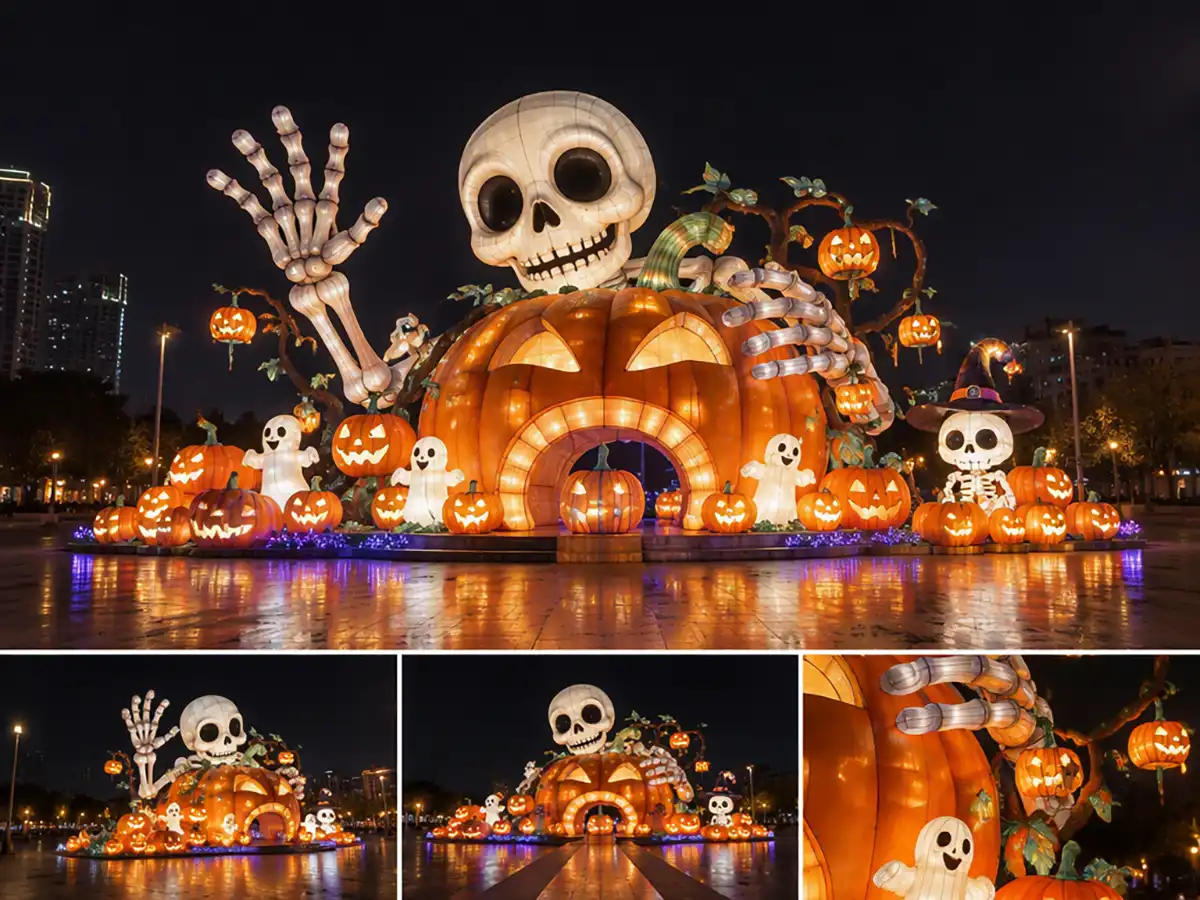
The reference build is a very large pumpkin with an arch-shaped opening cut through its middle, sitting on a plinth edge washed in violet light. A large cream-white skull sits on top of the pumpkin, grinning, with a curled green stem and vine running down one side. An enormous skeletal arm rises on the left with splayed finger bones, and the hand comes back down to rest on the pumpkin’s flank. Small ghosts and a row of jack-o’-lanterns of every size fill the ground around it, and a small cartoon skeleton in a witch hat stands to the right with its own little pumpkin court.
This is an AI-assisted concept visualisation paired with human-written design intent and production specifications. It is a design direction rather than a photograph of a finished product — when a project goes ahead, the scene is re-drawn to your venue dimensions and fabricated in our Zigong workshop on a weatherproof internal frame, covered in hand-painted high-density fabric over a shaped understructure, and lit internally with low-voltage LED. The same build method scales from a small crawl-through piece up to a full walkthrough attraction.
Design Intent
The tunnel is the whole design, so it is worth being precise about what it costs and what it buys. A walk-through opening in a pumpkin body is an arch, and an arch carries load around itself — but only if the frame is built to follow the curve. The covering is easy to open; the frame is where the engineering is. That is the difference between a scene with a hole in it and a structure a venue can send a queue through.
The tunnel also changes the lighting brief completely. On a normal scene the light source is inside the figure and the visitor is outside it. Inside a walkthrough, the visitor is standing in the light source, so the interior surfaces need their own circuit and their own brightness level, and the outside glow partly comes from the light escaping through the opening. The interior is the brightest place on the installation, and it is also the one place where the finish has to be clean, because people will look up at it from a metre away.
The skull sits on top rather than in front, and that is a balance decision as much as a compositional one. A tunnel removes material at ground level, so the read of the piece has to be re-weighted upward or the pumpkin starts to look like a hollow shell. Putting the largest single mass on the roof restores the weight, and it also gives the silhouette its character — the round pumpkin alone would be anonymous.
The giant skeletal arm is a cantilever, and cantilevers are where oversized animal and figure builds fail. The arm rises clear of the pumpkin, holds a splayed hand, and comes back down to rest — three load cases on one element. It is built as a separate piece with a tie-back into the main frame, and the hand rests on the pumpkin rather than floating, which takes part of the load off the shoulder joint. An unsupported arm of this length will droop over a season.
The violet wash around the plinth edge is a small detail doing a large job. A walkthrough of this size sits on a base, and a base on a dark plaza reads as a lump unless it is broken up. Washing the plinth edge in a different colour from the scene separates the installation from the ground plane and quietly describes where the queue goes. It is also the cheapest lighting on the whole build.
Specifications
| Theme | Giant skull walkthrough — Halloween light show |
| Hero structure | Very large pumpkin body with an arched walk-through tunnel |
| Roof element | Large grinning skull with curled stem and vine detail |
| Signature feature | Enormous skeletal arm with splayed finger bones, tie-backed into the main frame |
| Companion figures | Small ghosts at several heights, a cartoon skeleton in a witch hat, pumpkin band |
| Structure scale | Pumpkin 6 m – 9 m; total height with the skull 9 m – 13 m |
| Tunnel clear height | 2.6 m – 3.4 m, set to the expected crowd profile |
| Tunnel clear width | 2.5 m – 4 m, or two lanes for a queued route |
| Ground treatment | Level walkway through the tunnel, with the plinth edge washed in contrast colour |
| Base | Ballasted ground plates; no penetration of paving |
| Construction | Welded internal frame following the arch curve, hand-painted fabric panels over a shaped understructure |
| Lighting | Amber exterior, dedicated interior circuit, violet plinth wash, cool white on the ghosts |
| Power | 110V or 220V, DMX-capable control, weatherproof connections |
| Weather | Outdoor-rated, specified to the wind exposure of the site |
| Transport | Modular — arch section, pumpkin body, skull, arm and companions pack as separate units |
Key Features
- Arched tunnel through the pumpkin body turns the piece from a display into a walked attraction
- Frame built to follow the arch, so the opening carries load instead of weakening the structure
- Dedicated interior lighting circuit, because the visitor stands inside the light source
- Skull positioned on the roof to re-weight a silhouette that a ground-level opening would hollow out
- Giant skeletal arm built as a tie-backed cantilever with the hand resting on the pumpkin
- Violet plinth wash separates the base from the ground plane and describes the queue line
- Companion figures and pumpkin band stand on their own bases and can be re-sited
- Walkway through the tunnel is specified level and walkable, not a decorative opening
- Two-lane tunnel option for high-throughput routes with a managed queue
- Ballasted bases developed for city plazas that cannot be drilled
Where It Works in a Halloween Programme
This is a throughput piece. It belongs where a venue needs to move a queue through a moment rather than hold a crowd in front of a view — a ticketed trail, an enclosed seasonal attraction, a city centre route with one-way flow. Put it where people will pass through it rather than gather around it, and it earns its footprint; put it in a dead-end position and it becomes an obstruction.
The reference setting is a city landmark plaza, and that is the right kind of site: enough width for a queue to form safely, hard level paving through the tunnel, and the surrounding buildings giving the piece a backdrop. Our city lantern festival displays page covers siting, power and the approval sequence for public squares.
Inside an attraction, the same piece works as the transit between two zones — visitors leave one themed area and arrive in another, and the tunnel does the transition without a separate gateway structure. That is how we build routing into zoo lights programmes, and the logic transfers to any one-way trail.
For European sites the practical constraint is the walkway specification, since a public route through a structure has to satisfy the venue’s own safety assessment as well as the supplier’s build standard. Level access, lighting inside the tunnel and the queue approach are all agreed before the load-in date. Ports, CE documentation and install crews across those markets are covered in our European festival programme.
Production Notes
The pumpkin body is built in sections around the arch rather than as a shell with an opening cut afterwards. The arch frame is the first item set out, and the body panels are built onto it, because the curve of the opening is what carries the roof load — a shell that is cut later has no load path around the hole.
The skull is a separate shaped piece mounted on the roof structure, and the arm is a separate frame with its own tie-back, shipped detached. It goes on after the lighting runs have been tested, as does the skull, so that nothing has to be dismantled to reach a connection. The small ghosts and the pumpkin band are independent figures on their own bases.
The covering is hand-painted fabric stretched in panels over the shaped understructure. Because the tunnel interior is viewed from a metre away, the interior panels are finished to the same standard as the exterior, and the joints are closed rather than hidden — this is the part of the build where a rushed finish is visible to every single visitor.
Electrically the installation runs on low-voltage LED with the interior on its own circuit, which allows the tunnel to be set at a different level from the exterior amber. The violet plinth wash is a separate low-level run. Control is DMX-capable with weatherproof connections throughout, and the whole build is outdoor-rated and specified to the wind exposure of the actual site — a piece this tall with an opening through it is anchored on that basis rather than on a default.
Everything installs on ballasted ground plates without penetrating paving. Assembly sequence, the walkway and site safety are documented in our on-site installation guide, and container planning for European delivery is set out in the shipping guide.
FAQ
Is the tunnel genuinely walkable?
Yes, and that is the point of the design. The opening is framed as an arch so the structure carries the roof over it, and the walkway through it is specified level and built for foot traffic. The clear height is set from the crowd profile the venue expects.
Can it handle a queue rather than a walk-through?
Yes. The tunnel can be built as two lanes, and the approach is set out so a queue forms to one side rather than across the entrance. Throughput and queue layout are agreed with the venue at design stage, because they affect the width of the opening.
Does the interior need its own lighting?
It does, and it is on a separate circuit. On a walkthrough the visitor is standing inside what is normally the light source, so the interior surfaces are lit to their own level and can be adjusted independently of the exterior amber.
Is the skeletal arm part of the structure?
It is a separate piece with its own frame and a tie-back into the main structure, and the hand rests on the pumpkin to take part of the load. It is shipped detached and installed after the lighting has been tested.
Can the piece be re-themed for a later season?
The arch, the pumpkin body frame and the lighting infrastructure are the durable part; the covering and painted panels carry the theme. That means a later season is a change of artwork rather than a rebuild, which is normally planned at design stage for venues running an annual programme.
How is a structure with an opening through it anchored?
It is specified to the wind exposure of the actual site, and the specification accounts for the opening rather than treating the piece as a solid body. Ballast, tie-backs and ground plate spacing are set from the location, and nothing is drilled into the paving.
The Halloween Lantern Collection
This walkthrough is the route piece in a Halloween range that also includes a plaza centrepiece, a linear character frontage, a full haunted castle with a walk-through arch, a build-case study and a non-scary family village. Its closest relative is the haunted castle and skulls path, which uses a gateway rather than a tunnel to move a crowd through the build.
Sibling designs: giant pumpkin witch centrepiece · pumpkin witch festival frontage · cute witch and ghost village set
The season as a whole is set out on the Halloween lantern display page, the festival lantern range lists what ships alongside this build, and custom lantern manufacturing covers working up a walkthrough to a venue’s own theme.
Related Designs & Resources
- Halloween lantern displays — the full season range
- City lantern festival displays — site selection, power and approvals
- Zoo lights — routed seasonal programmes
- On-site installation guide — assembly sequence and site safety
- Shipping festival lanterns from China to Europe — ports, transit and customs
- Lantern displays for European festivals — documentation, ports and install crews
- Lantern products — the full range
- All creative designs — browse the full concept collection
Build This Look at Your Venue
A frontage has a different job from a centrepiece. A centrepiece has to be found from across a square; a frontage has to hold a boundary. This design runs along a line — a fence, a park edge, a mall frontage, the long side of a plaza — and its whole logic is that a visitor walks past it rather than towards it. That changes what has to be solved: not depth, but variety along the length.
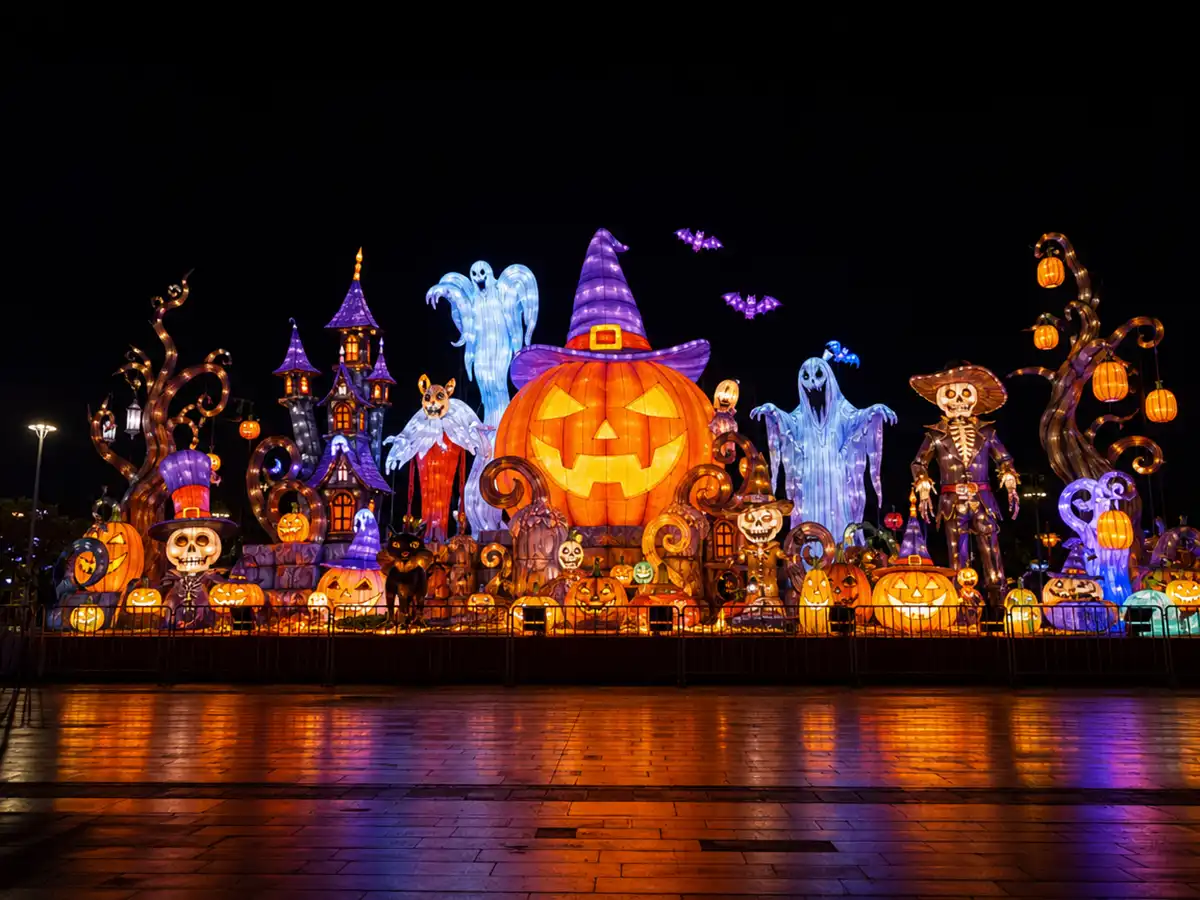
The reference build is a long row of characters behind a low fence: a purple witch-hat pumpkin at the centre, a set of tall flowing ghosts in white and blue, a gentleman skeleton in a top hat, a second skeleton in a wide-brim hat and jacket, a small purple castle with pointed turrets, and twisted trees hung with small pumpkin lanterns at both ends. At the base, a continuous band of pumpkins and lanterns; a black cat and an owl sit in among them as small discoveries.
This is an AI-assisted concept visualisation paired with human-written design intent and production specifications. It is a design direction rather than a photograph of a finished product — when a project goes ahead, the scene is re-drawn to your venue dimensions and fabricated in our Zigong workshop on a weatherproof internal frame, covered in hand-painted high-density fabric over a shaped understructure, and lit internally with low-voltage LED. The same build method scales from a short run of figures up to a full boundary frontage.
Design Intent
The whole design is built on silhouette variety along the line. Walking past a frontage, a visitor only ever sees a slice of it at a time, and progress depends on there being a new profile every few metres. In the reference build the run alternates heights and shapes deliberately: a soft irregular ghost mass, then a hard vertical castle tower group, then a pumpkin with a wide brim, then a wide-brim hat on a human frame, then a twisted tree. No two adjacent pieces share a silhouette.
The two skeletons are separated by hats, not by faces. A top hat and a wide-brim hat give two completely different head profiles, and profile is what carries at distance — the ribcage, the bow tie and the jacket detail only matter in the last few metres. If both skeletons wore the same hat the frontage would have a repeat in it, and a repeat in a linear run reads as a mistake rather than a pattern.
Ghosts are the cheapest height in the scene. A ghost is one soft silhouette with a wavy hem — no limbs, no joints, no pose, no structural articulation. That is why they are used here to fill the tall background slots, where a sculpted figure of the same height would be many times the work. Because they carry almost no detail, they also need contrast to read: they are lit cool white and blue against the violet structures, which is what stops them disappearing into the background.
The hanging pumpkin lanterns in the trees are doing a specific job. Between the tall figures and the ground band there would otherwise be a dark gap, and a frontage with a dark gap reads as a row of separate objects. The small lanterns at mid-height create a middle layer of glowing points that ties the tall pieces to the base and makes the whole run look dense. They are on short tethers so they swing, and the swing is worth having — it is the only thing on a static frontage that moves.
The fence is both a design device and a working element. Visually it draws a clean baseline under an irregular row of shapes, which is what stops the run looking untidy. Practically it hides the back-of-house line, and on a linear run cabling is the hardest thing to hide, because there is no depth to bury it in. Everything that feeds the frontage comes up behind that fence line.
Same palette rule as the rest of the range: violet for structure, amber for light. Pumpkins, lanterns and windows are amber; hats, trees, castle, ghosts and fence are violet and cool white. It is a two-colour system, and a busy row of characters needs it more than a single centrepiece does.
Specifications
| Theme | Giant pumpkin witch — Halloween lantern frontage |
| Hero piece | Jack-o’-lantern with a wide-brim witch hat, centred in the run |
| Character set | Two human-frame skeletons with different hats, multiple flowing ghosts, small purple castle |
| Companion elements | Twisted trees with hanging pumpkin lanterns, black cat and owl, pumpkin and lantern band |
| Figure scale | Ghosts and tall figures 4 m – 6 m; pumpkin hero 4 m – 6 m; base band 0.4 m – 1.2 m |
| Run length | 25 m – 45 m, extendable in modules by repeating the base band and adding figures |
| Depth required | Shallow — the run is built to be read from the front |
| Base | Ballasted ground plates behind a low fence line; no penetration of paving |
| Construction | Welded internal frame, hand-painted fabric panels over a shaped understructure |
| Lighting | Amber on the pumpkins and lanterns, violet on structures, cool white and blue on the ghosts |
| Power | 110V or 220V, DMX-capable control, weatherproof connections |
| Weather | Outdoor-rated, specified to the wind exposure of the site |
| Transport | Modular — figures, trees, castle and base band pack as separate units and the run length is set on site |
Key Features
- Built as a linear run, so it holds a boundary edge instead of occupying a square
- Every adjacent piece has a different silhouette, so the run stays interesting to walk past
- Two skeletons differentiated by hat profile — a top hat and a wide brim — rather than by detail
- Ghost figures used to fill tall slots cheaply, with cool white and blue light for contrast
- Hanging pumpkin lanterns at mid-height tie the tall figures to the ground band
- Low fence gives the run a clean baseline and conceals the back-of-house cable line
- Black cat and owl placed at child height as small discoveries along the route
- Extendable in modules — the base band repeats and figures can be added without redesign
- Two-colour system keeps a busy row of characters reading as one installation
- Ballasted bases developed for paved frontages and park edges that cannot be drilled
Where It Works in a Halloween Programme
This is the piece for a boundary. It runs along whatever edge already exists — a park perimeter, a fence line, a shopping centre frontage, the long side of a plaza, a riverside walk. Because it is shallow and front-facing, it needs very little floor area, which makes it the right choice where a centrepiece would eat the space a venue needs for circulation.
Its natural home is a walked route: the frontage does the work of a corridor, keeping visitors moving and giving them something to read at walking pace. That makes it a good fit for ticketed trails and for seasonal programming inside existing attractions. See zoo lights for how we structure routed programmes and where a frontage sits inside one.
On a city or town programme it is often the answer for the second and third locations, where the main square already has a hero piece and the surrounding streets need something of their own. Because the run extends in modules, a venue can start with a short frontage in year one and grow it. Site selection, power and the municipal approval sequence are covered on our city lantern festival displays page.
For European sites the shallow footprint is the practical advantage: the run can be installed along a frontage that has to stay in public use, with the fence and the base band doing the crowd control. Ports, documentation and install crews across those markets are covered in our European festival programme.
Production Notes
Figures are shaped over welded internal frames with hand-painted fabric stretched in panels over the shaped understructure. The ghosts are the simplest build in the set — a soft form with a hem and no articulation — while the skeletons are the most detailed, because the frame has to follow a skeletal profile rather than a solid body.
Hats are separate pieces and go on after the head is covered. That is deliberate: it means a venue can change the character of a figure at a later date by swapping one hat, which is a far smaller job than re-working a head. The castle is built in tower sections, and the trees are shaped metalwork with the curvature built into the branch, not bent on site.
The pumpkin lanterns in the trees are individual small lanterns on short tethers. They are the pieces most likely to need attention during a season, because they are the only moving parts, and they are specified so a single lantern can be replaced without dismantling the tree.
Electrically the run is split into circuits by colour family — amber for pumpkins and lanterns, violet for structures, cool white and blue for the ghosts — so one group can be adjusted without touching the others. Every circuit runs up behind the fence line, and the base band is set so that it closes over the cable entries. Control is DMX-capable with weatherproof connections, and the installation is outdoor-rated and specified to the wind exposure of the actual frontage — a linear run catches wind differently from a compact scene, and the anchoring is set accordingly.
Everything is modular and installs on ballasted ground plates without penetrating paving. Assembly sequence and site safety are documented in our on-site installation guide, and container planning for European delivery is set out in the shipping guide.
FAQ
Can the run be made longer or shorter?
Yes. The frontage is modular: the base band repeats and figures can be added or removed, so the run length is set to the site. The one piece that is not simply repeatable is the pumpkin hero, which is the visual centre of the composition and stays single.
How much depth does it need?
Very little. It is designed to be read from the front, so the run occupies a shallow strip along an existing edge. That is the main reason to choose a frontage over a centrepiece — it holds a boundary without taking space out of the middle of a site.
Can the two skeletons be made distinct?
They already are, and the difference is in the hats — a top hat and a wide brim. That is deliberate, because head profile is what carries at distance. If a venue wants two clearly different characters for a programme, the hats can be changed independently of the figures.
Can pieces be removed for a smaller site?
Yes. Every figure and every tree stands on its own base, so a venue can run a subset of the frontage. Removing pieces does affect the silhouette rhythm, so the shortened run is re-laid out rather than simply cut off at one end.
Can the figures be re-themed for a later season?
The frames, the base band, the fence and the lighting infrastructure are the reusable part; the covering and painted panels carry the theme. A later season is therefore a change of covering and artwork rather than a rebuild, which is usually planned at design stage for venues running an annual programme.
How is a linear run anchored in wind?
A long run presents a different wind profile from a compact scene, so it is specified to the exposure of the actual frontage rather than to a default. Ballast, tie-backs and the spacing of the ground plates are all set from the site, and nothing is drilled into the paving.
The Halloween Lantern Collection
This frontage is the boundary piece in a Halloween range that also includes a plaza-scale centrepiece, a full haunted castle with a walk-through arch, a walk-in pumpkin tunnel, a build-case study and a non-scary family village. The plaza-scale counterpart, the giant pumpkin witch centrepiece, is built around a moon disc and needs open space in front of it, which is the opposite requirement to this run.
Sibling designs: haunted castle and skulls path · giant skull walkthrough light show · cute witch and ghost village set
The season as a whole is set out on the Halloween lantern display page, the festival lantern range lists what ships alongside this run, and custom lantern manufacturing covers working up a frontage from a venue’s own theme.
Related Designs & Resources
- Halloween lantern displays — the full season range
- Zoo lights — routed seasonal programmes
- City lantern festival displays — site selection, power and approvals
- On-site installation guide — assembly sequence and site safety
- Shipping festival lanterns from China to Europe — ports, transit and customs
- Lantern displays for European festivals — documentation, ports and install crews
- Lantern products — the full range
- All creative designs — browse the full concept collection
Build This Look at Your Venue
The job of a plaza centrepiece is to be readable from the far side of the square, before a visitor has decided which way to walk. A pumpkin lantern on its own cannot do that — a pumpkin is one round amber mass, and from forty metres it reads as a glowing blob. This design solves that with a single move: it puts the pumpkin in front of a lit disc, and lets the disc do the announcing.
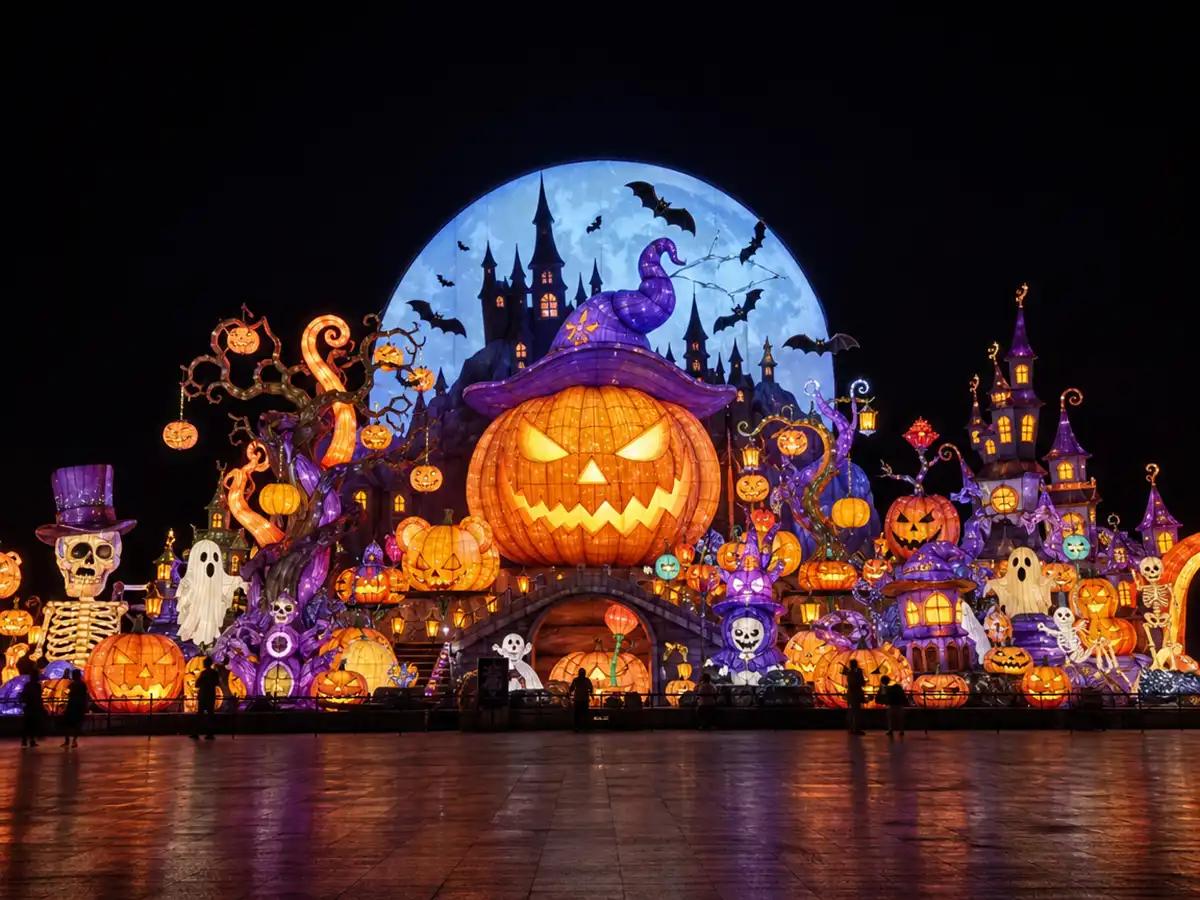
The reference build is a shallow arc of pieces arranged in front of a large circular moon disc. The disc carries a silhouetted castle skyline and bats across its face. In front of it: an oversized jack-o’-lantern wearing a purple witch hat at the centre, a gentleman skeleton in a top hat at one edge, a twisted tree hung with small lantern pumpkins at the other, ghosts, and a low band of pumpkins along the ground. From the entrance to the plaza the whole thing reads as three layers — a luminous disc, a dark castle line, and a warm amber crowd of figures underneath it.
This is an AI-assisted concept visualisation paired with human-written design intent and production specifications. It is a design direction rather than a photograph of a finished product — when a project goes ahead, the scene is re-drawn to your venue dimensions and fabricated in our Zigong workshop on a weatherproof internal frame, covered in hand-painted high-density fabric over a shaped understructure, and lit internally with low-voltage LED. The same build method scales from a single figure up to a full plaza centrepiece.
Design Intent
The moon disc is the reason this scene works as a centrepiece rather than a cluster. A large flat luminous circle gives the whole installation a boundary and a background in one piece. Everything else is arranged in front of it in a shallow arc, which means the scene has a clear viewing side and a clear back — so it does not have to be a full 360° build, and it does not need to be sited where a crowd can walk behind it.
The castle on the disc is a silhouette, not a structure. This is the single most useful thing about the design. A venue that wants a castle landmark behind a Halloween scene normally has to build a castle — towers, walls, frames, weight, load-in time. Here the castle exists only as a dark shape against a lit disc, which means the visual landmark costs one flat panel and no structure at all. The bats are the same panel. If a venue later wants a real castle, that is the haunted castle scene, and it is a different build with a different load-in.
The witch hat is a height device. Adding an actual pumpkin at this scale adds width, not height, and a taller pumpkin eventually stops reading as a pumpkin. A tall cone with a wide brim on top of an existing pumpkin buys several metres of silhouette for a fraction of the material, and it changes the reading from “pumpkin” to “witch” instantly. The brim is also what makes the top of the scene read at distance — a thin cone would disappear, a wide brim will not.
The composition is closed at both ends by two different things. On one side a twisted tree hung with small lantern pumpkins, which is an organic edge and widens the footprint; on the other a gentleman skeleton in a top hat, which is a character and gives the scene a protagonist. A scene that ends with pumpkins just stops. A scene that ends with a tree and a character feels finished from either approach direction.
The palette is a strict two-colour system, and it is worth copying deliberately: violet is structure, orange is light. The hat, the tree, the castle silhouette, the tower forms and the ghosts all sit in the violet family; the pumpkins, lanterns and windows all sit in the amber-orange family. Nothing else is allowed in. That is why a scene this busy still reads as one object instead of a rummage sale.
Specifications
| Theme | Giant pumpkin witch — Halloween plaza centrepiece |
| Hero figure | Oversized jack-o’-lantern with a wide-brim witch hat |
| Backdrop | Large circular moon disc carrying a silhouetted castle skyline and bats |
| Companion pieces | Top-hat skeleton character, twisted tree with hanging lantern pumpkins, ghosts, pumpkin band |
| Figure scale | Hero pumpkin 6 m – 9 m to the top of the hat |
| Disc diameter | 14 m – 20 m, sized to remain inside the viewing distance of the plaza |
| Group footprint | 20 m – 30 m frontage in a shallow arc |
| Base | Ballasted ground plates; no penetration of paving |
| Construction | Welded internal frame, hand-painted fabric panels over a shaped understructure; the disc is a flat framed panel |
| Lighting | Warm amber core on the pumpkins, violet on the structures, cool blue-white on the disc |
| Power | 110V or 220V, DMX-capable control, weatherproof connections |
| Weather | Outdoor-rated, specified to the wind exposure of the site |
| Transport | Modular — disc panels, figures and pumpkin band pack as separate units |
Key Features
- Framed moon disc gives the installation a background and a boundary for the cost of one panel
- Castle landmark rendered as a silhouette rather than a structure — no second building to erect
- Wide-brim witch hat adds height to the hero pumpkin without adding width
- Single viewing side, so the scene does not need a full 360° build or a walk-around footprint
- Composition closed at both ends by a character on one side and an organically shaped tree on the other
- Two-colour system throughout — violet for structure, amber for light — so the scene reads as one object
- Pumpkin band along the ground conceals ballast, ground plates and cable entries
- Gentleman skeleton gives the scene a protagonist and a human-scale reference point
- Ballasted bases developed for paved squares that cannot be drilled
- Figures, disc panels and pumpkin band travel as separate units
Where It Works in a Halloween Programme
This is a scene for a stationary crowd, not a route. It belongs in the middle of a plaza, at the far end of a walking route as the terminal view, or on a raised terrace where people can see it across water or across a square. It needs distance — the design only resolves at roughly twenty to thirty metres — so a narrow street or a tight courtyard will lose the disc and flatten the whole thing into a wall of orange.
The clearest fit is a city square or landmark plaza running a Halloween season alongside its ordinary programme: the scene is a single self-contained destination that does not need a route built around it. Our city lantern festival displays page covers site selection, power and the municipal approval sequence for that kind of placement.
It also works as the terminus of a ticketed trail — the piece a visitor walks the whole route towards — and as an entrance statement where a venue has a wide forecourt. On a routed experience the pumpkin band and the tree are the pieces that get re-sited to fill a gap, because every companion except the disc and the hero pumpkin stands on its own base. See zoo lights for how we structure routed seasonal programmes.
European venues should plan the load-in around the season, not the other way round. Halloween sits inside the autumn trade period, so a plaza usually has to keep trading while the scene goes up. The split footprint — disc, hero, character, tree, pumpkin band — is what makes a phased install possible. Ports, documentation and install crews are covered in our European festival programme.
Production Notes
The disc is built as a flat framed panel in sections, joined on site. Its silhouette detail is carried in the painted covering rather than as cut-outs, so the castle line and the bats stay crisp from the front and the panel remains weather-tight. Because it is flat, it is also the piece most sensitive to wind — the disc is specified with its own tie-backs and the siting has to account for the prevailing wind direction.
The hero pumpkin is shaped over a welded internal frame and covered in hand-painted fabric panels; the witch hat is a separate cone and brim that goes on after the pumpkin face is finished. Faces are painted into the covering, not projected, so the expression does not shift if a lamp is replaced.
The gentleman skeleton and the ghosts are figure builds on their own frames. The twisted tree is the most labour-intensive organic piece in the scene — the branch curvature is shaped metalwork, and the hanging lantern pumpkins are separate small lanterns on short tethers, which is why they swing in wind and why they need enough tether to move without tangling.
Electrically the scene runs on low-voltage LED in three circuits — amber for the pumpkins and lanterns, violet for the structures and ghosts, cool blue-white for the disc. Separating the disc onto its own circuit matters, because the disc should be able to come down in brightness independently while the pumpkins stay bright. Control is DMX-capable with weatherproof connections throughout, and the whole installation is outdoor-rated and specified to the wind exposure of the actual site.
Everything travels as separate units and installs on ballasted ground plates without penetrating paving. Assembly sequence and site safety are documented in our on-site installation guide, and container planning for European delivery is set out in the shipping guide.
FAQ
Does the scene need to be viewed from one side only?
Yes, and that is a design feature rather than a limitation. Everything is arranged in front of the disc, so the installation has a clear front. That keeps the structure lighter and means a venue does not need a walk-around footprint or a crowd-management plan for the back.
Is the castle a real structure?
No. The castle in this design is a dark silhouette carried on the moon disc, which is why it adds a landmark without adding a second building to erect. If a venue wants a physical castle with towers and a walk-through arch, that is our haunted castle scene, which is a substantially larger build.
How much viewing distance does it need?
Plan on roughly twenty to thirty metres for the composition to resolve. The scene is designed to be read from across a square. In a space narrower than that the disc closes in around the figures and the piece reads as a wall of orange rather than as a layered composition.
Can the companion pieces be placed separately?
Yes. The skeleton character, the twisted tree, the ghosts and the pumpkin band all stand on their own bases, so they can be spread across a site. Only the disc and the hero pumpkin are effectively a pair.
Can the scene be re-themed for a different season?
The frames, the pumpkin band and the lighting infrastructure are the reusable part. The covering and the painted panels are what carry the theme, so a later season is a change of covering and painted artwork rather than a rebuild. That is normally planned at design stage for venues that run an annual programme.
How is it specified for an exposed site?
The frame, the disc tie-backs and the ballast are specified to the wind exposure of the actual location rather than to a default. A sheltered city square and a waterfront plaza are not the same brief, and the disc is the piece that decides the anchoring.
The Halloween Lantern Collection
This centrepiece is the plaza-scale piece in a Halloween range that also covers a linear character frontage, a full haunted castle with a walk-through arch, a walk-in pumpkin tunnel, a build-case study and a deliberately non-scary family village. The other plaza-scale option, the pumpkin witch festival lantern frontage, is built for a boundary edge rather than a square, and the standard-bearer for the season is the Halloween lantern display programme.
Sibling designs: haunted castle and skulls path · giant skull walkthrough light show · cute witch and ghost village set
For a venue buying the season rather than a single scene, the festival lantern range lists what ships alongside this piece, and custom lantern manufacturing covers working up a bespoke centrepiece from a venue’s own theme.
Related Designs & Resources
- Halloween lantern displays — the full season range
- City lantern festival displays — site selection, power and approvals
- Zoo lights — routed seasonal programmes
- On-site installation guide — assembly sequence and site safety
- Shipping festival lanterns from China to Europe — ports, transit and customs
- Lantern displays for European festivals — documentation, ports and install crews
- Lantern products — the full range
- All creative designs — browse the full concept collection
Build This Look at Your Venue
Halloween has two audiences and they are not the same booking. A scare set is sold to teenagers and adults after dark. A cute set is sold to families, and it can run in daylight as well as after dark — which means a venue can sell the same installation twice in one day. This design is built entirely for the second audience, and every decision on the page follows from that.
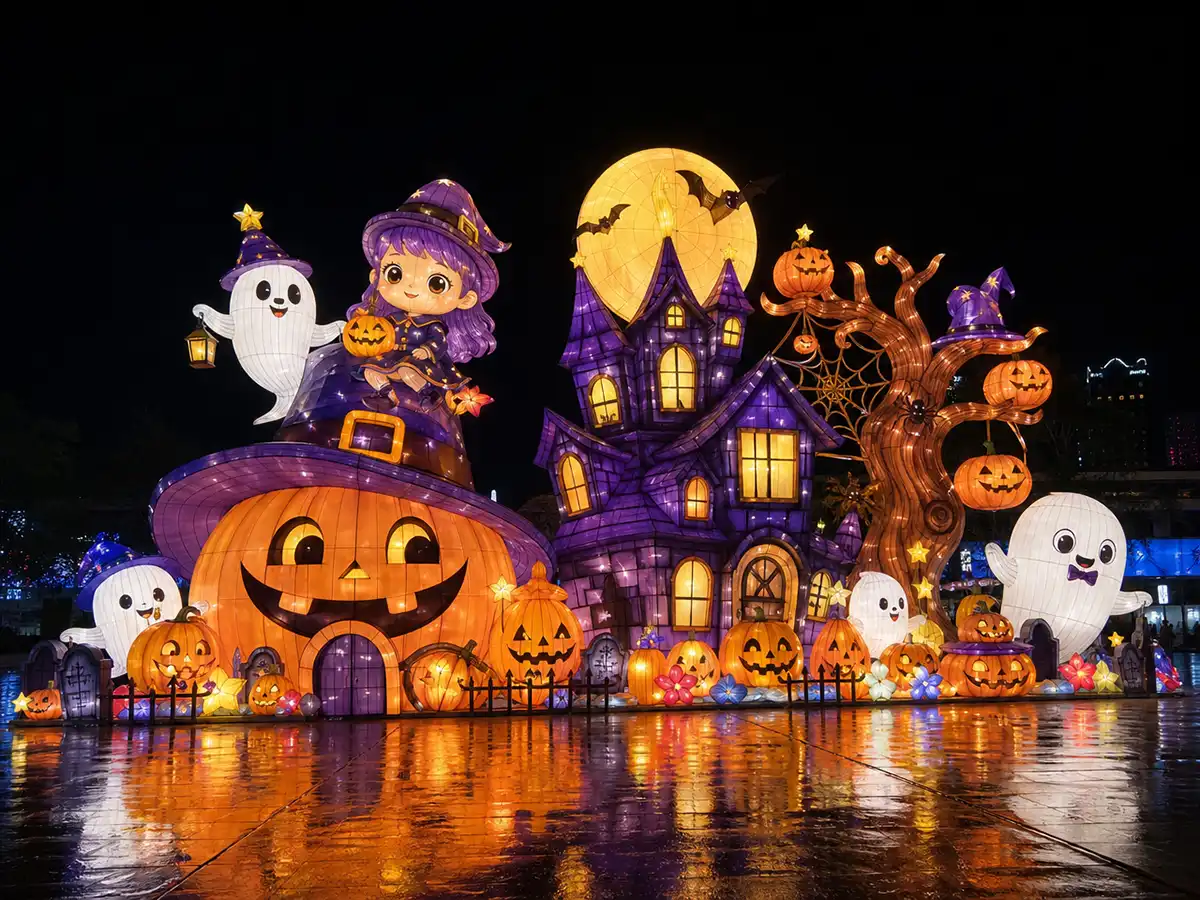
The reference build is a small village rather than a cast of characters. A cartoon girl witch with a very large head sits on top of a pumpkin that has been built as a house, with a door and lit windows. To her right, a crooked purple cottage leans at an angle with warm yellow windows. A large warm gold moon disc hangs behind, with bat silhouettes across its face. Smiling ghosts with bow ties float at several heights, a twisted tree on the right carries hanging pumpkin lanterns and a spider web, and a low black fence runs along the front with small gravestones and a band of pumpkins behind it.
This is an AI-assisted concept visualisation paired with human-written design intent and production specifications. It is a design direction rather than a photograph of a finished product — when a project goes ahead, the scene is re-drawn to your venue dimensions and fabricated in our Zigong workshop on a weatherproof internal frame, covered in hand-painted high-density fabric over a shaped understructure, and lit internally with low-voltage LED. The same build method scales from a single pumpkin house up to a full village set.
Design Intent
The moon disc sets the mood of the entire scene, and the colour of the disc is the control. Here it is warm gold, and that single choice makes everything in front of it friendly — the bats across its face read as a picture-book detail rather than a threat. The identical disc device appears in our plaza centrepiece scene, where it is lit cold blue-white and the same bats read as menace. It is the same panel and the same silhouette artwork; only the colour changes. If a venue wants to shift this set towards spookier without rebuilding it, the disc circuit is the first thing to touch.
The hero prop is a pumpkin that is also a house. It has a door and lit windows, which means one piece is doing three jobs at once: a recognisable Halloween symbol, a small structure, and a light source at the centre of the composition. Building it as a house rather than as a plain pumpkin is what makes the scene a village instead of a characters-and-props arrangement, and it gives the witch somewhere to sit.
The cottage is deliberately out of plumb. This is a storybook cue, not sloppy work: a straight-walled building reads as architecture, and a leaning one reads as illustration. The walls are built to a set lean, the roof is oversized, and the windows are warm and small. That combination is what places the scene in the same visual world as the chibi witch, and without it the two halves of the composition would look like they came from different products.
The bow tie is doing the single most important job on the ghosts. A ghost form with a soft blob silhouette and a wavy hem is inherently ambiguous — the difference between spooky and friendly is entirely in the face and the accessories. A smile instead of a hollow mouth, plus one small bow tie, flips the same shape completely. It is one of the cheapest details on the build and it is the one that decides whether a family stops in front of the scene or walks past it.
The low fence along the front is a working element, not decoration. On a family installation the electrical base, the ground plates and the cable entries all sit at exactly the height a small child finds interesting. The fence draws a physical line a metre out from the base, and it also gives the irregular village a clean baseline. On a children’s event that is the detail that keeps the scene family-facing rather than a thing parents have to guard their children from.
Specifications
| Theme | Cute witch and ghost village — family Halloween lantern set |
| Hero piece | Pumpkin built as a house with a door and lit windows, with a cartoon girl witch seated on top |
| Village element | Crooked purple witch cottage with warm lit windows |
| Backdrop | Large warm gold moon disc with bat silhouettes |
| Companion figures | Smiling ghosts with bow ties at several heights, twisted tree with hanging pumpkin lanterns and a spider web |
| Base elements | Low black fence line, small gravestone markers, pumpkin band |
| Witch figure scale | 1.6 m – 2.4 m seated; oversized head proportioned for a child-height reading |
| Pumpkin house scale | 2.5 m – 4 m, with the cottage at a similar height |
| Disc diameter | 8 m – 14 m |
| Group footprint | 12 m – 20 m frontage |
| Base | Ballasted ground plates behind a low fence line; no penetration of paving |
| Construction | Welded internal frame, hand-painted fabric panels over a shaped understructure; the disc is a flat framed panel |
| Lighting | Warm amber on pumpkins, windows and lanterns; warm gold on the disc; soft white on the ghosts |
| Power | 110V or 220V, DMX-capable control, weatherproof connections |
| Weather | Outdoor-rated, specified to the wind exposure of the site |
| Transport | Modular — disc panels, pumpkin house, cottage, figures and base band pack as separate units |
Key Features
- Deliberately non-scary throughout, so the set can run in daylight as well as after dark
- Warm gold moon disc — the same device as our scare builds, lit in the opposite colour to change the mood
- Hero pumpkin built as a house with a door and windows, doing the work of symbol, structure and light source
- Cottage walls built to a set lean so the village reads as illustration rather than architecture
- Ghost figures finished with smiling faces and bow ties, the cheapest detail that flips them from spooky to friendly
- Low front fence draws a physical line a metre out from the electrical base on a children’s event
- Gravestone markers give the season a gentle nod without a scare
- Spider web between the tree and the village ties two structures together visually for almost no material
- Every figure and the cottage stand on their own bases, so the village can be re-laid out per site
- Ballasted bases developed for shopping centres, town squares and park lawns that cannot be drilled
Where It Works in a Halloween Programme
This is the family precinct of a programme. On a routed trail it goes where the crowd includes small children and where parents need somewhere to stop rather than somewhere to hurry past — near the entrance, at the food and drink end, or as a dedicated children’s zone. On a mixed programme it is deliberately placed so that a family can complete the cute section and leave, without having to pass through the scare section to get out.
It also works as a standalone booking outside a festival context: a shopping centre atrium, a town square, a garden centre or a leisure venue running a half-term offer. Because it is not scary, it can operate through the day — which in practice means a shopping centre can run it against trading hours and a ticketed trail can sell a daylight session as well as an evening one. Our city lantern festival displays page covers siting and approvals for public and commercial squares.
Inside an existing attraction it works as the children’s element of a larger seasonal programme, and it is usually the piece that justifies a family ticket tier. See zoo lights for how we structure a programme where different zones carry different age profiles.
For European sites the daylight capability is a real commercial point, since many town-centre programmes want something that reads before dark. Ports, CE documentation and install crews across those markets are covered in our European festival programme.
Production Notes
Figures are shaped over welded internal frames with hand-painted fabric panels stretched over the shaped understructure. On a cute build the faces carry more weight than anything else, because the whole appeal rests on the expression: the eyes are large with a painted highlight, the mouth is a smile rather than a snarl, and the snout and blush areas are separate painted panels rather than blends. The witch’s oversized head is a deliberate proportion, not a scale error — the sitting figure is built head-heavy so that a child standing next to it is looking at a face at their own height.
The cottage is built with the lean set into the frame rather than fitted afterwards, because a crooked structure needs the plumb line designed out of it from the start. The roof overhangs deliberately, and the windows are painted panels backlit from inside, so the lit window pattern is artwork rather than individual lamps.
The moon disc is a flat framed panel in sections, joined on site, with the silhouettes carried in the painted covering rather than as cut-outs. It is the piece most sensitive to wind, so it has its own tie-backs and its siting takes the prevailing wind direction into account. The hanging lanterns on the tree are small individual lanterns on short tethers — they are the only moving parts, and they are set up so a single lantern can be replaced without dismantling the tree.
Electrically the set runs on low-voltage LED in separate circuits: warm amber for pumpkins and windows, warm gold on the disc, soft white on the ghosts. Putting the disc on its own circuit is what makes the mood changeable — the same build can be pushed warmer or cooler without touching the rest. Control is DMX-capable with weatherproof connections throughout, and everything is outdoor-rated and specified to the wind exposure of the actual site.
The fence, gravestones and base band all install on ballasted ground plates without penetrating paving, and the fence line is set out on site so the stand-off distance from the electrical base is consistent along the whole frontage. Assembly sequence and site safety are documented in our on-site installation guide, and container planning for European delivery is set out in the shipping guide.
FAQ
Is the set suitable for small children?
That is what it is designed for. Every figure is non-scary by specification — smiling faces, no gore, no sudden reveals — and the low front fence sets a physical stand-off distance from the electrical base along the whole frontage.
Can it run during the day?
Yes, and that is one of the commercial reasons to choose it. Because the scene is not built around darkness or fright, a venue can run daylight sessions as well as evening ones, which means the same installation can be sold to two different audiences.
Can the same set be made spookier?
It can be pushed in that direction, and the first control is the moon disc, which is on its own lighting circuit. Lighting the disc cooler and colder changes the mood of the whole scene without a rebuild. Beyond that, the ghost faces and the gravestone markers are the pieces that carry the tone.
Can the village be made smaller for a mall atrium?
Yes. The cottage, each figure and the base band stand on their own bases, so a smaller location can run a subset — typically the pumpkin house with the witch, one or two ghosts and the disc. The shortened layout is re-set rather than simply cut off at one end.
Can the pieces be re-used in a later season?
The frames, bases and lighting infrastructure are the durable part; the covering and painted panels carry the theme. A later season is a change of covering and artwork rather than a rebuild, which is normally planned at design stage for venues running an annual programme.
Does it need a flat paved surface?
It installs on ballasted ground plates and can sit on paving, a park lawn or a plaza. What the set does need is a reasonably level frontage along the fence line, because the stand-off from the base is part of the family-safety design rather than a decorative choice.
The Halloween Lantern Collection
This village is the family piece in a Halloween range that also includes a plaza centrepiece, a linear character frontage, a full haunted castle with a walk-through arch, a walk-in pumpkin tunnel and a build-case study. Venues running a mixed programme normally pair it with the pumpkin witch festival frontage in the older section, keeping the two zones visually separate so families can complete the gentle part of the route and leave without passing the scare pieces.
Sibling designs: giant pumpkin witch centrepiece · haunted castle and skulls path · giant skull walkthrough light show
The season as a whole is set out on the Halloween lantern display page, the festival lantern range lists what ships alongside this set, and custom lantern manufacturing covers working up a village set from a venue’s own characters.
Related Designs & Resources
- Halloween lantern displays — the full season range
- City lantern festival displays — site selection, power and approvals
- Zoo lights — routed seasonal programmes
- On-site installation guide — assembly sequence and site safety
- Shipping festival lanterns from China to Europe — ports, transit and customs
- Lantern displays for European festivals — documentation, ports and install crews
- Lantern products — the full range
- All creative designs — browse the full concept collection