Spain runs a festival calendar that no other European market has. Christmas lights come down across most of the continent in the first days of January. In Spain the season does not end then — it ends on the night of 5 January, when the Three Kings arrive, and in some cities the displays stay up into the middle of the month.
Two extra weeks of lit nights is not a small detail. It changes the length of the paying window, the number of photographs your visitors take, and the reason a family comes back to a route they have already walked.
This guide covers how lantern displays are planned for Spanish venues — the calendar, the iconography that works, the port cities you ship into, and the documentation an ayuntamiento expects to see before it signs anything.
In Spanish procurement the programme has a name. The council publishes it as the alumbrado navideño — also written iluminación navideña — the installation itself is an instalación efímera (a temporary installation, with its own insurance and safety expectations), and the contract is awarded through a licitación scored against a pliego de prescripciones técnicas. Those are the words that will appear on the tender notice, the invoice and the insurance policy, so they are worth using from the first email.
Why the Spanish festival calendar runs longer than the rest of Europe
Across Germany, the Netherlands and the UK the pattern is consistent: light trails open in mid-November, peak in the fortnight before Christmas, and close shortly after New Year. In Spain the same route opens at a similar time but the last big night sits a full twelve days later.
The Three Kings — Reyes Magos — are the reason. Spanish families exchange the main gifts of the season on the morning of 6 January, and the night before belongs to the Cabalgata, the parade that moves through the centre of almost every town and city. A display programme that ends on 2 January has already missed its biggest night of the year.
For a venue, that has three practical consequences:
- The lit window is two to three weeks longer, which spreads the same build cost across more evenings of trading.
- The final week needs its own content. A route built only around Santa reads as finished on 27 December. A route that gains a Three Kings scene keeps its reason to exist through to Reyes.
- Take-down starts later, so the storage and de-rig plan has to be written for mid-January, not for the week after New Year.
If you are comparing markets, it is worth reading the way the same question is handled in northern Europe. Our notes on Christmas market lighting in Germany show a market that peaks before Christmas and closes hard in December, while the light festival installation guide for the Netherlands works around canal routes that are walked well into January. Spain sits closest to the Dutch pattern, with a fixed national date at the end of it.
The run of dates has local names worth using when you build the schedule: Nochebuena on 24 December, Nochevieja on 31 December, and Día de Reyes on 6 January, with the lit climax on the evening of 5 January — la noche de Reyes. A route planned as a Christmas installation alone is effectively over by 2 January; a route that gains a Three Kings scene runs to the last night the council has already advertised.
Three Kings’ Night: the display opportunity most markets simply do not have
The Cabalgata de Reyes is the biggest family night in the Spanish calendar. Floats move through the centre, sweets are thrown into the crowd, and children arrive early to hold a place on the pavement. Cities spend serious effort on the route because the audience is not a niche — it is the whole city, on foot, for two or three hours.
That gives a lantern display an obvious job it does not get in other markets. The parade itself moves; the static pieces around it do not. Well-placed figure groups extend the event before the floats arrive and hold the crowd after they have passed — at the plaza where the route starts, along the approach streets, and at the end point where families are waiting to go home.
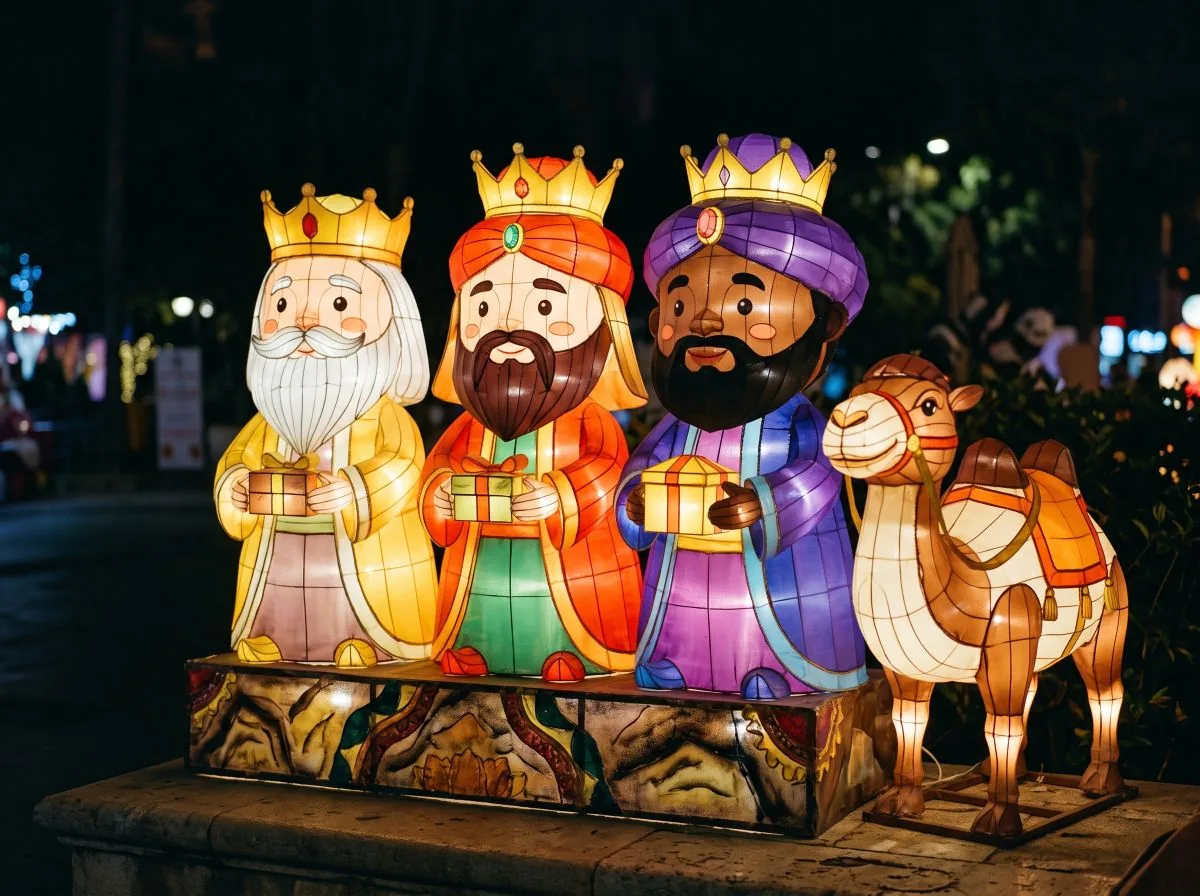
Three Kings work particularly well as lantern figures because the silhouette is unmistakable at distance: three crowned heads, three gift boxes, and a camel or two in profile. Built at entrance scale and lit in warm white, a group reads clearly from thirty metres without any text or interpretation panel — which matters on a night when the audience is moving.
Practical points that come up in nearly every Spanish brief:
- Placement against crowd flow. Figure groups belong on the side of the route that families walk first, so the pieces are seen on the way in rather than passed on the way out.
- Height and sightlines. Reyes figures are photographed constantly with children in front of them. A base height that puts the crowns above adult head height is the difference between a photograph and a blocked view.
- Colour discipline. Gold, red and deep blue read as the Three Kings. A group lit in mixed colour reads as a generic nativity set, and Spanish audiences notice the difference immediately.
The Cabalgata is a municipal event, and in most cities it sits with the concejalía de festejos — the festivities department of the ayuntamiento. That has a practical consequence for a supplier: static pieces placed along the parade route need their own permiso de ocupación de vía pública (permission to occupy public land), and the build needs a plan de seguridad y salud with a named coordinador de seguridad y salud, even when the assembly is carried out by local contractors. Both are routine, and both are what delay an otherwise finished programme if they are left to the last month.
Flamenco and Spanish iconography on a lantern frame
Away from the religious calendar, the strongest Spanish themes are not generic Christmas at all. They are cultural forms the audience already recognises and has an emotional relationship with.
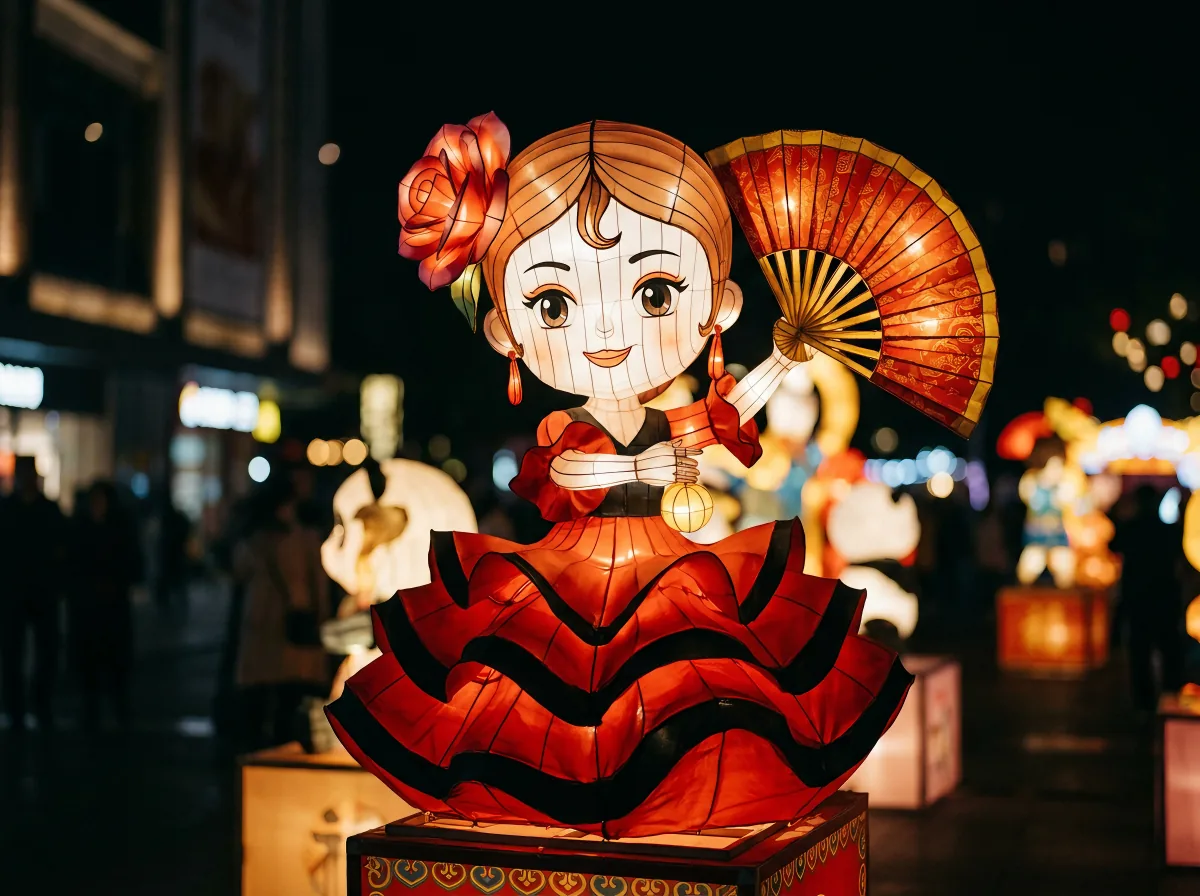
Flamenco is the clearest example. A dancer figure in a layered red dress, holding a fan, with a rose at the shoulder, works as an illuminated character piece in a way that a generic “Christmas lady” never does. The dress gives the builder a large, layered, translucent surface — which is exactly what a lantern frame handles best — and the fan creates a strong graphic shape that reads from a distance.
The same logic applies to other recognisable Spanish forms: the guitar, the castanets, the fan, the shawl, and the flower in the hair. None of them need explaining to a Spanish audience, and all of them give a lighting designer an obvious place to put colour.
Andalusia: Moorish arches, pomegranates and orange trees
Southern Spain has a regional visual language that is genuinely different from both the rest of Spain and the rest of Europe, and it translates well into lantern form.
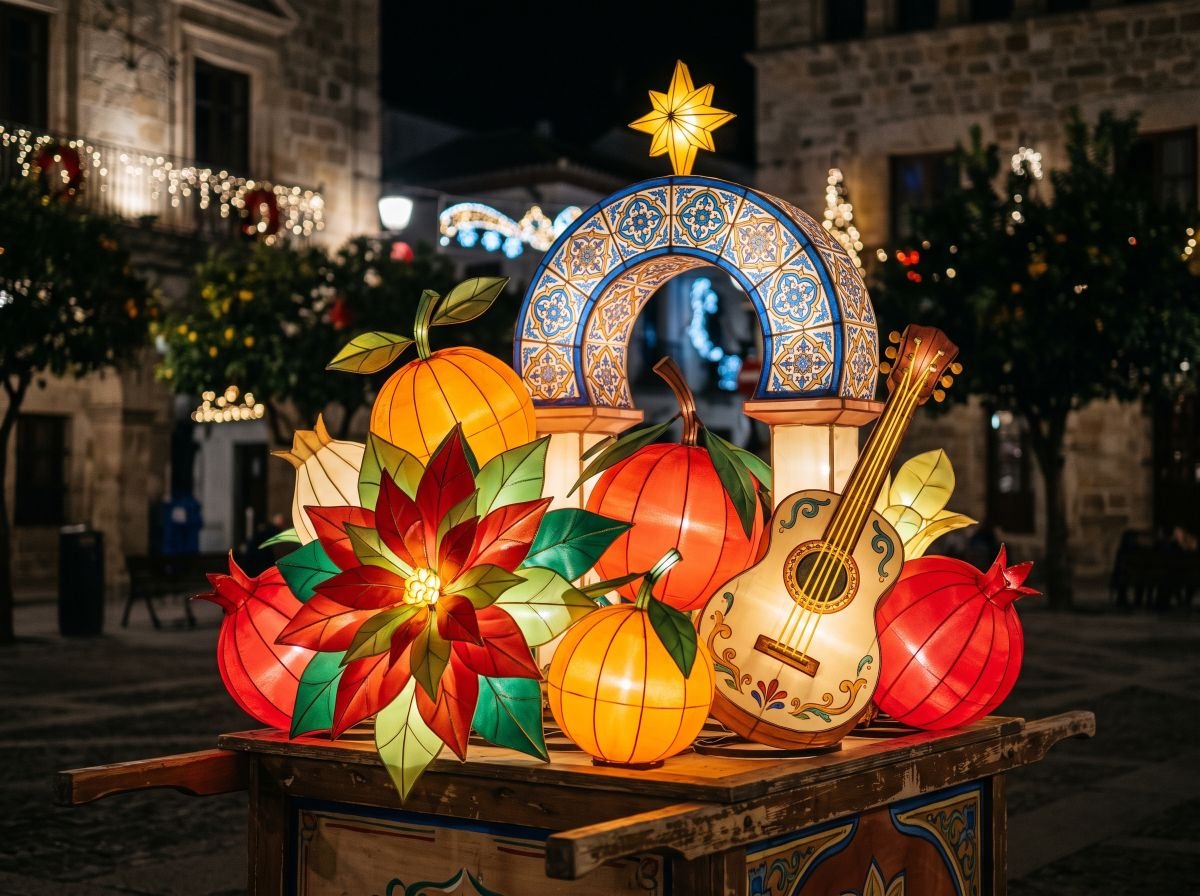
The Moorish arch is the anchor. Its repeated geometric pattern gives a builder a surface with structure rather than a plain panel, and it frames whatever is placed beneath it. Pair it with the fruit that grows all over the south — pomegranates, oranges — and the reference lands immediately for anyone who knows Andalusia, and reads as warm, decorative and photographic for anyone who does not.
It is worth separating the regional work from the religious work when you brief a designer. A Three Kings group is a date-specific installation with a short peak. An Andalusian motif group — arch, fruit, guitar, foliage — can run the whole season and be redeployed the following year with a different surrounding scene. Venues that run an annual programme get more out of the second category.
Story-driven themes: Don Quixote and the windmill
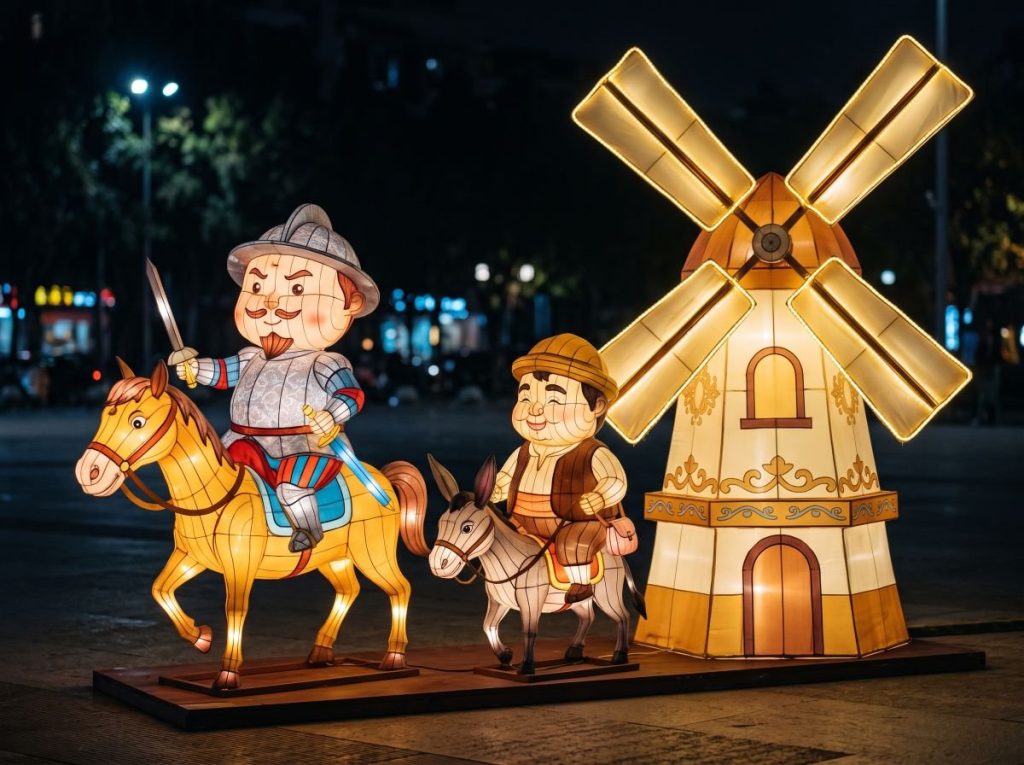
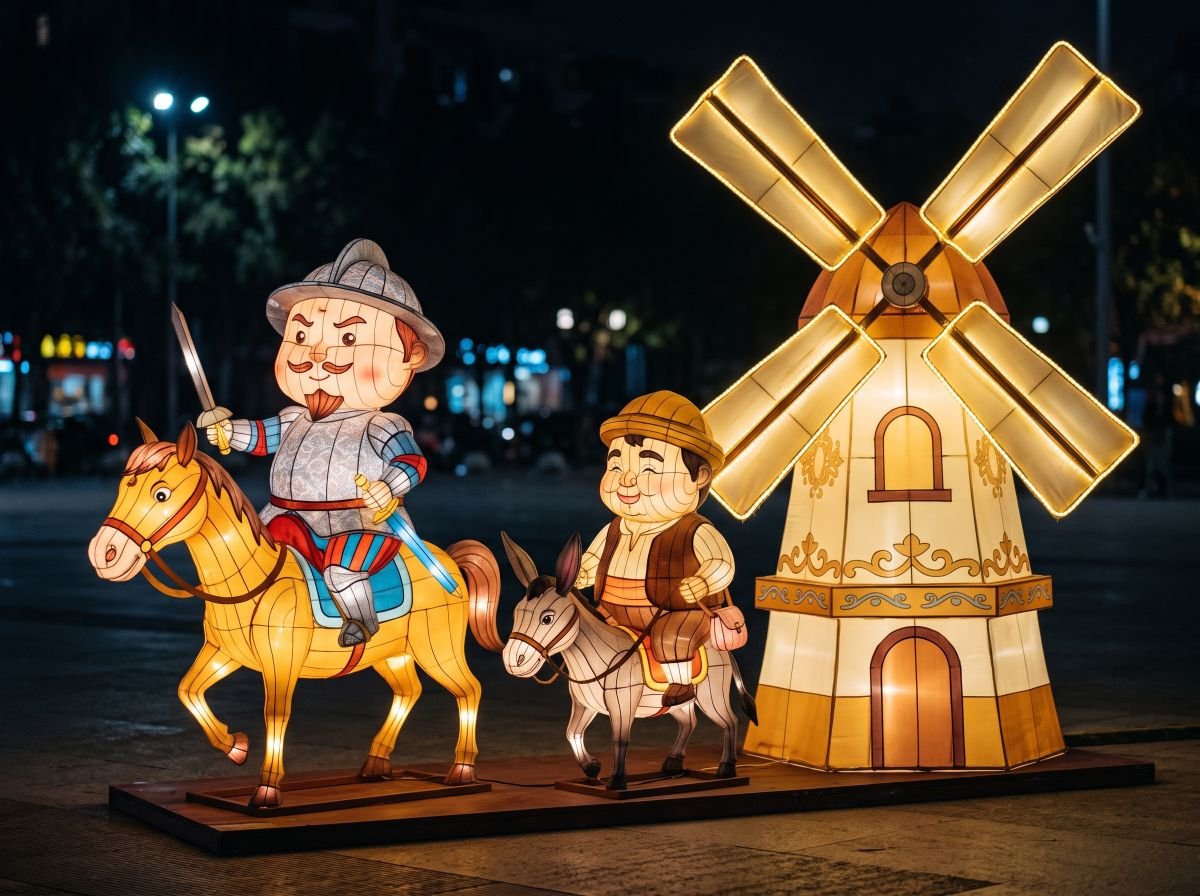
Spain has a piece of literature that the whole country can picture: a thin man on a thin horse, a round man on a donkey, and a windmill standing in for a giant. Cervantes does something for a lantern route that few themes can — it gives you a scene with a story already in the visitor’s head.
For a builder, the group is unusually generous. The horse gives a vertical figure with an animal form. The donkey gives a lower, wider silhouette that balances the composition. The windmill gives a large structure with four rotating blades that can be lit on separate circuits, which means a static installation can still produce a moving shadow pattern across a plaza without any mechanical movement at all.
It works in two directions. Placed near an entrance it becomes a talking point and a photo stop. Placed deeper in a route it gives visitors something to look forward to after the main gateway — which is the pacing problem every light trail has to solve.
Plaza-first planning: keeping the square open for business
Spanish city centres are not event venues that happen to have shops in them. The plaza is where people eat, drink and meet, and any display that closes it for six weeks creates a problem the council will hear about.
This changes the design brief in ways that are specific to Spain:
- Footprints have to leave the business perimeter working. Bars and restaurants trade through a Spanish winter, and they trade outside. A scene that blocks a terrace has a cost that does not appear on any festival budget.
- Anchoring has to respect stone and tile. Historic plazas and their paving are not designed to be drilled. Ballasted and non-penetrating fixing is usually the starting assumption, not an alternative.
- Access routes are permanent requirements. Deliveries, ambulances and refuse collection continue through the festival period. The route plan has to be drawn around them rather than adjusted once the pieces are placed.
Anchoring and power on a Spanish plaza are governed by two documents the municipal técnicos work to. The electrical design is assessed against the REBT (Reglamento Electrotécnico de Baja Tensión), and for a temporary installation the relevant instruction is ITC-BT-34, which covers provisional and temporary installations — the reason a supply that would pass indoors can still need revision before it goes onto a plaza. On the structural side, wind and snow actions for a Spanish site resolve to the CTE, the Código Técnico de la Edificación, in its DB-SE-AE document: the Spanish counterpart to the Eurocode load cases used further north, and the figure a técnico municipal will ask you to state.
For venues working through a municipal approval process for the first time, the sequencing is set out on our city lantern festival displays page — site selection, power supply and the approval timeline, in the order the paperwork actually moves.
Where Spanish lantern programmes are installed
Most Spanish enquiries fall into five categories, and each has a different priority:
- City plazas and ayuntamiento fronts. The highest-visibility installation and the longest approval process. Usually the council’s own programme, sometimes a tourism department.
- Zoo and aquarium trails. Animals are a natural fit for illuminated figures, and Spanish zoos increasingly run winter evening openings to fill the months when daytime visits drop. Our animal lantern manufacturer page covers how the species mix and the route are planned together.
- Seafront promenades. Spain’s coastline gives venues a route that does not exist in landlocked markets. Salt air and wind exposure change the specification, and installation windows are usually outside the summer season.
- Theme parks and shopping centres. Both run extended winter programmes, and both need pieces that can be moved or re-dressed year on year.
- Chinese New Year celebrations. Madrid’s Usera district holds one of the largest in southern Europe, and the audience is a mix of the Chinese community and Spanish visitors. This is the one theme where both cultural references can sit in the same route without either looking out of place.
Beyond Christmas and Reyes, Spanish venues run on a calendar of local events with their own names, and they are the reason illuminated pieces can work for more of the year than in northern Europe: Fallas in Valencia in March, Semana Santa processions across the south in spring, the Feria de Abril in Seville, and neighbourhood verbenas through the summer. A motif group built for a plaza — an arch, a fruit-and-foliage piece, a guitar — can be re-dressed and reused across those dates, which is usually cheaper than commissioning a second set.
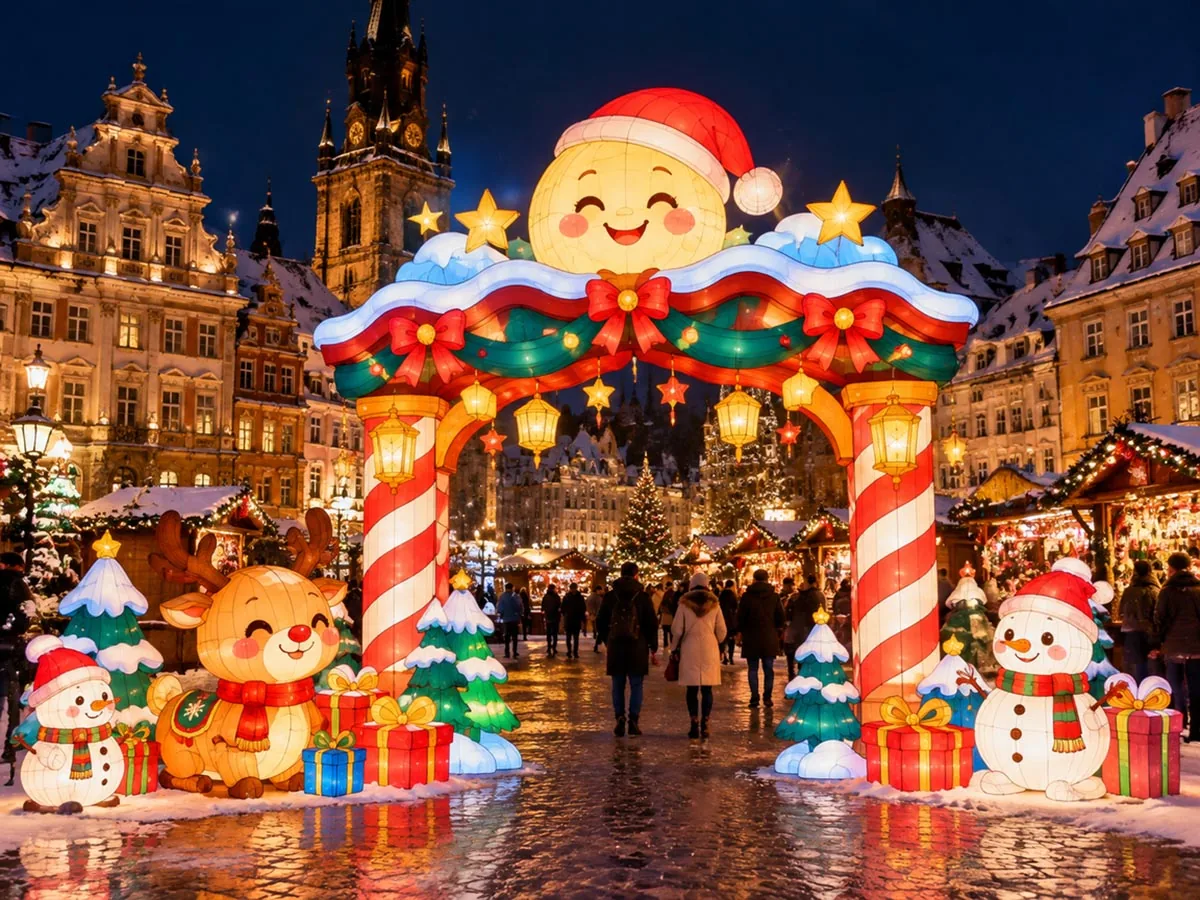
December programmes in these markets run the Christmas range before the Three Kings installations go up. The three pieces most often specified for a plaza are a light arch promenade across the approach, a traditional Santa, tree and reindeer set at the photo point, and a sleigh and gift-box scene where families queue. All three are free-standing and ballasted rather than fixed, so the paving is left untouched and the same pieces can be re-sited for the local festival dates that follow.
Shipping into Spain and Portugal: ports, transit and customs
Spanish deliveries are planned around four ports. Barcelona and Valencia carry the east coast and cover most of Catalonia, Valencia and Murcia. Bilbao serves the north and the Basque country. Algeciras is the practical entry point for Andalusia and for onward movement toward Portugal, alongside Lisbon and Leixões for Portuguese programmes.
Ocean transit from Chinese ports runs in the region of four to six weeks depending on the port pair and the season, and the booking is made against your opening night rather than against our production convenience. The full breakdown of that leg — routes, transit windows, documentation and the sequence of clearance — sits in our guide to shipping festival lanterns from China to Europe.
Two Spanish-specific points worth planning early:
- Inland delivery to a city centre is a separate operation from the port leg. A 40-foot container does not always reach the plaza. For historic centres the plan usually switches to smaller vehicles or a night-time transfer window, and this has to be agreed with the council in advance.
- Clearance timing matters more when the last night is fixed. With Reyes on 6 January, the installation window is already tighter than a German or Dutch programme of the same size.
Documentation Spanish venues and ayuntamientos ask for
Public procurement in Spain is documented, and the documentation is requested early — often before any commercial discussion. What is normally needed:
- CE marked components for lighting, cables and control electronics, declared in the documentation pack rather than confirmed verbally.
- Site plans and anchoring layouts drawn for the people who sign off public events, with load figures and clearances stated up front.
- Packing lists keyed to the installation sequence, so customs clearance and site unloading read from the same document.
- Method statements for build and electrical work, prepared to your venue’s own safety template.
We supply that pack as standard on programmes of any size. The same requirements, applied to a colder and wetter market, are set out in our winter lantern festival programme notes — the difference in Spain is not the specification, it is the date the whole programme has to be finished by.
The standards a Spanish venue or its técnico will name are these:
- REBT and ITC-BT-34 — the low-voltage regulation and its instruction for temporary installations. This is what the local electrician connects and inspects against.
- CTE DB-SE-AE — wind and snow actions on a temporary structure, including the anchoring and ballast assumptions behind them.
- EN 13501-1, adopted in Spain as UNE-EN — the fire classification of the covering material, and the first question asked about a fabric-covered structure in a public space.
- EN 60598 with a CE declaration of conformity — the luminaires and chain sets inside the structure.
- UNE adoptions of the European norms generally, plus whatever the project’s own pliego adds on top of them.
On a public tender the documentation travels inside a wider file, and the vocabulary is worth recognising: solvencia técnica (evidence that you have built comparable installations), the published presupuesto base de licitación as the ceiling, the plazo de ejecución, and a garantía definitiva — a performance bond — at award. Insurance is separate and specific: a seguro de responsabilidad civil naming the installation. Site work sits under the Spanish prevention-of-risks framework, which is why the plan de seguridad y salud is requested early rather than at handover.
The procurement calendar, counted back from 6 January
Spanish programmes are usually counted backwards from Reyes rather than forward from Christmas, because that is the date the council has already published. Working in reverse:
| Months before Reyes | What has to happen |
|---|---|
| 9–11 months | Site brief, drawings, approval in principle and the production slot reserved |
| 6–8 months | Fabrication and factory pre-assembly, with progress photography through the build |
| 3–4 months | Ocean freight booked, export documentation issued before the vessel sails |
| 6–8 weeks | Arrival, clearance, inland delivery to the venue access window |
| 3–4 weeks | Installation, electrical connection and night testing |
| Opening night | 5 January, with the route held through to 6 January |
The failure mode is consistent across the markets we work in: a programme that enquires in September for a Reyes opening is already competing for a production slot that was reserved in spring. If your opening date is fixed by a public calendar rather than by your own decision, the enquiry belongs nine to eleven months before that date, not three.
If you are buying through the public process rather than privately, the calendar carries one more layer, and it is set by the notice rather than by the supplier: the plazo de presentación (the window for submitting), adjudicación (award), and the garantía definitiva at signature. Because a Reyes opening is published by the council rather than chosen by you, the date worth planning against is the publication date, not the opening night — a tender published in spring is aiming at the following January.
Frequently asked questions
Can a display be built specifically for the Three Kings?
Yes, and it is one of the most requested Spanish themes. Figure groups are built at entrance scale with crowns, gift boxes and animals as separate pieces, so a venue can place three or four groups along a route rather than one large scene in a single location.
Do you work with local Spanish installation contractors?
Yes. We can send a supervision team to direct the build with your own crews carrying it, or we can supply to the contractor who holds the site works. On historic plazas the split is usually agreed early, because the anchoring method and the paving protection sit with whoever is on site.
How are displays specified for coastal venues?
Coastal installations are built to an outdoor-rated standard with the wind and salt exposure of the specific site taken into account at design stage. Indoor pieces use fittings specified for covered spaces. The same specification is not proposed for both.
Is there a minimum order size?
There is no fixed minimum in pieces, but container economics set a practical floor. A 20-foot container is the usual starting point for an international programme, and smaller orders can ship as part-load with a higher unit cost.
Can a route continue after 6 January?
Some venues extend into the middle of January, particularly where the display sits in a commercial or tourism district rather than a residential square. The take-down and storage plan is written for the date you actually choose.
Can the same structures be reused next year?
Modular entrance and motif structures can be re-dressed for the following season, which is usually planned at design stage for venues that run an annual programme. Reusable frames keep the following year’s scope smaller.
What does an ayuntamiento tender actually ask for?
Usually solvencia técnica — evidence that you have built comparable installations — the published presupuesto base de licitación as the ceiling, a defined plazo de ejecución, and a technical file covering the CE declaration for the electrical elements, the EN 13501-1 fire classification of the covering, structural assumptions against the CTE for wind and snow, and an electrical design to the REBT with ITC-BT-34 for the temporary installation. A garantía definitiva is normally required at award.
Which installation standards apply in Spain?
The REBT and its ITC-BT-34 instruction for temporary installations; the CTE, DB-SE-AE, for wind and snow actions; EN 13501-1, adopted as UNE-EN, for the fire class of the covering material; and EN 60598 for the luminaires. Site work also sits under the Spanish prevention-of-risks framework, which is why a plan de seguridad y salud and a named coordinador de seguridad y salud are requested on the build.
See the Spanish Festival Collection