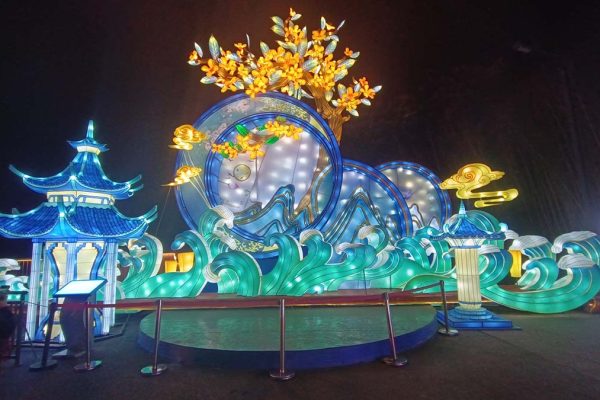
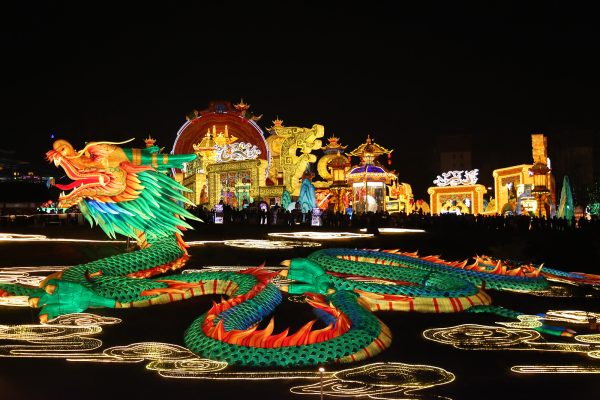
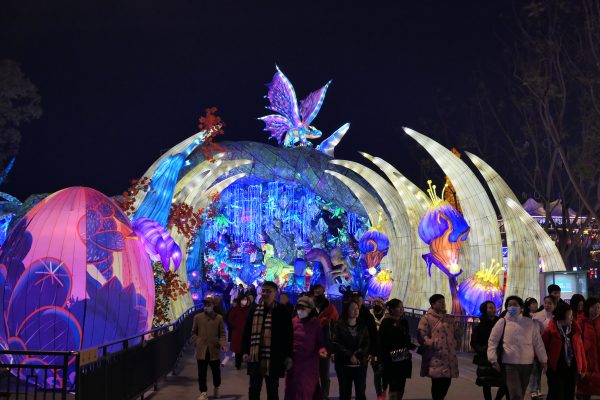
Walk through any Zigong lantern workshop and you will hear two terms repeated constantly: (shùn sī, “parallel-following wire”) and (héng sī, “horizontal cross wire”). They are not decoration vocabulary. They are the single most important distinction in how a lantern frame is built — and they determine whether a lantern looks like a cheap decoration or a museum-grade piece.
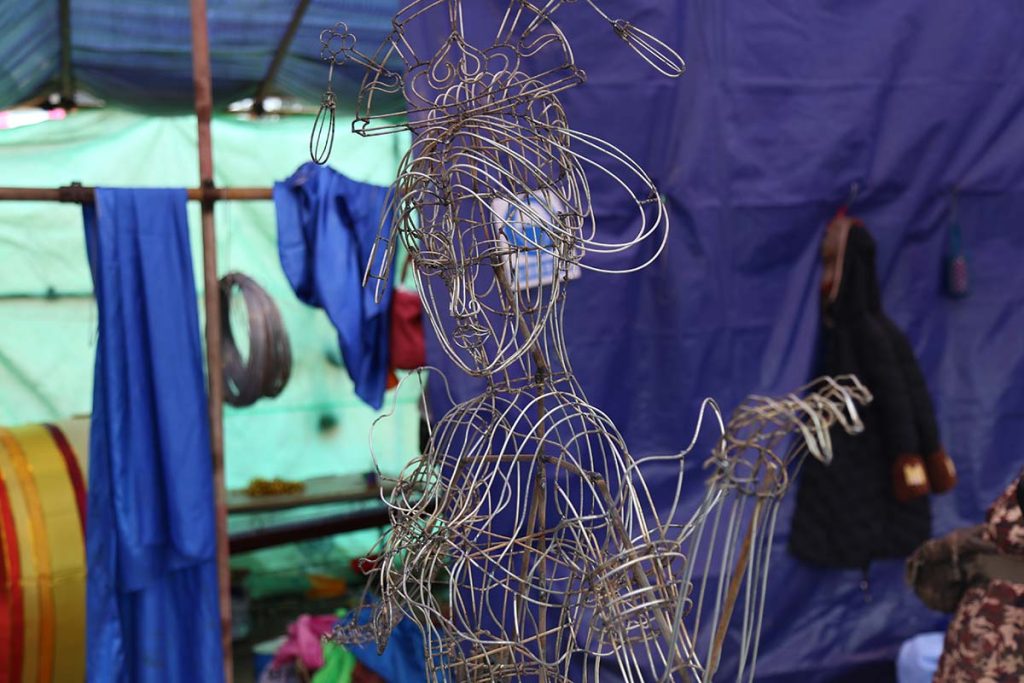
To an untrained eye, a wire frame looks like a random mesh of bent metal. But every single wire running through a professional lantern is placed with deliberate directional intent. defines form. defines volume. Together, they solve what is arguably the hardest problem in lantern art: making a rigid metal structure look fluid, expressive, and alive.
This article explains how Zigong’s master frame builders deploy these two wire types — and why understanding this distinction matters when you are evaluating a manufacturer’s craftsmanship.
1. The Fundamental Distinction
(Parallel-Following Wire) — The Form-Giver
Definition: Wire that runs along the natural contours and flow lines of the design. In a dragon lantern, 顺丝 follows the serpentine curve of the body. In a phoenix, it traces the arc of each feather. In a human figure, it mirrors the sweep of flowing robes.
Visual analogy: Think of as the pencil outline of a sketch — it defines the silhouette and the primary visual gesture.
Technical characteristics:
- Runs parallel to the “grain” of the form
- Spacing: typically 8–15 cm between adjacent parallel wires
- Wire gauge: lighter than structural beams (4–6mm diameter for contour, 6–8mm for primary flow lines)
- Primary function: visual expression — smooth curves, facial features, fabric folds
(Horizontal Cross Wire) — The Volume-Maker
Definition: Wire that runs perpendicular to the contour lines, cutting across the form at regular intervals. These wires function like the cross-sections of a 3D scan — each loop defines what the lantern looks like if you sliced through it at that point.
Visual analogy: Think of as the cross-sectional ribs — they turn a 2D outline into a 3D object.
Technical characteristics:
- Runs perpendicular to the dominant contour direction
- Spacing: 20–40 cm between adjacent cross-sections
- Wire gauge: heavier than (6–10mm diameter) because they bear the radial tension
- Primary function: structural integrity — maintaining the 3D volume, resisting compression, preventing the hand-finished surface from sagging between contour wires
The Relationship:
        ┌──────────────────────────────────┐
        │          (cross-section)       │
        │    ┌─────────────────────┐        │
        │    │                     │        │
        │    │    (contour)     │        │
        │    │   running along      │        │
        │    │   the form's flow    │        │
        │    │   → → → → → → →     │        │
        │    │                     │        │
        │    └─────────────────────┘        │
        │                                  │
        └──────────────────────────────────┘
The two wire directions form a grid — but unlike mechanical grid structures, this grid follows organic curves. Every intersection between a and a is a tie point (扎点, zhā diǎn). The quality of these tie points — tightness, consistency, and angle — is one of the key indicators of craftsmanship.
2. When to Prioritize (Parallel Wire)
Scenario A: Expressive Faces and Figures
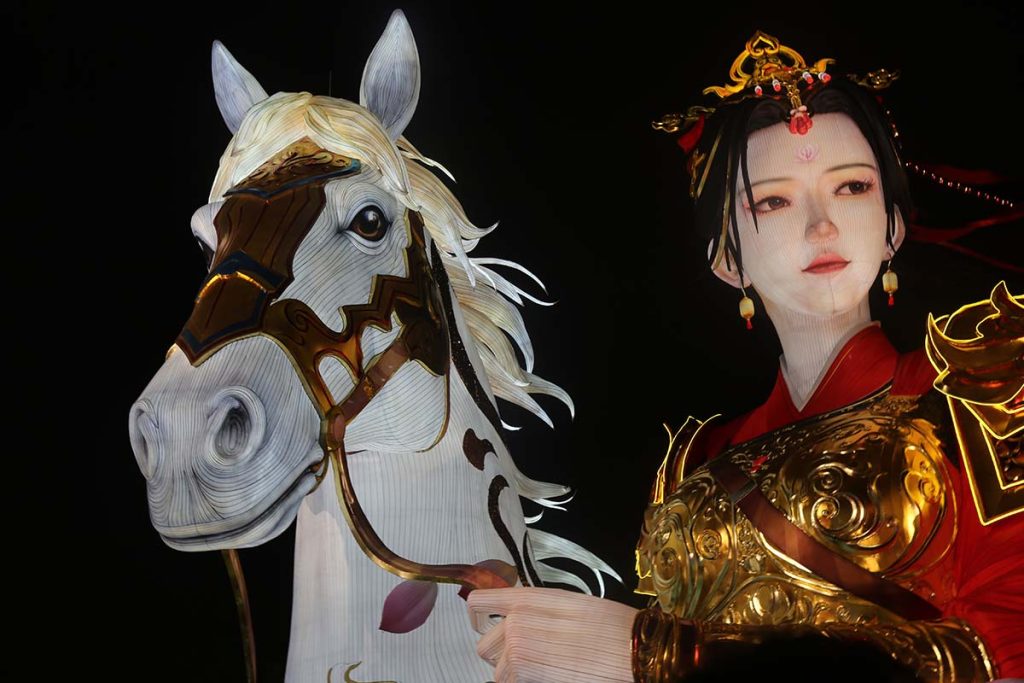
Human and animal faces in lanterns demand **high-density **. A facial expression depends on subtle curves — the arch of an eyebrow, the curve of a smile line, the flow of hair. These require 順丝 spaced at 6–10 cm intervals, with the wire bent to millimeter precision.
Example: God of Wealth (Caishen) Lantern
- Area: the face (approximately 60 × 80 cm)
- density: 8 cm spacing, 12 parallel contour wires along the facial profile
- density: 25 cm spacing, 5 cross-sectional ribs
- Ratio: roughly **2.5:1 in favor of **
- Why: the face’s visual impact depends entirely on contour accuracy — merely provides the underlying volume

Scenario B: Flowing Fabric and Robes
Traditional Chinese lantern figures wear robes with flowing sleeves, fluttering ribbons, and layered garments. These elements demand long, uninterrupted that trace the fabric’s movement.
Key rule: For flowing elements, a single should run continuously for at least 1.2–1.8 meters without a tie point interrupting its curve. The wire must be bent cold (no heat — heat changes the metal’s flexibility and creates “flat spots” in the curve).
Scenario C: Animal Fur and Feather Textures
For lantern animals with detailed surface textures — peacock feathers, lion manes, dragon scales — defines the surface grain. A peacock tail with 40 individual feather “eyes” requires 40 separate paths, each independently shaped, then tied to the underlying frame.
3. When to Prioritize (Cross Wire)
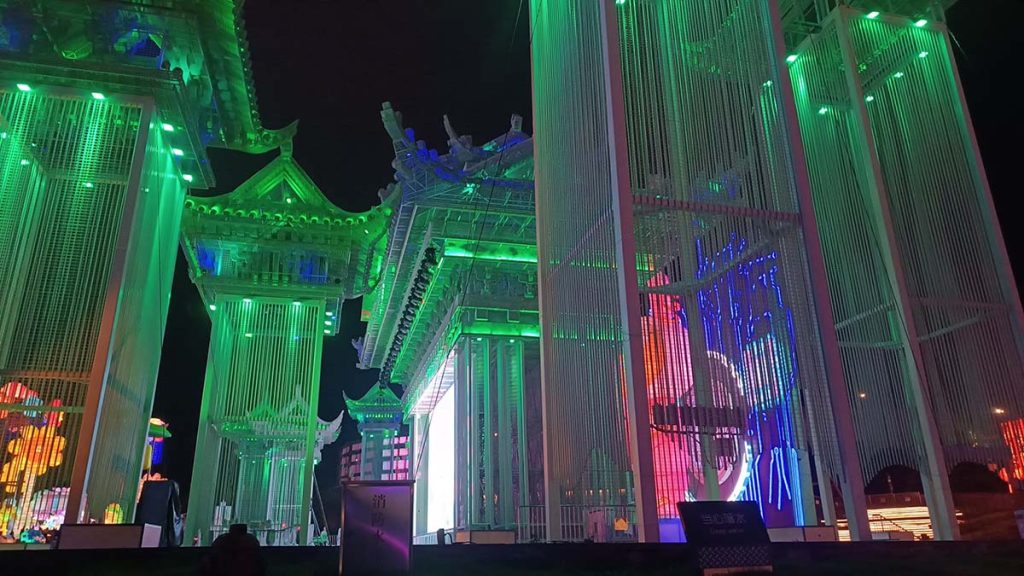
Scenario A: Large Flat Surfaces (Pagoda Walls, Archway Pillars)
Flat or gently curved surfaces — pagoda sides, archway pillars, lotus petals — rely on cross-sections to maintain flatness. Without sufficient 横丝 density, the fabric will pull the underlying wire into a concave “pillow” shape.
Example: 15-meter pagoda wall panel
- Panel dimensions: 15m × 4m flat surface
- density: 30 cm spacing, 14 horizontal cross-ribs
- density: 20 cm spacing, 20 vertical contour wires
- Ratio: approximately 1:1
- Why: Flatness requires balanced tension from both directions
Scenario B: Rotund Shapes (Lantern Bodies, Animal Torsos)
A round lantern body — such as a 3-meter fish lantern or a Buddha figure — needs dense to “push out” the 3D volume. Each ring defines a cross-sectional diameter. If a ring is even 2 cm too small, the hand-finished surface will look dented.
Key rule: For rotund shapes over 1.5 meters in diameter, spacing should not exceed 35 cm. At 40 cm, the fabric between rings begins to visibly sag inward between contour lines.

Scenario C: Weight-Bearing Structural Nodes
Where a lantern supports its own weight — the neck of a crane lantern, the wrist joint of a waving figure, the base of a tall tower — is doubled or tripled. These are called (reinforced cross-wires) and use 10–12mm gauge metal instead of the standard 6–8mm.
4. The “Golden Ratio” of Wire Density
Through decades of production refinement, Zigong frame builders have developed empirical standards for wire density. These are not rigid formulas — they adapt to each design — but they serve as a quality benchmark:
| Lantern Type | Spacing | Spacing | Ratio | Primary Visual Goal |
|---|---|---|---|---|
| Human face / figure | 6–10 cm | 20–30 cm | 2:1 ~ 3:1 | Expressive detail |
| Animal with fur/feathers | 8–12 cm | 25–35 cm | 2:1 | Surface texture |
| Dragon / serpentine | 10–15 cm | 30–40 cm | 1.5:1 | Fluid curve emphasis |
| Architecture (pagoda, arch) | 15–25 cm | 25–35 cm | 1:1 ~ 1:1.5 | Flatness, solidity |
| Large flat landscape | 20–30 cm | 20–30 cm | 1:1 | Uniform surface |
Quality check for buyers: Ask to see a close-up photo of the wire frame before the hand-finished surface is applied. Count the wire intersections in a 50cm × 50cm sample area. A professional frame will show at least 12–20 intersection points in that area. Fewer than 8 indicates sparse framing that will result in a lumpy, sagging surface.
5. The Tie Point — Where Craftsmanship Shows
The intersection between a and a is called a tie point . In a large lantern, there can be 2,000–5,000 individual tie points — each one hand-wrapped with thin binding wire and twisted tight with pliers.
What a good tie point looks like:
- Tight: The binding wire wraps 3–4 turns, each turn pulled snug so the crossing wires cannot slide
- Flush: The twisted tail is cut to under 5mm and folded flat against the frame
- Clean: No sharp wire ends protruding outward — every protrusion will poke through the fabric
Why tie points matter for aesthetics:
A loose or poorly placed tie point creates a microscopic bump under the hand-finished surface. Under LED illumination at night, every bump casts a tiny shadow. On a flat pagoda wall with 800 tie points, even 5% poor tie points means 40 visible surface blemishes — visible as small dark spots when the lantern is lit.
This is why master frame builders spend 30–40% of their assembly time on tie point quality control, not on bending the main wires.
6. Case Example: Rebuilding a “Flat” Dragon into a “Alive” Dragon
A client once brought us a dragon lantern produced by a different factory. The complaint: “It looks like a cardboard cutout — there is no life in it.”
Inspection of the frame revealed the problem immediately:
- ** excessive**: Cross-wires at 15–18 cm spacing dominated the structure. The frame was structurally solid but visually dead.
- ** insufficient**: Only 3–4 contour wires ran along the 12-meter body. The dragon’s serpentine curve was defined by the 横丝 rings, creating a segmented “earthworm” appearance instead of a fluid spine.
- Tie point alignment: The 橫丝 cross-sections were perpendicular to the ground plane (horizontal in the engineering sense), meaning they did not follow the dragon’s actual posture — which curves upward toward the head.
Our rebuild:
- Replaced the skeleton with a -first design: 9 contour wires running the full 12-meter body length, continuously from tail tip to throat
- Reduced to 35 cm spacing (structural-only role)
- Repositioned rings to be perpendicular to the body axis at each point (rotating as the body curved)
- Total tie points reduced by 15%, but wire placement changed the visual result completely
The rebuilt dragon won “Best Craftsmanship” at that year’s festival. The client reported that visitors commented on how “the dragon looks like it is actually moving.”
7. What Buyers Should Look For
When evaluating a lantern manufacturer’s work, these three questions will reveal their frame-building philosophy:
1. “Can I see a photo of the wire frame before the silk is applied?”
A manufacturer confident in their craftsmanship will happily show this. If they deflect or only show finished lanterns, it may indicate sparse framing hidden under the fabric.
2. “How do you decide the ratio of to for this design?”
There is no single “correct” answer — but there should be a thoughtful one. “We use the same spacing for everything” is a red flag. The answer should reference the specific visual goals of your requested design.
3. “What gauge wire do you use for the contour vs. structural elements?”
Professional workshops use at least two different wire gauges in a single frame. Using one gauge for everything suggests a factory that prioritizes speed over expression.
FAQ
Q: Does denser wire always mean better quality?
A: Not necessarily. Excessive density (under 15 cm spacing) can “choke” a form — the cross-sections become too dominant and the lantern loses visual flow. The goal is the right ratio for the design intent, not maximum density.
Q: How long does it take to build the wire frame for a large lantern?
A: A 10-meter dragon frame requires approximately 120–180 worker-hours of frame construction, plus an additional 30–50 hours for tie point finishing. Complex facial features can take a single artisan 2–3 full days.
Q: Can modern CNC wire-bending machines replace hand shaping?
A: CNC bending is used for repetitive elements (straight structural ribs, uniform rings, standardized cross-sections). But expressive contours — faces, flowing fabric, organic curves — are still done by hand. A wire bent by CNC can be geometrically perfect but visually stiff. The human hand introduces micro-curves and subtle asymmetry that read as “natural” to the eye.
Q: How do weather conditions affect the wire frame?
A: Metal wire frames are weatherproof or powder-coated for outdoor use. The tie points are the most vulnerable spots — moisture can accumulate at the binding wire junctions. We apply anti-corrosion sealant at all tie points for installations lasting over 3 months. The fabric is tensioned with 2–3% slack to accommodate thermal expansion of the metal in summer heat.
Q: Can a light, sparse frame work for indoor displays?
A: Yes — indoor lanterns are not exposed to wind or rain, so structural requirements are lower. Spacing can increase by 30–50%. However, the same aesthetic principles apply: insufficient contour wires will still make the form look flat, even without structural risk.
Q: Does wire gauge affect how the lantern photographs at night?
A: Indirectly, yes. Heavier wire (8mm+) creates a larger shadow under the silk when backlit. For lanterns intended to be photographed up close — such as zoo exhibits where visitors stand within 2 meters — we use thinner 4–5mm contour wire to minimize internal shadow lines. For display pieces viewed from 10+ meters away, 6–8mm is standard and invisible at distance.
Related Products & Resources
- Custom Chinese Lanterns — Full Collection — Explore our portfolio of handcrafted lanterns, from 2m to 30m.
- How Lanterns Are Made — From Metal Frame to Final Test — Step-by-step behind-the-scenes of Zigong lantern production.
- Giant Lanterns — Monumental Festival Centerpieces — See our largest installations and the engineering behind them.
- Chinese Lantern Festival — History, Craft & Planning Guide — Complete resource for festival organizers.
Learn how the internal structure shapes every scene: see our Chinese lantern frame display for festival installations.