A Christmas market and a Christmas light trail look like the same decision from a committee room. Both run after dark, both need lighting, both sell tickets or attract footfall. On the ground they are different businesses. One is a retail operation with a lighting layer on top; the other is an attraction with a route. The format decides your layout, your power, your staffing and which pieces you can reuse next year.
This is how the two compare on the things that actually get decided in the first meeting: ground, throughput, lighting and what survives February.
What each format asks of the ground
A market is a grid. Stalls need 3 m of frontage and 2.5 m of depth, with a service lane behind them wide enough for a van, and aisles of 3 to 4 m so two families can pass without one stepping into a stall. A 40-stall market therefore takes roughly 2,000 to 2,500 m² of usable ground once you add the service lane, the bin compound and the generator or power cabinets. Put it on grass in December and you will be laying trackway, which is a line item nobody remembers in the first budget.
A trail is a line. It needs a walkable route of 600 m to 2 km, a surface that survives 40,000 pairs of feet, and enough width at the pinch points that the flow does not stop. What it does not need is flat, drained, serviced ground in the middle of a town, which is why trails fit gardens, zoos, country parks and estates that could never host a market.
That single difference explains most of the format choice. If you have a hard-surfaced square with power and toilets, a market is available to you. If you have a green site with a path and a car park, a trail is available and a market mostly is not.
Throughput and how the money works
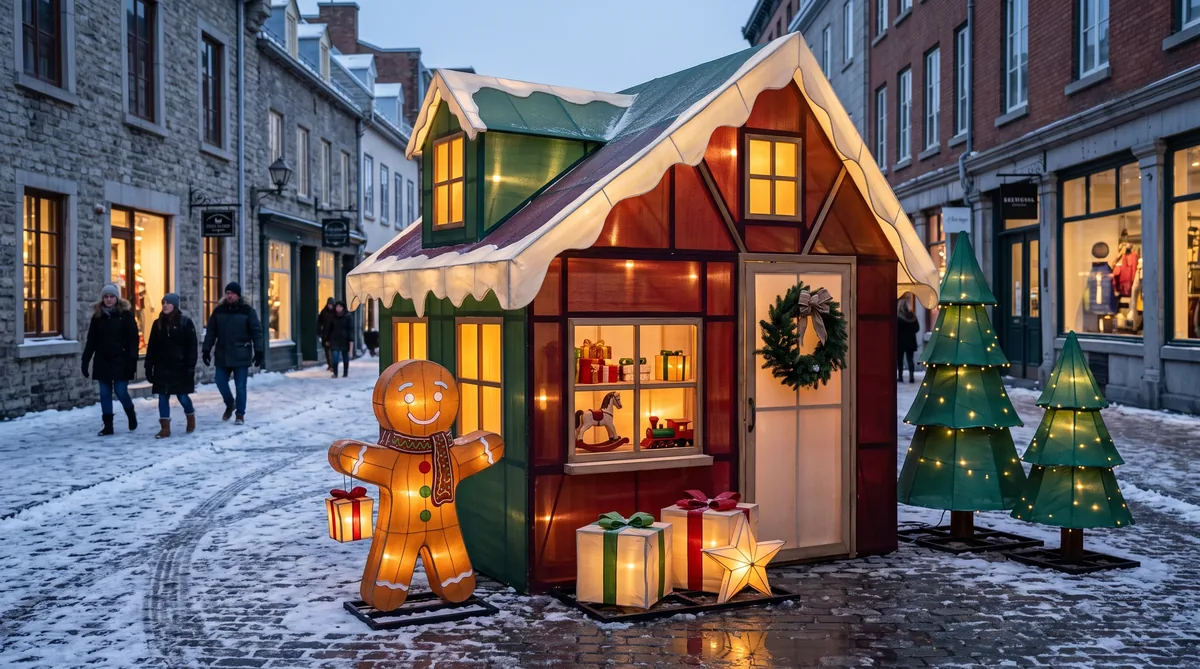
A market usually earns twice: a stall fee from the vendor, and whatever the venue takes on food, parking or entry. The operator’s job is footfall and dwell, and the economics reward a compact site — every metre a visitor walks between stalls is a metre not spent buying. Markets work at high density and short dwell: 60 to 90 minutes, several hundred people an hour at peak, and a layout where the exit route passes the food.
A trail earns once, at the gate, and the product is time. A 1.2 km route at a normal walking pace with stops takes 45 to 70 minutes, and that time is what the ticket buys. Trails therefore reward length and rhythm rather than density: a landmark every 80 to 120 m, a photo stop every 200 m, and nothing that creates a queue in a narrow section.
The failure mode is mixing the two without choosing. A market with a trail bolted on gets a route that competes with the stalls for the same ground. A trail with market stalls dropped into the middle gets a bottleneck and a smell of frying oil in the wrong place. Decide which one earns the money and let the other serve it.
What a market needs from the lighting
Market lighting is working light first and decoration second. A stallholder has to read a card machine, count change and see food that is being cooked. That means light at the counter — 200 to 300 lux under the canopy — and it means the decorative layer must not put glare into anybody’s eyes at that height.
In practice the decorative layer does three jobs: it defines the market’s edge so people can see where it starts, it lights the aisle from above rather than from the stall front, and it gives the site one photographed moment. Festoon and catenary over the aisle, a lit gateway at each entrance, and one large lit piece at the centre will do more than decorating every stall individually.
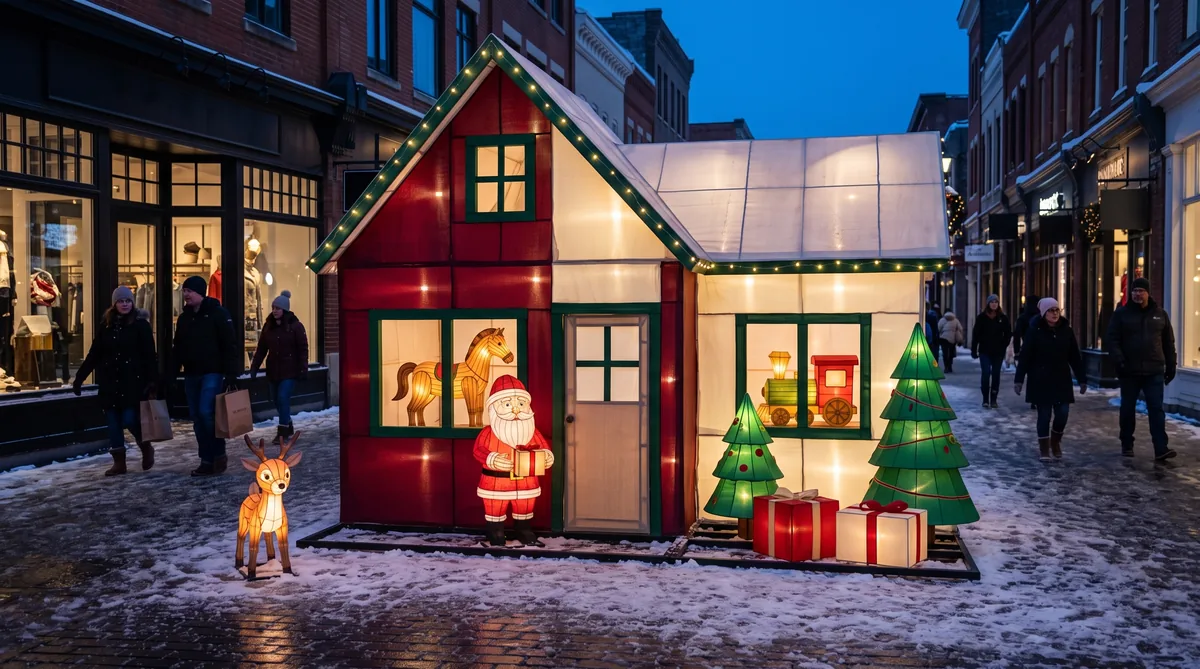
Colour temperature is the constraint people miss. Food looks wrong under cold white; mulled wine and roasted nuts want something warm. Keep the working light at 3000 K and the decorative light in the same family, and the site reads as one place. Mix 2700 K with 6000 K across a market and it looks like a car boot sale. Stall-level detail, including what German market organisers specify, is set out in our christmas market lighting guide.
What a trail needs that a market does not
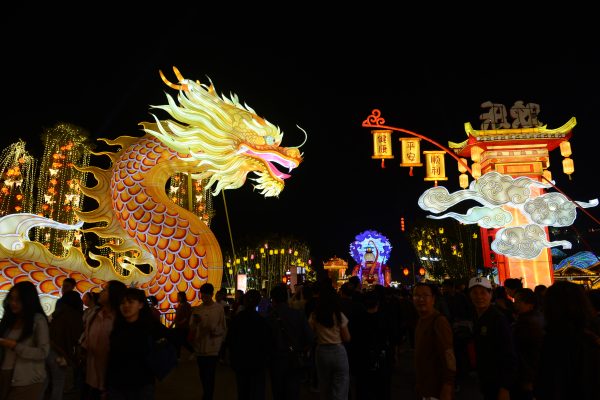
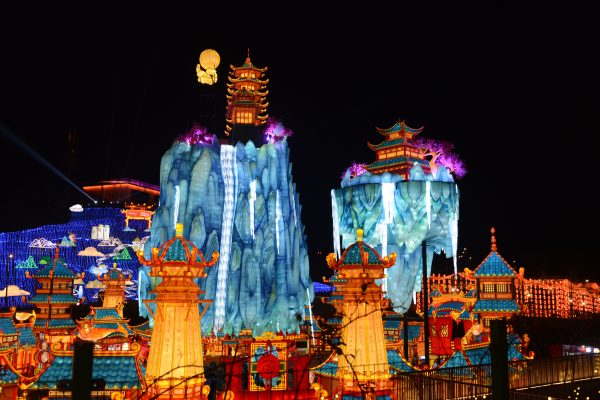
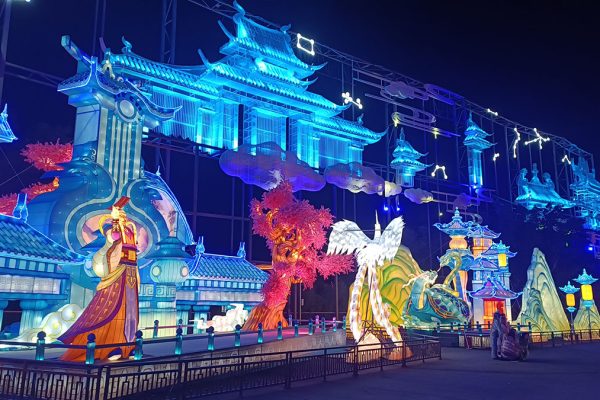
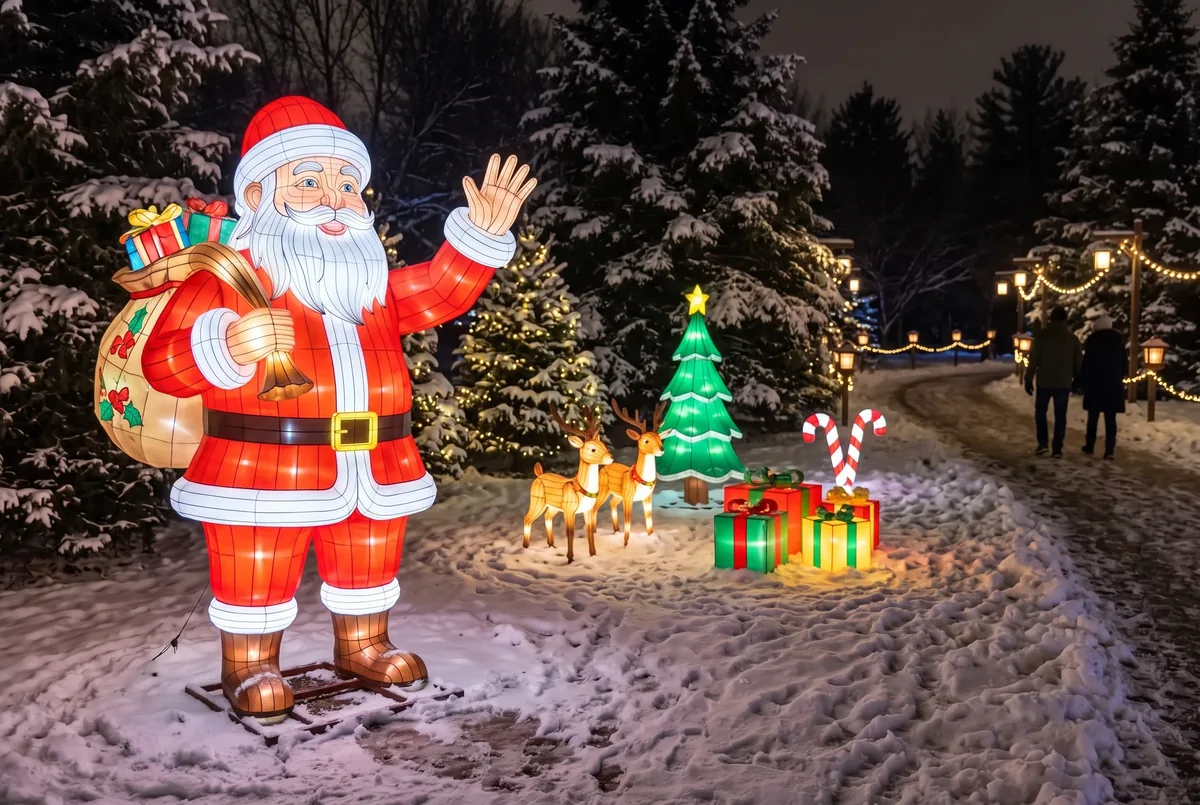
A trail is dark for most of its length, on purpose. The gaps between pieces are part of the design, because a route that is lit continuously has no rhythm and the visitor stops noticing anything after 300 m. The lighting design is really a sequence: gateway, first landmark, a quieter stretch, a second landmark that is bigger than the first, then a finale that can be photographed from outside.
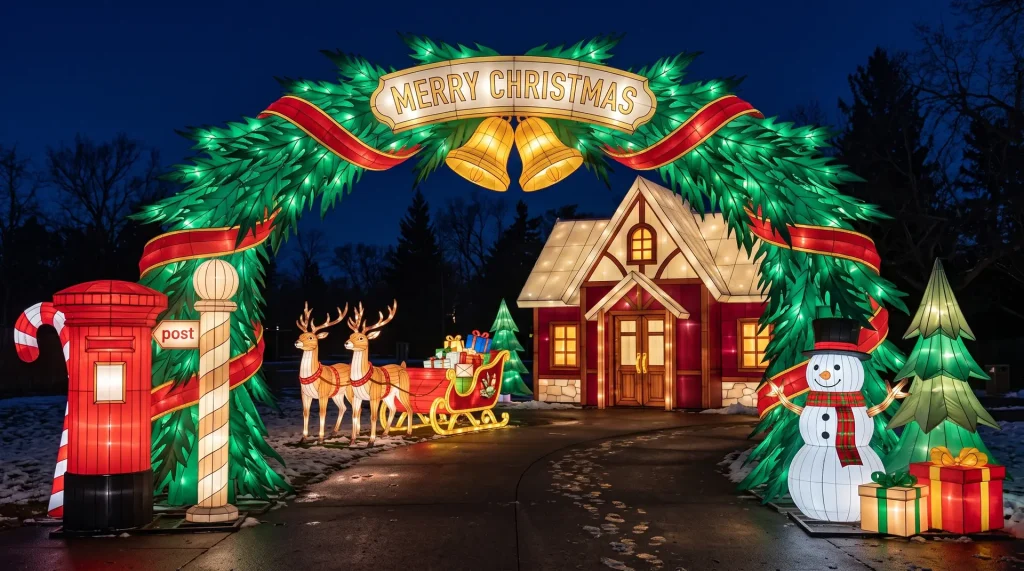
Each piece has to read from the distance the visitor first sees it, which is usually 20 to 30 m. That is a different build from market decoration: silhouettes matter more than detail, internal illumination matters more than surface colour, and anything under 2 m tall disappears in a dark route unless it is grouped. The gateway is the piece that carries the first impression, and a walk-through christmas archway is the usual way to build one.
Trails also need a decision about the path itself. Lit edges at ankle height keep people on the route without lighting the ground, and they are the cheapest safety measure on the whole site. Without them, a wet December path in a garden becomes an insurance conversation.
Wind, snow and the pieces that fail first
Both formats are outdoors in the worst month of the year, and the failure list is short and predictable. Gateways take wind on their largest flat face, so an arch is designed for 0.5 to 0.7 kN/m² on an exposed site and anchored rather than ballasted. Flat-topped structures collect snow; anything with an 8 to 10 degree crown sheds most of it. Ground frames sit in meltwater all January, which is why base plates run on 100 mm risers and the fixings go stainless within a few kilometres of the coast.
The pieces that fail first on a trail are the ones people touch: handrails on a walk-through, the plinth of a photo piece, the bottom 1 m of anything within reach — the same list we set out in what fails first on a UK winter light trail. On a market it is the stall-front decoration, which gets knocked by crates every morning. Both are solved by building the bottom metre heavier than the rest.
What stores, and what does not
A trail stores better than a market. Lit figures dismantle into crates — reindeer sets included — and a set stored dry comes out in year two in a day. Market infrastructure — stalls, trackway, fencing, generators — is bulky, and every season of storage costs more than the decoration does.
The rule that matters for either format: store by crate plan, not by pile. Numbered crates that follow the installation order turn next November into a two-day job instead of a two-week one, and the numbering is free at the point of manufacture.
Which format fits which site
A town square with power and toilets suits a market. Add a lit gateway and one centrepiece, and stop there.
A garden, zoo or country park suits a trail. The route already exists, the car park already exists, and the site is usually closed after dark anyway. For the animal-side specification, see the zoo christmas lights buying guide.
A shopping centre forecourt suits a market if the centre wants dwell, and a short trail if it wants a photograph. Under 400 m, a trail becomes a decorated walk rather than an attraction.
A stadium car park or brownfield site can host either. It will need power, surfaces and drainage priced in before the decoration is discussed.
An estate or heritage site usually suits a trail, because the ground will not take stalls and the buildings do the scenery work for free.
Phasing it over two years
Where the budget only covers one format in year one — what a christmas light festival costs is the usual starting point — build the one the site can actually run, and design the lighting so the second year can extend it. The gateway, the power distribution and the crate plan are the parts that carry over. A market that adds a 400 m trail at the far end in year two reuses the gateway and the distribution; a trail that adds a market in year two reuses the entrance sequence and the food position.
What does not carry over is the layout. Plan the second format into the site drawing in year one, even if nothing is built, so the power cabinets and the service lane end up in the right place.
Christmas market and light trail FAQs
Can one site run both at once?
Yes, if the trail starts where the market ends rather than overlapping it. The trail becomes the reason to stay longer, and the market becomes the reason to arrive early.
Which format needs more power?
A market, by a wide margin, because of cooking and heating at the stalls. A lit figure display is a small load next to a row of fryers. The figures themselves sit in our holiday and seasonal collection.
Which pieces can be reused across both formats?
Gateways, large figures and photo pieces move between the two. Aisle decoration and stall-front pieces are market-specific; route landmarks and walk-through structures are trail-specific.
How early does either format need to be ordered?
A market’s lighting layer runs 4 to 6 weeks from approved concept. A trail of 8 to 20 pieces, from a giant bell walk-through archway down to the small figures, runs 10 to 14 weeks. Shipping sits on top of both, and sea freight to Europe is 30 to 45 days.
Whichever format you pick, the christmas light festival programme is where the sequence, the gateway and the route get scoped together. Send the site plan, the opening date and the ground surface, and we will come back with a layout and a piece count. The brief form is at request a quote.