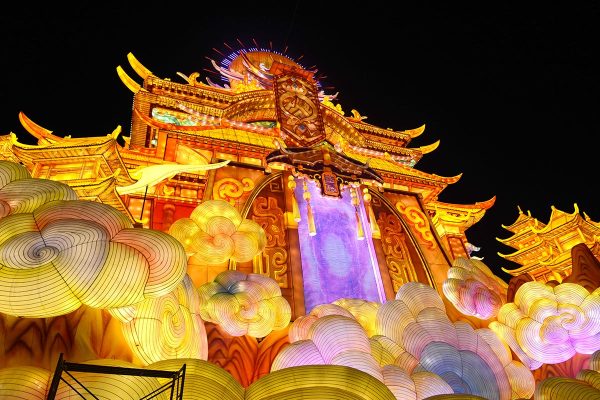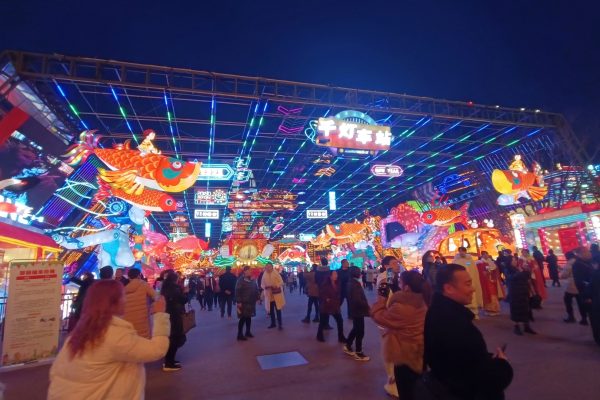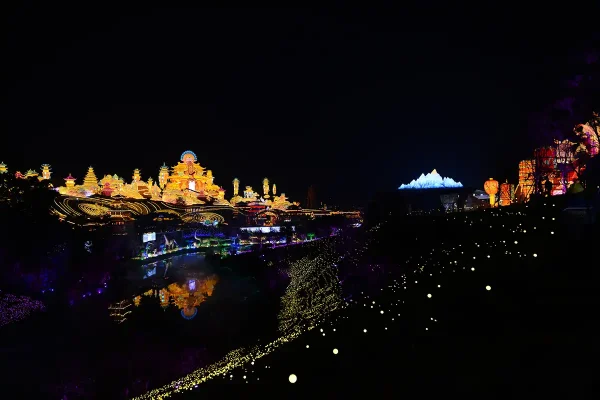
Marine life is the most widely used theme in festival lighting, and the one most often done badly. The forms are familiar to every visitor, which means the silhouette has to be right or everybody notices.
Sea animal lanterns·Fish · Whale · Turtle·Built to order
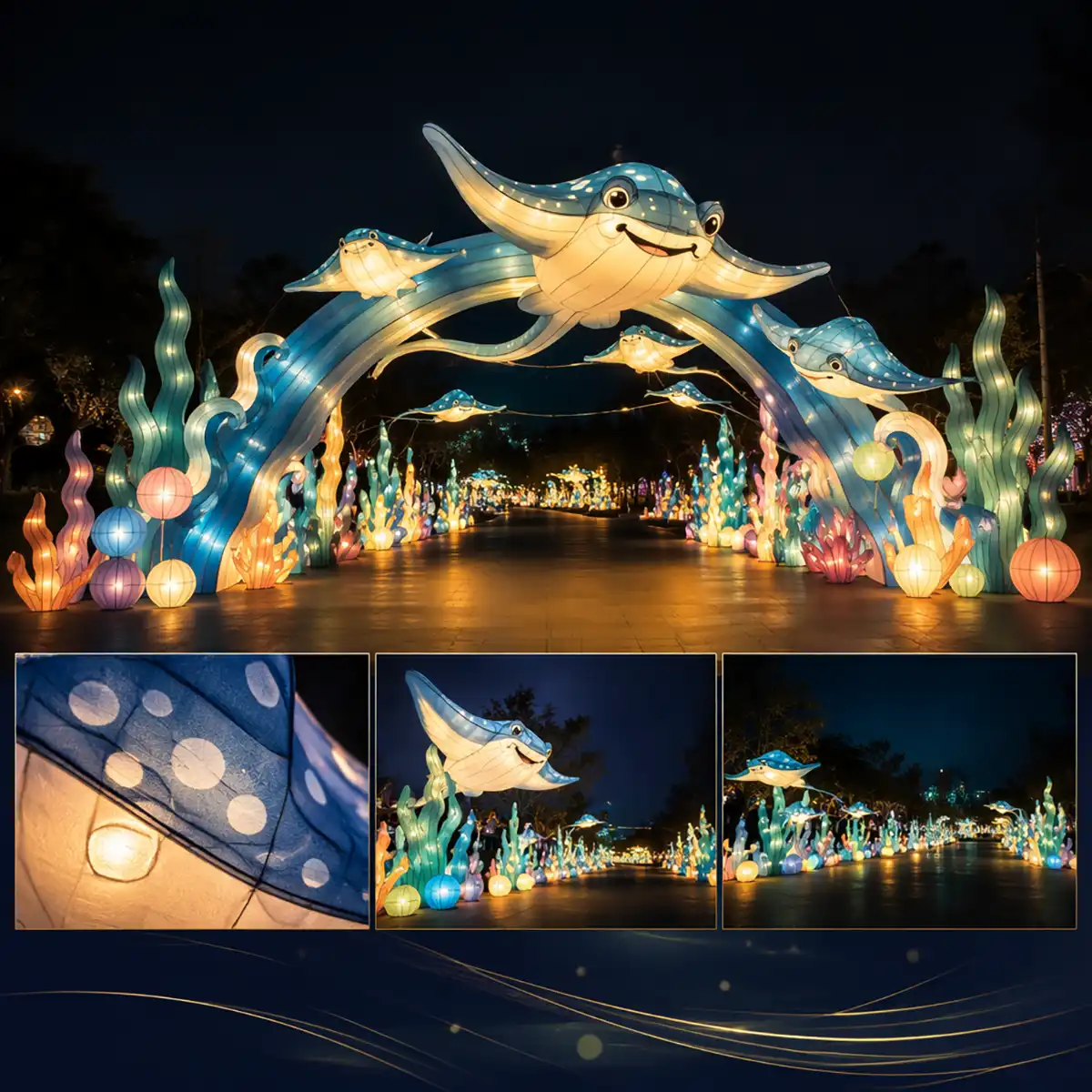
Every visitor already knows what a whale, a koi or a sea turtle looks like. That familiarity is an advantage and a trap: the form reads instantly when it is right, and looks wrong immediately when it is not. A dragon can be stylised. A whale cannot, because everyone has seen one.
What follows covers which marine forms work in which positions, how scale changes the design, what the manufacturing has to get right for water-adjacent positions, and how to tell a manufacturer who has actually built these from one who has only seen a photograph.
The short version
Choose the form by viewing distance, not by preference. Fish and turtle forms read well at close range; whale and manta forms need space to be seen from, and they are the pieces that carry a route.
Forms
What Counts as a Sea Animal Lantern
The category covers any illuminated marine form: fish, whales, turtles, jellyfish, octopus, seahorse, manta ray and the fantasy combinations that sit between them. In practice they fall into three groups by how they behave on a site.
01 · Cluster Fish schools and koi groups
Multiple forms at one scale, arranged as a group. They fill a volume rather than hold a position, and they work best where visitors pass through or around them.
02 · Feature Whale, manta and giant fish
Single large forms that need viewing distance. These are the pieces a route is built around, and they set the scale of everything near them.
03 · Detail Turtle, seahorse, octopus
Smaller character pieces for close range. They carry the theme into the corners of a site, and they are what people stop and photograph in front of.
Fish
Fish Lanterns: Forms and Where They Work
Fish are the most requested marine form and the most forgiving. A fish reads at almost any scale, from a 40 cm ornament to an 8 m installation, which is why fish lanterns turn up in everything from restaurant courtyards to city plazas.
Koi and carp forms
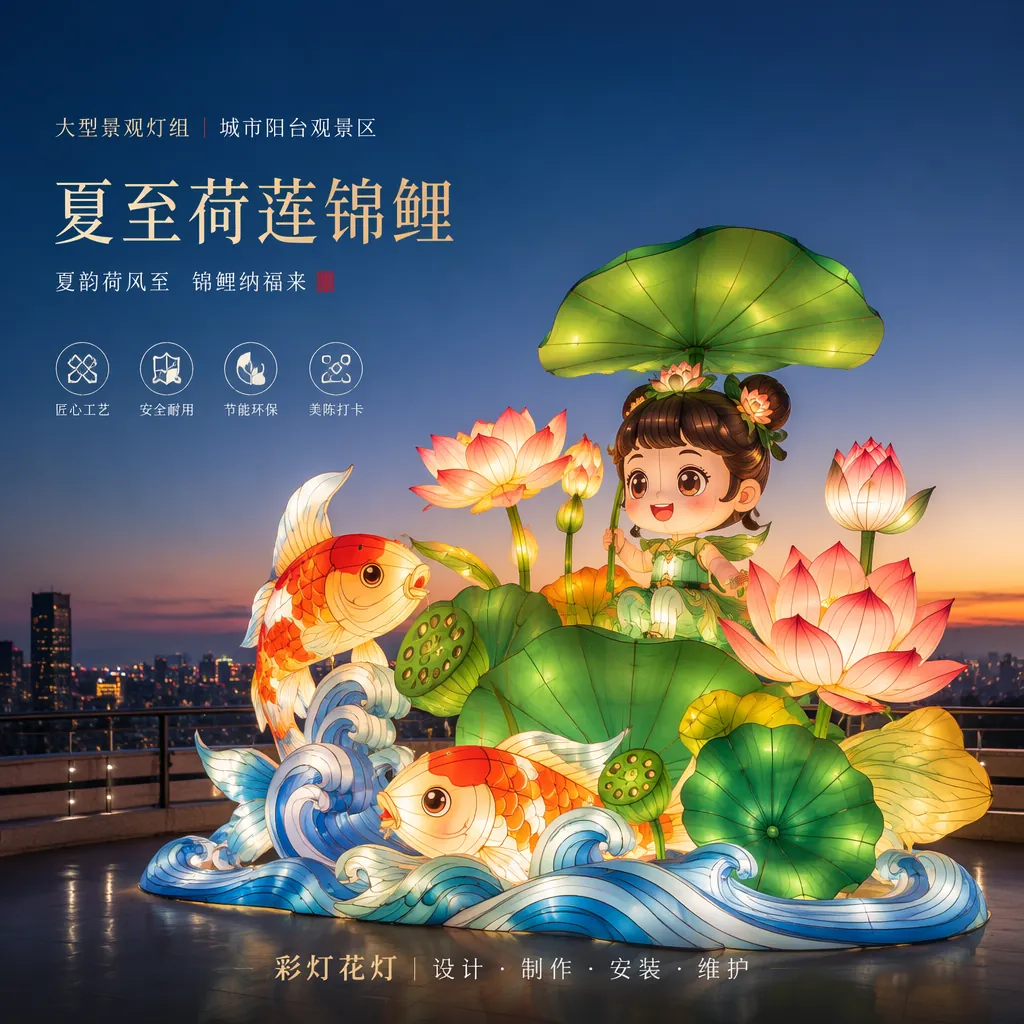
Koi carry cultural weight that plain fish do not. The form is associated with perseverance and with the Dragon Gate legend, and it is the fish most often specified for venues with an East Asian theme. Koi are also unusually good in groups: several fish at slightly different scales and angles read as a natural school rather than a repeated pattern.
Goldfish and ornamental forms
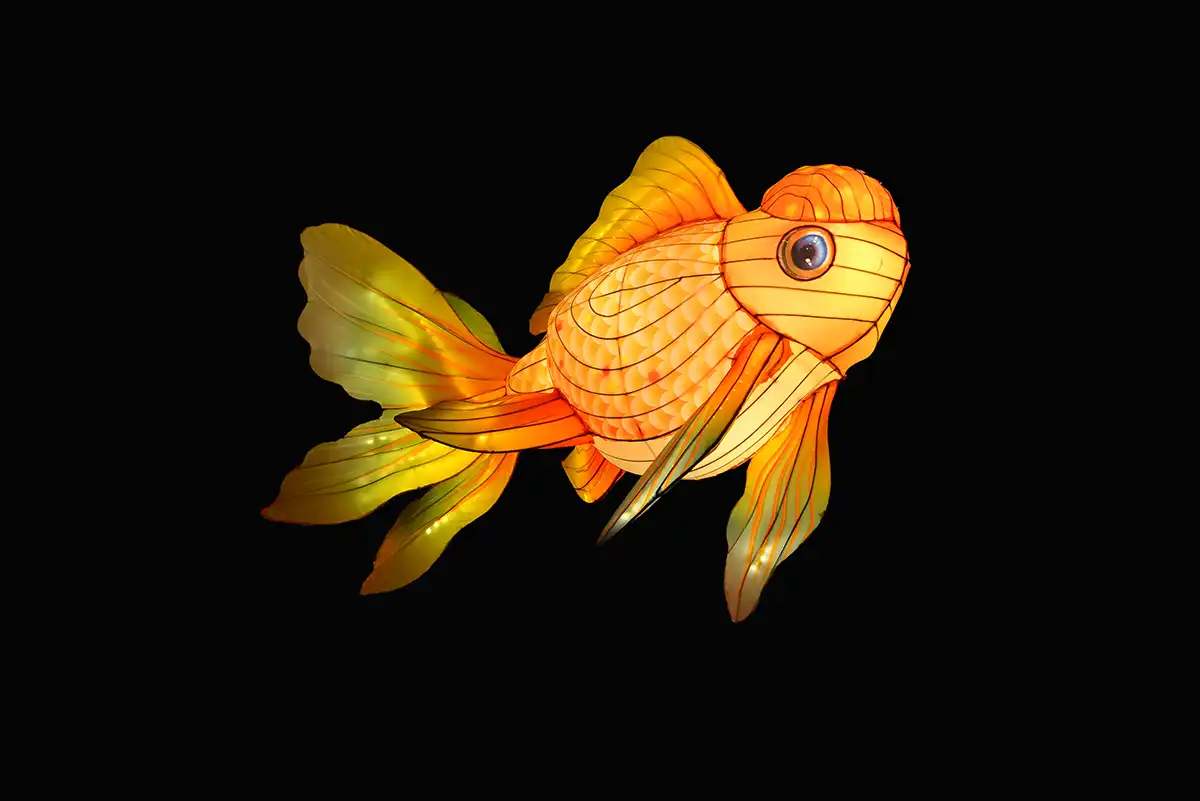
The goldfish is the most recognisable fish form and the one that works at the smallest scale. It reads at a metre, which makes it the default for restaurants, courtyards and retail frontage. Because the form is compact, it also survives being seen from a single viewpoint better than elongated forms do.
Giant fish lantern
A giant fish lantern is a feature piece, and it lives or dies on silhouette. The body has to read from the far side of a plaza, which means the tail and fins carry most of the recognition. Detail in the scales matters far less than the outline.
Colour and lighting
Marine forms are usually specified in cool tones, and the lighting does most of the work. A whale lit from within reads as a body rather than as a shape, which is why the internal layout matters more than the surface colour. Where the piece sits beside water, the reflection is part of the display and the light level is set for that rather than for the piece alone.
Fish schools and clusters
Suspended fish schools are the most efficient way to fill a large volume. A group of fish at one scale, hung at slightly different heights, reads as a single composition rather than a set of duplicates, and it uses ceiling space that ground-level displays cannot reach.
Whales
Whale Lanterns and Other Large Marine Forms
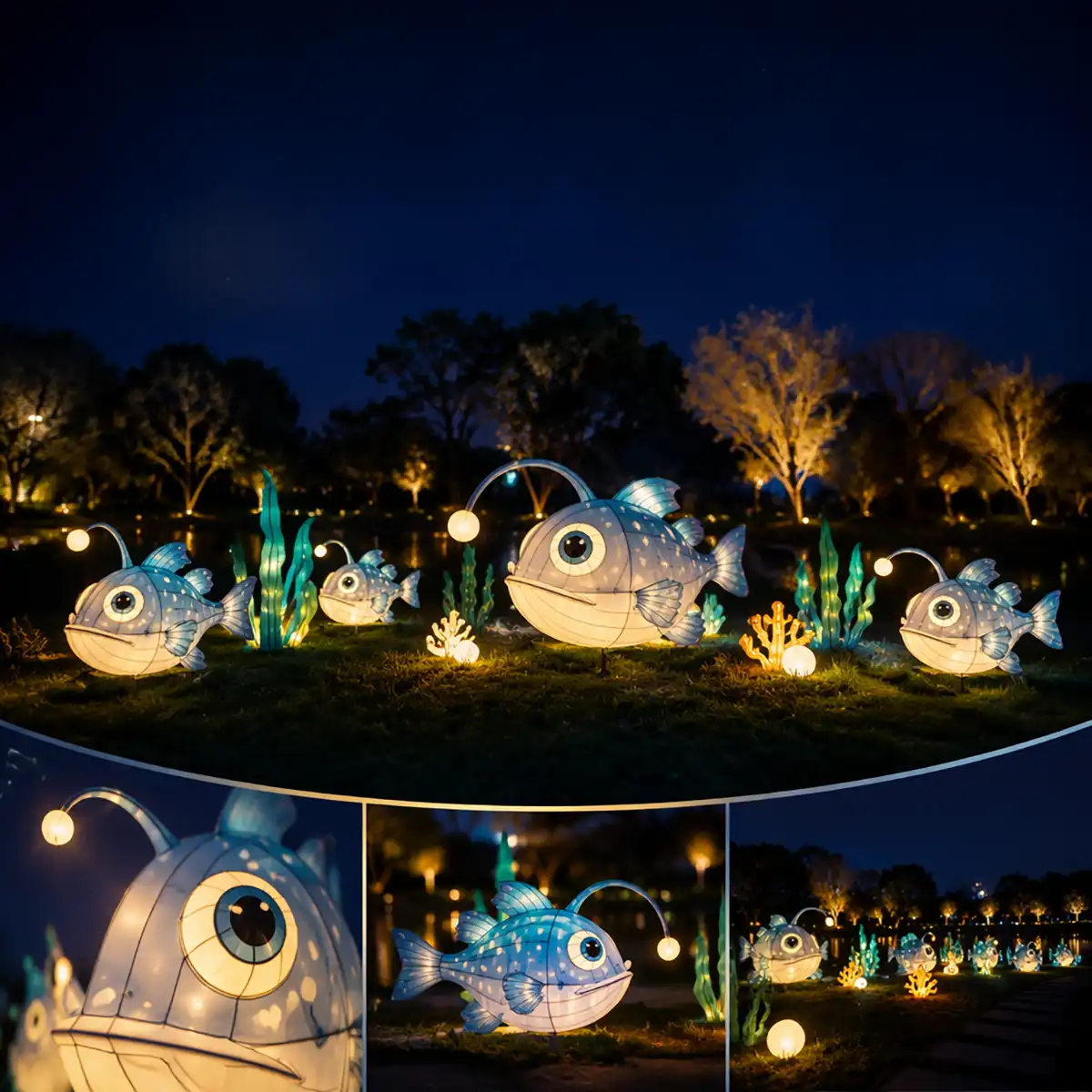
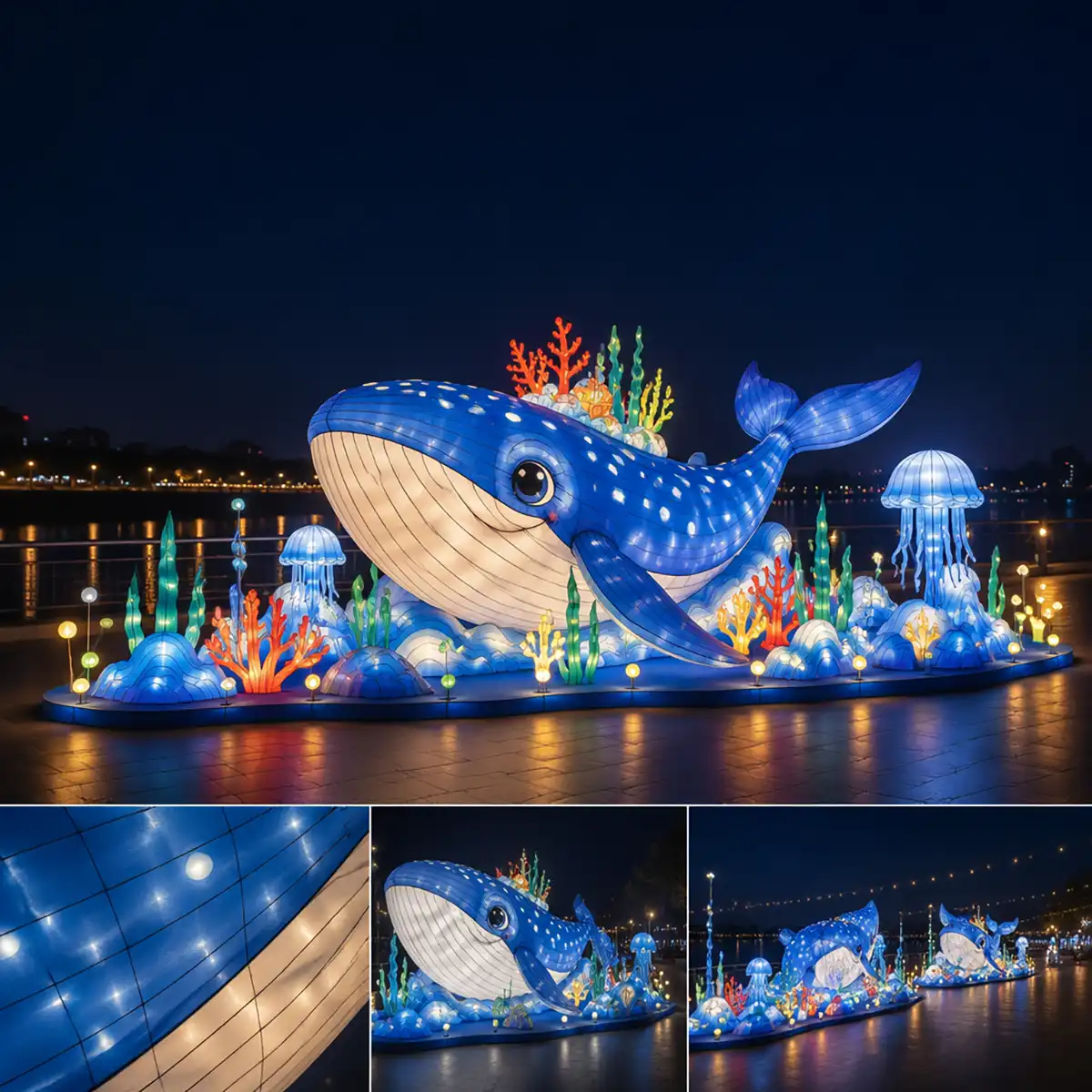
A whale lantern is the largest thing most venues will ever install. It is also the piece visitors remember, and the one that most often gets built too small.
Scale and viewing distance
A whale that is meant to be seen across a plaza needs to clear the heads of a crowd at the far edge. Sized for a corridor, it looks like a large fish rather than a whale, and the recognition is gone. Ask for the furthest viewing distance before the height is fixed.
Structure and weight
A whale is long and light, which makes it behave differently from a tall figure. It presents a large surface to wind along its length, so the base and the suspension points are designed around that rather than around weight alone. Where the piece is suspended rather than ground-set, the hanging points carry the whole form.
Other forms
Turtle, Octopus and Jellyfish Lanterns
The smaller marine forms do a specific job: they carry the theme into the parts of a site a large display cannot reach.
Sea turtle lanterns
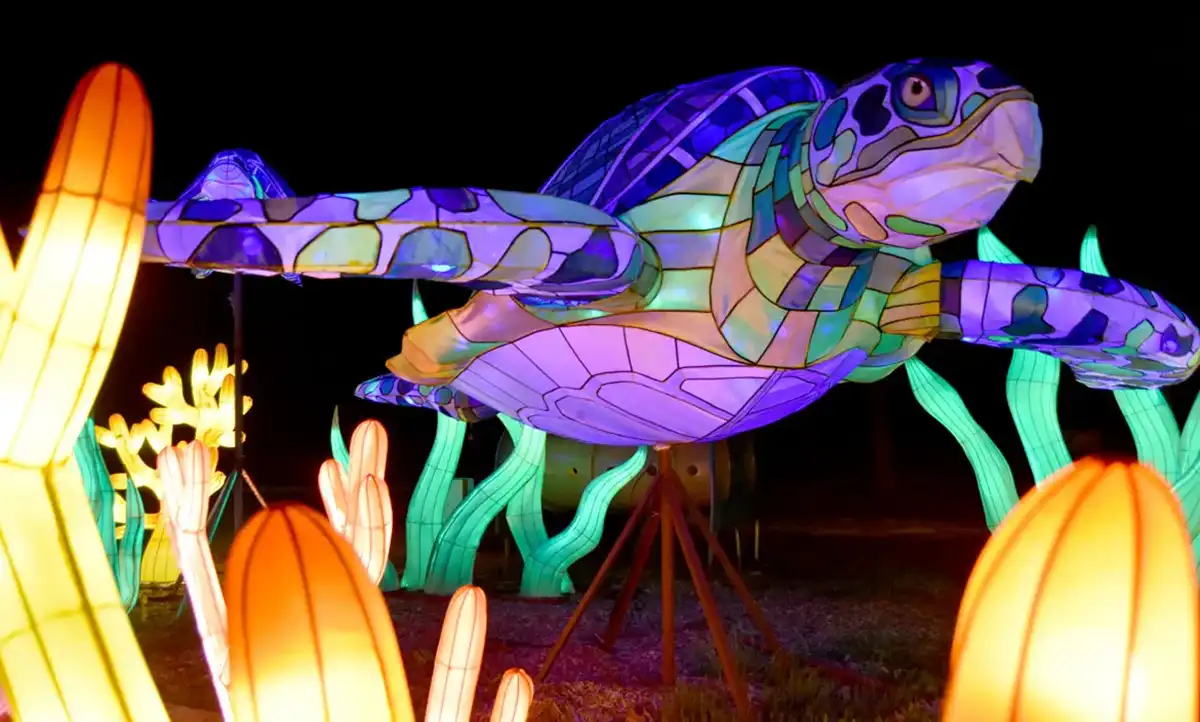
A sea turtle lantern reads well at close range and works as a character piece near seating, water features or a children’s area. The shell is the recognition element, so its pattern matters more here than it would on a fish.
Seahorse and small forms
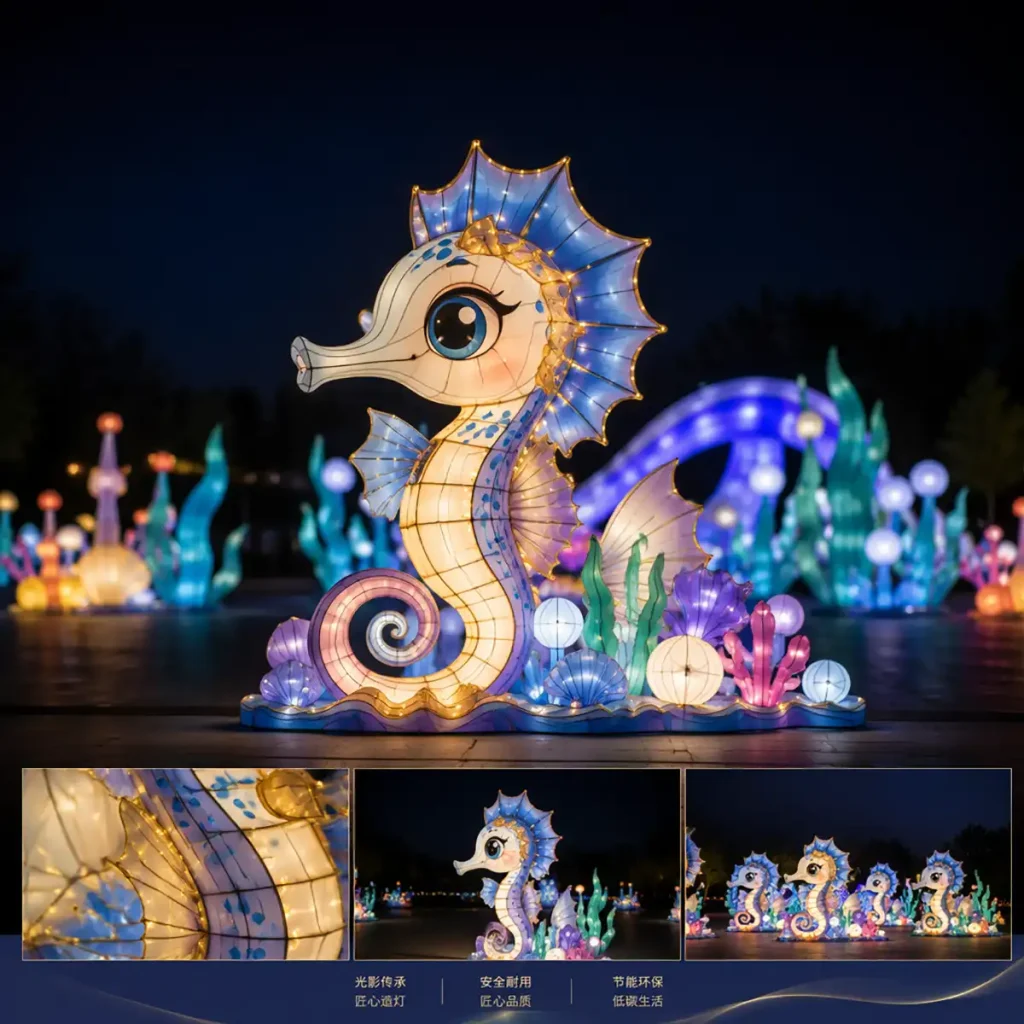
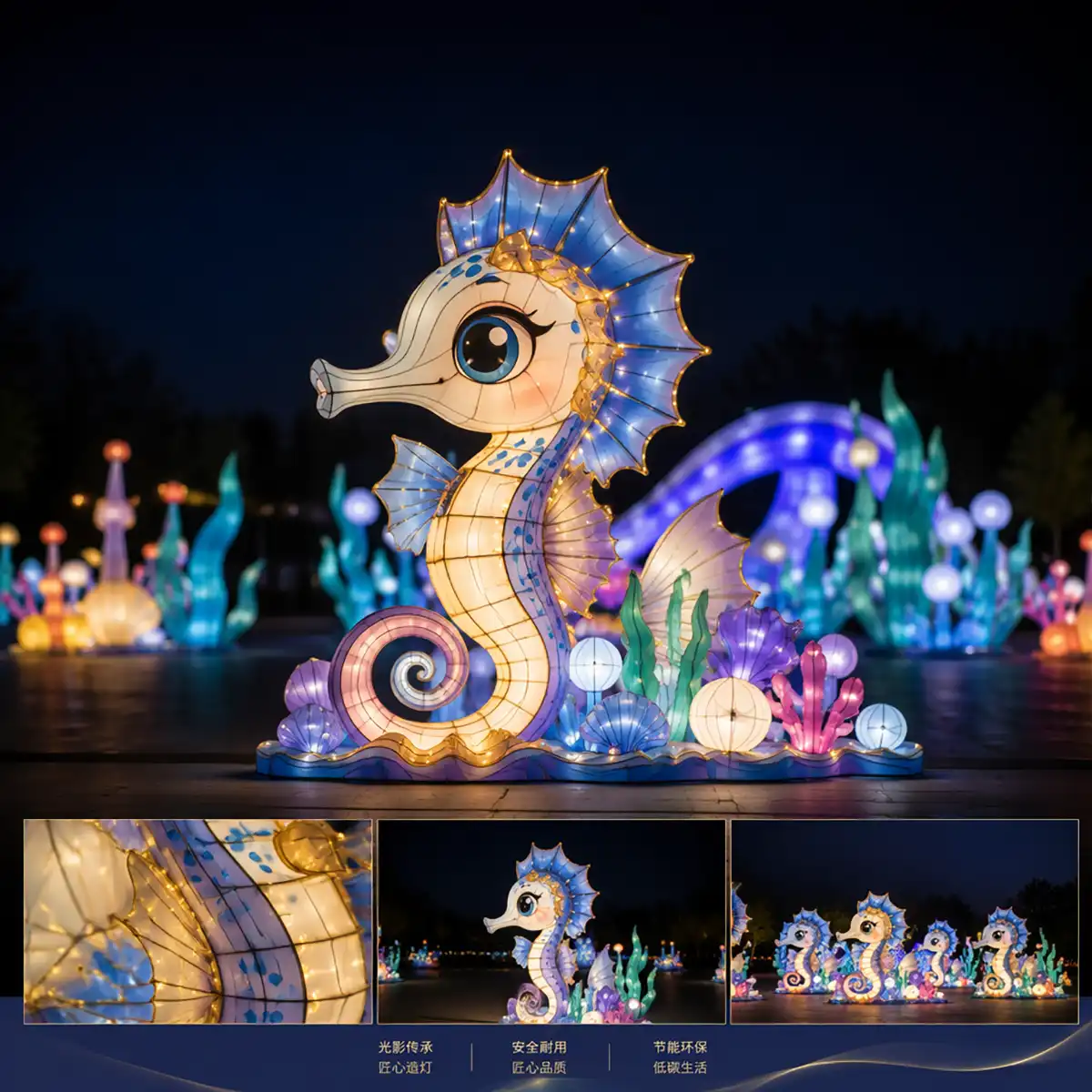
The seahorse is the most requested small marine form. It is compact, upright and reads from any direction, which makes it useful in positions where an elongated fish would be seen edge-on. It is usually specified in pairs or small groups rather than singly, because a single seahorse reads as an ornament rather than as a display.
Jellyfish and octopus
Jellyfish are the most successful suspended marine form. The trailing tentacles work vertically, they read from below, and they tolerate the distortion of distance better than any other marine shape. Octopus forms work best at close range, where the arms can be read individually.
Worth knowing: jellyfish and fish are the two marine forms that work suspended. Whale, turtle and octopus forms normally need to be ground-set, because their recognition depends on being seen from a distance rather than from below.
Tradition
What the tradition specifies
Japanese fish lantern forms are usually built flatter and wider than the European equivalent, because they were designed to be seen on water rather than from a plaza. The koi is read from above, so the body is drawn as it would be seen looking down rather than from the side. That is a detail worth keeping if the display is going beside a pond.
Japanese Fish Lantern Traditions
Fish lanterns have a longer history in Japan than in most markets, and it shapes what visitors there expect. The koi and the carp are the traditional forms, associated with perseverance and with the Dragon Gate legend, and they are usually built as floating or water-adjacent displays rather than ground figures.
For a venue outside that tradition the useful part is the water relationship: fish forms are the one marine category that reads correctly beside or on water, because that is where the visitor expects to see them. A koi beside a pond is more convincing than the same koi on a plaza.
Manufacturing
Manufacturing Sea Animal Lanterns
Marine forms are specified for two environments more than any other: beside water and under cover. Both change the build.
01 · Water Water-adjacent positions
Spray and humidity reach further than most buyers expect. Outdoor-rated enclosures and a finish that tolerates damp are specified even where the piece is not in the water.
02 · Structure Long forms behave differently
A whale is long and light. Wind acts along its length, so the base and any hanging points are designed around that rather than around weight.
03 · Under cover Suspended marine forms
Fish and jellyfish read from below, which makes them the natural choice for atriums and covered routes where floor space is limited.
Sectioning and delivery
Large marine forms are sectioned for container loading in the same way as any other large piece, but the section boundaries matter more. A whale cut in the wrong place loses the line that makes it read as a whale, so the joints are placed where the silhouette is least sensitive. Sections are trial-fitted before release, in the same way as a giant lantern frame.
Indoor versus outdoor builds
An indoor build omits the weather package and can use lighter components, but it has to survive being walked under. Cable routing and fixing points are designed for the ceiling structure rather than the ground, and the lighting is specified for a space that already has ambient light.
Maintenance during the season
Marine forms sit in the dampest positions on most sites, which is where lighting faults appear first. Sections are built so they can be reached and replaced without taking the piece apart, and the enclosures are specified for the position rather than for a generic outdoor standard. On a water-adjacent site this matters more than anywhere else on the route.
Recognition over detail
Marine forms are recognised by outline. A whale is a whale because of its fluke and its length, not because of the texture of its skin. That is why the frame geometry matters more than the surface work on any large marine piece.
Suppliers
Choosing a Manufacturer for Sea Animal Lantern Displays
Because the forms are familiar, mistakes are obvious. Three things are worth establishing before you commission anything.
01 · Reference Ask for marine work specifically
A portfolio of dragons and pagodas does not prove anything about whales. Ask for the last three marine pieces they built, and at what scale.
02 · Scale How they size a whale
The right answer starts with viewing distance. If a supplier quotes a height before asking how far away it will be seen from, they are working from a catalogue.
03 · Position Suspended or ground-set
Ask which forms they would suspend and which they would not. Fish and jellyfish suspend well; whale, turtle and octopus forms normally do not.
Set the opening date first, then count backwards: installation, sea freight, production, drawing approval. Marine themes tend to need one more revision round than land animals, because the forms are familiar and buyers notice when a silhouette is slightly off. Building that round into the schedule is what stops it becoming a delay.
Our guide on telling a factory from a trading company covers the wider checks, and planning the winter and New Year season sets out where each display type belongs in a route.
Related
Animal lanterns Land and marine animal forms already built to order, from single character pieces to grouped installations. Walk-through archways For the entrance a marine scheme sits behind, so the theme carries from the first step. Giant lantern structures How large-scale displays are engineered: wind load, base design and the questions to ask before ordering.
Frequently Asked Questions
Which marine forms work suspended?
Fish schools and jellyfish are the two that work best, because they read from below. Whale, turtle and octopus forms normally need to be ground-set, since their recognition depends on being seen from a distance.
How tall does a whale lantern need to be?
It follows the viewing distance. A whale meant to be read across a plaza has to clear the heads of a crowd at the far edge; sized for a corridor it reads as a large fish and the recognition is lost.
Can marine lanterns be installed beside water?
Yes, and fish and koi forms are the natural choice for it. The build uses outdoor-rated enclosures and a finish that tolerates damp, because spray and humidity reach further than most buyers expect.
What is the difference between koi and carp forms?
Koi are the coloured, long-established ornamental form and carry the cultural association most venues want. Carp is the plainer wild form. Both work as groups; koi is specified more often for its meaning than its shape.
Do marine lanterns work indoors?
Yes, and they are one of the strongest indoor themes. Fish schools and jellyfish in particular use ceiling height rather than floor area, which suits atriums and covered routes.
How many pieces does a marine scheme usually need?
It depends on the route. Most sites work better with one large feature form and a set of smaller character pieces than with a large number of similar fish, because the group reads as a composition rather than a repeated pattern.
Where the Work Happens
We build in Zigong, in Sichuan, where large illuminated displays have been made for centuries. Marine forms are among the most requested themes in our workshop, and the design and production teams sit in the same building, so a change to a whale silhouette in week five is resolved by the people who welded the frame.
Planning a marine life display for a site?
Send the usable area, whether the position is beside water, and the opening date. We will reply with what is buildable in that window.