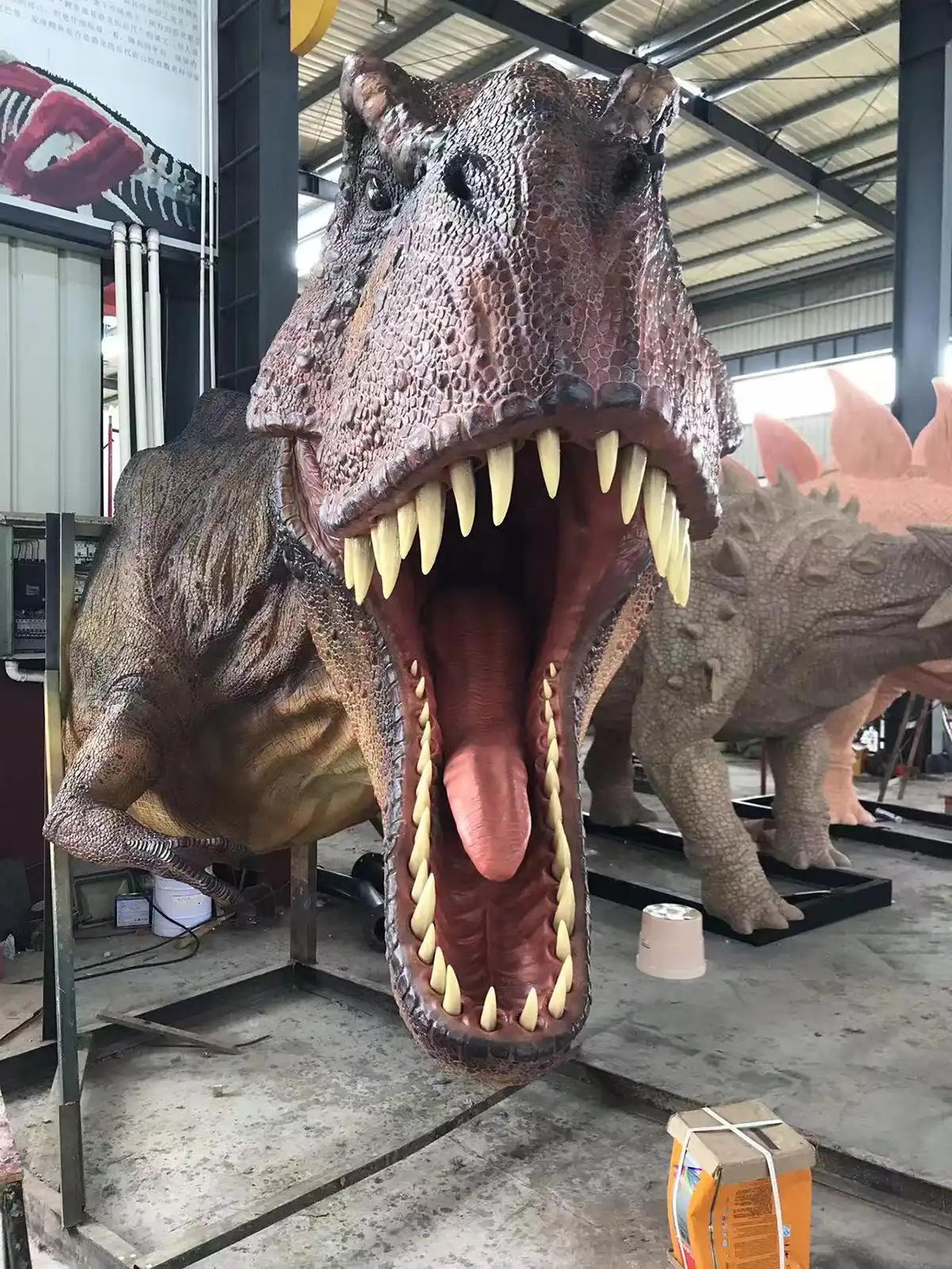
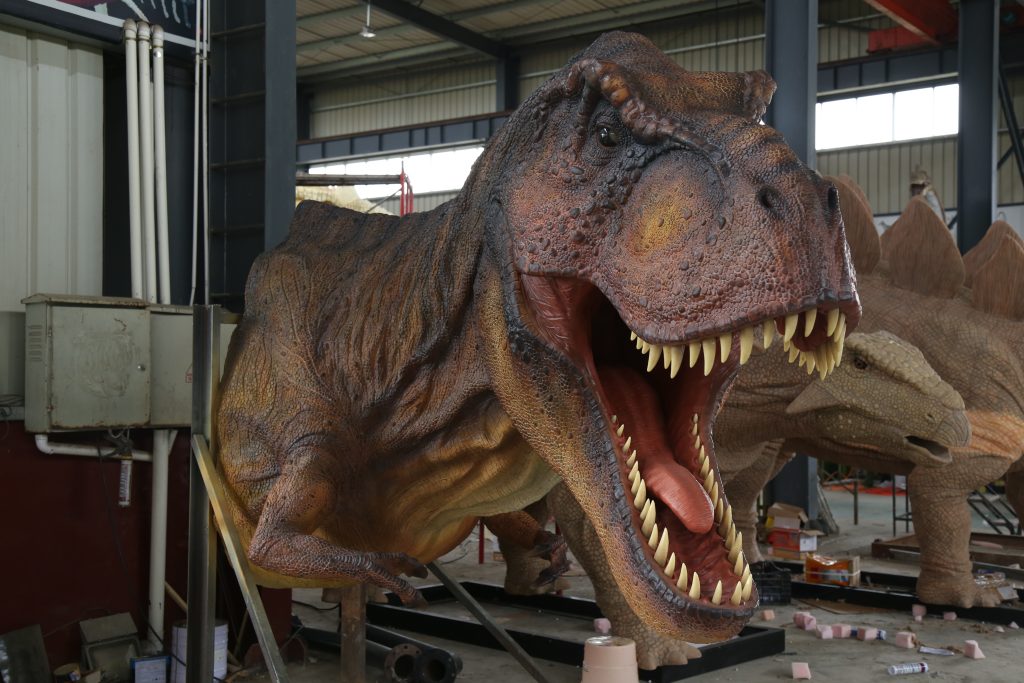
Walk toward the T-Rex. Stop two metres away. Raise your right hand above your shoulder. The dinosaur’s head tilts — its amber eyes lock onto you. You sweep your arm left. The massive skull follows. You clap your hands. The jaw drops open, thirty hand-painted teeth catch the light, and a roar shakes through the floor from a concealed 200-watt speaker. This is not a preprogrammed show. This is gesture-sensing interactive robotics — a motion-capture animatronic dinosaur that reads your body language in real time and responds like a living creature.
At FestiveLanterns, we have spent 14+ years in Zigong, China building animatronic dinosaurs. Until recently, most of them ran on fixed loops — same roar, same head turn, same timing, regardless of who was watching. In 2025 we changed that. We embedded dual-sensor fusion technology — ultrasonic motion detectors paired with infrared proximity sensors — into our animatronic frames. The result is an interactive dinosaur experience where every visitor gets a unique response shaped by their own gestures, walking speed, and body position.
Want a gesture-sensing dinosaur for your venue? Request a free interactive design proposal — sensor specifications, behaviour profiles, and itemised quote within 24 hours.
How Gesture-Sensing Works: The Sensor Fusion System
Our gesture-sensing dinosaurs do not use cameras. They do not use AI. They use a simpler, more reliable approach: sensor fusion — two detection systems working together to interpret visitor body language.
Sensor 1: Ultrasonic Motion Detector
Mounted in the dinosaur’s head or chest, an ultrasonic transducer emits high-frequency sound pulses and measures the returning echo. This tells the system four things about every visitor in the 3-metre trigger zone:
- Distance — How far is the visitor from the dinosaur? (measured to within 5 cm)
- Speed — Is the visitor walking slowly, running, or standing still?
- Gesture size — Large, fast movements (raised arm, clap, jump) produce a distinct echo pattern versus small, slow movements (head tilt, step forward).
- Visitor count — One visitor triggers a one-on-one interaction. A group of five triggers a group threat display.
Sensor 2: Infrared (IR) Proximity Array
A grid of three to five IR beams fans out in front of the dinosaur. When a visitor breaks any beam, the system knows three things:
- Position — Left beam broken = visitor approaching from the left flank. Centre beam broken = visitor standing directly in front.
- Proximity trigger — Beam 1 (outer, 3 m): low-intensity idle animation. Beam 2 (middle, 2 m): alert posture. Beam 3 (inner, 1 m): full interactive response.
- False-positive filtering — The IR system ignores wind-blown leaves, falling rain, and small animals. Only human-sized objects crossing at human speed trigger a response.
How They Work Together
The ultrasonic and IR outputs feed into a DMX512 show controller — a programmable logic box smaller than a laptop. The controller runs decision trees, not scripts. Here is an example of five real behavioural responses programmed into one of our installations:
- Visitor approaches slowly from centre, stops at 2 m, raises hand → T-Rex head tilts, eye colour shifts amber to red, soft vocalisation plays
- Visitor approaches quickly from left, stops at 1 m → T-Rex snaps head to left, jaw opens, full volume roar, eye flash red
- Visitor stands still for 5 seconds at 3 m → T-Rex breathes slowly, head sways gently, occasional blink — idle behaviour that signals the dinosaur is “alive”
- Three visitors approach simultaneously from centre at 2 m → T-Rex assumes defensive posture, head lowers, jaw cracks open, low warning growl
- Visitor claps hands or shouts — sonar picks up sudden sound burst → T-Rex startles, rapid head jerk backward, then slowly leans forward to investigate
This is gesture-sensing, not preprogrammed theatre. Every response is triggered by visitor action, not a timer.
Read our technical paper: How sensor technology is transforming animatronic dinosaur exhibits →
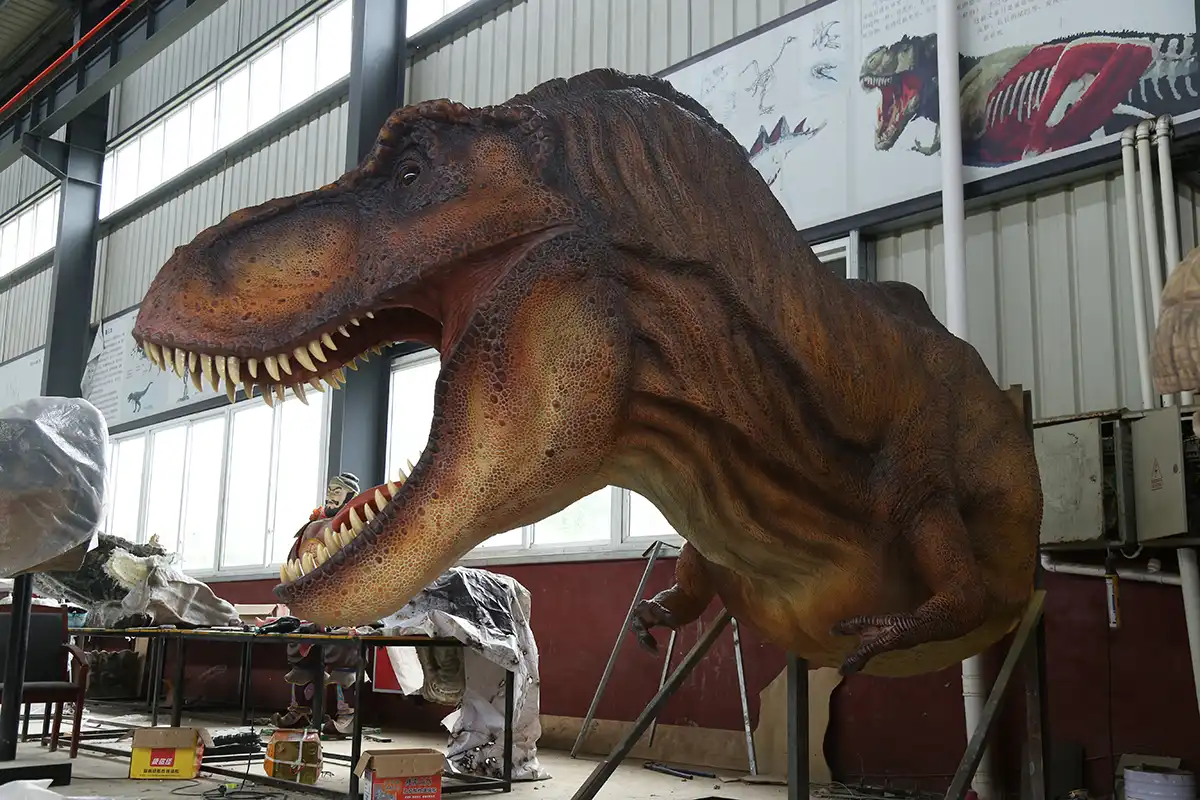
Three Flagship Gesture-Sensing Dinosaur Products
1. Motion-Activated T-Rex — Gesture Interactive Animatronic
Walk up to this 4–6 metre T-Rex, raise your hand, and the dinosaur responds. The Motion-Activated T-Rex Gesture Interactive Animatronic uses ultrasonic and infrared sensors embedded in its head and torso to track visitor movement across a 3-metre radius. It runs 16 programmable behaviour profiles — from gentle “Family Mode” (soft head turns, quiet vocalisations) to full “Thrill Mode” (theatrical jaw drop, roaring response, rapid eye colour shift from amber to red to white).
Hydraulic cylinders drive the jaw and neck for smooth, heavy motion — the kind of realism that pneumatic systems cannot achieve at this scale. Brushless servo motors handle the precise head tracking. Everything is outdoor-rated for outdoor installation. The DMX512 controller stores all behaviour profiles and switches modes with a single button press.
View the Motion-Activated T-Rex Product →
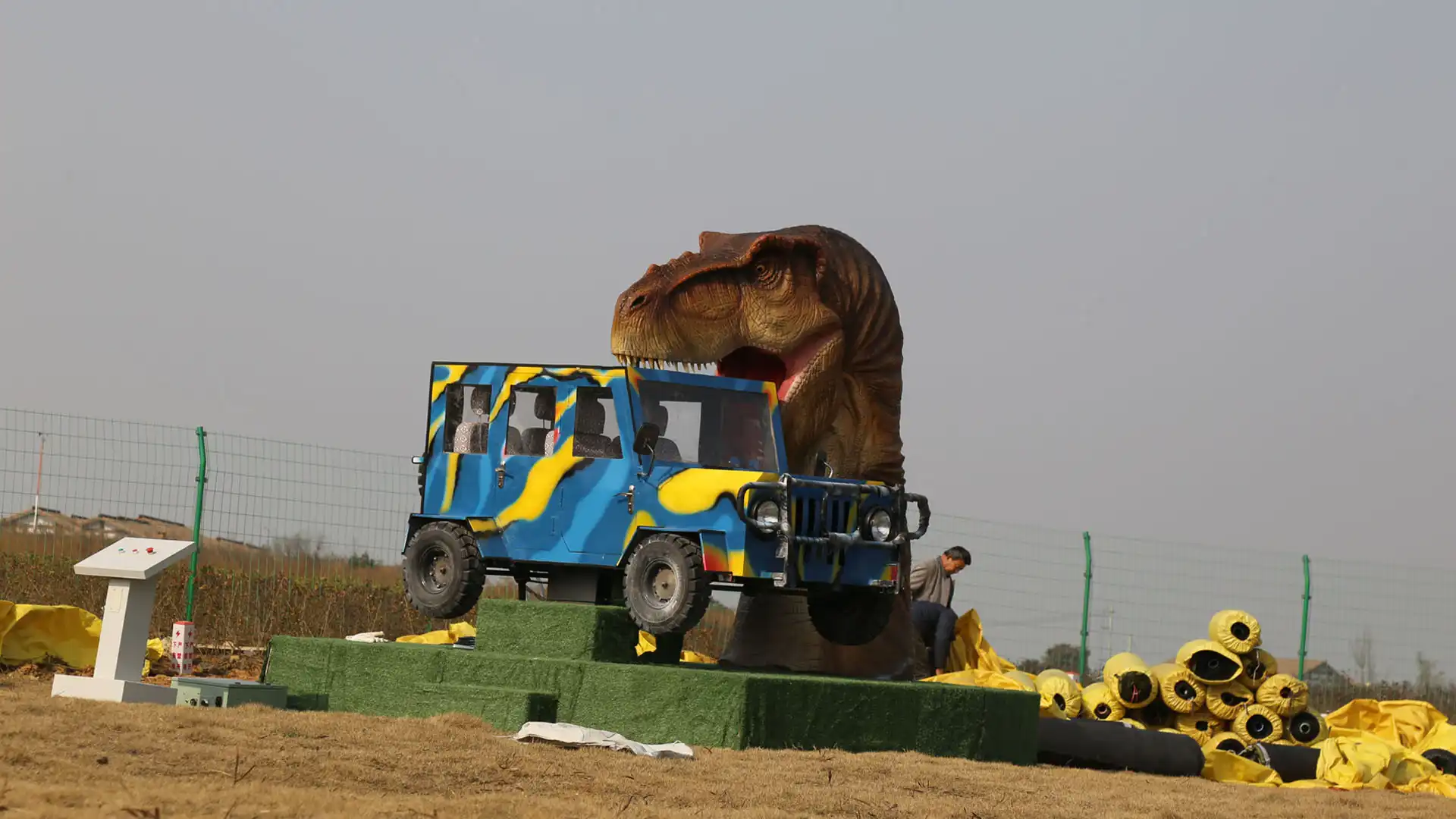
2. Interactive T-Rex Bites Car — Animatronic Photo Ride
A different kind of gesture interaction: visitors climb into a real-size 4×4 jeep cockpit while a life-size T-Rex head — triggered by an IR proximity sensor in the driver’s seat — lowers its jaw, emits a roar, and “bites” the vehicle roof. The Interactive T-Rex Bites Car is the most shared photo attraction across theme parks worldwide. Families pose in the jeep while the dinosaur reacts. Children lean out the window to “escape.” Every photograph goes onto Instagram.
Hydraulic jaw opens 40 cm. 200-watt outdoor-rated directional speaker delivers the roar. Eye LEDs flash red during the bite. The entire sequence lasts 8–12 seconds per trigger and automatically resets for the next visitor. No attendant required for operation.
View the Interactive T-Rex Bites Car Product →
3. Animatronic Spinosaurus — Giant Predator with Interactive Sensor Upgrade
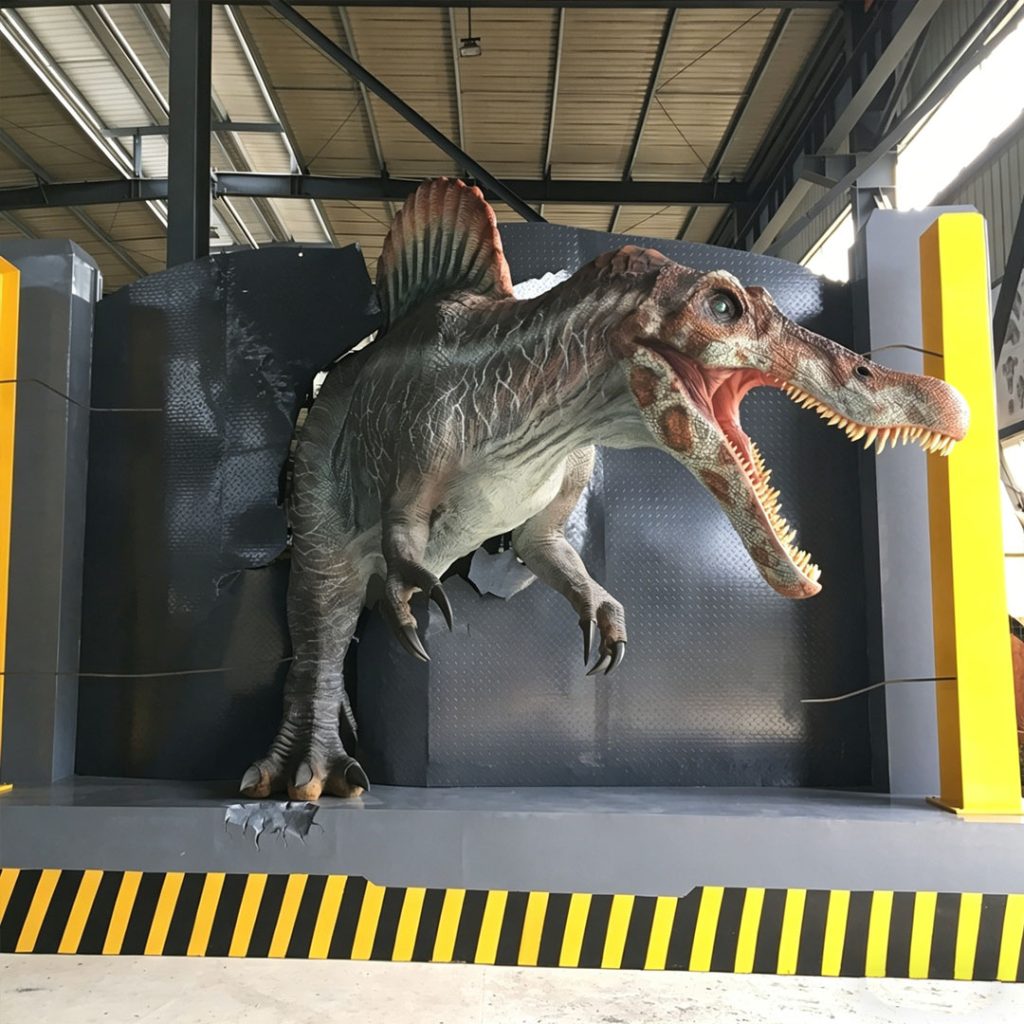
The Spinosaurus — at 9 metres long with a towering sail — is one of the largest animatronic predators we build. In its standard configuration, it opens its mouth, emits a roar, moves its head and tail, and simulates breathing. With our dual-sensor gesture-sensing upgrade, the Spinosaurus becomes a full interactive exhibit: visitors approach within 3 metres and the sail-back predator turns toward them. Step closer. The mouth opens. Raise a hand. The roar follows. The Spinosaurus’s 2-metre dorsal fin makes it one of the most visually spectacular interactive dinosaurs available — the sail catches ambient light and glows against a dark sky.
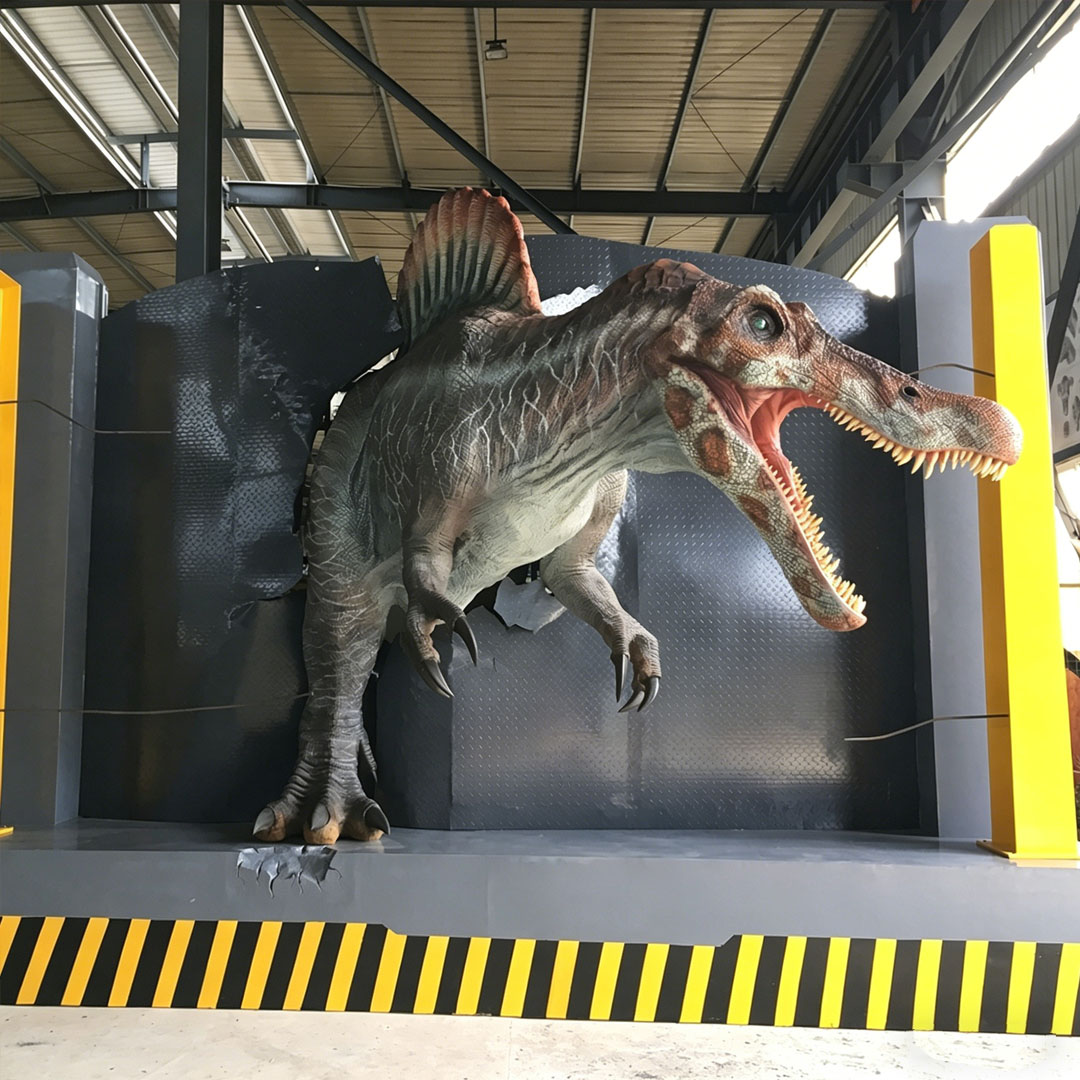
Browse the full animatronic dinosaur catalog with interactive upgrades →
Why Venue Operators Are Switching to Gesture-Sensing Animatronics
- Visitor dwell time quintuples — A passive dinosaur display holds attention for 20–40 seconds. A gesture-responsive dinosaur holds attention for 2–5 minutes. This directly increases food & beverage sales, gift shop traffic, and memberships.
- Social media sharing triples — Videos of visitors “interacting” with a responding dinosaur generate 5× more engagement than static photos. The moment of surprise — “It looked at me!” — is what gets shared.
- Education becomes interactive — Museum educators can use gesture-sensing to demonstrate predator-prey behaviour. Students approaching from different angles trigger different responses, turning the dinosaur into a teaching participant.
- Repeat visitation rises 20–35% — When a child discovers the dinosaur “sees” them, they want to come back. The variability of the interaction — different each time — drives season pass conversions.
- No staff required for basic operation — Once installed, our gesture-sensing dinosaurs run automatically. The sensors handle everything. A trained operator is only needed for show-mode presentations and maintenance.
What Our Sensors Capture — And What They Ignore
The magic of a convincing gesture-sensing dinosaur is not just what the system detects — it is what the system filters out. We have spent years tuning our sensor fusion to distinguish meaningful visitor gestures from environmental noise:
| Sensor Captures | Sensor Ignores |
|---|---|
| Visitor walking speed and direction | Wind-blown leaves |
| Hand gesture size and speed | Falling rain |
| Body position (centre, left, right) | Small animals (birds, squirrels) |
| Visitor count (1 vs. group) | Ambient festival noise |
| Sudden sound bursts (clap, shout) | Background music |
| Distance from dinosaur (to 5 cm precision) | Reflections from wet ground |
This filtering is what makes outdoor gesture-sensing reliable. In 2025 we installed a Motion-Activated T-Rex at an outdoor botanical garden in Australia where ambient temperatures reached 40°C and direct sunlight flooded the sensor zone. Standard IR sensors would have been blinded. Our solar-filtered sensor array operated without a single false trigger from opening day through the final night.
Pricing & Timeline
Gesture-sensing is an upgrade to our standard animatronic dinosaurs. Pricing depends on figure size, sensor complexity, and behaviour programming:
- Single interactive dinosaur with dual-sensor system and 2–4 behaviour profiles: $15,000–$30,000 added to the base dinosaur cost
- Multi-dinosaur interactive show with DMX512 controller, 16+ behaviour profiles, and custom programming: $50,000–$150,000 for the interactive system
- Complete turnkey interactive exhibits (5–10 dinosaurs, full sensor integration, on-site calibration): $150,000–$400,000
Timeline: Design (2–3 weeks) → Fabrication + sensor integration (6–8 weeks) → Controller programming (2–3 weeks) → 72-hour testing → Shipping (3–6 weeks) → On-site calibration (1–2 weeks). Start 5–6 months before your target opening date.
Request a free gesture-sensing design proposal →
FAQ
How does the dinosaur know what gesture I am making?
Our dual-sensor system combines ultrasonic pulse-echo measurement (tracks movement speed, direction, and size) with infrared beam detection (tracks visitor position and proximity). The two sensor inputs feed into a DMX512 controller that runs decision-tree logic — if the visitor is at 2 metres, centre position, and raises a hand above shoulder height, trigger Behaviour A. No cameras. No AI. No internet connection required.
Does the dinosaur respond differently to different people?
Yes. A child running toward the dinosaur triggers a different sequence than an adult approaching slowly. A group of three triggers a different response than one person alone. Fast, large gestures (clapping, jumping) trigger high-intensity responses (roar, jaw drop). Slow, small gestures (head tilt, step forward) trigger low-intensity responses (soft vocalisation, eye colour shift).
Can the interactive behaviour profiles be changed?
Yes. The DMX512 controller stores up to 16 behaviour profiles. You can switch between Family Mode (gentle responses for young children), Thrill Mode (dramatic responses for teenagers), and Photo Mode (pose-friendly sequences that hold still for camera shots) with a single button press. Custom profiles can be uploaded via USB.
Does the gesture-sensing work outdoors?
Yes. All sensors are outdoor-rated and tested in temperatures from -10°C to 45°C. Our ultrasonic system operates reliably in wind, rain, and direct sunlight. The IR system uses solar-filtered sensors that are not blinded by full daylight. We have outdoor installations running continuously from Australia (desert heat) to Canada (winter snow).
Do I need a technician to operate the dinosaur?
No. Once installed and calibrated, our gesture-sensing dinosaurs run autonomously. The sensors handle all visitor detection. The show controller handles all behaviour. Staff are only needed for show-mode presentations (where a narrator guides the interaction) or for routine maintenance.
What happens if a sensor fails?
All sensor components are modular and field-swappable. An IR sensor can be replaced in under 15 minutes without tools. The show controller automatically falls back to single-sensor mode (ultrasonic only or IR only) if one sensor array is offline. Spare sensor modules are included with every shipment.
Related Products & Resources
- Motion-Activated T-Rex Gesture Interactive Animatronic — Flagship gesture-sensing dinosaur, 16 behaviour profiles
- Interactive T-Rex Bites Car Photo Ride — Sensor-triggered photo attraction, family favourite
- Dinosaur Park Exhibits — Complete Turnkey Solutions — Interactive and passive dinosaur installations
- Animatronic Dinosaurs — Full Species Catalog — 20+ species with gesture-sensing options
- Sensor Technology in Animatronic Products — Technical deep-dive into IR and ultrasonic sensing
- Request a Free Gesture-Sensing Design Proposal — 3D renderings, sensor specifications, itemised quote within 24 hours
Technical Deep-Dive: Programming & Sensor Selection
The most memorable animatronic dinosaur exhibits aren’t just realistic to look at — they interact with visitors. A dinosaur that turns its head to follow a passerby, opens its mouth in response to a child’s wave, or even carries on a conversation creates a powerful emotional connection that static displays, no matter how detailed, simply cannot achieve.
Behind these interactive experiences lies an increasingly sophisticated stack of detection and control technologies: infrared sensors, programmable motion controllers, gesture recognition, and AI-powered voice interaction. This article explores how each technology works and how they combine to create truly interactive animatronic displays.
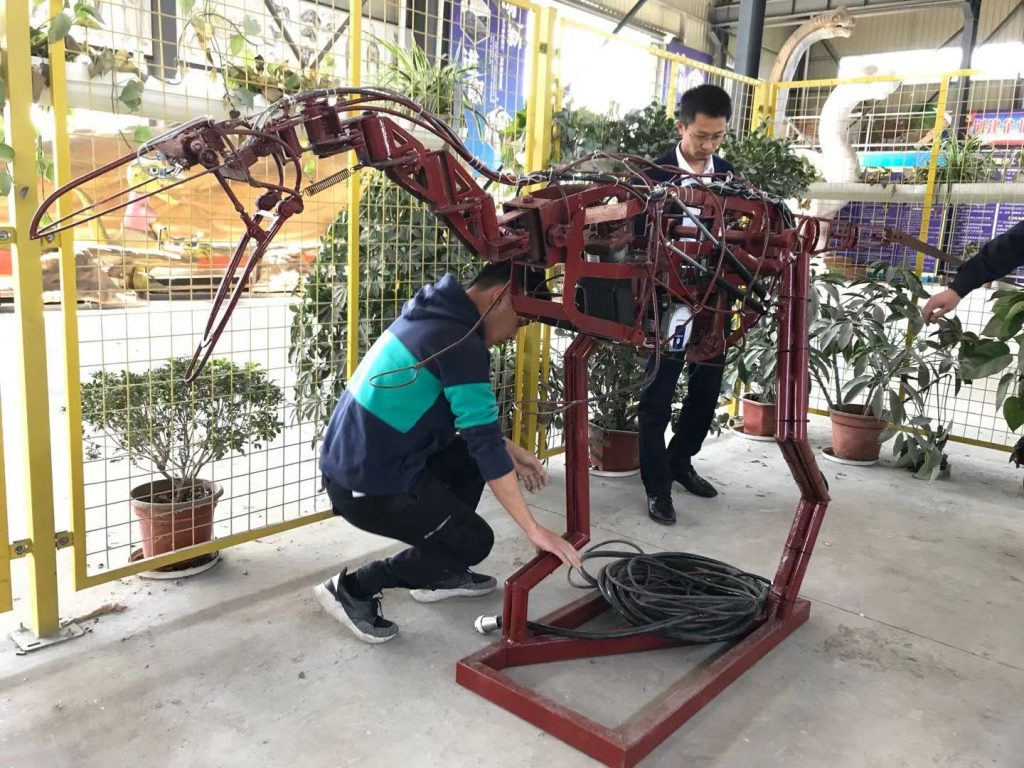
The Four Layers of Interactive Control
Modern interactive animatronics operate on four overlapping layers:
Layer 4: AI & Voice Interaction ──── Conversational responses, LLM-powered dialogue
Layer 3: Gesture Recognition ──────── Hand gestures, visitor movement patterns
Layer 2: Sensor Detection ─────────── Infrared, ultrasonic, pressure triggers
Layer 1: Core Programming ────────── Motion sequences, behavior scripts
Each layer builds on the one below, adding progressively more sophisticated interaction capabilities.
Layer 1: Core Motion Programming
At the foundation of every interactive animatronic is its motion control program. This software layer defines:
Basic Motion Sequences
Each joint movement is programmed as a set of parameters:
Joint: Jaw
Action: Open
Start: 0°
End: 45°
Duration: 1.5 seconds
Easing: Ease-out (slows toward end)
Sound: Roar_01.wav (3 seconds, loop)
Multiple joints are combined into sequences:
Sequence: "Roar_Display"
├── Step 1: Head tilt right (0.5s)
├── Step 2: Jaw open to 45° (1.5s) + Start roar sound
├── Step 3: Chest expand (1.0s)
├── Step 4: Head shake left-right (0.8s)
├── Step 5: Jaw close to 0° (1.0s) + Stop roar
└── Step 6: Return to idle (0.5s)

Total duration: 5.3 seconds
Behavior Modes
Modern animatronic controllers support multiple behavior modes:
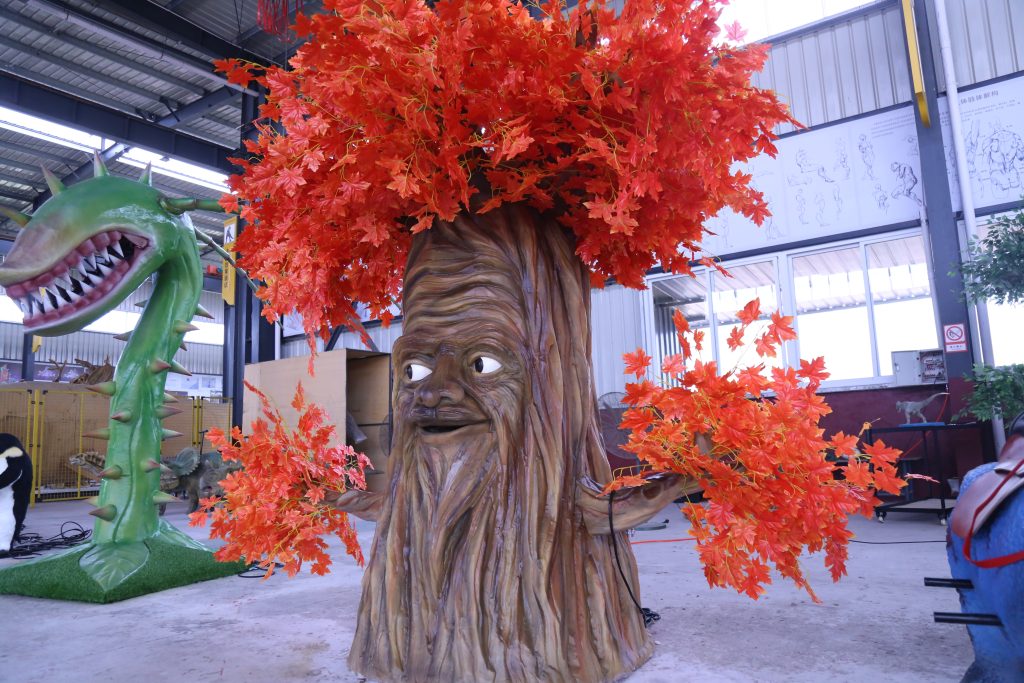
| Mode | Description | Typical Use Case |
|---|---|---|
| Idle | Subtle breathing, occasional eye blink | Default state when no visitors nearby |
| Passive | Slow head tracking, soft sounds | Low-traffic periods |
| Interactive | Full animation triggered by sensors | Active visitor engagement |
| Performance | Pre-programmed show sequence | Scheduled shows, timed events |
| Sleep | All motion stopped, minimal power | Overnight, maintenance periods |
The controller automatically transitions between modes based on sensor input and time of day.
Layer 2: Sensor Detection Technology
Before an animatronic can respond to visitors, it needs to detect them. This is the role of the sensing layer.
Infrared (IR) Sensors — The Workhorse of Interactive Detection
How IR Sensors Work:
Passive infrared (PIR) sensors detect changes in infrared radiation — essentially, they sense body heat. When a visitor walks into the sensor’s field of view, the temperature change triggers a signal.
Advantages:
- Low cost: $3-10 per sensor
- Simple integration: Digital on/off output
- Low power: Microamp-level consumption
- Day/night operation: Works in complete darkness
Limitations:
- Detection only, not identification
- Limited range (5-8 meters typical)
- Affected by rapid temperature changes
Sensor Configuration for Animatronic Dinosaurs
                  ┌─────────────────────────┐
                  │   Animatronic Dinosaur   │
                  │                          │
    Front Zone    │  ┌──────────────────┐    │    Rear Zone
  IR Sensor ──────│──┤   Main Controller │────│── IR Sensor
  (5m range)      │  │  (PLC / MCU)      │    │  (3m range)
                  │  └──────────────────┘    │
                  │         │                │
                  │    ┌────┴────┐           │
                  │    │ Motion  │           │
                  │    │ Drivers │           │
                  │    └─────────┘           │
                  └─────────────────────────┘
Typical sensor layout for a mid-size animatronic dinosaur (8-12 meters):
| Sensor Position | Type | Purpose | Range |
|---|---|---|---|
| Chest/front | PIR | Detect approaching visitors | 5 meters |
| Head | PIR + Ultrasonic | Visitor proximity for close interaction | 2 meters |
| Tail base | PIR+ | Detect visitors approaching from rear | 3 meters |
| Jaw area | Contact sensor | Detect physical touch/obstruction | Contact |
Automatic Standby Mode
One of the most practical benefits of sensor-based control is power management:
IR Sensor: No visitor detected for 10 minutes
    ↓
Controller: Transition to "Sleep" mode
    ↓
Motion: Stop (90% power reduction)
Sound: Off
Sensor: Still active (low-power polling)
    ↓
IR Sensor: Visitor detected entering zone
    ↓
Controller: Wake → Transition to "Idle" → Start interactive sequence
    ↓
Full animation resumes within 0.5 seconds
This saves approximately 70-80% of energy during off-peak hours and significantly extends the service characteristics of mechanical components.
Layer 3: Gesture Recognition
Moving beyond simple presence detection, gesture recognition allows visitors to actively control the animatronic’s behavior through hand and body movements.
How Gesture Control Works in Animatronics:
- Sensor array detects movement: Multiple IR or depth sensors positioned around the interaction zone
- Pattern recognition software: Analyzes the movement pattern against pre-programmed gestures
- Action mapping: Each recognized gesture triggers a specific animation response
Common Gesture Commands for Animatronic Dinosaurs:
| Visitor Gesture | Sensor Reads | Dinosaur Response |
|---|---|---|
| Wave hand left-right | IR beam interrupted, left→right | Head follows hand direction |
| Wave hand up-down | IR beam interrupted, top→bottom | Head tilts up/down |
| Clap | Audio sensor detects clap pattern | Roar response + head shake |
| Point (finger extended) | Proximity in specific zone | Approach toward pointed area |
| Raise both arms | Two zones triggered simultaneously | Stand up, full roar sequence |
| Step forward (into red zone) | Close-proximity sensor | Back away, defensive posture |
Gesture Recognition Technical Specs:
| Parameter | Typical Value |
|---|---|
| Response time | 200-500ms (gesture to animation) |
| Recognition accuracy | 85-95% (with proper sensor calibration) |
| Number of gestures | 5-12 (varies by complexity) |
| Detection range | 1-5 meters |
| Simultaneous users | 1-3 (in defined interaction zone) |
Layer 4: AI-Powered Voice Interaction
The newest and most sophisticated layer of interactive technology brings conversational AI to animatronic exhibits — allowing visitors to actually talk with the dinosaur.
How Voice-Interactive Animatronics Work
The system uses four core components:
Visitor Speech
    ↓
🎤 Microphone → Noise cancellation → Speech-to-Text (STT)
    ↓
🧠 Large Language Model (LLM) — generates contextual response
    ↓
🔊 Text-to-Speech (TTS) → Speaker → Dinosaur "speaks"
    ↓
🦕 Synchronized lip/jaw movement + gesture animation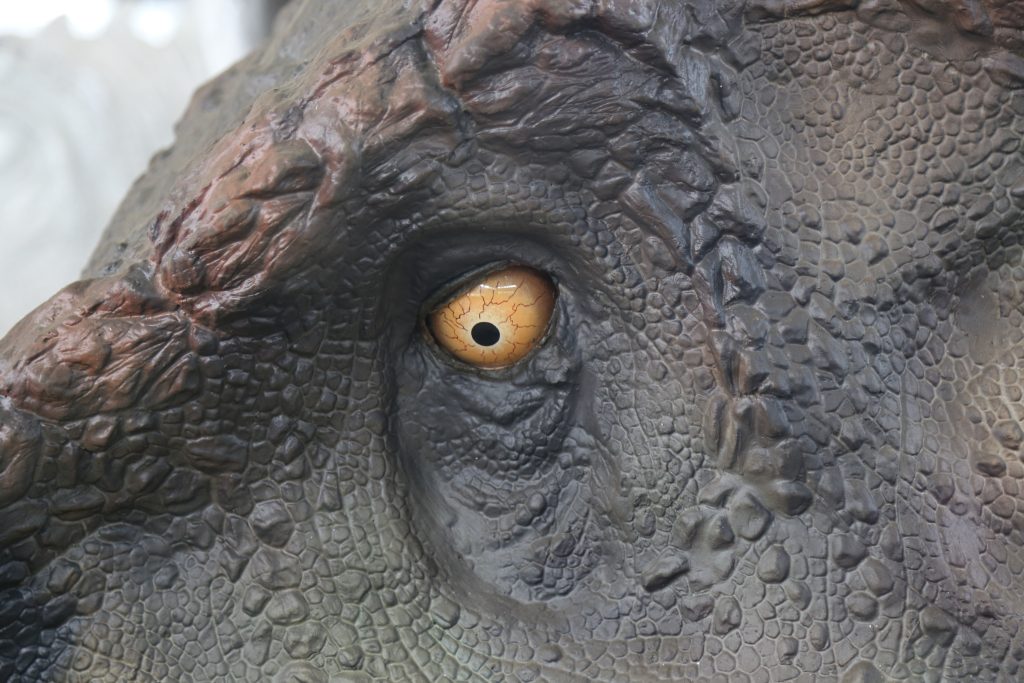
Technology Stack
| Component | Technology | Function |
|---|---|---|
| Microphone array | 2-4 MEMS microphones | Capture visitor speech, noise cancellation |
| Speech-to-Text | Whisper / DeepSpeech | Convert audio to text |
| AI Dialogue Engine | Local LLM / API-based | Generate natural language responses |
| Text-to-Speech | Edge TTS / ElevenLabs | Convert text to natural-sounding speech |
| Lip Sync | Wav2Lip / custom algorithm | Match jaw movement to audio |
| Animation Controller | PLC / motion control | Coordinate body movement with speech |
What Makes a Good Voice-Interactive Experience
Drawing inspiration from successful interactive characters in theme parks (such as the popular “talkative” Transformer and pirate characters), the key design principles are:
- Character consistency: The dinosaur should have a defined personality — friendly educator, fierce predator, or curious creature
- Context awareness: The system should reference the venue (“Welcome to Jurassic Hall!”) and remember previous interactions
- Responsiveness: Response time under 2 seconds maintains conversational flow
- Fail gracefully: If AI understanding fails, fall back to pre-recorded responses
- Safety moderation: Profanity and sensitive topics filtered via content moderation layer
Response Generation Pipeline
Visitor: "Are you a real dinosaur?"
    ↓
STT: "are you a real dinosaur"
    ↓
Classifier: Intent = "identity_question" | Confidence: 0.97
    ↓
LLM Prompt: "You are a friendly T-Rex animatronic at a museum exhibit.
Answer questions in character. Be enthusiastic and educational."
    ↓
LLM Response: "Well, I'm the next best thing! I'm a life-size animatronic
T-Rex — built using real fossil skeletons as a reference. I've got over
50 moving parts and my roar can reach 120 decibels! Want to see me
roar?"
    ↓
TTS → Speaker output
    ↓
Animation Controller: Jaw open to "roar" position, head tilt up (synchronized)
Practical Implementation: A Complete Interactive Cycle
Here’s how all four layers work together in a real animatronic exhibit:
1. IDLE STATE
   └── IR sensor polling, subtle chest breathing

2. DETECTION
   └── IR sensor detects visitor at 4 meters
   └── Controller transitions to Interactive mode
   └── Head slowly turns toward visitor (servo motors)
   └── Pre-programmed greeting: "Welcome, explorer!"

3. INTERACTION
   └── Visitor waves hand → Gesture recognition triggers head follow
   └── Visitor says "What do you eat?" → STT → LLM → TTS → Audio response
   └── Synchronized jaw + head movement during speech
   └── Occasional blink, tail sway, chest breathing

4. DEPARTURE
   └── IR sensor: visitor leaves zone
   └── 30-second timer starts
   └── If no new visitor → Transition to Idle
   └── If new visitor → Repeat from Step 2

5. SLEEP (no visitors for 10 minutes)
   └── All motion stops
   └── Sensors remain active (low-power mode)
   └── Wake on next detection
The Future: Autonomous Learning Animatronics
The next frontier for interactive animatronics is autonomous learning — dinosaurs that adapt their behavior based on visitor interaction patterns.
Emerging Technologies
- On-device AI inference: Processing voice and gesture recognition locally (no cloud dependency)
- Adaptive behavior: The dinosaur “learns” which responses get the best visitor reactions and adjusts accordingly
- Multi-character coordination: Multiple animatronic dinosaurs communicating with each other through a shared AI system
- Visitor identification: Facial recognition (with privacy controls) to recognize returning visitors and remember past conversations
Next Steps for an Interactive Exhibit
Sensor response is one design layer. Once you know how the exhibit reacts, the remaining decisions are mechanical, commercial and logistical — these are the pages that cover them:
- The six systems behind an animatronic dinosaur — how frame, motion, skin, sensing, sound and weatherproofing constrain each other.
- A motion-activated T-Rex — a simpler trigger layer as a comparison point.
- Hydraulic vs pneumatic actuation — response speed, smoothness and maintenance by system.
- Motor selection — torque, duty cycle and which motor for which joint.
- Buying guide for museums and theme parks — the five questions to answer before a supplier conversation starts.
- Complete buying guide — specification, ordering timeline, shipping and installation.
- What moves the price — how interaction depth and movement count are costed.
- Interactive dinosaur exhibits — the full build category, including sensing systems.
Conclusion
Interactive animatronic technology has evolved far beyond simple looped motion sequences. Modern exhibits combine infrared detection, gesture recognition, programmable motion control, and AI-powered voice interaction to create experiences that genuinely engage visitors.
For venues investing in animatronic displays, the level of interactivity directly correlates with:
- Visitor dwell time — Interactive exhibits keep visitors engaged 3-5x longer
- Social media value — Unique interactive moments generate organic content
- Return visits — Repeat visitors want to experience different interactions
- Educational impact — Interactive engagement improves information retention
At FestiveLanterns, our engineering team in Zigong designs and programs interactive animatronic systems tailored to each venue’s specific requirements — from simple IR-triggered motion sequences to full conversational AI exhibits.
Internal Links:
- Animatronic Dinosaurs Collection
- Dinosaur Rides & Interactive Exhibits
- Dinosaur Park Exhibits Manufacturer
- Animatronic Animal Collection
Related Products & Resources
- Chinese Lantern Products — Browse our full range of custom lantern displays
- Animatronic Dinosaurs & Animals — Life-size custom exhibits for parks and museums
- More Guides & Articles — Festival planning, buying guides, and industry insights
- Get a Free Custom Proposal & Quote
- Interactive Dinosaur Exhibit Guide — How sensor-triggered exhibits work and what visitors actually do
Planning an African safari or wildlife exhibit? See our life-size animatronic white rhino statue for zoos, museums and theme parks.
Need a centerpiece predator? Explore our life-size animatronic T-Rex dinosaur statue for museums and dinosaur parks.
Explore our Custom Animatronic Tiger Model — Life-Size Zoo Exhibit for your next custom festival or themed event.
Explore our Lifelike Giant Panda Animatronic Model (Tea Ceremony Pose) for your next custom festival or themed event.