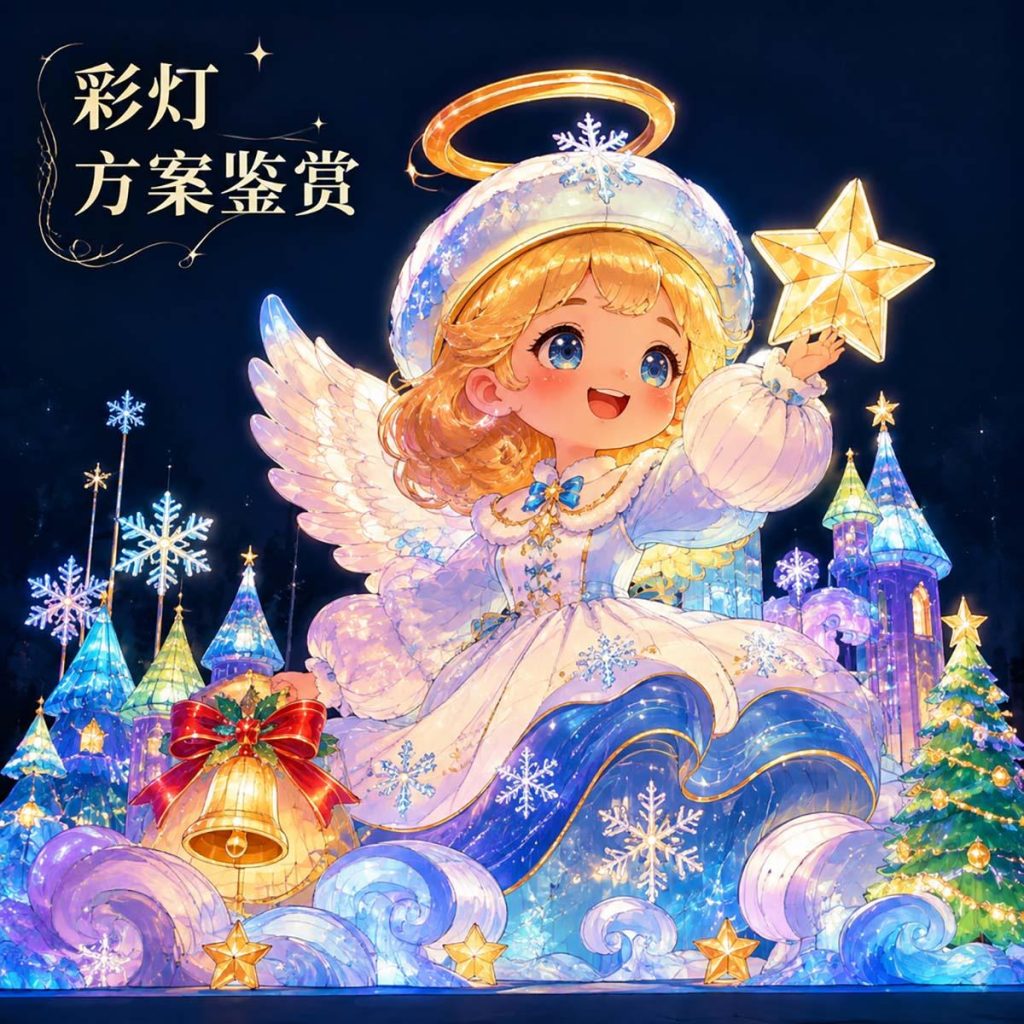
Christmas Lantern — Angel Winter Castle Scene
About This Design
This is an AI-assisted concept visualization paired with human-written design intent and production-verified technical specifications. It is a design direction — not a manufactured product. When you order, our team creates custom 3D renderings and fabricates the actual lantern in our Zigong workshop.
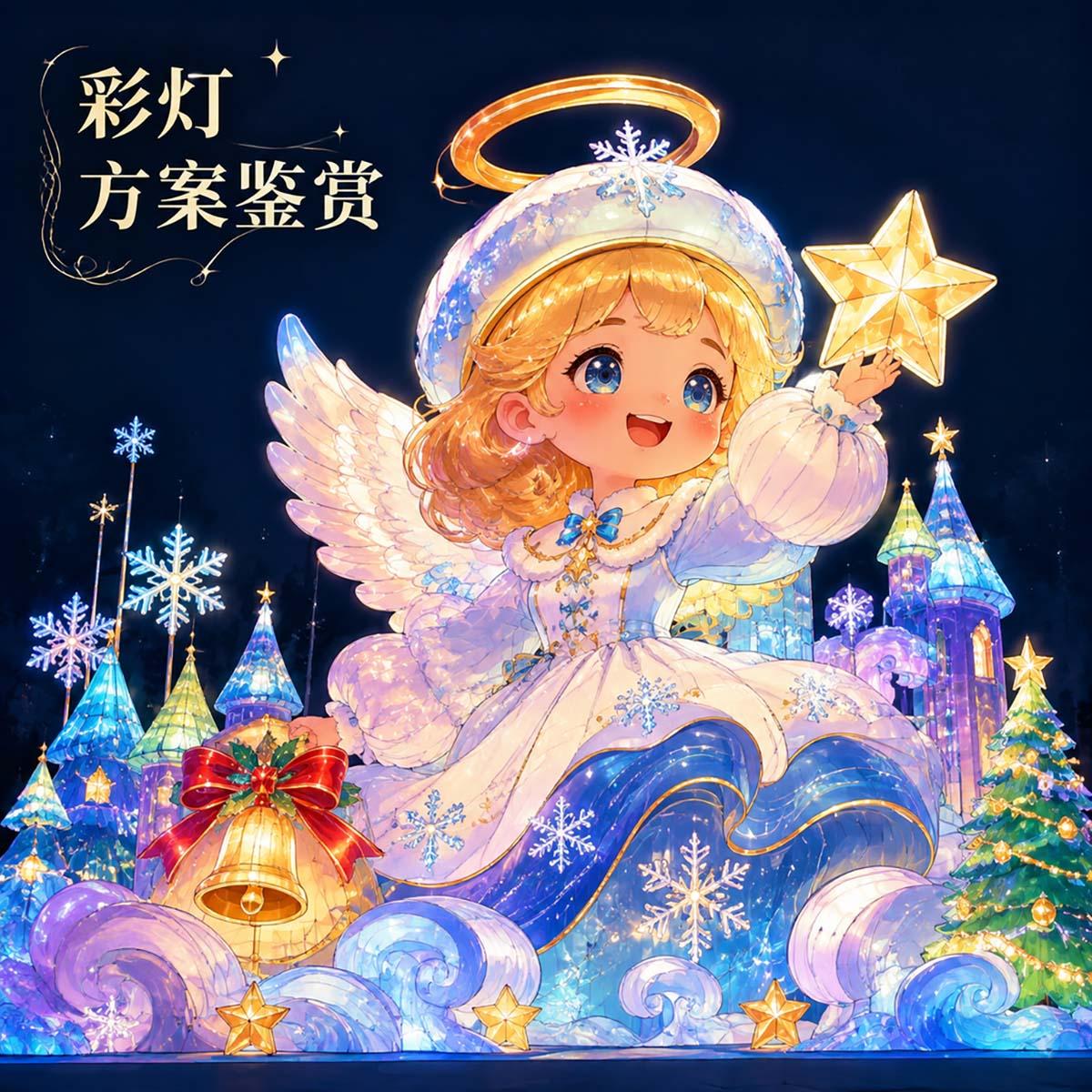
Most Christmas displays go warm — red and gold, tungsten yellows, warm white everywhere. A cold scene does the opposite, and that is exactly why it stands out on a trail that is otherwise orange: an angel lantern with a halo, snowflake motifs and golden bells set in front of a fairy-tale ice castle, lit in cool whites and ice blues so the whole stop reads as frozen rather than festive.
It is built in Zigong in the lantern tradition — shaped on weatherproof internal frames, covered by hand in painted fabric over a foam body, and lit from the inside so the surfaces glow evenly instead of being washed by floodlights. The palette is what makes the piece work: a cool scene is harder to light than a warm one, and the design decisions below are the ones that keep it from turning into a single blue mass.
Where the Cool Palette Works and Where It Doesn’t
A snow-and-frost scene is a programming decision as much as a design one, and it suits some sites much better than others:
- Northern winter programmes — where visitors arrive in cold weather and snow is already in the picture, a cool scene feels like an extension of the site rather than a decoration on it.
- Shopping centre atriums with a “frozen kingdom” theme — the colour is a merchandising decision, and cool schemes keep a centre visually separate from the usual red-and-gold offer.
- Botanical gardens and winter trails — a storybook, snow-globe stop that sits naturally between planting.
- Not for warm-climate outdoor events — in a hot-weather Christmas programme a full ice-blue scene reads as out of place; use the castle with a warm palette instead.
Angel and Castle — the Vertical Relationship
The two elements are built as one composition, and the relationship between them is the design decision worth getting right:
- Angel as the focal height. The angel sits at the top of the composition with the halo reading as the brightest point on the piece — which is what the eye goes to first.
- Castle as the frame. Turrets and the arched gateway sit behind and around the angel, giving the scene depth. The scale relationship is deliberate: a castle much larger than the angel makes the angel look like an ornament.
- The gateway is usable. The castle arch is designed as a walk-through opening where the route allows, so the stop handles visitor flow instead of blocking it.
Making Snow and Frost Read in Light
Snow is difficult to fake with light, because real snow is bright and diffuse while most lit surfaces are specular and coloured. The approach here:
- White stays white. The snow and frost surfaces are lit with a near-white cool source rather than a blue one — blue-tinted snow reads as blue plastic.
- Snowflakes carry the cold. The ice-blue is concentrated in the snowflake motifs, the castle glazing and the ground reflections, so the scene has cold colour without tinting the whole surface.
- Golden bells and ribbon break the scheme. A small amount of warm metal gives the eye relief and keeps the scene from becoming monotone.
Keeping a Blue Scene From Turning Into One Blue Mass
Three levels of colour temperature, and all three are needed:
- Structure — cold. Castle walls and turrets sit at the coldest point of the palette so the architecture reads as ice.
- Figure — neutral. The angel’s body is lit close to white, which separates it from the blue behind.
- Accents — warm. Halo edge, bells and ribbon carry the only warm light on the piece, which is what makes the cool areas look cold by comparison.
The LED system is RGB capable and DMX controlled, so the accent colours can be tuned or changed during a season, while the main cool wash stays fixed. The build uses weatherproof metal framing with modular panels and hand-painted fabric covering, and the electrical elements are rated outdoor-rated, so the same piece can run in a mall atrium or on an outdoor trail.
Where This Scene Works Best
- Winter light trails and park programmes — a cold stop in a line of warm ones.
- Shopping centre and mall atriums — a themed Christmas area built around ice rather than gifts.
- Botanical gardens — placed among planting where a soft, immersive stop is wanted.
- Public squares with a walk-through route — the castle gateway gives the square a lit doorway.
For a warmer reading of the same castle, the snowman and ice castle scene uses the same architecture with a snowman and warm accents instead of an angel — useful when you want both moods on one site.
In Europe this cold, restrained palette is specified most often for German Christmas markets and French municipal squares, where the brief is a calm scene rather than a bright one. The German market guide covers the market dates, load-in windows and documentation those organisers ask for, and the European programme overview covers how the wider season is planned across the continent.
Frequently Asked Questions
Can the palette be changed to red and gold instead of ice blue? Yes. The structure lighting is RGB and DMX controlled, so the cool wash can be shifted to a warm scheme. Do that only if the site does not need a cold scene — a warm-palette version of this piece is very close to other Christmas displays.
How tall is the scene, and how much space does it need? A typical build runs 6–10 m wide by 4–6 m tall and about 3 m deep, with the angel at the top of the composition. Send the site plan and the intended viewing distance and the footprint gets set from that.
Can visitors walk through the castle gateway? Where the route allows it, yes — the arch is designed as an opening so the piece works as a doorway as well as a backdrop. The opening size is set to your walking line.
What is it made from, and can it sit outdoors? Weatherproof internal frame, foam body and hand-painted fabric covering, with outdoor-rated electrical elements. That specification allows both an indoor atrium and an outdoor winter trail on the same drawings.
Does the cool scene work on a site that is already lit warm? It works best as a deliberate contrast, placed where visitors turn a corner or cross a threshold. If the whole route is cool, the piece stops standing out — mix palettes along the trail rather than repeating one.
Can the angel be supplied without the castle? Yes, and the reverse also works. The two are designed as a pair, but either element can be built as a standalone piece for a second location.
Related Displays and Resources
- Snowman and Ice Castle Scene — the same castle in a warmer, family-facing reading
- Candy Cane Wonderland — the sweet, high-colour alternative for family traffic
- Giant Christmas Bell Walk-Through Archway — a castle-scale entrance that pairs with a cold scene
- Christmas Light Sculpture Walk-Through Archway — the reindeer and gift tunnel version
- Winter lantern festival programme planning — route and site planning for a full season
- All Christmas design concepts — the rest of the Christmas collection
- Christmas lighting show services — programme and site planning
Send us the trail plan with the intended stop marked, the palette you are working to and the viewing distance, and we will come back with an angel and castle layout drawn to that position. Contact us with a site photo — that is usually enough to start.
From Concept to Your Venue
Select & Customise
Choose a design direction. We will adjust size, colours, lighting, and theme to match your venue.
3D Render
Our design team creates production-ready 3D renderings based on the concept and your requirements.
Fabricate
Master artisans handcraft your lantern in our Zigong workshop — internal frame, hand-painted covering, LED programming.
QC & outdoor-rated Test
72-hour burn-in test, full weatherproof verification, structural inspection. Built to last.
Ship & Install
Export docs handled. Container loading. On-site installation crew available for your event.