Ice Giant Yeti Winter Wonderland Lantern

Ice Giant Yeti Winter Wonderland Lantern
Holiday & Seasonal Decorations A yeti is the one winter figure that works as both a landmark and a photo point — it reads from distance by silhouette and at close range by texture. Holiday & Seasonal Decorations·Built to order·Zigong…
Holiday & Seasonal Decorations
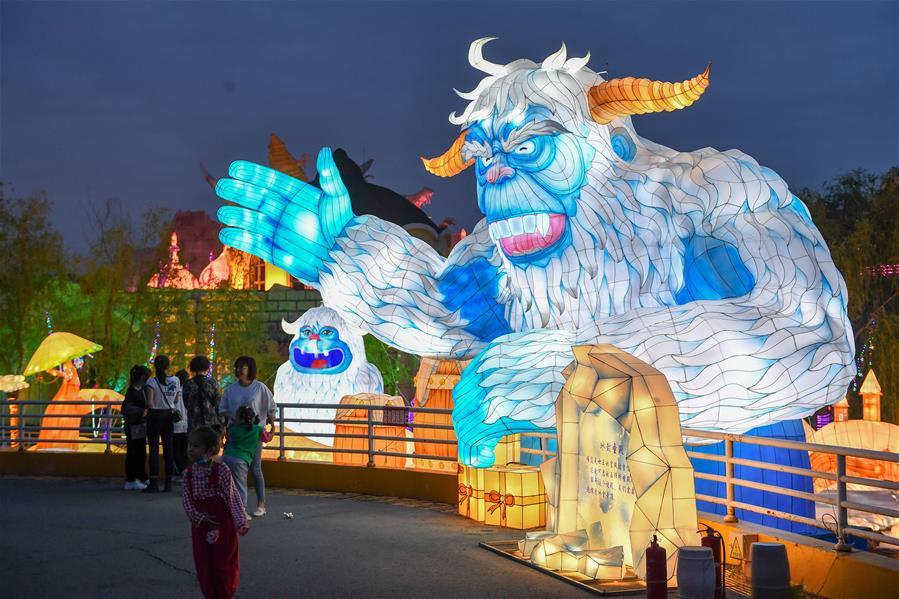
A yeti is the one winter figure that works as both a landmark and a photo point — it reads from distance by silhouette and at close range by texture.
Why a yeti holds two distances
Most winter figures work at one distance. A snowman reads at close range and disappears at 40 metres; a large Christmas tree reads at distance but offers nothing at arm’s length. A yeti sits between the two: the mass and the raised-arm silhouette carry across a plaza, while the fur texture and the face give visitors something to photograph up close.
That dual read is why yeti pieces are usually placed where a route both passes at a distance and approaches closely — the corner of a plaza, or the side of a path rather than its end.
Fur texture is the whole surface problem
Fur is the hardest surface to build in a lantern. Painted fur reads as pattern; a smooth surface reads as a mascot. The approach is layered surface panels at different depths, so the light falls unevenly across the figure the way it does on coarse hair. That is a build cost, and it is the difference between a convincing yeti and a large white shape.
The face is built with more detail than the body because that is where visitors look, and the eyes are set back so they catch shadow rather than direct light.
Winter wonderland placement
Yeti pieces belong in the cold-palette section of a winter trail, alongside ice forms, snow sculptures and white-toned animals. Placing one in a warm-palette zone breaks both the piece and the zone.
They are also popular for photo-point positions because the pose can be set for interaction — arm raised, head turned — which is what makes visitors stop and stand beside it rather than walk past.
Why not carve it in ice
Most winter briefs reach this question in the first meeting. An ice sculpture is the obvious answer for a cold-weather event, and the wrong one for anything that has to run longer than a month.
Ice works on a short clock. Outdoors a carved piece holds its detail for three to six weeks depending on temperature, and it starts to sweat on any day that climbs above freezing. The lighting is external, so light sits on the surface instead of coming through it. When it goes, it goes as meltwater across the visitor route.
A fabric lantern does the opposite. Light comes from inside, so the figure stays legible on a grey afternoon as well as at night. It stores flat between seasons and comes back out for the next one. The trade is texture: ice has a material honesty no fabric matches, which is why the two usually sit in the same trail instead of replacing each other.
Where both are in the budget, put the ice at the entrance and the yeti further along. The ice sets the expectation. The lantern carries the route.
Snow load and wind on a raised arm
A yeti pose is usually drawn with one arm up, and that arm is the part that has to be engineered. Everything horizontal collects snow: the forearm, the top of the head, the shoulders. A 200 mm snowfall on a 5 m figure puts real weight on a section that was designed for looks.
Three things keep it standing. Horizontal surfaces get a fall so snow slides instead of sitting. Shoulder and forearm panels are made removable, so a venue can pull them ahead of a heavy forecast rather than sweeping a raised arm with a pole. And the frame is calculated for the snow load of the region it ships to, not for a generic figure. A piece going to a lake-effect snow belt is not built like one going to a mild coastal city.
Wind is the second load. An arm held away from the body works as a lever, and the base fixing takes the turning force. On an exposed site the base is ballasted rather than anchored, because in winter there is often nothing reliable to anchor into.
Setting the base on frozen ground
Winter installation runs into a problem summer work never does: the ground is frozen. A chemical anchor will not cure in frozen soil. A ground screw will not bite.
Three methods cover most sites. On concrete or paving, expansion anchors work if the slab is thick enough, but resin needs above-freezing temperatures for a full cure — check the forecast for the week of install, not the day of it. On soil, gravel or a snow-covered surface, the piece is ballasted: a metal base frame loaded with concrete blocks or water ballast, sized so the figure holds at the wind speed the site is rated for. On ice or compacted snow, ballast is the only option and the base footprint has to spread wider than it would on soil.
Cable is the other cold-weather detail. Standard PVC stiffens below about -15°C and cracks if it is uncoiled at that temperature. Cold-rated cable, laid before the piece goes up, saves a return visit in January.
Scale, viewing distance and position
Yeti builds run from 1 m tabletop figures to 30 m structures, but the useful range for a winter trail is narrower. Most orders land between 3 m and 6 m.
Start from the far viewing distance. A figure reads by silhouette at roughly eight to ten times its own height, so a 5 m yeti holds a plaza from about 40 to 50 m out. Beyond that it is a shape. Closer than 3 m the visitor is looking at surface, and that is where the fur work has to hold up.
Position matters more than size. The figure works on the side of a route rather than at the end of one, because the side gives both reads at once: seen in profile from 30 m, approached from 3 m. At the end of a path visitors get one or the other. The corner of a plaza does the same job, since people cross it diagonally.
Set the pose at the same time as the position. Arm raised and head turned toward the approach line gives visitors something to stand beside. Facing straight down the path gives them a figure to walk past.
Build and finish
The figure uses a welded internal frame with layered fabric-covered surface panels. Outdoor builds use outdoor-rated LED modules and a finish treated for UV and moisture; the white surface is specified with a slight warm bias so it does not turn blue under cool light.
Where the piece runs for several seasons, the fur panels are built to be replaceable individually.
Specification
| Item | Detail |
|---|---|
| Type | Winter character lantern — yeti figure |
| Configuration | Single figure, pose set for photo interaction |
| Structure | Welded internal frame with layered surface panels |
| Surface | Layered fabric on multiple depths for fur effect |
| Lighting | Uneven wash to emphasise texture; recessed eyes |
| Rating | Outdoor-rated as standard; indoor builds omit the weather package |
| Scale | Built to order — mass sized for plaza viewing, detail for close range |
| Installation | Sectioned for container loading; panels replaceable per season |
Related
Holiday and seasonal decorations
Winter and Christmas figures built to order.
Ice and snow lanterns
Structures for cold-palette zones and winter trails.
Request a quote
Send the position and whether visitors approach closely.
Adding a character to a winter trail?
Send the position and how close visitors get. We will reply with the surface depth that works at that range.

You May Also Like
Related Products

Questions
Frequently Asked Questions
Interested in This Product?
Get a custom quote within 24 hours. Our team is ready to help.