Holiday & Seasonal Decorations
A Santa figure with candy-cane framing is an entrance组合 — the canes do the structural work and the framing work at the same time.
What the candy canes are actually for
Candy canes in a Christmas build are usually decoration. In this composition they are the frame: they flank the figure, they define the photograph, and they carry the light line that draws the eye to the entrance. That is why the canes are built as structural columns rather than as bent decoration hung beside a Santa.
The red-and-white spiral is also the single most recognisable Christmas shape after the tree itself, which makes it useful where a venue wants the theme read from a distance without signage.
Figure scale versus frame scale
A Santa figure needs to be large enough to be a landmark but not so large that it stops reading as a person. The usual approach is to size the figure for the viewing distance and then let the cane frame set the overall height — the frame can be taller than the figure without making the figure look wrong.
This is also what makes the piece composable: the canes can run taller or wider for a bigger entrance without rebuilding the Santa.
Where it works on a route
The composition belongs at a gate, a mall entrance, or the head of a Christmas trail, because it is a threshold piece rather than a mid-route one. Visitors pass it twice — entering and leaving — so it needs to work from both directions, which is why the frame is symmetrical and the figure is lit from both sides.
For retail and mall positions the cane span is usually set to frame a doorway; for park entrances it is set to frame a path.
Build and finish
The figure uses a welded internal frame with a fabric-covered surface; the canes are built as rigid spiral columns with a light line wound along the spiral. Outdoor builds use outdoor-rated modules and a weather-treated finish; indoor builds omit the weather package.
Because the canes carry the light, the composition stays readable even where the figure itself is set at lower brightness — which matters on a trail where every other piece is competing for attention.
Specification
| Item | Detail |
|---|---|
| Type | Holiday composition — figure with structural cane frame |
| Configuration | Santa figure flanked by lit spiral canes |
| Structure | Rigid spiral cane columns; welded figure frame |
| Surface | Fabric-covered figure; wound light line on the canes |
| Lighting | LED on figure and canes; two-sided for threshold positions |
| Rating | Outdoor-rated as standard; indoor builds omit the weather package |
| Scale | Figure sized to viewing distance; cane span set to the opening |
| Installation | Sectioned for container loading; assembled on site |
Related
Holiday and seasonal decorations
Christmas and winter compositions built to order.
Christmas light festival displays
Route-scale Christmas programmes rather than single pieces.
Request a quote
Send the entrance width and the opening date.
Framing a Christmas entrance?
Send the doorway or path width and the viewing distance. We will reply with the cane span that frames it.
There is a reason the same three figures appear in Christmas displays everywhere: visitors already know them, so no explanation is needed and the recognition happens at a distance. This Christmas Santa scene is that set built properly — a giant waving Santa, a decorated tree with a lit star, and illuminated reindeer — arranged so the three read as one composition rather than three separate decorations standing near each other.
It is made in Zigong in the lantern tradition: shaped on weatherproof internal frames, covered by hand in painted fabric over a foam body, and lit from the inside so each figure carries its own light. Warm white with red and green accents, sized for a mall atrium, a city square or a festival entrance where the display has to be understood in one glance.

Why the Traditional Set Still Wins
Novelty scenes photograph well but carry a risk: visitors have to work out what they are looking at. The traditional set carries the opposite risk, and for high-traffic locations it is usually the right trade:
- It reads from anywhere. Santa and a lit tree are recognised from across a square, in poor light, and from a photograph — which matters when the display’s job is to pull people across a site.
- It suits a mixed audience. Family programmes, town Christmas switch-ons and shopping centres all use the same three symbols, so one build serves several bookings.
- It is the expected photo. Visitors arrive intending to photograph Santa, not to discover something new — the piece should be easy to shoot, not surprising.
Arranging the Three Elements
The layout matters more than the individual figures, and the arrangement that works is depth, not spread:
- Tree at the back. The tallest element sits behind and slightly to one side, where it frames the scene and gives the composition its silhouette.
- Santa in front, on the sightline. The wave is the gesture that makes the figure feel like it is greeting the queue, so Santa goes where the main approach points.
- Reindeer forward and to the side. Placed ahead of Santa rather than beside him, the reindeer pull the eye along and give visitors a second thing to walk towards.
- Gifts and candy canes low and scattered. Small pieces fill the ground level of the photograph, which is where most visitor pictures actually sit.
Red and Green Outdoors — Visibility
The traditional palette has a practical weakness: red and green are both dark colours and they disappear against a dark background faster than warm white does. Three fixes are built into the design:
- Keep the green pale. Tree foliage is lit as a bright, slightly yellow green rather than a deep one, so the tree keeps its shape at distance.
- Carry the red with warm white. Santa’s suit is lit together with white on the trim, beard and cuffs, which is what stops the figure reading as a red silhouette.
- Use the accents sparingly. Baubles, ribbons and candy canes carry the saturated colour, so the palette is festive without losing the figures inside it.
Programmable colour runs on top of the fixed warm base, so the tree and accents can change during an evening while the figures stay readable. The build uses weatherproof metal framing with modular panels and hand-painted fabric covering, and the electrical elements are rated outdoor-rated, which allows the set indoors or outdoors on the same drawings.
Placing It Where the Sightline Lands
A set of this type has one requirement that outranks the others: it must sit where people look. That usually means one of three positions:
- The end of a walkway — visitors see it for the length of the approach, which builds the photograph before they arrive.
- The centre of an atrium — the tree gives the space a vertical anchor and Santa faces the main entrance.
- Just inside a main entrance — the scene becomes the arrival moment, which is where the traditional set is most useful on a mixed site.
For a scene built around gifts rather than the three figures, the giant gift box tower uses the same materials to make a vertical landmark instead of a group; the snowman and ice castle scene covers the family-focused version of the same idea.
The traditional three-piece set is the most requested configuration for German Christmas markets and for UK park trails. The German market guide covers the build-up windows and the UK light trail guide covers route pacing — the two markets split the same three figures across a site in quite different ways.
Frequently Asked Questions
How big is the set, and can it be built smaller? A typical layout runs 8–12 m wide by 6–8 m tall and about 4 m deep, with Santa at 4–6 m and the tree at 5–7 m. Smaller sites keep the three elements and reduce the spread rather than shrinking the figures.
Can we use only part of the set? Yes. Santa, the tree and the reindeer are separate pieces and each can be supplied alone or as a pair, which is useful when a site wants the scene repeated in more than one place.
What is it made from, and can it stay outdoors? Weatherproof internal frame, foam body and hand-painted fabric covering, with electrical elements rated outdoor-rated — indoor atrium or outdoor square, same drawings.
Can the colours be changed for a non-traditional scheme? Yes. The tree and accents are RGB and DMX controlled, so a site working to its own palette can shift them while keeping Santa and the reindeer in their expected colours.
How long does installation take? The set arrives as modular panels and assembles on site in a few days with a small crew. For an atrium, tell us the access route and the floor loading; for a square, the surface and where power can be taken from.
Will it work if the site already has other Christmas decorations? Yes, provided the set gets its own space and a clear approach. Give it the head of a sightline rather than a corner, and leave the ground in front open for visitors to stand in.
Related Displays and Resources
- Park Christmas Light Display — the same three figures laid out along an outdoor walking route
- Christmas Lighting Show — Mall Santa, Reindeer & Tree — the indoor retail layout of this set
- Standing Reindeer Light Sculpture — the single reindeer figure from the same series
- Giant Illuminated Reindeer & Moose Sculpture — the oversized alternative for a large approach
- Christmas Walk-Through Archway — a lit entry for the same route
- All Christmas design concepts — the rest of the Christmas collection
- Christmas light festival displays — full programme planning
Send us the site plan with the sightline marked, the approach direction and where power is available, and we will come back with a layout for the three elements drawn to that position. Contact us with a photo of the space — that is usually enough to start.
A snowman with an ice castle behind it solves a specific problem in a Christmas trail: it gives you a stop that works for the youngest visitors and, at the same time, a vertical landmark tall enough to be seen from the other end of the park. This snowman lantern scene is built as one piece — the snowman king seated in front, the ice castle standing behind — so the two elements read as a single composition rather than two decorations that happen to be near each other.
It is made in Zigong in the lantern tradition: shaped on weatherproof internal frames, covered by hand in painted fabric over a foam body, and lit from inside so the whole piece glows rather than being spotlit from outside. The palette stays in soft blues and whites with warm accents on the faces and gifts, which is what keeps a winter scene looking cold and cosy at the same time instead of just dark.
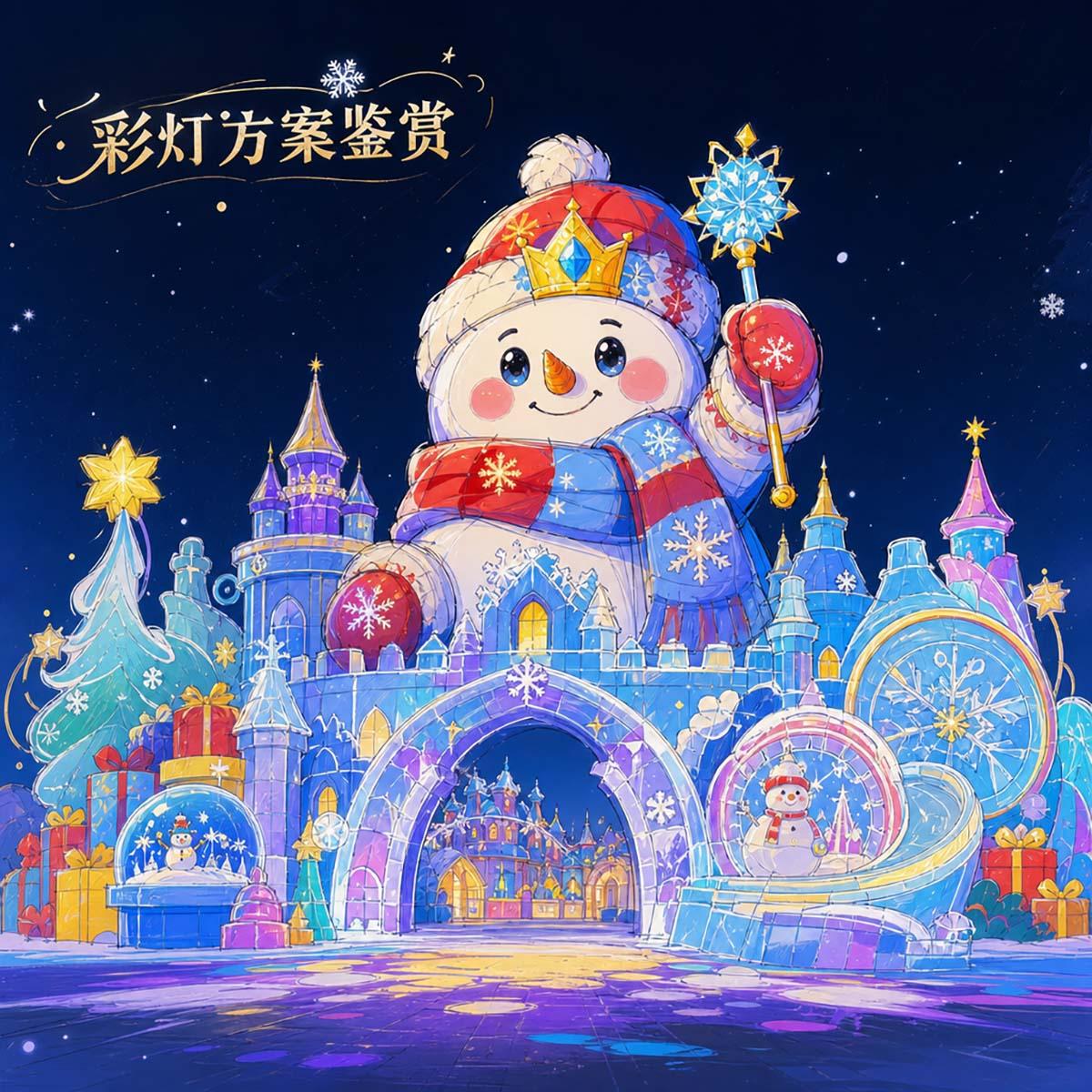
What the Snowman and Ice Castle Scene Is Built For
The pairing does two jobs at once, and it is worth being clear about which one matters for your site:
- A deliberate stop for families. The snowman is approachable at child height, which is where attention sits on a dark trail. Families stop here, so the ground around it has to work as a standing area, not just as a viewing point.
- A vertical landmark. The castle tower gives the scene height, so the composition has a silhouette that can be seen over hedges, fences and other displays. On a long trail that height is what makes the stop findable.
- A photo frame. Gifts, a snow globe and the castle arch give visitors something to stand inside or next to, which is what turns a decoration into a picture people share.
Sizing the Snowman for Children
The snowman is deliberately oversized — typically a 4–6 m figure — because a snowman at human scale disappears on a lit trail. Oversizing it does not make it less child-friendly; it makes the head sit within a child’s field of view while the body still carries weight from a distance. Two details decide whether it actually works at that size:
- The face has to be read from below. A figure this tall is almost always seen looking up, so facial features, the crown and the scarf are drawn to survive a low viewing angle — flat frontal detail looks wrong from underneath.
- The base should be walk-aroundable. If the snowman sits on a plinth that visitors cannot approach, the child-height advantage is lost. Leave a clear standing area at the front and keep services behind.
If your route is tight, the snowman can be built as the standalone figure and the castle dropped — see the angel and winter castle scene for how the castle reads on its own.
The Ice Castle as an Entry and a Landmark
The castle is built with an arched entry and turrets, and that arch is the part worth planning around: it works as a doorway, so visitors pass through the scene rather than stopping in front of it. Where the trail allows it, put the arch on the walking line and let people walk through the castle with the snowman off to one side — the stop then handles traffic instead of blocking it.
Turrets carry the height. Since they are the thinnest part of the structure, they are also the part that attracts wind, so the frame is braced internally and the castle is sited with its broad face across the main approach rather than square to the prevailing wind.
Lighting: Cool Structure, Warm Faces
Winter scenes fail when everything is lit the same blue-white, because nothing separates from anything else. The lighting here splits into two families:
- Cool white on the structure. Castle walls, turrets and the snowman’s body read as ice and snow, and cool light gives the scene its winter identity.
- Warm light on the features. Faces, the magic wand, gift ribbons and the snow globe interior run warm, so the eye finds the expressions first and the architecture second.
- Programmable where it earns its keep. The LED system is RGB capable and DMX controlled, so the castle can change tone across an evening or sync with a wider show, while the warm accents stay fixed.
Two practical notes from the build: the frame is weatherproof metal with modular panels, which is what allows a scene this size to travel in standard containers; the fabric covering is hand-painted and sealed, and the electrical elements are rated outdoor-rated for outdoor use, so the piece can go indoors in a mall atrium or outdoors on a park trail on the same drawings.
Where This Scene Works Best
- Family zones on city Christmas trails — the stop parents and children both stop at.
- Shopping mall atriums and outdoor malls — the castle arch doubles as the entrance to the Christmas area.
- Zoos, parks and gardens running winter programmes — pairs with the wider winter lantern festival route planning.
- Town squares and pedestrian streets — where height is needed to pull people down a side street.
Nordic programmes are where this scene works hardest, because the audience already lives with snow and ice and reads the reference instantly. The Nordic winter sourcing guide covers the temperatures, snow and wind loads the scene has to be specified against, and the European programme overview shows how those four countries are procured.
Frequently Asked Questions
How tall is the snowman, and can it be built smaller? The king figure is typically built between 4 m and 6 m, with the castle scaled to sit behind it. Smaller versions work, but keep the head above adult eye level or the figure stops carrying across a dark site.
Can visitors walk through the castle? Yes — the castle is designed with an arched entry, and where the walking line allows it visitors pass through the scene. The arch opening and the standing area in front are both set to your route drawing.
What is the scene made of, and can it stay outdoors? Weatherproof internal frame, a foam body and hand-painted fabric covering, with the electrical elements rated outdoor-rated. That specification is what lets the same build sit in a mall atrium or on an outdoor trail.
Can we change the colours to match our event palette? Yes. The structure lighting is RGB and DMX controlled, so the castle can change tone during the evening or follow a wider show, while the warm accents on faces and gifts stay constant.
How much space does it need, and how long does installation take? A typical scene runs 8–12 m wide by 5–7 m tall and about 4 m deep, and it is built from modular panels so it assembles on site in a few days with a small crew. Share the site plan and the walking line and the footprint gets set from that.
Does the snowman have to come with the castle? No. The two are designed to work as a pair, but the snowman can be supplied as a standalone figure and the castle built for a different scene — see the angel and castle concept.
Related Displays and Resources
- Christmas Lantern — Angel Winter Castle Scene — the same castle read with an angel instead of a snowman
- Christmas Lantern — Santa, Tree and Reindeer Scene — the other family stop in this set
- Giant Christmas Bell Walk-Through Archway — an entry piece that pairs with a castle scene
- Happy Holidays Ornament Archway — a lit letter entry for the same route
- All Christmas design concepts — the rest of the Christmas collection
- Christmas light festival displays — full programme planning
Send us your trail plan with the intended stop marked and the height of the surrounding structures, and we will come back with a snowman and castle layout drawn to that position. Contact us with a site photo — that is usually enough to start.
Most Christmas displays go warm — red and gold, tungsten yellows, warm white everywhere. A cold scene does the opposite, and that is exactly why it stands out on a trail that is otherwise orange: an angel lantern with a halo, snowflake motifs and golden bells set in front of a fairy-tale ice castle, lit in cool whites and ice blues so the whole stop reads as frozen rather than festive.
It is built in Zigong in the lantern tradition — shaped on weatherproof internal frames, covered by hand in painted fabric over a foam body, and lit from the inside so the surfaces glow evenly instead of being washed by floodlights. The palette is what makes the piece work: a cool scene is harder to light than a warm one, and the design decisions below are the ones that keep it from turning into a single blue mass.
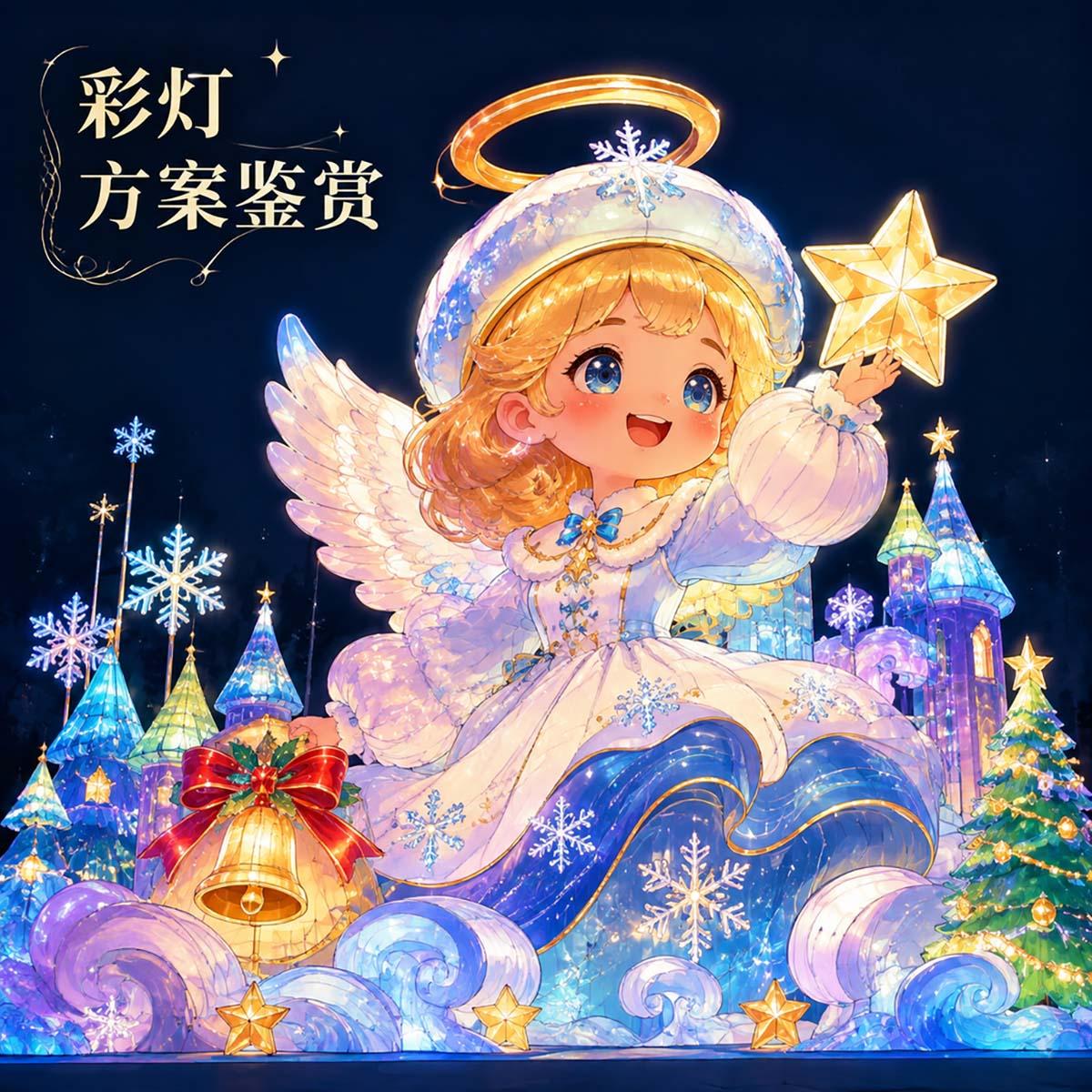
Where the Cool Palette Works and Where It Doesn’t
A snow-and-frost scene is a programming decision as much as a design one, and it suits some sites much better than others:
- Northern winter programmes — where visitors arrive in cold weather and snow is already in the picture, a cool scene feels like an extension of the site rather than a decoration on it.
- Shopping centre atriums with a “frozen kingdom” theme — the colour is a merchandising decision, and cool schemes keep a centre visually separate from the usual red-and-gold offer.
- Botanical gardens and winter trails — a storybook, snow-globe stop that sits naturally between planting.
- Not for warm-climate outdoor events — in a hot-weather Christmas programme a full ice-blue scene reads as out of place; use the castle with a warm palette instead.
Angel and Castle — the Vertical Relationship
The two elements are built as one composition, and the relationship between them is the design decision worth getting right:
- Angel as the focal height. The angel sits at the top of the composition with the halo reading as the brightest point on the piece — which is what the eye goes to first.
- Castle as the frame. Turrets and the arched gateway sit behind and around the angel, giving the scene depth. The scale relationship is deliberate: a castle much larger than the angel makes the angel look like an ornament.
- The gateway is usable. The castle arch is designed as a walk-through opening where the route allows, so the stop handles visitor flow instead of blocking it.
Making Snow and Frost Read in Light
Snow is difficult to fake with light, because real snow is bright and diffuse while most lit surfaces are specular and coloured. The approach here:
- White stays white. The snow and frost surfaces are lit with a near-white cool source rather than a blue one — blue-tinted snow reads as blue plastic.
- Snowflakes carry the cold. The ice-blue is concentrated in the snowflake motifs, the castle glazing and the ground reflections, so the scene has cold colour without tinting the whole surface.
- Golden bells and ribbon break the scheme. A small amount of warm metal gives the eye relief and keeps the scene from becoming monotone.
Keeping a Blue Scene From Turning Into One Blue Mass
Three levels of colour temperature, and all three are needed:
- Structure — cold. Castle walls and turrets sit at the coldest point of the palette so the architecture reads as ice.
- Figure — neutral. The angel’s body is lit close to white, which separates it from the blue behind.
- Accents — warm. Halo edge, bells and ribbon carry the only warm light on the piece, which is what makes the cool areas look cold by comparison.
The LED system is RGB capable and DMX controlled, so the accent colours can be tuned or changed during a season, while the main cool wash stays fixed. The build uses weatherproof metal framing with modular panels and hand-painted fabric covering, and the electrical elements are rated outdoor-rated, so the same piece can run in a mall atrium or on an outdoor trail.
Where This Scene Works Best
- Winter light trails and park programmes — a cold stop in a line of warm ones.
- Shopping centre and mall atriums — a themed Christmas area built around ice rather than gifts.
- Botanical gardens — placed among planting where a soft, immersive stop is wanted.
- Public squares with a walk-through route — the castle gateway gives the square a lit doorway.
For a warmer reading of the same castle, the snowman and ice castle scene uses the same architecture with a snowman and warm accents instead of an angel — useful when you want both moods on one site.
In Europe this cold, restrained palette is specified most often for German Christmas markets and French municipal squares, where the brief is a calm scene rather than a bright one. The German market guide covers the market dates, load-in windows and documentation those organisers ask for, and the European programme overview covers how the wider season is planned across the continent.
Frequently Asked Questions
Can the palette be changed to red and gold instead of ice blue? Yes. The structure lighting is RGB and DMX controlled, so the cool wash can be shifted to a warm scheme. Do that only if the site does not need a cold scene — a warm-palette version of this piece is very close to other Christmas displays.
How tall is the scene, and how much space does it need? A typical build runs 6–10 m wide by 4–6 m tall and about 3 m deep, with the angel at the top of the composition. Send the site plan and the intended viewing distance and the footprint gets set from that.
Can visitors walk through the castle gateway? Where the route allows it, yes — the arch is designed as an opening so the piece works as a doorway as well as a backdrop. The opening size is set to your walking line.
What is it made from, and can it sit outdoors? Weatherproof internal frame, foam body and hand-painted fabric covering, with outdoor-rated electrical elements. That specification allows both an indoor atrium and an outdoor winter trail on the same drawings.
Does the cool scene work on a site that is already lit warm? It works best as a deliberate contrast, placed where visitors turn a corner or cross a threshold. If the whole route is cool, the piece stops standing out — mix palettes along the trail rather than repeating one.
Can the angel be supplied without the castle? Yes, and the reverse also works. The two are designed as a pair, but either element can be built as a standalone piece for a second location.
Related Displays and Resources
- Snowman and Ice Castle Scene — the same castle in a warmer, family-facing reading
- Candy Cane Wonderland — the sweet, high-colour alternative for family traffic
- Giant Christmas Bell Walk-Through Archway — a castle-scale entrance that pairs with a cold scene
- Christmas Light Sculpture Walk-Through Archway — the reindeer and gift tunnel version
- Winter lantern festival programme planning — route and site planning for a full season
- All Christmas design concepts — the rest of the Christmas collection
- Christmas lighting show services — programme and site planning
Send us the trail plan with the intended stop marked, the palette you are working to and the viewing distance, and we will come back with an angel and castle layout drawn to that position. Contact us with a site photo — that is usually enough to start.
A candy-themed Christmas display works on a different logic from a traditional one: instead of reminding visitors of Christmas, it builds a place they can walk into. This candy cane wonderland is built around that idea — a fairy-tale candy castle with a princess at the top, oversized candy cane columns forming an entry, and a Santa and reindeer pair carrying the Christmas message at the side. It is aimed at venues with family foot traffic: shopping centres, theme parks and museum holiday programmes.
It is made in Zigong in the lantern tradition — shaped on weatherproof internal frames, covered by hand in painted fabric over a foam body, and lit internally so the surfaces glow evenly in the dark. The palette is the point: candy colours are bright and low-saturation, which is the opposite of how most Christmas lighting is designed, and the build is planned around that difference.
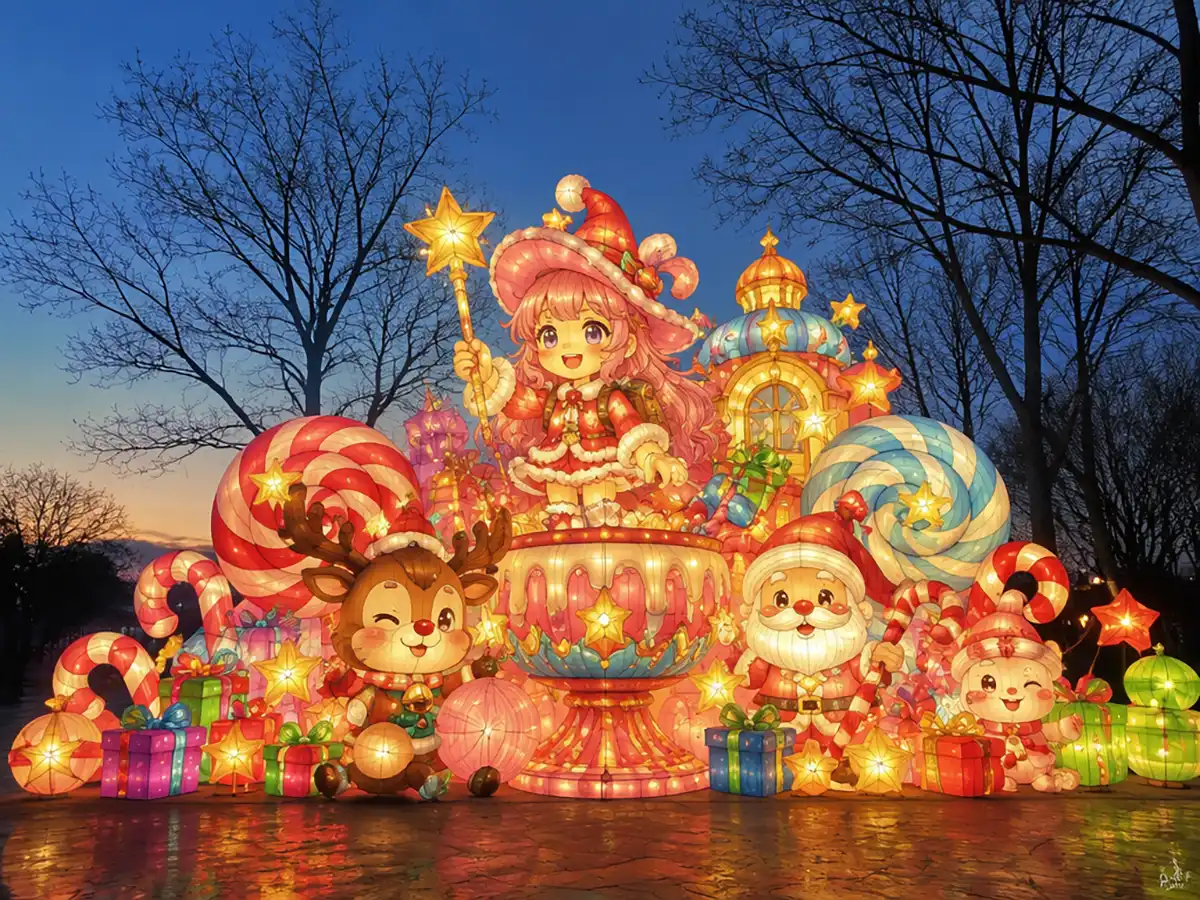
What a Candy-Themed Christmas Display Has to Do
Three requirements, and they are different from a traditional set:
- Give children something to walk into. A candy scene is an environment, not a statue — the entry has to be a place a child can pass through.
- Photograph in daylight and at night. Family venues run all day, so the piece has to hold up when the internal lights are barely visible and the paint is doing the work.
- Sit alongside a traditional scene without competing. Most sites already have Santa somewhere; the candy area usually sits on a separate loop rather than beside him.
The Candy Castle and the Princess at the Top
The castle is built with onion domes and a storybook silhouette, and the princess sits mounted on top with a magic wand — which is a deliberate structural decision as much as a design one:
- The princess is the anchor height. She sits above everything else in the scene, so the eye finds the top of the composition first and then works down through the domes.
- The domes carry the night silhouette. Onion domes read as fairy-tale architecture from a distance in a way that flat rooflines do not, which is what makes the castle recognisable on a dark site.
- The top figure has to be built for wind. A figure mounted at the highest point of the piece takes the greatest load, so it is braced back into the castle frame rather than sitting on the dome surface.
Candy Cane Columns as a Walk-Through Entry
The oversized candy cane columns are the part that turns the scene from a backdrop into an entry. Used as a pair or a run, they create a threshold visitors pass between, and that changes how a family moves through the space: children walk through the columns rather than being stopped in front of the castle.
Two practical points: the columns are set at a spacing that stays comfortable with pushchairs and wheelchairs, and they are anchored independently of the castle so that a column can be repositioned if the walking line changes. Where the route allows, a second pair further along extends the candy area into a short walk-through corridor.
Lighting Candy Colours at Night
Candy colours are the hardest palette to light in a Christmas context, because at night a bright pink or mint surface lit at full power turns white. The approach:
- Colour matching inside the panels. The light behind each surface is set to the paint colour rather than to white, so pink panels stay pink instead of washing out.
- Lower output, more contrast. Candy areas run at a lower brightness than a traditional set, and the contrast comes from the red-and-white stripes and the darker outlines rather than from intensity.
- Warm and cool separated. The castle runs warm, the candy cane stripes run cool white and red, and the princess figure is lit close to white so she reads as the brightest point.
The system is RGB and DMX capable, so a venue working to a shopping-centre brand palette can shift the candy colours while the castle and figures stay fixed. The build uses weatherproof metal framing with modular panels and hand-painted fabric covering, and electrical elements are rated outdoor-rated, which covers an indoor mall atrium and an outdoor family area equally.
Where Family-Traffic Venues Use It
- Shopping centres — a candy area for the children’s zone, kept separate from the main Santa set.
- Theme parks — a walk-through candy entry onto a Christmas land or a family ride.
- Museum and attraction holiday programmes — a bright, low-scare environment for younger visitors.
- Family festivals and fairgrounds — the piece children ask to go back to, because they can walk through it.
Sites that want the traditional message at the same event usually run this scene alongside a Santa, tree and reindeer set on a separate loop, and use the walk-through archway as the transition between the two.
Family-traffic venues in the UK and the Netherlands use this theme most, because a walk-through candy cane entry controls visitor flow as well as decorating it. The UK light trail guide and the Netherlands light festival guide both cover how those site types are laid out and what the local organisers ask for.
Frequently Asked Questions
How tall is the castle, and how wide is the scene? The castle is typically built at 4–6 m with the princess figure mounted above it, and a full scene runs about 8 m wide by 5 m tall and 4 m deep. Candy cane columns are usually 3–4 m so visitors pass under the stripes rather than beside them.
Can children walk through the candy cane entry? Yes — that is the purpose of the columns. Spacing is set wide enough for pushchairs and wheelchairs, and the columns are anchored independently so the opening can be adjusted to your walking line.
Will the candy colours still look right at night? Yes, because each surface is lit to match its paint colour rather than to white. Candy palettes do wash out if the lighting is not planned, which is why the output is set lower than a traditional Christmas set.
What is it made from, and can it go outdoors? Weatherproof internal frame with foam and hand-painted fabric covering, and electrical elements rated outdoor-rated — so it suits an indoor atrium or an outdoor family area.
Can the candy colours match our brand? Yes. The lighting is RGB and DMX controlled, so the candy elements can be tuned to a venue’s palette while the castle and the princess stay in their designed colours.
How much space does it need around it? Leave the ground in front of the entry clear for the queue and the photograph, and keep a service side clear for access. A candy area is usually planned as a loop of its own rather than a single stopping point.
Related Displays and Resources
- Giant Gift Box Tower — a vertical landmark for the same square
- Christmas Lighting Show — Mall Santa, Reindeer & Tree — the traditional set for the indoor loop
- Christmas Light Sculpture Walk-Through Archway — a lit threshold between two areas
- Santa Sleigh Christmas Light Sculpture — the delivery scene for a second spot
- Christmas Scene Lantern Set — gift and tree pieces to scatter through the area
- All Christmas design concepts — the rest of the Christmas collection
- Christmas light festival displays — full programme planning
Send us the floor plan with the children’s area marked, the walking line through it and the access route for installation, and we will come back with a castle and column layout drawn to that space. Contact us with a plan or a photo — that is usually enough to start.
A gift box tower is the simplest way to give a flat city square a vertical landmark. Stacked boxes read as Christmas instantly, they hold a colour programme on a large clean surface, and the silhouette can be seen from the far side of a square — which matters when the square is a thoroughfare and most visitors never walk to the middle of it. This Christmas gift tower concept puts the tower at the centre of a scene with elves, reindeer, a snow globe and a Christmas tree arranged around the base.
It is built in Zigong as a lantern piece rather than an inflatable or a metal frame with lights clipped on: shaped metal, hand-covered and hand-painted panels, and internal lighting, so the tower is evenly lit from within and holds up close as well as at distance. The scene is aimed at city squares, town centres, shopping districts and family attractions that need one clear photo point.

Why a Vertically Stacked Gift Tower Works in a City Square
Squares are hard sites: they are usually crossing points, the light is uncontrolled, and people move through rather than around. A tower answers three problems at once:
- It is visible across the whole square. A 6–8 m stack reads over market stalls, trees and crowds — so the display pulls people from the entrances rather than only from a few metres away.
- It gives a navigation point. On a large site visitors use the tallest lit object as a bearing. A tower with a distinctive silhouette does that job without signage.
- It photographs cleanly. Flat lit faces and strong colour give a good frame from almost any angle, which is why group photos end up here.
The base is where the scene is won or lost. A bare tower looks like a stack; the elves, reindeer and gifts arranged around it give it scale and give visitors somewhere to stand.
Composing the Tower With Elves and Reindeer
The supporting figures are set out in two rings, and the arrangement is deliberate:
- Inner ring — elves at 2–3 m. Three or four figures close to the base so the tower has human-scale company; this is what visitors stand next to.
- Outer ring — reindeer and snow globe. Placed further out and slightly apart, so the group reads as a scene and there is space for people to walk between the figures instead of around the outside.
- Gifts scattered low. Small pieces at 0.5–1 m fill the frame at ground level, which is the part of the picture most event photos actually show.
Where the square has a fountain, bandstand or other fixed centrepiece, the tower goes off-centre — the scene needs one side left open for the crowd, and a tower dead-centre on a crossing point will be walked into rather than looked at.
Sightlines: Making the Tower Legible From the Whole Square
A tower that is only visible from the front is a missed opportunity. Two checks before sign-off:
- Check the four approaches, not just the main one. The stack is designed with detail on all faces — ribbons, bows and open lids — so no side is a blank panel.
- Keep the top third simple. Detail crowds together when it is small and far away, so the upper boxes carry larger graphic shapes and the finer work sits in the lower two tiers where people actually get close.
If the square has trees, set the tower’s height against them — clearing the canopy line is what makes the top tiers readable from across the space.
Lighting the Tower
The tower lighting runs in two layers. Each box face is lit from inside with a wash that keeps the panel colour true, and the ribbons and lids carry their own accent so the stack reads as separate boxes rather than one column of light. The system is RGB and DMX controlled, so the tower can hold a fixed palette, run slow colour shifts across an evening, or be driven from a wider show with the rest of the square.
The build uses weatherproof metal framing with modular panels and hand-painted fabric covering; electrical elements are rated outdoor-rated, so the scene sits outdoors through a winter programme or indoors in a mall or atrium on the same drawings. Decking, cabling and anchoring are planned with the site, since a 6–8 m stack on a paved square usually differs from the same tower on grass.
Where the Gift Tower Works Best
- City squares and town centres — the piece that marks the Christmas programme.
- Shopping districts and outdoor malls — a gift tower is the most on-message centrepiece for retail.
- Christmas markets — placed at the junction of the aisles rather than among the stalls.
- Family attractions and theme parks — with the elf figures carrying the character side of the scene.
If your site is a park or garden rather than a square, the outdoor layout in the park Santa and reindeer display is the better starting point — the figures are spread along a route rather than gathered at a single point.
A vertically stacked landmark suits French municipal squares and Spanish plazas, where the constraint is keeping the square open for business around one tall centrepiece. The Spanish festival guide covers plaza-first planning and the January procurement calendar, and the European programme overview covers the rest of the continent.
Frequently Asked Questions
How tall is the gift box tower? The stack is typically built at 6–8 m across three tiers, sized against the buildings and trees around the square. If the site is enclosed, the height is set so the top tier clears the line of whatever stands behind it.
Can the scene be built smaller for a smaller square? Yes. Dropping a tier is the usual route rather than shrinking everything, because it keeps the elf figures and gifts at their proper scale relative to visitors.
What are the figures made from, and can they be used outdoors? Weatherproof metal framing, foam and hand-painted fabric covering, with outdoor-rated electrical elements. That specification suits a winter programme outdoors and an indoor atrium equally, which is useful when the same display appears in both.
Can the tower colours match our branding or event palette? Yes. The lighting is RGB and DMX controlled, so the faces can run brand colours, change scene during the evening, or be synchronised with other lighting in the square.
How long does installation take on a paved square? The scene arrives as modular panels and assembles on site over a few days with a small crew. Anchoring and cable routing are the parts that need planning on paving, so tell us the surface and where power can be taken from.
Can we add the elves later, or start with just the tower? Yes. The tower stands on its own, and the elves, reindeer and snow globe can be added as a second phase without rebuilding the piece.
Related Displays and Resources
- Christmas Lighting Show — Mall Santa, Reindeer & Tree — the indoor retail version of this scene
- Christmas Lighting Show — Candy Cane Wonderland — the same square read as a candy theme
- Santa Claus Gift Bag Light Sculpture — a single gifting figure for a second spot
- Sitting Santa with Gift Box Light Sculpture — the seated counterpart
- Christmas Scene Lantern Set — gift and tree pieces to scatter around the base
- All Christmas design concepts — the rest of the Christmas collection
- Christmas lighting show services — programme and site planning
Send us the square plan with the tower position marked, the surrounding building heights and where power can be taken from, and we will come back with a stack layout and a lighting concept for that spot. Contact us with a photo of the square — that is usually enough to start.
An outdoor park Christmas display is a different piece of work from a square centrepiece: there is no enclosure, no controlled light and no single viewing point. Visitors arrive along a path, they walk in one direction, and the display has to hold attention across a long distance in the cold. This park Christmas light display is laid out for that situation — a giant Santa as the anchor, reindeer, a penguin and a snowman spaced along the route, and a lit Christmas tree marking the end of the walk.
It is built in Zigong in the lantern tradition: shaped on weatherproof internal frames, covered in hand-painted fabric over a foam body, and lit internally so each figure carries its own light rather than depending on floodlights. The scene is aimed at zoos, botanical gardens, country parks and outdoor attractions running a winter light programme.
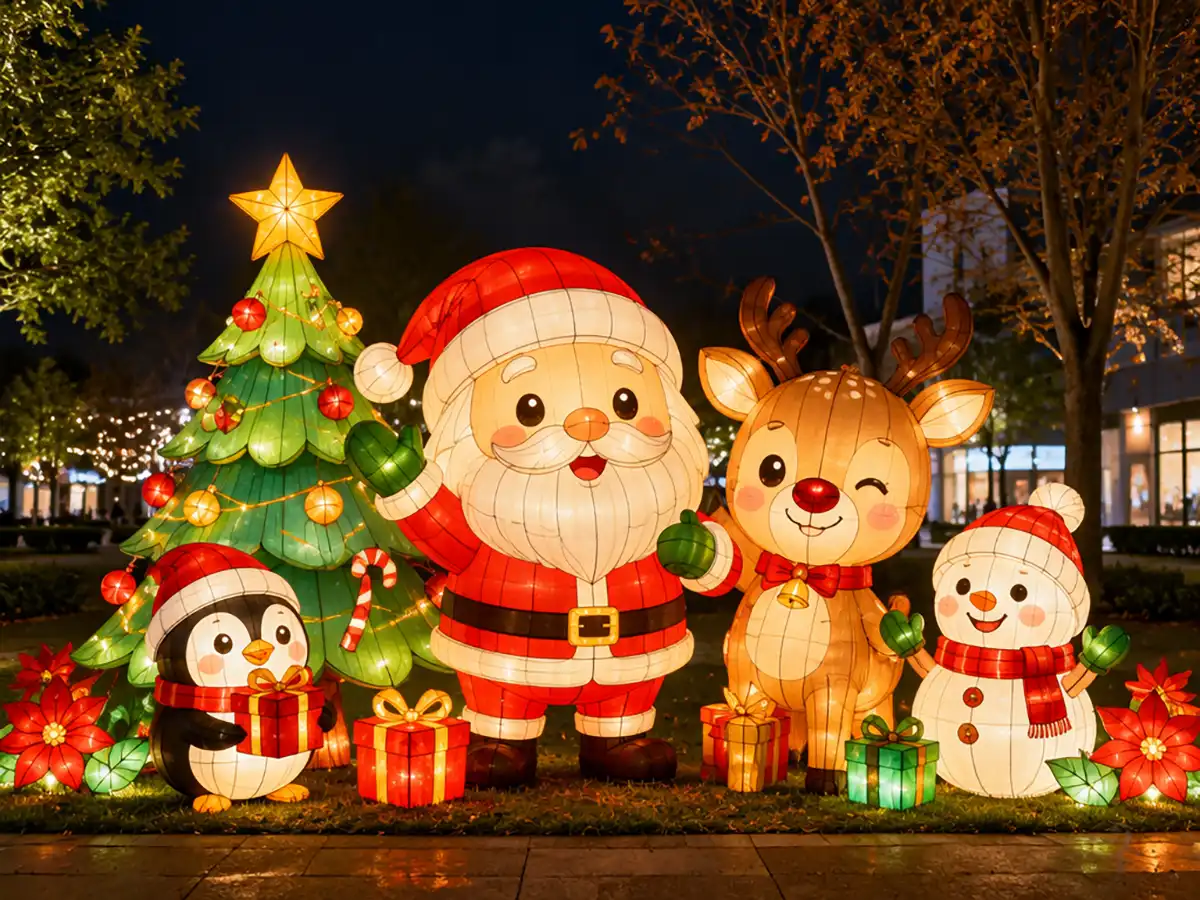
What an Outdoor Park Display Has to Do
Three things decide whether a park route works, and none of them is about a single figure looking good:
- Give a reason to keep walking. On a long path, the visitor needs something ahead of them. The Santa anchors the middle of the route; the tree marks the end.
- Work in the dark and in the cold. Figures are lit from inside, which keeps them readable with no ambient light, and the build is specified for a winter operating range rather than for summer.
- Survive being outdoors for a full season. Wind, rain and frost act on the frames and fixings long before they act on the lighting, so the structural build is the part that has to be right.
Spreading Figures Along a Route
On a park trail the layout matters more than the individual pieces. The arrangement that works:
- Anchor at a junction, not in a clearing. Put Santa where paths meet, so arriving visitors turn toward it from several directions.
- Reindeer ahead of the anchor. Two or three reindeer placed further along the route pull people forward — a single figure at the far end is not enough to move a crowd.
- Small figures at the gaps. The penguin, snowman and gift pieces fill the stretches between large figures, so the route never goes dark.
- Tree at the end, lit tall. The tree gives the route a destination and marks the exit, which reduces visitors doubling back on a one-way walk.
If the site is a square rather than a route, the gathered composition in the gift box tower lighting show is the better model — same materials, different layout logic.
Santa, Reindeer and the Small Figures at Child Height
Santa is built at 4–6 m with a raised, waving hand, because the gesture is what makes the figure feel like it is greeting the queue rather than standing still. The reindeer run at 2.5–3 m on anti-rust frames, sized to look like a group rather than a statue.
The small figures do the work that is easy to underestimate. A penguin and a snowman at 1.5–2 m sit at child eye level, which is where attention actually is on a dark trail — the tall pieces create the picture, the small ones create the stop. Plan a standing area in front of them, not just a sightline.
Weather, Wind and the Outdoor Specification
The build is specified for outdoor installation with outdoor-rated LED systems and sealed, UV-stable covered surfaces, and the figures operate across roughly −10 °C to 45 °C — a range that covers northern-hemisphere winter programmes and warmer southern-hemisphere Christmas seasons without a different build.
Two structural points are worth raising early, because they affect siting:
- Tall figures attract wind. Santa and the tree are the two pieces that need bracing planned against the site, so they should not be placed on the most exposed corner of a park.
- Ground conditions decide the base. Grass, gravel and paving need different anchoring and cable routes; a route that crosses a public path also needs its cable runs planned so nothing is a trip hazard.
Where This Display Works Best
- Zoos running a winter lights programme — the route format suits one-way paths through enclosures.
- Botanical gardens and arboretums — figures spaced between planting rather than gathered in one bed.
- Country parks and public gardens — where the trail is the attraction and the figures mark it.
- Outdoor attractions and fairgrounds — a seasonal overlay on an existing walking route.
Sites running a lantern programme rather than a light trail can extend the same route with animal lanterns — the ice and snow penguin display continues the winter theme, and the animal lantern range covers the wildlife side of a zoo route.
Outdoor park programmes in the UK and the Nordic countries are where this configuration earns its keep. The UK light trail guide covers route pacing and the wind load a park route has to be designed to, and the Nordic sourcing guide covers cold-weather specification and polar-night lighting conditions.
Frequently Asked Questions
How much route does the display need? The scene is designed to be spread rather than gathered: a typical layout runs Santa as the anchor, two or three reindeer along the path, small figures between them and the tree at the exit. A minimum useful route is around 100 m; longer routes take additional figures at the gaps.
Can the display stay outside for the whole season? Yes. The figures are built for outdoor installation with internally lit, outdoor-rated electrical elements and sealed covered surfaces, and the frames are weatherproof to resist rust through a wet winter.
What temperatures can it operate in? Roughly −10 °C to 45 °C, which covers both a northern winter programme and a southern-hemisphere Christmas. If your site runs colder than that, tell us at proposal stage so the specification is set accordingly.
Do we need power along the whole route? Yes — each figure is internally lit, so power and cable routing follow the path. Sending a route drawing early usually lets the runs share a smaller number of supply points.
Can the figures be re-themed for other seasons? The structural pieces can be re-covered and re-lit for a different programme, which is worth planning for if the route is used year-round rather than only at Christmas.
How is it shipped and installed? Figures are built in modular sections that pack into standard shipping containers with a labelled assembly sequence, and they assemble on site in a few days. Our crew can install or supervise a local team against the same drawings.
Related Displays and Resources
- Winter Lantern Festival — Reindeer Family Display — the reindeer group read across a whole family scene
- Christmas Lantern — Santa, Tree and Reindeer Scene — a compact version of this layout
- Standing Reindeer Light Sculpture — a single reindeer piece from the same series
- Reindeer Light Sculpture Christmas Archway — reindeer read as an entry rather than a figure
- Winter lantern festival programme planning — route and site planning for a full season
- All Christmas design concepts — the rest of the Christmas collection
- Christmas light festival displays — full programme planning
Send us the route plan with the junction and the exit marked, the ground types the path crosses and where power is available, and we will come back with a figure-by-figure layout for the walk. Contact us with a photo of the path — that is usually enough to start.
A shopping mall atrium is a theatre in the round with a ceiling, and that single fact changes almost every design decision. An outdoor display is composed for one approach; an atrium is viewed from a ground-floor concourse, from three or four upper galleries, from escalators and from the far end of two corridors at once. This concept is built for that — a waving Santa seated on a bank of oversized gifts, with a lit reindeer, a decorated tree and a toy castle as supporting cast, sized and arranged so the group reads from every level rather than only from the front.
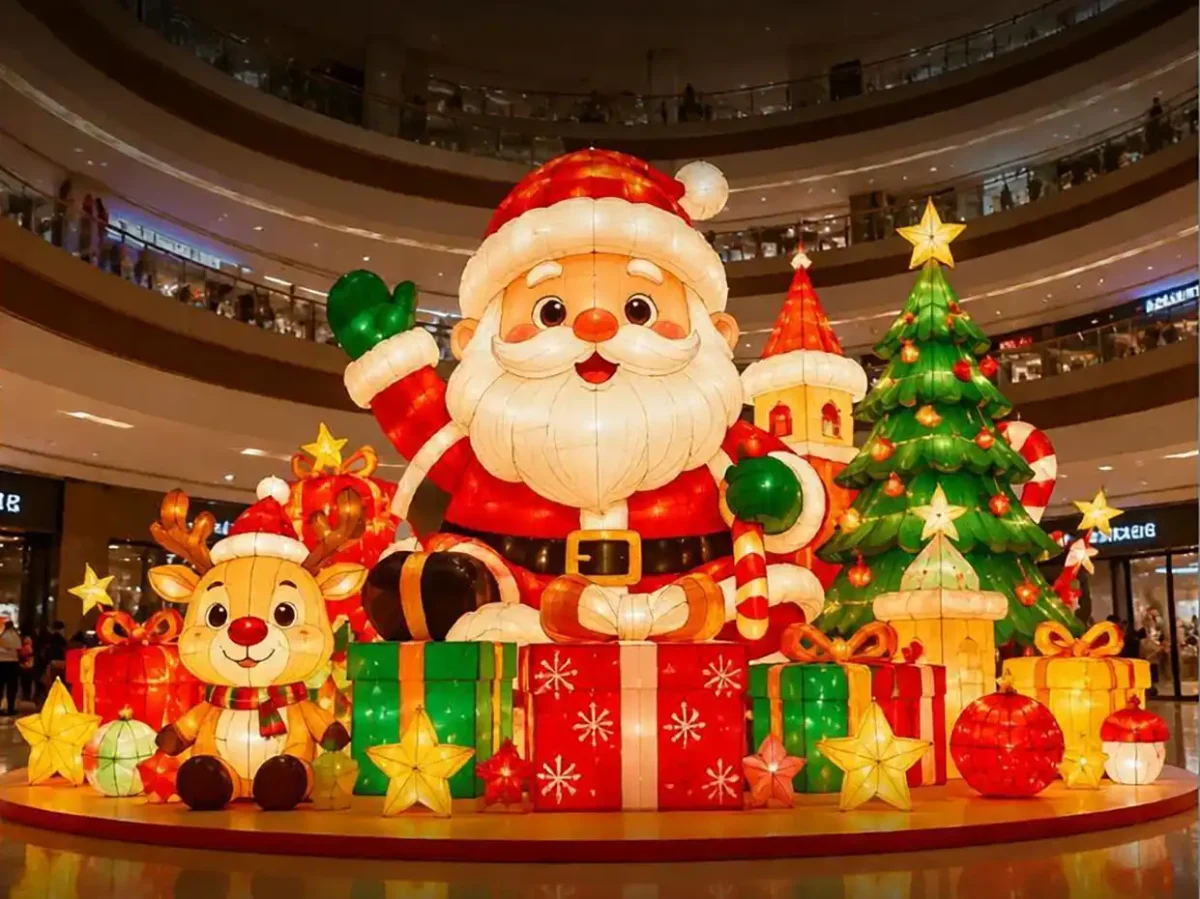
This is an AI-assisted concept visualisation paired with human-written design intent and production specifications. It is a design direction rather than a photograph of a finished product — when a project goes ahead, the layout is re-drawn to your atrium dimensions and fabricated in our Zigong workshop on a weatherproof internal frame, covered in hand-painted high-density fabric over a shaped understructure, and lit internally with low-voltage LED. The same build method scales from a compact single-level installation up to a four-storey atrium centrepiece.
What a Mall Atrium Demands That an Outdoor Site Doesn’t
Outdoor displays are designed around weather and ground conditions. Indoor atrium displays are designed around sightlines, and the constraints are almost entirely different.
| Constraint | Outdoor site | Mall atrium |
|---|---|---|
| Primary design driver | Wind load, ground anchoring | Sightlines from multiple levels |
| Viewing directions | One or two approaches | Effectively all round |
| Height limit | Open sky | Ceiling height and hanging points |
| Ground fixing | Ballast or excavation | Finished floor that cannot be damaged |
| Fire performance | Covering material class | Covering material class and the building’s own fire strategy |
The height limit is the constraint that surprises venues most often. A four-storey atrium does not mean a four-storey figure — it means the figure has to be tall enough to be seen from the top gallery without coming close to the ceiling void, sprinkler clearance or hanging signage. On most sites that lands the hero figure at around 4–6 m.
Designing for the Upper Floors
The first question to settle is what a visitor on the third floor actually sees, because they are seeing the display from above and from behind.
- The top of the composition has to work on its own. Upturned faces, hat pompoms, the star on the tree and the raised star in Santa’s hand are what the upper galleries read — the rest is foreshortened away.
- Flat tops disappear. A figure whose head is a smooth dome vanishes from above. Anything with a silhouette at the top — a hat, antlers, a crown, a star — is worth the extra frame work.
- Floor level still matters. Ground-floor visitors are the ones who walk around the piece, so the base band gets its own detail: the gift boxes, the candy canes, the scatter of lit stars and baubles.
- Avoid a single-sided composition. Anything that needs a “correct” viewing angle will look wrong from the gallery directly above it.
This is why the concept is built as a cluster rather than a row. A cluster has no back; a row has a front and a rear, and the rear is what half the mall sees.
Why the Gifts Become the Base
In this concept the oversized gift boxes are not decoration — they are the structural answer to three problems at once.
- They replace a plinth. A figure this size needs a base. A plain white plinth reads as temporary staging; a stack of lit presents reads as part of the scene.
- They protect the floor. Load is spread across the stack footprint instead of concentrated on a single point, which matters on a polished atrium floor that cannot be drilled or marked.
- They solve the height question. Seating Santa on the gifts lifts the figure without making it taller, so the crown of the head stays clear of the ceiling void while the face still lands at first-floor gallery height.
Snowflake patterns and ribbon wraps do the surface work. Keep the palettes to three — red, green and gold — because gift stacks read as a mass, and a mass with six patterns turns into noise from the upper floors.
The Circle, Not the Front Row
Atrium floors are usually a circular or oval footprint under a roof light, and the composition should be laid out on that geometry rather than squared off.
- Arrange the cast around a centre. Santa at the centre, with the tree, the castle, the reindeer and the candy canes distributed around him at uneven angles and distances.
- Leave a walk-through gap. A gap on one side lets visitors enter the composition for photographs rather than queueing in front of it. This is also the flow-control decision that keeps a December Saturday moving.
- Keep a sightline from the escalators. Escalators are the highest-traffic viewing position in most malls, and their angle is fixed at design stage — send us the escalator position and we compose around it.
- Consider hanging elements. Where the atrium has certified hanging points, suspended stars or baubles above the group use the vertical space without adding floor clutter.
Indoor Specification: What Changes
Running the same design indoors is not simply a matter of leaving off the ballast. Four things change.
- Fire performance. Covering materials for indoor public installations are specified to a fire classification, and larger venues will ask for the documentation before sign-off. This is normally the first question a mall’s technical team raises.
- No wind load, but no anchored fixing either. Frames are self-supporting and stabilised by their own bases, with the load spread to protect the finished floor.
- Lower light output. An atrium is a lit environment already. Internal lighting is specified at a lower output than the outdoor version so the figures glow against the ambient level rather than glaring.
- Access for build. Most malls have a narrow service route and a fixed overnight window. Frames are broken down to pass through service lifts and reassembled on the concourse.
The same frame and covering system is used for the outdoor version of this display, with the bracing and ballast added — so a venue that runs an atrium show in December can move the same figures into a park the following season.
Where This Show Works
The configuration is built for shopping centres and indoor commercial venues — multi-storey atriums, retail concourses, department-store halls and mixed-use centres running a December campaign. It also suits covered markets, transport interchanges and exhibition halls with sufficient height.
In Europe this layout is most often specified for Dutch and Belgian city-centre retail streets and covered shopping districts, where the December trading period is the busiest of the year and the display is a footfall driver rather than a decoration. The Netherlands light festival guide covers city-centre site types and installation windows, while the German market guide covers the market-side version of the same brief and the European programme overview covers how the season is planned across the continent.
Outdoor equivalents continue the same family — see the park Santa and reindeer display for a routed outdoor version, and the storybook character collection where the venue wants a cast of characters rather than one landmark.
Frequently Asked Questions
What atrium height does this display need?
Most installations are specified with the hero figure at around 4–6 m, which suits a two- to four-storey atrium with normal ceiling and sprinkler clearance. Send the floor-to-ceiling dimension and any hanging-point restrictions and the composition is set to those numbers.
Can it be installed without drilling the floor?
Yes. The pieces are self-supporting on their own bases with the load spread across the footprint, which is the standard method on finished mall flooring. Where a venue can provide certified fixing points, heavier bracing becomes an option rather than a requirement.
What fire documentation will the mall ask for?
Covering materials for indoor public installations are specified to a fire classification and the venue’s technical team normally asks for the material documentation during the approval process, together with electrical test records for the low-voltage circuits.
Can the display be branded for the centre or a sponsor?
Yes. Gift-box wraps, ribbon colours and the accent colour on the figures are the practical levers. Text and logos are usually carried on the gift stack or a separate panel rather than on the characters.
Can the same figures be used outdoors next season?
Yes. The frame and covering system is the same; the outdoor configuration adds bracing and ballast for the site’s wind load. A number of venues run the atrium version in December and redeploy the figures to a park or plaza the following winter.
How is the display delivered and installed?
Figures and props break down into frame sections with skin panels and lighting looms labelled by position, sized to pass through service access. Installation is by our crew or a supervised local team, normally across one or two overnight windows for a full atrium layout.
Related Displays and Resources
Compare this show with the three-piece traditional set for smaller frontages, and the giant gift-box tower where a single vertical landmark suits the space better than a cluster. For outdoor programmes, the park Santa and reindeer display covers routed layouts.
Related pieces from the same workshop include the Santa sleigh scene and the standing reindeer light sculpture. For the wider programme, see our Christmas light festival displays, browse all festival lantern designs, or send your atrium dimensions through the contact form.
A reindeer family scene has one job at a winter lantern festival: it has to be the thing a family walks towards from the far end of the site, and the thing they stand in front of for two minutes with a phone out. Everything else on a Christmas light trail can be a corridor. This one has to be a destination, and destinations are built around a face, not a body.
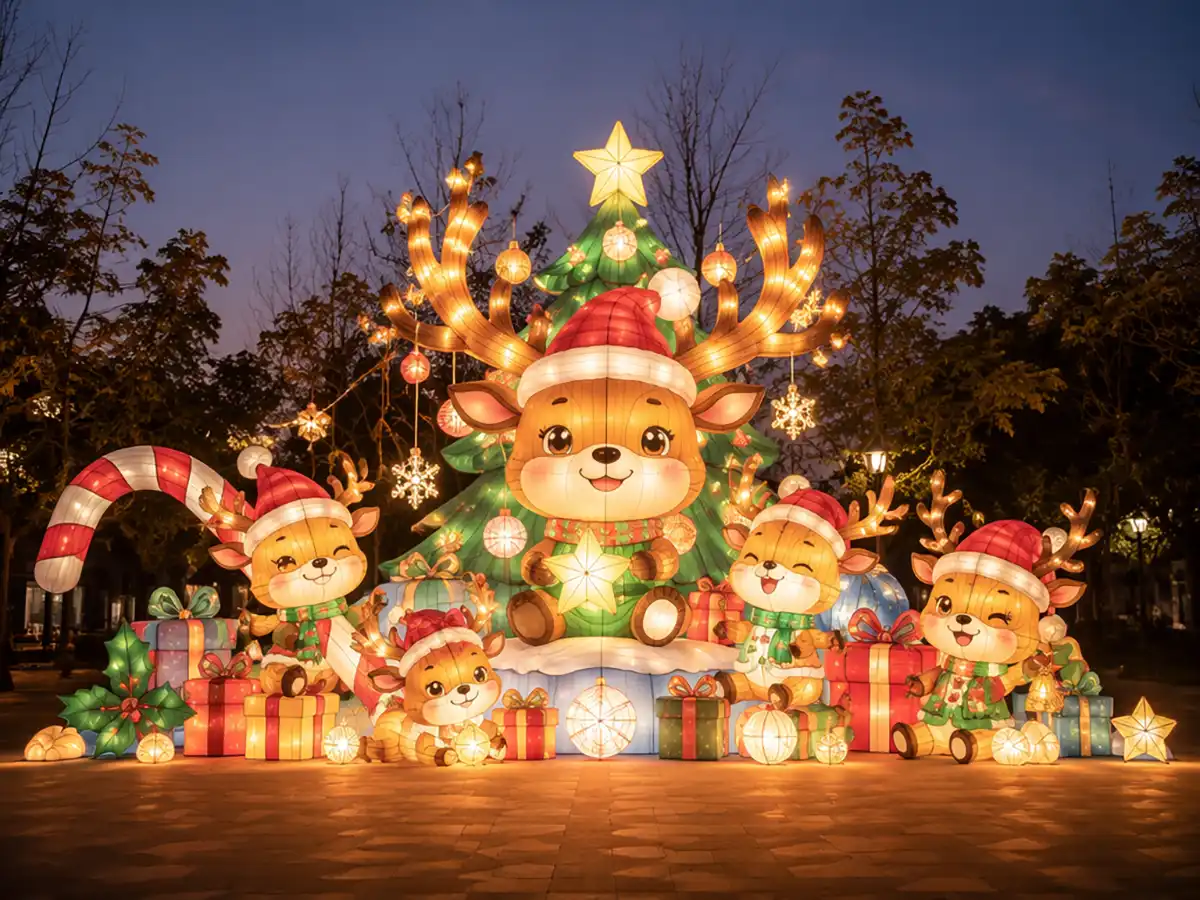
The reference build reads as a family: one oversized mother reindeer in a Santa hat, four smaller reindeer at four different heights and four different poses, a decorated tree, a candy cane, and a low border of gift boxes. From thirty metres away it resolves into three shapes — a wide golden antler crown, a soft amber mound of faces, and a low band of colour at ground level. That reading is the design. The individual detail is what you get in the last ten metres.
This is an AI-assisted concept visualisation paired with human-written design intent and production specifications. It is a design direction rather than a photograph of a finished product — when a project goes ahead, the scene is re-drawn to your venue dimensions and fabricated in our Zigong workshop on a weatherproof internal frame, covered in hand-painted high-density fabric over a shaped understructure, and lit internally with low-voltage LED. The same build method scales from a single companion reindeer up to the full group installation.
Design Intent
The most important decision in this scene is that the mother reindeer is a head, not a body. In the reference build she is an oversized illuminated head and chest with a Santa hat, mounted immediately in front of the Christmas tree — and the tree does the work her torso would otherwise do. This is not a styling choice, it is a scale solution. A reindeer built at this head size with a full standing body would be roughly as long as a horse, and at that point the silhouette stops reading as a reindeer family and starts reading as a farm animal. Compressing her into a head in front of a tree keeps the whole scene in one vertical form, so the composition stays tall and narrow instead of sprawling sideways.
The consequence is that the tree is a structural element, not decoration. It is the spine the mother’s head is mounted to, and it is what gives her a body. A venue that wants the reindeer without the tree is asking for a different build, not a smaller one — the head would need its own support behind it, and the scene loses the top third of its height.
The antlers are the widest element in the whole scene, wider than the tree canopy behind them. They are what a visitor sees from the gate, before any face is legible. We build them as separate cantilevered branches with the wiring run inside the branch tube, and with a tie-back into the main frame — an unsupported antler arm of this length will droop over a season, and a drooping antler is the single most common failure on an oversized animal figure. Small hanging ornaments and snowflakes are tethered on short links off the branches; they are the element that moves in wind, and they need enough freedom to swing and not enough to tangle.
The family reading comes from height and pose gradation, not from count. In the reference build one companion stands tall at the left, one kneels forward with its body close to the ground, one stands turned towards the centre, and one sits lower at the outer edge. Four identical standing reindeer in a row would read as four copies of one product. The smallest figure is placed at the front centre at the lowest height in the group, which is deliberate: that is child height, and that is where children stand for the photograph.
The gift boxes are doing three jobs at once. They hide the bases — ballast, feet, ground plates and cable entries all disappear behind a continuous low band of packaging. They give the eye something to climb, so the composition steps from the ground up to the head instead of starting at head height. And they are the cheapest place on the whole scene to carry a sponsor colour, because a gift box is a flat panel with a ribbon, not a sculpted figure.
Finally, the faces are cartoon faces, and that is a specification. Large eyes with painted highlights, a blush patch, a lighter snout panel — the reference build is deliberately not wildlife-accurate. A realistic reindeer head at this scale is unsettling, and worse, it stops the family reading. The highlight placement on the eye is what the whole thing turns on; put it in the wrong corner of the pupil and the same face looks unfriendly from every angle.
Specifications
| Theme | Winter reindeer family — Christmas / winter lantern festival |
| Main figure | Oversized mother reindeer in a Santa hat, head-and-chest build |
| Companion figures | Four reindeer at four heights and poses; smallest at the front centre |
| Scene structure | Decorated Christmas tree as the structural spine, with the mother figure mounted in front of it |
| Figure scale | Mother figure 5.0 m – 6.5 m to the top of the antlers; companions 1.6 m – 2.2 m |
| Tree height | 6 m – 8 m, sized to sit above the mother figure and carry the star |
| Group footprint | 12 m – 18 m run, or up to five separate placements |
| Antler build | Cantilevered branch tubes with internal wiring and a tie-back into the main frame |
| Base | Ballasted ground plates; no penetration of paving |
| Construction | Welded internal frame, hand-painted fabric panels over a shaped understructure |
| Lighting | Warm amber core with evergreen, red and white accents; low-level ground fill |
| Power | 110V or 220V, DMX-capable control, weatherproof connections |
| Weather | Outdoor-rated, specified to the wind and exposure of the individual site |
| Transport | Modular — figures, tree sections, antlers and gift boxes pack as separate units |
Key Features
- Head-and-tree composition keeps the scene tall and narrow instead of sprawling like a farm animal
- Antler arms are the widest element and the part that reads from the far end of a site
- Four companion reindeer at four heights and poses, so the group reads as a family rather than a row — with the smallest at the front centre, at child height
- Gift-box border conceals ballast, feet and cable entries, and doubles as sponsor space
- Cartoon face specification with fixed eye-highlight placement, so the group stays friendly at scale
- Every companion reindeer stands on its own frame, so the scene can be split across several placements
- Colour separation carried in the painted covering rather than the lamps, so the reading survives a lamp swap
- Ballasted bases developed for paved squares and market plazas that cannot be drilled
Where It Works in a Winter Programme
This is a December scene. Its natural positions are the entrance and the central gathering point of a winter programme — the place a site wants a crowd to stop, photograph and then move on from. German Christmas markets are the clearest fit: a Weihnachtsmarkt is already a hard-edged grid of stalls, and a soft vertical group at the approach or at the edge of the market square is what breaks that grid up and gives the market a centre. Market dates, load-in windows and documentation are set out in our Christmas market lighting guide for Germany.
On a Nordic winter light trail the same group usually ends up as the only warm-amber element on a route that is otherwise blue and white. That contrast is worth planning for rather than correcting: on a long dark trail, one amber scene becomes a waypoint, and the tree above it doubles as a marker that a visitor can navigate by. Nordic programmes are scoped alongside our wider winter range, and the season structure is covered in the Nordic winter light market sourcing guide.
On UK and Irish light trails the group works as a paced photo stop. Trails sold on timed entry need stations where a crowd naturally holds for a minute, and a family group with a clear front-centre figure does that without a steward. See the UK and Ireland light trail installation guide for routing and dwell planning.
For Dutch, Belgian and French town centres the scene suits the square rather than a route, because a European town square is already the place people agree to meet. The split-frame build matters here: three or four small footprints can be threaded between terrace edges where one large diorama cannot. Our European festival programme covers ports, CE documentation and install crews across these markets.
In the wider offer the scene is the December anchor of the Christmas light festival programme, one of the winter scenes delivered under the winter lantern festival programme, and a route stop on zoo lights experiences.
Production Notes
The tree is built first, because it is the structural spine. The mother figure’s head is shaped over its own frame and then mounted to the tree structure, which means the joint between the two has to be designed in from the start rather than improvised on site. Nothing about that joint is visible in the finished scene, and it is still the part that decides how the whole installation behaves in wind.
Antlers ship detached. A cantilevered branch of this length does not fit in a normal crate attached to the head, and shipping it attached is how arms arrive bent. On site they go on last, after the lighting runs have been tested — the assembly sequence is documented in our on-site installation guide.
Covering is hand-painted fabric stretched in panels over the shaped understructure. Colour separation is done in the painted layer, not with coloured lamps, so a replacement lamp from a later batch does not change how the family reads. The faces get their own painted panels with the snout and blush kept as separate pieces rather than blended into one sheet.
Electrically the scene runs on low-voltage LED with a warm amber core, 110V or 220V, DMX-capable control and weatherproof connections throughout. The small ground spheres around the base are low-level fill rather than feature lighting — they exist so the ground under the scene does not go black and the gift boxes are read against something. Everything is outdoor-rated and specified to the site’s own wind exposure rather than to a default.
Bases are ballasted and do not penetrate paving. A run of this size crosses public ground, so cable routes and ground plates are agreed with the venue and the installer before the load-in date. The whole scene is modular: mother figure, tree sections, four companions, antler set and gift-box border all travel as separate units, and every companion has its own frame so the group can be re-sited between seasons. Container planning and European delivery routes are covered in our guide to shipping festival lanterns from China to Europe.
FAQ
Can the scene be split across more than one location?
Yes, and it is often the better answer. Each companion reindeer has its own frame and its own base, so a venue can place one or two at approach points and bring the full family together in the main square. Only the mother figure and the tree are a fixed pair.
Can we order the reindeer without the Christmas tree?
It is possible, but it is a different build. In this design the tree is the structure the mother’s head is mounted to, so without it the head needs its own support behind and the scene drops the top third of its height. If the brief is a reindeer on its own, a single standing reindeer sculpture is usually a better starting point than this scene.
How many reindeer can be included?
The default is one mother and four companions. The count can be reduced to two companions or increased, and the arrangement is re-drawn around the number — the point of the extra figures is the height and pose variation, so adding more of the same pose does not add anything to the reading.
Can the gift boxes carry sponsor branding or a venue logo?
Yes. The gift boxes are flat panels with ribbons, which makes them the simplest place in the scene to carry a colourway or a mark. Sponsor-coloured packaging is a panel change rather than a change to a sculpted figure.
Can the faces be specified as realistic rather than cartoon?
They can, and we would usually advise against it at this scale. Large realistic animal heads read as unsettling rather than friendly, and the cartoon face is the reason families stop in front of the group. If the brief needs a realistic reindeer for a nature or wildlife theme, that is a different scene type and we would scope it separately.
How is the scene specified for an exposed or windy site?
The frame and the ballast are specified to the wind exposure of the actual location rather than to a default — an inland park and a coastal promenade are not the same brief. Anchoring is agreed at design stage, and for paved squares the base is developed so nothing is drilled into the surface.
The Winter Reindeer Family Collection
The reindeer family sits at the centre of a wider December set. Venues that run a route rather than a single installation usually pair it with the Santa, tree and reindeer group at the entrance and the candy wonderland show where the route turns family-facing. Where the brief includes a tall vertical, the gift tower carries the same colour reading in a different silhouette.
Sibling designs: park Santa and reindeer light show · snowman and ice castle scene · storybook character collection
For venues adding a non-Christmas winter element to the same trail, the polar bear family and the penguin winter display are built to the same method and read as the same world. The full range of pieces that can ship alongside this scene is listed under ice and snow lanterns, and what visitors search for before they book covers the demand side of a winter programme.
Related Designs & Resources
- Christmas light festival programmes — the December range this scene anchors
- Winter lantern festival manufacturer — programme scope and planning
- Christmas market lighting in Germany — market dates and load-in windows
- Nordic winter light market sourcing guide — season structure and specification
- Light trail installation in the UK and Ireland — routing and dwell planning
- Lantern displays for European festivals — CE documentation, ports and install crews
- Zoo lights — routed winter experiences for animal collections
- Festival lanterns — the full range by occasion
- All creative designs — browse the full concept collection
Build This Look at Your Venue
- Send the site brief — 3D renders and a specification come back within 24 hours
- Reindeer lanterns — the single-figure builds
- Standing reindeer light sculpture — golden illuminated statue
- Giant illuminated reindeer lantern — majestic moose light sculpture
- Reindeer light sculpture Christmas archway
- Santa sleigh Christmas light sculpture
- Christmas scene lantern set
Explore Winter Lantern Programmes
The Christmas Storybook Character Family Lantern Scene is our most popular Christmas installation — a show-stopping Christmas lighting show that turns any outdoor space into a destination. Perfect as zoo Christmas lights or a winter lantern festival centerpiece, this heartwarming holiday tableau centers on a waving Santa Claus flanked by a smiling snowman, a bright-nosed reindeer, a candy-cane elf, a drum-playing teddy bear, and towering lit Christmas trees surrounded by glowing gift boxes. The scene captures the warmth and wonder of Christmas in a single, photo-ready frame.
This is not a static decoration. Every character is handcrafted by Zigong lantern artisans on a weatherproof internal frame and dressed in high-density fabric with energy-efficient LED lighting, designed for multi-week outdoor display through cold winter nights. The figures are scaled so children can pose with them comfortably, and the layout leaves natural room for visitor flow — making it ideal as a walk-through family photo attraction or a centerpiece Christmas village display.
The scene is fully customizable. Santa’s height can be scaled from 3 m to 8 m; companion characters can be added or removed; trees can be swapped for custom shapes (gingerbread houses, nutcrackers, polar bears); gift boxes can be illuminated in your brand colors for sponsorships and partnership tie-ins. We have delivered this scene to zoo holiday lights events, mall atriums, theme park Christmas sections, and town-center Christmas markets worldwide.
Specifications
| Theme | Christmas Storybook Family |
| Main Figures | Santa Claus, snowman, reindeer, elf, teddy bear |
| Companion Elements | Decorated Christmas trees, gift boxes, candy canes, gingerbread house prop |
| Frame Material | Internal frame |
| Skin Material | High-density fabric |
| Lighting | Energy-efficient LED fixtures (warm white + Christmas red/green accents) |
| Color Palette | Santa red, snow white, evergreen, gold accents, candy-cane stripes |
| Recommended Setting | Zoo Christmas lights events, parks, mall atriums, winter lantern festivals, town-center Christmas markets |
| Customization | Figure scaling, character set, branded color tints, sponsor gift boxes |
| Installation | On-site assembly by our crew or supervised local install |
Key Features
- Iconic Storybook Lineup — Santa, snowman, reindeer, elf, and teddy bear form a recognizable ensemble that resonates with visitors of all ages and drives social media shares.
- Family Photo Optimized — Figures are scaled and arranged to leave natural posing space, making the scene a working photo-op from day one of installation.
- Handcrafted in Zigong — Every figure is shaped and painted by experienced lantern artisans from the birthplace of Chinese lantern festivals.
- All-Weather Construction — Internal frame + high-density fabric stands up to cold, wind, and light precipitation through multi-week winter events.
- Energy-Efficient LED Lighting — Bright, even illumination with low power draw, ideal for nightly operating schedules from Thanksgiving through New Year.
- Fully Scalable & Modular — Start with the core five-character scene or expand into a full Christmas village with reindeer sleigh, nativity, nutcrackers, and gingerbread houses.
- Turnkey Design Support — Concept art, layout planning, production, shipping guidance, and on-site or remote installation supervision.
FAQ
What venues does this Christmas lighting show work best for?
Zoo Christmas lights events, winter lantern festivals, mall atrium Christmas displays, theme park Christmas sections, town-center Christmas markets, botanical garden winter events, and municipal holiday trails.
Is this scene specifically designed as a zoo Christmas lights attraction?
Yes — the figures are scaled for family interaction, the layout leaves room for visitor flow, and the metal-frame construction with outdoor-rated electronics is built to handle outdoor zoo conditions, including cold weather from November through January. Many of our clients use this exact scene as their primary zoo Christmas lights centerpiece.
Can Santa be made larger or smaller than the default size?
Yes. The default Santa is 4 m tall, but we scale from 3 m to 8 m+ for entrance icons or skyline features. Companion characters scale proportionally.
Can the scene be customized with my brand or sponsor colors?
Yes. Gift boxes, ribbons, and accent lighting can be tinted to your brand or sponsor palette. Common configurations include a corporate-sponsored gift tower and themed accent zones.
Is this scene suitable for outdoor winter weather?
Yes. The internal frame and fabric are designed for outdoor display in cold, wind, and light precipitation. All electronics operate reliably through freezing temperatures.
How long does production and delivery take?
Standard production is 6–10 weeks depending on scene size and order queue. For peak November delivery, we recommend placing orders by August. Sea freight and air freight options are available.
Can you add other Christmas characters to the scene?
Absolutely. Popular additions include nutcrackers, gingerbread men, polar bears, penguins, reindeer sleigh with Santa, and nativity scenes. Multi-figure orders receive coordinated finishing and volume pricing.
Do you provide installation support?
Yes. We offer on-site assembly by our crew or remote guidance for your local team, including wiring diagrams, anchor plans, and structural layout drawings.
Related Designs & Resources
- Zoo Lights & Animatronic Solutions — Zoo Christmas lights and winter lantern festival installations
- Creative Design Gallery — Browse more custom lantern festival concepts and themed scenes
- Chinese Lantern Products — Explore traditional and modern lantern displays for events
- Halloween Lights Buying Guide — A practical guide to planning seasonal lantern events
“`
Related Products & Resources
- Chinese Lantern Products — Manufactured lanterns ready for deployment
- Festival Lanterns — Custom holiday and event displays
- Zoo Lights Solutions — Complete packages for zoo events
- Turn This Concept Into a Custom Order
Build This Look at Your Venue