Candy Cane Wonderland — Christmas Display | FestiveLanterns
About This Design
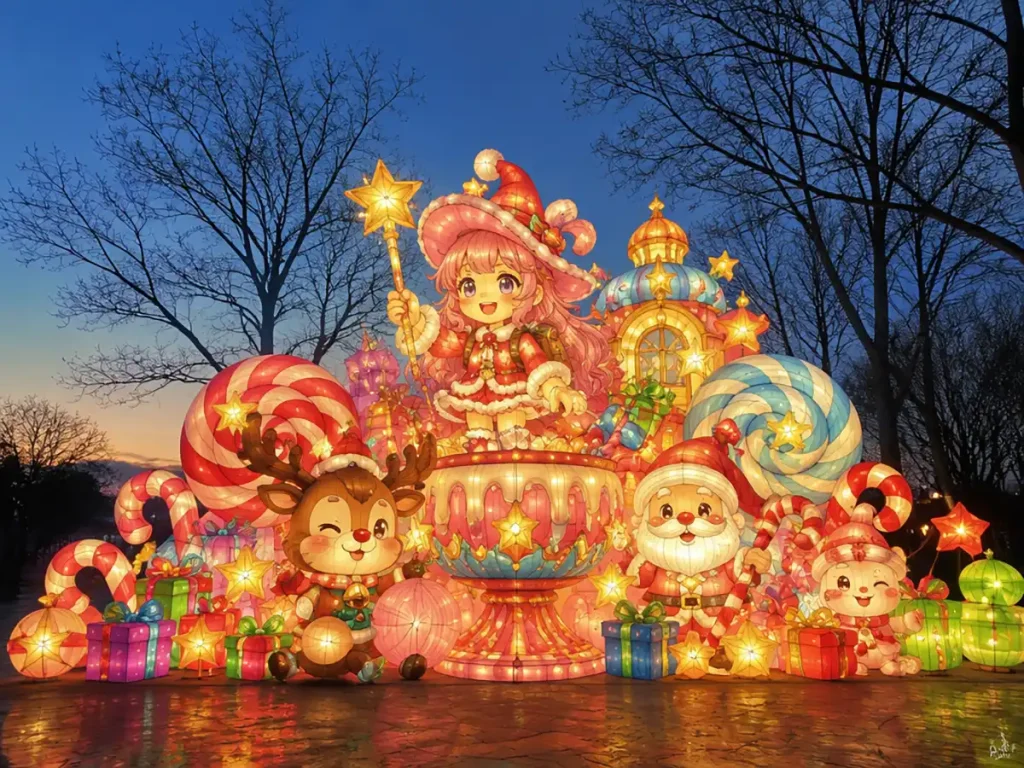
This is an AI-assisted concept visualization paired with human-written design intent and production-verified technical specifications. It is a design direction — not a manufactured product. When you order, our team creates custom 3D renderings and fabricates the actual lantern in our Zigong workshop.
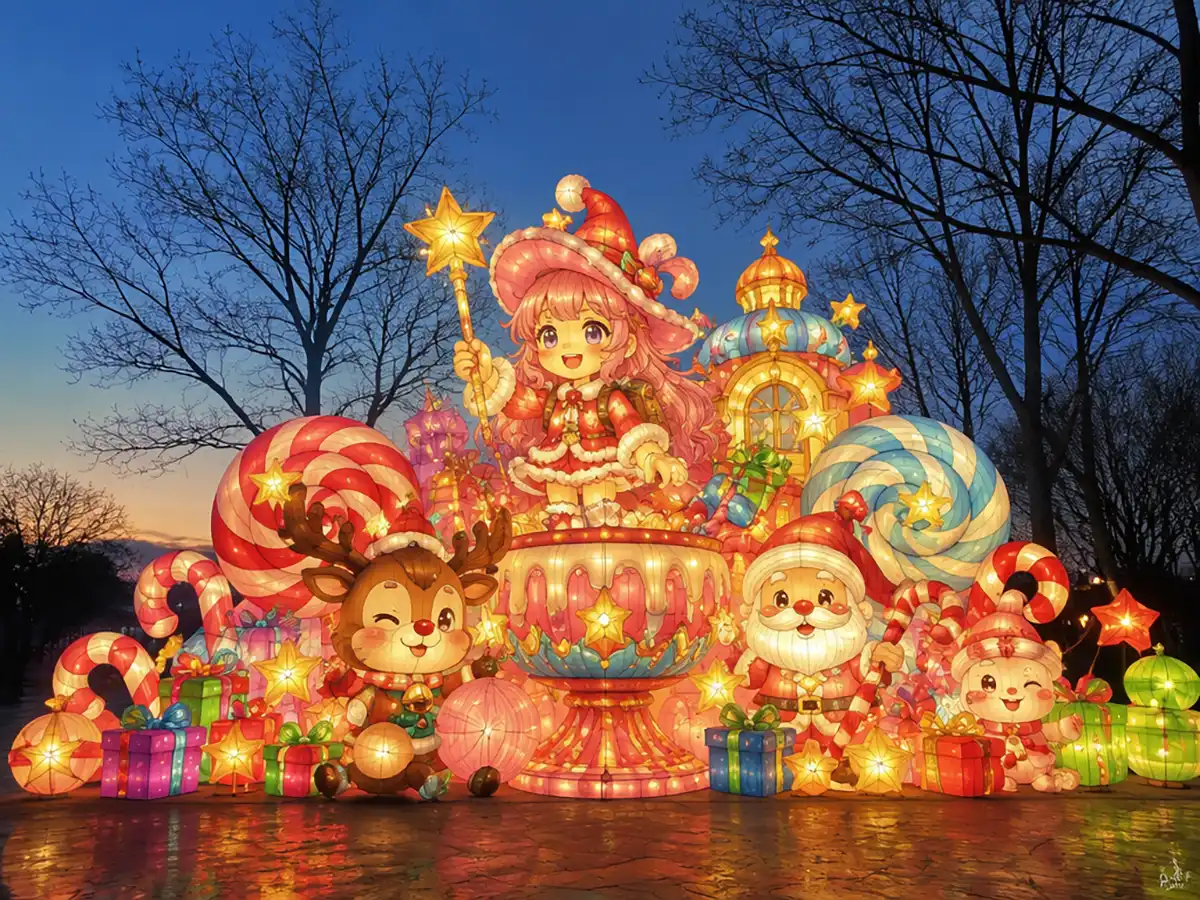
A candy-themed Christmas display works on a different logic from a traditional one: instead of reminding visitors of Christmas, it builds a place they can walk into. This candy cane wonderland is built around that idea — a fairy-tale candy castle with a princess at the top, oversized candy cane columns forming an entry, and a Santa and reindeer pair carrying the Christmas message at the side. It is aimed at venues with family foot traffic: shopping centres, theme parks and museum holiday programmes.
It is made in Zigong in the lantern tradition — shaped on weatherproof internal frames, covered by hand in painted fabric over a foam body, and lit internally so the surfaces glow evenly in the dark. The palette is the point: candy colours are bright and low-saturation, which is the opposite of how most Christmas lighting is designed, and the build is planned around that difference.
What a Candy-Themed Christmas Display Has to Do
Three requirements, and they are different from a traditional set:
- Give children something to walk into. A candy scene is an environment, not a statue — the entry has to be a place a child can pass through.
- Photograph in daylight and at night. Family venues run all day, so the piece has to hold up when the internal lights are barely visible and the paint is doing the work.
- Sit alongside a traditional scene without competing. Most sites already have Santa somewhere; the candy area usually sits on a separate loop rather than beside him.
The Candy Castle and the Princess at the Top
The castle is built with onion domes and a storybook silhouette, and the princess sits mounted on top with a magic wand — which is a deliberate structural decision as much as a design one:
- The princess is the anchor height. She sits above everything else in the scene, so the eye finds the top of the composition first and then works down through the domes.
- The domes carry the night silhouette. Onion domes read as fairy-tale architecture from a distance in a way that flat rooflines do not, which is what makes the castle recognisable on a dark site.
- The top figure has to be built for wind. A figure mounted at the highest point of the piece takes the greatest load, so it is braced back into the castle frame rather than sitting on the dome surface.
Candy Cane Columns as a Walk-Through Entry
The oversized candy cane columns are the part that turns the scene from a backdrop into an entry. Used as a pair or a run, they create a threshold visitors pass between, and that changes how a family moves through the space: children walk through the columns rather than being stopped in front of the castle.
Two practical points: the columns are set at a spacing that stays comfortable with pushchairs and wheelchairs, and they are anchored independently of the castle so that a column can be repositioned if the walking line changes. Where the route allows, a second pair further along extends the candy area into a short walk-through corridor.
Lighting Candy Colours at Night
Candy colours are the hardest palette to light in a Christmas context, because at night a bright pink or mint surface lit at full power turns white. The approach:
- Colour matching inside the panels. The light behind each surface is set to the paint colour rather than to white, so pink panels stay pink instead of washing out.
- Lower output, more contrast. Candy areas run at a lower brightness than a traditional set, and the contrast comes from the red-and-white stripes and the darker outlines rather than from intensity.
- Warm and cool separated. The castle runs warm, the candy cane stripes run cool white and red, and the princess figure is lit close to white so she reads as the brightest point.
The system is RGB and DMX capable, so a venue working to a shopping-centre brand palette can shift the candy colours while the castle and figures stay fixed. The build uses weatherproof metal framing with modular panels and hand-painted fabric covering, and electrical elements are rated outdoor-rated, which covers an indoor mall atrium and an outdoor family area equally.
Where Family-Traffic Venues Use It
- Shopping centres — a candy area for the children’s zone, kept separate from the main Santa set.
- Theme parks — a walk-through candy entry onto a Christmas land or a family ride.
- Museum and attraction holiday programmes — a bright, low-scare environment for younger visitors.
- Family festivals and fairgrounds — the piece children ask to go back to, because they can walk through it.
Sites that want the traditional message at the same event usually run this scene alongside a Santa, tree and reindeer set on a separate loop, and use the walk-through archway as the transition between the two.
Family-traffic venues in the UK and the Netherlands use this theme most, because a walk-through candy cane entry controls visitor flow as well as decorating it. The UK light trail guide and the Netherlands light festival guide both cover how those site types are laid out and what the local organisers ask for.
Frequently Asked Questions
How tall is the castle, and how wide is the scene? The castle is typically built at 4–6 m with the princess figure mounted above it, and a full scene runs about 8 m wide by 5 m tall and 4 m deep. Candy cane columns are usually 3–4 m so visitors pass under the stripes rather than beside them.
Can children walk through the candy cane entry? Yes — that is the purpose of the columns. Spacing is set wide enough for pushchairs and wheelchairs, and the columns are anchored independently so the opening can be adjusted to your walking line.
Will the candy colours still look right at night? Yes, because each surface is lit to match its paint colour rather than to white. Candy palettes do wash out if the lighting is not planned, which is why the output is set lower than a traditional Christmas set.
What is it made from, and can it go outdoors? Weatherproof internal frame with foam and hand-painted fabric covering, and electrical elements rated outdoor-rated — so it suits an indoor atrium or an outdoor family area.
Can the candy colours match our brand? Yes. The lighting is RGB and DMX controlled, so the candy elements can be tuned to a venue’s palette while the castle and the princess stay in their designed colours.
How much space does it need around it? Leave the ground in front of the entry clear for the queue and the photograph, and keep a service side clear for access. A candy area is usually planned as a loop of its own rather than a single stopping point.
Related Displays and Resources
- Giant Gift Box Tower — a vertical landmark for the same square
- Christmas Lighting Show — Mall Santa, Reindeer & Tree — the traditional set for the indoor loop
- Christmas Light Sculpture Walk-Through Archway — a lit threshold between two areas
- Santa Sleigh Christmas Light Sculpture — the delivery scene for a second spot
- Christmas Scene Lantern Set — gift and tree pieces to scatter through the area
- All Christmas design concepts — the rest of the Christmas collection
- Christmas light festival displays — full programme planning
Send us the floor plan with the children’s area marked, the walking line through it and the access route for installation, and we will come back with a castle and column layout drawn to that space. Contact us with a plan or a photo — that is usually enough to start.
From Concept to Your Venue
Select & Customise
Choose a design direction. We will adjust size, colours, lighting, and theme to match your venue.
3D Render
Our design team creates production-ready 3D renderings based on the concept and your requirements.
Fabricate
Master artisans handcraft your lantern in our Zigong workshop — internal frame, hand-painted covering, LED programming.
QC & outdoor-rated Test
72-hour burn-in test, full weatherproof verification, structural inspection. Built to last.
Ship & Install
Export docs handled. Container loading. On-site installation crew available for your event.