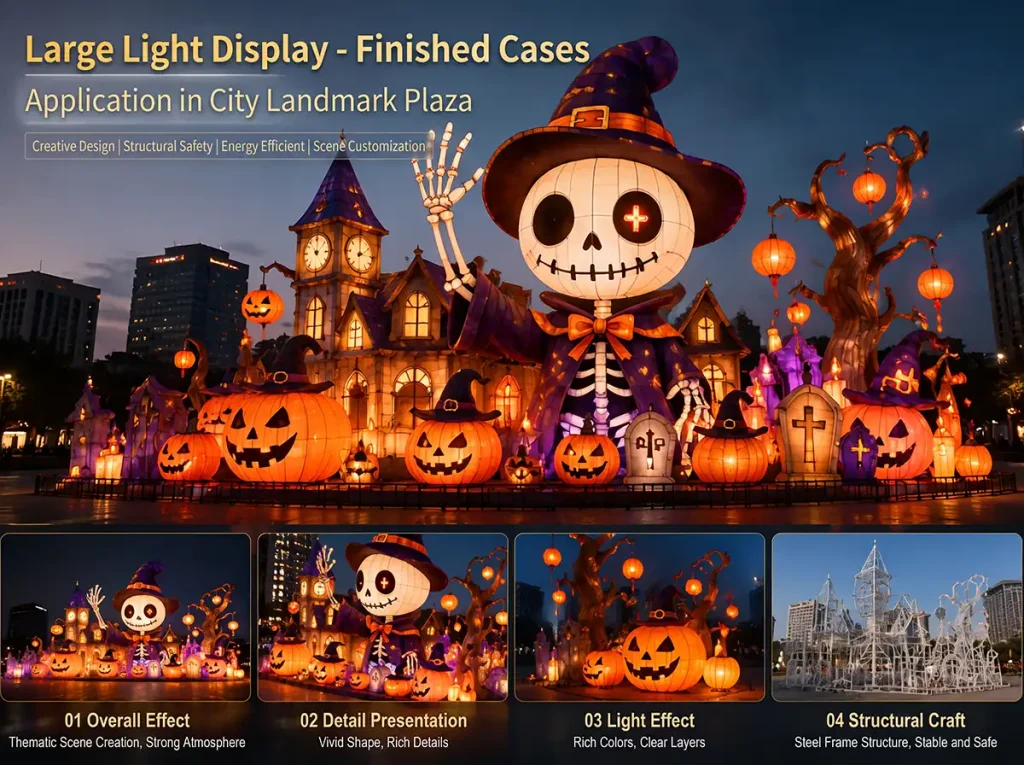
Large Halloween Lantern Display Detail Case Study
About This Design
This is an AI-assisted concept visualization paired with human-written design intent and production-verified technical specifications. It is a design direction — not a manufactured product. When you order, our team creates custom 3D renderings and fabricates the actual lantern in our Zigong workshop.
Most Halloween briefs arrive as a picture of a finished scene. The useful questions start after that: what holds it up, what it looks like before the covering goes on, and how it reads against whatever is already standing behind it. This page is the worked example — a large Halloween display on a city landmark plaza, shown as a finished piece, in detail, in light, and in frame.
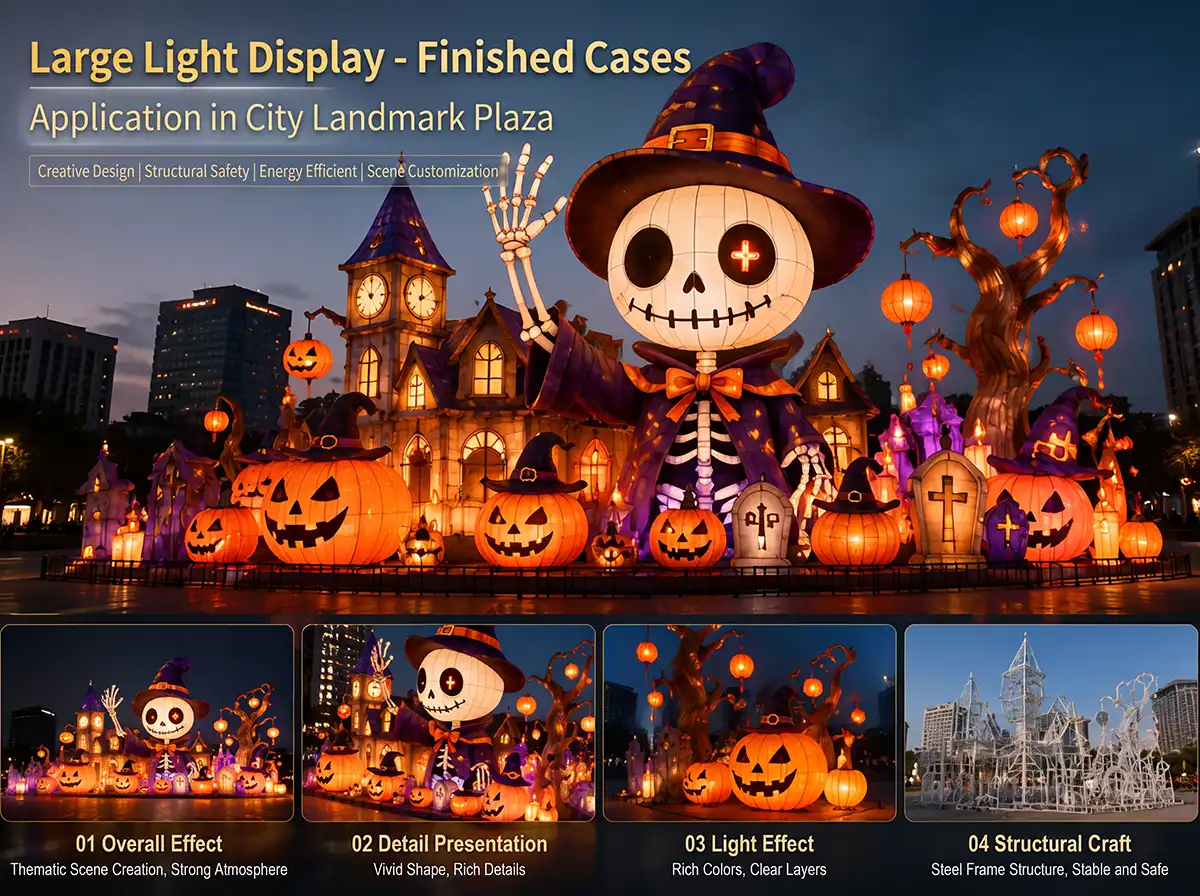
The reference installation is a large plaza scene built in front of an existing city landmark: a cartoon skeleton in a violet robe, witch hat and bow tie at the centre, holding one arm up; a court of pumpkins wearing small witch hats; gravestone markers with crosses; twisted trees hung with orange lanterns. The landmark building behind it is warm-lit and partly occluded by the scene, which is the arrangement the whole brief was designed around.
This is an AI-assisted concept visualisation paired with human-written design intent and production specifications. It is a design direction rather than a photograph of a finished product — when a project goes ahead, the scene is re-drawn to your venue dimensions and fabricated in our Zigong workshop on a weatherproof internal frame, covered in hand-painted high-density fabric over a shaped understructure, and lit internally with low-voltage LED. The same build method scales from a compact mall atrium set up to a full city plaza installation.
Design Intent
When an installation shares a site with a landmark building, the scene has to be designed against that building rather than in isolation. Here the landmark is a clock tower with warm-lit windows, and the scene answers it in three ways: the figure heights are set so the towers still read above the sculpture, the silhouette is kept clean enough that both shapes stay legible against each other, and the palette stays in the warm family so the new lighting does not compete with the building’s own.
The figure is a good illustration of how a family-facing Halloween character is assembled. The hat does the character work — a wide violet witch hat with a buckle gives instant recognition at distance, and it takes a cone, a brim and one painted panel. The bow tie does the same job at the other end of the scale: it takes a skull from menacing to comic in one small prop. Neither of those two elements is structural; between them they carry the whole tone of the piece.
The gravestone markers along the base are doing more than theme. A plaza scene sits on a plinth or a ground plate, and a plain base reads as a lump of engineering. The markers break that line up along its whole length and turn the base into part of the composition instead of a thing the composition stands on. They are simple flat pieces, and they are the highest-value detail in the whole scene for the work involved.
The twisted trees with hanging lanterns give the scene its second layer. A figure at ground level plus a building in the background leaves a gap in the middle of the frame; hanging lights at intermediate height fill it and make the installation look tall rather than wide. Everything in that middle layer is small, replaceable and on its own tether, which matters over a full season on a public site.
Specifications
| Theme | Large Halloween lantern display — city landmark plaza installation |
| Hero figure | Cartoon skeleton in a violet robe, wide-brim witch hat and bow tie, one arm raised |
| Base elements | Gravestone markers with crosses, pumpkin court in small witch hats, lantern-hung twisted trees |
| Hero figure scale | 6 m – 9 m, set so existing landmark towers still read above the sculpture |
| Companion pumpkins | 0.6 m – 2.5 m, arranged as a court around the hero figure |
| Group footprint | 15 m – 25 m frontage on a plaza or atrium floor |
| Base | Ballasted ground plates or plinth; no penetration of paving |
| Construction | Welded internal frame, hand-painted fabric panels over a shaped understructure |
| Lighting | Warm amber core, violet on figures and structures, low-level uplighting on trees |
| Power | 110V or 220V, DMX-capable control, weatherproof connections |
| Weather | Outdoor-rated, specified to the wind exposure of the site |
| Transport | Modular — figure, pumpkin court, trees, markers and base pack as separate units |
Key Features
- Figure heights set so an existing landmark building still reads above the installation
- Warm palette chosen to sit against a lit landmark rather than compete with it
- Wide-brim witch hat and bow tie carry the character in two low-cost props
- Gravestone markers turn the base line into part of the composition
- Lantern-hung trees create a mid-height layer that makes the scene read tall
- Pumpkin court gives the hero figure a crowd of small warm masses to sit against
- Every companion piece stands on its own base, so the scene can be re-laid out per site
- Small lanterns on individual tethers can be replaced singly during a season
- Ballasted bases and plinths developed for landmark plazas that cannot be drilled
- Modular units sized for a phased load-in on a public site that keeps trading
Where It Works in a Halloween Programme
This is a civic-scale piece for a site that already has architecture worth answering. A landmark plaza, a heritage square, a civic forecourt or a mall atrium with a strong existing frontage — anywhere the seasonal installation has to earn its place beside something permanent rather than stand in an empty field.
It suits venues whose Halloween is a season alongside an existing offer, rather than a standalone ticketed attraction. The scene reads from outside, works in daylight, and does not need a queue or a route built around it. Our city lantern festival displays page covers the siting, power and municipal approval sequence that a landmark location brings with it.
The same build also works indoors where the atrium is tall enough — the height cascade from the hero figure down to the pumpkin court is what makes it legible in a multi-level space, and the lamp output is adjustable for an interior setting. See zoo lights for how we structure seasonal programmes inside existing attractions.
For European sites the constraint is usually the load-in window, because a landmark plaza keeps trading through the season. The split between the hero figure, the pumpkin court and the trees is what allows a phased install. Ports, CE documentation and install crews across those markets are covered in our European festival programme.
How a Large Halloween Display Is Built
The order is always the same, and it is worth setting out because it explains where the weight of the work actually sits. First the frame: a welded metal armature shaped to the figure, with the load path decided before anything is covered. This is the stage that decides whether a figure holds its shape over a season — everything visible afterwards is stretched over this structure, so the shape of the build is the frame, not the covering.
Then the covering: high-density fabric stretched in panels over the shaped understructure and hand-painted. Colour and detail live in this painted layer rather than in the lamps, which is why a finished lantern keeps its colours when a lamp is replaced — on a public installation, that is the difference between a repaint and a small maintenance job.
Then lighting: low-voltage LED inside the frame, split into circuits by colour family, with the control on a DMX-capable system and weatherproof connections throughout. Circuits are grouped so the amber, the violet and the interiors can be adjusted independently — a scene lit as one circuit can only be all-on or all-off.
Then install: modular units on ballasted bases, assembled in a sequence that means nothing has to be dismantled to reach a connection. On a working plaza the load-in is phased, and the base units, the pumpkin court and the trees go in before the hero figure. The full sequence and site safety are documented in our on-site installation guide.
FAQ
Can the scene be scaled to an existing building?
Yes, and on a landmark site it has to be. Figure heights, frontage and palette are all set from the building behind — the aim is for both shapes to stay legible rather than for the installation to win the frame.
Can it be installed indoors?
Yes, where the atrium is tall enough. The height cascade from the hero figure down to the pumpkin court is what makes the scene legible across multiple levels, and the lamp output is adjusted for an interior setting. Ceiling clearances and fire requirements are set from the venue.
How long does the build take?
Fabrication and shipping take a set lead time from order confirmation, and the load-in on site runs over a few days depending on access. For a public plaza with a fixed opening date, we schedule backwards from the opening rather than forwards from the order.
Does the site have to be closed during installation?
Not necessarily. The build is modular, so on a working plaza it goes in in phases with the piece-by-piece layout set out in advance. Ground plates are ballasted, so nothing is drilled and the paving is left as found.
Can the pieces be re-used in a later season?
The frames, bases and lighting infrastructure are the durable part; the covering and painted panels carry the theme. A later season is a change of covering and artwork rather than a rebuild, which is normally planned at design stage for venues running an annual programme.
Is this scene available as a company-wide programme?
Yes. The reference case is a single site, but the same pieces can be rolled out across a group of locations with a shared look and a per-site layout. That is usually planned as one programme rather than as repeat single orders.
The Halloween Lantern Collection
This case study sits alongside the design pieces in the Halloween range: a plaza centrepiece, a linear character frontage, a full haunted castle with a walk-through arch, a walk-in pumpkin tunnel and a deliberately non-scary family village. For venues comparing the large builds, the closest piece to this one in structure is the giant skull walkthrough light show, which is designed around a walked route rather than a standing plaza.
Sibling designs: giant pumpkin witch centrepiece · haunted castle and skulls path · cute witch and ghost village set
The season as a whole is set out on the Halloween lantern display page, the festival lantern range lists what ships alongside this build, and custom lantern manufacturing covers a build worked up from a venue’s own landmark and theme.
Related Designs & Resources
- Halloween lantern displays — the full season range
- City lantern festival displays — site selection, power and approvals
- Zoo lights — routed seasonal programmes
- On-site installation guide — assembly sequence and site safety
- Shipping festival lanterns from China to Europe — ports, transit and customs
- Lantern displays for European festivals — documentation, ports and install crews
- Lantern products — the full range
- All creative designs — browse the full concept collection
From Concept to Your Venue
Select & Customise
Choose a design direction. We will adjust size, colours, lighting, and theme to match your venue.
3D Render
Our design team creates production-ready 3D renderings based on the concept and your requirements.
Fabricate
Master artisans handcraft your lantern in our Zigong workshop — internal frame, hand-painted covering, LED programming.
QC & outdoor-rated Test
72-hour burn-in test, full weatherproof verification, structural inspection. Built to last.
Ship & Install
Export docs handled. Container loading. On-site installation crew available for your event.