Harvest Vegetable Lantern Display — Custom Farm-to-Table Festival Lanterns

Harvest Vegetable Lantern Display — Custom Farm-to-Table Festival Lanterns
Bring the warmth of a farmers' market to your festival grounds with a handcrafted harvest vegetable lantern display. Featuring giant illuminated vegetables — cucumbers, corn cobs, tomatoes, carrots, garlic bulbs, wheat stalks, and pumpkins — this is a one-of-a-kind display…
Bring the warmth of a farmers’ market to your festival grounds with a handcrafted harvest vegetable lantern display. Featuring giant illuminated vegetables — cucumbers, corn cobs, tomatoes, carrots, garlic bulbs, wheat stalks, and pumpkins — this is a one-of-a-kind display designed for food festivals, harvest celebrations, agricultural exhibitions, farm-to-table restaurant decor, and Thanksgiving events.
Every vegetable is hand-sculpted in our Zigong factory, finished with high-density fabric skin and outdoor-rated LED lighting that brings out vivid greens, yellows, oranges, and reds. The display can be scaled from a single hero vegetable to a full 30-meter harvest field installation with mixed species. Our proprietary surface finish technology (Patent ZL 2022 1 0224489.5) ensures your harvest display stays vibrant through multiple outdoor seasons.
From a small chef’s table centerpiece to a complete agricultural pavilion, the harvest vegetable lantern display is the most distinctive food-themed festival installation you can commission.

Specifications
| Parameter | Standard | Premium |
|---|---|---|
| Materials | Internal frame + high-density fabric | Internal frame + double-layer silk with surface finish coating |
| Lighting | outdoor-rated RGB LED strips | outdoor-rated RGBW with DMX512 control |
| Color range | 8 preset colors | 16 million colors with synchronized animation |
| Standard sizes | 1m / 1.5m / 2m single vegetable | Custom sizes up to 5m hero pieces |
| Operating temperature | -10°C to 45°C | -15°C to 50°C |
| IP rating | outdoor-rated weatherproof | IP66 with sealed electronics |
| Voltage | 110V or 220V configurable | Dual voltage with auto-detect |
| Power consumption | 80–150W per vegetable | 120–250W with full animation |
| LED System | Commercial-grade LED modules | Commercial-grade LED modules |
| Lead time | 30–45 days | 45–60 days |
Shaping Something That Has No Straight Lines
An animal has a skeleton to build against. A cucumber does not. Everything about a vegetable piece is decided by the surface, and a surface with no straight line is the hardest thing in the workshop to keep clean.
Each vegetable is built on a ribbed armature rather than a box frame: hoops along the length, tapering at the ends, sized so the fabric follows one continuous curve. Corn is built on a straight taper with a slight bend; a carrot on a sharp cone with a blunt shoulder; a pumpkin on a lobed frame with eight to twelve vertical ribs, because a smooth sphere reads as a ball, not a squash.
Leaves are separate pieces, not painted onto the body. A cucumber leaf is a shaped panel with a wire in the rim and two or three shallow folds pressed into it. Fixed flat against the fruit, it reads as a sticker; standing off by 20 to 40 mm, it casts the shadow that makes the piece look grown rather than manufactured.
Stems and roots are where a build shows its budget. A garlic bulb gets a papery skin built from layered thin fabric and a short dried stalk; a wheat stalk gets a real tube with the ear built as a separate cluster of 30 to 50 grains. Built as a single formed piece, a wheat ear reads as a feather.
Colour That Looks Picked, Not Painted
Vegetables are the most saturated subject we build, and saturation is exactly what goes wrong under LED.
Three failures account for most of it. A single flat colour over a whole vegetable — a tomato painted one red — reads as plastic, because a real tomato goes from deep red at the shoulder to almost orange where the light hits. Pure pigment at full saturation blows out under warm light and loses all form. And no dark side: a piece with even colour from every angle has no volume after dark.
The build works in three passes: a base tone, a deeper shade worked into the recesses and the underside, then a paler tint dry-brushed on the high points only. On a tomato that is deep red, near-black red in the crease, and a warm orange on the crown. The eye reads that as ripe.
Colour temperature is set to 2700 to 3000 K. Cooler light pushes greens toward blue and turns a cucumber into something inedible; warmer light turns every red toward brown. The exception is a display built for daylight viewing at a farmers’ market, where the palette is mixed against sun rather than against LED and the internal lighting is set dimmer.
Sizing a Harvest Field
The range runs from a single piece on a chef’s table to a 30-metre run, and the layout rules are the same at both ends.
Individual vegetables run 0.8 to 2.5 metres. Below a metre they read as decoration; above 2.5 they stop being food and become sculpture. The working size for a festival field is 1.2 to 2 metres, which is roughly four to six times life size — enough to be absurd, not so much that the shape is lost.
A 30-metre field carries 15 to 25 pieces. Grouping by species rather than mixing everything together is what makes it read as a harvest: a row of corn standing at different heights, a cluster of pumpkins at ground level, wheat at the back. Mixed evenly, the field looks like a market stall knocked over.
Height does the rest. Corn and wheat stand 1.5 to 2.5 metres; pumpkins, tomatoes and garlic sit at 0.6 to 1 metre. That gives the field two levels and a sightline from the entrance, and it means a child walking the route has something at their own height. Where the site already runs an autumn programme, the harvest scene sits beside pieces such as the persimmon harvest display without repeating it.
Key Features
- Patent surface finish technology (ZL 2022 1 0224489.5) — UV-stable, weatherproof, hand-painted detail
- Custom vegetable species — choose from cucumbers, corn, tomatoes, carrots, garlic, pumpkins, wheat, peppers, or design a bespoke harvest scene
- Modular display — start with a single hero piece and expand the harvest scene across multiple seasons
- Food-festival optimized — pairs with culinary events, farmers markets, and farm-to-table restaurant activations
- Hand-painted finish — every leaf, kernel, and stem is individually painted for photo-ready realism
- Standard 110V/220V — works on any country’s electrical system
- Modular internal frame — sectioned for easy transport and on-site assembly
FAQ
Can the vegetables be made in a specific species?
Yes. Species, size, pose and colour are all set per order; a bespoke form starts from reference photographs.
How long does a piece last outdoors?
The frame and finish are built for seasonal outdoor display, with UV-stable pigments and a sealed surface.
Do the pieces need their own base?
Each vegetable carries its own base plate or ground spike depending on the site surface.
Can a harvest field be added to over several seasons?
Yes. Pieces are modular, so a field can start with five and grow.
Related Products & Resources
- Food & Harvest Lantern Collection — Custom food-shaped lanterns for culinary events, harvest festivals, and farm-to-table venues.
- Custom Chinese Lanterns — Full Catalog — Browse all festival lantern types: animal, scene, architectural, and themed displays.
- Chinese Lantern Festival — Complete Event Displays — Turnkey festival packages for venues worldwide.
- Request a Free Design Proposal — Tell us your venue and event date. Custom 3D rendering within 3-5 business days.
Related

You May Also Like
Related Products
Festival Lanterns
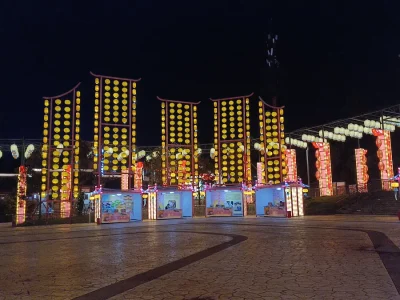
Chinese Lantern Frame Display — Festival Lantern Pillar for City Plazas & Cultural Events
View Details →


Questions
Frequently Asked Questions
Interested in This Product?
Get a custom quote within 24 hours. Our team is ready to help.