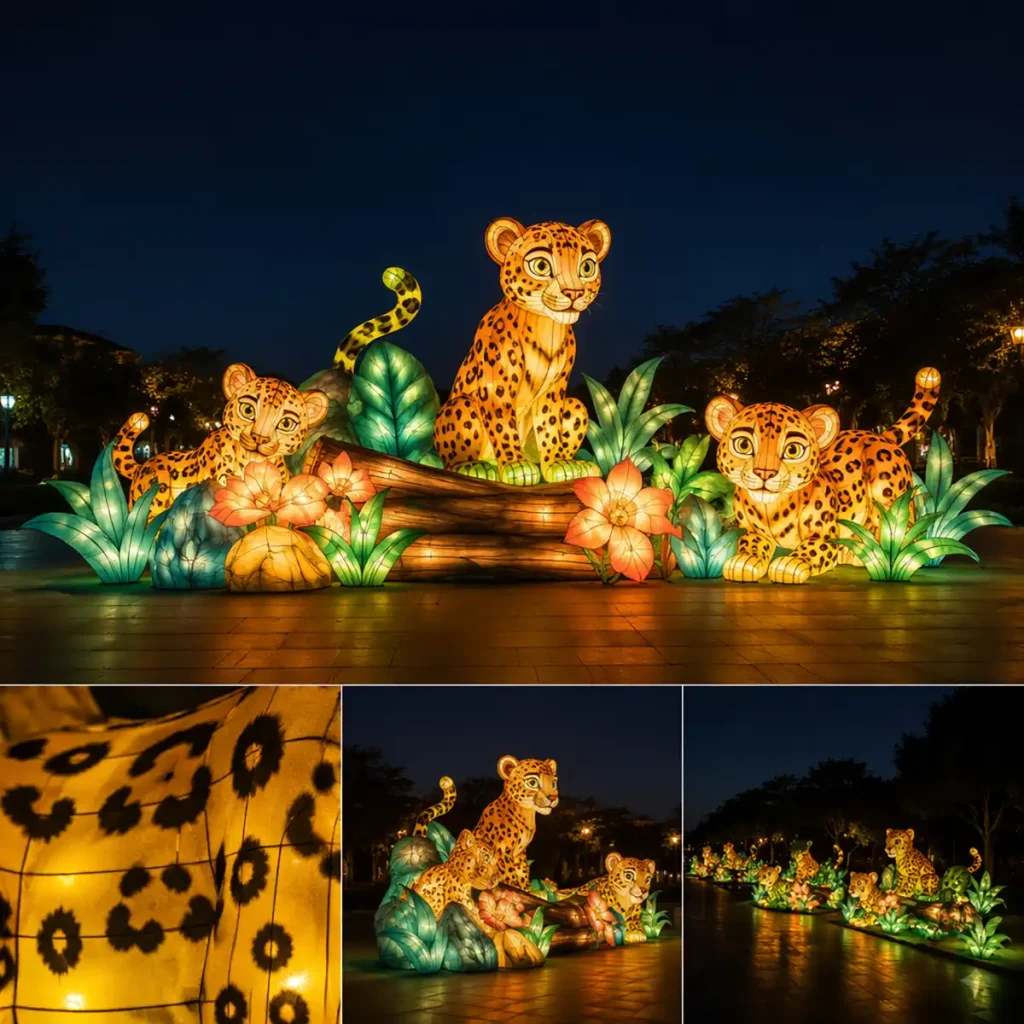
Cheetah Lantern Family Sculpture — Cute-Style Adult and Cub with Log Display
About This Design
This is an AI-assisted concept visualization paired with human-written design intent and production-verified technical specifications. It is a design direction — not a manufactured product. When you order, our team creates custom 3D renderings and fabricates the actual lantern in our Zigong workshop.
A cheetah is defined by movement, and a lantern sculpture is completely still — which makes this the hardest animal in the whole animal-lantern range to get right. Get the pose wrong and a cheetah reads as a large spotted cat lying on a log. Get it right and visitors see speed in a static object before they can explain why. This concept is built around that problem: an adult cheetah and cub on a fallen log, with lily flowers and a small amount of tropical foliage, composed so the group reads as a family at rest rather than two animals parked side by side.
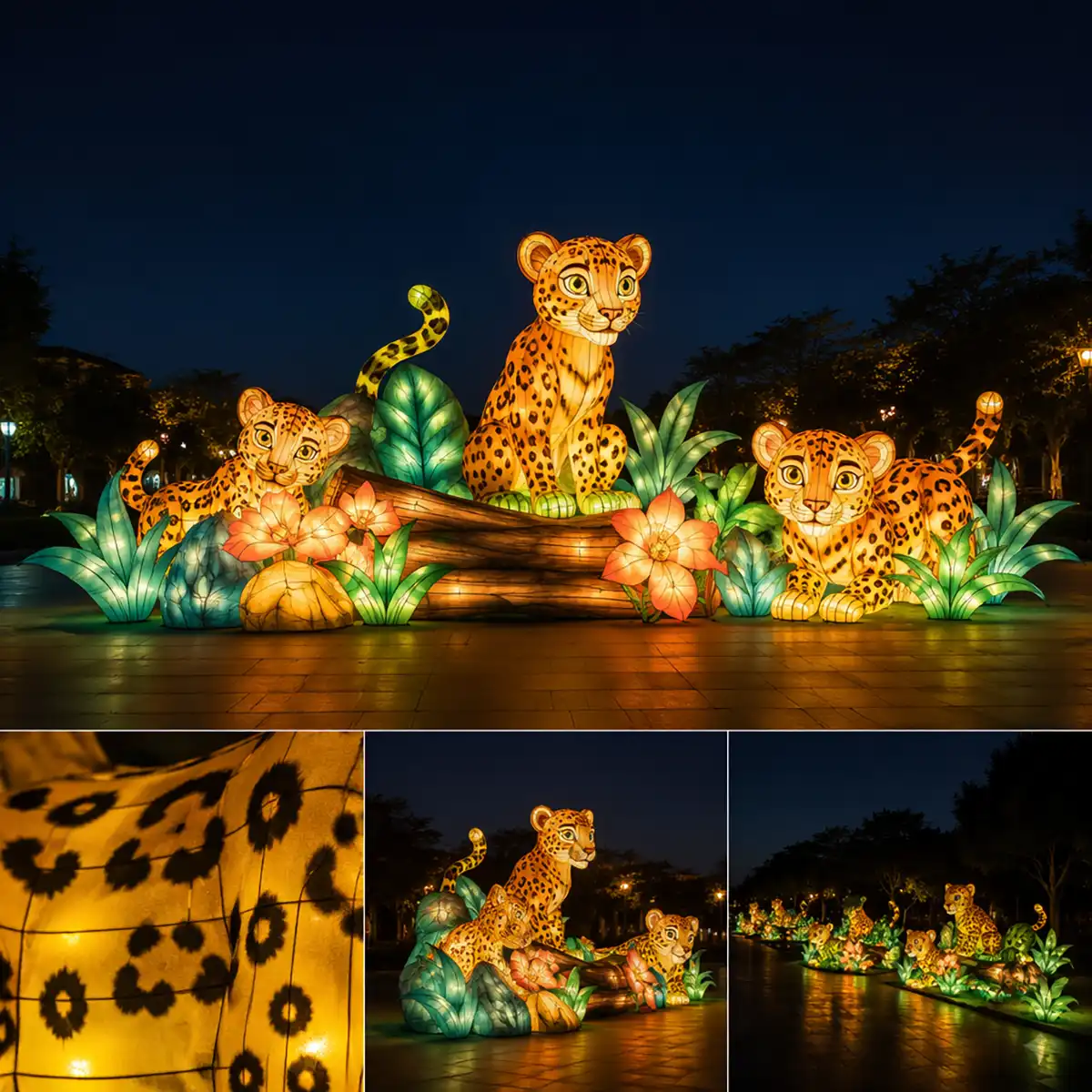
This is an AI-assisted concept visualisation paired with human-written design intent and production specifications. It is a design direction rather than a photograph of a finished product — when a project goes ahead, the scene is re-drawn to your venue dimensions and fabricated in our Zigong workshop on a weatherproof internal frame, covered in hand-painted high-density fabric over a shaped understructure, and lit internally with low-voltage LED. The same build method scales from a compact 3 m composition up to a 15 m centrepiece.
Why the Cheetah Is the Hardest Animal to Build as a Lantern
Most animals carry their character in shape. An elephant reads as an elephant from a silhouette; a panda reads from colour blocks. A cheetah carries its character in motion, and motion is the one thing a static lantern cannot show directly.
Three specific problems follow from that:
- The body is thin and long. A cheetah’s silhouette is much narrower than a lion or tiger at the same height, so the frame has to hold a slender form without looking fragile or flimsy in daylight.
- The markings are small. Cheetah rosettes are much finer than leopard spots, and fine detail is exactly what disappears first when a surface is lit from inside.
- The shape is unfamiliar to most visitors. Many people cannot reliably tell a cheetah from a leopard. The build has to carry the identification itself — through tear marks, stance and the log perch.
Practically, this means the design work for a cheetah goes mostly into pose and surface treatment, not into scale. A bigger cheetah is not a better cheetah.
Choosing a Pose That Still Reads as Speed
There are three static poses that keep a cheetah legible, and each suits a different setting. All three avoid the two that reliably fail: lying flat with the head down, and standing square like a zoo specimen.
| Pose | What it communicates | Best setting |
|---|---|---|
| Alert on the log, head up and turned | Readiness — the instant before the sprint | Paths and gateways, where the figure is seen from the side |
| Cub beside the adult, both looking outward | Family, protection, a shared viewpoint | Photo points and family zones |
| Adult stretched along the log, tail trailing | Relaxed state — the animal at rest after the hunt | Quieter garden pockets and trail midpoints |
The alert-on-log pose used here works because the head is the highest point and it is turned slightly away from the body axis. That turn is what suggests a live animal rather than a model — a straight-ahead stare reads as a statue. Keep the tail as a long, low line behind the figures; it is the single cheapest way to add movement to a static composition.
One caution: do not attempt a mid-stride or leaping pose unless the venue genuinely wants a suspended or heavily braced structure. A lantern is a large light box, and an unsupported airborne attitude puts the mass in the wrong place for both wind load and stability.
Cheetah Markings at Night — Leave the Dark Alone
The instinct with a spotted animal is to light the spots. That is the mistake. Cheetah markings are read from the contrast between the markings and the coat, and adding light to the markings destroys the contrast that makes them visible.
- Keep rosettes unlit. Paint them and leave them in shadow. The spots should be darker than the surrounding coat, not brighter.
- Wash the base coat from inside. The warm tan body reads best as a soft, even internal glow rather than a strong one. The brighter the base coat, the less the markings show.
- Use the tear marks deliberately. The dark lines from the inner eye corners down to the mouth are the most reliable cheetah identifier. Give them crisp edges and keep light away from them.
- Watch the belly. Light colours under the body raise apparent height and make the animal look heavier. Keep the belly value close to the upper body.
For the cub, the same rules apply but the coat value should be slightly softer and lighter overall — cubs are handled visually as the warmer, gentler half of the pair, which is what gives the family group its appeal to younger visitors.
Adult and Cub Proportions in a Family Group
Family groups succeed or fail on proportion. The relationship that works here is an adult at roughly 1.4× life-size with a cub at roughly 0.7×, both scaled on the same system.
| Element | Typical scale | Why |
|---|---|---|
| Adult cheetah | 1.4× life-size | Large enough to hold the composition at a distance |
| Cub | 0.7× life-size | Small enough to read as young without looking like a toy |
| Log perch | Composed to suit the pose | Carries both figures and anchors the scene |
The gap between adult and cub matters more than either absolute size. A cub built at 0.85× of an adult reads as a second adult; too small and it reads as a mascot. The 2:1 visual relationship is the one that comfortably reads as parent and young from five metres away, which is the distance most visitors stop at.
Where children will be photographed with the set, keep the cub between about 0.8 m and 1.2 m at the shoulder. This puts it in the frame at child height, so a photo taken from the natural standing position includes both the child and the young animal rather than cropping one of them out.
Keeping the Scene Sparse
The supporting elements in this concept are intentionally few: one log, lily flowers, and a small amount of tropical foliage. Restraint is what protects the subject.
- One strong prop beats five weak ones. The fallen log gives the figures a reason to be on an elevated level, which is also what makes them visible over people’s heads.
- Lily flowers are scale cues. Flowers at roughly knee height make the animals look larger without changing a single dimension.
- The ground plane stays clear. Loose grass tufts and stones get kicked, moved and lost over a season; a clean base is easier to maintain and reads better in photographs.
- Colour discipline. Warm tan, dark rosettes, soft white belly, fresh green leaves and pink lilies — five values is the practical ceiling for a night scene before it turns into noise.
Where a Cheetah Family Set Works
Cheetah and cub pairs suit African safari zones, children’s wildlife parks, zoo entry plazas, botanical garden safari themes and the African area of a theme park. They work especially well at a path junction, where the elevated log solves a very practical problem: the display stays visible above crowds moving in two directions at once.
For venues building a route rather than a single piece, this set pairs naturally with other African-area figures — see the animatronic zebra with foal and the life-size African elephant exhibit. For a complete programme across a site, see our animal lantern manufacturer and zoo lights pages, or browse all animal lantern designs.
Frequently Asked Questions
Can the cheetah family be made larger than the standard scale?
Yes. The composition scales from roughly 3 m wide for a garden pocket up to 15 m and beyond for a landmark installation. Above about 6 m the frame gains extra bracing and the internal lighting is zoned into more circuits so sections can be controlled independently.
Is the log perch structurally separate from the animals?
It is built as its own frame unit, and the animals are fixed to it. That separation keeps transport practical and lets a venue change the perch later — a rock base or a raised mound can replace the log without rebuilding the figures.
Can the set survive a full winter outdoors?
Yes. The frame is weatherproof metal and the skin is high-density fabric over a shaped understructure, with internal LED lighting protected to an outdoor-rated standard. Venues in heavy snow regions usually add a seasonal inspection of fastenings and cable protection.
How many figures can the family group include?
The standard build is an adult and a cub. Three-figure and five-figure versions are available, and additional cubs are usually placed at different heights on the perch so the group does not read as a row.
Can the markings be adapted to a different big cat?
Yes. The frame and painting approach supports leopard, jaguar, snow leopard and tiger variations. Each requires different marking work — tiger stripes, for example, need a completely different lighting treatment, since stripes are long lines rather than discrete spots.
How is the scene delivered and installed?
Figures and props break down into frame sections with the skin panels and lighting looms labelled by position. Installation is by our crew or a supervised local team, normally within a day or two for a family-scale set.
Related Animal Designs
Compare this scene with the tiger family, where the design problem is stripes rather than spots, and the rhino family, which solves the opposite challenge — managing heavy visual mass. Smaller woodland and Australian scenes sit alongside them: the raccoon family leaf-gathering scene, the squirrel with acorn scene and the koala in a eucalyptus grove.
For a larger custom figure, the custom animatronic big cat and the lifelike giant panda model show how the same workshop approach works on animatronic builds. Browse the full animal lantern range or send your venue type and available width through the contact form.
From Concept to Your Venue
Select & Customise
Choose a design direction. We will adjust size, colours, lighting, and theme to match your venue.
3D Render
Our design team creates production-ready 3D renderings based on the concept and your requirements.
Fabricate
Master artisans handcraft your lantern in our Zigong workshop — internal frame, hand-painted covering, LED programming.
QC & outdoor-rated Test
72-hour burn-in test, full weatherproof verification, structural inspection. Built to last.
Ship & Install
Export docs handled. Container loading. On-site installation crew available for your event.