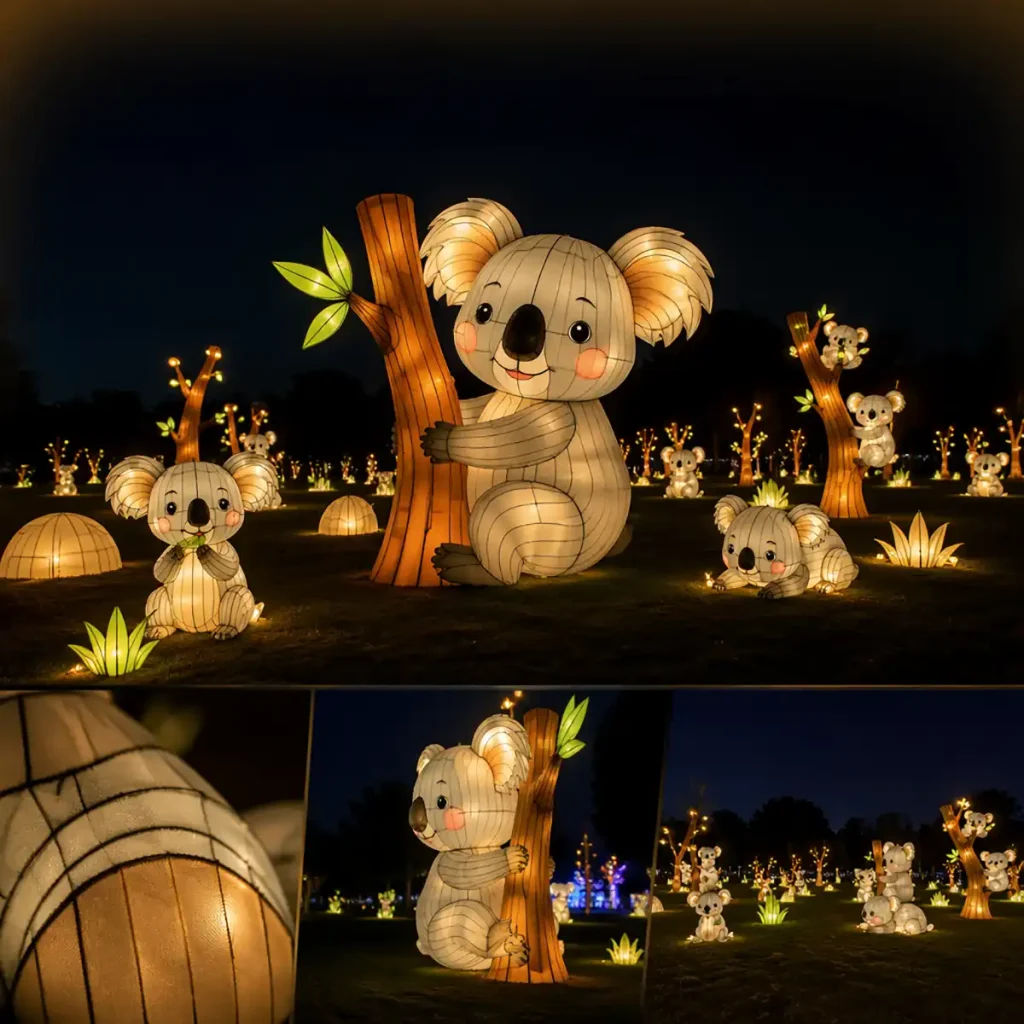
Cute Koala Lantern with Eucalyptus Grove Scene
About This Design
This is an AI-assisted concept visualization paired with human-written design intent and production-verified technical specifications. It is a design direction — not a manufactured product. When you order, our team creates custom 3D renderings and fabricates the actual lantern in our Zigong workshop.
A koala is one of the few animals that carries its entire identity in the head, and the reason is a subtraction: it has no tail. Strip the tail from most mammal silhouettes and the species becomes ambiguous — which is why the koala’s design weight falls on three features that must all be right at once: the oversized round ears with a furry rim, the large dark nose, and the soft cheek patches. This concept builds the whole composition around a single koala gripping a eucalyptus trunk, with a ring of smaller koalas at different heights so that the group reads as a grove rather than a figure.
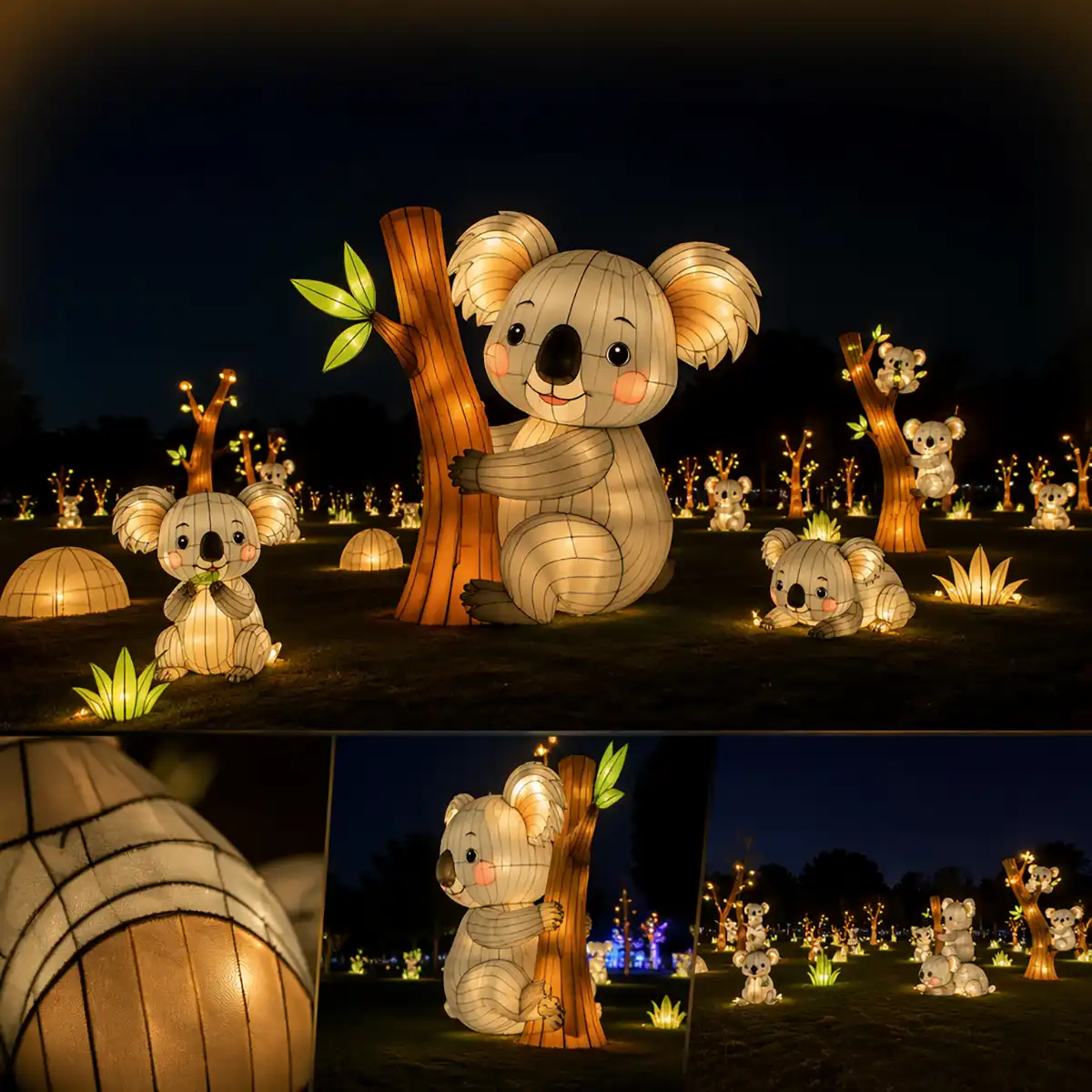
This is an AI-assisted concept visualisation paired with human-written design intent and production specifications. It is a design direction rather than a photograph of a finished product — when a project goes ahead, the scene is re-drawn to your venue dimensions and fabricated in our Zigong workshop on a weatherproof internal frame, covered in hand-painted high-density fabric over a shaped understructure, and lit internally with low-voltage LED. The same build method scales from a single 2 m tree unit up to a 12 m grove installation.
A Koala Has No Tail — and That Changes Everything
Most animal lanterns can afford one approximate feature without losing the species. A koala cannot, because it has only three identifying marks and no silhouette backup.
- No tail to balance the figure. A tailless animal reads as a soft mass, so the ears and nose have to carry the whole identification load from every viewing angle.
- The nose is not a smudge. A koala’s nose is a large, glossy, leathery black shape covering the lower centre of the face. Painting it too small or too soft produces a bear.
- The cheek patches are structural. They are not decoration — the pale cheeks and the dark nose together form the face pattern, and they hold the whole expression.
The practical consequence is that a koala cannot be simplified in the head area. Savings elsewhere on the figure — a plainer body, fewer accessory props — will not be noticed. Savings on the head will be noticed immediately, which is why the head is the last place to economise on this animal.
Ears Are the Hardest Part to Get Right
The round furred ears are the single most difficult element on a koala lantern, and almost the entire difficulty is in the edge. At lantern scale the ear is a large disc, and a plain lit disc reads as a dinner plate. What makes an ear look fuzzy is a broken edge, and a broken edge has to be built, not painted.
| Ear treatment | How it is built | Result at night |
|---|---|---|
| Smooth disc | Single continuous panel | Reads as a plate — avoid |
| Toothed rim | Separate silk lobes on the outer edge | Soft fur impression — use this |
| Recessed inner ear | Deeper frame inside the disc | Adds depth; useful on large builds |
The toothed rim works because each lobe casts a small shadow onto the next one, and the eye reads that repeating shadow as fur. On a large build the ears can carry both the toothed rim and a deeper inner recess, which gives the head a convincing interior without adding surface detail that would catch dirt outdoors.
Keep the ears large — noticeably larger than realistic. A koala’s ears are already oversized in life and exaggerating them further is what reads as friendly rather than as a specimen. If the ears and the nose are both correct and slightly exaggerated, the figure works at any size from two metres upward.
The Tree Is the Structure
In this concept the koala grips a eucalyptus trunk, and the trunk is not a prop — it is the load-bearing element of the whole composition. That is worth understanding before the design is adapted, because it affects what can be changed later.
- The trunk carries the figure. The koala’s arms wrap the trunk and the grip is a genuine structural attachment, not a decorative gesture. The animal can be positioned at height without a separate stand.
- The trunk hides the services. Cabling runs inside the trunk to the branch units, which is why the model shows no visible looms.
- The trunk separates for transport. It breaks into sections, and the koala detaches from it as a complete unit — so a venue can re-position the animal on a different trunk or a rock base in a later season.
- Foliage does the framing. The leaf clusters at the top are the only green in the composition, and they are what tells the eye this is a tree rather than a pole.
The trunk finish matters more than it looks. A warm brown with visible painted bark striations reads as timber; a flat brown column reads as scaffolding. This is a painting task, not a structural one, and it is one of the cheapest quality upgrades on the whole build.
Sizing a Small Animal Large
Koalas are small animals — around 60 to 85 cm — and that creates an unusual sizing rule. Making the figure dramatically larger does not make it more impressive; past a certain point it simply stops reading as a koala and starts reading as a generic bear-like object.
The approach that works is to keep the animal itself close to life-size to moderately oversized, and to build the scale impression through the tree instead. A taller tree with more foliage makes the koala look appropriately placed, while the animal stays recognisable.
| Element | Typical scale | Why |
|---|---|---|
| Koala figures | 1.2–2× life-size | Stays recognisable; exaggeration goes into ears and nose |
| Main tree | 3–8 m | Carries the composition height instead of the animal |
| Companion figures | 0.6–1× life-size | Fills the grove at ground level |
This is also why the koala set works indoors. The figures are compact, the transport volume is modest, and the ambience is soft rather than dramatic — which suits an atrium or a mall concourse far better than a large predator would.
Turning One Figure into a Grove
The strongest version of this concept is not one koala on one tree. It is a grove: several trunks at different heights, each with a koala in a different attitude, plus ground-level figures between them.
- Vary the pose per tree. Climbing high, sitting at the base, lying along a low branch, reaching for leaves. Four attitudes are enough to make a grove feel populated.
- Vary the spacing. Even spacing reads as an installation; uneven spacing reads as woodland. Leave one deliberate gap where visitors can walk through.
- Add ground scatter. Small lit domes and grass tufts at the base fill the ground plane cheaply and give the low figures something to sit against.
- Keep the palette tight. Warm white and cream for the animals, amber-brown for bark, one green for foliage. Adding a second foliage colour costs the scene its calm.
Because every tree unit shares the same trunk design, expanding a grove in a later season costs far less than commissioning new animals — a venue that starts with three trees can add four more without any redesign.
Where a Koala Grove Works
Koalas suit zoo Australia zones, wildlife parks, botanical gardens with a southern-hemisphere section, family entertainment centres, and shopping-centre atriums. The scene is unambiguously gentle, which makes it a safe choice for venues with young children and for indoor locations where a dramatic predator would not fit the brand.
Its biggest market advantage is recognition: the koala is one of a small group of animals that audiences worldwide can identify from a silhouette alone, which means signage and programming need to do less work.
For venues building a trail, this scene pairs naturally with the squirrel and acorn scene and the raccoon family leaf-gathering scene, both of which use the same compact-figure, woodland-scatter approach. Larger animal groups continue the route — see the cheetah family and the animatronic zebra with foal. For a full site programme, see our animal lantern manufacturer and zoo lights pages, or browse all animal lantern designs.
Frequently Asked Questions
Can a koala be built sitting rather than climbing?
Yes. The tree grip is one configuration, and the same figure can be built seated at the base of a trunk or resting on a low branch. Venues running a grove usually mix two or three attitudes, because a set of climbing figures alone can look repetitive.
How large can the grove be?
A single tree unit starts around 2 m and a full grove can reach roughly 12 m across and 8 m tall. Above roughly 5 m the trunk gains extra internal bracing and the lighting is split into more circuits so the trunk, foliage and animals can be controlled separately.
Is the koala removable from the tree?
Yes. It is built as its own frame unit that attaches to the trunk, which keeps transport practical and lets a venue change the arrangement or move the figure to a different trunk later.
Can the grove be used indoors?
Yes, and it is one of the more suitable animal scenes for indoor use — the figures are compact, the transport volume is modest and the light level is soft. Height clearance is the main constraint, so indoor versions are usually specified with shorter trees.
Will the set survive a full season outdoors?
Yes. The frame is weatherproof metal and the skin is high-density fabric over a shaped understructure, with internal LED lighting protected to an outdoor-rated standard. Sites in high-wind or coastal locations normally add a seasonal inspection of trunk joints and cable protection.
How is the scene delivered and installed?
Trunks, foliage and animals break down into sections with skin panels and lighting looms labelled by position. Installation is by our crew or a supervised local team, normally within a day for a single tree and proportionally longer for a full grove.
Related Animal Designs
Compare this scene with the squirrel with acorn, where a single oversized prop does the identifying work, and the raccoon family, which solves the same small-animal problem through a group rather than a tree. The tiger family and rhino family show the opposite end of the scale range.
For a larger bespoke figure, the lifelike giant panda model and the custom animatronic big cat demonstrate the same craft on animatronic builds. Browse the full animal lantern range, or send your venue type and available height through the contact form.
From Concept to Your Venue
Select & Customise
Choose a design direction. We will adjust size, colours, lighting, and theme to match your venue.
3D Render
Our design team creates production-ready 3D renderings based on the concept and your requirements.
Fabricate
Master artisans handcraft your lantern in our Zigong workshop — internal frame, hand-painted covering, LED programming.
QC & outdoor-rated Test
72-hour burn-in test, full weatherproof verification, structural inspection. Built to last.
Ship & Install
Export docs handled. Container loading. On-site installation crew available for your event.