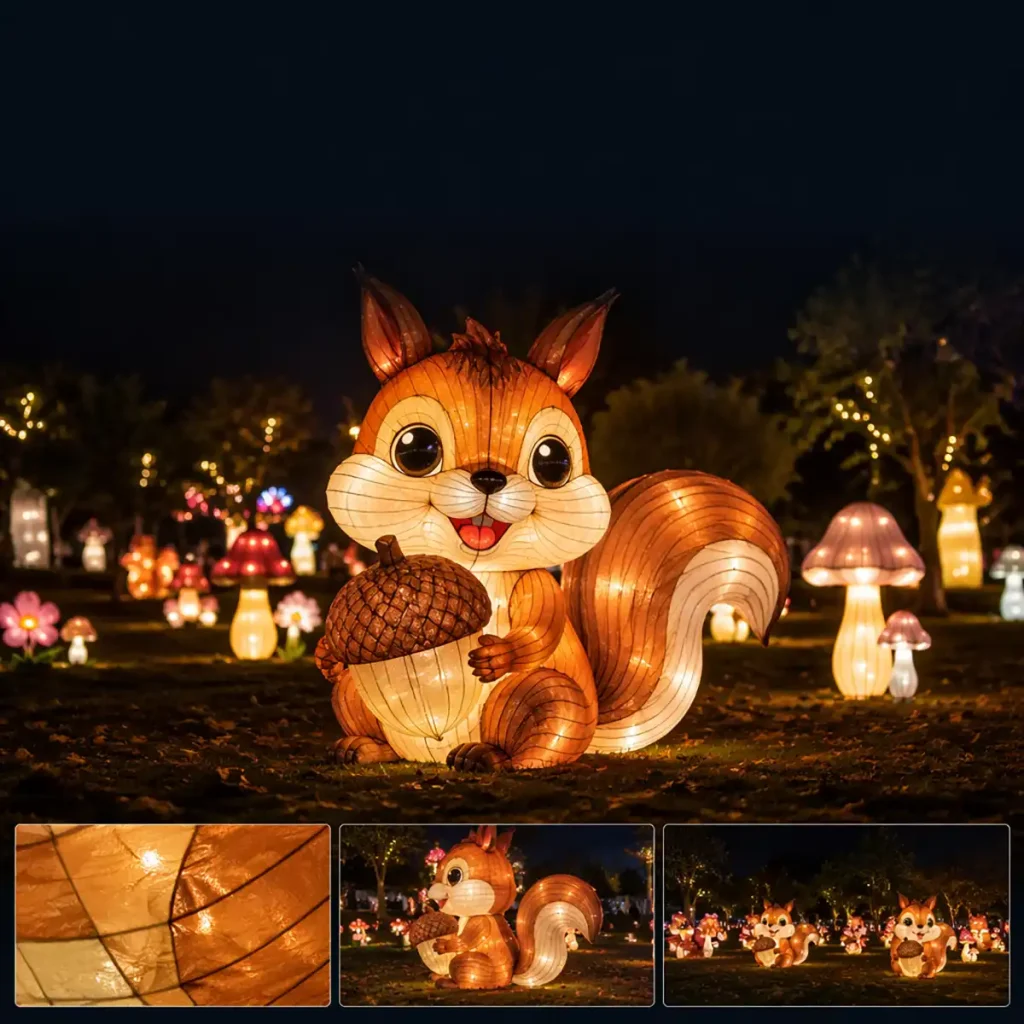
Squirrel Lantern Holding Acorn with Autumn Mushroom Scene
About This Design
This is an AI-assisted concept visualization paired with human-written design intent and production-verified technical specifications. It is a design direction — not a manufactured product. When you order, our team creates custom 3D renderings and fabricates the actual lantern in our Zigong workshop.
A squirrel lantern is a scale problem before it is a sculpting problem. A real squirrel is roughly 25 cm long and the nut it carries about two, so a lantern that copies reality faithfully ends up with an acorn the size of a human thumb — invisible from three metres away, and the entire pose is wasted. This concept solves that by treating the acorn as a hero prop: one oversized nut, faceted and lit from within, gripped in both paws. The animal reads instantly as a squirrel collecting, and the collecting is what carries the autumn story.
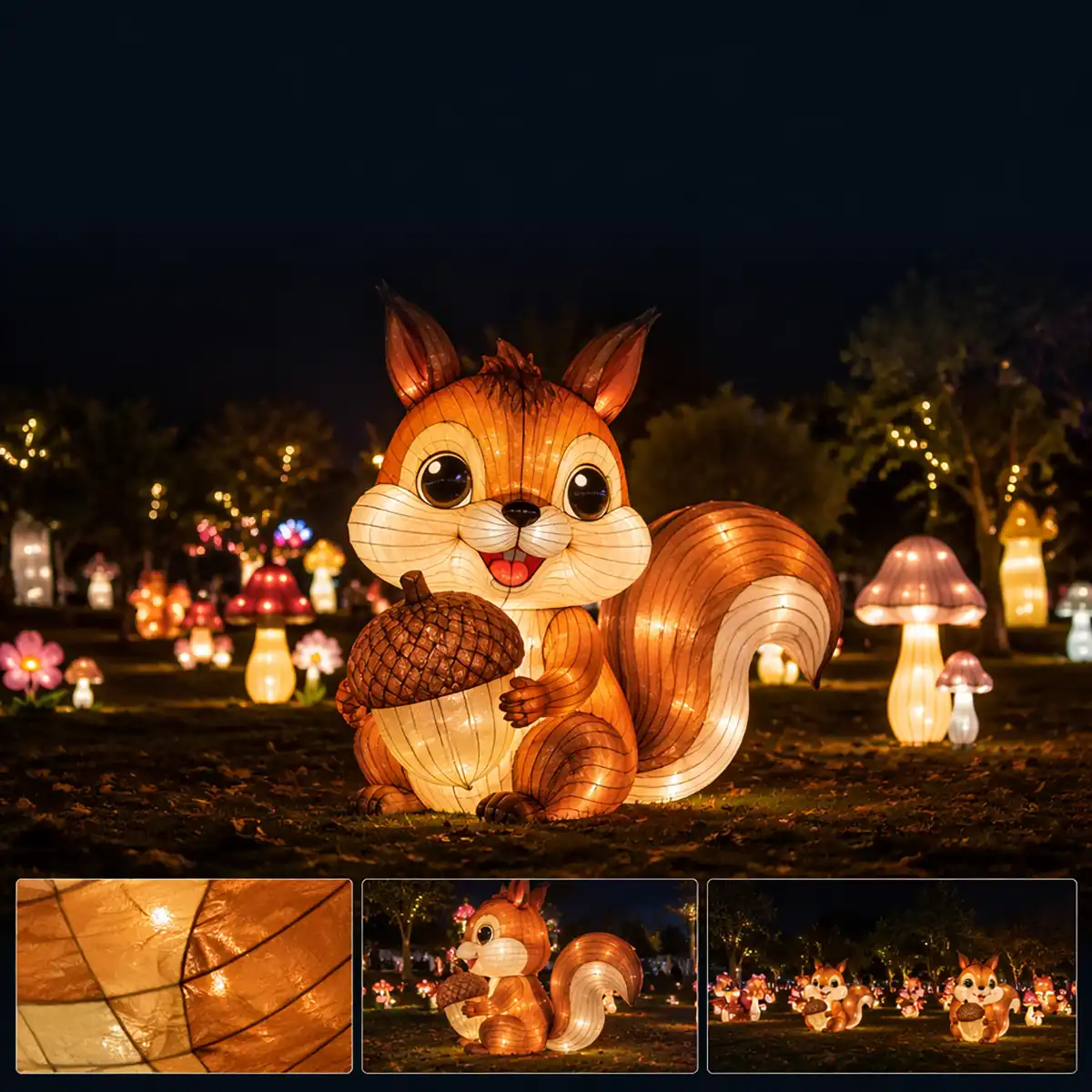
This is an AI-assisted concept visualisation paired with human-written design intent and production specifications. It is a design direction rather than a photograph of a finished product — when a project goes ahead, the scene is re-drawn to your venue dimensions and fabricated in our Zigong workshop on a weatherproof internal frame, covered in hand-painted high-density fabric over a shaped understructure, and lit internally with low-voltage LED. The same build method scales from a compact 2.5 m composition up to a 10 m centrepiece.
Why the Acorn Has to Be Oversized
Squirrel figures fail in one of two directions, and both come from the same mistake — treating the prop as an accessory instead of the subject.
- Too small to read. A proportionally accurate acorn disappears at walking distance. Visitors see an orange animal sitting on grass and nothing else.
- Too literal to be interesting. A squirrel doing nothing is a colour block. The pose only becomes a scene once something is being held.
The working ratio here is an acorn roughly half the height of the squirrel’s head. That is far larger than life and it is deliberately exaggerated — a prop at that scale registers from five metres, reads clearly in a phone photograph, and gives the paws something meaningful to grip. Faceting the nut surface matters as much as the size: a smooth sphere under internal light turns into a plain glowing ball, while the diamond-pattern cap and the ridged body break the light into shapes the eye can identify as an acorn rather than a lamp.
| Element | Real proportions | Display proportions |
|---|---|---|
| Acorn | ≈2 cm long | ≈50% of head height |
| Squirrel body | ≈25 cm long | 1.2–1.5× life-size |
| Paw grip | One paw, casual | Both paws, wrapped |
The two-paw grip is worth insisting on. A one-paw hold reads as a mistake; both paws wrapped around the front of the prop reads as possession, which is the emotion the whole piece is built to deliver.
The Tail Is the Real Structural Challenge
The bushy tail is the most recognisable thing about a squirrel and the hardest thing to build at lantern scale. It is a large, thin, high-aspect panel carrying almost no internal volume, and the two failure modes are opposite: too little support and it droops into the body silhouette, too much and the internal framework becomes visible as dark lines through the silk.
Three tail treatments work, and each suits a different setting.
| Tail form | What it communicates | Best setting |
|---|---|---|
| Upright curl behind the back | Alertness, the classic silhouette | Paths and gateways where the figure is seen from the side |
| Broad sweep to one side | Relaxation, a wider readable profile | Photo points viewed from the front |
| Soft S-curve at rest | Contentment, a calmer line | Quieter garden pockets and trail midpoints |
The upright curl used here works because the tail’s leading edge stays slightly outside the body outline. That separation is what makes the animal legible from a distance — if the tail tucks inside the body silhouette, the squirrel loses its identity and reads as a generic small mammal. Keep the tip rounded rather than pointed; a sharp tail tip reads as a cat.
One practical caution: the tail is the largest wind-catching surface on the figure, and it sits at the very top of the mass. On exposed sites it should be braced back to the main body frame rather than cantilevered from the hip, and the fastening points inspected before an outdoor season. This is a design decision, not a build-time fix — it has to be drawn in from the start.
Making “Cute” Read as Craft, Not Toy
A cute-style animal lantern lives or dies on four measurements. Get these wrong and the figure looks like an inflatable from a fairground; get them right and it looks designed.
- Eye height. Eyes sit low on the head, at roughly 45% of head height rather than the realistic 60%. Low eyes read as young.
- Head-to-body ratio. A head around 40% of total height. Larger and the figure becomes a mascot; smaller and the appeal is lost.
- Ear tufts. The dark tufted tips on the ears are a squirrel identifier and need no extra parts — two small painted cones. Without them the head reads as a rabbit.
- Restraint on the blush. A soft warm tone under the eye, not a hard pink disc. Hard blush is the single fastest way to make a well-made figure look mass-produced.
The front teeth deserve a note of their own. Squirrel incisors are prominent in the concept and they are what pushes the expression from “wild animal” to “character”. Keep them small and slightly parted — visible teeth at full length read as a rodent from a nature documentary rather than a friendly figure.
Surface finish does the rest. The silk is hand-painted with a warm gradient from russet along the back to a paler cream under the chin and belly, and the belly value is kept close to the upper body so the figure does not appear to float. The tail is painted with softer internal striations, which is what gives it the fur impression at night without any sculpted texture.
Mushrooms Do Two Jobs at Once
The mushroom cluster in this concept is not scenery — it earns its place twice over.
- They set the scale. Mushroom caps at roughly knee height make the squirrel read as larger without changing a single dimension of the animal. This is the cheapest scale cue available in a lighting scene.
- They are a separable product. The mushroom and flower units are self-contained frames with their own lighting, so they can be bought as an accompanying ground-scatter set, re-used in a different season, or spread across a site where the squirrel itself is not deployed.
- They fill the ground plane cheaply. A scattered field of small lit mushrooms does more for a night photograph than another large figure, and it costs a fraction of the transport volume.
- They carry the autumn palette. Russet, amber and cream caps with pink and yellow accents — five values is the practical ceiling for a night scene before it turns into visual noise.
Two or three mushroom heights are enough. Uniform heights read as a manufactured row; varied heights read as a forest floor.
One Squirrel or a Whole Row
Because the pose is compact and self-contained, the same figure reproduces cleanly. That gives venues a choice that most large centrepieces do not offer.
| Configuration | Quantity | Where it works |
|---|---|---|
| Single figure with mushroom cluster | 1 + scatter | Path junction, garden pocket, photo point |
| Short line | 3–5 | Entrance approach, retail street, market avenue |
| Full array | 6–12 | Plaza, park meadow, festival lawn |
A repeated array works best when the figures are not identical in presentation — alternate the tail angle, vary spacing, and stagger the mushroom clusters between them. Identical copies in an even line read as a production run; slight variation reads as a woodland. Because every unit shares the same frame design, the array costs far less to produce per piece than an equivalent number of bespoke designs, and it packs into a small transport volume.
For an autumn or harvest programme, the array is the more useful purchase: it can be split across three or four locations on the same site and re-combined for the main event.
Where an Autumn Squirrel Scene Works
The squirrel and acorn theme suits autumn lantern festivals, harvest celebrations, botanical gardens running a woodland trail, zoo children’s zones, farm parks, and shopping-centre atriums running an autumn campaign. It is one of the few animal concepts that works indoors without modification, because the figures are compact and the mushroom scatter provides its own low-level ambience.
Seasonally it sits at the front of the autumn calendar — a set installed for a September or October opening runs comfortably through to the end of November before the winter programme takes over.
For venues building a route rather than a single piece, this scene pairs naturally with the raccoon family leaf-gathering scene, which uses the same autumn woodland language with a different animal, and with the koala in a eucalyptus grove for an Australian section. Larger cat and plains figures sit alongside them — see the cheetah family sculpture and the animatronic zebra with foal. For a complete programme across a site, see our animal lantern manufacturer and zoo lights pages, or browse all animal lantern designs.
Frequently Asked Questions
Can the squirrel be built without the oversized acorn?
Yes. The acorn is a separate prop unit fixed to the body frame, so it can be omitted, reduced, or swapped for another held object — a lantern, a leaf or a smaller nut. Venues that want a more naturalistic figure usually keep the pose and shrink the prop, accepting that it reads best from closer range.
How large can a single squirrel be?
The composition scales from roughly 2.5 m for a garden pocket up to about 10 m for a landmark piece. Above roughly 5 m the tail gains extra internal bracing and the lighting is split into more circuits so the body, tail and prop can be controlled separately.
Is the tail removable for transport?
It is built as its own frame section that bolts to the body. That keeps shipping volume practical and lets a venue replace or re-angle the tail later without rebuilding the animal.
Can the set be used outdoors through a full autumn season?
Yes. The frame is weatherproof metal and the skin is high-density fabric over a shaped understructure, with internal LED lighting protected to an outdoor-rated standard. Sites in high-wind or coastal locations normally add a seasonal inspection of tail fastenings and cable protection.
Can the mushrooms be ordered on their own?
Yes — they are self-contained frames with independent lighting, so a venue can buy the ground scatter alone, or expand an existing autumn scene with more units in a later season.
How is the scene delivered and installed?
Figures and props break down into frame sections with skin panels and lighting looms labelled by position. Installation is by our crew or a supervised local team, normally within a day for a single figure and its scatter, and proportionally longer for a full array.
Related Animal Designs
Compare this scene with the raccoon family, which solves the opposite problem — three figures that have to read as a family group rather than three separate animals — and the koala grove, where the figure has no tail at all and identification rests entirely on the head. The tiger family and rhino family show how the same workshop approach handles much heavier subjects.
For a larger custom figure, the lifelike giant panda model and the custom animatronic big cat demonstrate the same craft on animatronic builds. Browse the full animal lantern range, or send your venue type and available width through the contact form.
From Concept to Your Venue
Select & Customise
Choose a design direction. We will adjust size, colours, lighting, and theme to match your venue.
3D Render
Our design team creates production-ready 3D renderings based on the concept and your requirements.
Fabricate
Master artisans handcraft your lantern in our Zigong workshop — internal frame, hand-painted covering, LED programming.
QC & outdoor-rated Test
72-hour burn-in test, full weatherproof verification, structural inspection. Built to last.
Ship & Install
Export docs handled. Container loading. On-site installation crew available for your event.