A cheetah is defined by movement, and a lantern sculpture is completely still — which makes this the hardest animal in the whole animal-lantern range to get right. Get the pose wrong and a cheetah reads as a large spotted cat lying on a log. Get it right and visitors see speed in a static object before they can explain why. This concept is built around that problem: an adult cheetah and cub on a fallen log, with lily flowers and a small amount of tropical foliage, composed so the group reads as a family at rest rather than two animals parked side by side.
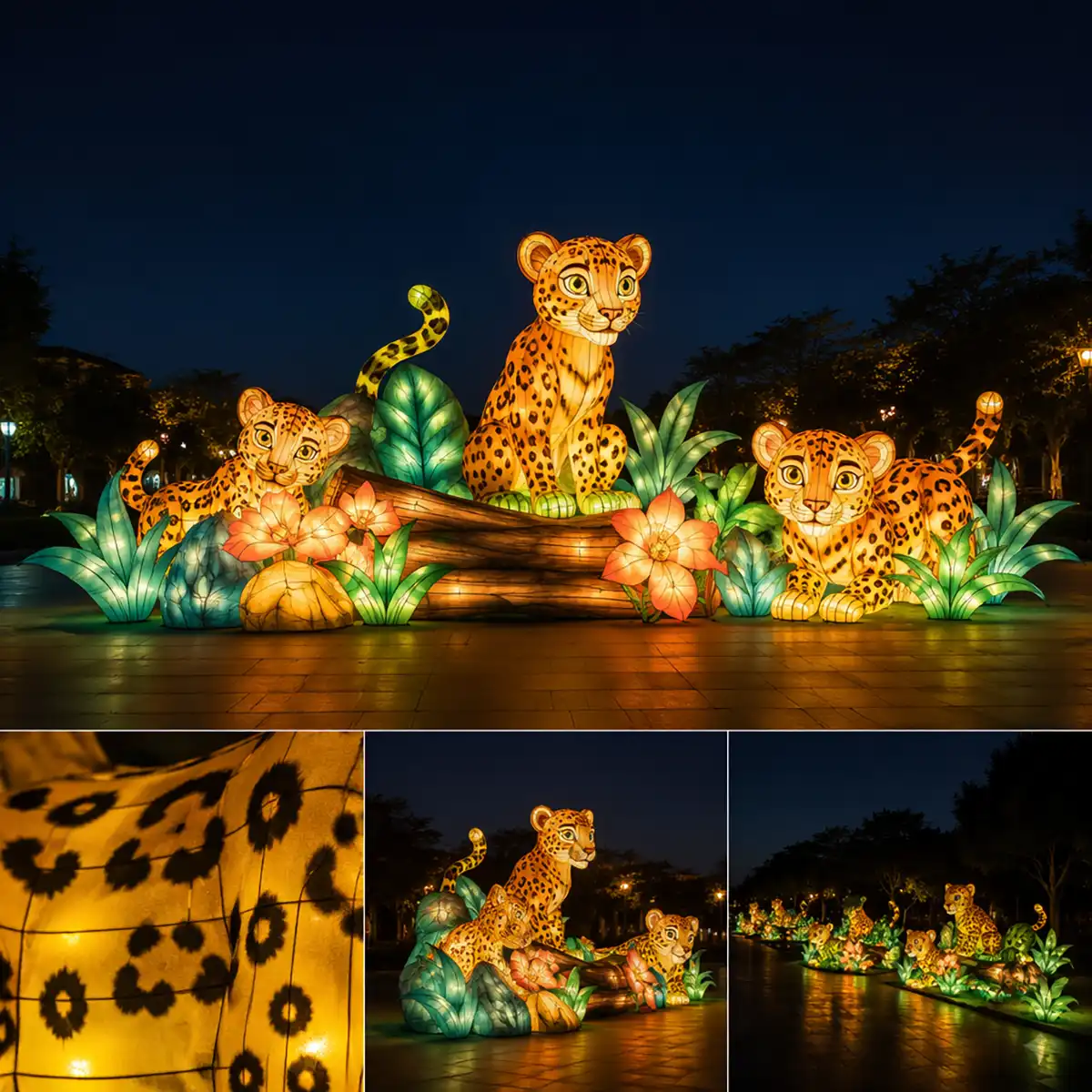
This is an AI-assisted concept visualisation paired with human-written design intent and production specifications. It is a design direction rather than a photograph of a finished product — when a project goes ahead, the scene is re-drawn to your venue dimensions and fabricated in our Zigong workshop on a weatherproof internal frame, covered in hand-painted high-density fabric over a shaped understructure, and lit internally with low-voltage LED. The same build method scales from a compact 3 m composition up to a 15 m centrepiece.
Why the Cheetah Is the Hardest Animal to Build as a Lantern
Most animals carry their character in shape. An elephant reads as an elephant from a silhouette; a panda reads from colour blocks. A cheetah carries its character in motion, and motion is the one thing a static lantern cannot show directly.
Three specific problems follow from that:
- The body is thin and long. A cheetah’s silhouette is much narrower than a lion or tiger at the same height, so the frame has to hold a slender form without looking fragile or flimsy in daylight.
- The markings are small. Cheetah rosettes are much finer than leopard spots, and fine detail is exactly what disappears first when a surface is lit from inside.
- The shape is unfamiliar to most visitors. Many people cannot reliably tell a cheetah from a leopard. The build has to carry the identification itself — through tear marks, stance and the log perch.
Practically, this means the design work for a cheetah goes mostly into pose and surface treatment, not into scale. A bigger cheetah is not a better cheetah.
Choosing a Pose That Still Reads as Speed
There are three static poses that keep a cheetah legible, and each suits a different setting. All three avoid the two that reliably fail: lying flat with the head down, and standing square like a zoo specimen.
| Pose | What it communicates | Best setting |
|---|---|---|
| Alert on the log, head up and turned | Readiness — the instant before the sprint | Paths and gateways, where the figure is seen from the side |
| Cub beside the adult, both looking outward | Family, protection, a shared viewpoint | Photo points and family zones |
| Adult stretched along the log, tail trailing | Relaxed state — the animal at rest after the hunt | Quieter garden pockets and trail midpoints |
The alert-on-log pose used here works because the head is the highest point and it is turned slightly away from the body axis. That turn is what suggests a live animal rather than a model — a straight-ahead stare reads as a statue. Keep the tail as a long, low line behind the figures; it is the single cheapest way to add movement to a static composition.
One caution: do not attempt a mid-stride or leaping pose unless the venue genuinely wants a suspended or heavily braced structure. A lantern is a large light box, and an unsupported airborne attitude puts the mass in the wrong place for both wind load and stability.
Cheetah Markings at Night — Leave the Dark Alone
The instinct with a spotted animal is to light the spots. That is the mistake. Cheetah markings are read from the contrast between the markings and the coat, and adding light to the markings destroys the contrast that makes them visible.
- Keep rosettes unlit. Paint them and leave them in shadow. The spots should be darker than the surrounding coat, not brighter.
- Wash the base coat from inside. The warm tan body reads best as a soft, even internal glow rather than a strong one. The brighter the base coat, the less the markings show.
- Use the tear marks deliberately. The dark lines from the inner eye corners down to the mouth are the most reliable cheetah identifier. Give them crisp edges and keep light away from them.
- Watch the belly. Light colours under the body raise apparent height and make the animal look heavier. Keep the belly value close to the upper body.
For the cub, the same rules apply but the coat value should be slightly softer and lighter overall — cubs are handled visually as the warmer, gentler half of the pair, which is what gives the family group its appeal to younger visitors.
Adult and Cub Proportions in a Family Group
Family groups succeed or fail on proportion. The relationship that works here is an adult at roughly 1.4× life-size with a cub at roughly 0.7×, both scaled on the same system.
| Element | Typical scale | Why |
|---|---|---|
| Adult cheetah | 1.4× life-size | Large enough to hold the composition at a distance |
| Cub | 0.7× life-size | Small enough to read as young without looking like a toy |
| Log perch | Composed to suit the pose | Carries both figures and anchors the scene |
The gap between adult and cub matters more than either absolute size. A cub built at 0.85× of an adult reads as a second adult; too small and it reads as a mascot. The 2:1 visual relationship is the one that comfortably reads as parent and young from five metres away, which is the distance most visitors stop at.
Where children will be photographed with the set, keep the cub between about 0.8 m and 1.2 m at the shoulder. This puts it in the frame at child height, so a photo taken from the natural standing position includes both the child and the young animal rather than cropping one of them out.
Keeping the Scene Sparse
The supporting elements in this concept are intentionally few: one log, lily flowers, and a small amount of tropical foliage. Restraint is what protects the subject.
- One strong prop beats five weak ones. The fallen log gives the figures a reason to be on an elevated level, which is also what makes them visible over people’s heads.
- Lily flowers are scale cues. Flowers at roughly knee height make the animals look larger without changing a single dimension.
- The ground plane stays clear. Loose grass tufts and stones get kicked, moved and lost over a season; a clean base is easier to maintain and reads better in photographs.
- Colour discipline. Warm tan, dark rosettes, soft white belly, fresh green leaves and pink lilies — five values is the practical ceiling for a night scene before it turns into noise.
Where a Cheetah Family Set Works
Cheetah and cub pairs suit African safari zones, children’s wildlife parks, zoo entry plazas, botanical garden safari themes and the African area of a theme park. They work especially well at a path junction, where the elevated log solves a very practical problem: the display stays visible above crowds moving in two directions at once.
For venues building a route rather than a single piece, this set pairs naturally with other African-area figures — see the animatronic zebra with foal and the life-size African elephant exhibit. For a complete programme across a site, see our animal lantern manufacturer and zoo lights pages, or browse all animal lantern designs.
Frequently Asked Questions
Can the cheetah family be made larger than the standard scale?
Yes. The composition scales from roughly 3 m wide for a garden pocket up to 15 m and beyond for a landmark installation. Above about 6 m the frame gains extra bracing and the internal lighting is zoned into more circuits so sections can be controlled independently.
Is the log perch structurally separate from the animals?
It is built as its own frame unit, and the animals are fixed to it. That separation keeps transport practical and lets a venue change the perch later — a rock base or a raised mound can replace the log without rebuilding the figures.
Can the set survive a full winter outdoors?
Yes. The frame is weatherproof metal and the skin is high-density fabric over a shaped understructure, with internal LED lighting protected to an outdoor-rated standard. Venues in heavy snow regions usually add a seasonal inspection of fastenings and cable protection.
How many figures can the family group include?
The standard build is an adult and a cub. Three-figure and five-figure versions are available, and additional cubs are usually placed at different heights on the perch so the group does not read as a row.
Can the markings be adapted to a different big cat?
Yes. The frame and painting approach supports leopard, jaguar, snow leopard and tiger variations. Each requires different marking work — tiger stripes, for example, need a completely different lighting treatment, since stripes are long lines rather than discrete spots.
How is the scene delivered and installed?
Figures and props break down into frame sections with the skin panels and lighting looms labelled by position. Installation is by our crew or a supervised local team, normally within a day or two for a family-scale set.
Related Animal Designs
Compare this scene with the tiger family, where the design problem is stripes rather than spots, and the rhino family, which solves the opposite challenge — managing heavy visual mass. Smaller woodland and Australian scenes sit alongside them: the raccoon family leaf-gathering scene, the squirrel with acorn scene and the koala in a eucalyptus grove.
For a larger custom figure, the custom animatronic big cat and the lifelike giant panda model show how the same workshop approach works on animatronic builds. Browse the full animal lantern range or send your venue type and available width through the contact form.
Every animal in this range has one design problem that decides whether the piece works. For the tiger family, it is the stripes. Tiger markings are long, irregular bands that wrap around a rounded body, and the moment a lantern is lit from inside, those bands become the hardest thing on the whole figure to keep readable — a tiger with soft stripes looks like an orange cat with smudges. This concept is an adult and a cub in an Asian habitat setting with palm trees, rock forms and lily flowers, composed so the stripes hold their edge at night rather than dissolving into the coat.
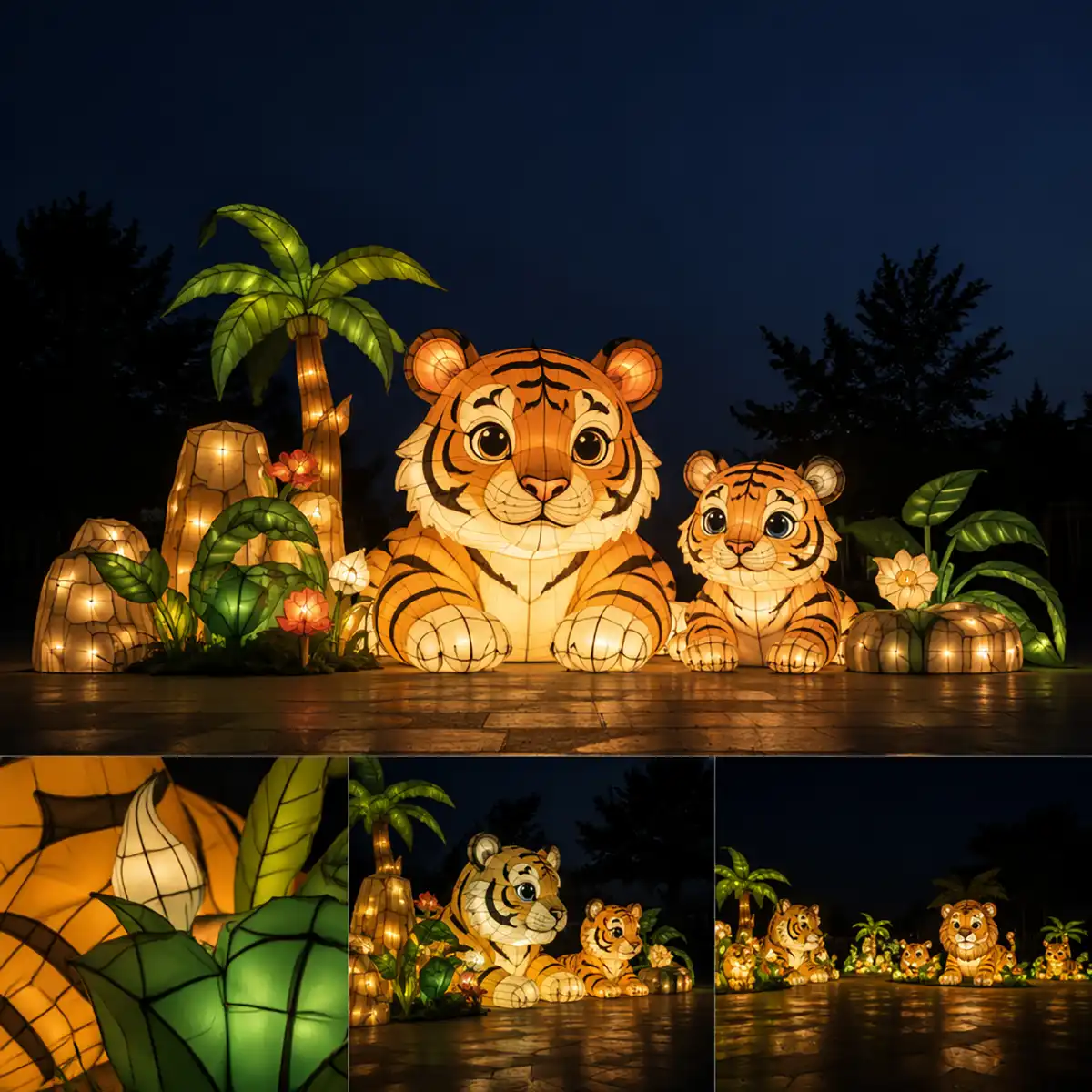
This is an AI-assisted concept visualisation paired with human-written design intent and production specifications — a design direction, not a photograph of a manufactured product. When a project is confirmed, the scene is redrawn to your venue dimensions and built in our Zigong workshop on a weatherproof internal frame with hand-painted high-density fabric over a shaped understructure and internal low-voltage LED. The composition scales from a compact 3 m set to a monumental 15 m feature.
Why Tiger Stripes Are the Hardest Marking in Lantern Work
Spots are forgiving. A cheetah’s rosettes sit as discrete shapes on a flat-ish surface, and they survive a soft light wash. Stripes do something much more difficult.
- They cross form. A stripe has to travel over the shoulder, down the flank and around the belly without breaking. Every seam in the surface is a place where the stripe can misalign.
- They are long lines. The eye is very good at spotting a line that changes width or wanders, so any inconsistency in a 2 m stripe is immediately visible.
- They are read edge-on. Visitors see a tiger from the side, from three-quarters and from below. A stripe that works from one angle can look like a random blotch from another.
- They sit on the brightest surface. Orange catches internal light strongly, and bright surfaces are where dark markings lose contrast first.
All of this means the design effort for a tiger goes into how the markings were laid out and how the light behaves around them — not into making the animal bigger.
Stripes Change How Wide the Animal Looks
Stripes are not just decoration; they control how heavy the body reads. Two tigers built from the same frame with different stripe direction look like different animals.
| Stripe direction on the flank | Visual effect | When to use it |
|---|---|---|
| Vertical, running down the flank | Emphasises height, slims the body | Narrow figures, tall display positions, side-on viewing |
| Horizontal, running along the body | Emphasises length, widens the body | Long sightlines where the animal should feel substantial |
| Diagonal, following the rib line | Neutral — reads as natural and slightly dynamic | The default for a standing or alert pose |
The useful practical rule: stripes on the flank control apparent mass; stripes on the shoulder and haunch control apparent power. Thicker, denser markings over the shoulder and thigh make the animal look stronger without adding a single centimetre to the frame. Keeping the belly and inner legs lightly marked keeps the silhouette from closing up into a solid mass.
For the cub, reduce stripe density rather than stripe strength. A cub with fewer, softer bands automatically reads as younger, and it avoids the common mistake of making a small tiger look like a scaled-down adult.
How the Stripes Are Lit — and Why They Must Not Be Lit Evenly
The lighting principle that makes a tiger legible is the same one that makes the cheetah work, applied differently: the contrast belongs to the surface, not to the lamp.
- Never run a light strip along a stripe. Illuminating a marking directly makes it glow and destroys the dark-vs-light reading that defines the animal.
- Zone the body, not the pattern. The internal LED is split into zones across the shoulder, flank, haunch and head so brightness can be tuned by area, leaving the painted markings to do their own work.
- Keep the head slightly brighter. Visitors look at the face first, so a modest brightness step at the head makes the whole figure feel alert.
- Hold the edges crisp. Paint edges matter more than paint quantities. A thin, well-defined stripe beats a heavy, fuzzy one every time.
- Add a controlled highlight on the chest. A warm-white chest wash lifts the front of the figure and separates it from the belly when viewed from the side.
Orange Is Not Orange at Night
Tiger orange is one of the most reliably misjudged colours in illuminated work. Under typical night viewing and a camera white balance set to the surrounding scene, a saturated orange shifts toward a warm yellow-brown, and any red mixed in drops out almost completely.
- Start warmer than the target. Choose a base coat that looks slightly too red in daylight; it will land close to correct under warm interior light.
- Avoid pure saturated orange. A slightly desaturated earth-orange holds its identity across a wider range of light temperatures.
- Protect the white areas. Cream chest, muzzle and inner ears are the reference the eye uses to judge the orange. Keep them clean and neutral, or the whole animal looks dirty.
- Check with a phone camera at dusk. The camera is the tool most visitors will use. If the orange reads as yellow on a phone at dusk, it will read as yellow in every photograph shared from the event.
This is also why the dark stripes should be painted rather than lit: on a warm-lit orange surface, painted markings stay readable at any light temperature, whereas lit markings follow the lamp colour and drift with it.
The Habitat Set — Palm, Rock and Understorey Light
The supporting scenery does one job: it tells visitors where the animal lives without competing for attention.
- Palm and broadleaf forms give the Asian forest cue and add vertical interest above the figures without blocking them.
- Rock forms provide the level change that raises the main figure for visibility and gives the cub something to stand against.
- Understorey light — a low warm-white wash on the ground plane — makes the set feel like a clearing rather than an object on grass.
- Restraint on colour. Tiger orange, black stripes, cream belly, green foliage and pink lilies is already five values. Adding more turns a night scene into a light show.
Keep the ground plane walkable. Anything loose at foot level — small stones, low tufts, unsecured props — will move over a season and eventually read as damage rather than design.
Where a Tiger Family Set Works
Tiger family groups suit Asian wildlife zones, children’s theme parks, family festival grounds, the Asian hall of a zoo and botanical gardens with a jungle theme. The pair works particularly well as a gateway piece: the adult on the elevated level and the cub in front create a natural pause point that slows visitors at the entrance without blocking the route.
For venues building a themed route, this set sits naturally with the custom animatronic big cat for a moving counterpart, and with the lifelike panda model where an Asian area includes several species. See also our animal lantern manufacturer and zoo lights programme pages, or browse all animal lantern designs.
Frequently Asked Questions
Can the tiger’s markings be customised?
Yes. Stripe density, thickness and direction on the flank are all set at the design stage, which also means the animal’s apparent build can be tuned without changing the frame. Venue-specific marking layouts can be discussed before production.
Is a snow tiger or white tiger version possible?
Yes, and it demands a completely different lighting treatment — a pale coat needs lower overall internal brightness and stronger edge definition, otherwise the markings lose contrast and the animal reads as a white shape.
Can the family group be built with more than two figures?
Yes. Three-figure and five-figure versions are available, with additional cubs placed at different heights and orientations so the composition stays a group rather than a line.
How does the set handle wind on an exposed site?
The adult figure is the governing element for wind. On exposed sites the base and ballast are sized for the figure’s surface area, and the plant and rock elements are built with pass-through frames so they do not act as sails.
Can the scene be adapted for an indoor space?
Yes. The same figures suit indoor exhibition halls and covered atriums; the difference is in the fixing method and the base arrangement, which is agreed before production.
What is supplied with the set?
Figures, scenery elements, lighting with local drivers and pre-terminated labelled looms, plus an assembly layout drawing that positions every part. Installation is by our crew or a supervised local team.
Related Animal Designs
For the inverse design problem — markings that must stay dark rather than readable — see the cheetah family. For managing heavy visual mass instead of fine detail, see the rhino family. Smaller scenes in the same family: the koala eucalyptus grove, the raccoon leaf-gathering scene and the squirrel with acorn.
Browse the full animal lantern range, or send your venue type, viewing distances and available width through the contact form for a layout drawn to your site.
Most animal lanterns are judged on detail. A rhino family is judged on the opposite: whether a very large, very simple shape can be made to feel alive instead of heavy. This concept puts two adult rhinos and a calf together with ground stones, grass tufts and globe lanterns, and the design work sits almost entirely in three places — body proportion, skin expression and how the three figures occupy space without turning into a wall of grey. Get those right and the set reads as calm and monumental; get them wrong and it reads as three boulders with legs.
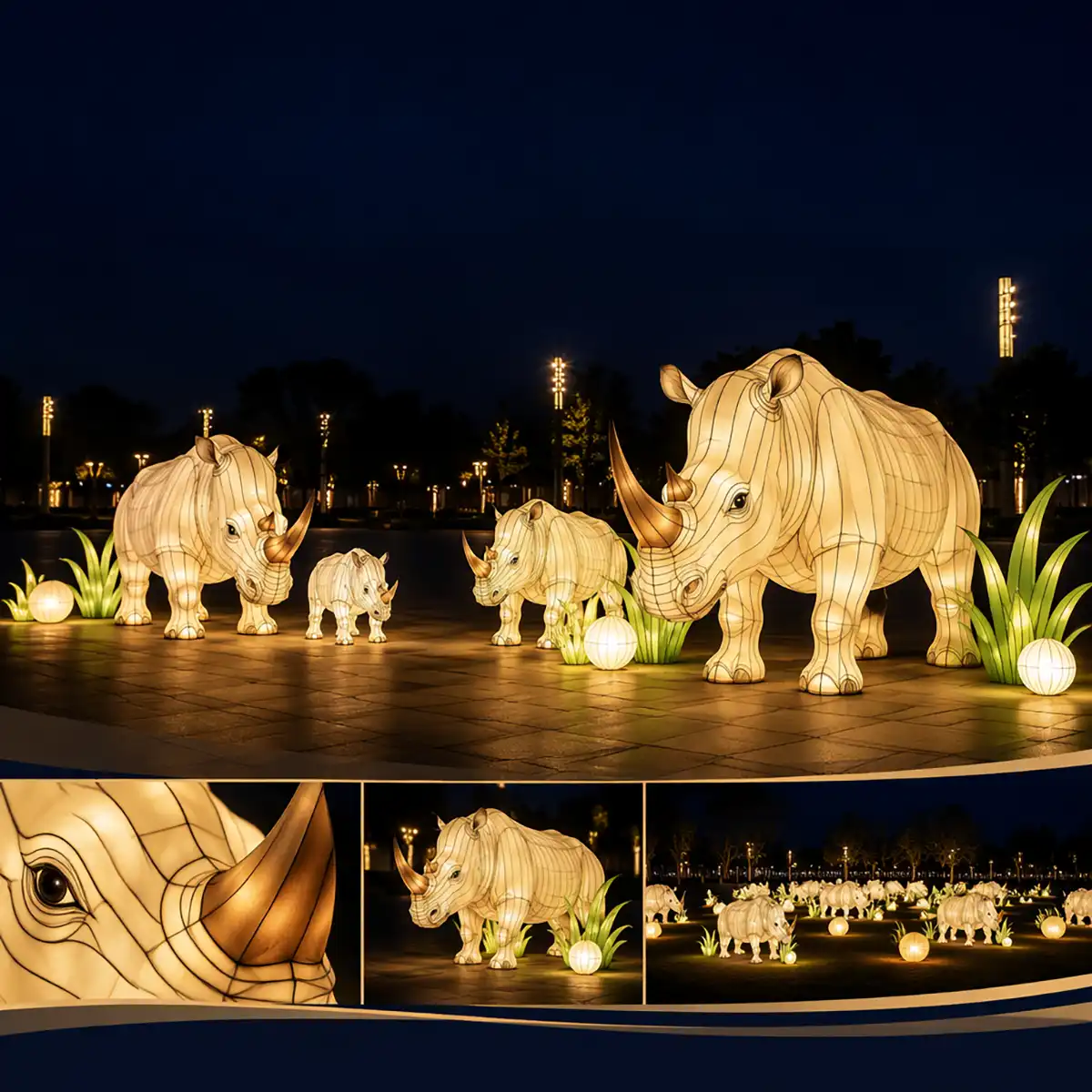
As with every concept in this range, this is an AI-assisted visualisation paired with human-written design intent and production specifications — a design direction rather than a photograph of a finished piece. On confirmation, the scene is redrawn to your venue and built in our Zigong workshop: weatherproof internal frame, hand-painted high-density fabric over a shaped understructure, internal low-voltage LED, scalable from a compact 3 m group to a monumental 15 m feature.
The Opposite Design Problem — Mass, Not Detail
The cheetah family has to keep fine markings readable. The tiger family has to keep long stripes crisp. The rhino family has neither of those problems, and that is exactly what makes it difficult.
- There is very little to look at. A rhino is a large, near-monochrome form. Nothing on the surface draws the eye, so all the character has to come from proportion and posture.
- The silhouette is a box. Head, shoulders and body sit at similar heights, which flattens the profile compared to a big cat.
- Surface area is enormous. A large pale form under internal light becomes a glowing panel unless brightness and surface treatment are handled carefully.
- Nothing about the animal suggests movement. Rhinos read as slow and grounded by default, so the composition needs calm to be a feature rather than a fault.
This is also why rhino pieces are unusually effective at entrances. Where a cat figure needs to be seen from the side to work, a large grounded mass reads from almost any angle — including straight on, which is the direction most visitors approach an entrance from.
Why Volume Drives Transport and Site Access
A big rhino is a bulky object before it is a sculpture, and the practical constraints usually shape the design more than the art direction does.
| Constraint | What it means for the build |
|---|---|
| Vehicle and doorway widths | Body split into frame sections that pass through a standard opening |
| Site path and gate access | Pieces sized to be carried by hand or light trolley, not crane-dependent |
| Available machinery on site | Heaviest single unit kept within a manageable lift weight |
| Storage between seasons | Stackable sections with protected skin panels |
Designing to these numbers early avoids the most common large-figure problem: a beautiful piece that cannot reach its plinth. Where the venue has genuinely restricted access, proportion can be adjusted — a slightly narrower body reads almost identically at ten metres but changes what fits through a door.
The three-component approach used here helps: two adults and a calf means no single unit is a monolithic block, so there is always a way to sequence delivery and assembly.
Skin Folds — Making a Heavy Surface Feel Alive
A rhino’s character lives in its skin. The shoulder plate, the flank folds and the belly lines are what tell the eye this is a living animal rather than a cast shape, and they are also the only place where a largely single-colour figure can carry detail.
- Build folds as real form. The shoulder and hip breaks should be part of the understructure, not painted lines on a smooth surface. A fold that exists in three dimensions keeps working when viewed from different angles.
- Follow the anatomy. The shoulder arch, the flank crease running back from the front leg and the belly line are the three that matter most. Extra invented folds make the animal look inflated.
- Use paint to soften, not to draw. Slightly darker values in the creases and a lighter value over the raised form do the work quietly. Hard outline lines make it look illustrated.
- Keep the face simple. Wide-set eyes, a heavy muzzle and a broad horn base carry the character. Over-detailed faces make large animals look like caricatures.
The recommended palette is deliberately narrow — warm sandy grey, a soft pink tone on the muzzle and ears, fresh green grass and ivory globe lanterns. On a large figure, a limited palette is what keeps the piece feeling expensive rather than busy.
Horns, Protrusions and Public Contact
Anything that sticks out of a figure in a public space is a design decision with safety consequences, and rhinos have two obvious examples.
- Horn shape. Keep the profile smooth and the tip rounded rather than sharp. Removing the point costs nothing visually at normal viewing distance and removes an eye-height hazard.
- Climbability. A low-set back invites children to climb. Either keep the body high enough that mounting is not tempting, or accept it and design the base so a child standing on it is not near a drop or a moving part.
- Fixings in public reach. All fasteners within about two metres should be captive or covered, because a loose fixing is the first thing that goes missing.
- Ears and tail. These are small, light and easy to lose or break. Build them as replaceable elements rather than integral parts.
The same logic applies to the ground stones in this scene: stones that can be lifted and moved will be, so they should either be fixed or heavy enough to stay put.
Arranging Three Figures So They Do Not Form a Crowd
Two adults and a calf is enough to build a family narrative, and too many to line up. The arrangement principles are simple.
| Principle | How it is applied here |
|---|---|
| Stagger the depth | One adult forward, one set back, calf between and slightly to one side |
| Vary the facing | At least one adult turned outward so the group has a relationship with the space |
| Break the height line | Set the calf on a low stone so heads sit at three different levels |
| Leave a viewing pocket | Keep a clear standing area where a camera sees calf and both adults at once |
The calf should sit between roughly 0.8 m and 1.1 m at the shoulder so it lands at child height in photographs. With large adult figures on either side, that low centre point is also what gives the composition its sense of protection — the visual story being told is a family closing around the young one.
For the globe lanterns in this concept, keep them low and at the edges. At the perimeter they frame the group and mark the footprint for visitors; placed among the figures they read as clutter.
Where a Rhino Family Set Works
Rhino groups suit zoo entrances, African safari parks, family festival grounds, children’s wildlife parks and nature centres. Because the form reads from straight on, it is a particularly good fit for a gateway or plaza where visitors approach head-on rather than passing along a path.
For a wider African-area scheme, pair this with the animatronic zebra with foal and the life-size African elephant, which share the grounded, large-form approach. See our animal lantern manufacturer and zoo lights pages for full site programmes, or browse all animal lantern designs.
Frequently Asked Questions
Is the rhino family available with fewer or more figures?
Yes. The standard arrangement is two adults and a calf, with single-figure and larger group versions available. Group size is normally decided by the width of the viewing area and how much walking space the venue wants to keep clear.
Can the set be built for a site with restricted access?
Yes. Body sections are sized around access constraints such as gate widths and available lifting equipment, and proportion can be adjusted slightly where a full-scale body would not reach the installation point.
How is the skin detail maintained through a season?
Folds are built into the understructure rather than being surface decoration, so they do not flatten or wear away. Routine checks cover fastenings, skin panels and lighting sections.
Are the protrusions safe around children?
Horns, ears and tails are built with rounded profiles and no sharp points, and elements in public reach are designed to be replaced rather than repaired on the figure. Fixings within reach are captive or covered.
Does a pale figure look washed out under lighting?
Not when the brightness is set correctly. Light-grey figures need lower overall internal brightness than saturated colours, with the lighting zoned so the under-body and creases stay slightly darker than the raised forms.
Can this be adapted for a white rhino or an Indian rhino?
Yes. Horn count and shape, ear and skin proportions and overall stance differ between species, and each is designed from reference material supplied or agreed at the design stage.
Related Animal Designs
Two contrasting approaches in the same family: the cheetah family, where fine dark markings must hold their contrast, and the tiger family, where long stripes have to stay crisp across a rounded body. Smaller scenes: the koala eucalyptus grove, the raccoon leaf-gathering scene and the squirrel with acorn.
Browse the full animal lantern range, or send site access constraints, viewing distances and venue type through the contact form and we will return a layout that fits the space.
A squirrel lantern is a scale problem before it is a sculpting problem. A real squirrel is roughly 25 cm long and the nut it carries about two, so a lantern that copies reality faithfully ends up with an acorn the size of a human thumb — invisible from three metres away, and the entire pose is wasted. This concept solves that by treating the acorn as a hero prop: one oversized nut, faceted and lit from within, gripped in both paws. The animal reads instantly as a squirrel collecting, and the collecting is what carries the autumn story.
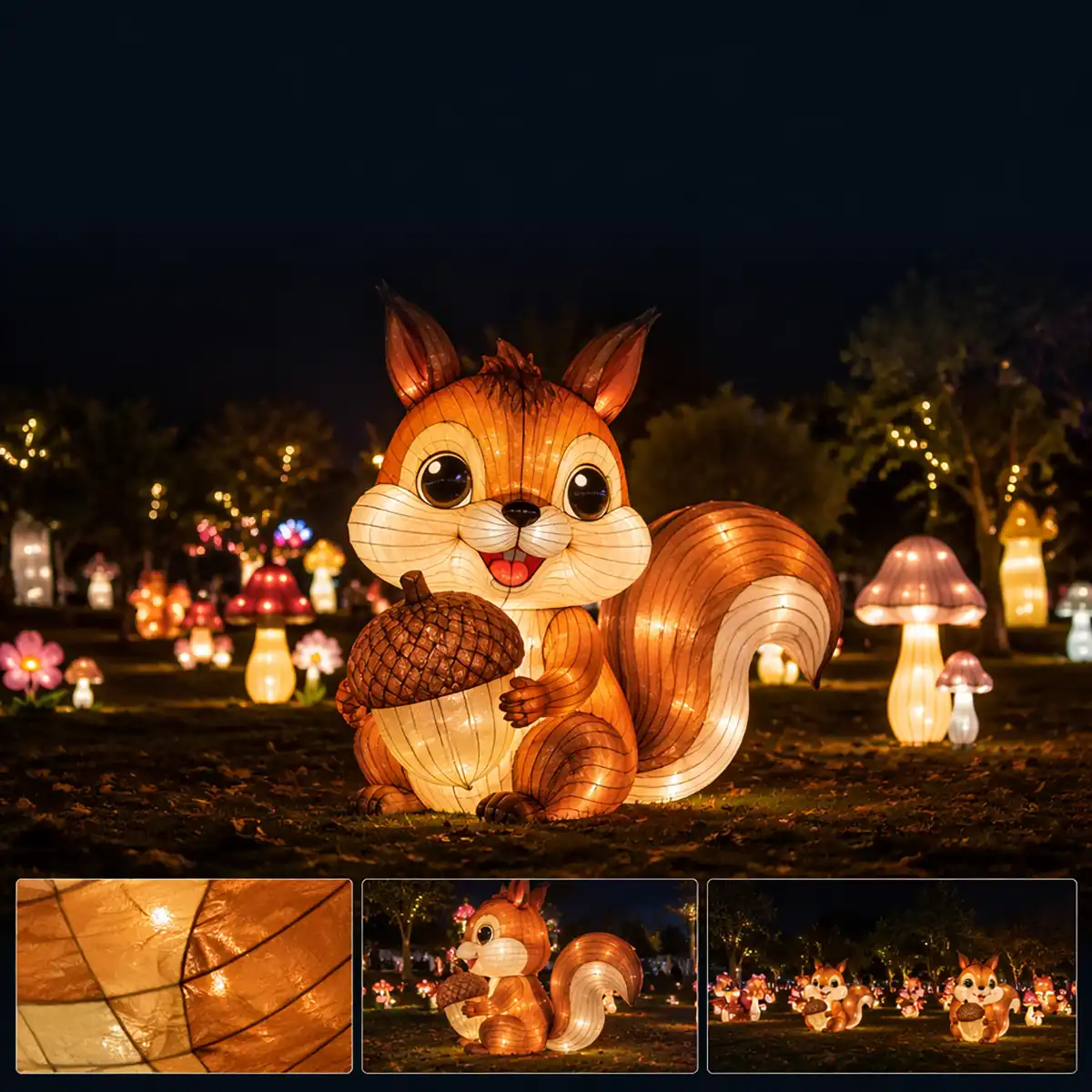
This is an AI-assisted concept visualisation paired with human-written design intent and production specifications. It is a design direction rather than a photograph of a finished product — when a project goes ahead, the scene is re-drawn to your venue dimensions and fabricated in our Zigong workshop on a weatherproof internal frame, covered in hand-painted high-density fabric over a shaped understructure, and lit internally with low-voltage LED. The same build method scales from a compact 2.5 m composition up to a 10 m centrepiece.
Why the Acorn Has to Be Oversized
Squirrel figures fail in one of two directions, and both come from the same mistake — treating the prop as an accessory instead of the subject.
- Too small to read. A proportionally accurate acorn disappears at walking distance. Visitors see an orange animal sitting on grass and nothing else.
- Too literal to be interesting. A squirrel doing nothing is a colour block. The pose only becomes a scene once something is being held.
The working ratio here is an acorn roughly half the height of the squirrel’s head. That is far larger than life and it is deliberately exaggerated — a prop at that scale registers from five metres, reads clearly in a phone photograph, and gives the paws something meaningful to grip. Faceting the nut surface matters as much as the size: a smooth sphere under internal light turns into a plain glowing ball, while the diamond-pattern cap and the ridged body break the light into shapes the eye can identify as an acorn rather than a lamp.
| Element | Real proportions | Display proportions |
|---|---|---|
| Acorn | ≈2 cm long | ≈50% of head height |
| Squirrel body | ≈25 cm long | 1.2–1.5× life-size |
| Paw grip | One paw, casual | Both paws, wrapped |
The two-paw grip is worth insisting on. A one-paw hold reads as a mistake; both paws wrapped around the front of the prop reads as possession, which is the emotion the whole piece is built to deliver.
The Tail Is the Real Structural Challenge
The bushy tail is the most recognisable thing about a squirrel and the hardest thing to build at lantern scale. It is a large, thin, high-aspect panel carrying almost no internal volume, and the two failure modes are opposite: too little support and it droops into the body silhouette, too much and the internal framework becomes visible as dark lines through the silk.
Three tail treatments work, and each suits a different setting.
| Tail form | What it communicates | Best setting |
|---|---|---|
| Upright curl behind the back | Alertness, the classic silhouette | Paths and gateways where the figure is seen from the side |
| Broad sweep to one side | Relaxation, a wider readable profile | Photo points viewed from the front |
| Soft S-curve at rest | Contentment, a calmer line | Quieter garden pockets and trail midpoints |
The upright curl used here works because the tail’s leading edge stays slightly outside the body outline. That separation is what makes the animal legible from a distance — if the tail tucks inside the body silhouette, the squirrel loses its identity and reads as a generic small mammal. Keep the tip rounded rather than pointed; a sharp tail tip reads as a cat.
One practical caution: the tail is the largest wind-catching surface on the figure, and it sits at the very top of the mass. On exposed sites it should be braced back to the main body frame rather than cantilevered from the hip, and the fastening points inspected before an outdoor season. This is a design decision, not a build-time fix — it has to be drawn in from the start.
Making “Cute” Read as Craft, Not Toy
A cute-style animal lantern lives or dies on four measurements. Get these wrong and the figure looks like an inflatable from a fairground; get them right and it looks designed.
- Eye height. Eyes sit low on the head, at roughly 45% of head height rather than the realistic 60%. Low eyes read as young.
- Head-to-body ratio. A head around 40% of total height. Larger and the figure becomes a mascot; smaller and the appeal is lost.
- Ear tufts. The dark tufted tips on the ears are a squirrel identifier and need no extra parts — two small painted cones. Without them the head reads as a rabbit.
- Restraint on the blush. A soft warm tone under the eye, not a hard pink disc. Hard blush is the single fastest way to make a well-made figure look mass-produced.
The front teeth deserve a note of their own. Squirrel incisors are prominent in the concept and they are what pushes the expression from “wild animal” to “character”. Keep them small and slightly parted — visible teeth at full length read as a rodent from a nature documentary rather than a friendly figure.
Surface finish does the rest. The silk is hand-painted with a warm gradient from russet along the back to a paler cream under the chin and belly, and the belly value is kept close to the upper body so the figure does not appear to float. The tail is painted with softer internal striations, which is what gives it the fur impression at night without any sculpted texture.
Mushrooms Do Two Jobs at Once
The mushroom cluster in this concept is not scenery — it earns its place twice over.
- They set the scale. Mushroom caps at roughly knee height make the squirrel read as larger without changing a single dimension of the animal. This is the cheapest scale cue available in a lighting scene.
- They are a separable product. The mushroom and flower units are self-contained frames with their own lighting, so they can be bought as an accompanying ground-scatter set, re-used in a different season, or spread across a site where the squirrel itself is not deployed.
- They fill the ground plane cheaply. A scattered field of small lit mushrooms does more for a night photograph than another large figure, and it costs a fraction of the transport volume.
- They carry the autumn palette. Russet, amber and cream caps with pink and yellow accents — five values is the practical ceiling for a night scene before it turns into visual noise.
Two or three mushroom heights are enough. Uniform heights read as a manufactured row; varied heights read as a forest floor.
One Squirrel or a Whole Row
Because the pose is compact and self-contained, the same figure reproduces cleanly. That gives venues a choice that most large centrepieces do not offer.
| Configuration | Quantity | Where it works |
|---|---|---|
| Single figure with mushroom cluster | 1 + scatter | Path junction, garden pocket, photo point |
| Short line | 3–5 | Entrance approach, retail street, market avenue |
| Full array | 6–12 | Plaza, park meadow, festival lawn |
A repeated array works best when the figures are not identical in presentation — alternate the tail angle, vary spacing, and stagger the mushroom clusters between them. Identical copies in an even line read as a production run; slight variation reads as a woodland. Because every unit shares the same frame design, the array costs far less to produce per piece than an equivalent number of bespoke designs, and it packs into a small transport volume.
For an autumn or harvest programme, the array is the more useful purchase: it can be split across three or four locations on the same site and re-combined for the main event.
Where an Autumn Squirrel Scene Works
The squirrel and acorn theme suits autumn lantern festivals, harvest celebrations, botanical gardens running a woodland trail, zoo children’s zones, farm parks, and shopping-centre atriums running an autumn campaign. It is one of the few animal concepts that works indoors without modification, because the figures are compact and the mushroom scatter provides its own low-level ambience.
Seasonally it sits at the front of the autumn calendar — a set installed for a September or October opening runs comfortably through to the end of November before the winter programme takes over.
For venues building a route rather than a single piece, this scene pairs naturally with the raccoon family leaf-gathering scene, which uses the same autumn woodland language with a different animal, and with the koala in a eucalyptus grove for an Australian section. Larger cat and plains figures sit alongside them — see the cheetah family sculpture and the animatronic zebra with foal. For a complete programme across a site, see our animal lantern manufacturer and zoo lights pages, or browse all animal lantern designs.
Frequently Asked Questions
Can the squirrel be built without the oversized acorn?
Yes. The acorn is a separate prop unit fixed to the body frame, so it can be omitted, reduced, or swapped for another held object — a lantern, a leaf or a smaller nut. Venues that want a more naturalistic figure usually keep the pose and shrink the prop, accepting that it reads best from closer range.
How large can a single squirrel be?
The composition scales from roughly 2.5 m for a garden pocket up to about 10 m for a landmark piece. Above roughly 5 m the tail gains extra internal bracing and the lighting is split into more circuits so the body, tail and prop can be controlled separately.
Is the tail removable for transport?
It is built as its own frame section that bolts to the body. That keeps shipping volume practical and lets a venue replace or re-angle the tail later without rebuilding the animal.
Can the set be used outdoors through a full autumn season?
Yes. The frame is weatherproof metal and the skin is high-density fabric over a shaped understructure, with internal LED lighting protected to an outdoor-rated standard. Sites in high-wind or coastal locations normally add a seasonal inspection of tail fastenings and cable protection.
Can the mushrooms be ordered on their own?
Yes — they are self-contained frames with independent lighting, so a venue can buy the ground scatter alone, or expand an existing autumn scene with more units in a later season.
How is the scene delivered and installed?
Figures and props break down into frame sections with skin panels and lighting looms labelled by position. Installation is by our crew or a supervised local team, normally within a day for a single figure and its scatter, and proportionally longer for a full array.
Related Animal Designs
Compare this scene with the raccoon family, which solves the opposite problem — three figures that have to read as a family group rather than three separate animals — and the koala grove, where the figure has no tail at all and identification rests entirely on the head. The tiger family and rhino family show how the same workshop approach handles much heavier subjects.
For a larger custom figure, the lifelike giant panda model and the custom animatronic big cat demonstrate the same craft on animatronic builds. Browse the full animal lantern range, or send your venue type and available width through the contact form.
Almost everything that identifies a raccoon sits inside the head: the black mask across the eyes, the pale brow line above it, the white muzzle, the pointed snout. That concentration creates a specific lighting problem, because a lantern glows from the inside — and the moment light reaches the mask, the most valuable feature on the figure stops working. This concept is built around that constraint: three raccoons gathered at ground level, each holding a different object, with the mask deliberately kept as the darkest area on the whole scene.
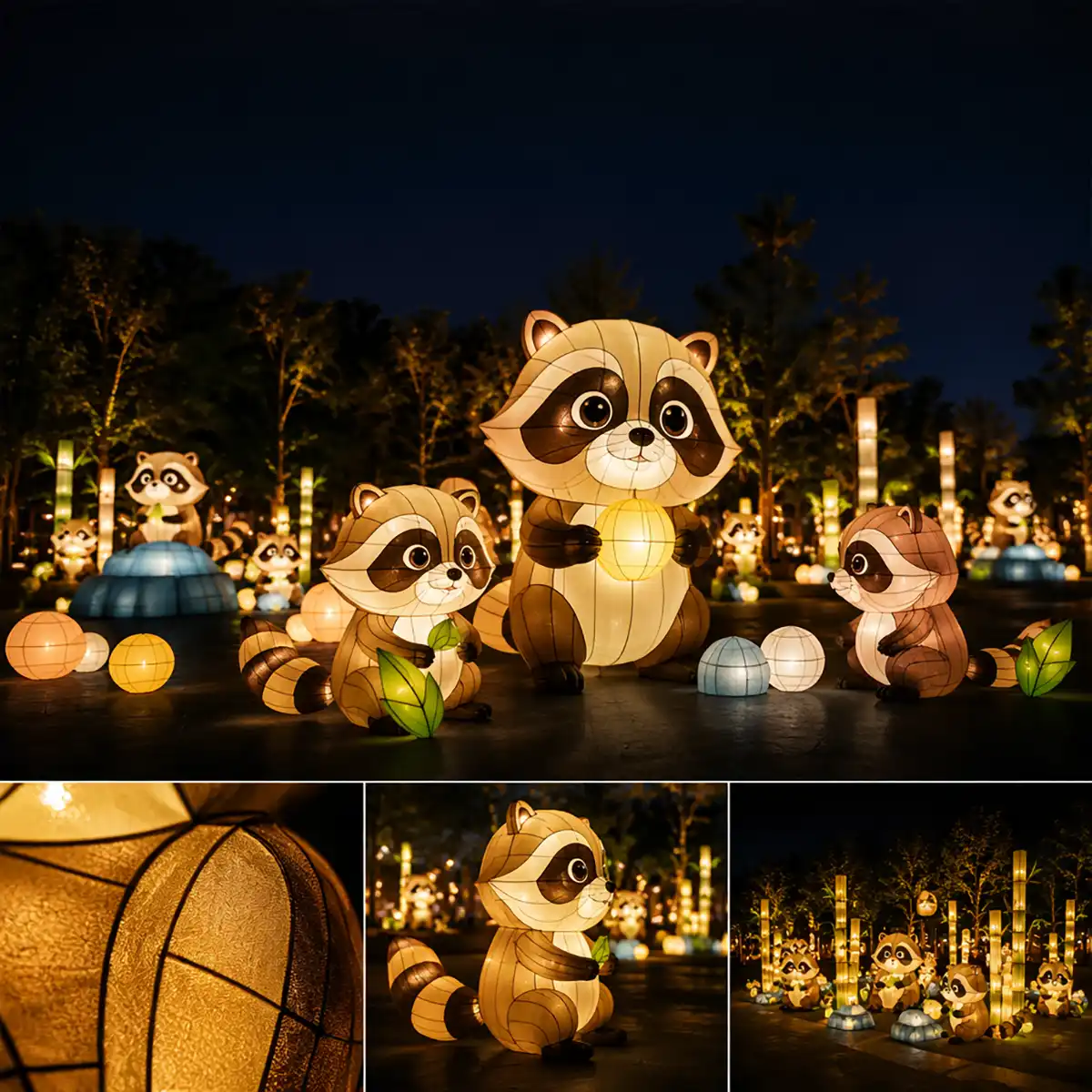
This is an AI-assisted concept visualisation paired with human-written design intent and production specifications. It is a design direction rather than a photograph of a finished product — when a project goes ahead, the scene is re-drawn to your venue dimensions and fabricated in our Zigong workshop on a weatherproof internal frame, covered in hand-painted high-density fabric over a shaped understructure, and lit internally with low-voltage LED. The same build method scales from a compact 2.5 m group up to a 12 m centrepiece.
Why the Mask Has to Be the Darkest Thing on the Figure
The instinct when lighting a dark marking is to light it so visitors can see it. With a raccoon that instinct destroys the animal. The mask is legible because it is darker than the fur around it, and adding light to it removes the only contrast that makes it readable.
- Keep the mask unlit. Paint it and leave it in shadow. It should read as a deep grey-black band, never as a glowing shape.
- Wash the pale areas from inside. The brow line, muzzle and cheek fur are what makes the mask visible by surrounding it with light. The brighter those areas are, the stronger the mask reads.
- Punch the eyes with a small point source. Two bright points inside the mask — not a glowing eye shape, just a small lit core — give the animal life. Enlarging them turns a raccoon into a cartoon mouse.
- Watch the shoulder. Light creeping down from the body into the cheek area flattens the face. The mask band should be blocked from the body circuit so it can be controlled on its own.
If the mask is wired to the same circuit as the body, the designer has no control over the single most important element on the figure. Splitting it out is the whole difference between a raccoon and a grey dog.
Getting the Ringed Tail Right
The second identifier is the banded tail, and the banding succeeds or fails on proportion rather than count. A raccoon tail carries five to seven dark rings on a pale base, and at lantern scale the mistake is almost always making the rings too narrow.
| Ring count | Effect at night | Verdict |
|---|---|---|
| 3–4 rings | Reads as a striped tube, loses the raccoon | Avoid |
| 5–7 rings, wide bands | Clean, immediately identifiable | Use this |
| 8+ narrow rings | Blurs into grey at any distance | Avoid |
Keep each dark band at roughly the same width as the pale gap beside it, and let the tail carry a slight downward curve rather than a rigid hook. The tail is also the cheapest place to suggest movement on a static figure — a tail angled away from the body line makes the animal look as though it has just turned its head.
A Family Group Needs Three Different Poses
Three identical raccoons in a row read as a production batch. Three raccoons doing three different things read as a family, and the difference costs nothing extra in materials.
- The adult, upright and holding the glowing orb. The centre and the tallest element — this is the anchor of the composition.
- A smaller figure seated, holding a leaf. Sitting lowers the silhouette, which breaks the row effect and adds a second visual level.
- A third figure turned partly away. The half-turn is what suggests the group is mid-activity rather than posing. It also gives photographers a second angle.
The scale relationship matters more than any individual size. The adult should be roughly 1.4× life-size with the smaller figures at about 0.75×, and the seated figure placed between 0.8 m and 1.2 m at the shoulder so that it lands at child height in a photograph. Where children will be photographed with the set, that single measurement matters more than the whole group’s total width.
The Glowing Orb — and the Ground Scatter
The lit sphere held by the adult is doing two jobs. In the composition it is the visual centre — the brightest single point on the figure, which is why the eye lands there first. And because it is a self-contained lit unit, it is also a product that sells on its own.
- As a held prop, it gives the pose a reason to exist and provides the group’s brightest point without washing out the faces.
- As a ground scatter, the same sphere reproduces in three or four sizes across the lawn, giving the scene low-level ambience and a reason for visitors to walk through the space rather than past it.
- As a seasonal re-use, the spheres work in winter, midsummer and harvest programmes without any change — they are the one element of an autumn scene that is not season-locked.
Colour discipline matters here. Two warm tones and one cool tone across the scatter is enough; four competing colours turn a woodland clearing into a fairground.
Building the Grove Around Them
The tall lit columns visible behind the group are the element that turns a set of figures into a place. They serve three practical purposes at once: they give the raccoons a habitat, they add vertical interest so the scene does not read as objects on a lawn, and they are the cheapest way to fill an awkward site where trees already exist but cannot be lit.
Use them in uneven clusters rather than an even receding row, and vary the column heights by at least 40% between neighbours. An even-height line of columns reads as street furniture; a varied cluster reads as woodland. Where a venue already has mature trees, the columns can be reduced to a few accent pieces — the trees themselves provide the canopy.
Where a Raccoon Family Works
Raccoons have an advantage in North America that most lantern animals do not: visitors already know them. A raccoon is a backyard animal across the United States and Canada, which means the recognition is instant and the affection is already there before a visitor has read a single word of signage. For venues marketing to family audiences, that familiarity converts better than an exotic species.
The scene suits zoo North America zones, wildlife parks, autumn lantern festivals, harvest events, farm parks and shopping-centre atriums running a fall campaign. It also works well in Halloween-adjacent programming without carrying any horror element — the animals are nocturnal, which fits the evening setting naturally.
For venues building a trail rather than a single set, this scene pairs naturally with the squirrel and acorn scene, which shares the autumn woodland language, and with the koala grove as a contrast piece. Larger family groups continue the run — see the cheetah family and the animatronic zebra with foal. For a full site programme, see our animal lantern manufacturer and zoo lights pages, or browse all animal lantern designs.
Frequently Asked Questions
Can the group be built with two figures instead of three?
Yes. The adult with the orb works on its own as a single piece, and a two-figure version — adult plus one juvenile — is the most common compact configuration. Three or more figures are usually specified where the set will be a photo point or a zone anchor.
Is the mask really left unlit, or is it just painted dark?
Both. The panel is finished in a dark value and it is also blocked from the internal lighting so that no light reaches it from behind. Where the mask sits above a lit chest, a small internal baffle keeps the spill off it.
How large can the family group be?
The composition scales from roughly 2.5 m for an indoor atrium piece up to about 12 m for a landmark outdoor set. Above roughly 6 m the frame gains extra bracing and the lighting is split into more circuits so the orb, the faces and the bodies can be controlled independently.
Can the scattered spheres be ordered separately?
Yes — they are self-contained lit units in their own frames, so a venue can buy the ground scatter on its own or expand an existing scene in a later season without ordering new animals.
Will the scene survive a full autumn outdoors?
Yes. The frame is weatherproof metal and the skin is high-density fabric over a shaped understructure, with internal LED lighting protected to an outdoor-rated standard. Sites in exposed or coastal locations normally add a seasonal inspection of fastenings and cable protection.
How is the set delivered and installed?
Figures and lighting columns break down into frame sections with skin panels and looms labelled by position. Installation is by our crew or a supervised local team, normally within a day for a three-figure group with scatter.
Related Animal Designs
Compare this scene with the squirrel with acorn, where a single oversized prop carries the whole composition, and the koala in a eucalyptus grove, which handles a similarly compact animal with an entirely different structural approach. The tiger family and rhino family show how the same workshop handles far heavier subjects.
For a larger bespoke figure, the lifelike giant panda model and the custom animatronic big cat demonstrate the same craft on animatronic builds. Browse the full animal lantern range, or send your venue type and available width through the contact form.
A koala is one of the few animals that carries its entire identity in the head, and the reason is a subtraction: it has no tail. Strip the tail from most mammal silhouettes and the species becomes ambiguous — which is why the koala’s design weight falls on three features that must all be right at once: the oversized round ears with a furry rim, the large dark nose, and the soft cheek patches. This concept builds the whole composition around a single koala gripping a eucalyptus trunk, with a ring of smaller koalas at different heights so that the group reads as a grove rather than a figure.
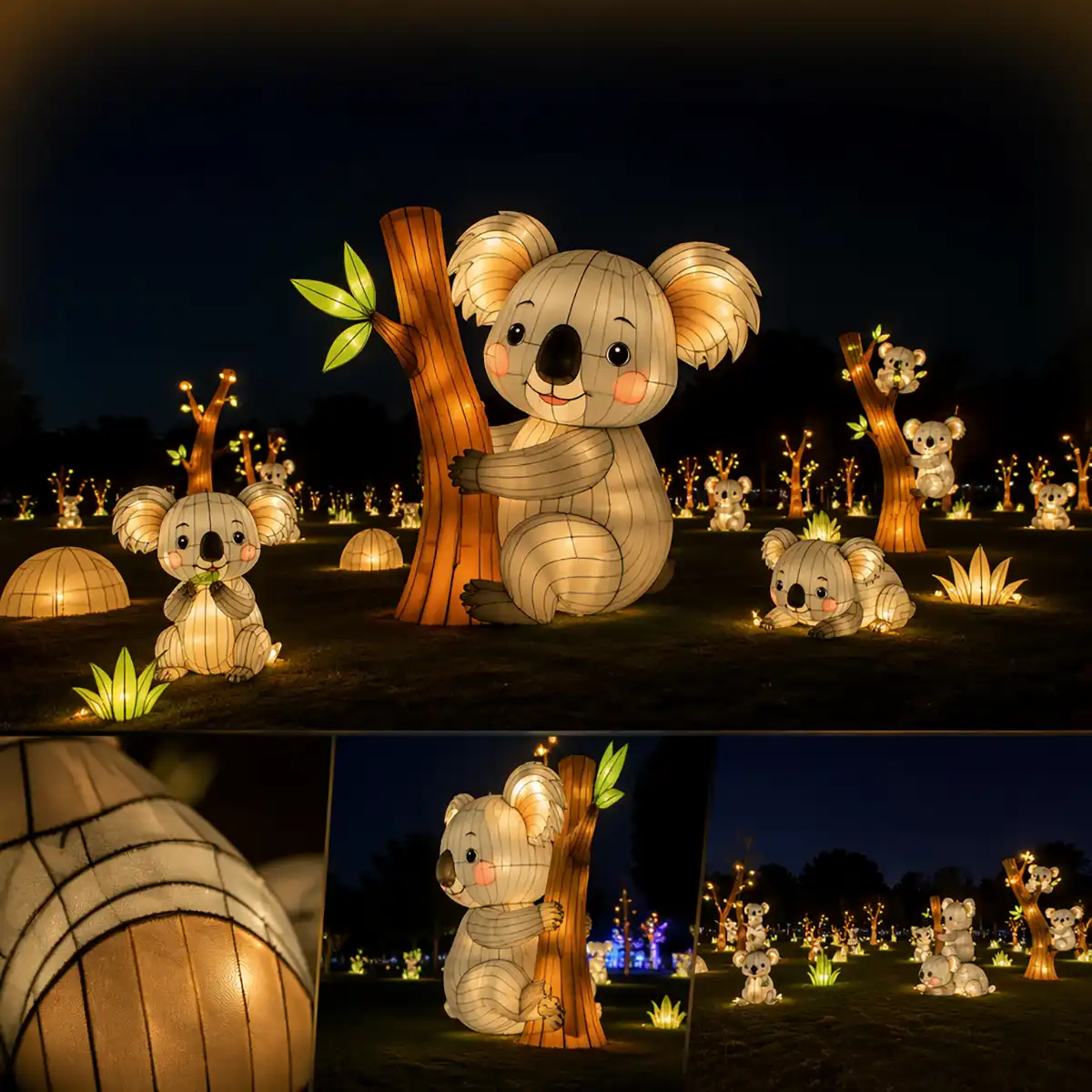
This is an AI-assisted concept visualisation paired with human-written design intent and production specifications. It is a design direction rather than a photograph of a finished product — when a project goes ahead, the scene is re-drawn to your venue dimensions and fabricated in our Zigong workshop on a weatherproof internal frame, covered in hand-painted high-density fabric over a shaped understructure, and lit internally with low-voltage LED. The same build method scales from a single 2 m tree unit up to a 12 m grove installation.
A Koala Has No Tail — and That Changes Everything
Most animal lanterns can afford one approximate feature without losing the species. A koala cannot, because it has only three identifying marks and no silhouette backup.
- No tail to balance the figure. A tailless animal reads as a soft mass, so the ears and nose have to carry the whole identification load from every viewing angle.
- The nose is not a smudge. A koala’s nose is a large, glossy, leathery black shape covering the lower centre of the face. Painting it too small or too soft produces a bear.
- The cheek patches are structural. They are not decoration — the pale cheeks and the dark nose together form the face pattern, and they hold the whole expression.
The practical consequence is that a koala cannot be simplified in the head area. Savings elsewhere on the figure — a plainer body, fewer accessory props — will not be noticed. Savings on the head will be noticed immediately, which is why the head is the last place to economise on this animal.
Ears Are the Hardest Part to Get Right
The round furred ears are the single most difficult element on a koala lantern, and almost the entire difficulty is in the edge. At lantern scale the ear is a large disc, and a plain lit disc reads as a dinner plate. What makes an ear look fuzzy is a broken edge, and a broken edge has to be built, not painted.
| Ear treatment | How it is built | Result at night |
|---|---|---|
| Smooth disc | Single continuous panel | Reads as a plate — avoid |
| Toothed rim | Separate silk lobes on the outer edge | Soft fur impression — use this |
| Recessed inner ear | Deeper frame inside the disc | Adds depth; useful on large builds |
The toothed rim works because each lobe casts a small shadow onto the next one, and the eye reads that repeating shadow as fur. On a large build the ears can carry both the toothed rim and a deeper inner recess, which gives the head a convincing interior without adding surface detail that would catch dirt outdoors.
Keep the ears large — noticeably larger than realistic. A koala’s ears are already oversized in life and exaggerating them further is what reads as friendly rather than as a specimen. If the ears and the nose are both correct and slightly exaggerated, the figure works at any size from two metres upward.
The Tree Is the Structure
In this concept the koala grips a eucalyptus trunk, and the trunk is not a prop — it is the load-bearing element of the whole composition. That is worth understanding before the design is adapted, because it affects what can be changed later.
- The trunk carries the figure. The koala’s arms wrap the trunk and the grip is a genuine structural attachment, not a decorative gesture. The animal can be positioned at height without a separate stand.
- The trunk hides the services. Cabling runs inside the trunk to the branch units, which is why the model shows no visible looms.
- The trunk separates for transport. It breaks into sections, and the koala detaches from it as a complete unit — so a venue can re-position the animal on a different trunk or a rock base in a later season.
- Foliage does the framing. The leaf clusters at the top are the only green in the composition, and they are what tells the eye this is a tree rather than a pole.
The trunk finish matters more than it looks. A warm brown with visible painted bark striations reads as timber; a flat brown column reads as scaffolding. This is a painting task, not a structural one, and it is one of the cheapest quality upgrades on the whole build.
Sizing a Small Animal Large
Koalas are small animals — around 60 to 85 cm — and that creates an unusual sizing rule. Making the figure dramatically larger does not make it more impressive; past a certain point it simply stops reading as a koala and starts reading as a generic bear-like object.
The approach that works is to keep the animal itself close to life-size to moderately oversized, and to build the scale impression through the tree instead. A taller tree with more foliage makes the koala look appropriately placed, while the animal stays recognisable.
| Element | Typical scale | Why |
|---|---|---|
| Koala figures | 1.2–2× life-size | Stays recognisable; exaggeration goes into ears and nose |
| Main tree | 3–8 m | Carries the composition height instead of the animal |
| Companion figures | 0.6–1× life-size | Fills the grove at ground level |
This is also why the koala set works indoors. The figures are compact, the transport volume is modest, and the ambience is soft rather than dramatic — which suits an atrium or a mall concourse far better than a large predator would.
Turning One Figure into a Grove
The strongest version of this concept is not one koala on one tree. It is a grove: several trunks at different heights, each with a koala in a different attitude, plus ground-level figures between them.
- Vary the pose per tree. Climbing high, sitting at the base, lying along a low branch, reaching for leaves. Four attitudes are enough to make a grove feel populated.
- Vary the spacing. Even spacing reads as an installation; uneven spacing reads as woodland. Leave one deliberate gap where visitors can walk through.
- Add ground scatter. Small lit domes and grass tufts at the base fill the ground plane cheaply and give the low figures something to sit against.
- Keep the palette tight. Warm white and cream for the animals, amber-brown for bark, one green for foliage. Adding a second foliage colour costs the scene its calm.
Because every tree unit shares the same trunk design, expanding a grove in a later season costs far less than commissioning new animals — a venue that starts with three trees can add four more without any redesign.
Where a Koala Grove Works
Koalas suit zoo Australia zones, wildlife parks, botanical gardens with a southern-hemisphere section, family entertainment centres, and shopping-centre atriums. The scene is unambiguously gentle, which makes it a safe choice for venues with young children and for indoor locations where a dramatic predator would not fit the brand.
Its biggest market advantage is recognition: the koala is one of a small group of animals that audiences worldwide can identify from a silhouette alone, which means signage and programming need to do less work.
For venues building a trail, this scene pairs naturally with the squirrel and acorn scene and the raccoon family leaf-gathering scene, both of which use the same compact-figure, woodland-scatter approach. Larger animal groups continue the route — see the cheetah family and the animatronic zebra with foal. For a full site programme, see our animal lantern manufacturer and zoo lights pages, or browse all animal lantern designs.
Frequently Asked Questions
Can a koala be built sitting rather than climbing?
Yes. The tree grip is one configuration, and the same figure can be built seated at the base of a trunk or resting on a low branch. Venues running a grove usually mix two or three attitudes, because a set of climbing figures alone can look repetitive.
How large can the grove be?
A single tree unit starts around 2 m and a full grove can reach roughly 12 m across and 8 m tall. Above roughly 5 m the trunk gains extra internal bracing and the lighting is split into more circuits so the trunk, foliage and animals can be controlled separately.
Is the koala removable from the tree?
Yes. It is built as its own frame unit that attaches to the trunk, which keeps transport practical and lets a venue change the arrangement or move the figure to a different trunk later.
Can the grove be used indoors?
Yes, and it is one of the more suitable animal scenes for indoor use — the figures are compact, the transport volume is modest and the light level is soft. Height clearance is the main constraint, so indoor versions are usually specified with shorter trees.
Will the set survive a full season outdoors?
Yes. The frame is weatherproof metal and the skin is high-density fabric over a shaped understructure, with internal LED lighting protected to an outdoor-rated standard. Sites in high-wind or coastal locations normally add a seasonal inspection of trunk joints and cable protection.
How is the scene delivered and installed?
Trunks, foliage and animals break down into sections with skin panels and lighting looms labelled by position. Installation is by our crew or a supervised local team, normally within a day for a single tree and proportionally longer for a full grove.
Related Animal Designs
Compare this scene with the squirrel with acorn, where a single oversized prop does the identifying work, and the raccoon family, which solves the same small-animal problem through a group rather than a tree. The tiger family and rhino family show the opposite end of the scale range.
For a larger bespoke figure, the lifelike giant panda model and the custom animatronic big cat demonstrate the same craft on animatronic builds. Browse the full animal lantern range, or send your venue type and available height through the contact form.