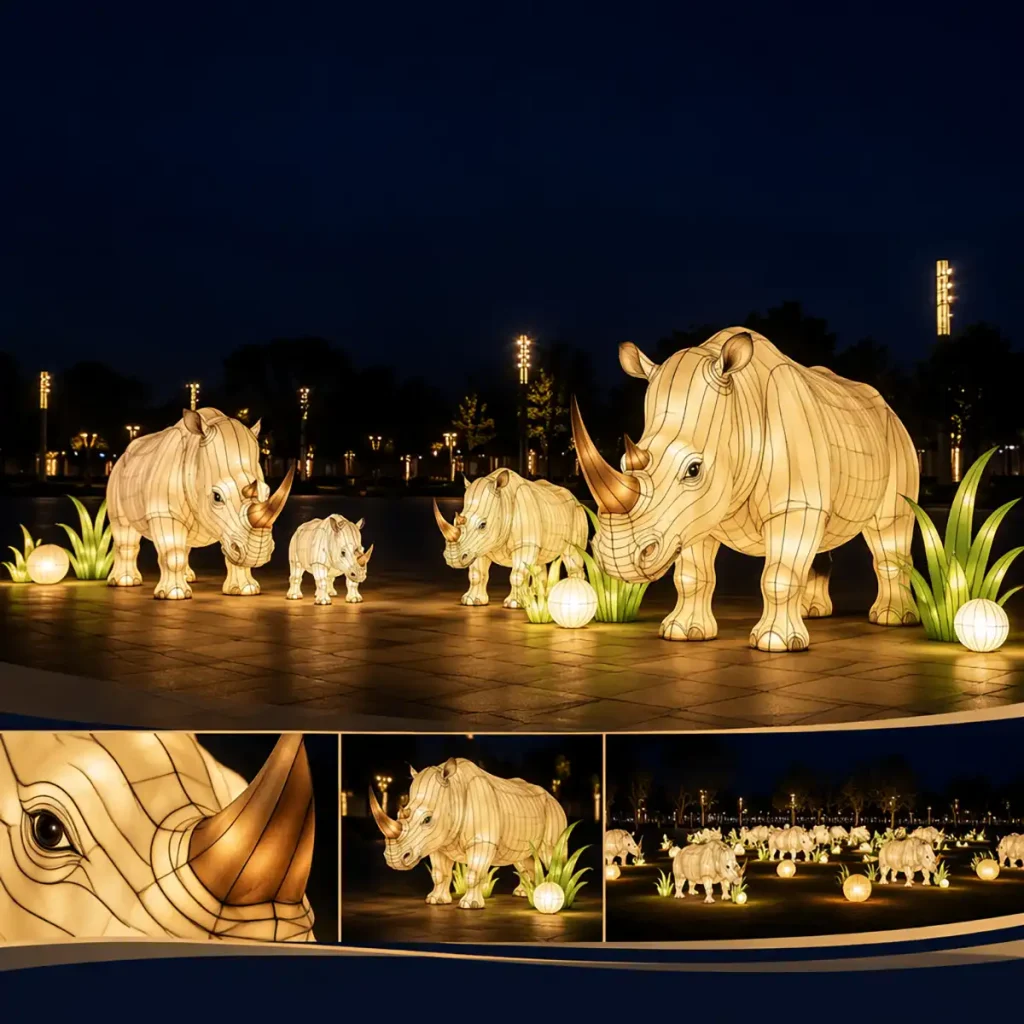
Rhino Lantern Family Sculpture — Cute-Style Multi-Figure Wildlife Display
About This Design
This is an AI-assisted concept visualization paired with human-written design intent and production-verified technical specifications. It is a design direction — not a manufactured product. When you order, our team creates custom 3D renderings and fabricates the actual lantern in our Zigong workshop.
Most animal lanterns are judged on detail. A rhino family is judged on the opposite: whether a very large, very simple shape can be made to feel alive instead of heavy. This concept puts two adult rhinos and a calf together with ground stones, grass tufts and globe lanterns, and the design work sits almost entirely in three places — body proportion, skin expression and how the three figures occupy space without turning into a wall of grey. Get those right and the set reads as calm and monumental; get them wrong and it reads as three boulders with legs.
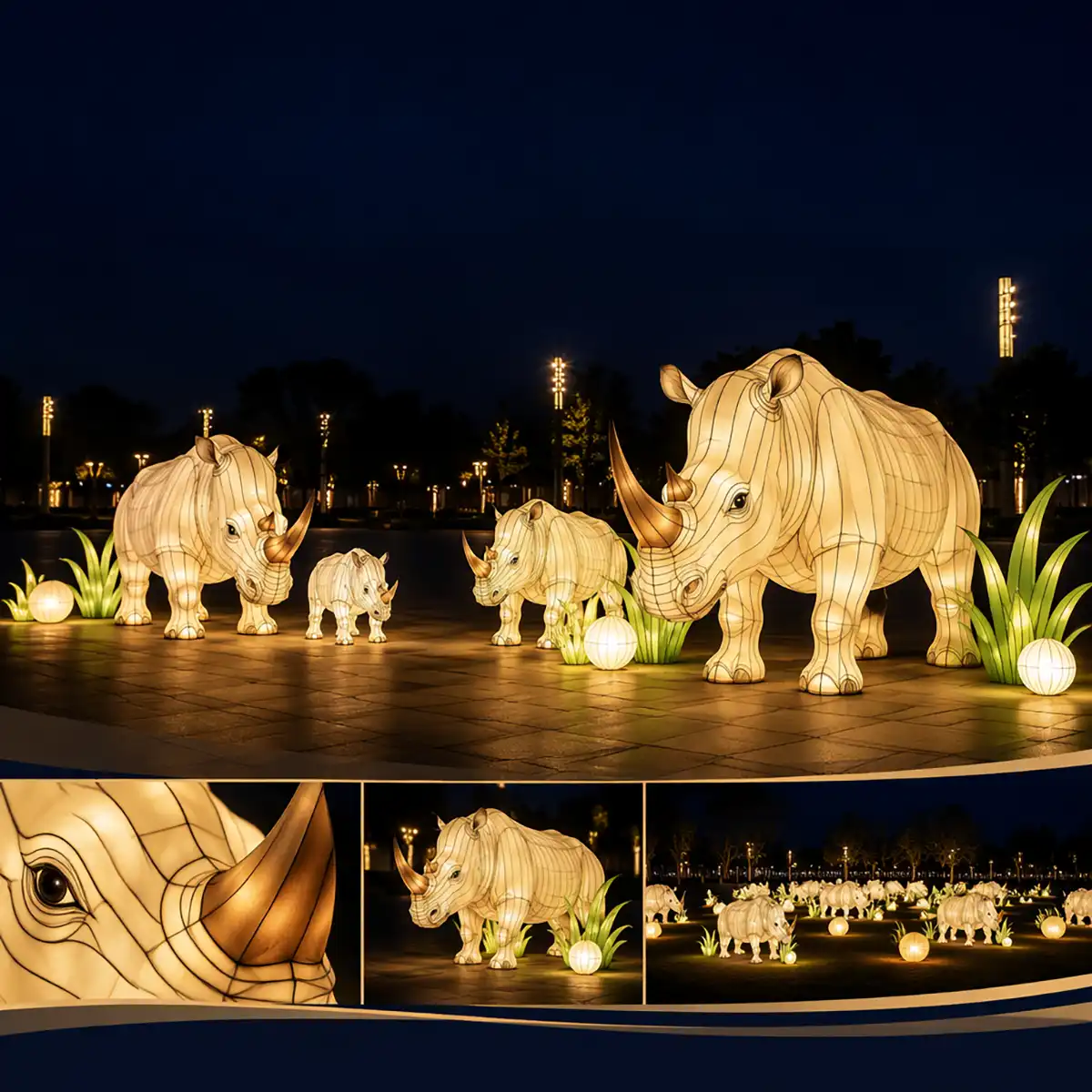
As with every concept in this range, this is an AI-assisted visualisation paired with human-written design intent and production specifications — a design direction rather than a photograph of a finished piece. On confirmation, the scene is redrawn to your venue and built in our Zigong workshop: weatherproof internal frame, hand-painted high-density fabric over a shaped understructure, internal low-voltage LED, scalable from a compact 3 m group to a monumental 15 m feature.
The Opposite Design Problem — Mass, Not Detail
The cheetah family has to keep fine markings readable. The tiger family has to keep long stripes crisp. The rhino family has neither of those problems, and that is exactly what makes it difficult.
- There is very little to look at. A rhino is a large, near-monochrome form. Nothing on the surface draws the eye, so all the character has to come from proportion and posture.
- The silhouette is a box. Head, shoulders and body sit at similar heights, which flattens the profile compared to a big cat.
- Surface area is enormous. A large pale form under internal light becomes a glowing panel unless brightness and surface treatment are handled carefully.
- Nothing about the animal suggests movement. Rhinos read as slow and grounded by default, so the composition needs calm to be a feature rather than a fault.
This is also why rhino pieces are unusually effective at entrances. Where a cat figure needs to be seen from the side to work, a large grounded mass reads from almost any angle — including straight on, which is the direction most visitors approach an entrance from.
Why Volume Drives Transport and Site Access
A big rhino is a bulky object before it is a sculpture, and the practical constraints usually shape the design more than the art direction does.
| Constraint | What it means for the build |
|---|---|
| Vehicle and doorway widths | Body split into frame sections that pass through a standard opening |
| Site path and gate access | Pieces sized to be carried by hand or light trolley, not crane-dependent |
| Available machinery on site | Heaviest single unit kept within a manageable lift weight |
| Storage between seasons | Stackable sections with protected skin panels |
Designing to these numbers early avoids the most common large-figure problem: a beautiful piece that cannot reach its plinth. Where the venue has genuinely restricted access, proportion can be adjusted — a slightly narrower body reads almost identically at ten metres but changes what fits through a door.
The three-component approach used here helps: two adults and a calf means no single unit is a monolithic block, so there is always a way to sequence delivery and assembly.
Skin Folds — Making a Heavy Surface Feel Alive
A rhino’s character lives in its skin. The shoulder plate, the flank folds and the belly lines are what tell the eye this is a living animal rather than a cast shape, and they are also the only place where a largely single-colour figure can carry detail.
- Build folds as real form. The shoulder and hip breaks should be part of the understructure, not painted lines on a smooth surface. A fold that exists in three dimensions keeps working when viewed from different angles.
- Follow the anatomy. The shoulder arch, the flank crease running back from the front leg and the belly line are the three that matter most. Extra invented folds make the animal look inflated.
- Use paint to soften, not to draw. Slightly darker values in the creases and a lighter value over the raised form do the work quietly. Hard outline lines make it look illustrated.
- Keep the face simple. Wide-set eyes, a heavy muzzle and a broad horn base carry the character. Over-detailed faces make large animals look like caricatures.
The recommended palette is deliberately narrow — warm sandy grey, a soft pink tone on the muzzle and ears, fresh green grass and ivory globe lanterns. On a large figure, a limited palette is what keeps the piece feeling expensive rather than busy.
Horns, Protrusions and Public Contact
Anything that sticks out of a figure in a public space is a design decision with safety consequences, and rhinos have two obvious examples.
- Horn shape. Keep the profile smooth and the tip rounded rather than sharp. Removing the point costs nothing visually at normal viewing distance and removes an eye-height hazard.
- Climbability. A low-set back invites children to climb. Either keep the body high enough that mounting is not tempting, or accept it and design the base so a child standing on it is not near a drop or a moving part.
- Fixings in public reach. All fasteners within about two metres should be captive or covered, because a loose fixing is the first thing that goes missing.
- Ears and tail. These are small, light and easy to lose or break. Build them as replaceable elements rather than integral parts.
The same logic applies to the ground stones in this scene: stones that can be lifted and moved will be, so they should either be fixed or heavy enough to stay put.
Arranging Three Figures So They Do Not Form a Crowd
Two adults and a calf is enough to build a family narrative, and too many to line up. The arrangement principles are simple.
| Principle | How it is applied here |
|---|---|
| Stagger the depth | One adult forward, one set back, calf between and slightly to one side |
| Vary the facing | At least one adult turned outward so the group has a relationship with the space |
| Break the height line | Set the calf on a low stone so heads sit at three different levels |
| Leave a viewing pocket | Keep a clear standing area where a camera sees calf and both adults at once |
The calf should sit between roughly 0.8 m and 1.1 m at the shoulder so it lands at child height in photographs. With large adult figures on either side, that low centre point is also what gives the composition its sense of protection — the visual story being told is a family closing around the young one.
For the globe lanterns in this concept, keep them low and at the edges. At the perimeter they frame the group and mark the footprint for visitors; placed among the figures they read as clutter.
Where a Rhino Family Set Works
Rhino groups suit zoo entrances, African safari parks, family festival grounds, children’s wildlife parks and nature centres. Because the form reads from straight on, it is a particularly good fit for a gateway or plaza where visitors approach head-on rather than passing along a path.
For a wider African-area scheme, pair this with the animatronic zebra with foal and the life-size African elephant, which share the grounded, large-form approach. See our animal lantern manufacturer and zoo lights pages for full site programmes, or browse all animal lantern designs.
Frequently Asked Questions
Is the rhino family available with fewer or more figures?
Yes. The standard arrangement is two adults and a calf, with single-figure and larger group versions available. Group size is normally decided by the width of the viewing area and how much walking space the venue wants to keep clear.
Can the set be built for a site with restricted access?
Yes. Body sections are sized around access constraints such as gate widths and available lifting equipment, and proportion can be adjusted slightly where a full-scale body would not reach the installation point.
How is the skin detail maintained through a season?
Folds are built into the understructure rather than being surface decoration, so they do not flatten or wear away. Routine checks cover fastenings, skin panels and lighting sections.
Are the protrusions safe around children?
Horns, ears and tails are built with rounded profiles and no sharp points, and elements in public reach are designed to be replaced rather than repaired on the figure. Fixings within reach are captive or covered.
Does a pale figure look washed out under lighting?
Not when the brightness is set correctly. Light-grey figures need lower overall internal brightness than saturated colours, with the lighting zoned so the under-body and creases stay slightly darker than the raised forms.
Can this be adapted for a white rhino or an Indian rhino?
Yes. Horn count and shape, ear and skin proportions and overall stance differ between species, and each is designed from reference material supplied or agreed at the design stage.
Related Animal Designs
Two contrasting approaches in the same family: the cheetah family, where fine dark markings must hold their contrast, and the tiger family, where long stripes have to stay crisp across a rounded body. Smaller scenes: the koala eucalyptus grove, the raccoon leaf-gathering scene and the squirrel with acorn.
Browse the full animal lantern range, or send site access constraints, viewing distances and venue type through the contact form and we will return a layout that fits the space.
From Concept to Your Venue
Select & Customise
Choose a design direction. We will adjust size, colours, lighting, and theme to match your venue.
3D Render
Our design team creates production-ready 3D renderings based on the concept and your requirements.
Fabricate
Master artisans handcraft your lantern in our Zigong workshop — internal frame, hand-painted covering, LED programming.
QC & outdoor-rated Test
72-hour burn-in test, full weatherproof verification, structural inspection. Built to last.
Ship & Install
Export docs handled. Container loading. On-site installation crew available for your event.