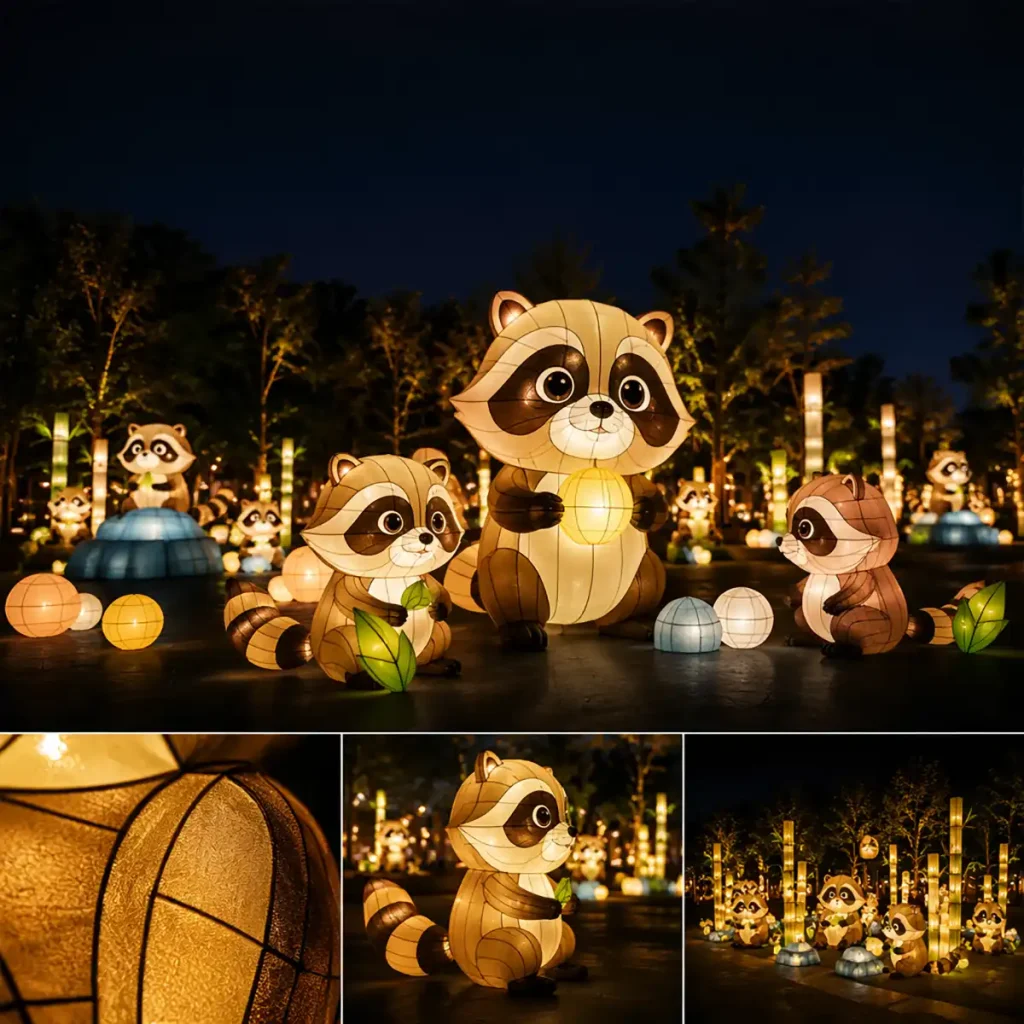
Raccoon Family Lantern with Leaf Gathering Scene
About This Design
This is an AI-assisted concept visualization paired with human-written design intent and production-verified technical specifications. It is a design direction — not a manufactured product. When you order, our team creates custom 3D renderings and fabricates the actual lantern in our Zigong workshop.
Almost everything that identifies a raccoon sits inside the head: the black mask across the eyes, the pale brow line above it, the white muzzle, the pointed snout. That concentration creates a specific lighting problem, because a lantern glows from the inside — and the moment light reaches the mask, the most valuable feature on the figure stops working. This concept is built around that constraint: three raccoons gathered at ground level, each holding a different object, with the mask deliberately kept as the darkest area on the whole scene.
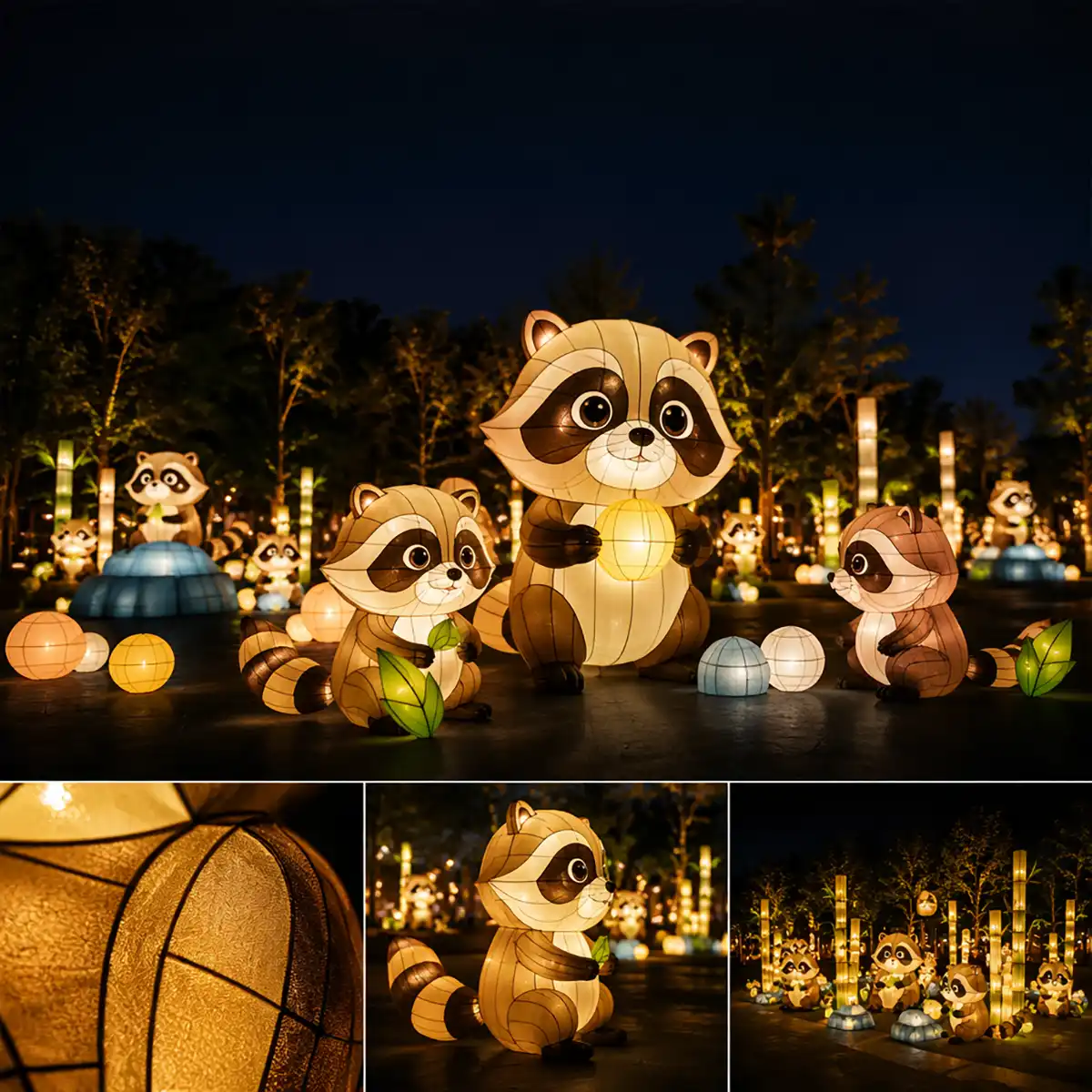
This is an AI-assisted concept visualisation paired with human-written design intent and production specifications. It is a design direction rather than a photograph of a finished product — when a project goes ahead, the scene is re-drawn to your venue dimensions and fabricated in our Zigong workshop on a weatherproof internal frame, covered in hand-painted high-density fabric over a shaped understructure, and lit internally with low-voltage LED. The same build method scales from a compact 2.5 m group up to a 12 m centrepiece.
Why the Mask Has to Be the Darkest Thing on the Figure
The instinct when lighting a dark marking is to light it so visitors can see it. With a raccoon that instinct destroys the animal. The mask is legible because it is darker than the fur around it, and adding light to it removes the only contrast that makes it readable.
- Keep the mask unlit. Paint it and leave it in shadow. It should read as a deep grey-black band, never as a glowing shape.
- Wash the pale areas from inside. The brow line, muzzle and cheek fur are what makes the mask visible by surrounding it with light. The brighter those areas are, the stronger the mask reads.
- Punch the eyes with a small point source. Two bright points inside the mask — not a glowing eye shape, just a small lit core — give the animal life. Enlarging them turns a raccoon into a cartoon mouse.
- Watch the shoulder. Light creeping down from the body into the cheek area flattens the face. The mask band should be blocked from the body circuit so it can be controlled on its own.
If the mask is wired to the same circuit as the body, the designer has no control over the single most important element on the figure. Splitting it out is the whole difference between a raccoon and a grey dog.
Getting the Ringed Tail Right
The second identifier is the banded tail, and the banding succeeds or fails on proportion rather than count. A raccoon tail carries five to seven dark rings on a pale base, and at lantern scale the mistake is almost always making the rings too narrow.
| Ring count | Effect at night | Verdict |
|---|---|---|
| 3–4 rings | Reads as a striped tube, loses the raccoon | Avoid |
| 5–7 rings, wide bands | Clean, immediately identifiable | Use this |
| 8+ narrow rings | Blurs into grey at any distance | Avoid |
Keep each dark band at roughly the same width as the pale gap beside it, and let the tail carry a slight downward curve rather than a rigid hook. The tail is also the cheapest place to suggest movement on a static figure — a tail angled away from the body line makes the animal look as though it has just turned its head.
A Family Group Needs Three Different Poses
Three identical raccoons in a row read as a production batch. Three raccoons doing three different things read as a family, and the difference costs nothing extra in materials.
- The adult, upright and holding the glowing orb. The centre and the tallest element — this is the anchor of the composition.
- A smaller figure seated, holding a leaf. Sitting lowers the silhouette, which breaks the row effect and adds a second visual level.
- A third figure turned partly away. The half-turn is what suggests the group is mid-activity rather than posing. It also gives photographers a second angle.
The scale relationship matters more than any individual size. The adult should be roughly 1.4× life-size with the smaller figures at about 0.75×, and the seated figure placed between 0.8 m and 1.2 m at the shoulder so that it lands at child height in a photograph. Where children will be photographed with the set, that single measurement matters more than the whole group’s total width.
The Glowing Orb — and the Ground Scatter
The lit sphere held by the adult is doing two jobs. In the composition it is the visual centre — the brightest single point on the figure, which is why the eye lands there first. And because it is a self-contained lit unit, it is also a product that sells on its own.
- As a held prop, it gives the pose a reason to exist and provides the group’s brightest point without washing out the faces.
- As a ground scatter, the same sphere reproduces in three or four sizes across the lawn, giving the scene low-level ambience and a reason for visitors to walk through the space rather than past it.
- As a seasonal re-use, the spheres work in winter, midsummer and harvest programmes without any change — they are the one element of an autumn scene that is not season-locked.
Colour discipline matters here. Two warm tones and one cool tone across the scatter is enough; four competing colours turn a woodland clearing into a fairground.
Building the Grove Around Them
The tall lit columns visible behind the group are the element that turns a set of figures into a place. They serve three practical purposes at once: they give the raccoons a habitat, they add vertical interest so the scene does not read as objects on a lawn, and they are the cheapest way to fill an awkward site where trees already exist but cannot be lit.
Use them in uneven clusters rather than an even receding row, and vary the column heights by at least 40% between neighbours. An even-height line of columns reads as street furniture; a varied cluster reads as woodland. Where a venue already has mature trees, the columns can be reduced to a few accent pieces — the trees themselves provide the canopy.
Where a Raccoon Family Works
Raccoons have an advantage in North America that most lantern animals do not: visitors already know them. A raccoon is a backyard animal across the United States and Canada, which means the recognition is instant and the affection is already there before a visitor has read a single word of signage. For venues marketing to family audiences, that familiarity converts better than an exotic species.
The scene suits zoo North America zones, wildlife parks, autumn lantern festivals, harvest events, farm parks and shopping-centre atriums running a fall campaign. It also works well in Halloween-adjacent programming without carrying any horror element — the animals are nocturnal, which fits the evening setting naturally.
For venues building a trail rather than a single set, this scene pairs naturally with the squirrel and acorn scene, which shares the autumn woodland language, and with the koala grove as a contrast piece. Larger family groups continue the run — see the cheetah family and the animatronic zebra with foal. For a full site programme, see our animal lantern manufacturer and zoo lights pages, or browse all animal lantern designs.
Frequently Asked Questions
Can the group be built with two figures instead of three?
Yes. The adult with the orb works on its own as a single piece, and a two-figure version — adult plus one juvenile — is the most common compact configuration. Three or more figures are usually specified where the set will be a photo point or a zone anchor.
Is the mask really left unlit, or is it just painted dark?
Both. The panel is finished in a dark value and it is also blocked from the internal lighting so that no light reaches it from behind. Where the mask sits above a lit chest, a small internal baffle keeps the spill off it.
How large can the family group be?
The composition scales from roughly 2.5 m for an indoor atrium piece up to about 12 m for a landmark outdoor set. Above roughly 6 m the frame gains extra bracing and the lighting is split into more circuits so the orb, the faces and the bodies can be controlled independently.
Can the scattered spheres be ordered separately?
Yes — they are self-contained lit units in their own frames, so a venue can buy the ground scatter on its own or expand an existing scene in a later season without ordering new animals.
Will the scene survive a full autumn outdoors?
Yes. The frame is weatherproof metal and the skin is high-density fabric over a shaped understructure, with internal LED lighting protected to an outdoor-rated standard. Sites in exposed or coastal locations normally add a seasonal inspection of fastenings and cable protection.
How is the set delivered and installed?
Figures and lighting columns break down into frame sections with skin panels and looms labelled by position. Installation is by our crew or a supervised local team, normally within a day for a three-figure group with scatter.
Related Animal Designs
Compare this scene with the squirrel with acorn, where a single oversized prop carries the whole composition, and the koala in a eucalyptus grove, which handles a similarly compact animal with an entirely different structural approach. The tiger family and rhino family show how the same workshop handles far heavier subjects.
For a larger bespoke figure, the lifelike giant panda model and the custom animatronic big cat demonstrate the same craft on animatronic builds. Browse the full animal lantern range, or send your venue type and available width through the contact form.
From Concept to Your Venue
Select & Customise
Choose a design direction. We will adjust size, colours, lighting, and theme to match your venue.
3D Render
Our design team creates production-ready 3D renderings based on the concept and your requirements.
Fabricate
Master artisans handcraft your lantern in our Zigong workshop — internal frame, hand-painted covering, LED programming.
QC & outdoor-rated Test
72-hour burn-in test, full weatherproof verification, structural inspection. Built to last.
Ship & Install
Export docs handled. Container loading. On-site installation crew available for your event.