
Christmas Storybook Character Lantern Collection
About This Design
This is an AI-assisted concept visualization paired with human-written design intent and production-verified technical specifications. It is a design direction — not a manufactured product. When you order, our team creates custom 3D renderings and fabricates the actual lantern in our Zigong workshop.
A storybook collection is a different design problem from a single large figure. One figure has to carry a whole scene by itself; a collection has to hold together as one picture while every character inside it stays individually readable. This concept solves that with a cast of seven — Santa Claus, a reindeer, a penguin, a snowman, a teddy bear and the decorated tree — arranged on two deliberate levels so the group reads as a Christmas card that visitors can step into rather than a row of lit objects.
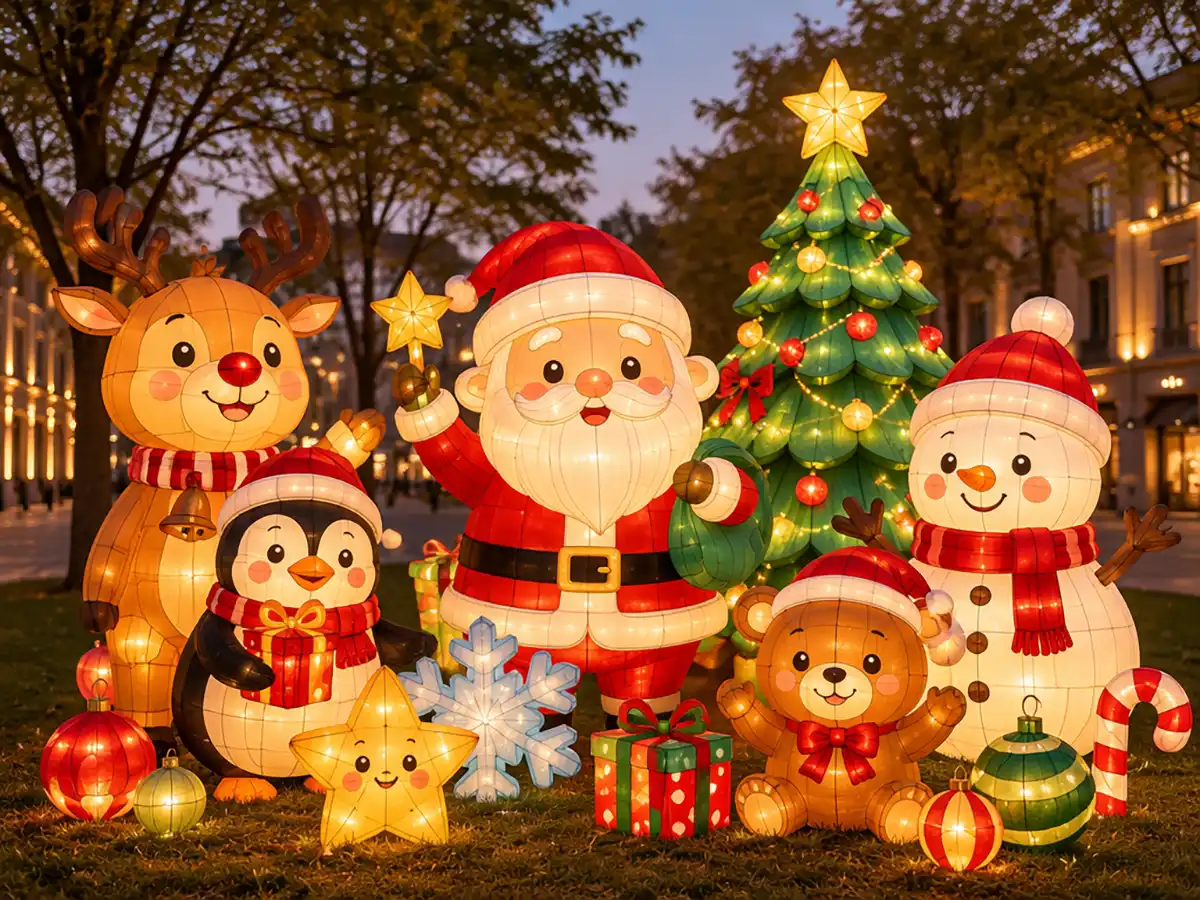
This is an AI-assisted concept visualisation paired with human-written design intent and production specifications. It is a design direction rather than a photograph of a finished product — when a project goes ahead, the scene is re-drawn to your venue dimensions and fabricated in our Zigong workshop on a weatherproof internal frame, covered in hand-painted high-density fabric over a shaped understructure, and lit internally with low-voltage LED. The same build method scales from a compact 6 m group for a mall atrium up to a 16 m city-square installation.
Why Seven Characters Beat One Big Figure
The instinct on a Christmas commission is to spend everything on one landmark. That works for a gateway or a centrepiece, and it fails badly for a photo zone, because a single figure offers exactly one composition. Everybody who photographs it stands in the same place and produces the same picture.
A cast of characters changes the maths. Seven figures standing 0.6 m to 3.5 m tall give a family group several different ways to arrange themselves, and give a shorter child a character at their own height to stand beside instead of a giant they have to look up at.
| Single large figure | Character collection | |
|---|---|---|
| Photo compositions | One | Several, depending on where visitors stand |
| Child-height interaction | None without steps | Built in — the small characters sit at child height |
| Reads from a distance | Strong | Good, if the height hierarchy is right |
| Reusable in parts | Not really | Yes — characters can be redeployed separately |
The trade is that a collection is harder to compose. Seven figures in a line look like a shop window; seven figures at two heights in uneven spacing look like a scene.
Building a Height Hierarchy
The composition in this concept is a pyramid, and the pyramid is doing functional work rather than decorative work.
- Santa sits at the top. Around 2.5–3.5 m depending on the venue — tall enough to be the landmark visible from the far end of a square.
- The snowman and the reindeer form the middle band at roughly 1.8–2.5 m. They frame Santa without competing with him.
- The penguin and the teddy bear sit low, between about 0.8 m and 1.2 m at the head. This is the measurement that matters most for photography, because it is child height — a child standing beside them lands in the frame at the same scale.
Get the middle band wrong and the group flattens. If the snowman is built at Santa’s height, the eye has no clear place to land and the composition reads as a crowd. The rule we work to is a clear step between each band, roughly 30% in height, so the silhouette resolves at a distance.
Every Character Needs One Prop
A character without a prop is a shape. A character with two props is clutter. The working rule is one prop each, chosen so that the prop explains what the character is doing.
| Character | Prop | What the prop adds |
|---|---|---|
| Santa Claus | Lit star held up in one hand | Gives the figure a gesture, and adds a second light point at the top of the composition |
| Reindeer | Sleigh bell at the neck, red nose | The red nose is the recognition cue; the bell gives it a reason to have a collar |
| Penguin | Wrapped gift box held in front | Turns a static bird into a character mid-action — the cheapest storytelling device in the set |
| Snowman | Carrot nose, twig arms, scarf | The twig arms give the silhouette its asymmetry, which is what stops it reading as a sphere stack |
| Teddy bear | Seated pose with a bow | Sitting lowers the figure and adds a different posture to the group |
All of the props are separate parts bolted or hung on the figure rather than sculpted into it. That matters commercially: a venue can change the held object in a later season without rebuilding the character.
The Small Pieces Do the Floor Work
The pieces that visitors barely notice are the ones that make the group photograph well. In this concept they are the lit star, the snowflake, the wrapped gift boxes, the baubles and the candy canes scattered across the front of the composition.
- They fill the ground plane. A row of large figures standing on empty gravel shows the gravel. A scatter of small lit pieces at the base turns it into snow.
- They hide the engineering. Base plates, ballast and cable entries are the least photogenic part of any installation, and a 0.5 m lit gift box is the cheapest way to cover them.
- They carry the near-field detail. Visitors standing close to take a photograph see the small pieces at eye level, not the characters’ feet.
- They are the cheapest part of the order. Ground scatter is small, light and stacks into almost no transport volume, so it adds visual value out of proportion to what it takes to ship.
Two or three sizes across the scatter is enough. Uniform sizes read as a manufactured set, and half a dozen sizes read as mess.
The Cast Is Modular
Because every character is its own frame unit, the collection is assembled rather than fixed. That gives a venue three useful levers.
| Lever | How it works |
|---|---|
| Change the cast | Characters can be added or removed — a nutcracker, a polar bear or a gingerbread figure can be built into the same system in a later season |
| Change the width | The same cast spans roughly 6 m in a mall atrium and 16 m in a city square by altering spacing and base layout, not by rebuilding figures |
| Change the branding | Colour accents can be adapted to a venue or sponsor palette — the reindeer’s nose colour, the ribbon colours and the gift-box wraps |
Sizing is the design decision to get right early. Sixteen metres of characters in a space with eight metres of frontage produces a group that can only be seen from one spot; six metres in a large square disappears. Send the frontage and the sightline distance and the layout follows from those two numbers.
Keeping Seven Characters From Looking Busy
The failure mode of a storybook set is visual noise, and it is almost always a lighting problem rather than a colour problem.
- One light rhythm, not seven. If every character pulses to a different pattern the group reads as a fairground. A shared warm base with one slow chase across the tree is enough movement.
- Keep the faces brightest. Visitors read faces first. Washing a costume brighter than a face pulls attention to the wrong place.
- Five colour values is the ceiling. Red and white for the seasonal base, green for the tree, warm brown for the reindeer and bear, one cool accent for the snowflake. A sixth colour turns the scene into a display and loses the storybook feel.
- Uneven spacing. Equal gaps read as a production line. Vary the distance between characters by at least a third from one gap to the next.
Surface finish does the rest. The characters are hand-painted in flat blocks rather than gradients — a painted gradient on a cartoon figure reads as a rendering error at close range, while flat blocks with a lit interior read as illustrated.
Where Storybook Collections Work
The set suits shopping-mall atriums, city squares, zoo and farm-park entrances, garden centres, family entertainment venues and hotel lobbies running a December programme. It is designed to work indoors as it stands, which is unusual for a lantern set of this size.
In Europe the collection is most often specified for German Christmas markets, for French and Spanish municipal squares and for Dutch and Belgian city-centre streets, where the storybook register matches the market tradition rather than competing with it. The German market guide covers the dates, load-in windows and documentation those organisers work to; the Netherlands guide covers city-centre and canal-side site types; and the European programme overview covers how the wider season is planned across the continent.
Frequently Asked Questions
Can we choose which characters are included?
Yes. The cast in the concept is a recommended composition rather than a fixed list. Characters can be swapped or added, and the height hierarchy is maintained by specifying the new figure at the right band rather than by rebuilding the layout.
How wide does the collection have to be?
From roughly 6 m for a compact mall atrium arrangement to about 16 m for a city-square installation. The width is set by spacing and base layout, so the same figures work at either end of that range.
Can the same set be used indoors and outdoors?
Yes. The figures are built on weatherproof internal frames with high-density fabric covers and internal LED lighting protected to an outdoor-rated standard, so an indoor atrium installation in one season can be moved outdoors in the next. Outdoor layouts are braced and ballasted for the site’s wind load.
Can the characters be branded for a sponsor?
Yes. Colour accents are the practical lever — the reindeer’s nose, the ribbon colours and the gift-box wraps can all be adapted. Where a venue wants text or a logo, it is usually carried on the gift boxes or on a separate sign panel rather than on the characters.
Is the tree part of the set or ordered separately?
It is normally specified as part of the composition because it provides the vertical accent the group needs. It can also be built as a standalone piece, which is useful where a venue already runs a tree elsewhere on site.
How is the collection delivered and installed?
Characters and ground pieces break down into frame sections with skin panels and lighting looms labelled by position. Installation is by our crew or a supervised local team, normally within a day for a six-metre group and proportionally longer for a full square layout.
Related Displays and Resources
Compare this collection with the three-piece traditional set, which covers the same theme with far fewer figures, and the snowman and ice castle scene for a venue that wants one landmark rather than a cast. Where the site is a shopping centre, the mall atrium Christmas show is the configuration built specifically for multi-storey visibility.
For the wider programme, see our Christmas light festival displays and browse all festival lantern designs, or send your venue type and available frontage through the contact form.
More Concepts
Related Designs

Christmas Lantern — Snowman Ice Castle Scene
View Design →
Christmas Lantern — Angel Winter Castle Scene
View Design →
Candy Cane Wonderland — Christmas Display | FestiveLanterns
View Design →
Christmas Lighting Show — Giant Gift Box Tower with Elves & Reindeer
View Design →From Concept to Your Venue
Select & Customise
Choose a design direction. We will adjust size, colours, lighting, and theme to match your venue.
3D Render
Our design team creates production-ready 3D renderings based on the concept and your requirements.
Fabricate
Master artisans handcraft your lantern in our Zigong workshop — internal frame, hand-painted covering, LED programming.
QC & outdoor-rated Test
72-hour burn-in test, full weatherproof verification, structural inspection. Built to last.
Ship & Install
Export docs handled. Container loading. On-site installation crew available for your event.