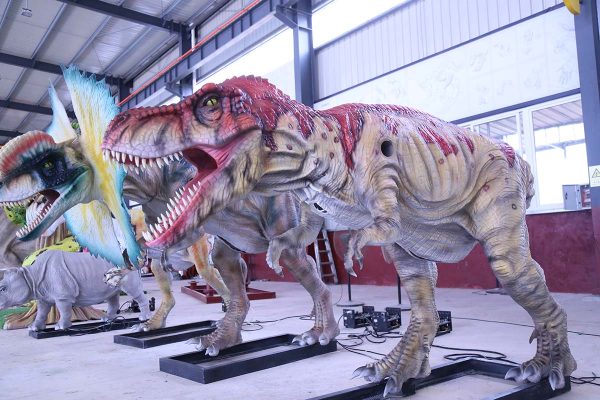
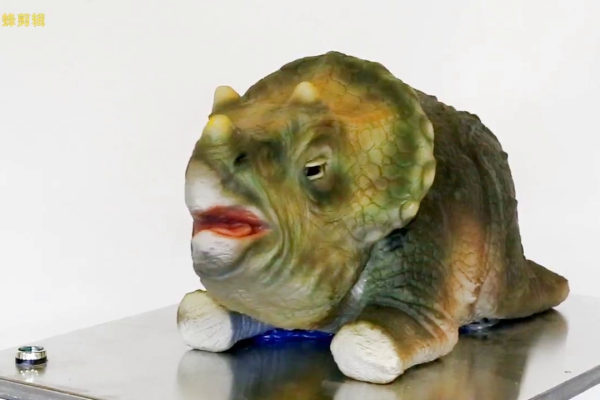
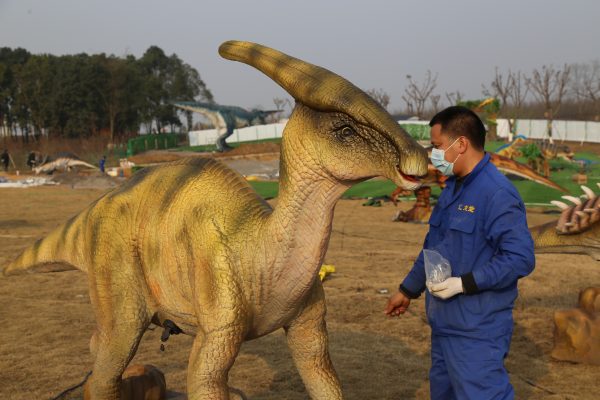
Walk past a life-size animatronic dinosaur in a museum, and it turns its head toward you. A child shouts — and the animatronic velociraptor leans in to observe. This isn’t movie magic. It’s sound and light detection in animatronics — the sensor technology that makes robotic creatures react to their environment in real time.
For museums, theme parks, and zoos investing in animatronic exhibits, the difference between a static display and an interactive one comes down to detection systems. The right sensors turn a passive sculpture into a living experience — and keep visitors returning year after year.
Why Detection Matters in Animatronic Products
A dinosaur that simply moves on a loop is impressive — for about 30 seconds. A dinosaur that reacts — roaring when approached, blinking when a flash goes off, tracking visitors as they walk past — is unforgettable. The key is the detection layer.
In the animatronics industry, detection systems serve three purposes:
- Synchronization — Matching movements and sounds to create lifelike behaviour. When a T-Rex opens its jaws, the accompanying roar must fire at precisely the right frame.
- Interaction — Reacting to visitor presence. PIR (passive infrared) sensors detect body heat and trigger a sequence; ultrasonic sensors measure distance and adjust the movement scale accordingly.
- Safety — Monitoring mechanical performance. Hall-effect sensors track servo motor positions; light barriers detect obstructions and halt movement before a collision occurs.
Without detection, an animatronic is just a puppet on a timer. With it, the creature performs.
The Core Detection Technologies We Use
At our Zigong factory, sound and light detection in animatronics is built into every exhibit from the design stage. Here are the sensor categories we deploy — and when to choose each one.
| Sensor Type | What It Detects | Best For | Range |
|---|---|---|---|
| PIR (Passive Infrared) | Body heat / motion | Triggering sequences when visitors approach | 3–12 meters |
| Ultrasonic | Distance measurement | Proportional movement — the closer you get, the more intense the reaction | 0.2–8 meters |
| Hall-Effect | Magnetic field / position | Precision servo motor control — jaw angle, eyelid position, tail sweep | Contact |
| Photoelectric / Light Barriers | Beam interruption | Safety cutoff; counting visitor throughput; triggering at exact walk-past points | Up to 20 meters |
| MEMS Microphone Arrays | Sound level & direction | Roar-triggered movement; directional head-turning toward loud sounds | Ambient |
| DMX + Audio Sync | Pre-programmed light/sound cues | Theatrical shows — synchronizing animatronics with stage lighting and soundtrack | Wired |
For most commercial animatronic exhibits — dinosaurs in museums, animals in zoo education centres — we recommend a PIR + ultrasonic combination. This gives you proximity-aware triggering without complex calibration. The dinosaur is still when the hall is empty; it activates when visitors enter the sensor zone.
Sound Detection: How Animatronics “Hear” Their Audience
Sound-triggered animatronics create some of the most memorable visitor moments. A child roars at a T-Rex — and the T-Rex roars back. The technology behind this is simpler than most people think.
We use MEMS (micro-electromechanical system) microphone arrays paired with an Arduino or Raspberry Pi-based controller. The mic listens for sound levels above a calibrated threshold — typically 70–85 dB for a museum setting, higher for noisy theme park environments. When the threshold is crossed, the microcontroller fires a pre-programmed movement sequence.
More advanced installations use directional sound detection — two or more microphones positioned to triangulate sound origin. The animatronic can actually turn its head toward the source of the noise, which dramatically increases immersion. We’ve deployed this in custom velociraptor exhibits where the creature tracks a moving visitor based on their voice.
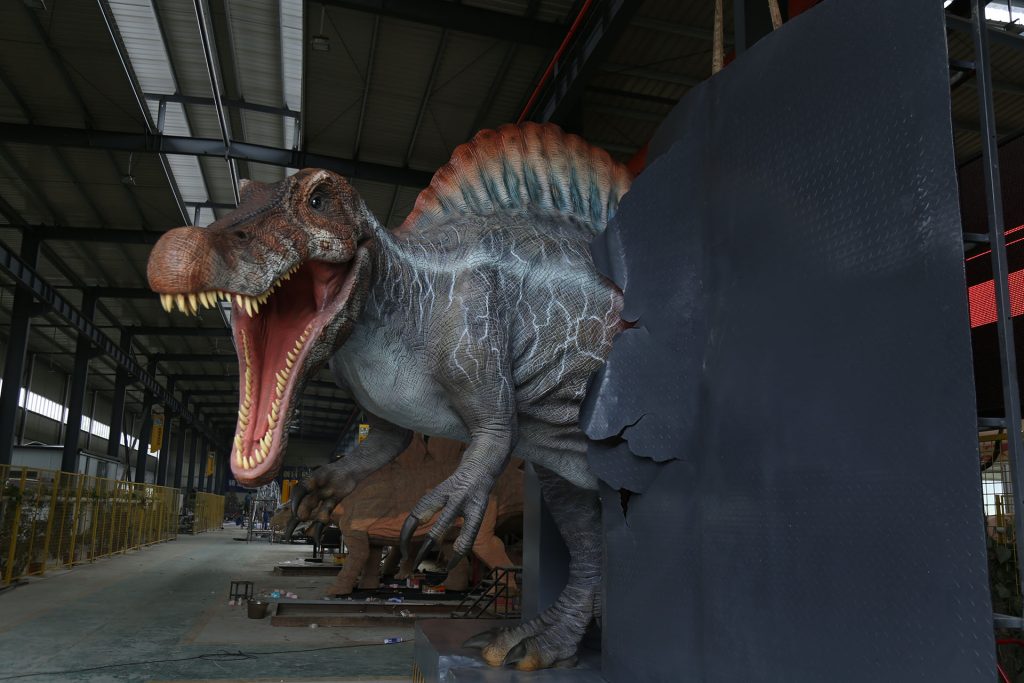
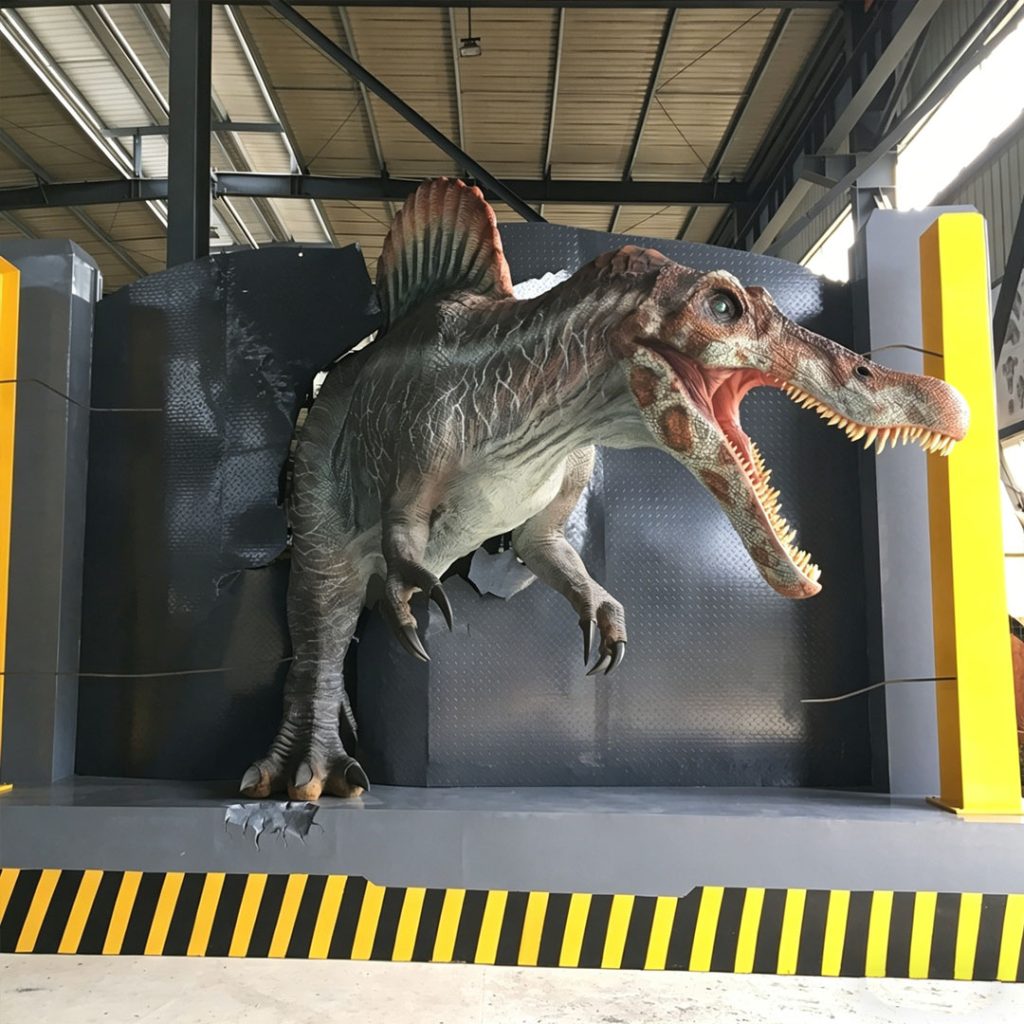
Real-World Example: Proximity-Aware Spinosaurus
One of our most requested configurations is the proximity-aware animatronic — and the Spinosaurus is a perfect canvas for it. With an ultrasonic sensor mounted in the chest cavity, the creature tracks visitors at three distance zones:
- Far (4–6m): Subtle breathing motion, occasional head tilt — the dinosaur is “watching” you.
- Mid (1.5–4m): Full head turn, mouth opens, preliminary vocalisation.
- Near (<1.5m): Full roar, lunge motion, jaw snap — the crowd-pleaser moment.
A single $20 ultrasonic sensor, wired to our standard servo controller board, turns a static display into a three-stage interactive experience. The installation takes less than an hour during final assembly at the client venue.
Light Detection: Infrared, Laser, and Photoelectric Triggers
Light-based detection offers a different interaction model — one that is invisible to visitors and far more precise than sound. It’s the backbone of exhibit automation.
Photoelectric Beam Triggers (Light Barriers)
A photoelectric sensor consists of an emitter and receiver. When a visitor walks between them, the beam breaks, and the controller fires a movement sequence. This is the most reliable trigger method for high-traffic venues because:
- No calibration drift over time (unlike PIR, which can be affected by ambient temperature)
- Predictable, repeatable — every beam break produces the same behaviour
- Can be hidden in exhibit scenery (floor-level beams between decorative rocks; overhead beams disguised as vines)
Infrared Distance Sensors
IR-based distance sensors (like Sharp GP2Y0A series) are excellent for close-range detection — measuring visitor distance within 10–80 cm. These are ideal for small animatronic animals and interactive kiosks where visitors lean in close. A common application: an animatronic baby dinosaur that “nuzzles” toward a visitor’s hand when detected within 30 cm.
Ambient Light Detection
For outdoor animatronic exhibits, ambient light sensors serve a practical purpose. The controller reads the light level and adjusts LED brightness accordingly — maximising visibility during daytime while avoiding the harsh glare that over-lit hand-finished surface produces at night. On shows synchronised with a DMX lighting console, the ambient light sensor feeds data back to the controller so the animatronic’s onboard lighting always matches the stage environment.
DMX Integration: Where Light and Sound Detection Meet Show Control
For venues running theatrical shows — museum opening ceremonies, theme park nighttime spectacles, seasonal lantern shows — the highest level of animatronic control comes through DMX512 integration.
In a DMX-controlled setup, the animatronic becomes one instrument in a larger orchestra of lights, fog machines, audio tracks, and stage effects. A single lighting console operator can:
- Trigger the animatronic’s roar sequence at the exact beat of the soundtrack
- Dim or colour-shift the creature’s onboard LEDs to match stage lighting cues
- Pause or reset the animatronic instantly via DMX relay — critical for live shows where timing is everything
We pre-wire DMX ports on all custom animatronic orders by default. Even if you don’t use them now, having the infrastructure in place means your exhibit can be integrated into a show at any point in the future without retrofitting.
Gesture & Motion Recognition — When the Animatronic Reads Body Language
The most sophisticated layer of sound and light detection in animatronics is gesture control — letting visitors interact with a creature through body language alone, with no buttons, no screens, and no instructions needed.
This works through infrared depth cameras (similar to those in gaming consoles) paired with skeleton-tracking algorithms. The camera maps the visitor’s joint positions in real time — head, shoulders, elbows, hands — and the controller translates specific gestures into animatronic responses:
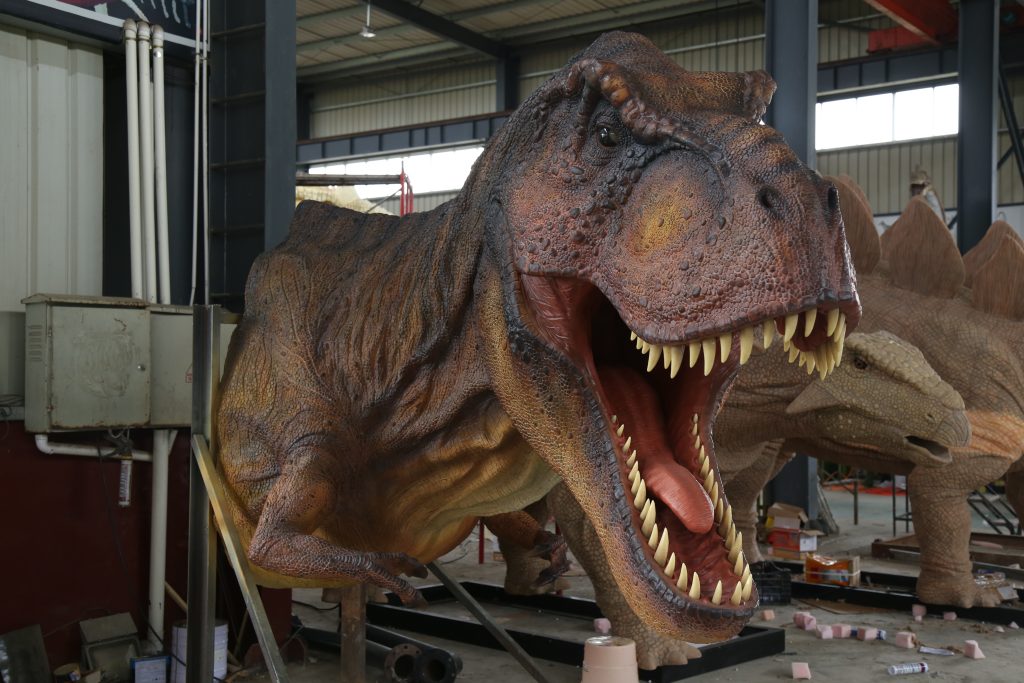
- Wave your hand — the T-Rex turns its head to face you
- Raise both arms — the dinosaur rears up to full height with a full-volume roar
- Step forward — the creature leans in closer, as if inspecting you
- Stand still for 3 seconds — the dinosaur enters a calm breathing cycle, resetting for the next visitor
Gesture recognition is particularly effective in museum and science centre exhibits. It creates a cause-and-effect loop that visitors immediately understand: “I move, it reacts.” No language barrier, no age limit — a 5-year-old and a 50-year-old both know how to wave at a dinosaur.
We deploy this technology using a compact depth-sensing module integrated into the animatronic’s mounting base or an adjacent display pedestal. The entire processing pipeline — image capture, skeleton mapping, gesture classification, motor command — runs on an onboard ARM processor with sub-200ms latency. Visitors perceive the interaction as instantaneous.
Safety Detection: Hall-Effect Sensors and Emergency Stops
Behind the spectacle, sound and light detection in animatronics also serves a critical safety function. Our servo-driven exhibits incorporate redundant safety layers:
- Hall-effect sensors on every motor axis track the exact angular position. If a joint exceeds its programmed range of motion — due to a stuck mechanism or unexpected external force — the controller cuts power to that channel within 50 milliseconds.
- Photoelectric safety curtains create invisible light barriers around the exhibit perimeter. Break the beam, and all movement sequences pause until the zone is clear.
- Current monitoring on each servo detects unusual load — if an animatronic jaw encounters unexpected resistance (a visitor’s hand, a child’s backpack), the motor reverses direction instead of forcing through.
These systems operate continuously in the background. The audience never notices them — and that’s exactly the point.
What to Ask When Ordering Sensor-Equipped Animatronics
Every venue has different interaction requirements. Before ordering a custom animatronic with detection systems, here are the questions we recommend buyers ask:
- What is the expected visitor throughput? High-traffic venues benefit from photoelectric beam triggers (more reliable under heavy use). Lower-traffic installations can use PIR.
- Indoor or outdoor? Outdoor exhibits need weather-sealed sensor housings (outdoor-rated minimum) and ambient-light compensation.
- What kind of interaction do you want? “Reactive” (creature responds to presence) vs. “show” (creature follows a pre-programmed timeline with DMX sync). These use different sensor configurations.
- How close will visitors get? Within 1 metre needs IR distance sensors. 3–6 metres works with PIR or ultrasonic. More than 6 metres typically needs photoelectric beams.
- Do you need data collection? Some buyers want the controller to log interaction counts for visitor analytics. This requires a board with onboard storage or network connectivity.
Answering these five questions before your initial consultation saves design time and ensures the sensor package matches your venue and audience.
The Future: AI-Powered Detection
The next frontier in sound and light detection in animatronics is computer vision. Cameras paired with edge-AI processors can now recognise visitor age groups, count crowd density, and even detect emotional response — feeding data back to the animatronic controller to adapt behaviour in real time. A dinosaur that performs differently for a school group than for an evening gala audience is no longer science fiction. We’re prototyping this technology now, and expect it in commercial exhibits within 2–3 years.
Where Detection Fits in a Complete Exhibit
Detection is one layer of an interactive build. What you do with the signal — which actuator moves, how fast, how long the response lasts — is decided elsewhere in the design, and those pages are worth reading alongside this one:
- The six systems inside an animatronic dinosaur — frame, motion, skin, sensing, sound and weatherproofing, and how sensing sits inside them.
- Gesture-sensing interactive dinosaurs — the full sensor-fusion approach, detection distances and what the sensors deliberately ignore.
- Hydraulic vs pneumatic actuation — what the trigger is actually driving, and why response speed differs by system.
- Motor selection for animatronic joints — which motors respond fast enough for a triggered movement.
- Animatronic animals — the same detection and control systems applied to mammals, where movement language changes.
- Interactive dinosaur exhibit guide — how detection, movement and dwell time are planned together for a venue.
- Dinosaur rides — where safe stopping and duty cycle matter as much as detection.
- The complete buying guide — supplier evaluation, timeline and shipping, from brief to handover.
- What moves the price — how sensor count, movement count and duty cycle change a quotation.
- Interactive dinosaur exhibits — builds specified around visitor response.
- Motion-activated T-Rex — a worked example of detection driving movement.
- The interactive T-Rex build — a high-movement exhibit with multiple sensor triggers.
- The animatronic dinosaur range — species and movement options across the catalogue.
Build an Interactive Animatronic Exhibit That Reacts to Your Visitors
Whether you need a single sensor-triggered dinosaur for a museum gallery or a full DMX-synchronised animatronic show for a theme park attraction, our team designs detection systems that match your venue, audience, and budget. Every exhibit is custom-built in our Zigong workshop, with sensors integrated from the design stage — not bolted on as an afterthought.
Related Products & Resources
- Animatronic Dinosaurs — Our full collection of custom animatronic dinosaurs with sensor-configurable movement
- All Animatronic Products — Dinosaurs, animals, and custom creatures for museums, theme parks, and zoos
- How to Buy an Animatronic Dinosaur: The Ultimate Buying Guide — Everything you need to know before ordering
- Top 10 Most Popular Animatronic Dinosaurs for 2026 — Which species get the most orders — and why
“`