What Makes an Exhibit “Interactive”
An interactive dinosaur exhibit is one where the visitor changes what the animal does. That is the whole definition, and it rules out a lot of models sold as interactive.
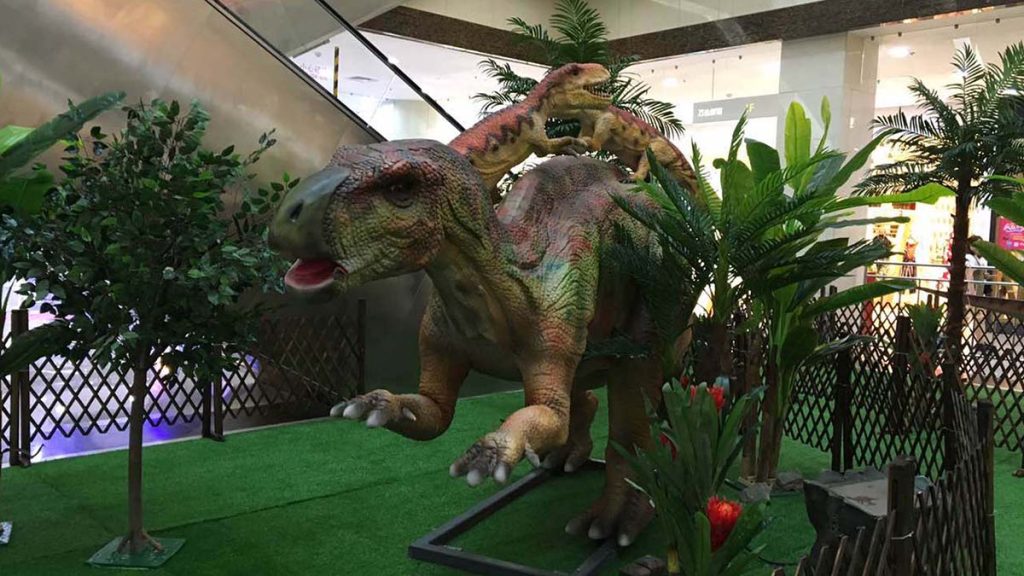
A dinosaur running a fixed movement loop is animated, not interactive. It performs the same sequence on a timer regardless of who is standing in front of it, and visitors work this out within about two cycles. A genuinely interactive build detects a visitor and selects a response — which means the animal appears to have noticed you, and the crowd that forms behind you can see that their own movement will produce a reaction too.
The practical difference shows up in behaviour. On a looping model, visitors watch for a few seconds and walk on. On a responsive model, they test it: they step closer, step back, wave, bring a friend. That testing behaviour is what extends dwell time, and dwell time is what venues are actually buying.
How the Sensing System Works
The chain is short: a sensor detects an input, a controller decides which response to run, actuators execute it, and the sound module plays matched audio.
Sensors are usually infrared or microwave-based proximity detectors, or a camera running gesture recognition. Detection range is typically set between one and three metres for a walk-by exhibit — close enough that the reaction feels personal, far enough that visitors are not standing inside the animal’s moving parts. The range is adjustable, and it is tuned on site at commissioning rather than fixed in the workshop, because footfall patterns and floor layouts differ between venues.
The controller is the part buyers never ask about and the part that decides whether the exhibit ages well. A controller that can hold several response variants — a short reaction for one visitor, a longer sequence when a group gathers — keeps the exhibit fresh across repeat visits. A controller with one response wears out in a week.
Actuators execute the movement. Servo motors handle precise positioning on the head, jaw and limbs; stepper motors cover simpler repeatable movement; brushless motors handle continuous rotation where a part has to spin. For how these compare, see our motor selection guide for brushless, servo and stepper motors, and for how the whole system fits together, the key systems behind an animatronic model.
Types of Interaction
Motion and proximity triggering
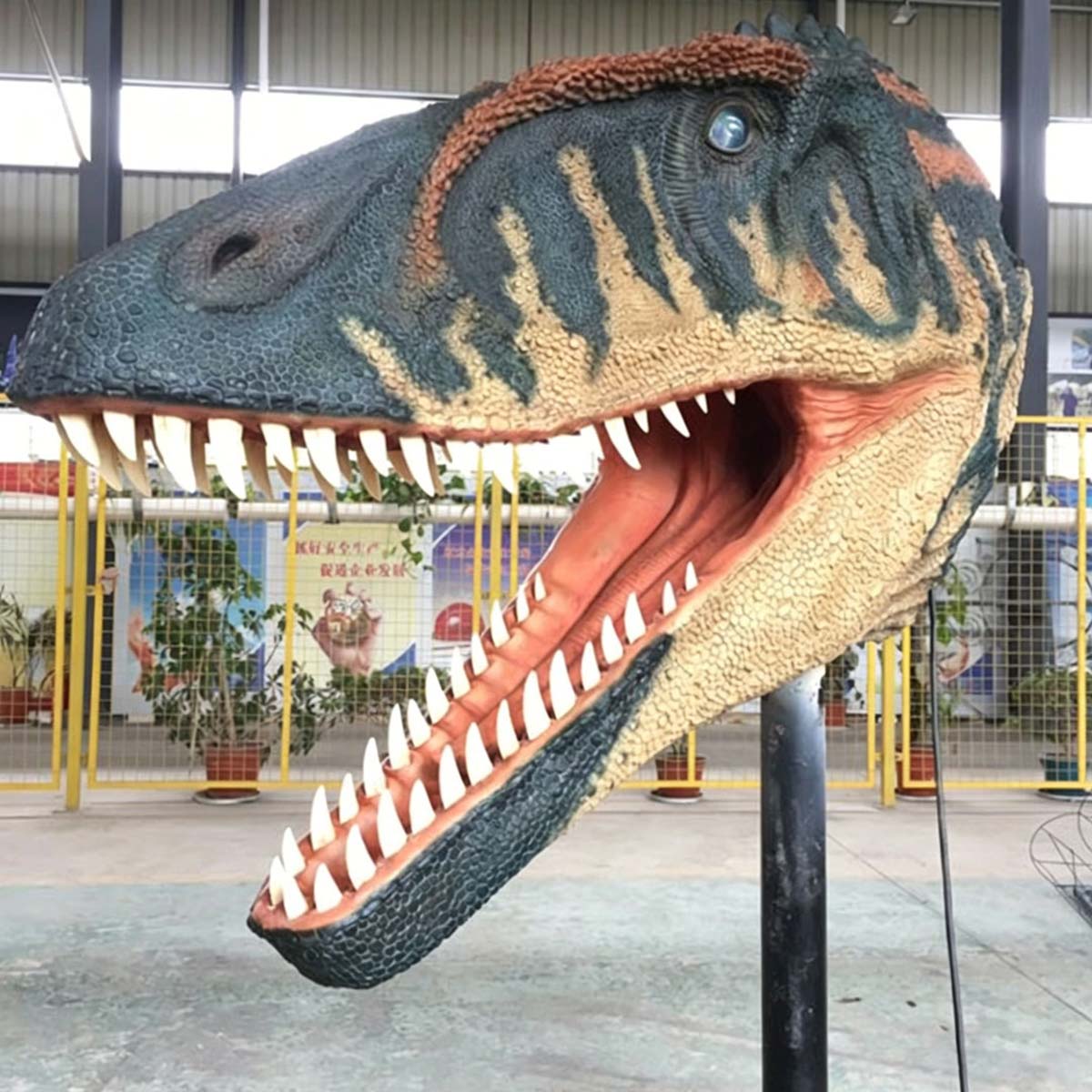
The workhorse. A visitor crosses a detection line and the animal responds with a synchronised sequence — head turn, jaw open and close, eye blink, tail sway, chest breathing. Multiple sensors can be chained so the dinosaur reacts differently depending on which angle a visitor approaches from, which is what stops the exhibit feeling like a switch.
Sound and voice response
The animal reacts to noise level or to a specific audio cue. A quiet group gets a slow head turn; a loud one gets a full roar. This works best in indoor halls where ambient noise is low enough for the trigger to be meaningful, and it pairs naturally with presenter-led sessions where a host calls a cue.
Gesture control
Camera-based recognition lets visitors command the animal rather than just trigger it — a raised hand makes it raise its head, a wave makes it respond. This is the format that produces the longest queues, because onlookers can see that the visitor caused the reaction and want a turn. We cover the control layer in more detail in our guide to gesture-sensing interactive dinosaurs.
Touch and pressure
Pressure mats and touch sensors trigger the exhibit when stepped on or touched — effective for fossil-dig stations, hatching-egg exhibits and walk-through scenes where the trigger should feel physical. Children understand the mechanic immediately, with no instruction.
Operator-driven shows
A presenter drives the animal from a handheld controller, timing reactions to the story being told. These are built for scheduled shows rather than walk-by traffic: the value comes from the presentation, and the presenter can hold a pose, build tension or respond to one specific child in the audience.
What Visitors Actually Do
Observation from installed exhibits, and the reason this matters is that visitor behaviour dictates where a build should be placed.
The approach test. Visitors step into the detection zone, step out, and step in again to confirm the animal reacted to them. This takes about eight to fifteen seconds and happens with almost everyone who encounters a responsive model.
The wave. Roughly a third of visitors test whether the dinosaur responds to a wave rather than to movement alone. On gesture-enabled builds this produces the crowd effect; on proximity-only builds it produces a moment of disappointment, which is worth knowing before you decide against gesture control.
The photograph. Most visitors photograph the animal during or immediately after a reaction, not while it is idle. The best placement puts the animal between the visitor path and a clean background, so the photo reads.
The bring-a-friend. Visitors who get a reaction frequently return with someone else to show them. This is the behaviour that makes interactive models worth their premium over static ones — a single model generates repeat traffic within the same visit.
The bypass. Adults walking a route alone often skip the interaction entirely. This is not a failure; it tells you where to put the model. Interactive exhibits earn their cost in family zones, discovery areas and entrances, not on through-routes.
Dwell Time: What Changes When the Dinosaur Reacts
Venues justify the cost of interactivity on dwell time, so it is worth being precise about what actually changes.
A static or looping model holds a visitor for the length of one glance plus the time to read a label — a few seconds. A responsive model holds a visitor through the testing cycle, the reaction, the photograph and, for a meaningful fraction, a return with another person. The difference is not that people stare longer at the dinosaur; it is that the interaction creates a small event, and events take time.
Where that time converts into value depends on the venue. In a mall, dwell time near retail units is the metric. In a museum, it is engagement with the surrounding interpretation. In a theme park, it is the journey out of a queue and onward into the next paid zone. In every case the interactive model is doing the same thing — it is generating a stop where visitors would otherwise have walked.
Where Interactive Exhibits Work
- Entrances and thresholds — the first reaction sets the expectation for the whole visit. A responsive animal at an entry point is the most photographed object in most venues that install one.
- Family and discovery zones — where the audience is children, interaction beats spectacle. Models sized to child height with gentle movement limits do better here than a full-scale predator.
- Education spaces — a model driven by a presenter is teaching equipment; a model the visitor triggers themselves is a discovery exhibit. Both have a place, and they are specified differently.
- Indoor halls and malls — low circulation speed converts well into dwell time, and the enclosed acoustic environment makes sound-triggered response practical.
- Photograph points along a route — anywhere visitors already stop, an interactive build adds a reason to stop longer.
For how these choices fit into a site-wide plan, see our overview of animatronic product applications.
Programming the Response
Programming is where a good build and an adequate one diverge, and it is the part buyers are least equipped to assess from a specification sheet.
Three things are worth confirming at order stage. First, how many distinct responses the controller holds — one sequence per sensor zone is the minimum, and variety is what survives repeat visits. Second, how the response is timed: the pause before the animal “notices” a visitor, and the slight lag between jaw opening and the roar, are what make the movement read as deliberate rather than mechanical. Third, who can adjust it later: a venue with technical staff can take a configurable controller, while a site with volunteer staff needs a system that can be reset without a manual.
Sound design belongs in the same conversation. Roar volume that is right for a theme park is antisocial in a residential or mall setting, and audio level should be agreed before shipping rather than discovered on the first evening.
Indoor and Outdoor Installations
An interactive outdoor model is a different build from an indoor one, for three reasons.
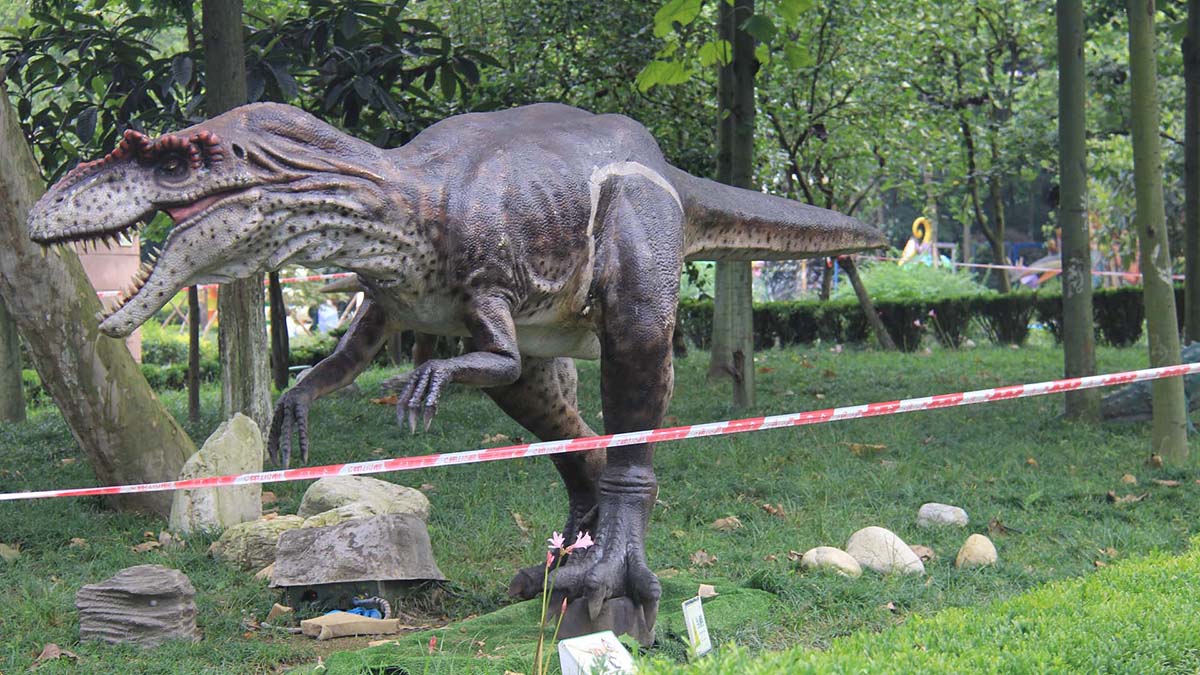
Environmental protection. Sensors, controllers and connectors are the components most sensitive to moisture. Outdoor builds use sealed enclosures and protected cable entries, and the sensor positions are chosen for shelter as well as line of sight.
Sensor reliability. Direct sunlight, rain and moving vegetation all create false triggers. Outdoor detection is configured with tighter thresholds and, where necessary, with sensor types less affected by weather — which is a design decision, not a settings tweak.
Public contact. Outdoors, visitors are less supervised. Detection ranges are set longer so that the reaction happens before someone reaches the animal, and any model sited where children can touch it is built with reduced movement forces and no accessible pinch points.
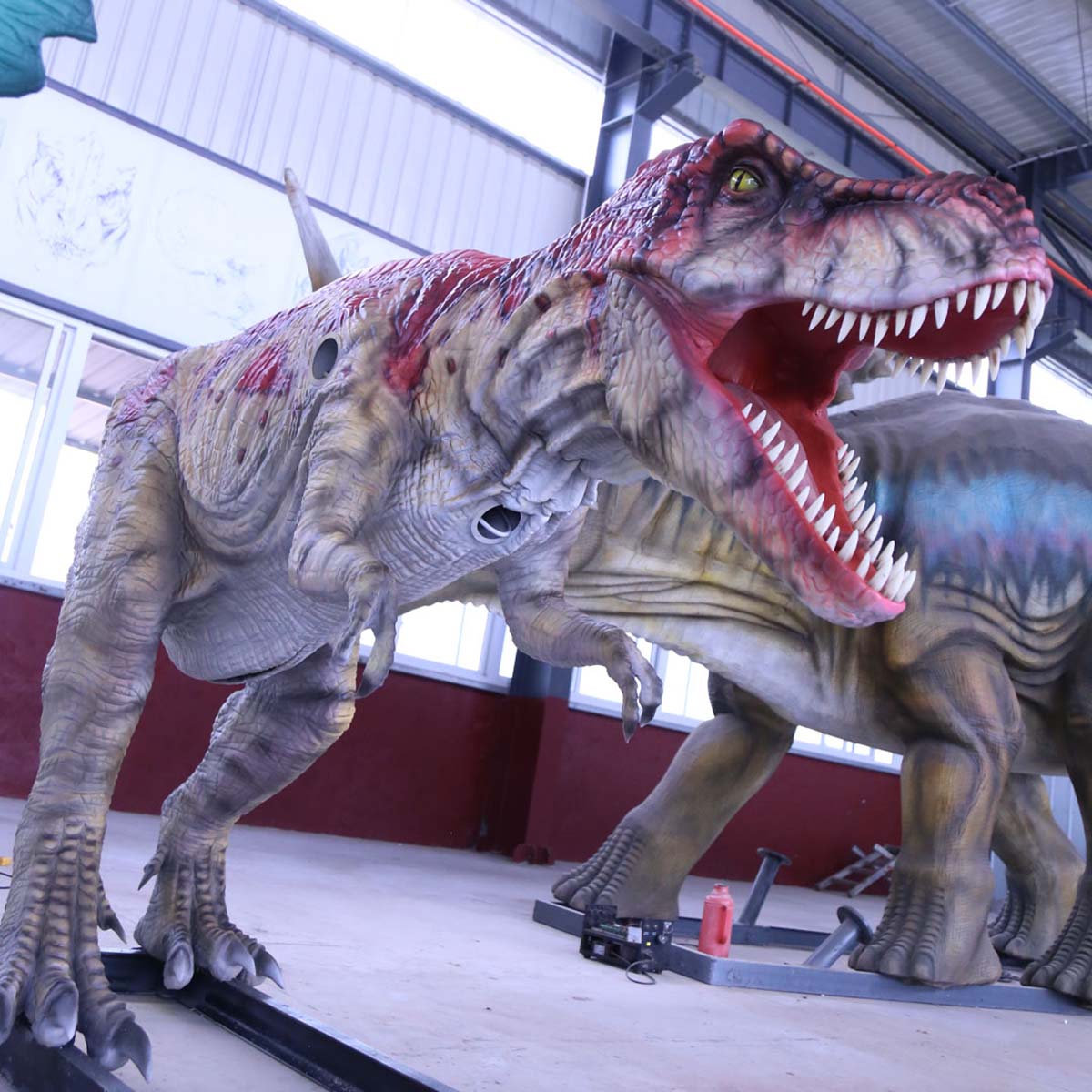
Outdoor models also get the full surface specification — UV-stable skin and a frame protection system suitable for the climate. Our surface formulation is patented (Patent ZL 2022 1 0224489.5) and was developed specifically for the outdoor case.
Safety and Public Contact
An exhibit that invites visitors to come close has to be designed around the fact that they will.
Visitors are kept clear of moving parts by layout and detection distance rather than by signage. Models sited at child height are built with lower movement forces and no reachable joints. Electrical enclosures and cabling are protected from public access and sealed for their environment. Movement speeds are matched to the audience — a jaw closing at adult head height is a different specification from the same movement at toddler height.
If your concept depends on contact — a petting station, a feeding interaction, a walk-through encounter — say so at brief stage. It changes the finish (fur work does not survive constant handling), the movement limits and the frame protection. It is a genuinely buildable requirement, and it is much cheaper to design in than to add.
What to Specify Before You Order
- The reaction you want — “notices visitors and roars” and “obeys gestures on command” are different systems with different costs.
- Visitor path and approach angles — where people come from, how close they get, and whether children will be within reach.
- Species, size and pose, and whether the model is the centrepiece or part of a route.
- Indoor, covered or fully exposed, plus floor surface and ground conditions.
- Power position and cable route — usually a site cost, and usually underestimated.
- Operating model — unattended all day, supervised, or part of a scheduled show.
- Maintenance responsibility — who checks it, how often, and whether spares should ship with the order.
There is no fixed price list for interactive exhibits, for the same reason as across our range: the same species at two sizes, with two movement sets and two sensing packages, is two entirely different builds. The cost drivers are explained in what affects the cost of an animatronic dinosaur.
Frequently Asked Questions
How do interactive dinosaur exhibits detect visitors?
Infrared, microwave or camera-based sensors, set to a detection range of roughly one to three metres for walk-by exhibits. Range and sensitivity are tuned on site at commissioning to suit the actual visitor flow and lighting, which is why the settings are adjustable rather than fixed.
Can an interactive model be installed outdoors?
Yes, and it is a separate specification rather than an upgrade. Outdoor builds use sealed enclosures and weather-tolerant sensors, and detection is configured to ignore rain and moving vegetation. Exposed coastal sites need an additional level of protection again.
How much does an interactive dinosaur exhibit cost?
It depends on species, size, movement list, sensing package and environment, which is why we quote per project rather than publish a price list. Interaction hardware is usually a small share of the total; the larger variables are scale, movement complexity and surface specification.
How long does production take?
Driven by species, scale and movement complexity, with surface work the longest stage. A fixed delivery date is agreed once the design is confirmed.
Can the dinosaur react differently to different visitors?
Yes, and it should. Grouping responses by sensor zone — a short reaction for one visitor, a longer sequence when a crowd gathers — is standard on our builds, because a single repeated response stops working after a visitor’s second encounter.
Is there a support?
Our standard position for animatronic products is a 12-month support, with spare parts available as part of the order and remote support for adjustments after commissioning.
Next Steps
Tell us the reaction you want visitors to have and where the exhibit will stand. We will come back with a concrete proposal — species and scale recommendations, footprint, movement and interaction list, sensing method, environmental protection, power and access requirements, delivery schedule and a precise quotation.
Useful before you write that brief: the interactive dinosaur exhibits collection for the formats we build, the animatronic dinosaur range for standard-motion species, dinosaur rides if the exhibit should be ridden rather than watched, and dinosaur park exhibits if you are planning a full route.
Send us your brief to start.