Feitian Apsara Lantern — Custom Flying Celestial Maiden Festival Display
Feitian Apsara Lantern — Custom Flying Celestial Maiden Festival Display
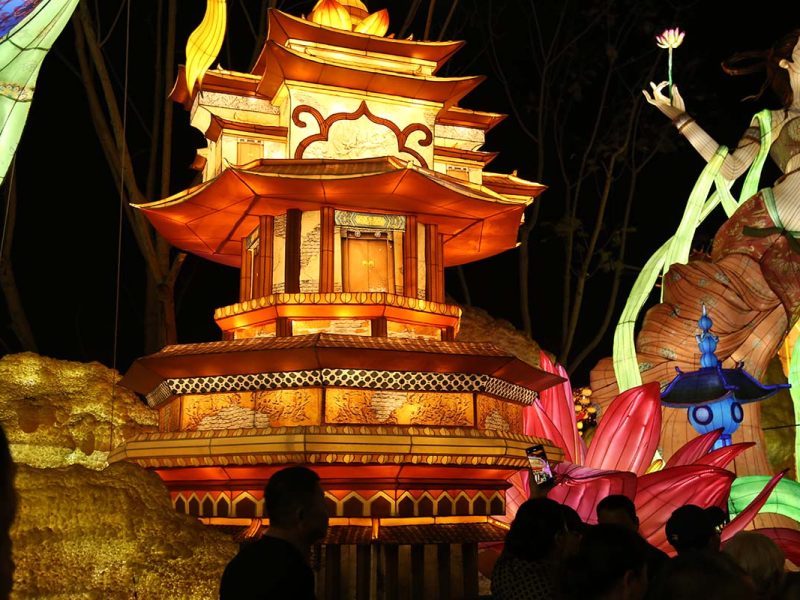
The Feitian Apsara (飞天) lantern is a handcrafted sculpture of the legendary flying celestial maiden of Chinese Buddhist and Taoist tradition — flowing silk robes, suspended mid-flight above a lotus throne, with a multi-tiered pagoda rising beneath her. Inspired by…
The Feitian Apsara (飞天) lantern is a handcrafted sculpture of the legendary flying celestial maiden of Chinese Buddhist and Taoist tradition — flowing silk robes, suspended mid-flight above a lotus throne, with a multi-tiered pagoda rising beneath her. Inspired by the Dunhuang cave paintings of the Silk Road era, this is one of the most visually poetic installations in our catalog.
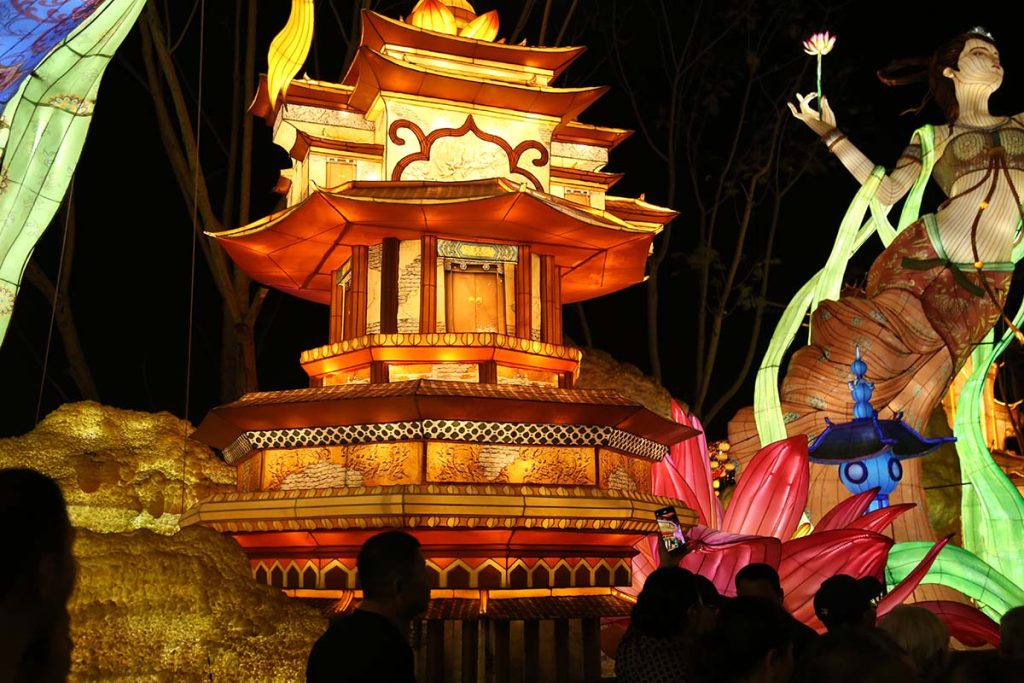
The composition tells the story of the apsara descending from heaven: she holds a lotus in her upraised hand, her robes and scarves trail in flowing arcs around her body, and the pagoda below represents the earthly temple she descends to bless. Pink lotus petals and gold ornamentation complete the scene.
Built to outdoor-rated weatherproof standard with our proprietary hand-finished surface (Patent ZL 2022 1 0224489.5), the Feitian Apsara is suitable for cultural festivals, museum exhibitions, Buddhist heritage events, and Asian cultural tourism installations. Custom sizes from 3m to 12m tall are available.
What Dunhuang actually gives you
Feitian is not one figure. It is a type, painted across the Mogao caves at Dunhuang over roughly a thousand years, and it changes considerably across that span. A brief that says “a flying apsara” without naming a period leaves the design open in ways that matter.
The early caves give you angular figures with short ribbons and heavy outline. The Tang caves give the image most clients picture: fuller body, long silk scarves sweeping in wide arcs, flowers falling from the hands. The later caves become more formal and the ribbons shorter again.
Most builds here work from the Tang reading, because that is the one in the photographs and the one that holds up at large scale. The scarf arc, in particular, is what makes a figure read as flying rather than as standing with her arms out. Get the arc wrong and the pose collapses.
Where a client is working with a museum or a heritage body, ask which cave the reference came from. Reproducing a specific mural is a different brief from an interpretation of the type, and it changes the approval process at their end.
Suspension: the hardest part of a flying figure
A standing figure sits on its base. A flying figure does not touch anything, so the whole load has to be carried by something the visitor is not supposed to notice. This is the part of the build that decides whether the piece looks convincing or looks like a puppet on a string.
Three methods are used. The cleanest is a cantilever from the pagoda: a structural arm rises from the top of the tower and reaches out to the figure’s back, hidden behind the scarf and robe volume. The second is a side mast, used where the pagoda is short and the figure sits low. The third is cable suspension from an overhead structure, which only works indoors or under a built canopy.
Whichever is used, the connection point is at the back between the shoulder blades, never at the head or the hands. A figure carried from the head reads as hanged. A figure carried from the back reads as flying, because that is where a body would be supported in a harness.
Wind is the reason most outdoor builds use the cantilever rather than cables. A suspended figure on cables has a long period of swing and will move in any breeze, which reads as instability at exactly the scale where the illusion matters.
Ribbons and the failure point
The scarves are the most photographed part of the piece and the first thing to fail. They are long, thin, unsupported at the ends, and they catch wind on every axis.
The build that survives uses a light wire spine inside each scarf, so the ribbon holds its arc instead of folding. The root, where the scarf leaves the body, is the highest-stress point on the whole figure and gets a reinforced collar rather than a simple sewn join. And the outer end carries a small weight, which keeps the arc from lifting and slapping against the body in wind.
On an outdoor site, order a spare scarf set with the piece. A torn scarf takes the whole figure out of service, and a replacement made two seasons later will not match the faded originals. Scarves are also the part to inspect first after any storm.
Figure, pagoda and the proportion between them
Figure, pagoda and the proportion between them
The relationship between the figure and the pagoda is fixed by the viewing distance, not by taste.
In the 4 to 6 m build the figure is 1.8 to 2.5 m and the pagoda carries three to five tiers. At that size the two elements are read together from 15 to 20 m and the pagoda is a base, not a subject. In the 8 to 12 m build the figure goes to 3 or 4 m and the pagoda to five or seven tiers, because at 40 m the pagoda has to hold its own detail or it reads as a plain column under a lit figure.
The common mistake is scaling the figure up and leaving the pagoda alone. The composition then reads as a large woman standing on a small building, and the descent narrative disappears. Both elements scale together, and the height ratio between them stays roughly constant across the range.
Specifications
| Parameter | Standard | Premium |
|---|---|---|
| Materials | Internal frame + high-density fabric | Internal frame + double-layer silk with surface finish coating + gold-leaf accents |
| Total height | 4–6m (with pagoda base) | 8–12m (expanded pagoda) |
| Apsara figure height | 1.8–2.5m | 3–4m hero figure |
| Pagoda tiers | 3–5 tiers | 5–7 tiers with carved detail |
| Lighting | outdoor-rated LED (cool white + warm amber) | outdoor-rated RGBW LED with programmed fade and color sequences |
| Color palette | White, gold, pink, soft green | Same with optional jade and lavender accents |
| Operating temperature | -10°C to 45°C | -15°C to 50°C |
| IP rating | outdoor-rated weatherproof | IP66 fully sealed |
| Voltage | 110V or 220V | Dual voltage with auto-detect |
| Power consumption | 300–600W total | 600–1200W with full animation |
| LED System | Commercial-grade LED modules | Commercial-grade LED modules |
| Lead time | 30–45 days | 45–60 days |
Key Features
- Dunhuang-inspired design — authentic Silk Road aesthetic, faithful to the famous cave paintings
- Multi-element composition — apsara figure + pagoda + lotus + ribbons + optional genie lamp in a single scene
- Hand-sculpted silk robes — every flowing ribbon and fabric fold is hand-shaped for lifelike flight
- Patent hand-finished surface (ZL 2022 1 0224489.5) — UV-stable, weatherproof for multi-season outdoor use
- Cultural festival optimized — perfect for Buddhist heritage events, museum exhibitions, and Asian cultural tourism
- Custom sizing — from 3m for intimate museum settings to 12m+ for festival centerpieces
- Standard 110V/220V — works on any country’s electrical system
- Modular internal frame — sectioned for easy transport and on-site assembly
Related Products & Resources
- Cultural Figure Lantern Collection — Custom hand-sculpted mythological and historical figure lanterns for cultural venues.
- Architectural Lantern Collection — Custom pagodas, palaces, gates, and architectural lantern structures.
- Chinese Lantern Festival — Complete Event Displays — Turnkey festival packages including cultural figures and architectural elements.
- Request a Free Cultural Display Design Proposal — Tell us your event theme and venue. Custom concept rendering within 3-5 business days.
Related
You May Also Like
Related Products
Questions
Frequently Asked Questions
Interested in This Product?
Get a custom quote within 24 hours. Our team is ready to help.